
Cautiously Optimistic
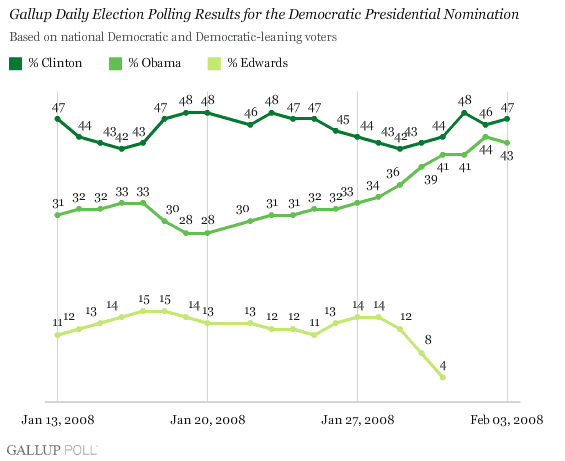
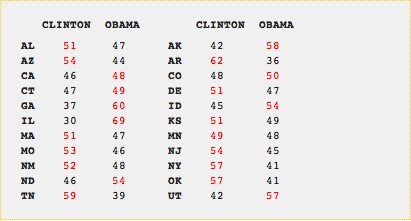
Obama has momentum. But then again, he did before New Hampshire. Polls show him just now edging out Hillary in California. Again, the same as New Hampshire. And yet, so many signs are good for Obama. He raised $32 million in January, while Clinton probably did a lot worse (they’re not saying, but one report has the number at “at least” $10 million). And despite Krugman’s out-of-balance Obama-bashing (sorry, but Krugman’s over-reaction to Obama goes way beyond logic), Obama is racking up the endorsements, and not just from the Kennedys.
I think the key thing here is to keep perspective, and look at it as Obama catching up. Obama supposedly lost in New Hampshire, right? A big blow to his campaign. Except one thing: he lost by only a few percentage points, in a race where Hillary had a huge lead in the polls up until the last several days. The real story about New Hampshire for Obama was a come-from-way-behind almost-win, not some sort of crushing defeat.
The problem is, a lot of people are now touting Obama as a possible winner on Super Tuesday–so if he gets fewer than 50% of the total votes tomorrow, even if he performs admirably compared to where he was in the polls a week ago, people will call it a “loss.” Despite the fact that (a) Hillary has no chance of tying up the nomination tomorrow, not even close to it, (b) Obama is doing better in states that will vote after Super Tuesday, and (c) momentum is in his favor, which means he’ll do better in a drawn-out race. Even if Obama “loses” tomorrow, so long as it’s not a blow-out in Hillary’s favor, it’s good news for the Obama campaign. These things are not decided in one day–this will be a long, drawn-out affair, and in that context, Obama has the advantage.
And let’s not forget that after Super Tuesday, we have a stack of February primaries (Louisiana, Nebraska, Washington, Maryland, Virginia, and Hawaii) which almost all favor Obama heavily; even if he “loses” his momentum on Super Tuesday, he’s bound to pick it back up with successive wins in the weeks following. (Ironically, in an election year where so many states flooded the early calendar so as to be more relevant, it’s the states at the end of the calendar that may prove most influential of all!)
Obama does have one big disadvantage: the primary race is among Democrats and some Independents, and so we see fewer of Hillary’s flaws and fewer of Obama’s strengths in the context that counts: in a general election where everybody votes. In a general election, Hillary will face far greater obstacles than will Obama. Say all you want about Hillary being a fighter (though that hasn’t helped her much against Obama), say all you want about her being pre-smeared and that things somehow couldn’t get worse for her–the fact remains, she is polarizing. She stands a far worse chance of bringing Independents to her side than Obama does, and she stands virtually no chance of bringing any Republicans over.
But the big story was pointed out to me a few days ago: Hillary will not just lose the Republican vote solidly; she will actually galvanize the right wing and help them bring out the vote. Republicans who will be dissatisfied enough with John McCain and/or accepting enough of Obama will stay home, if those are the choices. But those same voters will turn out in droves to defeat Hillary Clinton. That is a huge negative for Clinton which does not show up in any way in the primaries.
Even further down the road, we have to look at how things will play out after a Hillary or Obama victory. If Obama becomes president, he will likely have much bigger coattails than Hillary, helping him win more congressional seats for the Democrats; Hillary, in bringing out the Republican vote, will lose more seats for the Democrats. Neither will have a Democratic super-majority, so either would have to face a Republican filibuster machine perhaps even more obstinate and obstructionist than the one that has shut down virtually every Democratic initiative for the past year. Obama fixes this by bringing the center to him; Hillary fixes this by running to the center, which means that if you think her proposals are more progressive today, you won’t much like them next year–and Obama will suddenly look a lot better.
This especially counts towards health care: there is no way that any Hillary health care plan will get through a Republican Senate filibuster. The Republicans have too much history, too much invested in that. They vaulted to power in 1994 very much aided by their opposition to Hillary’s health care plan back then; allowing one to pass for President Hillary would be unthinkable for them. Where they could deal with Obama, they will flat-out shut down Hillary. Whatever you think of mandates, Hillary will not bring you anything come 2009. Even if you think that that is no worse than an Obama health care plan winning, it still cancels out any advantage Hillary has over Obama, leaving Obama again with all the advantages.
And then there’s the chance, as I explained earlier, that Obama, in bringing more votes for Democratic Senate and House seats, will not only have a stronger voting bloc in Congress, but will scare more Republicans who won by close margins; if Obama can maintain a strong, positive, and popular image in office, as Reagan did, then he may very well get his “Obama Republicans” which might even give him that filibuster-proof Senate super-majority. The one Hillary has no chance of getting.
That, along with the very real chance that Hillary could lose the election to a Republican–which for Democrats this year is the nightmare scenario–demonstrates more and more reason to support Obama.
My biggest fear, one that I don’t see in the media, is that McCain is 72! Why is this not more of an issue? Anyone who has spent time around somebody this age would not put them in charge of our country. It may seem biased against the aged, but the people I know who are in this bracket wouldn’t stand up to the pressure of the office. This also makes McCain’s running mate that much more of an issue as well.
Advocating on behalf of Krugman
On behalf of Krugman, I don’t think he is way out of line.
It’s a matter of understanding the economic model for commidity-utilities.
Health care obviously is not a commodity or a utility. But health insurance most certainly is both a utility and a commodity.
Like all utilities the cost goes down (and generally the quality goes up) as the pool of contributors become larger. This is true with electricity, gas, water and sewage.
Case in point is the St. Louis area’s water utility.
St. Louis has a lot of food processing industries that consume and use water in their products. The most prominent being Anheuser-Busch. Anheuser-Busch is perhaps the wealthiest company in the city, located on the Mississippi River, it has it’s own water treatment plant. It doesn’t need to buy water from the city. But it’s plant is mandated, by law, to buy a portion of its water from the local water utility.
The reason is the formula for utilities breaks down the minute you allow subscribers to opt out.
Busch represents the wealthy subscriber that could obviously opt out as it could produce its own water. This would force water rates up on the rest. Soon poor subscribers opt out by digging wells or some other method because the burden on them has gone up. As the burden goes up more and more subscribers opt out or find alternative means.
Eventually you are left with something that looks like our current health care system.
Let me tell you that St. Louis has some of the best water coming out of the tap in the country. It taste great, it’s better for you than the stuff you buy in the bottle because it has fluoride in it, and it is very cheap.
Anheuser-Busch and other industrial consumers don’t really object because they understand the model, their cost is still low, and the quality is high.
Because Health care insurance is a utility, it functions best if we treat it as such.
In this sense, I am surprised that someone had not stepped forward and proposed a model based upon the Telecom industry circa 1979. That was a very successful model for the time.*
The telecom model was based upon a perceived need for universal service. The phone companies were forced to merge into a monopolistic oligopolly that was heavily regulated. This allowed the network to become universal (I still pay a very small charge to allow service to the back woods), have high quality and low cost.
I am surprised that no Democrat has considered this idea because it would give us universal and single payer health care (something Democrats want) and yet leave it in the hands of a private, though highly regulated, company (something Republicans want, thus negating their arguments). (If I were John McCain, I would pick up this idea to one up the Democrats).
I don’t think that Krugman is being unreasonable or hard in his analysis.
He’s just being very technical. The utilities model is an old, well known one. He is doing us all a service by pointing it out. No doubt this is very inconvenient for Obama’s supporters and those of us who would like to vote for him but need a universal health care system.
I agree with Krugman that health care is the strategic issue. I also need this to occur. For me, Obama is a vanity candidate. I like him, I want to vote for him. He’s my want. But I have needs. I am in a deep economic hole and I need access health insurance especially during periods of economic instability.
Unfortunately, I must service my needs before my wants. (not doing so is part of the reason I fell into this economic hole).
I could have both if he buttoned down this issue. But he hasn’t . When I vote today, I may punch the ticket for Edwards anyway, hoping he picks up a few delegates and can use them to bargain for a better platform for me from the other candidates.
With people taking delegates proportional to vote, the exact percentage is not as important. They both will get approx 50% of the delegates, +-10%, I think.
I think Obama and Hillary would be the strongest combo on a democratic ticket, and McCain and Romney on a Republican ticket.