
Demagoguery in Tokyo
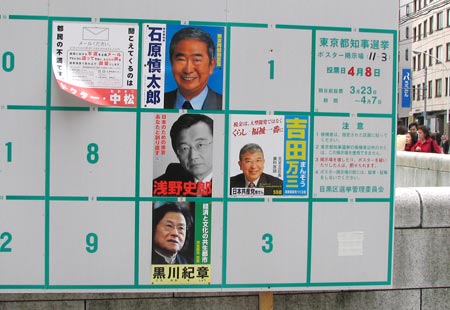
Shintaro Ishihara just got re-elected for a third four-year term in Tokyo:
Tokyo Governor Shintaro Ishihara, an outspoken nationalist who is fond of riling Japan’s neighbours, has secured a third term leading the world’s largest metropolis.Mr Ishihara, who has used racial slurs for Chinese and Korean residents and has described women past child-bearing age as “hags,” had an unassailable lead over his rivals for a four-year term, Japanese media said.
He was first elected chiefly from name recognition, having been the famed author of the nationalist screed The Japan that Can Say “No”, and seems to have gained popularity with his rather overt demagoguery.
Ishihara is not at all loved by the foreign community here, as he has a history of stereotyping and scapegoating on racial grounds, distorting statistics to make it look like foreigners are a criminal menace, and inciting fear among the local population as a means of creating support for his administration. This is in part why you get comments like this:
“I voted for Ishihara as I think Tokyo needs a leader who is convincing and has strong leadership,” said Manabu Koiso, a 24-year-old fish market worker.
In a very real way, it is the same kind of effect that Bush gets when he makes people afraid of terrorism, with the understood linkage to Islam and people of Middle Eastern origin, or that Republicans in general get when they play the race card on immigration (see Bill O’Reilly’s latest meltdown where he tried to connect his immigration scare with a recent drunk-driving tragedy).
For those of you not familiar with Tokyo’s charming governor, here’s a sample of his tasteful commentary:
Roppongi is now virtually a foreign neighborhood. Africans — I don’t mean African-Americans — who don’t speak English are there doing who knows what. This is leading to new forms of crime such as car theft. We should be letting in people who are intelligent.
He has also referred to Koreans, Taiwanese, and Chinese as “sangokunin,” a derogatory term from Japan’s colonial days. In his speech, to Japan’s military forces, he said that these foreigners “are committing heinous crimes over and over” and suggested that such foreigners should be rounded up in case of a natural disaster, otherwise they would “cause civil disorder.” This was evocative of the panic following the Great Kanto Earthquake of 1923, when rumors spread that Koreans were poisoning wells, burning buildings, looting, and even planting bombs; as a result, as many as 2,500 Koreans were killed by Japanese mobs of vigilantes. For Tokyo’s governor to be stirring up the exact same fears even before another quake strikes is reprehensible beyond belief.
But at least he’s a strong leader.
We should be letting in people who are intelligent.
This guy sounds like a real ass.
Of course, I have to admit to being really confused by immigration in general. How do people even manage it? I have a Master’s degree and a okay but not great income (about $35k USD). If I wanted to immigrate to the UK as a skilled migrant I would fall short of the 75 points required by their skilled migrant assessment test.
I would either need to earn a Ph.D. or make 10-15k USD more per year in order to have the 75 points required to be accepted. By the time I manage either of those I’ll lose 10 points from the age category because I will be in the next highest age group which only earns 10 points instead of 20. Thus putting me right back where I started with not enough points.
Right now I have 35 (master’s) + 20 (20-27 age group) + 10 (income). If I it takes me more than 2 years to earn a Ph.D. I only really gain of 5 points (+15 for Ph.D. -10 for age), which still puts me at less than 75, if I take more than 2 years to get about a $10,000 pay raise on my annual income to move into the next bracket I only break even (income +10, age -10) and end up right were I started.
Of course if I had an MBA from an approved school, for some damn reason, I would be automagically given 75 points, but because I have a Master’s of Library Science, which isn’t a high paying career, I’m not good enough to earn points.
New Zealand is a little better with their point system, I’d just need an offer of employment anywhere outside to Auckland to put me well into the automatically accepted range on their system. I have 95 points with no job offer, 100 is required to be considered at all, with a job offer outside of Auckland, I’d have 155 points (140+ being auto accepted.)
So, and I’m not trying to sound racist when I ask this, how do people who don’t speak the language of the country they are moving to and are coming from very poor nations, manage to get into countries like the UK, Canada, Australia, New Zealand, when I couldn’t!? The various immigration pages, suggest that I try an employment based migration category, which would require me to find a job before immigrating and the employer would have to prove that there is a skills shortage in that area before they could hire me! So again, how do poor, non-English speaking, people manage to get to western, English speaking countries!? I have zero problems with the immigrants, I just want to know how they do it so I can try it!
This is truly sad to hear and read about.
I know, I have no room to talk, I am an American, and our President was an easily predictable disaster in 2000, then was a disaster and we still re-elected him, or voted in large enough numbers that it was plausible to fix the election.
That said.
This seems tied to the problem of Japan not acknowledgeing its actions in WWII.
All the more surprising to me because Japan has benefited immensly from the contrition system in criminal law. In that system, first time offenders are given an opportunity to:(1) Admit to the crime (2) Appologize to the victime (3) Seek their forgiveness/make restitution (4) Acknowledge openly the superiority of the law (5) Rely on family, work and community members to vouch support and accountability for the purpetrators future acts. If all these actions are taken, the Japanese system will simply drop the case.
Almost alone among post war industrial powers, Japan has enjoyed a declining (until 1990) crime rate. This is largely attributable to the system of contrition.
Less than five percent of criminals are repeat offenders.
Japan, perhaps more than any country, understands the value of contrition. Yet the refuse to do so on the international level.
I don’t think its a question of liability. Though it would help to have a system of contrition that facilitates what Japan does domestically, on an international level.
However, when ever a person or a group or a nation is unwilling to make a full act of contrition, its as if they are reserving the right to do so again. Neighbors rightly have a reason to be concerned and even angry.
And now along comes this.
I think it has to be taken in the context of what’s going on in the United States. George Bush gets elected, and starts down an increasingly fascist path. The vatican elects an arch conservative Pope with the spector of a Nazi past. Japan begins to slide far to the right.
Maybe Japan should consider what life there would be like if a hard right George Bush type had been President instead of Harry Truman. Take a good look at Iraq (see ” The Occupation of Iraq: Winning the War, Losing the Peace” by Ali Allawi). Liberalism has brought Japan immense peace and prosperity. The slide to the right is hard for me to understand from my limited base of knowledge on Japan.
Anyway, this is certainly a revolting and sad thing to have to read about.
The information from Wikipedia on “The Japan That Can Say No” is interesting. It appears that Morita was writing from an honest perception of working in America and that Ishihara was writing from a viewpoint based on right-wing isolatioist ideology instead of actual social scientific understanding.
I imagine people said similar things about Hitler before World War 2… “Sure he said that the Jewish People cause all our problems in his book, but he’s a strong leader!”
I’m not sure how much power the governor of Tokyo actually has politically though and wonder how much to actually worry about this. As I understand it there is a large council that sets policies and such and there are mayors of each city and ward in the prefecture that are a little closer to the populace.