Archive

Archive for April, 2013

Neighborhood Incident

April 24th, 2013 3 comments

I was walking to the station this morning to go to work, and saw something that was rather troubling.

There’s a small candy shop near the station exit, and as I approached, I saw four people standing in front of it: two uniformed police officers, one man in a suit, and one “regular” person, a foreigner. The person in the suit was wearing white gloves.

As I passed, I noted two things: first, the foreigner, a dark-skinned gentleman, spoke English but with an accent that suggested he was a national of an African nation. Second, the man in the suit with gloves spoke English—and was telling the man that he wanted to do a “body search” (I assume he meant a pat-down).

In the 80’s and 90’s it happened constantly. They never patted me down, but they stopped me all the time, very often when I was riding my bicycle, which they always accused me of stealing. They would ask for my ID card (all non-Japanese save for some Koreans are required by law to carry their registration cards with them at all times), sometimes that being the only purpose of the stop.

In recent years, I have not been subjected to this, but it has never stopped for many in the foreign community.

So when I saw what I did this morning, it evoked more than just a little suspicion.

True, it could have been justified—perhaps the man had actually stolen something from the store, maybe it had been caught on video or something. Or it could have been something completely unrelated to the shop.

But here’s the thing: I have never seen police confront anyone on the street in that manner before.

I have seen endless incidents of cops pulling people over in cars for traffic violations, of course. I have seen cops dealing with people in all sorts of situations. But in over 20 years in Japan, I have never see cops stand by as a man in a suit and gloves patted someone down on the street.

As I mentioned, it was somewhat disturbing to see.

First of all, where did the guy in the suit speaking English come from? Certainly not from any local police box, that’s for sure. There were no cop cars parked nearby that could see, no cars at all in fact—the streets there are pretty narrow, it’d be hard to miss. The closest police station of any size is 3km south, a good 12-14 minutes away by car—and even there, I’d be surprised to find English-speaking plain-clothed cops. So where did this guy come from? Was someone holding the man there for a half-hour while they called someone in?

More disturbing, though, was the venue: they were suggesting a pat-down, presumably for shoplifting (though who knows what they were in fact stopping him for), right there in the street.

Is it just me, or is that more than a little improper?

One incident this brought to mind was one of the many times I was stopped on suspicion of stealing the bicycle I was riding, usually in the same area I biked almost every single day. On this one occasion, I was stopped by not one cop, but by about half a dozen, with a squad car and everything. While one peered into my bicycle frame for a serial number to trace, the others grilled me about my job, where I lived, my country of origin, and so on.

Now, at this time—in the late 80’s to early 90’s—there was a great deal of friction between the U.S. and Japan, and part of this played out in police behavior and part in the media. When Americans would appear in TV dramas, they were usually violent, loud, criminal, obnoxious, and/or AIDS carriers. When Japanese pitchers intentionally hit American players with fastballs, the players would rush the mound—prompting media excitation about “害人”, supposed to be the word “foreigner,” gaijin, but spelled with the characters meaning “harmful person.” And so on.

So, when I was surrounded by those cops engaged in the serious business of discovering that I did, indeed, own my own bicycle, I saw Japanese pedestrians walking past and glancing at the tableau—and had no doubt that many were seeing me, and thinking, “So, it’s true.”

Nor did it help that, while I was pulled over with some regularity, and while I saw other foreigners pulled over, I never saw Japanese people pulled over for bike-theft checks. Not that it never happened, but it was pretty clear there was a sharp difference in how such stops were decided.

Ergo I am sensitive to such displays which center on foreign residents.

It is possible that what I saw was completely legit. However, the fact that I never seen anything even resembling this treatment before raises doubts with me.

Am I being unreasonable? I’d be interested in anyone’s thoughts on this…

Categories: Focus on Japan 2013 Tags:

Kit Kats

April 23rd, 2013 Comments off

As you may or may not know, the KitKat candy bar in Japan is famous for taking on multitudes of flavors, including some odd ones. I got some wasabi KitKats for my nephews a year or two back, but this one surprised even me: Red Pepper-flavored KitKats. At least, the ones on the right. On the left are Blueberry Cheesecake ones.

Redpepperkitkat

And no, I didn’t try the pepper ones (nor, alas, the tastier-looking cheesecake ones).

Categories: Focus on Japan 2013 Tags:

Slide!

April 23rd, 2013 1 comment

This photo was from a building we passed the other day:

Slide

When we first started walking Ponta, we saw something similar in our neighborhood: a 2-story building with a slide, not a staircase, from the second floor to the ground. At first I thought it was a kindergarten with a novel route to recess, but then I discovered it was an old folk’s home. The building above is, in fact, a hospital.

As you may have guessed, the slides are not for kids, but for incapacitated people unable to take stairs with any speed, or perhaps at all.

Do we have this in the states? Don’t ever recall seeing or hearing about anything like this.

Categories: Focus on Japan 2013 Tags:

Boston

April 17th, 2013 2 comments

We don’t know what happened yet in Boston. Most people are holding back from blaming anyone yet. Some on the left are blaming right-wingers. Right-wingers are blaming Islamists. Islamists are denying involvement. Right-wingers are attacking left-wingers for blaming right-wingers. And far-right-wingers are saying it might even be a false-flag operation to start a war in Iran.

A few key elements have been pointed out: the bombing occurred on Tax Day, a day anti-government extremists are strongly offended by; the day coincided with Patriot’s Day, a day many of these same groups consider significant.

Less indicative of a source but still of note are the facts that the bombings were home-made devices, pressure-cookers, with crude shrapnel, packed into duffel bags—a weapon anyone could use, but leans towards domestic in nature; and the target was in Boston, a city identified with left-wing politics.

The general timing also coincides somewhat with Waco; although the siege ended in fire on April 19th, it was ongoing for a month and a half previous to that. Also, the Boston Marathon may have been too “good” a target to wait another four days.

Pointing away from an Islamist terror bombing is the lack of anyone claiming responsibility.

Right-wingers are quickly and sometimes preemptively denying right-wing involvement. Glenn Beck, for example, quickly came out with the defense that, “when our crazies go off, they target the government.” Other right-wing sites are simply venting that a few on the left are making such suggestions, while the comment sections of the articles sport a fair number of people claiming it was a false-flag attack by liberals to make conservatives look bad. (You may fully expect, when a suspect is named, that right-wing blogs will be rife with the phrase “Registered Democrat,” no matter what the suspect’s orientation.)

One thing that is kind of hard to ignore: while we are still a ways off from knowing who did it or why, the evidence definitely leans towards the right-wing-extremist theory. Not that this is what conservatives want—they are decrying this as evil as much as anyone else—more likely, if such extremists are responsible, they are likely crazies with their own deluded ideas.

It does, however, bring back into focus the fact that the rhetoric on the right is often fuel for such fires—one reason, perhaps, there is so much pushback from conservatives against what is now the most likely theory.

It may turn out it was just a demented non-political loon looking for thrills and attention, or who knows, maybe an extremist from an country we haven’t even considered yet. However, there is no bad time for discussing the dialing back of violent extremist rhetoric in our national dialog. I don’t think that it is too much to ask that this kind of messaging be denounced by everyone, whether or not it had anything to do with this week’s attack.

Categories: Political Ranting Tags:

The Weight of a Gun

April 6th, 2013 2 comments

The Trayvon Martin case has a number of elements which are, to say the least, distracting. The fact that the police accepted Zimmerman’s story and seemed to dismiss Martin as a criminal, failing even to identify him in a timely fashion. The fact that Zimmerman’s wounds were not at all apparent from then-current evidence, and that police may not have collected evidence properly. The fact that parts of the 911 call were unclear, and there was not a small amount of media sensationalism regarding an assumed racial epithet. All of this fired up discussions of racial profiling, police collusion, and the possibility of a conspiracy. While this may have helped motivate the police to act more properly on the case, it also created a flurry of red herrings.

This only got worse as time went on, with problems in the other direction as well. Which photos of Trayvon were used created complaints, and that the friend who Trayvon was on the phone with had made false statements under oath. All of these became issues that everyone focused on.

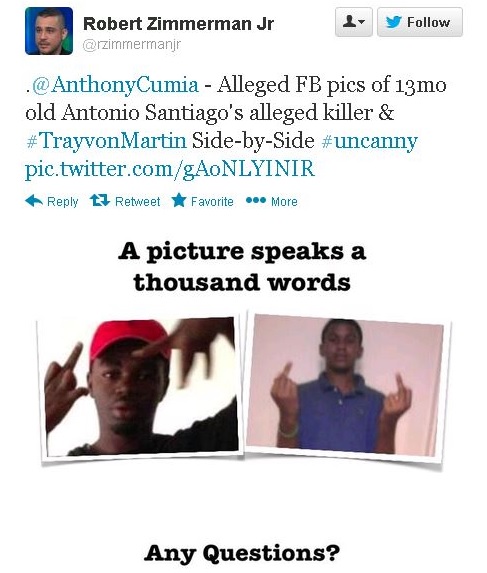
Today was no different. Zimmerman’s brother, Robert, posted (or re-posted) an image on Twitter:

Zimtweet

While this throws a certain amount of doubt as to whether there is indeed racism in the Zimmerman household, it is yet another red herring—possibly the mother of all red herrings. Robert is not George, and George should not be held responsible for crap his brother posts. Whether or not Robert intended only to demonstrate how photographs can be used to make any associations and that people should not judge Trayvon Martin based on his “harmless friendly teen” images, the post was the height of idiocy and insensitivity—and not the least bit relevant to the main questions of the case.

These distractions are not only less relevant, but they distort perceptions: for example, so much attention was placed on whether or not Zimmerman had any injuries, that when photos came out showing the injuries were real, many seemed to assume that was the end of it, case closed—as if that were the only real question in the case.


At the time when the story first broke, and still today, I held and do hold that most of that is irrelevant, and there is one central issue here: George Zimmerman was armed, and deliberately left his car to follow and confront someone who only looked suspicious to him. I hold that a key lesson of this incident is the cavalier attitude we have assumed toward the carrying and use of guns, especially in terms of vigilantism.

This is what I posted almost a year ago, comparing Zimmerman with Rodney Peairs, the man who shot and killed Yoshi Hattori:

[T]he most significant factor, at least to my reckoning, was that the men who wielded the guns failed to act responsibly. Neither did what they were supposed to do. Rodney Peairs, the man who shot Yoshi Hattori, had a right to defend his home–but he violated that precept when he unnecessarily stepped outside his home to actively confront the “intruders.” No matter how it played out in terms of specifics, George Zimmerman made the same error: instead of holding back and allowing trained professionals to do their job, he pursued Martin, and Martin is now dead as a result. In both cases, the men with guns felt the necessity to confront the people they felt threatened by, no doubt emboldened by the possession of their weapons. …

Peairs and Zimmerman both owned guns, and they both assumed a right to step beyond their own bounds and confront people they believed to be criminals. That is an explosive combination that will result in the deaths of innocent people. Peairs required no training to be armed in his home; Zimmerman only needed to take a few hours of gun safety courses before he was allowed to walk the streets armed. If either received training which firmly emphasized that they retreat from confrontation instead of seek it out, it certainly did not take.

In my mind, Zimmerman is guilty. Not because I know how the specifics played out, that Martin did not assault him, or anything else. Instead, it was because Zimmerman was the one holding a gun, he did not need to pursue Martin (the 911 call made that clear), and so he bore responsibility.

As far as I’m concerned, that by itself should be a separate element in any judgment about Zimmerman. What happened specifically after that—whether he initiated the confrontation with Martin or was attacked, whether there was justification to shoot or not—these I see as separate issues.

Zimmerman carried a gun. He willfully engaged in vigilante behavior. He left his car and followed a suspect, against the instructions of the police, apparently assuming too much about who he was following, apparently without thinking how his actions might be perceived were the person in fact innocent.

What happened after that was a result of this choice on his part.

I think this needs to be emphasized and recognized as a central issue. How photos are used in journalism, the significance of race and racial profiling, even the details of the confrontation itself—these all are relevant within their own contexts, but irrelevant to a very critical issue.

That issue is armed engagement: that, when you carry or use a gun, you must also assume a responsibility to be cautious in the extreme.

We have moved in the opposite direction, sending all manner of signals—cultural and legal—telling people to shoot first and ask questions later.

That has to stop, it has to be reversed. People need to be sent the message: if you pick up the gun, you should feel the weight of the responsibility it carries.

It also highlights a critical element of gun control: training and licensing. These are absolutely essential and should be required nationwide.

Categories: Social Issues Tags:

Cheating at Corruption

April 4th, 2013 2 comments

There is quite a bit of concern over recent scandals involving school- and teacher-driven cheating on standardized tests:

The extent of the top-down malfeasance under Beverly Hall may be unprecedented, but as I report in this Slate piece, there is reason to believe that policies tying adult incentives to children’s test scores have resulted in a nationwide uptick in cheating. An investigation by the Atlanta Journal Constitution found 196 school districts across the country with suspicious test score gains similar to the ones demonstrated in Atlanta, which statisticians said had only a one in 1 billion likelihood of being legitimate. A 2011 study by USA Today of test scores from just six states found 1,610 instances in which gains were as likely to be authentic as you are likely to buy a winning Powerball ticket. Absent independent, local investigations of suspected wrongdoing—which are rarely conducted—we simply cannot know the full extent of the cheating, which makes it difficult to assess whether the United States ought to continue down the road of tying teacher and administrator pay and job security to kids’ standardized test scores.

There seems to be some focus here on the shock that teachers and schools are cheating. We hold teachers to a high standard (while we hold ourselves to low standard in terms of how we treat them), and cannot imagine that so many would do something so terrible as to cheat.

Furthermore, the assumption seems to be that these teachers are cheating to save their own asses, and the cheating is harming their students, using them as tools for selfish gain. Thus the question about tying pay and job security to testing, as if the testing itself were not at all in question.

And sure enough, there are cheaters, no question. There will always be people in any group who are more noble and more base. As with everyone else, there is a spectrum—some will hold to their principles no matter what, some will violate the rules for no reason, and the vast majority lie somewhere in between, and where we lie along this spectrum is influenced by our conditions. I covered this before in a post from eight years ago: as conditions intensify, more of us reach the conditions of our “price,” our necessary level of incentive to break the rules. More of us are primed to do wrong.

This is one reason why tenure is a good thing: it releases the pressure, the fear of harm, and thus dissipates the conditions that prime us to do the wrong things.

Take away tenure, tell teachers that they will lose their jobs if their students don’t perform to a standard, and those conditions intensify, and more teachers manipulate their environment to work the system.

One element that will further prime us to break the rules is the availability and strength of rationalizations. The easier and more convincingly we can come up with excuses for defying a system, the more we will do so.

Tying school funding to standardized testing offers excellent excuses. Teachers can very easily look at that system and believe utterly that it is arbitrary and meaningless, and therefore violating its rules is not an actual wrong, just a technical one.

They know that standardized testing is not a true measure of education. They know that it is a political tool, designed to win votes. They know that robbing a school or a district of funding because of it is in itself a wrong. (In fact, one could argue that the schools with the worst results need more funds, not less.) They know that teaching to the test, which standardized testing favors, can actually be detrimental to students. They understand that the quality of education is not something that can be so easily measured, and pretending to do so can emphasize the wrong things and de-emphasize the good.

It is amazingly easy to convince oneself that cheating on this system is actually a moral good.

And here is where immoral and moral behavior blend: most of these rationalizations are in fact correct; the system is indeed useless and corrupt in itself; and teachers face a crisis where they must choose between following a bad system and giving their students the best they can manage.

Yes, some teachers cheat because they fear losing their jobs. But many honestly cheat—yes, that is very possible to do—to best serve their students.

They are faced with the knowledge that losing funds for this school may indeed harm the students in their care, students these teachers have committed themselves, often times selflessly, to protect and nurture.

This is not helped by the fact that teachers know that their children can be further disadvantaged when other schools cheat, and they know that cheating is inevitable.

Imagine, for example, that the government decided that health care for children be parceled out on the basis of the child passing a test that parents could easily help their children cheat on. The children pass, and they get medical attention. They fail, and they get nothing when they fall ill. And it is apparent that there is little connection between the test and worthiness of medical attention.

You think most parents will not cheat? Of course they will. You’re practically forcing them to. You are creating a system which encourages cheating, rewards it—even makes it necessary if one cares for one’s children.

Now, you may think that the analogy of medical care based on an arbitrary test is absurd—but have you considered that it is not because the analogy is incorrect, but because standardized testing as well as tying it to funding is equally absurd?

The fault, in fact, lays not in the cheaters, but in the selfishly-motivated manipulators who created the unhealthy system in the first place.

Strange how that fact is far less discussed, as if standardized testing should not be questioned.


Allow me to segue into a related point: evaluation.

I got my graduate degree in TESOL at one of the best-rated schools for that department, and yet there was a glaring omission in that program: testing and scoring. I simply cannot remember many lessons or book chapters which trained us how to create testing materials and evaluate student progress. There was certainly no course on the topic; the courses we did have focused more on teaching and remained mostly silent on evaluation.

There may have been a reason for that: like teaching itself, evaluation is not a straightforward thing. There is no “correct” method. It is, as the old saying goes, more art than science.

Grading demands the application of a numerical value to performance—but how do you weigh the performance? This question invokes issues from the fundamental to the specific.

First of all, what is the purpose of education? To teach students skills to find and perform well at jobs, or to enrich their lives at a more abstract level? Do they need specific skills, or should we outfit them with general tools which can be adjusted to adapt to any situation? Some even question whether we should be teaching them critical thinking skills at all. The answers to these questions fundamentally alter how evaluation should be performed, and yet we cannot even agree on these basic goals.

Should students be rated on an absolute scale, or in relation to each other, or even based upon personal progress? If absolute, who sets the standard, and what is it based upon? If in relation to others, then in relation to what group—the immediate class, the entire school, the state, or a national average? Or should students be graded on how much they achieve relative to where they started?

In any one topic, how should different elements be rated? Is a student rewarded for simple, mechanical memorization skills, or the ability to analyze and understand, to perceive the principles behind something and apply those so as to come to a creative result? Should we prize narrow technical competence in a skill, or creative approaches? If a combination, the how to weigh the value of each?

Upon serious and objective consideration of all of these facts and many, many more, it is easy to see that evaluation is a deeply complex and irreducible process. Applying standardized testing to education is like trying to rate literature by counting vowels.


The answer to standardized testing “scandals” is to address the greater problems, and the first step to that is to recognize standardized testing for the abject failure that it is, to trash it and to start over again. This time, leave the politicians out of it, as well as monetary incentives, and make an honest attempt to address the problem objectively and systematically.

A good start at such a project would be to first establish why we have education in the first place, and come to a firm decision about what education is supposed to be for. From there, we can move towards more specific elements and work our way through the system. There will never be universal agreement, but at least if we can make the standards clear, we have some hope of doing a better job.

Categories: Education Tags:

Mandatory Religious Deference

April 2nd, 2013 5 comments

In the United States, we live under the protection of religious freedom. This means that, as far as government and the law are concerned, we may believe, or not believe, as we wish.

However, this is a legal protection, not a cultural one. Culturally, there can be all sorts of religious discrimination. More than that, there can be religious bullying.

Think of it in terms of working at an office where most of the people there are, let’s say, die-hard Dodgers fans. They not only hang Dodgers pennants and other paraphernalia up, they get offended when you put up a banner for any other team (especially if it’s bigger than their pennant). In fact, they get upset if you don’t put up a Dodgers pennant in your cubicle or office. They get downright pissy about it, in fact. A coworker emails everyone:

Can I just say how disappointed I am that even though the Dodgers won yesterday, Linda chooses to celebrate by hanging her daughter’s artwork instead.

And you know you’re going to catch all kinds of dirty looks and snide remarks all day.

You would probably dread working in an environment like that. Not just because you’re the outsider, but because the majority of people there are such asses about the fact that you’re not—and that you’re not praising or worshipping them or their favorite things.

Well, welcome to the United States of America. Today, Google did not choose to represent the mainstream holiday or event (as is often the case) and instead chose to post something out of the mainstream—Caesar Chavez’s birthday, in this case.

Conservative Christians across the nation were offended. Some were livid. A few representative tweets:

Google thinks Cesar Chavez is more important than Easter. #whoareyou #happyeaster

Why is Jesus not on google but Cesar Chavez and his 86th birthday is ???

Wow. Congrats Google, youve managed to alienate all Christians in America today: instead of celebrating Christ, they celebrate Cesar Chavez.

That last one has just about the right ring to it: fail to put us above and before everyone else, and you risk our wrath. Many reported their intent to move exclusively to Bing.

Seriously, you would think that Google is a church or something, in that not recognizing Easter is completely out of character, a slap in the face. Since when has it become a requirement for businesses to genuflect? Why expect them to celebrate Easter with a special graphic? Why on earth would you get upset if they don’t?

“You said ‘happy birthday’ to Mark on his birthday, but not to me on mine? Well, don’t expect me to give you the time of day from now on!”

Yes, it is just that petty and pissy.

Not that it is anything new. You know about the infamous “War on Christmas,” right? Same thing. It consists mostly of Christians whining about how a few people are saying “Happy Holidays” instead of joining the popular chorus of “Merry Christmas.”

“Happy Holidays” is inclusive: it includes Christmas, but also everyone else. It’s perfect when you are speaking to a large number of people or are unsure of what holiday a particular person celebrates.

“Merry Christmas,” on the other hand, while perfectly fine for addressing someone you know celebrates the holiday, happens to exclude anyone who is not a Christian.

Demanding that retailers say “Merry Christmas” and forbidding them to say “Happy Holidays” is like men demanding that crowds be addressed as “Gentlemen” only, and getting all offended when “Ladies and Gentlemen” is used instead.

Seriously, if you hear “Merry Christmas” two dozens times a day, hear Christmas carols on nearly every radio station, see special Christmas episodes of most of your favorite TV shows, are bombarded with Christmas decorations and jingles everywhere you go… is it really going to put you out that much to hear the occasional business cheerfully wishing you a happy holiday?

If you can’t be satisfied with hogging 99% of the pie and then sharing the last sliver with others, then you’re a whiny, selfish, self-centered ass.

And you’re giving Christianity a bad name.

Honestly, would you want to be a Dodgers fan if all their followers were dicks?

Categories: Religion, Right-Wing Hypocrisy Tags: