Archive

Archive for July, 2015

Respect the Artist… Don’t Buy the Song
July 18th, 2015 4 comments

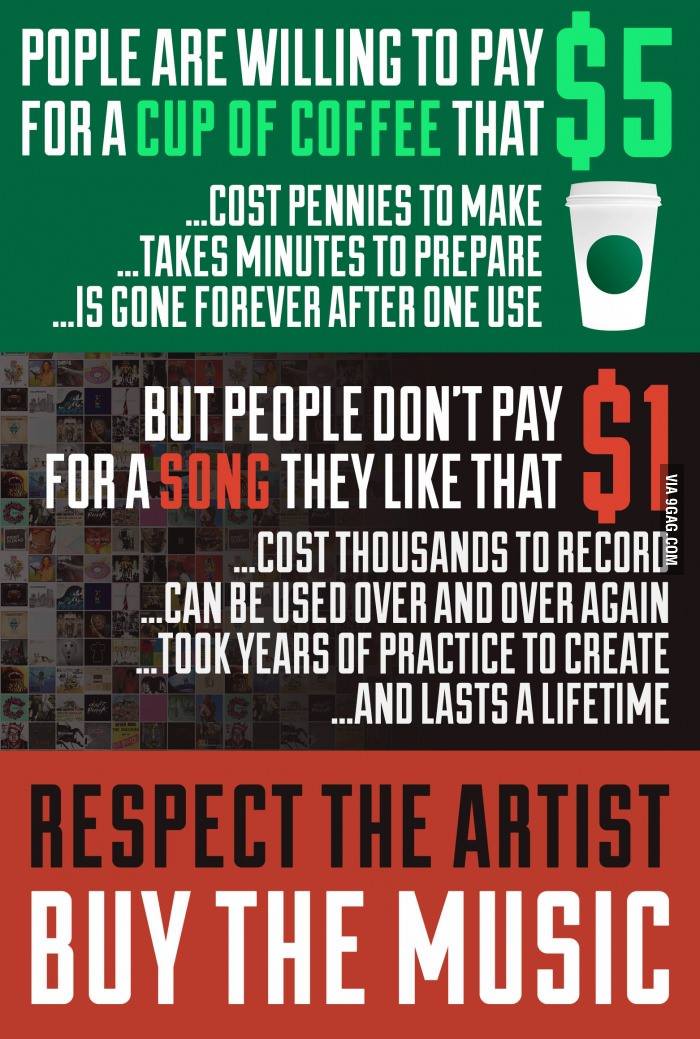
message from the RIAAI saw this graphic on Facebook today, and it really cheesed me off. While the message has some truth to it, it is filled with subtle yet powerful distortions.

To say that a cup of coffee costs “pennies” to make is misleading; “pennies” sounds like 5~9 cents, while the actual cost in materials is over a dollar, and the price goes up if you account for costs such as labor, rents, etc.

That a cup of coffee takes “minutes to prepare” is also wrong, because the comparison is with the beginning-to-end song production; to account for coffee production in the same way, from planting to processing to shipping to preparing and to serving, making a cup of coffee can involve hundreds of people over a year or more of time to create. Hell, the graphic even cites musicians’ “practice”! How about farmers’ training? No, if you count coffee as taking “minutes” to prepare, then a song takes only “minutes to sing.”

That coffee is “gone forever after one use” is simply the nature of the product—should we value food and drink less because we cannot eat and drink them endlessly?

Not to mention that a cup of coffee can be made to last for a good half hour, resting in a comfy chair at the coffee shop while reading a nice book. A song lasts maybe three minutes, so a cup of coffee can be worth maybe 10 listens. You may still listen to a song dozens of times, but by the time metric, the comparison is far less severe than it is made out to be.

As for the songs, well, those claims are also exaggerated. Yes, it costs thousands of dollars to record—but after they record it, they can cheaply create endless millions of copies. Divided between copies, the cost comes to… pennies!! Much less than a cup of coffee, to be certain! It may cost $100,000 to record a song, but a best-selling song can sell 10 million copies. That’s about one penny per copy.

It can be used over and over again… but not exactly. First, media types (records, tapes, CDs, digital) change often, and every time they do, the music industry demands you pay full price for the new version. Some people have been made to pay for the same Beatles song half a dozen times. Many of these versions have been discarded when the new ones present themselves, so not a “lifetime” thing after all.

Second, it used to be that you owned the media; you could buy or sell used, you could borrow or lend. You could inherit music from a parent, even. Now, you only own the “license”—the temporary, limited right to listen to the music in restricted ways. And when a music service dies, or if you stop paying, you usually lose access to the music you paid for. You can pay $1 for a song, but you can’t own it for $1.

For you to truly buy and own a song for a long time (maybe a lifetime), you have to buy the CD… which is much more expensive than the coffee.

The final statement, however, is the worst of all, and makes me really angry. The biggest text on the graphic: RESPECT THE ARTIST: BUY THE MUSIC.

Oh, really? Well, aside from the fact that you don’t “buy” it anymore (you pay for a license), the whole “respect the artist” thing is a heaping, stinking pile of bull.

Music labels have for decades abused the artists, and pay them very little or even nothing; most artists make their money from tours and performances, even endorsements, but not from music sales. The artists’ income from music sales is a tiny percentage (divided between the band and their managers & agents), but that’s before the studios first charge the band for almost every possible cost they can force them to pay. For example, although everyone profits from the use of the studio, the artists are forced to pay for that by themselves. In the end, they get little to nothing—literally nothing, very often. Lyle Lovett, for example, sold 4.6 million albums, and got a net of $0. Nothing. Not a single penny.

Indeed, artists are forced to sign long-term contracts and give up their rights, working long and hard for the tiny chance at success, while the music companies rake in all the profits. So, every time I hear the industry shout, “Respect the Artist!” my response is simple: You first.

Here’s the real irony: if you pirate every MP3 you listen to, but go to the concerts to listen to your favorite bands, then you are respecting the artists. That gives them the most profit. I’m not saying you should pirate the music, I am only pointing out that it rarely, if ever, hurts the artist. It hurts the insanely rich recording studios who abuse the artists.

Most artists don’t care if you pirate the music; in fact, the more you pirate their music, the more likely you are to want to see them in concert, which gives them much more profit than if you bought the rights to listen to the song! But the artists can’t usually say that, because they still are bound to the music companies. Some do, however; Lady Gaga, Neil Young, Shakira, Norah Jones, and many others have actually said they’re OK with piracy… and no wonder. It helps them more than it hurts them. Neil Young calls piracy “the new radio.”

Whatever you think of piracy, whatever its legal status, it has no damaging effect on them. When studios condescendingly exhort us to “respect the artist,” it’s like billionaires saying that the estate tax “hurts farmers.” Which is bullshit—and, ironically, actual bullshit does help the farmers. The bullshit in the graphic above, though, helps the artists not even a little. It may even hurt them.

Categories: RIAA & Piracy Tags:

The Donald, Racism, and the Right

July 6th, 2015 6 comments

The Republican Party has a racism problem. They simply can’t shake it. They wanted to appeal to black voters, and draw them into the fold—but they could not help saying and doing things that offended and alienated that entire part of society. Then they realized that Hispanics are becoming a vital demographic, and again vowed to pull them in—only to quickly revert to form, and drive away even many who are already conservative.

Why? Because the right wing is beholden to its base like nothing else, and its base has a wide swath of racism right down its middle. As has been often said, not all Republicans are racist, but if you’re a racist, then it’s a good bet that you’re a Republican.

Conservatives have denied this for years, trying to dismiss what they can, and blame the rest on extremists and outliers, combined with a generous helping of the “No True Scotsman” fallacy. The party does not have a racism problem, they insist. In fact, they claim that racism just isn’t a thing anymore—I mean, hey, we elected a black president, so, racism: gone!

When Donald Trump entered the race, however, he uncovered and laid bare the massive eyesore they all have been trying to deny. Trump now-famously said:

When Mexico sends its people, they’re not sending their best. They’re sending people that have lots of problems… they’re bringing drugs, they’re bringing crime. They’re rapists. And some, I assume, are good people.

Far from apologizing, Trump has been doubling- and tripling down on those remarks ever since.

What has not really been remarked upon lately is how Trump’s unrepentant racism has shown up the racism in the party itself.

Consider that Trump, despite making blatantly racist remarks at the very outset of his race, jumped into second place after Jeb Bush, holding 10-12% to Bush’s 16-19%. That in itself is very telling, perhaps to the degree that “despite” is not the right word for the previous sentence—maybe it should be “because.” (Okay, “due to.”)

It’s not as if Trump’s qualifications, ideas, or intelligence dazzled anyone. Nor is it his celebrity, as he was holding at about 2% in the polls before his remarks. Nor is it his general conservative outlook. What marked Trump was his unabashed extremism, and in particular, the racism. A lot of people in the party responded to that. Even Ted Cruz said that Trump should not apologize, adding, “I like Donald Trump. I think he’s terrific. I think he’s brash. I think he speaks the truth.”

Meanwhile, we on the left are still agog, scratching our heads, asking ourselves, “How can these people take such an outrageously idiotic buffoon so seriously?” Even Sarah Palin can’t bring the magnitude of the stupidity into clear focus. It’s as if some psychopathic clown just walked on to the GOP stage with his pants around his ankles, started swearing a blue streak, and they’re all sitting there applauding, as if it were Dan Quayle spelling “potato” with an “e.” We just can’t comprehend this. We’re just asking ourselves, “Don’t they know how this looks??”

What was even more telling, however, was the reaction from the leading GOP candidates. Normally, a comment like that would bring an instant firestorm from all sides. But while the left and the public in general raged… conservatives kept quiet. Except for the ones like Cruz who praised Trump, or Chris Christie, who called Trump “a good guy.”

But for a whole two weeks, all criticism was held back. Marco Rubio, the quintessential Hispanic candidate, took the whole two weeks before saying anything critical. Jeb Bush, claiming many Hispanic family members and trying hard to ingratiate himself with Hispanics, took two and a half weeks.

Ask yourself, why? Why not shoot down a potential rival right away, and score some nice, juicy Sister Souljah points, making it work with the Hispanic demographic? It seems so obvious! Instead, they just stand back, and wait so long that it sounds like they are commenting on history, for cripe’s sake.

The “why” should be clear: Trump said something that a very large portion of the base has been waiting to hear for a long time. Bush, Rubio, and the rest immediately recognized that if they took shots at Trump, they would strongly alienate this core group that they so badly need. So instead they waited until the groundswell became so inevitable that they could finally say something bad about Trump, while still sending the clear message to the base: We’re really okay with all this. Don’t worry.

This is the only reasonable explanation for their reticence—but it very clearly shows that not only does the racist base exist, but that Republican politicians are very consciously aware that it exists, and are eager to pander to that group. This is also why they mouthed ignorance as to what Dylann Roof’s motives were, as if it were some inscrutable mystery. To recognize that it was about race would have been to tie a despicable act directly to the racists—and thereby to their own party.

Time to live up to your very real roots, Republicans. You are not all racists, not by a long shot.

But almost all the racists call your party “home.” And they are there in large numbers, and they have very substantial clout. You simply cannot deny it any longer.

Categories: Race, Right-Wing Extremism Tags: