Watching TV As You Drive

September 24th, 2003 Comments off

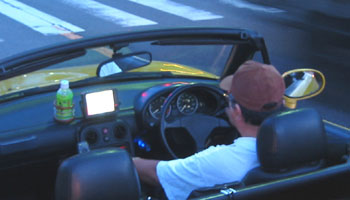
I’ve noticed that a lot of cars have little TV screens for the DVD navigation system–but all too often, I noticed that people are watching TV instead of the navigation maps. Makes me wonder exactly how safe these drivers are. You see enough people smoking or talking on cell phones–watching TV is not a distraction you really want to add. In the back seat, for the kids, maybe….

Categories: Focus on Japan 2003 Tags: by

Sunset, Sunrise

September 24th, 2003 Comments off

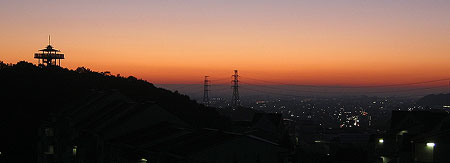
Some photos taken in the past few days. First, I caught a sunset–not great as a sunset, but some interesting photos within nevertheless. Then a sunrise, after a very late night up, taken from my dining room window.

Seiseki Sakuragaoka, on the Keio Main Line, seen from the bridge. A time elapse shot, about 10 seconds.

An egret in the water below. This shot is not reduced in size, but rather is a crop from a much larger photograph; otherwise, I would never have gotten it so close up. A “digital zoom,” I suppose you could say.

A nice two-second elapse shot, a truck rolling by.

And the shot out my dining room window. A nice view, I just wish it got sunsets rather than sunrises–I’m not awake for enough of the latter.

Categories: Focus on Japan 2003 Tags: by

Different Perspectives, Different Languages

September 23rd, 2003 Comments off

President Bush will be giving a speech at the U.N. tomorrow to ask them to come to our aid. Previously, he went before them, and threatened that they would become “irrelevant” if they did not go along with his unilateral decision. After charging toward war without consultation with our allies, he came to them instead (claiming credit for being “diplomatic” for doing so) and essentially said, “We want your rubber stamp, but if you don’t go with us, we’re going alone anyway.” This after his famous “you’re either with us or against us” speech about a year before.

Well, they stayed back and did not come with; and Bush charged ahead with a “screw you” thrown over his shoulder at them. Even Turkey did not agree to let us so much as use their borders, despite tens of billions in bribes that Bush offered. And when Bush did go in, despite the tremendous effort and heroic fighting done by our troops, we sank quickly into the quagmire. The WMD that Bush promised were there were not, which the U.N. might have discovered had not Bush’s invasion cut short their inspections; and while the Iraqi military was not nearly the force we thought it would be and the terrorist ties were found to be false, the guerilla afterfight wound up killing more than the war itself. The Iraqi people, far from cheering and welcoming us (minus the few staged ones) as Cheney was sure they would, they more resent us and in too many cases, fight us to the death. And now we either stay and pay a tremendous cost, or we leave and allow Saddam, anarchy, or religious fundamentalists come to rule. But the U.S. is already strapped financially, and Americans, disenchanted, are likely not going to tolerate the continued burden in deficit dollars and lost lives. And the U.N.’s participation would add great legitimacy to the rebuilding of the country.

This situation has forced Bush to go back to the U.N. to ask for their help. Now, when Bush campaigned to be president, he said that other nations would respect us only if we were “humble.” But, according to reports, Bush is not going to be very humble. Yes, the U.N. can help write a constitution, and yes, they can oversee the elections. But first, the war was right (forget all those lies we told you), the U.S. will retain control (if you send troops, they must be under our command, and don’t think of coming near the power base) and will hold on to the profits (give us your money, but U.S. companies get dibs on taking it).

In other words, he’ll throw out some bones and keep the meat, while asking the U.N., whom he insulted and berated before, to get their member nations, whom we ridiculed, to send their sons and daughters to fight and die for our cause and for our profit, to clean up the mistake we made despite their warning.

The only reason the U.N. would agree to this galling presentation would be because they are caught between Iraq and a hard place: refuse to accept Bush’s demands, and Iraq could fall apart and the region could become unstable, added to the deaths and misery the Iraqis themselves would suffer. Essentially, Bush holds them hostage.

But there may be reason for Bush to worry. 82% of Germans and 72% of the French believe that the U.S. invasion has made the world more dangerous, and similar number oppose their countries’ troops going in to Iraq to help the U.S. In the face of such strong opposition, will these countries really bow down before Bush’s demands?

I have the feeling that the U.N. may eventually go in, but they’re not going to accept Bush’s terms automatically; if they do, that will be what renders them “irrelevant.” With the known arrogance of the Bush people, I would not be surprised if they refuse to compromise, but then again, with an election coming up and even the most generous polls now dropping to 50% approval, Bush could be in even bigger trouble if he doesn’t get the U.N. to come in. So the U.N. seems to hold the stronger cards; the question is, will they risk Iraqi security to call Bush’s bluff?

Categories: Archived Tags: by

Card on RIAA

September 22nd, 2003 Comments off

I don’t always agree with his politics, but Orson Scott Card is a great fiction writer, no question about it. Here are his views, as an author, on the RIAA and copyrights. Very interesting view.

Categories: Main Tags: by

Judicial Politics

September 21st, 2003 1 comment

The executive and legislative branches we have always expected to be highly political, and although we have always known the judicial branch has its politics as well, he have, perhaps naively, expected that branch of government to be relatively objective in their rulings. We did not expect them to be outright party hacks. Yes, we have expected that their political biases to swing their judgment in an underlying, philosophical way; for instance, to favor Constitutional Constructionism as a way to justify conservative biases. This covert rule of bias at least allowed us to covet the belief that the judiciary was still above the fray, that we could count on the courts as being the final bastion of objective fairness.

That objectivity, whether true or simply a thin sheen, has been quickly evaporating over the past few years, and the judiciary has evolved into a political system all too much like the other two branches of government. It was doubtlessly energized by the standardization of court-stacking that evolved, in the 20th century, into the fine art conservatives have made of it (place young judges with known far-right leanings but little in the way of a paper trail, so as to control benches for decades). The overt politics-over-law trend, however, started to come fully out in the open with the 2000 elections, and the purely partisan ruling in Bush v. Gore, a ruling that had far more basis in politics than in actual law (read Vincent Bugliosi’s The Betrayal of America for further edification).

Another such outburst, lesser-known, was when the Fifth Circuit court, in 2001, used the case United States v. Emerson in an attempt to single-handedly re-interpret and reverse a long history of high-court decisions, including two Supreme Court decisions, on the nature of the Second Amendment to the Constitution. Over a hundred high court decisions, including the two by the Supremes, had held steadfast in the interpretation that the Second Amendment applied only in militia, or military, situations, and did not guarantee an independent, individual right to keep and bear arms.

The Emerson case, interestingly enough, did not even touch on Second Amendment rights, but two of the three judges on the Fifth, both strongly right-wing, issued what is called a “dicta” ruling–essentially, a ruling on law that is unconnected to the case. In the dicta, these two justices rewrote more than 60 years of judicial history and unilaterally declared the Second Amendment an individual right.

This ultraconservative judicial coup prompted an opposite but more than equal response from the more liberal 9th Circuit, which ruled in Silveira v. Lockyer in 2002 that the 5th Circuit was incorrect, and re-instituted the long-standing legal rulings on the matter. A good, brief, and objective reading of the story can be found here.

But the politics had come out of the judicial closet. And in a manner very similar to all this, the hard-right-wing judgment from the Supreme Court in Bush v. Gore was answered by a liberal trio from the 9th Circuit last week when it cited the 2000 decision in its ruling to delay the California elections until March of 2004. And now, a group of eleven conservative judges on the 9th is seeking to overturn their brethren early next week, in a move that is more of a political gunfight at the O.K. Corral than a stately, informed judicial proceeding.

We are beginning to see judges become outright politicians more and more often, as with judge Roy Moore in Alabama trying to force his own personal view of the First Amendment, and with the aforementioned 5th Circuit in Texas forcing their personal views on the Second.

Add this to John Ashcroft taking a partisan political stand on the law, and at the same time trying to rework several of the Amendments on his own, and we have a state of affairs which is truly dismal indeed. What used to be, at least, the outward appearance of judicial restraint and objectivity is breaking down into down-and-dirty politics. Of course, there are still quite a few fair judges out there, but they are at best being heard less above the political roar, and at worst, are being replaced by a new generation of political judges.

Lady Justice is taking off her blindfold, and choosing sides. Say goodbye to the balance, and watch out for the backswing on that sword.

Categories: Archived Tags: by

Quake: 9/20/2003

September 20th, 2003 Comments off

A pretty strong quake just hit. I had just been on the phone with my father and sister for a few minutes when I felt the room shake. It wasn’t violent, but it was a pretty darned respectable shaking, probably the strongest I’ve felt in Japan so far. The glass doors on my video cabinet were shaking, and the ceiling lamp was swinging quite a bit. It has been announced on NHK as a 5.5 quake (don’t know if that’s Richter or Japanese scale), 80 km deep under southeast Chiba prefecture, just east of Tokyo. That’s not the biggest quake I’ve felt since in Japan, but it was the strongest because it was the nearest big quake.

Tenki.jp and Hi-net are both not responding, probably deluged by people like me, trying to access their pages to see about the quake.

More as it comes in.


Here’s a map that came from the Tenki.jp site, which is now responding again:

Categories: Focus on Japan 2003 Tags: by

Faux News

September 19th, 2003 Comments off

Nightline had a piece on Hurricane Isobel today, and they showed a plethora of shots from newscasters following the hurricane “formula,” which include the broadcaster standing in the gale-force wind (I think Dan Rather was one of this style’s pioneers).

Most laughable was the Fox News broadcaster, who made it look like he was caught in the middle of, well, a hurricane, doing theatrics with the wind, staggering against the gales, even sitting down one time to keep from being swept away.

Then, at one point, his pants started getting blown off. So he walked just a few steps out of the way… into a completely windless area. Turns out the wind he’d been showing off in was a highly localized phenomenon, a kind of narrow wind tunnel created by a street.

About par for Fox.

Categories: Archived Tags: by

Fox Not Yet Ready for Prime Time Polling

September 19th, 2003 Comments off

Fox News is demonstrating that it has no idea how to conduct a poll with it’s just-released survey on people’s attitudes about downloading. They come to the conclusion that most people agree with the RIAA on music downloading, which is untrue.

Their evidence? They asked two questions:

1. Recently the recording industry has sued students and other individuals who have downloaded music over the Internet. Do you approve or disapprove of people downloading music over the Internet?

2. Have you personally downloaded music over the Internet without paying a fee?

First of all, it doesn’t take much to see that each question will influence the answer of the other. Some people who download, when asked the first question, will come out with a moral reply–they download, but they know it’s wrong, so they may say they disapprove. But then when they’re hit with the second question, would they admit to it after saying they disapprove? A similar effect would happen if the questions were reversed; if they admit to downloading, would they then say they disapprove of themselves?

These two questions, therefore, should never be asked to the same individual; it would only make sense to ask one question in one poll, and the other question in a separate poll.

Second, the questions are not well designed to produce the answer to the questions Fox seems to be asking. They suggest that the polls indicate approval of the RIAA’s position on the downloading issue. If they wanted to make that connection, then why not ask the question? They mention the industry, but do not ask if people approve or disapprove of it. They do not ask about what response to downloading is appropriate. Had they asked these questions, especially at the top of the poll, the results would hardly have “agreed” with the RIAA.

More effective questions would have been, “Do you agree with the RIAA’s decision to sue music downloaders?” or “What do you think of the RIAA’s tactics concerning people who download music without a fee? The answers would, almost without a doubt, have been far less in “agreement” with the RIAA.

Categories: Archived Tags: by

News Briefs

September 19th, 2003 Comments off

The press seems to have finally started realizing, just a little, that Bush is a scumbag. After many low-level news stories and countless rehashes on the Internet, the press is finally realizing things like, hey, maybe if the vice-president is the former CEO and current stockholder in Halliburton, then maybe it’s a tad suspicious that his company is now getting all these juicy contracts in Iraq, many non-competitive, high-paying gigs. Will they awaken to the strong Bush-bin Laden ties? To the fact that Bush was AWOL in the Texas National Guard where he was draft-dodging Vietnam? To the proven fact that Bush lied under oath as governor of Texas, and violated SEC laws at least three, maybe four times while his father was president? That he lied all over the place about Iraq, about his tax cuts, about just about everything?

Well, maybe for the moment, we should settle for a little light on Halliburton.

There has been much ado recently over the fact that 55 senators, including a dozen or so Republicans, voted to overturn the FCC’s decision to further deregulate news media ownership rules. I don’t know why people think it’s such great news; Bush has promised to veto the bill, and 67 senators would be needed to overturn the veto. The thing that amazes me is that only 55 senators went for this. I would have presumed more would vote for it, as Democrats and Republicans both worry that the “other side” will at some point take full control over the media–even the NRA and other far-right institutions are against it. I can only assume that media lobbying must be applying pressure we don’t hear about. Next year is, after all, a big election year, and all a lobbyist would have to do is say, “remember what we did to Al Gore?” and votes would come their way.

Who, me, cynical? Nah.

The San Francisco Giants have clinched a playoffs berth. I’m a long-time Giants fan, low-key, but I am not too excited. This has happened too many times before: the Giants get in the playoffs and/or the World series, then find a way to blow it all. Okay, so I’m more fair-weather than faithful. But it comes from practice.

Two more soldiers dead in Iraq, many more wounded every day. The U.N. is holding back, obviously unhappy that Bush wants them to share the burden but leave all the decisions, power and benefits to the U.S. alone. Even now, Bush is making it harder for our troops in Iraq to catch a break. Had this been an international effort from the start, more of our men and women would have been coming home. What a mess. Naturally, everyone wants it to clear up as soon as possible. But so many also want to make sure that Bush pays the price for what he’s done. Let’s hope we get both.

And finally, here in Japan, a secret fish conspiracy has come to fruition, as a school of tropical fish in a tank at a residence in Tokyo are blamed for setting fire to the house. Hmmm. Must have seen the family watching the “Finding Nemo” DVD from their tank and gotten ideas.

Categories: Main Tags: by

More on Clark

September 18th, 2003 Comments off

At first, any candidate you’ve never heard of before is naturally a blank canvas; before the media paints the picture, we ten to project our own hopes and desires onto it. Dean was that way. I’m still not too sure of him. He’s able to generate a groundswell and seems to have liberal enough leanings, but he’s also been conservative in the past. So I’m seeing an indeterminate canvas for him.

Retired general Wesley Clark is another new face, the details still largely absent. But unlike with Dean, the substantive things I learn about him are more positive, with fewer negatives so far. The main negative thing you’ll hear is how he’s bristly, a little arrogant, harsh, and not too friendly. But few commentators who mention these qualities seem to realize that these characterizations come from people who knew him as a general, and as the NATO commander. I mean, what else would you expect? Warm and fuzzy?

You also hear words like brilliant, talented, driven, brave–words that suggest both character and ability. Four-star general, NATO commander, Silver Star–not tokens you can pick up lightly. He was against the Iraq war from the get-go. He is for gun control, is firmly pro-choice, pro-affirmative action, and is against Bush’s tax cuts for the wealthy. He would avoid war except where absolutely necessary, and feels it is vital to work together with our allies. He is still more a blank slate where domestic issues are concerned, but the “brilliant” and “driven” qualities will likely make up for that. I would presume that, after all this time looking at the prospects, that he has done his homework and has forged a base of stands on issues, both foreign and domestic.

We’ll have to wait and see how he does, if he can keep up a warm demeanor with the press and public, if the press takes kindly to him or starts shooting him down, if he stands up on the issues, if he can improve his oratory, and many other intangibles. But there is hope in this candidate.

Categories: Archived Tags: by

Conservative Half-Truths

September 17th, 2003 Comments off

On “Nightline” tonight, Condoleeza Rice said the Bush administration had never blamed Saddam Hussein for the September 11 attacks. “We have never claimed that Saddam Hussein … had either direction or control of 9/11,” she said.

Insofar as that statement is concerned, it is true, but it is a half-truth. Yes, the administration never actually said the words, “Hussein did 9/11.”

But the administration did say that Saddam Hussein gave his weapons and support to terrorists, that he supported al Qaeda terrorist camps in regions of Iraq that he controlled, and that Iraqi agents met with one of the hijackers–all of which were false, by the way. In addition, Bush has until this day pressed the idea that Iraq is the nexus of terrorism.

Today, 69% of the American people think Hussein was behind 9/11. Where do you suppose they got that idea? From Howard Dean?

So to try to claim that you never mislead the people because you only implied a lie by using smaller lies instead of actually stating the big lie outright is nothing less than a mealymouthed attempt to weasel yourself out of trouble.

The half-truth is a favorite pastime of conservatives. Remember Rush Limbaugh’s defense of trickle-down Reaganomics, where he told us “in the 1980’s, we cut taxes and revenue doubled”? Well, yes, we cut taxes, but we raised them a bit more. And yes, revenues double (almost), but when you factor inflation in (as any honest person would do), then revenue did not even come close to doubling. Two half-truths which amounted to a Big Lie.

Categories: Archived Tags: by

Cry Justice, and Let Slip the Dogs of War

September 17th, 2003 Comments off

The 9th Circuit’s decision to delay the election until March so that voting machines could be updated (else have 40,000 people be disenfranchised) was met with vitriolic vigor by Republicans today.

Representative Darrell Issa, who funded the recall petition drive, called today’s decision a “judicial hijacking of the electoral process.” Can you believe that? Here’s a guy who invoked a little-known century-old throwback to recall the governor, an effort which started only a few months after he was legally elected, blatantly for the purpose of overthrowing the election results (we don’t like that the other guy won, so we want a do-over). By getting the signatures of a tiny minority of the citizens of the state, he’s costing the state tens of millions, sabotaging the very core of our election system, and making us into a worldwide laughingstock. And he’s saying the judiciary is “hijacking” the process? Because they want to allow voting machines to be updated so tens of thousands of votes won’t be trashed like they were in Florida?

The GOP is crying foul, that this is an attempt to overturn the “will of the people.” What hypocrites. Do I even need to explain about Florida? The “will of the people of California”? A tiny minority of people, mostly conservatives, signing a sheet people shove under their noses outside of WalMart, and this is the “will of the people”? It’s the will of the Republicans, not the people. Benefit to Gray Davis or not, the core purpose of the appeal, to allow as many votes to count as possible, is valid. The GOP is only worried that after 5 months, people will vote based on their solid opinions and not on hype and publicity.

More than that, they’re worried because Arnold will not be able to say he’s “looking into” a solution for the budget crisis for that long. If the election is put off until March, Schwarzenegger will have no choice but to lay out a plan to fix the mess he blames Davis for–and the odds are he doesn’t have the slightest clue, and what he’ll present will be easily picked apart.

Gee, allowing more people to vote and forcing the candidates to tell the people what they intend to do when they are elected to office. What a travesty.

Categories: Archived Tags: by

And Then There Were Ten

September 17th, 2003 Comments off

CNN and others are now reporting that Clark is indeed throwing his hat into the ring. If the reports are correct, he’ll announce at 1pm local time in Arkansas on Wednesday.

Interestingly, he’s already got one endorsement that will count a lot to many if not most Americans, despite the derision of neo-cons: Michael Moore.

Categories: Archived Tags: by

Connected

September 17th, 2003 Comments off

I find it ironic that I live in Tokyo, where Internet access is perhaps more advanced than anywhere in the world–heck, I even teach computer classes–and yet I’m stuck at about 1.5 Mbps, which for the uninitiated, means I can download almost 200KB per second, or the equivalent of a floppy disk in 7 seconds (which, ironically, is faster than a floppy drive could read all of that data to my hard drive). To many in the U.S., this may sound pretty fast; broadband speeds in America are now fairly slow, slower than they were 2-3 years ago in fact. My father pays about what I do for a 300 Kbps (0.3 Mbps) DSL connection; to get even close to my speed, he’d have to cough up $70 a month or more.

A bit about Internet connections first (those in the know skip to the next paragraph). While data on a disk is measured in bytes, transmission speeds are measured in bits, which are one-eighth of a byte. 100 KB (kilobytes), for example, is 800 Kb (kilobits, that’s a lowercase “b”). The slowest connection nowadays is referred to as “dialup,” or “analog,” which means you stick your telephone line directly into the back of your computer and then dial the telephone number of your Internet service provider (ISP). This gives a theoretical maximum of 56 Kb per second, more realistically about 40. The next step up is ISDN, which allows you to dial up the Internet on your computer while at the same time using the phone to call someone; it uses a digital line, and gets you up to 64Kbps. Then there’s a big jump up to DSL, which ranges from just over a megabit (Mb) per second to 12 Mbps, and soon up to 26 Mbps. And finally, fiber optic cables, which go considerably faster than that–top speed of 100 Mbps.

Up to about three years ago, Japan was hopelessly behind. We were stuck with either analog dialup or ISDN, which sucks because both require not only a monthly charge for the telephone line but you also have to pay by the minute–Japan has no free local telephone calls. Meanwhile, in the U.S., my father had DSL and was getting about a megabit of broadband DSL, which you can stay connected to all day long, no phone charges incurred.

Then things flip-flopped. The U.S. hit its current economic slump, and American DSL providers started raising rates and lowering speeds. Japan, in a program to help the country out of its decade-long economic crisis, completed a new phase of its Internet infrastructure plan and got DSL, quickly followed by fiber optic. DSL speeds started out at 1.5 Mbps, then got upgraded to 8 Mbps and 12 Mbps, and recently they started selling 26 Mbps (more than 3MB sent per second at theoretical top speed!). DSL costs only about $20 per month here, including ISP fees. I have the 12 Mbps service, but because I live in a nice, big place in a remote, gree area, I am more than 2 km from the switching station and so my speed is degraded, probably at about 2 Mbps–but I’m not complaining, er, too much.

I looked into getting fiber optic, but the cables are big and stiff and cannot be fitted into most older buildings, like mine. If it were possible, I could get 100Mbps (12.5 megabytes per second) for about $70 a month, same as my father in California would pay SBC for a connection 1/100th as fast. However, I can get fiber optic at the school where I work. We got the connection for the school a year ago, and it is fast. So fast, in fact, that we can’t get near the top speeds because almost no one else has such a fast connection to send the data. But I have pulled down data from Apple’s web site at 2 megabytes per second. What’s funny here is that my school of 300 students or so has had this for a while now, and I see CNN articles about how a 40,000-student university in the states is bragging about their new 100 Mbps connection.

There is hope for my apartment in the Tokyo outback, though. A new service, called VDSL (yeah, I know), may be available in a year or two; VDSL brings fiber optic to a local phone switch, then converts to DSL. I’ve been told that we could get 18 Mbps by then.

Categories: Focus on Japan 2003, Main Tags: by

Surrender Your Liberty or Be UnPatriotic

September 16th, 2003 Comments off

Lest we forget, the Patriot 2 Act is coming through Congress, with Herr Ashcroft making the rounds trying to frighten people into approving the act. While the original “USA Patriot” Act was enough of a hit to our civil rights, P2 stands to erode them even further. Here are a few highlights:

  • Increases surveillance of U.S. citizens and allows warrantless wiretaps, electronic eavesdropping, and searches;
  • Allows them to spy on you, collect all sorts of personal information, credit histories, etc., even when not connected with terrorism
  • Allows agencies to get your DNA and catalog it without your consent or a court order;
  • Expands legal definition of terrorism to include what is currently accepted as legal protesting;
  • Allows the government to convict U.S. citizens using “secret evidence” which the accused may not see or contest;
  • Allows the government to strip Americans of their citizenship simply by saying they belong to a “terrorist organization,” by whatever definition they please. After which, aforementioned Americans may be indefinitely imprisoned as undocumented aliens;
  • Allows spying on U.S. citizens for the benefit of foreign countries;
  • Allows the arrest and detention of immigrants without filing charges or allowing legal representation;
  • Allows the government to arrest citizens who aid “terrorist organizations,” even if the organization you are associated with is not identified as “terrorist”;

And lots, lots more. A full treatment of the oppressive legislation is provided by the ACLU. In short, the government can perform almost unlimited spying on you without warrant or cause, can try and convict you with evidence that cannot be challenged or even seen, and if the courts get too fussy about what rights of yours they’re trampling on, they can strip you of your citizenship at will and then do whatever they please with you.

This is absolutely terrifying. While we have “assurances” from the government (which I would value less than a pitcher of warm spit) that these dangerously expanded police powers would never be abused, the fact remains that police powers are always abused, sooner or later, more often than not. Look back at the 60’s and 70’s, when so many who protested the government or the status quo, including people like Martin Luther King, were spied on for political purposes.

The fact is, most of the ingredients for a fascist police state are contained in the bill; abuse would not only be possible, it would be completely legal.

Be a patriot–a real one–and let Ashcroft and his conservative cronies know exactly where they can stuff this bill. Tell your Congressional Representative that not only do we not need Patriot 2, we have to review the sweeping powers given under the first act. Remember “give me liberty, or give me death”? Well, now it’s “take my liberties, I’m frightened.”

There are better ways to protect our country than by surrendering our freedoms.

Categories: Archived Tags: by

Wisdom from the Bush VI: Firm Grasp of World Affairs

September 15th, 2003 Comments off

“For a century and a half now, America and Japan have formed one of the great and enduring alliances of modern times.”—Tokyo, Japan, Feb. 18, 2002; What’s a little thing like World War II between friends?

“We spent a lot of time talking about Africa, as we should. Africa is a nation that suffers from incredible disease.”—Gothenburg, Sweden, June 14, 2001; I’d like to joke about this, but the statement probably sums up how he looks at the continent.

“Do you have blacks, too?”—To Brazilian President Fernando Cardoso, Washington, D.C., Nov. 8, 2001; Yeah, they’re everywhere, it seems. How did that happen?

“The suicide bombings have increased. There’s too many of them.”—Albuquerque, N.M., Aug. 15, 2001; When it was just once or twice a month, that was OK. But now….

Categories: Archived Tags: by

Funny Money

September 14th, 2003 Comments off

Apparently, some people will fall for anything. Two years ago, a clerk at a Diary Queen drive-through in Danville, Kentucky, was presented with a $200 bill bearing George W. Bush’s portrait on the front. She gave the payer $197.88 in change. Funny enough… but it’s not an isolated case. Just a week ago, a man in Roanoke Rapids, North Carolina used the exact same gag bill to pay for $50 in groceries, and was given $150 in change.

A closer image of the $200 bill can be found here. It claims to be a “Moral Reserve Note,” and on the back, shows a White House with signs in the lawn saying, “We like Broccoli,” “No more scandals,” and “USA deserves a tax cut.” The bill is also adorned with an oil well, an NRA slogan, and the statement that “this note is moral legal tender to preserve the U.S. constitution.” Apparently the counterfeiter was a Republican….

On the other hand, some people won’t accept real money because they think it’s fake. This is a rather amusing recounting of an incident at a Taco Bell where the manager refused to believe that there was such a thing as a $2 bill. I don’t know if it is a true story or not, but it is fun to read nonetheless.

Categories: Main Tags: by

Wisdom from the Bush V: The Truth Slips Out

September 13th, 2003 Comments off

“There may be some tough times here in America. But this country has gone through tough times before, and we’re going to do it again.”—Waco, Texas, Aug. 13, 2002; And he meant it, folks. In spades.

“My administration has been calling upon all the leaders in the—in the Middle East to do everything they can to stop the violence, to tell the different parties involved that peace will never happen.”—Crawford, Texas, Aug, 13, 2001; Not as long as Bush is in office, anyway.

“For every fatal shooting, there were roughly three non-fatal shootings. And, folks, this is unacceptable in America. It’s just unacceptable. And we’re going to do something about it.”—Philadelphia, May 14, 2001; Yeah, the NRA has demanded that Bush up the number of fatal shootings.

“I appreciate that question because I, in the state of Texas, had heard a lot of discussion about a faith-based initiative eroding the important bridge between church and state.”—Question and answer session with the press, Jan. 29, 2001; He said it, I didn’t. Like the title says, The Truth Slips Out, at least the way Bush sees it.

“The great thing about America is everybody should vote.”—Austin, Texas, Dec. 8, 2000; Too bad Katherine Harris and so many more like her in the GOP prevent them from doing it.

“The legislature’s job is to write law. It’s the executive branch’s job to interpret law.”—Austin, Texas, Nov. 22, 2000; You’d think this was a mistake, but no… he really believes it.

“I don’t know whether I’m going to win or not. I think I am. I do know I’m ready for the job. And, if not, that’s just the way it goes.”—Des Moines, Iowa, Aug. 21, 2000; Oh, swell. “That’s the way it goes.” That about sums up the last three years.

“If you’re sick and tired of the politics of cynicism and polls and principles, come and join this campaign.”—Hilton Head, S.C., Feb. 16, 2000; No disagreement here.

Categories: Archived Tags: by

Walter Cronkite: Still a Man to Admire

September 12th, 2003 2 comments

Walter Cronkite was a guest on Larry King Live on September the 10th (the 11th in Japan), and acquitted himself in his usual dignity and straightforwardness. The frank honesty that made him so popular with America remains undiminished. And in the recent times of mass patriotic obeisance to the Bush administration, Cronkite’s no-nonsense truthfulness was a breath of fresh air. There is so much I would like to quote from this interview, but cannot. I am posting a fair amount, but I strongly urge you to read the entire transcript. For here and now, some key excerpts from the interview:

KING: John Ashcroft will be here tomorrow night. He’s, as you know, going around the country on behalf of the Patriot Act. What do you think of that Act?

CRONKITE: I think it is disastrously severe. When you darn well know that we must be exceedingly careful these days and we need new rules and regulations in order to be as safe as we possibly can be from the terrorist threats, but the Patriot Act goes far too far. Far too far. […]

One of the principal things that bothers so many of us is this incredible business of giving the FBI the right to go into any library, any bookstore, and look at all of their records to find out what people are reading, what individuals are reading. Clearly it is the reverse side of freedom of speech and press. This is the freedom to think, the freedom to research one’s faith. What business does the government in doing that? If they have legitimate reason, they have a suspect in mind, then they could go to a court and get the proper authority to do that kind of search which is in the law anyway. But they are waiving all of that. They don’t have to go to court at all. They are — doing a pro forma thing of going to a particular court in this regard, but that court is closed to public examination. The public isn’t permitted into the court, and its rulings are not even printed. And actually, it’s a rubber stamp for the FBI’s to go anywhere they want.


KING: I mean, Lincoln suspended habeus corpus. We put Japanese Americans in interment camps. […] Both of which are highly anti-constitutional.

CRONKITE: Sure, as this is, as what the attorney general is doing now with the Patriot Act. There are moves in Congress, as you know, to amend that act so that some of these more heinous, I would say, actions, which severely impact upon our freedom as Americans, and in that case we’ve got to balance certainly our protection from the terrorists and our own freedoms. If we destroy our own freedoms in order to protect ourselves from the terrorists, what is the value of protecting ourselves from the terrorists in the first place if what we think of as America is gone?

We can’t put up with that, it seems to me. And also, you know, this whole idea of patriotism is a very important part of the course of our souls, our very bodies. But it’s got to be defined very carefully. The charge of those who are unpatriotic because they disagree with the government at any given moment on any given issue is very likely a false accusation.


KING: Were you opposed to the war in Iraq? Were you opposed to going?

CRONKITE: Yes, I was. I was indeed. I felt that we were not giving the inspections time enough. I felt there was a mistake going unilaterally. I thought it was a great mistake to bypass the United Nations, and I think we’ve been proved — those of us who felt that way — right. If we’d stuck with our — with the United Nations in the first place and played along with them and gotten their permission eventually, making some concessions, of course, to the French, the Germans and the Russians, but at the same time getting a United Nations action, we wouldn’t be in this mess we are in now. It would already be internationalized.

KING: But Saddam Hussein would still be running that country.

CRONKITE: Maybe. I’m not so sure of that. I don’t — I’m not so sure that we wouldn’t have gotten the United Nations’ approval if we’d gone at it perhaps a little more diplomatically, if we — had the president had not in that original speech he made, where he made a perfectly good case for going into Iraq, but he ended that speech by saying, “On the other hand, it doesn’t matter what you do at the United Nations. We’re going in anyway, unilaterally.” Well, that was hardly the way to get an agreement out of the United Nations. I think we might have done it if we’d played our hand a little differently.

KING: What are you — what’s your worst fear about the current situation?

CRONKITE: Well, my worst fear is that we are indeed inspiring a hatred greater than existed before among the Arab peoples for the United States and out intervention in their affairs, as they would interpret it. The — as much as they might have agreed, many of them, that they should get rid of Hussein and his regime, we have in a sense overplayed our hand, and they’re angry. […] We haven’t handled this very well.

[…] We’re having to eat crow, is what we’re doing, and we might as well admit it. We’re having to go to the United Nations and say, “We’re sorry, the way we treated you before. Now come along with us. Now come along — now that we’re in the hole, now it’s going to cost you more. Now it’s going to cost you more people, more troops than it did before, but still we need you desperately. Please help us.”

KING: Do you think this is a mistake or do you think we were misled? […] By the administration, weapons of mass destruction and the like, fed to the United States.

CRONKITE: Oh, yes. I think we were misled. I think it’s a question seriously of whether that was deliberately done or whether it was just their vocabulary got ahead of their thinking.

KING: Do you think they wanted to go to war in Iraq?

CRONKITE: Oh, I don’t have any doubt about that, no. They saw this as a necessity and they were making whatever case they could to convince us all that we had to go and go then.


CRONKITE: I like California. I enjoy it. I have a lot of dear friends out there. Visit it every chance I can get. But this misuse of democracy…

KING: The recall, you mean.

CRONKITE: For the recall […] is a dangerous move. If other states adopt that similar thing, our elections mean nothing. […] I personally would like to see the recall fail. I have no particular — I’m not carrying a dossier here for the present governor, but just to preserve the democracy and the way it works. If you can recall the governor anytime that you decide that he’s not functioning well, you’re going to have chaos around the country.

Categories: Archived Tags: by

September 11

September 11th, 2003 Comments off

Here we are again. the second anniversary is always more subdued than the first. But it is still very much on our minds.

The new political blog site, xpat.org, is now up and running. I have my 9/11 editorial up there; Sako’s will be up by tonight.

I am still very unhappy about where Bush has taken us since then. He seems more interested in using 9/11 to justify a conservative agenda he wanted before 9/11; he is less interested in actually protecting the United States. While he spends in excess of $100 billion on the war in Iraq, local security lags and suffers. Bush has not given funding anywhere near sufficient for the U.S. to protect itself, with states and local communities not having enough money to police their borders or support emergency crews in case of another terrorist attack. As Bush hands out multi-hundred-billion-dollar tax cuts to his rich friends, he tells us to use duct tape. Our borders are still unprotected, and Bush can’t even get the CIA, FBI and Department of Homeland Security to work together, which is pitiful.

I also remain extremely uncomfortable with the fact that Bush’s poll numbers continue to follow their mathematical trend downward, broken only by upward surges on 9/11 and the Iraq war. The math, which Bush must himself see, clearly says that Bush will lose the next election–unless there is another war or major terror attack. Now combine the following three facts: (1) Bush has not caught bin Laden nor come close to shutting down al Qaeda; (2) Bush has alienated our allies and started a war in Iraq that has inflamed hatred to the U.S. in the Middle East; and (3) Bush has underfunded our security at home.

Does this not worry anyone else?

Meanwhile, in other areas, Bush is performing miserably. He apparently thought that to bring peace to Israel, all he had to do was to slap together prior peace initiatives, claim it was his idea, and then give it a snappy name, the “Roadmap to Peace.” And the press bought into it; everyone was talking about how it had such a good chance of success. I mean, come on. As if nobody could guess that we would have suicide bombings followed by Israeli attacks on Hamas targets followed by a derailed peace plan. Yeah, that’s never happened before.

Meanwhile, Bush continues to abuse the terrorism scare, slipping the word “terrorist” into the Iraq issue every chance he gets. There is still no proof that there are any terrorists in Iraq, just the presence of guerillas one can expect in any war front. But he is succeeding in getting the press to go along with it, and now, as an amazing seventy percent of Americans think that Saddam Hussein was behind 9/11, he has succeeded in implanting the idea that the war on terror is justification for the debacle in Iraq.

America is better than that. I really believe it.

UPDATE: Here is another good article, revealing how the “war on terror” has made little, if any, progress. At least the British press isn’t scared spitless to publish something that doesn’t praise the government when it comes to the “terror” mess.

Categories: Archived Tags: by