Blogging 102 – Lesson Plan 2, RSS Feed Reader

May 31st, 2003 3 comments

Thanks to various sources I have been upgrading my blogging experience quite a bit recently, and wanted to share what I’ve found with anyone who hasn’t heard of these yet. I primarily use Macs, so the following will mostly center on apps for that platform.

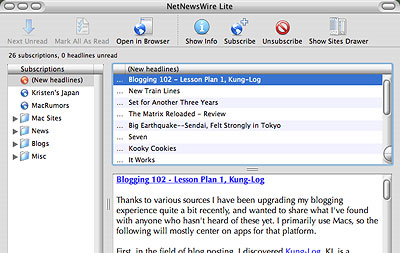
Another recent find for me was an RSS Feed reader, NetNewsWire Lite. I found this program by checking my web site statistics. Naturally, two months after I started it, I’m interested in how this blog is doing, whether or not it’s being read. So far this month, I have some 400 unique visitors, not bad for a startup. A lot of it is thanks to joining the Japan Blogger’s Webring, a lesser but substantial number of hits coming from search engines.

When scanning these stats, I found that one of the biggest referrers was ranchero.com, and when I went to the page, instead of finding a link to my blog, I found it was a site for some software called NetNewsWire. After looking at it, I found that I might want to use this thing.

Some web sites, not too many so far, produce what is called an RSS Feed (“RSS” usually stands for Really Simple Syndication,” though other names have been used) using XML code. This feed effectively allows other sites or applications to grab the web site’s content and display it dynamically. For news readers, this means that you can view the web site’s content in the reader, or at least see an excerpt and follow a link to that web page.

How the app works: First, you subscribe to a particular site’s RSS Feed. If a site provides such a feed, there will usually be a link to it, most often titled “syndicate” or “XML.” Copy the URL within the link to the clipboard, then go to the reader, click the “Subscribe” button, and paste. If you think the site provides a feed but you can’t find a link, just click “Subscribe” and type in the base URL for the site; the reader will search for the feed and find it if there is one.

Once you have subscribed to whatever sites you desire, the reader will then, on a regular basis, check the site for changes. If it finds a change, you are notified and can view it. The Mac app NetNewsWire displays the number of new, unread articles it finds by showing it in a red indicator box in its Dock icon. This way, you don’t even have to make the app active to see if there’s something to look for.

When you see that there is a new story to check, activate NetNewsWire and click on the site (or folder containing many sites) with the indicator for new stories. If you see any titles that interest you, you can click on the title and read the feed. Some web sites syndicate their entire feed, meaning you can read the entire story, with photos. Most sites, though–especially those who depend on clickthrough ad revenue–will just show you a snippet or summary, and to read the whole article you must go to the web site. But no sweat there, just click on the link right there in NetNewsWire, and it’ll open the page automatically in your default browser (I use Mozilla, BTW, and highly recommend it).

If you want to see a collection of sites with RSS feeds, you can check out the Sites Drawer, a pop-up drawer (a nice but underused Mac OS X capability) which contains many sites waiting to be read, including a large number of blogs. Want your blog included in the app? email to Brent at Ranchero and if he approves of the site, he’ll add yours to the drawer in the next version release.

Thus we see one of the primary benefits of the reader: you no longer have to check each web site on a regular basis. The news reader does it for you. One drawback is that few web sites have RSS Feeds yet; we’ll have to see if that improves in the future.

NetNewsWire Lite is freeware; a more feature-rich version is available for $40 as downloadable software. For those of you with Windows PCs, check out Newz Crawler ($25), Feedreader, or Syndirella, both freeware. For cross-platform, Amphetadesk is also free, and has both Mac and Windows versions, for users with current and older OS versions.

Categories: BlogTech Tags: by

Blogging 102 – Lesson Plan 1, Kung-Log

May 31st, 2003 Comments off

Thanks to various sources I have been upgrading my blogging experience quite a bit recently, and wanted to share what I’ve found with anyone who hasn’t heard of these yet. I primarily use Macs, so the following will mostly center on apps for that platform.

First, in the field of blog posting, I discovered Kung-Log. KL is a donationware Mac app that allows you to create blog entries more easily than by using Movable Type’s web page editor. This is not to put down MT’s editor–it is very well made and easy to use. Nor is it to say that KL allows you to control all aspects of your site, it can’t. But when entering the daily blog, it is a lot easier to use an independent app than to depend on a web page interface. It’s kind of like the difference between using a web page email account like Hotmail and using an email client like Eudora (try their beta version 6, it’s working well for me so far); the client is much faster and more flexible in many regards. So is KL.


With KL, you initially enter your blog’s URL, the user name and password, and it logs in automatically from then on. When you use the app, a nice Aqua-esque window with toolbar comes up, with a drawer for recent posts if you want to edit. Just type in the entry and its title and click on the Post button, and that’s it. But the real benefits come from the HTML coding and the image uploading.

There is an HTML menu in the toolbar that automatically inserts HTML code around whatever text you’ve selected. You can add code selections yourself, or modify what’s there; it even allows you to add hotkey commands. For example, I’ve added the hotkey “COMMAND-U” for adding a link. The link feature automatically grabs whatever URL is in the clipboard (that you’ve copied with CMD-C or -X) and puts it into the link.

Even better is the “Upload File” feature. When activated, a window comes up, and you just drag your photo into a frame in the window; a preview of the photo appears, and there are prompts for “arguments” at the right–for example, what kind of border and spacing, alignment, and so on you want. When you click “upload,” it not only uploads the file (a la FTP) to your blog’s image folder, but it also adds the HTML code to link to the photo within the blog entry! Very cool stuff.

You can save drafts on your computer on the fly to avoid having your work wiped in case of a crash (faster than on the web page). You can edit recent entries, ping URLs, and even have KL automatically add to your post what music you’re listening to in iTunes when you post. And there is spell-checking, a very badly missed feature in the web page editor. The program also allows “previews,” but they do not show correct formatting; perhaps this will improve in future releases.

That said, I did have a problem, which may or may not have been related to KL. After using it for a few days, I suddenly started getting error messages when I tried to post, saying “permission denied.” The error messages even prevented me from posting via the web page interface; I could save files and edit them, but I was denied permission whenever I tried to rebuild the indexes so the changes would appear on the site. I was able to get past the problem with a few fixes suggested at the MT forums. For all I know, the errors had nothing to do with KL, but they happened when I was using KL. The errors were easily fixed, though.

In the meantime, it looks like a good app, and I would recommend it to anyone looking for these features. I plan to keep trying it out, and hope it’ll prove itself over time.

For those using Windows, aside from my sympathies, I would suggest trying W. Bloggar freeware.

Categories: BlogTech Tags: by

And Here Comes the Payoff

May 31st, 2003 Comments off

This coming Monday, a decision will be made by the U.S. government which will decide how the property of the American people will be parceled out to large corporations, a decision that will greatly affect the interests of the American people, and how we receive information that enormously influences the public’s stance on all social and political issues. And if you are a member of the American public and want to have a part in this decision: too bad. The doors are closed, and you’re not allowed in.

It’s payoff time.

Remember how the large media organizations tore into Clinton whenever there was even a whiff of scandal? How they went endlessly on about relatively unimportant issues such as how he “didn’t inhale” and had affairs and then lied about them. That demonstrates how willingly, even enthusiastically presidents were hounded by the press in light of a potential scandal.

Remember in the 2000 campaign, whenever Gore, a man with strong character, was caught in the smallest of prevarications, he was widely labeled a liar and a spinner of tall tales in the media, but when Bush was found to have been a drunk driver, cocaine user, National-Guard deserting, SEC reg violator who lied under oath as governor of Texas and showed the worst of character–that the media essentially shrugged its collective shoulders and said, “so what?”

During that election, Gore was often put down by the media and Bush was given every benefit (save for the funny stuff about his speaking skills). And in the crucial days of December in Florida, the media clearly favored Bush–for example, it made big news about the “people of Florida” protesting and disrupting the recount, but went silent when it was revealed they were really Washington D.C. Republican staffers.

It was quite clear to anyone who looked at the overall picture: the media corporations liked Bush and did not like Gore. But why? A conservative media? Not really, it has more to do with a relatively little-known corner of FCC regulations. Currently, there are limits to how many TV and radio stations one person or corporation can own. The reason: so that the media cannot be controlled by one person or a small group of people who could then control what people see and hear. Remember the Frank Capra movie “Mr. Smith Goes to Washington,” where the political machine run by the kingmaker Taylor owned all the media in Smith’s hometown, and silenced any opposing views about him? That caricature is what the current FCC rules are designed to prevent.

Not for long, though.

All the media bias over the past several years is about to pay off. Gore was staunchly opposed to changing these FCC regs, but Bush was clearly in favor of letting the big boys have even bigger slices of the pie. And the large media conglomerates have known that if they want the FCC to allow them to own as much of the media pie as they want, they had better show that it will benefit the president–after all, would Bush want to allow the media giants to own it all if they worked against his interests? The media conglomerates also made sure that the issue did not get much play–only now, at the very last minute,are a few news outlets picking up the story, far too little, far too late, perhaps so they can claim that they “covered the story” before the decision was made. It would not have served their interests to alert the public beforehand.

See these stories by FAIR (Fairness and Accuracy In Reporting) and Truthout.org.

Ironically, activists on both the right and the left are against the new FCC regs to be swept in under the cloak of the gag on Monday. Liberals and conservatives both reel at the thought of the media conglomerates, which could potentially swing to the left or the right depending on the issue or the CEO, dominating the airwaves and sending only a single voice out to the people. Even the NRA is getting into the picture, getting their faithful to send out 300,000 messages to the FCC, fearful of what they see as a press consolidated against free gun rights.

But the political activists and the people are in the back seat on this one–the media lobbyists, with the full weight of media power endorsing the current office holder, have control of the wheel, and it looks like they are going to get their way.

Look for the current 6 television and 2 radio media giants to merge soon under the blessings of the current administration, and expect voices of opposition to be broadcast less and less. So goes the state of Bush’s America.

Categories: Archived Tags: by

Yakitori You Don’t Want to Miss

May 30th, 2003 6 comments

When I first came to live and work in Japan in 1985, I made one of those 24-hour multi-layover flights that was extended even further by a train ride out to Toyama City, in the Hokuriku region, where I would work for the next two years. When I got off the train at the end of that epic journey, I was immediately whisked off by the welcoming committee to have dinner at a place I go to up to this day (literally, I ate there tonight). The name of the place is Akiyoshi, and they specialize in yakitori.

Akiyoshi is a national chain with 127 outlets, but it originated in Hokuriku–Fukui prefecture, to be exact. Toyama, despite being out in the boonies, was close to Fukui so the city had three branches (the prefecture now has 15). It became a familiar haunt, and no less so two years later when I moved to Tokyo. Originally, I lived in Suginami ward, in Asagaya, so the Ogikubo branch was practically next door. Tokyo now has about a dozen, including Ikebukuro, Kanda, Tokiwadai, Gotanda, Nakano, Shibuya, Takadanobaba, Ginza and Ueno.

My personal preference is still for the Ogikubo store, not just for sentimentality or because the staff knows me going on 16 years now, but because the atmosphere and portions are the best there. The Ogikubo store is one of those places where everyone shouts greetings when you walk in; in fact, any order given is another occasion for the staff to shout to each other. Gyuu-hire, itchou! Hai! It’s mostly bar seating, and generally a more convivial atmosphere than most eateries you might go to.

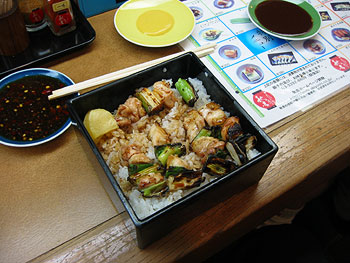
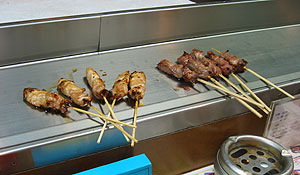
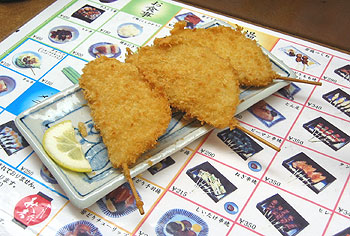
But the food is the best thing about it. More than a dozen varieties of meat-on-a-stick, my personal favorites being negima, gyuu-hire (filet beef), and the standard wakadori. If you want a great meal starter, you can order tori-juu or hire-don, both square lacquer boxes filled with rice and either chicken or beef (cooked on the stick, presented on the rice off the stick), adorned with the house tare sauce. The chicken dish is pictured at the top of this post.

You can also get a variety of other meat and/or vegetable dishes, and beer and chu-drinks are available on tap. The menu for the store can be found here, on their web site. The full on-line menu is in Japanese and has only a few photos; a menu with links to more photos but to more limited dishes can be found here. They also have menu placemats, which you can see under the onion fry dish at the bottom of this post.

That is one of my favorite side dishes: tama-negi furai (pictured at bottom), or onion fry–slices of deep-fried onion in batter. Mmmmmmm, baaaatterrrr…

Even better is the house sauce–a garlic flavored tare sauce, accompanied by a spicy Chinese mustard sauce, and special sauces for additional dishes.

What’s more, it’s cheap, as far as yakitori joints go. The 5-stick wakadori plate is 350 yen. I usually get a tori-juu (5 negima on a bed of rice), two orders of wakadori (5 sticks per order), a tama-negi furai and a couple bottles of Coke, and the damage comes to 1,920 yen.

Do yourself a favor, head on over to one of these next chance you get. The Ogikubo shop is out of the West exit of JR Ogikubo station. Once out of the ticket gate, turn right and go down the stairs. When you reach the shopping street, turn left, and go about 20 meters; Akiyoshi is on the left, past the Yuu-topia bath house.

Categories: Focus on Japan 2003 Tags: by

A View from Inagi

May 30th, 2003 Comments off

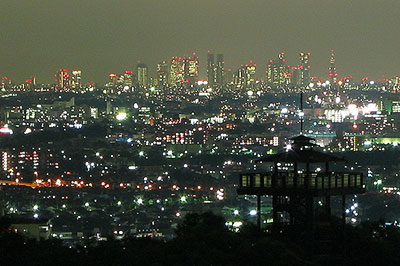
A 15-second time-lapse photo taken from the top of my apartment building (10th floor) at nighttime. The foreground is an observation tower atop a hill nearby my apartment building; the background in downtown Shinjuku.

By the way, I hope to have Day 5 of the Spain trip up this weekend… a visit to El Ermitaño Restaurant, on the way back to Madrid.

Categories: Focus on Japan 2003 Tags: by

Shiki no Michi

May 30th, 2003 Comments off

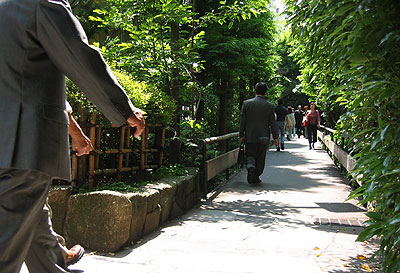
Every once in a while you come across a little corner of Japan, tucked neatly away where you might never have noticed it before. One such pleasant reprieve from the gray maze of central Tokyo is a small road called “Shiki no Michi,” or “Avenue of the Four Seasons.”

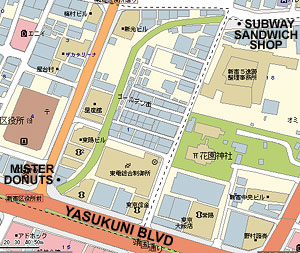
If you work or play in Shinjuku’s east-side “San-chome” neighborhood, you may have come across it. It begins just next to a Mister Donuts shop on Yasukuni Blvd., and cuts across an otherwise not-so-attractive neighborhood to come out just north and east–suitably enough for us expats, right next to a Subway sandwich shop. But the street itself is the attraction, one of those places where you suddenly lose the city and for a short time, you can imagine you’re out in the countryside somewhere. Well, almost. The street is just at the periphery of Shinjuku’s famed red-light district “Kabuki-cho,” and you can spy a few love hotels and other establishments through the few points where the foliage thins out.

It’s great for my co-workers and me, as it lies on the path between JR Shinjuku Station and our college–it even cuts down on our walking time between the two. If you’re ever in the neighborhood, give it a walk.

Categories: Focus on Japan 2003 Tags: by

Self-Serving Self-Service

May 29th, 2003 2 comments

When I first came to Japan, I felt like Michael J. Fox in Back to the Future: I saw a car pull into a service station, and a flock of attendants rushed up to the car, cleaning the windows, vacuuming the inside, checking the oil and water and whatnot. Never happened in the U.S. in my lifetime!

Gasoline in Japan costs quite a bit more than in the U.S.; a gallon goes for about $3.25 by today’s prices and exchange rate. For that much money, you would expect to get better service! But in recent years, the quality of service has fallen somewhat–where you used to see teams serving cars, now it’s just a single attendant, though they will do more than just fill ‘er up. And now we seem to be seeing the downfall of even that level of service.

A few months ago, I happened across the first self-service gas station I have ever seen in Japan. I was quite surprised by it. Apparently, instead of the service guy coming out, taking care of you and then taking the payment, you instead pump gas yourself, and then swipe a card to pay for it. A single attendant stands by to help anyone who needs instructions–which I would imagine happens a lot, as few people here have ever pumped their own gas.

Apparently, self-serve stations have been around for as long as a decade, but they have been quite rare until recently. The photo above left shows one station I spied this morning that is in the process of changing from full- to self-serve.

The problem: the gas costs almost exactly the same! Maybe you get 1 yen or so less per liter (maybe 3 cents to the gallon), but that’s hardly worth the trouble. Not only do the gas companies save loads on payroll, but the self-serve paradigm also encourages users to be station card-holders. You use your Mobile or Jomo company gas station cards to pay with the swipe machine–or else you have to go over to the attendant stand for a cash transaction. Since people will prefer the card, and because they will not want to have a wallet full of cards for different companies, they will be maneuvered into being more monogamous with one company.

Sounds self-serving on the part of the gas companies to me….

Categories: Focus on Japan 2003 Tags: by

Ranting: 9 Months Later

May 28th, 2003 Comments off

9 months ago, I was in my heavily politically-oriented blog mode, before I got Movable Type and all. One of the entries I wrote concerned the then-upcoming war with Iraq. Looking back, it is interesting to see which predictions came true, and which didn’t. Some excerpts, and post-mortem comments:


First is international support. There is none. A coalition is vital to carrying out an armed conflict in the Middle East, and not only is there no coalition, but it appears that at this point, a coalition would be impossible to form.

Well, I got that one right. The “coalition of the willing” was more a joke than anything else. Essentially, the coalition was the U.S. and U.K. Spain was an anomaly more than anything else. Ari Fleischer once tried to fictionalize the coalition’s size by lining up all the “member” nations, and adding up their populations. Of course, coalition “members” included anyone who simply voiced any approval, and almost no “members” gave any actual financing or support. And the population ploy, saying “X millions of people are behind us” was a joke. Spain was a coalition member, but 90% of its population opposed the war. Kuwait was a more active member, but then, duh. Most laughable member: Afghanistan. If the coalition is so weak that you have to include puppet dictators to indicate support, you know you’re in trouble.


The immediately obvious repercussion of the go-it-alone strategy is cost: This war could easily cost $80 billion, probably much more than that. Bush Jr. has already snatched a huge deficit from the jaws of a surplus, and the country can ill-afford to pay for a costly war all by itself. We’re already in big budget trouble, helping to push us into deeper into recession, but a war paid for by the U.S. alone could aggravate the national debt substantially; Bush Jr., in just the course of a few years, could erase more than a decade of red-ink recovery and send us into deficits that would dwarf those of the 80’s.

If anything, this was an understatement.


But the cost would not simply be financial: we would also pay in terms of lost reputation, international respect and influence in world affairs. … Future presidents would be saddled by the body blow to our prestige, likely needing decades to repair the damage and to rebuild worldwide confidence and trust. This kind of irresponsible action could remove us from our already precarious seat of world leadership.

This certainly seems to be coming true.


…there is also the specter of Armageddon rising in the Middle East as a direct result of a U.S. invasion. Already relations are tense, not helped by the confusion and neglect that the Bush administration has used to turn a region grasping for peace into a region torn by escalating conflict and little hope for even a cease-fire. But if the U.S. should invade with opposition from the Arab states, the hope for any peace of any kind will die a swift death. Contrary to the rosy the-Arabs-will-love-us-for-saving-them pipe dream that Cheney has been hawking, the Arab people do not and never have reacted kindly to U.S. intervention, even when their governments allow it; should we go in with everyone opposing us, tempers will flare further still. … Cheney argued that “extremists in the region would have to rethink their strategy of jihad.” Is he truly so utterly naive?

“Armageddon” may have been too much, but again, the jury is out on this one–the region is still unstable, more so then it was before. Certainly the Israeli-Palestine situation has not been helped, despite White House predictions. And I was right on the nose about the reaction of the Iraqis; aside from (a) Kurds, who were a sure thing, and (b) Shiites, who benefitted but still hate us with a passion, the celebrating you have seen was largely engineered by the military and the media. Cheney’s jihad-rethinking mentality has certainly proved wrong.


And let us not forget the Israeli part of the equation: an attack by the U.S. would, without question, be answered by Iraq with missile attacks on Israel, just as it was in the Gulf War. The difference will be that this time, Israel will not sit back and take it without acting–they will retaliate, and that retaliation will bring outrage and reprisals from the Arab world.

I’m glad to say I was dead wrong on that one. Why, I have no idea.


Cheney recently asserted that “many of us are convinced that Saddam Hussein will acquire nuclear weapons fairly soon. Just how soon, we cannot really gauge.” In other words, there is no evidence whatsoever that Iraq is even working on nuclear weapons. Furthermore, we have no data to substantiate the claim of a current nuclear program in Iraq. …we would be naive to presume that Cheney or anyone else spouting that rhetoric is not lying through their teeth. Remember the old admonition: “fool me once, shame on you; fool me twice, shame on me.”

Boy, was I right on that one. But I didn’t go far enough–like almost everyone else, I believed that Iraq had bio- and chemical WMD stockpiles. Got fooled on that one.


Isn’t this a blatantly obvious pattern? Bush Jr. uses whatever country is best at hand to frighten the American people, and hypes them as a soon-to-be-nuclear terrorist state on the verge of destroying America. This is not done to protect America, it is done to fool the American people into letting Bush Jr. get what he wants. With North Korea, it was to get SDI pushed through; with Iraq, it is to restore his wartime popularity. Now SDI is still being paid for with your taxes (forgot about that, didn’t you? It’s not gone, it just went secret so that you don’t hear about its failures any more). Will you allow yourself to be suckered again?

Now it’s Iran, harboring Al-Qaida and building nukes!. Gee, where did I hear those accusations before? And, hey, don’t pay any attention to the deficit, education, environment, recession, joblessness, corporate scandals and all those other issues hiding behind the curtain. Pay attention to Iran! Dubya’s got a brand new bag!


And then we come to the end game: what is the exit strategy? How long will it take? How many Iraqis (whom the Bush Jr. administration claims to be acting to benefit) will we end up killing? How long will our troops be there? How deeply will we become involved in rooting out everyone there who violently disagrees with our occupation? And how will the nation-building succeed? What guarantees do we have that the moment we extract ourselves, another Saddam Hussein won’t pop up again and bring us back to square one? As far as I can determine, not a single one of these questions has been answered.

And still they haven’t been answered. But Halliburton is doing great in the end game.


And do not forget to ask, “why now?” Why the immediate interest in invading Iraq at this specific time? Why not anytime since the 80’s, when we knew Iraq had developed and was using chemical weapons, and later when we found that Hussein was trying to build biological and nuclear weapons? Why not any time since the Gulf War? Why not when Bush Jr. first took office, and knew as much then about Iraq as now? Why not just after 9-11, when world support was stronger? What is the sudden emergency in the late summer of 2002? The truth of the matter is, there is no more reason to invade Iraq now than there has been in the past decade and more. The only likely reason for the timing is, as I have argued before, because Bush Jr.’s poll numbers are dropping and an election is coming soon.

Karl Rove would probably tell us that it’s not yet time to push for war with Iran or Syria. Wait until mid-year 2004; that’ll both shut up the Democrats and raise the president’s poll numbers just in time. In the meantime, lay the groundwork. Hey, it worked in 2002.

I made some errors in prediction, notably how the region would immediately explode, particularly involving Israel. But overall, I was pretty accurate.

Not that it’ll make any difference….

Categories: Archived Tags: by

Who Is This Mr. Pocari, Anyway?

May 28th, 2003 Comments off

I am certain we have all seen this before, but it’s always good for a chuckle. The, of course, there is the traditional, infamous “Calpis” drink. And, interestingly, Coca Cola’s own slogan campaigns. Remember “I Feel Coke”? And now, it’s just “No Reason.” Gotta agree, it seems like they don’t have any.


Categories: Uncategorized Tags: by

It Works

May 28th, 2003 Comments off

OK, I am officially using Kung-Log as my blog editor. It makes it a LOT easier to upload photos; you don’t have to use an FTP. Also, it allows for some customization and previews. Even has a spell-checker–I was getting tired of doing that manually. Cool enough.

Categories: BlogTech Tags: by

Kooky Cookies

May 27th, 2003 Comments off

Part of the reason I am posting this is because I want to test some new blog posting software I’m using, called KungLog. The software can upload photos if you are using Moveable Type, so let’s give it a try.


An unfortunate name, and an even more unfortunate shape, given the name…


For those who prefer to avoid Air Jordan…


Hey! Not funny! Well, OK. Funny.

Categories: Focus on Japan 2003 Tags: by

Seven

May 26th, 2003 Comments off

Now they’re saying it was a 7.0 quake on the Richter….

Hi-Net is now reporting magnitude 7.2 on the Richter, NHK is still saying “at least 7.0,” Tenki says 7.0. No tsunami worries, they say.

Considering that power, it seems like there was relatively little damage–but we’re just seeing what’s in Sendai and Morioka–it could have hit some smaller towns very hard, and we just don’t know about it yet. Phone services are still not working perfectly in the area, it seems.

New Hi-net data is shown below:

Categories: Uncategorized Tags: by

Big Earthquake–Sendai, Felt Strongly in Tokyo

May 26th, 2003 1 comment

Earthquake, 6 on the Japanese scale of 7, just hit Sendai–and NHK shows fires going in the city, shown from a helicopter camera. I am really not too surprised–I am roughly 400 km from the epicenter, and that was the biggest quake I’ve felt in Japan so far. And I’ve been here for 12 years.

Tenki.jp and Hi-Net are currently overloaded.

More as it comes in.

UPDATE: OK, those two web sites I mentioned are back up. Hi-Net is showing a 6.7 quake on the Richter scale.

To the right is a partial image from Tenki.jp.

I felt it right after coming home from shopping, and man, that was strong, not to mention long-lasting here. It also obviously far-travelling–immediately after it died down, I turned on my TV, and they were already showing detailed maps showing the magnitude all around Tohoku. That means they had time to get the graphics up, which means the quake hit Sendai some minutes before it must have gotten to Tokyo.

I called up my brother, who also lives in Tokyo; he picked up his phoen and immediately said, “No, I didn’t feel anything!” (Joking, of course.)

At right, I am adding a picture of all recent quaked in the region; the green star is the big one. Below is a table with info on the quake. Both these graphics are from Hi-net.

Categories: Uncategorized Tags: by

The Matrix Reloaded – Review

May 25th, 2003 2 comments

Note: For those who are looking for a detailed look at Revolutions, you can find my standard review here, or go look at my Matrix Revolutions: Major Spoiler Review.


First off, this will not be a spoiler review, as I don’t want to have only an entry which gives out secrets of the film, which could hurt the experience for those who haven’t seen it. But if you want spoilers and a deeper discussion of the film, the follow the white rabbit–er, link–at the end of this entry. This review does tell you a bit about the film, but nothing, I hope, that diminishes the experience. On the contrary, the film can be confusing, and I hope this review could help you through those parts, without giving anything away, so you can understand the whole much better.

One good thing to keep in mind when seeing “Reloaded” is to understand that it is a bridge, a middle act, and ends with the words “to be concluded.” There’s a lot of stuff which we don’t learn in the movie, and which is still a mystery. So don’t expect to understand everything.

At the end of the first movie, we had established several points about the universe these characters live in: that there was the matrix, and there was the real world, and that the matrix was constructed to keep humans functioning while acting as an energy source for the machines. Also that the first iteration of the matrix was a paradise, but it failed, as human “programming” could not accept such a perfect world. This is reiterated in “Reloaded,” and may or may not be of some relevance–depends on where the Wachowski brothers take us in the third film, “Revolutions” (more discussion on this in the spoiler review).

We also learned that the matrix was a virtual world, a program; even with this spelled out, and with gravity rules broken in due kung-fu fashion, it was difficult to remember at times; in “Reloaded,” however, you see more computer-world stuff coming to life in the story. The world inside the matrix will have more real-world “rules” broken than in the last film, more computer-hacker tricks played out by people throughout the film.

“Reloaded” picks up some time after the first film ended (I believe it was supposed to be six months later, but I’m not sure). It begins, actually, with a dream sequence Neo has: Trinity breaks into a facility, and then is chased by an agent–straight out a window of a high-rise, down to the street, and on the fatal plunge, shoots her dead. No spoiler, that; you see it in the first few minutes. It’s a dream. The question is, does it come true.

Neo awakens, and he’s there, in bed, with Trinity, and she sees that something is troubling him, but he can’t tell her. Afraid that she might see it as inevitable, perhaps, and that view might contribute to her death. Soon they dock and all enter the matrix, for a meeting between ships’ captains, where they discuss the plot mover for the film: a quarter million machines, “squiddies” as they’re called (you saw them attack the Nebuchadnezzar at the end of the first film), are boring down into the earth. There is one machine for each man, woman and child in Zion. Everyone will be killed.

The captains are told to all return to Zion for a final battle by Lock, commander of Zion’s fleet of hover craft. Morpheus, however, convinces the captains that one ship should stay at broadcast depth so that the Oracle can contact them, as foretold by prophecy. This infuriates Lock, who doesn’t believe in the Oracle, or in Neo; he just sees that Morpheus disobeyed his command.

So all return to Zion, the last human city, where all are told that all could be destroyed within a few days’ time–but not to fear, we will prevail.

That, of course, is yet to be seen, as so much of what we accept about this story is called into question in this second installment.

Various review of the film have faulted it for being lesser than the first film, especially in the area of meaning and depth. This surprises me, because in my view, the ideas become deeper and more interesting than before. There are still plot twists–perhaps not on the level of the first film when we discover that our real world is a simulacrum–but still, the twists and turns are there, and obviously there are a few mind-blowers yet to come.

But philosophy is still at the heart of this movie. For the first film, the themes were faith, love, fate, and the question, “what is real?” Those themes are still present in the second film, but new themes enter the picture: control and choice. These come in as the age-old question of free will vs. predetermination. Are our fates escapable? Will Trinity die as foreseen? Are we capable of making such a thing as a “choice”? This film asks these questions, but the Wachowski brothers are waiting until the final film to tell us what they believe.

In fact, the ideas of choice and control did enter into the first film, but only in passing. When Morpheus first explains the matrix to Neo in the loading program, he notes that the purpose of the matrix is to control humans while they are used as an energy source. He does not elaborate on the theme, however. Also, when Neo meets the Oracle, she speaks about predetermination and choice, in the form of the vase falling, and as the choice Neo would have to make about saving Morpheus.

I believe that many people’s idea of this film not being as “deep” as the first has to do with those questions being unanswered for the moment–as I said at the beginning, it is important to remember that this is the middle of the story and is incomplete. The “long, boring parts” these same critics talk about though, are where the depth comes in. Discussion and interplay concerning fate and predestination.

The characters in the film get perhaps less development than they got in the first film, and certainly less development than the philosophy and the universe of the Matrix itself. Where in the first film we saw Neo gain faith in himself, here Neo just seems to walk through and do what is expected of him, albeit with cooler sunglasses and nifty superpowers. Trinity also stays where she left off, in love with Neo and determined to do whatever she can to keep him safe, not to mention hers (in an interesting scene with Persephone, wife of a matrix power dealer). Interestingly, Morpheus has a better development curve, though we only see it starting: something very important to him, vital to his perception of reality, begins to shake loose.

Other characters pass by and through, but none with the depth or captivating character of the three principles. Commander Lock, in charge of Zion’s fleet, comes across as one of those unnecessary characters that exist only to throw roadblocks into the way of the protagonist. He and Morpheus are in a love triangle with Niobe, captain of the Logos, former lover of Morpheus and present lover of Lock. Niobe seems like a central figure and shows up to be useful from time to time, but doesn’t really do much as a character. Also in Zion is council member Hamann, who complements and offsets Lock. Hamann doesn’t entirely believe, but he’s willing to give Morpheus a chance. He also offers an interesting take on the relationship between men and machines.

Link is the new crew member, replacing Tank. Some people ask, “where is Tank?” He was one of the survivors from the first film… but in this film he is declared dead (perhaps complications from the shot Cyber took at him?). Link, in any case, is his replacement, and also doesn’t do much that any other character couldn’t do. He is married to Zee, who is Tank and Dozer’s sister, and worries that her husband may suffer their fate.

Some characters fly through the story, like The Kid. A young guy, who we hear unplugged himself from the Matrix, but idolizes Neo. We get introduced to his backstory and wonder, “what was that about? Who is this guy?” Well, you’ll know if you get “The Animatrix” DVD, a Japanese-produced set of cartoons which fill in backstory for the movies. Also in The Animatrix is the “Flight of the Osiris,” a tale about how Zion gets informed of the digger machines; we hear it referenced in Reloaded, but the full story is elsewhere.

In the matrix itself, we see several new faces. Merovingian, a hedonist and broker of information and power in the matrix, who both writes software for it and keeps various discarded programs; Persephone, his aforementioned wife, a temptress and somewhat tragic figure; the Keymaker, kept prisoner by Merovingian, and possible ‘key’ figure in taking down the matrix. Then there are the twins, bodyguards to Merovingian, two all-in-white programs with trademark razors, who have the ability to become insubstantial, materially speaking, so they can move through floors, walls and windshields, and avoid bullets and blades.

We also meet the Oracle again, now with her bodyguard Seraph, who comes to know Neo by fighting him (I think it was just an excuse for another fight, though). We see the Oracle as being the same as before, but now in an absolutely different light.

And then there is the ubiquitous agent Smith, who really gives new meaning to the word “ubiquitous” in this film. Thought destroyed by Neo in the first film (though he was supposed to be “a” Smith, as I recall), he returns with a vengeance, not to mention a free pass at Kinko’s, it would seem. Copies of Smith abound; he claims that when Neo entered him, something of Neo transferred to him. We have yet to see what this may be, or what Neo may have gotten from him.

But there is one more character, floating in the background, but very important to the story: Bane. It’s easy to get confused about this character, because it’s easy not to recognize him from scene to scene. He looks like a background character, but is not. We first see him in the matrix, sending his partner through the land-line phone to get word from the Oracle to Zion. Then he goes back to the real world–sort of. Look for him, later on, in a hand-cutting scene, then trying to get his ship’s captain to go up to help Morpheus, and then at the end of the film. But pay attention to that first scene where he sends his friend through with the Oracle message. It comes right before one of Neo’s dream sequences, so it’s easy to dismiss as a dream; but what happens there is not a dream, and is central to the plot. So watch for it, and consider it.

Those of you who don’t care as much for the philosophy or the people, but would rather get awed by the action and special effects–you won’t be disappointed. Astounding fight sequences, a chase sequence to end all chase sequences, explosions, computer graphics… they’re all there, squared and cubed. I thought Neo’s Superman bit at the end of the first film was too much, and gave him too much power; I thought it would limit the possibilities in the following films. I was wrong. It is nicely integrated here; he can do “his Superman thing,” as Link puts it, but is hardly omnipotent.

All in all, I was duly impressed. The story, the dialog, the action, the effects, all were as good as one could hope. But as I started out saying, it is the middle of the story. It needs an end. So final judgment will have to wait… until November 5th (Nov. 15th here in Japan).

Oh, and don’t forget: at the end of the credits (quite a few minutes of very loud music, by the way), there is a teaser trailer for “Matrix Revolutions.” That’s why so few people are leaving the theater.

Images copyrighted by Warner Bros., Inc.

To see the spoiler review, click here.

Categories: Uncategorized Tags: by

Set for Another Three Years

May 23rd, 2003 Comments off

Got my new visa today. Another three years taken care of. Perhaps I’ll apply for permanent residency next time…

I understand that they’ve closed both the Otemachi and Shibuya immigration offices, and have consolidated them in Shinagawa. Too bad–the Shibuya office was cool, and both were relatively near convenient train stations. The Shinagawa (technically Minato, but it’s closest to JR Shinagawa, which ironically is also in Minato) building is in a former tax agency building, and I can see why they moved. Right near the airport (must be noisy), and smack in the middle of a landfill island, a long walk from the station, not close to where anyone I know lives. I hear it’s a good and efficient office setup, too bad the location stinks.

But since I live in the general vicinity of Tama, I am able to use the Tachikawa branch office. A lot closer and more convenient, but pretty small. When I went recently, I got a number 40 and 25 times (respectively) behind the number being served, and both times it took about an hour and a half to get helped. But part of that is because I come so late in the day, a side effect of my current schedule.

At least now they hand out three-year work visas. Used to be just one year per, and you had to go through the whole rigmarole all too often.

You also have to wonder, why they heck can’t they have a cash drawer instead of making you go out to a post office to get their revenue stamps?

Categories: Uncategorized Tags: by

New Train Lines

May 23rd, 2003 1 comment

On December 12th, 2000 (12/12/12 on the Japanese calendar), the Teito Rapid transit Company opened Tokyo subway line #12, later dubbed the Oedo Line. This was a bit of a deal for me and my school because one station on the line opened up pretty much across the street from our school doors; before then, one had to make a 12- to 15-minute walk from any one of 4 or 5 more or less equidistant train stations. On cold, hard-raining days, that makes a world of difference.

The Oedo line is a loop line ranging from Shinjuku to Tsukishima to Ryogoku and Iidabashi, with a tail heading out to Nerima. Apparently, the line will be extended from Nerima out to Oizumi Gakuen at some point in the future.

What few people know is that Teito isn’t taking a break; as they finished construction on the Oedo, they had already started on yet another line, lucky number 13. This will be a north-south line, connecting Ikebukero with Shibuya, going along underneath Meiji Blvd., more or less. Already a small bit of the line exists, running from Kotake-Mukaihara to Ikebukuro along the Yurakucho Line. Stops will include Shinjuku Nanachome (right under Oedo’s Higashi-Shinjuku), Shinjuku-Sanchome, Shin-Sendagaya, Meiji Jingu-mae and Shibuya. The line will extend farther north into Wako City, Saitama. You can see a subway map, in English, which includes it, albeit in a small and general way, on this page, or a more detailed map in Japanese at Teito’s home page. Also, on the same site, this page has very detailed maps of each of the stations along the new line.

If you travel along Meiji Blvd. In Shinjuku, then you have seen the construction going on down its length. I have yet to check if the work extends up to Ikebukuro or down to Shibuya, but that would make sense.

If you look at the signs accompanying the construction, you will see the date of November 14, 2004 (Heisei year 16) as the projected end date for construction. Alas, the line itself will not open until 2007, four years from now. Even at that, don’t get your hopes up–the Oedo line was slated to be finished a few years before it actually got finished, so who knows. For me, it just means that I get a station on yet another line near my work. Cool.

You may have noticed, by the way, this new line is coming at about the same time we might expect the new residential towers to be completed after they finish the archaeological excavation next door. That, and several other large construction projects are going on in the area. This place stands to really become a new crossroads for the area.

By the way, there are other rail extension plans slated for the future, including an extension of the JR Keiyo Line from Tokyo out to Mitaka; it would run in a tunnel underneath the Chuo Line, kind of like an alternate line to relieve congestion on the Chuo. Construction is slated to begin by 2015, so you can tell your kids about it.

Categories: Uncategorized Tags: by

Whew

May 23rd, 2003 Comments off

Partially because I don’t trust CNN anymore…. Further and more detailed confirmation that the FEIE is going to stay with us:

http://www.iht.com/articles/97021.html

Categories: Uncategorized Tags: by

Umm, OK….

May 22nd, 2003 1 comment

Saw this on the back of a bus in traffic today:

One that I saw a while ago and was unable to photograph: a mover’s truck driven by a tough-looking guy, which on the side proudly sported in large letters, “MOVING MY STAFF.” Seriously.

Categories: Uncategorized Tags: by

Very Good Bizarro

May 21st, 2003 Comments off


See the comic at this site.

Categories: Uncategorized Tags: by

FEIE Repeal Nixed!

May 21st, 2003 Comments off

Thanks to Brian for bringing the good news–Congressional leaders, meeting to hash out the respective Senate and House tax cut plans, have killed the proposed repeal of the Foreign Earned Income Exclusion. CNN reported:

In a significant concession, House leaders agreed in principle to accept some, but not all, of the so-called “offsets” needed to bring the tax package down to $350 billion. Those offsets are effectively tax increases. The group also agreed to kill one particularly controversial offset, the elimination of $32 billion in tax breaks for overseas workers.

So you can file your 2555 and get the $80,000 exclusion in April ’05 and forward, as usual. Crisis ended.

Categories: Archived Tags: by