
Cassini at Iapetus
One of my favorite moons in the solar system is Iapetus, and the Cassini probe just made its closest flyby of the moon a few days ago, at the end of 2004. Iapetus is an alluring moon because of a fascinating surface feature: an incredibly high-contrast swath of blackened material over much of its surface. Look at the first image here: it looks like you are looking at the shadow side of the moon, but that is a full-on bright side view; the “shadowed” areas are the dark swath I mentioned.
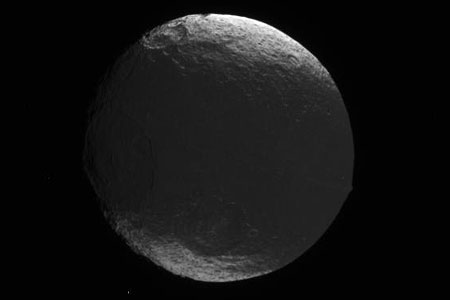
Other features show themselves at this distance as well: note three very large impact craters, the largest located on the left edge. Also note a ridge on the middle right that leads to a small visible rise on the limb of the moon (see below). There will be some talk about whether the ridge is related to the dark material, which is as black as coal.
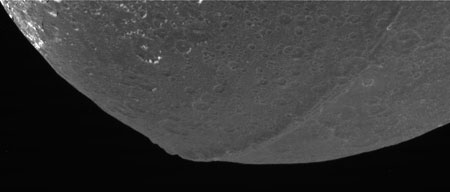
The contrast can be seen even better in this time-lapse image, taken of the dark side of the moon, brightened by the light side of Saturn.
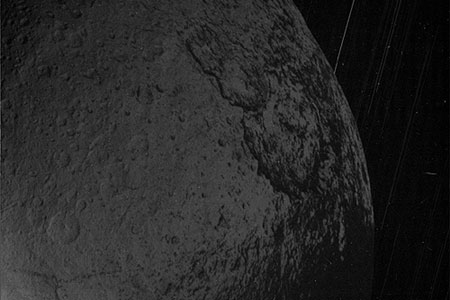
There is also this image of one of the large craters, caught very nicely in light and shadow.
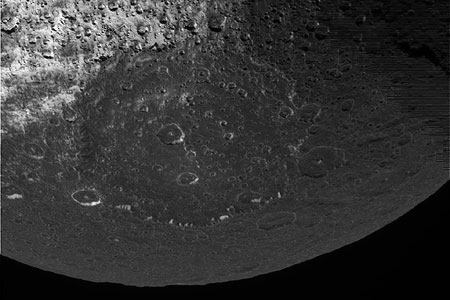
Cassini also just released the Huygens probe, a package that will, in ten days, fly into the atmosphere of Titan (the largest moon in the solar system, and the only one with an atmosphere) and perhaps give us some astounding data of the satellite close-up.
So far, NASA has been just stellar this year, with the energizer-bunny Mars rovers (images all available here) which have so far outlasted their 90-day lifetimes by nine months, and now the Cassini probe doing so spectacularly well, imaging the Saturn system. We need to hear more praise for this government-agency-that-could.
The Cassini probe can be followed at CICLOPS (more of a diary of events) or at the European Space Agency, but the best page is at NASA, with a great image library, including the latest, unprocessed raw images (which NASA has been publishing from all its missions) in a searchable database. Cool.