
Akemashite Omedeto Gozaimasu
In translation, the title of this post means “Happy New Year” in Japanese. When I first came to Japan in the mid-80’s, I was taken to a shrine for New Year’s, and since then have always preferred this place at this time. Every year, I try to make a point of going to a good local shrine to participate in the goings-on; I simply enjoy the atmosphere very much. Not a crazy party atmosphere, but a quietly festive neighborly get-together of strangers for a unified purpose, everyone friendly and enjoying themselves.
This year was also special because it was the first time in three years that I have been able to make it to the local shrine. As you may recall, two years ago, a severe nosebleed kept me over in the U.S. for an extra week and I missed the proceedings here. Last year, a broken foot saw me back in Japan on time, but unable to go out and do anything–especially to climb the steep stairs of the shrine. So this year was the first time in a long time that I was able to get back into the action.
Visiting a shrine or temple on New Year’s is called “Hatsumode,” literally “first visit to a temple.” It is usually done anytime in the first three days of the year, though right at midnight on New Year’s is Prime Time, so to speak. One visits the shrine, throws coins in the offering box, shakes the rope with the big bell at the top, and then prays to the spirits (I always say a prayer for my mom). Famous shrines are often swamped; Meiji Shrine, for example, has so many visitors that most cannot even get to the batteries of offering boxes arrayed before the shrine. Most visitors wind up tossing the coins over the heads of those in front of them, causing some in the first row to get pelted with coins. Shrines and temples see their biggest revenues of the year at this time.
Activities at the shrines and temples are also a big draw. Temples ring a large bell 108 times, allowing visitors to take one hit each. Shrines offer a variety of attractions. When I first came to this town, I thought that the shrine atop the tallest hill near the central train station would be the Place to Be. However, when I got there just before midnight (this must have been 2001, I suppose), there was no one anywhere around; I was all by myself at this dark, deserted shrine, albeit with a great view. But then I saw fireworks from another location, and followed them to their origin–and found the shrine that I go to to this day. And that shrine has just about every attraction a shrine is bound to have: fireworks, shi-shi-mai dancers, hyottoko, sake and ama-zake, festival-style food, a traditional Japanese band, and a few bonfires. It’s quite a show.
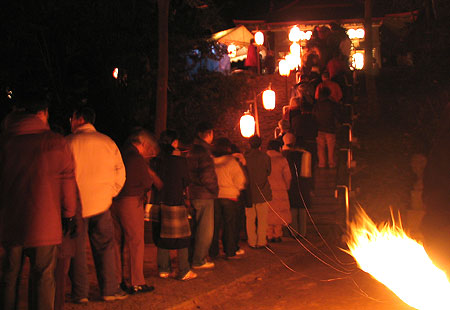
In the image above, people line up to ring the bell and pray; the line winds down the stairs all the way to the bottom. This year, I got there at 11:15 and was surprised to find that I had gotten there before anyone else. Even after waiting for 20 minutes (and getting the very first cup of sake to be served from the barrel), I was still first in line–after the band players, who all got to cut to be first in line.
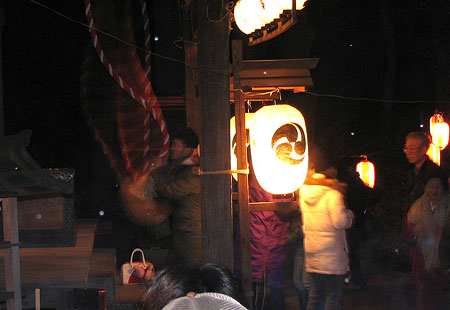
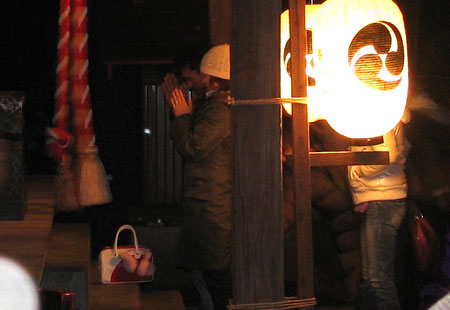
You shake the rope, you clap twice (optional), and you pray. It’s not a big religious thing.
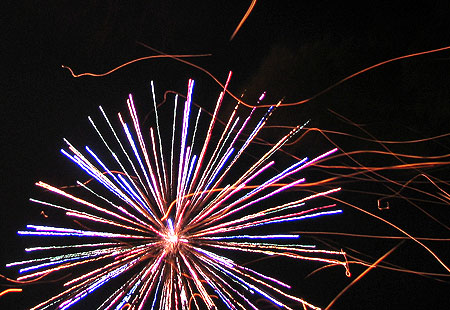
I caught one of the fireworks on film, with embers from the bonfires rising to meet the burst.
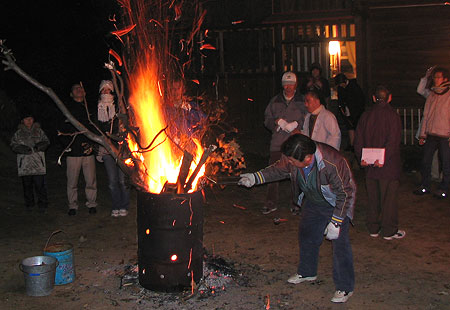
Bonfires are maintained partly to provide warmth (it’s cold!), and to allow you to burn the old stuff you bought the year before, like the wooden arrow I always buy.
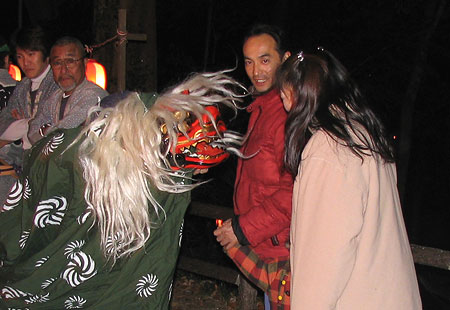
The shi-shi-mai dance; someone inside the big lion’s head goes around to visitors at the shrine. They approach a visitor, who then bows their head. The lion’s head opens, and touches the visitor’s head for a few moments, then the dancer pulls away, bobs up and down and claps the jaws a few times. This is supposed to frighten away the evil spirits about you. It also scares the heck out of half the kids at the shrine, some who go running and screaming.
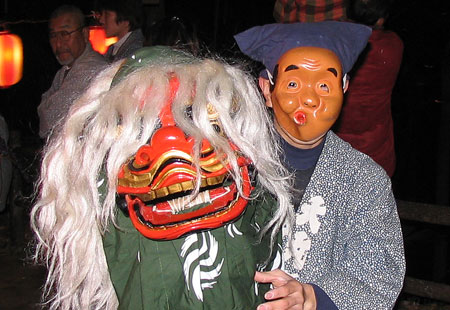
In this case, a hyottoko doubled as the shi-shi-mai dancer. “Hyottoko” is actually “hi otoko,” or “fire man; supposedly, the distorted face comes from blowing through a straw to stoke a flame.
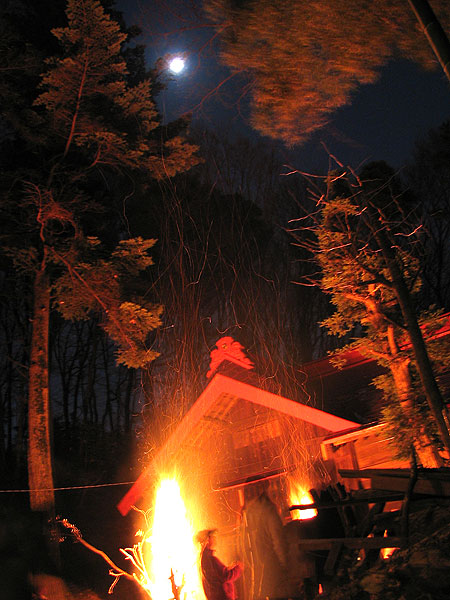
Finally, a nice time-lapse photo showing the scene from the bonfire at bottom to the moon above the shrine and the tall trees.
Happy New Year!
Neat pics! Thanks for sharing.
The New Year’s Kosen-rufu Gongyo meeting of the SGI is always the biggest as well- big enough, in fact, that we split it in two, and do one at ten AM and then same service over again at 1 PM. Aids greatly in scheduling of football watching- or nursing sore heads from the evening before.
This year I’m going to a James Bond-themed party. Tickets were like 50 bucks, but several drinks are included and I don’t really do booze, so my girlfriend will no doubt drink too much. Fortunately, it’s within easy staggering distance of my condo. 😉
Happy New Year!
Paul
Seattle, WA