Archive

Author Archive

The Institution of Marriage

July 6th, 2013 1 comment

There are several reasons people may oppose gay marriage. A predominant reason is that people are at least uncomfortable about homosexuality, or they feel threatened by it somehow, or they simply despise it. However, these are highly subjective; one cannot deny others rights simply because one does not like them. Not to mention that hatred does not play well publicly. Since such reasons will not withstand debate, they are very seldom proffered as the reason to oppose the rights of gay people.

Another common reason is religious opposition. The Bible offers up enough basis for those either inclined to follow prescribed moral values over apparent ones, or who are pre-inclined to dislike gay people, to ostracize homosexuals and/or to define what they do as an “abomination.” Many, if not most, religious groups choose to do so. This is more often cited in public debate, especially by those who believe that marriage is primarily a religious function, or else feel there is enough of a connection to make a difference. However, we live under a set of laws that do not allow religious beliefs to strip others of their rights. As a result, they also will not withstand much public debate.

However, let’s not fool ourselves: the above two reasons are the real grounds upon which most people oppose gay marriage. We all know that these are the primary objections, but they are not the primary argument because, from the objective standpoint of public and legal debate, they are weak and increasingly unpopular.

So instead we hear a different argument: gay marriage will weaken the institution of marriage. That’s the primary public argument forwarded by those opposing gay marriage. Thus, the “Defense of Marriage Act.”

It sounds like it could be a solid reason. Institutions are important. They are the foundations of society. We don’t want to weaken them. And, especially if you are inclined to dislike homosexuality, it sounds reasonable that allowing gay marriage would “dilute” or otherwise diminish the institution. As a result, this is a popular argument, even though it is not a reason most who oppose gay marriage ever would have considered had it not been handed to them.

The problem is, this argument is meaningless. Or, more specifically, it is semantically void in any way that could apply to public legal debate.


First of all, when the “institution of marriage” is cited, which institution of marriage is being referred to? I can think of several: historical, societal, religious, personal, legal, or semantic.

Historically, marriage is an evolving institution, so acceptance of gay marriage does not “weaken” or “dilute” it. This is like strict grammarians making similar assertions about new linguistic practices; what it comes down to is that they don’t like things changing. However, language by nature changes and evolves. So does marriage. As has been pointed out many times, the “one man, one woman marriage based on love” is hardly the classic form of wedlock.

The societal institution of marriage can be defined as what society decides it is. Again, this is liquid and changing, based on what a society wants. Well, our society wants this now. The institution cannot be weakened by allowing what society allows; it can only be weakened if society is not allowed to define the institution as it likes. Ironically, this argument was valid (and I believe was often proffered) before, but now it works the other way, supporting gay marriage instead of defying it.

One aspect of the societal institution could be the idea that marriage is intended to encourage and/or maintain population growth. However, no society I know of requires reproduction or even reproductive ability as a prerequisite for marriage. For the “dilution” argument to work, we would need to ban marriage between any couple incapable of having children. In fact, couples who clearly cannot or do not intend to have children are not even frowned upon in the slightest. Furthermore, as noted below, the arguments that gay marriage will somehow discourage childbirth is ludicrous.

The religious institution of marriage is what a lot of people point to; however, there are some problems. First of all, religious texts, even within any specific sect, do not usually have rigidly defined or consistent definitions of marriage. Second, there are lots of different religions with different ideas about marriage. So, the argument that changing this institution would damage it is already somewhat weak.

However, most religions will consolidate at least current theological standings into dogma. It could be argued that defying this dogma could weaken the institution of marriage within a church, especially with a specific type of marriage that the church has never supported.

The problem with this argument: churches are not being asked to accept or sanctify gay marriage. Therefore, gay marriage does not really affect the internal institution. Still, these people will argue that publicly allowing gay marriage infringes on that institution—but this only could be true if one accepts the idea that religious organizations “own” marriage in our society, a premise which is not valid. Just as one religion may not impose its dogma on all of society, no religion may impose their internal institutions on all others through legal means. Religious people may feel threatened by gays marrying outside of their own institutions, or they may feel that what other people do in light of societal approval affects them somehow; however, that is not a rational public argument.

The personal institution of marriage could be defined as the meaning of marriage to the people engaging in the institution. This also has many variations: it could be for love, for reproduction, for appearances, for wealth, for convenience—for a myriad of personal or legal reasons relevant to the people involved. Since the personal institution is, like the societal institution, defined by what people want it to mean, gay marriage cannot detract from or otherwise diminish this. It does, in fact, add to it.

Only if, as with religious institutions, people feel like they have joined a select membership and are offended by people they do not approve of also joining, can they see the “institution” being harmed. This, however, like the religious objections, is exclusive; they deny other people rights based solely on subjective claims to ownership of an institution which is intended for all. It is, in fact, a stronger argument that gay marriage supports the personal institution, as it makes marriage between all people possible, something previously denied.

Then we come to the legal institution of marriage. This one is simple: like societal and personal definitions, this is what we decide it to be. Gay marriage no more weakens the legal institution of marriage than equal pay for women weakens the legal institution of employment. It’s a null argument.

One odd-man-out argument could be called the “semantic” institution of marriage, that marriage simply won’t “mean” the same thing, and some go as far as saying that changing the meaning of marriage will mean that we no longer have the concept of marriage in its “traditional” sense. That even the meaning of terms like “husband” or “mother” will be diluted and will no longer have the same meaning (see page 53 of this tome).

Forgive me, but this is simply utter bullshit. At worst, it will add new definitions (what standard terms for “two mommies” or “two daddies” may have, etc.), but the long-standing definitions will still be there. If there is confusion over the meaning (“Do you mean your traditional ‘mom’ or your gay ‘mom’?”) terms will evolve to fit.

So, what are we left with? The only “institutional” arguments that have any meaning at all are religious and personal, and the damage done is highly subjective and indirect. Any “weakening” done is purely in the eye of the beholder, and, together with the fact that neither religious nor personal biases are allowed to dictate the legal rights of others, is meaningless in terms of objecting to gay marriage becoming legal.


Secondly, beyond the philosophical questions about the meaning of “the institution of marriage,” one has to ask, “What actual, real-world effect will gay marriage have on those wishing to participate in the institution of marriage?”

This is where the opposition to gay marriage falls apart even more rapidly. The answer to the above question tends to be even less well-established than what the “institution of marriage” is supposed to mean in the first place. Most people who oppose gay marriage prefer to remain vague, even when citing what they believe will be the real-world effects of the change. I have tried to find and categorize these claims as best I can.

Public endorsement of gay marriage will legitimize and therefore increase the incidence of homosexuality. There are at least a few aspects to this argument: whether it is possible, whether it would happen, and whether it would be a bad thing.

The first hinges on a controversial point: that people have a choice in their sexual orientation. To refute this, a common question asked to heterosexuals is, “When did you decide to be straight?” Since straight people make no such decision, it is hard to classify sexual orientation as a real choice. It is, in a sense, like right- or left-handedness: one is more common and the other is stigmatized; one can force oneself to act like everyone else, but it goes against one’s nature to do so.

The argument that sexual orientation is a matter of choice is vanishingly relevant. It’s pretty clear that in most cases, it is not possible for an individual to determine that for themselves. Children raised in gay environments, for example, tend not to be any more or less gay than people in straight environments. And just recently, a significant conservative organization selling a “pray the gay away” therapy not only shut down, but publicly apologized for being wrong and harming people.

That said, it is also apparent that human sexuality is not binary; the evidence seems to point to the fact that, as in most all things, we live along a spectrum, or even a landscape of sexual orientations. Few if any people are “100%” straight or gay. Where we are in that landscape is not variable—we do not slide up or down towards one area or the other. However, someone more between defined areas than most may be able to make themselves comfortable in various camps, bisexuals being one example. However, even this “preference” is not necessarily a “choice”; bisexuals usually report that the preference leads them, and not the other way around.

The only way that the legitimization of gay marriage could have an effect on the incidence of homosexuality, as I see it, is if we have a formative stage in which people who are towards the middle of the sexual spectrum form habits that dictate the sexuality they will feel comfortable with.

However, the legitimization of gay marriage would not have a chilling effect on this; rather, it would create a freer environment in which a person could develop more naturally, with fewer external pressures to conform forced upon them unnaturally.

The only way in which this could be seen as a negative would be if one judged that anything but strict heterosexuality were immoral or otherwise wrong. This, however, is a subjective decision. Homosexuality is not innately immoral. Innate immorality stems from an act being non-consensual and/or harmful to others. Since homosexuality is consensual, and only stigmatization leads to physical or mental harm, it does not fit in that category; instead, it is only subjectively immoral, like taking the name of a god in vain, or walking around naked. Only a circular argument could assert that homosexuality harms people, as the putative reason it harms people is because it is immoral.

To sum up, the development of sexual orientation is a natural process and has no innate moral impact. It is highly improbable that legitimization of gay marriage could increase the incidence of homosexuality, nor would such a thing weaken our intrinsic moral basis as a society or people.

The legitimization of gay marriage would discourage straight people from marrying. This one is simply idiotic. First, while I can think of many trends that were enhanced by gay participation, I cannot think of a single one that was made less popular by gay participation. Second, can you even imagine a straight couple saying, “We’re deeply in love and really want to get married, but since gay people can do it, it’s just meaningless to us”? I mean, seriously.

As I argued a decade ago, it is far more likely that people would be deterred by generic aspects of marriage than by any aspect of gay marriage. Indeed, when people argue against marriage, they cite broken marriages in general. That the social and personal pressures of marriage weigh them down and make them unhappy; that promises of fidelity may not be realistic; that wedlock can make people feel as though their options are limited and possible futures are closed off. They cite unhappy couples, spousal abuse, and other pitfalls of the institution. None of these are caused by, nor would be exacerbated by gay marriage. In fact, many straights will, perhaps jokingly, ask gays if they really want to deal with all the baggage that comes with marriage.

Now, if there’s a gay couple living next door, and a person is so disgusted with having to live near that, then it is only that person’s own bigoted hatred would be the problem, and not the happy couple living nearby. If this causes fewer of these people to have children to whom they would hand down this hatred and bigotry, then I see no problem in that result.

Gay marriage will have a chilling effect on population. How this will occur is usually left unsaid; I can only infer two possibilities, these being the two purported effects listed directly above. That gay marriage could increase the unnatural incidence of homosexuality is bunk, and the idea that straights will stop getting married and/or having children because gays are marrying is, not to put it too lightly, one of the most breathtakingly stupid ideas I have ever heard. To the contrary, it might bring new life to the institution.

Gay marriage is unnatural. See the discussion above. This is also often conflated with the argument of a divine mandate. Homosexual behavior occurs naturally in the animal kingdom, and the evidence that we have on human sexuality right now points strongly to it being a natural phenomenon. And since marriage is a human construct in any case, citing “nature” does not really apply anyway.

Gay marriage will lead to polygamy and bestiality. Another chestnut among conservatives, that allowing gay marriage will open the floodgates to any form of marriage, from group marriages to people deciding to marry chickens and goats. In short, the classic slippery slope and false choice fallacies. This is not a package deal, not to mention that the alternate forms cited as “next on the list” are incredibly more rare than homosexuality. While a few people do promote group marriages (ironically, mostly religious people, and mostly citing biblical example!), nobody is pushing for, shall we call it, “animal husbandry.” This is simply yet another dishonest or ignorant attempt to smear homosexuality with the stigma of very different (usually non-consensual) sexual activities; as with the attempts to equate homosexuality with pedophilia, there is simply no relation whatsoever. As much as I am sure that there are conservatives out there secretly harboring their love of barnyard animals, they will simply have to live with their own self-hate and leave the rest of us alone.

Taxpayers would be forced to subsidize gay marriages. Taxpayers are forced to subsidize all marriages, which has no meaning regarding the type of marriage or the moral status of those involved. We are already “forced” to subsidize marriages we do not approve of; we don’t get to pick and choose which ones we like.

What this argument really is, however, is a new conservative tactic borrowed from the reproductive-rights arena, the “religious-rights” appeal. Direct government subsidy of a single religious group violates the establishment clause; one lesser aspect of this is that individuals are forced to subsidize religious groups with their taxpayer dollars. It has always been a side issue next to the greater issue of government endorsement and state religion; however, conservatives glommed onto this and now claim that anything they don’t like is now barred from receiving any government funding whatsoever, even indirectly. As a result, because Planned Parenthood also performs abortions, conservatives want to ban it from getting government funding for any health services whatsoever.

The use of this in regards to gay marriage is just a rebranding of that same twice-borrowed side issue, and is just as irrelevant as the fact that people without children may resent subsidizing education, or that people who are single may resent subsidizing anyone who is married. We already subsidize sham marriages, and marriages with abuse, and marriages of convenience, and so forth and so on. Tax-funded support of married couples does not equal personal taxpayer endorsement of the morality or lack of same within that marriage.

Marriage is about having children. No it’s not. If it were about having children, we would not allow people beyond childbearing age to marry. Nor would we allow younger people who, by condition or choice can no longer conceive, to marry. There is nothing in the legal or even the religious institutions of marriage that tie those institutions solely to childbearing.

Many more stupid arguments. Just too many to list one by one. Here’s a “top ten” list, including some of the arguments above, as well as: “Schools would teach that homosexual relationships are identical to heterosexual ones,” “Freedom of conscience and religious liberty would be threatened,” “Fewer people would remain monogamous and sexually faithful,” “Fewer people would remain married for a lifetime,” “Fewer children would be raised by a married mother and father,” and “More children would grow up fatherless.” Most of these are supported by bogus “research” (note that the source scrupulously avoids citing any specific research).

Here’s a super-idiotic list, one that really pushes the envelope. He claims that gay marriage “can bring huge financial and emotional stress” (gays will be more able to sue religious bigots for discrimination, thus causing the “stress”), “The health risks are enormous to themselves and others” (essentially he cites HIV/AIDS, as though somehow gay marriage will cause increases in such diseases—presumably gays will otherwise remain celibate and healthy), “The morals of the minority forced upon the majority” (ironically, the opposite is now true), and “Gay Marriage affects people spiritually” (religious folk will be mentally harmed by being forced to see married gay couples). He also makes the falling-birth-rate claim, and as is usual, gives no evidence to support the claim, nor any framework under which such an effect could occur.

If you think that’s as stupid as stupid gets, he gets stupider: Gay marriage “forces government to get involved in changing laws which automatically affect everyone in society.”

Really. He wrote that.

What all of this ultimately comes down to is, we have a heteros-only club, and it would just be ruined if those icky gays got in. But like I said, this does not play well, so we get the “institution” argument instead.


Categories: Social Issues Tags:

Knocking Hillary

July 1st, 2013 3 comments

How do you know Hillary has a good shot at winning the 2016 election? Republicans are scared spitless of her. You can tell by the fact that the continuously declare her candidacy for 2016 dead. They thought that they had her at Benghazi, but that turned out to be worse for the Republicans, as Romney discovered to his chagrin.

Now? Her age.

Stuart Stevens, the top strategist for Mitt Romney’s presidential campaign, declared to an audience of reporters at a breakfast last month that electing Hillary Rodham Clinton would be like going back in time. “She’s been around since the ’70s,” he said.

At a conservative conference earlier in the year, Senator Mitch McConnell of Kentucky, the Republican leader, ridiculed the 2016 Democratic field as “a rerun of ‘The Golden Girls,’ ” referring to Mrs. Clinton and Vice President Joseph R. Biden Jr., who is 70.

First, notice that they don’t say how old she’ll be—69—when she would be inaugurated; instead, they use the word “70’s” and compare her to a man in his seventies as well as fictional characters into their seventies.

And after all, Republicans never nominate old people to office. After all, Mitt Romney was a buoyantly chipper 65. And look at Dubya, he was no more than 54 when he took office.

But then we have Bush Sr., who was 68 when he started his second term. And, oh yeah, Reagan, who was 69 in his first term, 73 in his second. And John McCain, who would have started at 72. And oh yeah, Bob Dole, who would have been 73.

In fact, when the average age of 5 of your last 6 nominees was exactly 69 at the onset of a term they ran for, I don’t think you can go around knocking the leading Democratic candidate for being exactly that age when she would take office.

So, what’s next?

Categories: Right-Wing Hypocrisy Tags:

Yes, There Really Was a Partisan Political Witch Hunt

June 25th, 2013 1 comment

It has been a while since I could get a full blog post out. My apologies; work has demanded my full attention for several weeks now. It hasn’t lessened too much, but I am enjoying a little bit of a breather.

During that time, I abortively started a post on the IRS “scandal” at least a few times. Each time it seemed to be less and less likely that the scandal was a scandal at all. Each time I sat down to address the issue, there was more and more evidence that this, like Benghazi, was indeed a political witch hunt—just by conservatives against Obama, and not the other way around.

The first clue: Republicans said it was a scandal of monumental proportions. This tends to be a fairly good indicator of a non-scandal. Conservatives have been attempting to smear the administration with something since he started running for president. Any time anything comes along, it’s supposed to be The Thing That Takes Obama Down. How many “Obama’s 9/11”s have we seen? How many “Obama’s Katrina”s? How many “Obama’s Watergate”s? And yet, nothing sticks, because nothing was there in the first place. Wishing does not make it so, even though conservatives have been wishing so hard that you’d think it would make it so. When right-wingers start claiming that something is “worse than Watergate and Iran-Contra combined, times maybe 10,” you can rest assured that there’s nothing to it.

The second clue: predictably, accusations by Republicans starting turning out to be bullshit, like the story about how IRS Commissioner Douglas Shulman visited the White House “at least” 157 times, which of course could only mean he was constantly scheming with Obama personally to target conservatives. The “at least” was a cute touch, meaning that it was probably even more than 157 times. It turned out that this “smoking gun,” as Fox News talking heads referred to it, was baloney. Shulman did not visit the White House 157 times. The number refers to how many events Shulman was cleared to attend. In fact, Shulman signed in only 11 times over 4 years. Furthermore, 76% of the clearances were for health care-related briefings.

The third clue: it was revealed that about two-thirds of the groups applying for tax-exempt status were conservative, and about two-thirds of the groups approved… were conservative. As Kevin Drum pointed out, it’s a funny way to run a “witch hunt.” If the intent was to target conservatives and disproportionately shut them down, why did that not happen?

The fourth clue: right-wingers started using the investigation of whether there was a focus on conservative groups applying for tax-exempt “social welfare” status to claim that any IRS audit against any conservative for any reason was only more evidence of Obama’s criminality. Take Wayne Allyn Root, former Libertarian vice-presidential running mate and conservative talk show host. He was claiming to anyone who will listen that he knew all along there was a witch hunt, because he was audited!

Despite the fact that it was a personal audit—meaning that, in fact, the current IRS brouhaha has absolutely no relation to Root’s case. Nevertheless, Root claims he is “vindicated” in his accusation that Obama personally targeted him for persecution.

The fifth clue: after many hearings and enough investigation so that some clear evidence of wrongdoing should have been uncovered, Darryl Issa (whose personal reputation is hardly sterling) issued a statement which clearly insinuated that Obama, through his lackeys, was directing the IRS to attack his political enemies—but when you looked closely, it was clear that Issa had nothing:

… Republican Rep. Darrell Issa said interviews with workers in the Cincinnati IRS office show targeting of conservative groups was “a problem that was coordinated in all likelihood right out of Washington headquarters – and we’re getting to proving it.”

“My gut tells me that too many people knew this wrongdoing was going on before the election, and at least by some sort of convenient, benign neglect, allowed it to go on through the election,” he said. “I’m not making any allegations as to motive, that they set out to do it, but certainly people knew it was happening.”

Now, read that carefully: “in all likelihood,” “getting to prove it,” “My gut tells me.” When you factor all of that in, you are left with, semantically, nothing. Zero. But after reading it, you get the strong impression that this is real and true. After all, “people knew it was happening,” and there can’t be “motives” for something that was not happening, right?

And the excerpts of testimony? They seemed to consist of every time that “Washington D.C.” was ever mentioned, so as to give the impression that D.C., and therefore Obama personally, was involved. But again, a close inspection shows that no one piece of testimony showed any actual evidence of direction from D.C., and that references to “requests” for information from D.C. were likely of a simple procedural nature.

The sixth clue: an IRS manager, this time making clear statements, said that the focus on “Tea Party” groups did not originate from D.C. (not that originating from D.C. in any way means that Obama was involved anyway). And this official claiming it was his idea was a conservative Republican.

That was kind of when the ongoing firestorm of conservative-media outrage ebbed quite a bit.

But today, we have one last piece of the puzzle:

The Internal Revenue Service used the terms “progressive,” “Israel” and “occupy” on internal documents that helped agency employees screen groups’ applications for tax-exempt status, according to IRS documents.

In other words, it was not a witch hunt for conservatives. They were looking for wrongdoing by pretty much anyone.

My favorite line comes next in the article:

The disclosure adds a dimension to the controversy surrounding IRS scrutiny of applications for tax exemptions.

Ya think? The “extra dimension,” by the way, is that this is not a scandal at all. The groups under scrutiny are supposed to be “promoting social welfare,” and it seems clear that many, if not most, are primarily partisan political action groups using the tax-exempt and donor-anonymous status illegitimately as a shield. Which is why any political leaning is a clue. The wrongdoing would have been if one type of group had been singled out over the others. This new information suggests that this was not the case.

Republicans like to ask, “What did Obama know and when did he know it?” the classic Watergate question. Now it becomes, “Did Darryl Issa and the Republicans know about this new information, and if so, when?”

Because there has been an egregious abuse of power culminating in a partisan political witch hunt—by Republicans, targeting Obama. That abuse of power, that string of lies, that waste of taxpayer money will never be investigated. And the media will likely allow this all to fizzle without fanfare, leaving a huge chunk of the American population to feel like there was something there, because it was not refuted as loudly or as clearly as it was accused.

Scientists Do the Work, God Takes the Credit

May 23rd, 2013 4 comments

From a news report that caught my eye:

Timing, faith, heroics, preparation and a bit of luck spared thousands.
Local, state and federal officials credit luck, happenstance, timing, faith, heroics, preparation and the seasoned experience that comes with living in the heart of Tornado Alley for the relatively low victim count.

Really? Faith was one of the elements? How did that work?

Of the elements listed, “luck,” “happenstance,” and “timing” all pretty much mean the same thing, and are true. Some people survived simply due to chance.

“Heroics” I get as well—for example, teachers risking their lives to save their students.

“Preparation” definitely—storm shelters no doubt saved many lives. Related to that would be “seasoned experience,” which both led to the preparation and informed people what to do in cases like these.

But “faith”? Where did that come in? I mean, let’s say we’re assuming God controls everything, at least as far as nature is concerned (people have free will). Okay, but then that means that he sent the tornado. I don’t see how faith helps you there. And if it means that praying saved people, then that must also be applied to those who did not survive: did they fail to pray? And if so, did God kill them for it? What if they did pray but died anyway; how would faith have helped them there? Surely there must be many among the survivors who did not pray; why were they left alive?

So, really, I don’t see how faith could possibly be included in that list. Maybe as a coping mechanism afterwards, but in terms of keeping people from harm? Hardly. So why force that into the list? Read the article, and you will see no evidence whatsoever to support the inclusion.

Eventually, the “news media” was also credited, albeit only near the end of the article; acknowledgment of the communication system for warnings is appropriate, surely more than faith was.

However, something far more relevant was pretty much ignored: science. You know how all those people got warned so quickly? Scientists studied how weather works. Scientists, some of whom risk their lives chasing these storms to get the data required, worked out the mechanics of tornado prediction. And scientists developed the technology which brought the message to these people. Not to mention that engineers designed the building structures and shelters that saved so many lives.

So, really, the biggest thanks of all should go to scientists, who probably were #1 on the list of life savers.

How many thanks did they get? How many were mentioned in stories like these?

None.

But faith gets a big “thank you.” Not as big as God himself, though; see the video at top, in which Wolf Blitzer awkwardly tries to actually press a “thanks” to the Lord for the woman and her child surviving the storm. It’s not just that she was an atheist, but rather that Blitzer seemed so eager to get a “Thanks be to Jesus!” out of her.

Next time, Wolf, ask someone if they might want to say a word of thanks to the nameless scientists who did most of the work. But then, if he did that instead of trying to praise Jesus, then he’d be part of the War on Christianity™.

Categories: Religion, Science Tags:

In Case You Needed More Reminding that Republicans Are Flaming Hypocrites

May 20th, 2013 2 comments

It looks like the three “scandals” brewing for the last week are, by any objective standard, petering out. The IRS scandal was at low levels, and neither Obama nor his staff knew anything at a time when it was relevant, nor tried to cover anything up. There is no evidence that Obama could realistically have been expected to do anything that would have prevented the violence in Benghazi, and the editing of the talking points was an interagency scuffle which did not involve him, nor did it really have any significant impact in real life. And the AP phone record incident, while reprehensible, was pretty pedestrian as far as national security snooping has been for the past decade; ironically, it’s the kind of thing Republicans have been pushing for, and which the administration has, at least in principle, been trying to weaken.

None of this will stop Republicans and their PR machine from claiming they are scandals worse than Watergate-times-infinity-plus-one, however. Republicans desperately want a scandal to be there, and will never stop investigating, will never stop reacting in false outrage, and will never stop making baseless accusations which they claim are high crimes and misdemeanors.


Now, remember back in 2004, when the Bush administration was drowning in scandals—actual, real-life scandals, scandals which caused real and significant damage to our country and its principles—and the Republicans in Congress steadfastly refused to investigate?

Republican leaders in Congress have refused to investigate who exposed covert CIA agent Valerie Plame, whose identity was leaked after her husband, Joe Wilson, challenged the administration’s claims that Iraq sought nuclear weapons. They have held virtually no public hearings on the hundreds of misleading claims made by administration officials about Iraq’s weapons of mass destruction and ties to al Qaeda.

They have failed to probe allegations that administration officials misled Congress about the costs of the Medicare prescription drug bill. And they have ignored the ethical lapses of administration officials, such as the senior Medicare official who negotiated future employment representing drug companies while drafting the prescription drug bill. …

There is a simple but deplorable principle at work. In both the Clinton and Bush eras, oversight has been driven by raw partisanship. Congressional leaders have vacillated between the extremes of abusing their investigative powers and ignoring them, depending on the party affiliation of the president.

Nor were they really trying that hard to hide why:

Republican Rep. Ray LaHood aptly characterized recent congressional oversight of the administration: “Our party controls the levers of government. We’re not about to go out and look beneath a bunch of rocks to try to cause heartburn.”

In fact, they not only avoided investigations, they deplored them as unpatriotic and damaging to the nation. They went so far as to make the claim that any such investigations would derail the business of government and cause us to plummet into an abyss of anarchy and terror. And no, I’m not really exaggerating here. They claimed that such investigations would literally cause terror attacks. Starting in early 2006, Ken Mehlman, Chairman of the RNC, sent out multiple fundraising letters which warned that Democrats would try to investigate, censure and impeach Bush if they took back Congress. This warning, for example, went out in March:

The Democrats’ plan for 2006? Take the House and Senate, and impeach the President. With our nation at war, is this the kind of Congress you want?

Here’s another from May:

This year, we face another momentous choice. Fight and defeat the terrorists, or retreat from the central front in the War on Terror. Live up to our calling as Americans to stand for freedom, or choose Democrats, who are being as clear as they possibly can that they will censure and impeach the President if they win back Congress.

Republicans continued to use this scare tactic even after Pelosi specifically ruled out any attempt at impeachment should Democrats take back Congress.

Of course, Democrats did win back both houses in 2006—and did not try to investigate, censure, or impeach Bush, despite having a long list of offenses which richly merited such attention.


So here we are, with Republicans in control of the House… and they are doing exactly what they said would ruin the country if Democrats did it, and for reasons far more spurious and illegitimate.

Like the post’s title said, this is nothing new. However, it does bear repeating from time to time when it is at peak tide.

The Truth, Revisited

May 20th, 2013 3 comments

This post is from a year ago. Maybe I should re-post this annually, or even monthly. It bears seeing again, and again. Recommend this. Share it. Post it. It’s the Truth.


Precisely. I’ve also been reading Thomas Frank’s Pity the Billionaire, which deals with the same topic from a different perspective.

The frustrating thing is, this should be so obvious, as obvious as the fact that the Laffer curve was full of crap. And yet millions, even a majority, buy into the bull.

Money naturally circulates upward; in order for an economy to work well, there must be some kind of mechanism to circulate the money back down. Conservatives think that jobs will perform this function all by themselves, even as they try to destroy unions, deny workers benefits, and otherwise minimize that precise flow downwards. In fact, a healthily progressive tax system and good working conditions are what create jobs and a prosperous economy.

The best way to stimulate the economy is to inject the money into the lower half of the economic cycle; injecting it into the upper half is counter-productive.

Taxing the rich is not only a good thing, it is a necessary thing. Government spending on infrastructure, education, and supporting the poorest among us is not just a good thing, it is a necessary thing. If you truly wish to have a robust economy.

But just as we still prosecute the same old drug war despite decades of studies telling us that decriminalization and treatment would be light-years better, we still bridle against the bloody obvious in economics.

We know it’s a fact that dollar for dollar, food stamps are the most effective stimulus mechanism, followed closely by unemployment benefits and infrastructure spending, and yet most of the nation seems to accept Republican whining about how that will destroy the economy.

It is just as solid a fact that dividend & capital tax gain tax cuts, corporate tax cuts, and the billionaire-slanted Bush tax cuts are among the absolute worst stimulators–and yet we somehow allow right-wingers to insist that these be given a priority.

We’ve tried it the Republican way for 30 years and we have nearly destroyed our economy. Now right-wingers complain about how they have never gotten a chance and how liberals have ruined everything. They are absolutely wrong. Tax rates for the wealthy and for corporations should rise, for their own good as well as everyone else’s. Tax rates for the middle class should stay the same (being as low as they are) or be eased. Money should be spent on infrastructure, scientific & technological research, and education.

Categories: Economics, Right-Wing Lies Tags:

Like Neville Chamberlain

May 18th, 2013 4 comments

Five years ago to the day in 2008, both Bush (speaking on foreign soil no less) and McCain accused Obama of being an “appeaser.” In that case, it was for saying that he would talk to groups like Hamas.

I pointed out that the definition of “appeasement” requires the actor to “pacify or placate someone by acceding to their demands.”

Now, in retrospect, I see that in fact, they were right about Obama. Not in that he appeased Hamas or Iran or anyone they were suggesting… but that Obama is an appeaser at home. His major flaw is genuinely wanting to bring in a consensus, despite facing an implacably irrational opposition dead-set to oppose him on any grounds.

Bush and McCain were correct, just not about who Obama would, to our own ruin, appease.

It’s a blind spot that has cost us dearly.

Categories: The Obama Administration Tags:

It Long Ago Stopped Being About What Matters

May 17th, 2013 6 comments

Last Friday, Republicans leaked what they claimed were exact quotes from administration emails showing the alteration of talking points. The emails appeared to be somewhat damning, suggesting that “the changes suggest administration officials were interested in sparing the State Department from political criticism in the wake of the attack.”

One email leaked by Republicans, from Ben Rhodes, Deputy National Security Adviser to President Obama, read thus:

We must make sure that the talking points reflect all agency equities, including those of the State Department, and we don’t want to undermine the FBI investigation.

The problem? He didn’t write that. The administration released the actual emails today. In the email quoted above, the genuine quote is:

We need to resolve this in a way that respects all the relevant equities, particularly the investigation.

Just a wee bit different, wouldn’t you say?

Turns out that CBS, which received the leaked emails and reported them on May 10, were none too pleased at having been lied to. Their original report did not specify where they had gotten the emails.

This is a common game in D.C.: partisan players leak info damaging to the other side, but demand anonymity so that it won’t look like a partisan attack. The news agency reports the information without naming the biased source, thus presenting the appearance that the information is more trustworthy and not part of a political attack.

Except in this case, the release included intentionally faked information to make the administration look bad—meaning that Republicans hoodwinked CBS into making a false political smear against the administration.

So today, they not only noted the altered emails, they also revealed their source as having been Republicans.

Another alteration, this one of an email purportedly written by State Department Spokesman Victoria Nuland, read:

…and the penultimate point is a paragraph talking about all the previous warnings provided by the Agency [CIA] about al-Qaeda’s presence and activities of al-Qaeda…[which] could be abused by members of Congress to fault the State Department for not paying attention… so why would we want to cede that, either?

The actual email:

…and the penultimate point could be abused by Members to beat the State Department for not paying attention to Agency warnings, so why would we want to cede that, either?

The main point that Republicans are making is that the Obama administration altered information given to the public for political purposes. Which is exactly what the Republicans did here.

You might wonder, “Why is this at all important? The changes don’t seem too great, and it’s not as big an impact as the government misinforming the people in the midst of a presidential election.”

The answer is that, in the case of the administration reports before the election, it is virtually impossible that different reporting by the administration could have altered the election. After all, Republicans were making great hay about Benghazi in the final weeks of the election; had there been 100% perfect transmission of information from the administration from Day One, there would have been far less damage to the administration—and yet, despite the greater damage, Obama still won handily. In short, the impact of the claimed distortions was petty, at best.

On the other hand, Republicans would clearly love to impeach Obama over this controversy; failing that, they wish to damage Obama at least to the degree of derailing his political agenda and bringing even more gridlock and delay to government policies intended to repair the economy and fix the problems we face. In which case, faked information could have a substantially significant impact.

In the end, however, this entire affair comes down to nothing more than sordid and contemptible political game-playing—which means that facts have little impact on what will happen. It’s has moved from a matter of saying and doing things with meaning, to a reprehensible game of creating and fighting back against absurd partisan narratives.

We no longer have a functioning government. But then, that is hardly news.

UPDATE: New Headline!

FOX: NEW EVIDENCE HILLARY KILLED LINCOLN

The accusation against Mrs. Clinton drew a strong response from Sen. Lindsey Graham (R.—S. Carolina): “There’s been a concerted effort by Hillary Clinton to cover up her role in President Lincoln’s murder. She has said nothing about it. This is bigger than Watergate, the Cuban missile crisis, and the Second World War put together.”

The Well of Madness

May 16th, 2013 2 comments
Categories: Political Ranting Tags:

NOW Can We Talk about Gun Control?

May 13th, 2013 2 comments
This is getting to be morbidly absurd.

We are now seeing mass shootings as common occurrences, and it is most likely we are become inured to them. After a shooter kills a few dozen first-graders, after all, what’s all that big about 19 shot in a New Orleans Mother’s Day parade?

Certainly, we should not react in a shocked manner, and absolutely it’s not something that should, for the nth time, trigger discussion about actually doing something about reasonable gun control. After all, HITLER! And OBAMA WILL CONFISCATE YOUR GUNS! And BOOGAH BOOGAH!!

Though I am not sure what effect this will have; after Newtown, not only did Congress fail to pass gun control, they actually passed laws that weakened gun control. Will the New Orleans mass shooting trigger even more pro-gun laws? Hard to tell.

It does beg the question: what will it take?

At least 19 injured in New Orleans Mother’s Day shooting
Sunday, May 12, 2013
At least nineteen people in New Orleans, including two children, were injured on Sunday when multiple gunmen opened fire on a Mother’s Day parade, police said. A 10-year-old boy and 10-year-old girl were grazed by bullets but are in good condition, New Orleans Police spokesman Garry Flot said in a statement.

But hey, no one was killed, right? Just like no one was killed here:

North Vallejo Little League cancels Saturday games after shooting
Sunday, May 12, 2013
VALLEJO, Calif. (KGO) — Vallejo Little League players are disappointed after they learned that all of thier Saturday games were cancelled because of another shooting near one of their fields. This is the second time shots were fired near North Vallejo little league players.

I mean, just because we have multiple incidents of shots being fired near Little League games doesn’t me we should be concerned! After all, who would be upset that kids can’t play baseball in their own neighborhood for fear of being shot? Besides, we all know that Vallejo is a shooting gallery anyway.

And it’s not like any of this is unusual. In an incomplete count, Slate tallies a minimum of 3963 shooting deaths in 149 days, about 25 people killed each day. But don’t worry, only 75 were children—well, unless you count the 199 teens. But that’s only three or four children and ten teenage kids killed a week. Perfectly acceptable losses for the right to unfettered gun ownership!

Why bother with training, controls, screening, and registration when we’re only talking about 60 small children slaughtered every year? 70 tops! And only 500 or so teens, which is OK, because they don’t count as much. [Note: suicides are typically not counted in the tolls being referenced here.]

Here’s a very small sampling of gun violence in the past 24 hours, from Google News—and you can be certain that this is just the tip of the iceberg.

Buncombe County Triple Shooting
Sunday, May 12 2013, 03:33 PM EDT
The Buncombe County Sheriff’s Office is investigating a domestic shooting that injured two people and left another dead. It happened around 1:30 this morning on Rathfarahan Circle. Investigators say Arthur McArdle and Banning McArdle were taken to Mission Hospital. The shooter, Joshua McArdle, died at the scene from a self-inflicted gunshot wound. Deputies say there are no other suspects. Neighbors tell News 13 Joshua Mcardle had been fighting with his father and brother for the past few days.

Four injured during shooting at motorcycle club
May 12, 2013 at 12:16 PM
APACHE JUNCTION, Ariz. — Four people were injured early Sunday morning when a shootout took place at a motorcycle club in Apache Junction.

Police Investigating Double Shooting In Hartford
2:37 p.m. EDT, May 12, 2013
HARTFORD—
Police are investigating a double shooting that took place early Sunday morning on Lawrence Street. Police said officers responded to the area of 172 Lawrence St. at 1:54 a.m. for reports of several shots fired. When they arrived at the scene they found one victim shot in the arm. A second victim arrived later at St. Francis with a gunshot wound to the foot, police said.

Four dead in Waynesville shooting
May 12, 2013
Autopsies will be conducted Monday on the bodies of four people murdered inside a home in Waynesville in Bartholomew County.

Man, woman wanted in connection to D.C. shooting
May 12, 2013 6:01 pm
Police are on the lookout for a male and female in connection with a shooting on the District’s southeast side early Sunday morning. Around 1:43 a.m. Sunday, D.C. police responded to reports of a shooting on the 2500 block of Pennsylvania Avenue SE. On the scene, authorities found an adult male suffering from an apparent gunshot wound. He was conscious and breathing.

Elderly man charged with murder after Mother’s Day shooting
May 12, 2013 at 6:33 PM
GASTON COUNTY, N.C. – Police arrested an elderly man after they said he shot and killed a woman Sunday afternoon. The shooting happened around 12:30 p.m. on Venn Drive. Authorities said they answered a call for a cardiac arrest, but when they arrived they found Vivian Schronce, 80, shot in the chest. Shortly after the shooting, she was pronounced dead at Caromont Regional Medical Center.

Hammond man killed at party early Sunday
May 12, 2013
HAMMOND | A 21-year-old man was killed after being gunned down early Sunday at a party on the 600 block of Sibley Street in Hammond, police said. Jeffrey Morgan, of the 6400 block of Monroe Avenue in Hammond, died from multiple gunshot wounds about 1:27 a.m., according to a release from the Lake County coroner’s office.

Police search for two suspects in Saturday shooting
MAY 12, 2013
Revere police are searching for two men who allegedly shot a man in the back on Sagamore Street Saturday night before fleeing on foot.

Man killed, woman in critical condition after Jacksonville shooting; 1 in custody
May 12, 2013 – 3:01am
A Jacksonville man who served 21 years in prison for the attempted murder of civil rights leader W.W. Schell is back behind bars after a weekend shooting killed one man and critically injured a woman.

Neighbor heard ‘angry voices’ prior to fatal shooting in Central District
May 12, 2013 at 9:10 AM PDT
SEATTLE — A man believed to be in his 20s was fatally shot in the city’s Central District neighborhood early Sunday morning, Seattle Police said.

Man, 22, Killed In Bridgeport Shooting
4:35 p.m. EDT, May 12, 2013
BRIDGEPORT—
Police are investigating a fatal shooting Sunday morning on Berkshire Avenue near the Noble Avenue intersection. Police responded to the area at 4:15 a.m. after receiving a report of gunfire and found a parked silver Ford Fusion with several bullet holes, authorities said. Inside the car was Robert Rivera, 22, of Bridgeport, who had been shot multiple times, police said.

Just another Sunday in America. But hey, freedom ain’t free, right? And if we had to get training for guns and submit to background checks, we wouldn’t be free, now would we? Mandatory firearm safety training? Might as well just lock us all in concentration camps. FEMA has some ready, I hear.

Categories: Social Issues Tags:

The Metro-Interfaced Turd

May 13th, 2013 2 comments

Microsoft is getting fed up with people telling them how badly Windows 8 sucks. Frank Shaw, a Microsoft VP of communications, said:

In this world where everyone is a publisher, there is a trend to the extreme — where those who want to stand out opt for sensationalism and hyperbole over nuanced analysis. In this world where page views are currency, heat is often more valued than light. Stark black-and-white caricatures are sometimes more valued than shades-of-gray reality.

So let’s pause for a moment and consider the center. In the center, selling 100 million copies of a product is a good thing. In the center, listening to feedback and improving a product is a good thing.

“Nuanced analysis” being sales-talk for “I’m about to lie to you.” Hate to carp on this, buddy, but you didn’t sell 100 million copies. That may be the pipeline number, but as for actual copies sold and in use, the number is closer to 60 million. Some of the licenses have been shipped but not sold, and a good many are simply not used—users even pay a premium so they can downgrade to Windows 7.

Not to mention that of the 60 million probable actual sales, it is more than likely that most were not willful, but instead were people who simply bought computers and Windows 8 happened to be on them. Not to mention that Windows 8 is now on tablets, which cannot downgrade to Windows 7, and tablet sales are included in the numbers reported, inflating the overall numbers and yet making the picture more dismal for the Desktop.

This all means that instead of matching the adoption rate of Windows 7, Windows 8 is doing probably only about half as well, if even that.

Which, of course, is in line with reality, as most people agree: Windows 8 sucks on desktop computers. I get the same vibe from W8 users that I got from Vista users. If Vista was a Chrome-Plated Turd, Win 8 is a Turd in a Metro interface. Now, don’t get me wrong, I am not just trashing Windows, else I would call W8 a total failure. The fact is, for a tablet, 8 is supposedly a sweet ride. But that’s the problem: Microsoft designed 8 for tablets, and apparently figured that it would be perfectly fine for desktops as well.

Which raises the same question I had on the first day of the Windows 8 public beta release: What the frack is Microsoft thinking? It took me all of five minutes to conclude that Windows 8 was a complete and total frack-up on a desktop. It was not an act of genius on my part, it was simply stupendously obvious.

I mean, really: changes to the basic user interface without even a hint to users about what to do? No tutorial? No step-by-step? Are you kidding me? And then later, with the official release, still no compensation?

And even if Microsoft had decided to keep the Start menu in it, the OS was hardly a worthy upgrade for desktop users in the first place.

Shaw’s complaint comes across as… well, let’s just say that if we pause for a moment and consider the center, the center is realizing that you have seriously screwed up and so you have to cover your ass with excuses. Which explains his corporate ass-covering statement.

Microsoft has had four OS releases in the past 12 years. Two have been successful, stable, and well-liked releases. However, the other two have been breathtaking pieces of crap.

That’s not really a very good track record.

Categories: Computers and the Internet Tags:

Ponta Got Bit

May 1st, 2013 5 comments

Rest01

Ponta got bit today. We took him to the hospital and had him treated. The wound was about an inch long and required four stitches.

We usually take Ponta to Koganei Park, a large park to the south of here. It has a three-pen dog run, big with good trees and running area. The pens are separated into large dogs, small dogs, and an exercise area for retrieving and so forth.

Ponta is small, but too big for the small-dog pen, so we always take him to the large pen. He is aloof from other dogs, but plays with partners that are usually his own size. Today, for example, there was a Shiba mix named “Penne” that Ponta got along great with.

Sometimes there are aggressive dogs. The first time we came, a Shiba mix named Sakura kept bullying Ponta, but he got over it. Several months ago, a chocolate lab named Cocoa was very aggressive with Ponta, to the point where I had to pick Ponta up to protect him.

Today, there were two white shepherds, dogs we had seen at the run several times before. They are sizably bigger than most of the dogs in the run, and tend to be pretty forward—not so much aggressive as they simply are big and imposing. Ponta got along OK with them, at least up until today.

Below is an image of the white shepherds and their owner.

Culprit

Today, we were at the run, and everything was okay. At one point, a few new dogs, a pair of border collies, were introduced. Ponta didn’t seem to like them very much, but had approached one. He growled and barked a bit, and the other dog growled and barked back—nothing really unusual, but enough for me to get up and stand over them, ready to pull Ponta out should things get dicey.

Just as Ponta and the collie had a bark-and-stance, with one other dog close in, one of the white shepherds jumped into them, and it devolved into what I suppose you could call a scrum—all dogs at close quarters, barking and making such close contact that there was no space between any of them. Almost immediately, within a second or so, I saw the shepherd bite into Ponta’s neck, and had no doubt that this was way more serious than usual. Ponta yelped and more or less screamed, and it was clear that his teeth were deep into Ponta’s neck.

Within a few seconds, the scrum separated, but the shepherd kept coming after Ponta. Ponta was unmistakably scared and defensive, trying to get away. I placed my body between them—the shepherd did not seem like he was dangerous to humans—and then I picked Ponta up. At that point, I was not sure that Ponta’s skin had been broken, but I was fairly sure he had taken some damage, even if just a bruise.

But here was where I became livid at the owner of the shepherds: the jerk didn’t do anything about his dogs. He hadn’t when the one got out of hand, and he didn’t when they started harassing me. I was holding Ponta up, but the shepherd was still going after him, jumping up next to me, barking, and scaring the crap out of Ponta.

And the ass who owned the dog still did nothing.

After 5 or 10 seconds, I got Ponta away from that area and the shepherd lost interest. The owner still took zero interest, though Ponta was clearly hurt. I probed Ponta’s neck and was shocked when I felt my finger go through a puncture in Ponta’s skin—easily big enough that it was clear the wound was bigger than my finger. It felt warm and wet, and when I drew my finger out, it had blood on it.

I turned to the owner, who was peering at us, and I said, rather clearly, “Ana ga aru! Chi ga deru!” (“There’s a hole! Blood is coming out!”)

The owner did not react, but simply turned and walked away, apparently unconcerned.

Ponta was a wreck; he was whimpering and his tail was down, and when I held him his heart was beating like crazy and he was shaking awfully hard. Sick with worry, we got Ponta out of there, back to the car, and took him to the nearest animal hospital. Our usual doctor’s office is closed from 12:30 to 4:00 pm; by the time we got out of the park, it was almost 3:00. The vet’s office answered, and Sachi explained Ponta’s injury while I drove—but they refused to treat Ponta until their break was over.

So instead, we drove to a hospital a bit farther from our house (but very close to our old apartment) where they opened up at 3:30, which was five minutes or so after we arrived. As we were waiting, it became clear that Ponta was bleeding a bit—but his neck fur is so thick, it’s kind of hard to see anything, and it holds the blood in.

Bite01

That doesn’t look like much, but when I pulled his fur back, the seriousness of the wound was somewhat more clear:

Bite02

We got in to see the vet, and they started treating Ponta right away. The vet said that they would have to shave the area (which I expected), and then they could assess the damage and do whatever they needed to do. They took Ponta in, and Sachi and I waited outside.

After a few minutes, we started hearing Ponta make frightened noises, so I asked the receptionist if we could come in and calm him down. After another minute, they called us in. As they treated Ponta, we were able to hold him and tell him what a good boy he was. This calmed him considerably, and I am really grateful to the vet for letting us do that.

Ponta was sitting on an exam table, being held bodily by a nurse, with a plastic cone around his neck, the wound being enough below it to not cause a problem. This also helped as Ponta could not see anything but us.

We could see the doctor working, however, and saw the damage—an inch-long crescent-shaped tear (the vet had clipped away excess damaged flesh). I am including the photo, but am hiding it behind a link—it is pretty graphic.

Image of Ponta’s neck wound (will open in new tab or window)

The doc gave Ponta a local anesthetic, cleaned the wound, and then stitched it up and applied an antibiotic ointment before wrapping it; again, I’ve put an image behind a link, this time of the stitches (less gory, but still kind of disturbing):

Image of Ponta’s stitches (will open in new tab or window)

The doc applied gauze to the wound, and wrapped Ponta’s neck with long bands of tape, presumably made to not stick disastrously to fur. He said Ponta would be fine, but told us to bring Ponta in two days later. One thing we like about this hospital: not only do they have better hours, they are open 365 days a year, no holidays. This is Golden Week, a huge vacation season, and two days from now is a national holiday.

We took Ponta home, gave him some nice treats (including some rice with his antibiotic medicine), and lots of love. He seems to have recovered emotionally for now, and is resting fine.

Rest02

Rest03

Sachi later called up the park office which oversaw the dog run. To our dismay, they refused not only to identify the owner so we could contact him, but also refused to take any action beyond simply making a record of our call. What the hell good is the registration for the place if people can bring dogs that bite and injure other dogs with no repercussions of any kind?

At the very least, I want to confront this guy and hand him the vet’s bill—though, considering his alarming unconcern at the time, I have the feeling he’s not the kind of person who would take any sort of responsibility for his dogs.

Another possibility I am mulling is to make a handout, showing the dogs and the owner, and a photo of Ponta’s wound, describing what happened, and warning people to watch out for those dogs. Maybe post it up outside the run or something.

But then, I am still more than a little pissed at the jackass; maybe I’ll calm down eventually.

One point about all of this which is less bad than expected: vet bills in Japan are much lower than you’d expect. For injections, shaving & cleaning the wound, stitches, ointment, dressing, and the time spent by a vet and a nurse, in addition to a week’s medication, I expected a bill at least in the hundreds of dollars.

Instead, the bill came out to ¥8,295—just $85.

Sachi, meanwhile, simply does not want to return to the dog run at all—a shame, because it’s the only dog run less than 10 minutes’ drive away; we have been going there every two or three weeks for more than a year and a half now. There’s one in Tokorozawa to which there is no direct driving route; there’s another in Nerima we haven’t tried yet. Both would take about 40-45 minutes to get to. We’ll see….

Categories: Focus on Japan 2013 Tags:

Neighborhood Incident

April 24th, 2013 3 comments

I was walking to the station this morning to go to work, and saw something that was rather troubling.

There’s a small candy shop near the station exit, and as I approached, I saw four people standing in front of it: two uniformed police officers, one man in a suit, and one “regular” person, a foreigner. The person in the suit was wearing white gloves.

As I passed, I noted two things: first, the foreigner, a dark-skinned gentleman, spoke English but with an accent that suggested he was a national of an African nation. Second, the man in the suit with gloves spoke English—and was telling the man that he wanted to do a “body search” (I assume he meant a pat-down).

In the 80’s and 90’s it happened constantly. They never patted me down, but they stopped me all the time, very often when I was riding my bicycle, which they always accused me of stealing. They would ask for my ID card (all non-Japanese save for some Koreans are required by law to carry their registration cards with them at all times), sometimes that being the only purpose of the stop.

In recent years, I have not been subjected to this, but it has never stopped for many in the foreign community.

So when I saw what I did this morning, it evoked more than just a little suspicion.

True, it could have been justified—perhaps the man had actually stolen something from the store, maybe it had been caught on video or something. Or it could have been something completely unrelated to the shop.

But here’s the thing: I have never seen police confront anyone on the street in that manner before.

I have seen endless incidents of cops pulling people over in cars for traffic violations, of course. I have seen cops dealing with people in all sorts of situations. But in over 20 years in Japan, I have never see cops stand by as a man in a suit and gloves patted someone down on the street.

As I mentioned, it was somewhat disturbing to see.

First of all, where did the guy in the suit speaking English come from? Certainly not from any local police box, that’s for sure. There were no cop cars parked nearby that could see, no cars at all in fact—the streets there are pretty narrow, it’d be hard to miss. The closest police station of any size is 3km south, a good 12-14 minutes away by car—and even there, I’d be surprised to find English-speaking plain-clothed cops. So where did this guy come from? Was someone holding the man there for a half-hour while they called someone in?

More disturbing, though, was the venue: they were suggesting a pat-down, presumably for shoplifting (though who knows what they were in fact stopping him for), right there in the street.

Is it just me, or is that more than a little improper?

One incident this brought to mind was one of the many times I was stopped on suspicion of stealing the bicycle I was riding, usually in the same area I biked almost every single day. On this one occasion, I was stopped by not one cop, but by about half a dozen, with a squad car and everything. While one peered into my bicycle frame for a serial number to trace, the others grilled me about my job, where I lived, my country of origin, and so on.

Now, at this time—in the late 80’s to early 90’s—there was a great deal of friction between the U.S. and Japan, and part of this played out in police behavior and part in the media. When Americans would appear in TV dramas, they were usually violent, loud, criminal, obnoxious, and/or AIDS carriers. When Japanese pitchers intentionally hit American players with fastballs, the players would rush the mound—prompting media excitation about “害人”, supposed to be the word “foreigner,” gaijin, but spelled with the characters meaning “harmful person.” And so on.

So, when I was surrounded by those cops engaged in the serious business of discovering that I did, indeed, own my own bicycle, I saw Japanese pedestrians walking past and glancing at the tableau—and had no doubt that many were seeing me, and thinking, “So, it’s true.”

Nor did it help that, while I was pulled over with some regularity, and while I saw other foreigners pulled over, I never saw Japanese people pulled over for bike-theft checks. Not that it never happened, but it was pretty clear there was a sharp difference in how such stops were decided.

Ergo I am sensitive to such displays which center on foreign residents.

It is possible that what I saw was completely legit. However, the fact that I never seen anything even resembling this treatment before raises doubts with me.

Am I being unreasonable? I’d be interested in anyone’s thoughts on this…

Categories: Focus on Japan 2013 Tags:

Kit Kats

April 23rd, 2013 Comments off

As you may or may not know, the KitKat candy bar in Japan is famous for taking on multitudes of flavors, including some odd ones. I got some wasabi KitKats for my nephews a year or two back, but this one surprised even me: Red Pepper-flavored KitKats. At least, the ones on the right. On the left are Blueberry Cheesecake ones.

Redpepperkitkat

And no, I didn’t try the pepper ones (nor, alas, the tastier-looking cheesecake ones).

Categories: Focus on Japan 2013 Tags:

Slide!

April 23rd, 2013 1 comment

This photo was from a building we passed the other day:

Slide

When we first started walking Ponta, we saw something similar in our neighborhood: a 2-story building with a slide, not a staircase, from the second floor to the ground. At first I thought it was a kindergarten with a novel route to recess, but then I discovered it was an old folk’s home. The building above is, in fact, a hospital.

As you may have guessed, the slides are not for kids, but for incapacitated people unable to take stairs with any speed, or perhaps at all.

Do we have this in the states? Don’t ever recall seeing or hearing about anything like this.

Categories: Focus on Japan 2013 Tags:

Boston

April 17th, 2013 2 comments

We don’t know what happened yet in Boston. Most people are holding back from blaming anyone yet. Some on the left are blaming right-wingers. Right-wingers are blaming Islamists. Islamists are denying involvement. Right-wingers are attacking left-wingers for blaming right-wingers. And far-right-wingers are saying it might even be a false-flag operation to start a war in Iran.

A few key elements have been pointed out: the bombing occurred on Tax Day, a day anti-government extremists are strongly offended by; the day coincided with Patriot’s Day, a day many of these same groups consider significant.

Less indicative of a source but still of note are the facts that the bombings were home-made devices, pressure-cookers, with crude shrapnel, packed into duffel bags—a weapon anyone could use, but leans towards domestic in nature; and the target was in Boston, a city identified with left-wing politics.

The general timing also coincides somewhat with Waco; although the siege ended in fire on April 19th, it was ongoing for a month and a half previous to that. Also, the Boston Marathon may have been too “good” a target to wait another four days.

Pointing away from an Islamist terror bombing is the lack of anyone claiming responsibility.

Right-wingers are quickly and sometimes preemptively denying right-wing involvement. Glenn Beck, for example, quickly came out with the defense that, “when our crazies go off, they target the government.” Other right-wing sites are simply venting that a few on the left are making such suggestions, while the comment sections of the articles sport a fair number of people claiming it was a false-flag attack by liberals to make conservatives look bad. (You may fully expect, when a suspect is named, that right-wing blogs will be rife with the phrase “Registered Democrat,” no matter what the suspect’s orientation.)

One thing that is kind of hard to ignore: while we are still a ways off from knowing who did it or why, the evidence definitely leans towards the right-wing-extremist theory. Not that this is what conservatives want—they are decrying this as evil as much as anyone else—more likely, if such extremists are responsible, they are likely crazies with their own deluded ideas.

It does, however, bring back into focus the fact that the rhetoric on the right is often fuel for such fires—one reason, perhaps, there is so much pushback from conservatives against what is now the most likely theory.

It may turn out it was just a demented non-political loon looking for thrills and attention, or who knows, maybe an extremist from an country we haven’t even considered yet. However, there is no bad time for discussing the dialing back of violent extremist rhetoric in our national dialog. I don’t think that it is too much to ask that this kind of messaging be denounced by everyone, whether or not it had anything to do with this week’s attack.

Categories: Political Ranting Tags:

The Weight of a Gun

April 6th, 2013 2 comments

The Trayvon Martin case has a number of elements which are, to say the least, distracting. The fact that the police accepted Zimmerman’s story and seemed to dismiss Martin as a criminal, failing even to identify him in a timely fashion. The fact that Zimmerman’s wounds were not at all apparent from then-current evidence, and that police may not have collected evidence properly. The fact that parts of the 911 call were unclear, and there was not a small amount of media sensationalism regarding an assumed racial epithet. All of this fired up discussions of racial profiling, police collusion, and the possibility of a conspiracy. While this may have helped motivate the police to act more properly on the case, it also created a flurry of red herrings.

This only got worse as time went on, with problems in the other direction as well. Which photos of Trayvon were used created complaints, and that the friend who Trayvon was on the phone with had made false statements under oath. All of these became issues that everyone focused on.

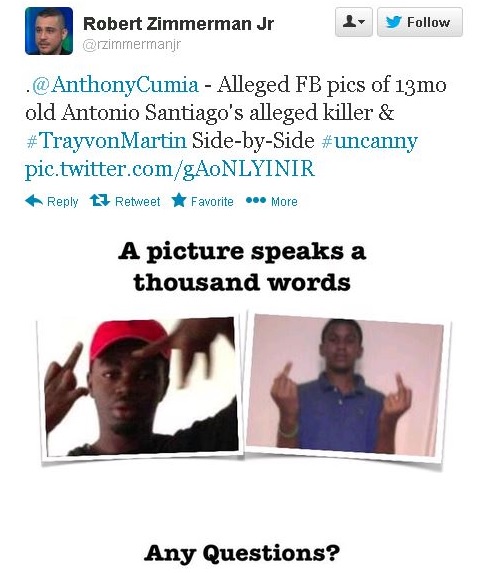
Today was no different. Zimmerman’s brother, Robert, posted (or re-posted) an image on Twitter:

Zimtweet

While this throws a certain amount of doubt as to whether there is indeed racism in the Zimmerman household, it is yet another red herring—possibly the mother of all red herrings. Robert is not George, and George should not be held responsible for crap his brother posts. Whether or not Robert intended only to demonstrate how photographs can be used to make any associations and that people should not judge Trayvon Martin based on his “harmless friendly teen” images, the post was the height of idiocy and insensitivity—and not the least bit relevant to the main questions of the case.

These distractions are not only less relevant, but they distort perceptions: for example, so much attention was placed on whether or not Zimmerman had any injuries, that when photos came out showing the injuries were real, many seemed to assume that was the end of it, case closed—as if that were the only real question in the case.


At the time when the story first broke, and still today, I held and do hold that most of that is irrelevant, and there is one central issue here: George Zimmerman was armed, and deliberately left his car to follow and confront someone who only looked suspicious to him. I hold that a key lesson of this incident is the cavalier attitude we have assumed toward the carrying and use of guns, especially in terms of vigilantism.

This is what I posted almost a year ago, comparing Zimmerman with Rodney Peairs, the man who shot and killed Yoshi Hattori:

[T]he most significant factor, at least to my reckoning, was that the men who wielded the guns failed to act responsibly. Neither did what they were supposed to do. Rodney Peairs, the man who shot Yoshi Hattori, had a right to defend his home–but he violated that precept when he unnecessarily stepped outside his home to actively confront the “intruders.” No matter how it played out in terms of specifics, George Zimmerman made the same error: instead of holding back and allowing trained professionals to do their job, he pursued Martin, and Martin is now dead as a result. In both cases, the men with guns felt the necessity to confront the people they felt threatened by, no doubt emboldened by the possession of their weapons. …

Peairs and Zimmerman both owned guns, and they both assumed a right to step beyond their own bounds and confront people they believed to be criminals. That is an explosive combination that will result in the deaths of innocent people. Peairs required no training to be armed in his home; Zimmerman only needed to take a few hours of gun safety courses before he was allowed to walk the streets armed. If either received training which firmly emphasized that they retreat from confrontation instead of seek it out, it certainly did not take.

In my mind, Zimmerman is guilty. Not because I know how the specifics played out, that Martin did not assault him, or anything else. Instead, it was because Zimmerman was the one holding a gun, he did not need to pursue Martin (the 911 call made that clear), and so he bore responsibility.

As far as I’m concerned, that by itself should be a separate element in any judgment about Zimmerman. What happened specifically after that—whether he initiated the confrontation with Martin or was attacked, whether there was justification to shoot or not—these I see as separate issues.

Zimmerman carried a gun. He willfully engaged in vigilante behavior. He left his car and followed a suspect, against the instructions of the police, apparently assuming too much about who he was following, apparently without thinking how his actions might be perceived were the person in fact innocent.

What happened after that was a result of this choice on his part.

I think this needs to be emphasized and recognized as a central issue. How photos are used in journalism, the significance of race and racial profiling, even the details of the confrontation itself—these all are relevant within their own contexts, but irrelevant to a very critical issue.

That issue is armed engagement: that, when you carry or use a gun, you must also assume a responsibility to be cautious in the extreme.

We have moved in the opposite direction, sending all manner of signals—cultural and legal—telling people to shoot first and ask questions later.

That has to stop, it has to be reversed. People need to be sent the message: if you pick up the gun, you should feel the weight of the responsibility it carries.

It also highlights a critical element of gun control: training and licensing. These are absolutely essential and should be required nationwide.

Categories: Social Issues Tags:

Cheating at Corruption

April 4th, 2013 2 comments

There is quite a bit of concern over recent scandals involving school- and teacher-driven cheating on standardized tests:

The extent of the top-down malfeasance under Beverly Hall may be unprecedented, but as I report in this Slate piece, there is reason to believe that policies tying adult incentives to children’s test scores have resulted in a nationwide uptick in cheating. An investigation by the Atlanta Journal Constitution found 196 school districts across the country with suspicious test score gains similar to the ones demonstrated in Atlanta, which statisticians said had only a one in 1 billion likelihood of being legitimate. A 2011 study by USA Today of test scores from just six states found 1,610 instances in which gains were as likely to be authentic as you are likely to buy a winning Powerball ticket. Absent independent, local investigations of suspected wrongdoing—which are rarely conducted—we simply cannot know the full extent of the cheating, which makes it difficult to assess whether the United States ought to continue down the road of tying teacher and administrator pay and job security to kids’ standardized test scores.

There seems to be some focus here on the shock that teachers and schools are cheating. We hold teachers to a high standard (while we hold ourselves to low standard in terms of how we treat them), and cannot imagine that so many would do something so terrible as to cheat.

Furthermore, the assumption seems to be that these teachers are cheating to save their own asses, and the cheating is harming their students, using them as tools for selfish gain. Thus the question about tying pay and job security to testing, as if the testing itself were not at all in question.

And sure enough, there are cheaters, no question. There will always be people in any group who are more noble and more base. As with everyone else, there is a spectrum—some will hold to their principles no matter what, some will violate the rules for no reason, and the vast majority lie somewhere in between, and where we lie along this spectrum is influenced by our conditions. I covered this before in a post from eight years ago: as conditions intensify, more of us reach the conditions of our “price,” our necessary level of incentive to break the rules. More of us are primed to do wrong.

This is one reason why tenure is a good thing: it releases the pressure, the fear of harm, and thus dissipates the conditions that prime us to do the wrong things.

Take away tenure, tell teachers that they will lose their jobs if their students don’t perform to a standard, and those conditions intensify, and more teachers manipulate their environment to work the system.

One element that will further prime us to break the rules is the availability and strength of rationalizations. The easier and more convincingly we can come up with excuses for defying a system, the more we will do so.

Tying school funding to standardized testing offers excellent excuses. Teachers can very easily look at that system and believe utterly that it is arbitrary and meaningless, and therefore violating its rules is not an actual wrong, just a technical one.

They know that standardized testing is not a true measure of education. They know that it is a political tool, designed to win votes. They know that robbing a school or a district of funding because of it is in itself a wrong. (In fact, one could argue that the schools with the worst results need more funds, not less.) They know that teaching to the test, which standardized testing favors, can actually be detrimental to students. They understand that the quality of education is not something that can be so easily measured, and pretending to do so can emphasize the wrong things and de-emphasize the good.

It is amazingly easy to convince oneself that cheating on this system is actually a moral good.

And here is where immoral and moral behavior blend: most of these rationalizations are in fact correct; the system is indeed useless and corrupt in itself; and teachers face a crisis where they must choose between following a bad system and giving their students the best they can manage.

Yes, some teachers cheat because they fear losing their jobs. But many honestly cheat—yes, that is very possible to do—to best serve their students.

They are faced with the knowledge that losing funds for this school may indeed harm the students in their care, students these teachers have committed themselves, often times selflessly, to protect and nurture.

This is not helped by the fact that teachers know that their children can be further disadvantaged when other schools cheat, and they know that cheating is inevitable.

Imagine, for example, that the government decided that health care for children be parceled out on the basis of the child passing a test that parents could easily help their children cheat on. The children pass, and they get medical attention. They fail, and they get nothing when they fall ill. And it is apparent that there is little connection between the test and worthiness of medical attention.

You think most parents will not cheat? Of course they will. You’re practically forcing them to. You are creating a system which encourages cheating, rewards it—even makes it necessary if one cares for one’s children.

Now, you may think that the analogy of medical care based on an arbitrary test is absurd—but have you considered that it is not because the analogy is incorrect, but because standardized testing as well as tying it to funding is equally absurd?

The fault, in fact, lays not in the cheaters, but in the selfishly-motivated manipulators who created the unhealthy system in the first place.

Strange how that fact is far less discussed, as if standardized testing should not be questioned.


Allow me to segue into a related point: evaluation.

I got my graduate degree in TESOL at one of the best-rated schools for that department, and yet there was a glaring omission in that program: testing and scoring. I simply cannot remember many lessons or book chapters which trained us how to create testing materials and evaluate student progress. There was certainly no course on the topic; the courses we did have focused more on teaching and remained mostly silent on evaluation.

There may have been a reason for that: like teaching itself, evaluation is not a straightforward thing. There is no “correct” method. It is, as the old saying goes, more art than science.

Grading demands the application of a numerical value to performance—but how do you weigh the performance? This question invokes issues from the fundamental to the specific.

First of all, what is the purpose of education? To teach students skills to find and perform well at jobs, or to enrich their lives at a more abstract level? Do they need specific skills, or should we outfit them with general tools which can be adjusted to adapt to any situation? Some even question whether we should be teaching them critical thinking skills at all. The answers to these questions fundamentally alter how evaluation should be performed, and yet we cannot even agree on these basic goals.

Should students be rated on an absolute scale, or in relation to each other, or even based upon personal progress? If absolute, who sets the standard, and what is it based upon? If in relation to others, then in relation to what group—the immediate class, the entire school, the state, or a national average? Or should students be graded on how much they achieve relative to where they started?

In any one topic, how should different elements be rated? Is a student rewarded for simple, mechanical memorization skills, or the ability to analyze and understand, to perceive the principles behind something and apply those so as to come to a creative result? Should we prize narrow technical competence in a skill, or creative approaches? If a combination, the how to weigh the value of each?

Upon serious and objective consideration of all of these facts and many, many more, it is easy to see that evaluation is a deeply complex and irreducible process. Applying standardized testing to education is like trying to rate literature by counting vowels.


The answer to standardized testing “scandals” is to address the greater problems, and the first step to that is to recognize standardized testing for the abject failure that it is, to trash it and to start over again. This time, leave the politicians out of it, as well as monetary incentives, and make an honest attempt to address the problem objectively and systematically.

A good start at such a project would be to first establish why we have education in the first place, and come to a firm decision about what education is supposed to be for. From there, we can move towards more specific elements and work our way through the system. There will never be universal agreement, but at least if we can make the standards clear, we have some hope of doing a better job.

Categories: Education Tags:

Mandatory Religious Deference

April 2nd, 2013 5 comments

In the United States, we live under the protection of religious freedom. This means that, as far as government and the law are concerned, we may believe, or not believe, as we wish.

However, this is a legal protection, not a cultural one. Culturally, there can be all sorts of religious discrimination. More than that, there can be religious bullying.

Think of it in terms of working at an office where most of the people there are, let’s say, die-hard Dodgers fans. They not only hang Dodgers pennants and other paraphernalia up, they get offended when you put up a banner for any other team (especially if it’s bigger than their pennant). In fact, they get upset if you don’t put up a Dodgers pennant in your cubicle or office. They get downright pissy about it, in fact. A coworker emails everyone:

Can I just say how disappointed I am that even though the Dodgers won yesterday, Linda chooses to celebrate by hanging her daughter’s artwork instead.

And you know you’re going to catch all kinds of dirty looks and snide remarks all day.

You would probably dread working in an environment like that. Not just because you’re the outsider, but because the majority of people there are such asses about the fact that you’re not—and that you’re not praising or worshipping them or their favorite things.

Well, welcome to the United States of America. Today, Google did not choose to represent the mainstream holiday or event (as is often the case) and instead chose to post something out of the mainstream—Caesar Chavez’s birthday, in this case.

Conservative Christians across the nation were offended. Some were livid. A few representative tweets:

Google thinks Cesar Chavez is more important than Easter. #whoareyou #happyeaster

Why is Jesus not on google but Cesar Chavez and his 86th birthday is ???

Wow. Congrats Google, youve managed to alienate all Christians in America today: instead of celebrating Christ, they celebrate Cesar Chavez.

That last one has just about the right ring to it: fail to put us above and before everyone else, and you risk our wrath. Many reported their intent to move exclusively to Bing.

Seriously, you would think that Google is a church or something, in that not recognizing Easter is completely out of character, a slap in the face. Since when has it become a requirement for businesses to genuflect? Why expect them to celebrate Easter with a special graphic? Why on earth would you get upset if they don’t?

“You said ‘happy birthday’ to Mark on his birthday, but not to me on mine? Well, don’t expect me to give you the time of day from now on!”

Yes, it is just that petty and pissy.

Not that it is anything new. You know about the infamous “War on Christmas,” right? Same thing. It consists mostly of Christians whining about how a few people are saying “Happy Holidays” instead of joining the popular chorus of “Merry Christmas.”

“Happy Holidays” is inclusive: it includes Christmas, but also everyone else. It’s perfect when you are speaking to a large number of people or are unsure of what holiday a particular person celebrates.

“Merry Christmas,” on the other hand, while perfectly fine for addressing someone you know celebrates the holiday, happens to exclude anyone who is not a Christian.

Demanding that retailers say “Merry Christmas” and forbidding them to say “Happy Holidays” is like men demanding that crowds be addressed as “Gentlemen” only, and getting all offended when “Ladies and Gentlemen” is used instead.

Seriously, if you hear “Merry Christmas” two dozens times a day, hear Christmas carols on nearly every radio station, see special Christmas episodes of most of your favorite TV shows, are bombarded with Christmas decorations and jingles everywhere you go… is it really going to put you out that much to hear the occasional business cheerfully wishing you a happy holiday?

If you can’t be satisfied with hogging 99% of the pie and then sharing the last sliver with others, then you’re a whiny, selfish, self-centered ass.

And you’re giving Christianity a bad name.

Honestly, would you want to be a Dodgers fan if all their followers were dicks?

Categories: Religion, Right-Wing Hypocrisy Tags:

The Annals of Selective Quoting

March 29th, 2013 3 comments

Republicans love to characterize Democrats as “Tax and Spenders.” They love to paint themselves as frugal. The problem is, they spend just as much as the Democrats, only with an emphasis on different things—and since they despise taxes, that makes them the party of “Tax and Borrow,” the party of “Tax and Debt.” Republicans are the chief architects of this nation’s debt; there is no question at all of that. And yet, fantastically, they try to blame it all on the Democrats.

Currently, Republicans are fighting a daily battle to blame Obama for all the debt, as if Republicans had not been handed a surplus by a Democrat, as if they had not obliterated that surplus in the name of tax cuts for the wealthy and massively costly wars and porkbarrel spending, as if they had not characterized the paying off of debts as a hideous injustice against taxpayers, as if $10 trillion in debt did not exist before Obama was elected, as if that debt was not chiefly created by Republicans, as if Obama had not been handed stupendous debts in a tail-spinning economy, and as if Obama had not been successful at lowering those deficits despite Republicans’ best efforts to make Obama fail.

In the latest round, John Boehner sent a memo to House Republicans, in which he cited Lincoln—a favorite pastime for conservatives vainly desperate to score on Lincoln’s gravitas. Boehner wrote,

The book Congressman Lincoln by Chris DeRose, which I recently read, includes a chapter focused on Abraham Lincoln’s efforts to help craft a new national agenda. At one point in the book, young Lincoln warns that government debt is “growing with a rapidity fearful to contemplate.”

“[Government debt] is a system not only ruinous while it lasts, but one that must soon fail and leave us destitute,” Lincoln warns his countrymen in Congressman Lincoln. “An individual who undertakes to live by borrowing, soon finds his original means devoured by interest, and next no one left to borrow from –- so must it be with a government.”

Well, it turns out that if you go to the source material for that quote, a campaign circular for the people of Illinois from March 4, 1843, you find that the quote is indeed authentic, and indeed Lincoln laments debt.

But here’s the thing: the very next words after that quote are,

We repeat, then, that a tariff sufficient for revenue, or a direct tax, must soon be resorted to; and, indeed, we believe this alternative is now denied by no one.

In other words, the very next words in Lincoln’s missive are a conclusion that revenues be raised—the precise solution Boehner and House Republicans have been fighting relentlessly to defeat! Not only that, but Boehner even quotes around Lincoln’s argument for taxation; Boehner cherry-picks the part about debt “growing with a rapidity fearful to contemplate,” but conveniently leaves out the very next sentence; the whole quote is,

By this means a new National debt, has been created, and is still growing on us with a rapidity fearful to contemplate—a rapidity only reasonably to be expected in time of war. This state of things has been produced by a prevailing unwillingness, either to increase the tariff, or resort to direct taxation.

Not just that, but Lincoln himself advocates tariffs over direct taxation not because he dislikes taxes, but because tariffs target the rich:

In short, by this system, the burthen of revenue falls almost entirely on the wealthy and luxurious few, while the substantial and laboring many who live at home, and upon home products, go entirely free.

But wait, it gets even better. Lincoln, as it turns out, was on Obama’s side, as pointed out by Greg Sargent:

Lincoln was also a firm believer in spending public money on infrastructure and boosting the economy.

As an Illinois state legislator, Lincoln was a leading proponent of using the proceeds from sales of public lands to pay for the digging of canals and building of railroads. As a member of Congress, Lincoln defended the idea of federal subsidies for internal improvements. Indeed, Lincoln was an ardent believer in Henry Clay’s “American System,” which was heavily predicated on government sponsored internal improvements and was one of the most significant instances of government intervention in the economy in the country’s history.

“Lincoln was a tremendous advocate of government spending on infrastructure and economic development,” leading Lincoln historian Eric Foner told me. “As president Lincoln presided over a tremendous increase in government spending, not just because of the war but also on the Homestead land grant system and aid to construction of the transcontinental railroad.”

Huh. How about that. Lincoln wanted to raise revenues on the backs of the wealthy and use the money to pay off debts and invest in infrastructure improvements.

Well, Boehner? Any comments about how Abraham Lincoln was a Commie Socialist Fascist?

Unfortunately, the fact that a Republican, whose party has left us in financial ruin, attempts to heap blame on another man after repeatedly sabotaging that man’s efforts to alleviate that ruin, should selectively quote Lincoln in an effort to defeat Lincoln’s principles… well, let’s just call it “par for the course.”

Republicans, as if it is not obvious, and as if I have not said this repeatedly, are the most egregiously asinine lying hypocritical dirtbags you can imagine.