Archive

Author Archive

Just Saying

September 24th, 2013 1 comment

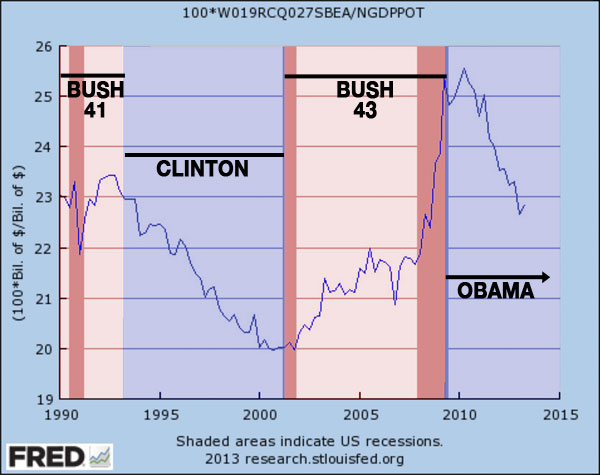
This is Krugman’s chart showing the U.S. budget as a percentage of potential GDP. To accentuate my point, I highlighted Republican administrations in red, and Democratic administrations in blue. There’s a pattern there, though it may be hard to discern if you are conservative.

Bgdpchart01

Categories: Economics Tags:

iPhone Fingerprint ID Uselessly Hacked

September 23rd, 2013 1 comment

A German site is claiming they have successfully defeated Apple’s Touch ID technology with “materials that can be found in almost every household.” OK, let’s see what they require:

  • A clean original print of the finger used to set the Touch ID;
  • Colored powder or superglue
  • Ability to photograph the print cleanly “with 2400 dpi resolution”
  • “A bit of graphical refurbishment”
  • A laser printer
  • A transparency slide
  • Wood glue
  • Glycerine

I think we have superglue in the house, and I have a high-quality digital camera and the graphics software. None of the other stuff, though. I’d have to go buy a laser printer and the transparencies. Other trouble with the list lies in the vagueness. For example, how much is “a bit” of cleaning up the image in a graphics app? From the photo they showed, it looked like a semi-tough job to me, balancing the contrast and then repairing the ridge detail just so. Most people I know couldn’t do that. And they say that you “may” use “glycerene” (I presume they mean glycerine), but did not say that they were successful without its use. Nor did they detail how many attempts were necessary with perfect conditions before they were successful.

But let’s see how this process might work in real life.

The trouble begins right there at the top of the list: a clean print of the correct finger. They assume this will be easy to get, from a glass bottle or doorknob. Getting such a print is not quite as easy as they suggest. Have you ever tried to get a glass or bottle that a stranger used? It’s not as if they are simply laying around everywhere. Unless you live or work with the person, you would have to go to quite a bit of trouble to acquire that. And a doorknob? If you happen to find one the person used, like on a hotel room door, would you really have the time and privacy to use the powder, glue, and photography equipment in order to lift the print?

You could try to use the phone itself, but that’s not entirely easy either. The phone will have to have a full, clean print of the correct finger. Take a look at your phone: you may see some prints, but look carefully, and ask if any of those prints are complete and clear enough (not partial or smudged) to lift a usable print. I checked my iPhone and my wife’s at a random time: neither had anything close to a usable print. My iPad had a lot more prints on it, but all of them were smudged and not complete.

So, if someone is lucky enough to steal your iPhone or find it when lost, what is the likelihood that they will also be able to get your prints? While it may be possible that you leave your iPhone at a bar with a glass or bottle with a clean print of the finger you used that you can pick up and leave without anyone noticing or objecting, the chances are not exactly high. Realistically, the thief would have to follow you around for days to find the opportunity to get your phone and the print, and probably would have to take significant risks in doing so.

Next is the process of getting an image of the print. It is described as being a simple process. If you think it is, then I suggest you try it. Maybe under good lab conditions with a great print specimen with an experienced person doing it—but most people, I am fairly sure, would not have an easy time of it at all without a great deal of practice beforehand. So, again, you need someone really dedicated to the endeavor.

I am further puzzled by the incorrect terminology, as they describe a “2400 dpi” photograph. DPI is a printing measure, not a photography measure. Perhaps they mean 2400 pixels per inch of fingerprint area? It would be more clear if they could express the required detail of the fingerprint in pixel resolution.

Finally, aside from not revealing how many tries were necessary under perfect conditions to get the usable fake print, they introduced a further vagueness: the video shows the same person who established the fingerprint on the iPhone also using the fake print to unlock the phone. Apple’s technology claims to look beneath the outer layer of skin; I am not sure if it would be harder for a different person to also successfully use the fake print, but their video example raises that exact question.


So, let’s review what is actually needed:

  • The ability to steal the phone (not easy in the first place);
  • The ability to acquire a clean fingerprint of the correct finger;
  • The skill to successfully process and photograph the print;
  • The skill to use graphics software to clean up the print;
  • An unclear number of attempts to create a usable fake print;
  • Presumably the ability of a person other than the original user to successfully apply the print;
  • All the materials listed in the first list above.

You begin to get an idea of how the chances for all of this to be applied in a real-life situation are vanishingly slim. Right off the bat, most people who steal a phone have no ability to also obtain a fingerprint, and few thieves have the forensic skills to actually accomplish this process. As stated above, the thief would have to spend a great deal of time and effort, specifically targeting you, just to have a chance at being successful.

And they would have to accomplish this quickly enough so that the phone’s owner does not have the time to notice their phone is missing and wipe the data from it.

Does Apple oversell the technology? Absolutely. If you are a corporate executive or government official with top-secret information which you happen to store on your phone, should you rely completely on Apple’s technology? Of course not, you would be stupid to do that.

But if you are just a normal person trying to keep your personal information safe, then frankly, this is more than secure enough for you. Anyone so dedicated to accomplish the described hack would probably have an easier time just figuring out your online account passwords.

Categories: iPhone Tags:

iPhone Sales in Japan

September 22nd, 2013 Comments off

Splist01
Wow. In the week before the new iPhones come out (9/9 to 9/15), the iPhone 5 still dominates, taking the #1 and #2 positions (Softbank and Au 16 GB versions), as well as the 7th and 10th spots (32 GB versions).

This is significant because usually sales drop off dramatically in the weeks before a new model is released. In the past, that has been the only time when other models get to surpass the iPhone in sales.

I will be very interested to see the numbers for the next few weeks, in part because of the tracking web site’s method of fragmenting iPhone sales by model, carrier, and capacity, something it does for no other phone, and clearly an attempt to make it appear that other phones are doing better against Apple’s handset.

This fragmenting has already produced eight different iPhone listings (for all three capacities of iPhone 5 plus the iPhone 4S, and two carriers).

However, from now, DoCoMo joined as a third carrier, and there are two new models concurrently released, with five different capacities, and the iPhone 4S. That’s eighteen permutations.

It is entirely possible that, for a few weeks at least, the tracker’s attempt to break up and diminish the appearance of iPhone sales in Japan will actually result in the iPhone inhabiting all ten of the top ten spots, and probably most of the #11 to #20 spots as well. Should be interesting to see!

Categories: iPhone Tags:

Reaching New Lows: Deranged, Perverted, AND Hypocritcal

September 21st, 2013 6 comments

a creepy conservative adConservatives have a new ad out, one which is universally being referred to as “creepy,” which attacks Obamacare. It depicts a woman at a gynecological exam having a ghoulish pervert in an Uncle Sam costume sneak up on her with a speculum.

The message, void of the warped imagery, is that Obamacare puts the government between you and your medical care, an old canard which conservatives always fall back on when it comes to anything related to health care reform, a message as fake as the asininely depraved vehicle used to deliver it.

The real irony: these same conservatives—pretty much exactly the same conservatives—are the ones who are getting laws passed around the country which force women, including rape victims, to undergo mandatory vaginal ultrasounds before they can get an abortion.

That’s right. The people who actually are getting Uncle Sam to creepily violate women in hospitals for no defensible reason are putting out ads falsely saying that Obamacare will do to women what they are doing to women. Imagine a rapist putting out a commercial saying that the district attorney sexually violates women, or an arsonist running a nationwide TV campaign about how firefighters actually start fires. That’s pretty much what we’re looking at here.

It would be creepy even if it weren’t true that these people want to force rape victims who are trying to stop the pregnancy caused by their rapist to undergo a medically unnecessary procedure equivalent to government-mandated rape. I’m trying to imagine how you could be even a little bit more perverse than these people without sounding ludicrously obscene, but these people have long since passed that landmark.

New Cell Phone

September 15th, 2013 4 comments

Got a giggle from reading a 10-year-old blog post about how I got a new cell phone.

I wrote about the “feature-rich” phones back then (relative to U.S. phones at least), and mentioned someone taking pictures of a nature spot with them. I can only imagine that they treasure their 144 x 120 pixel memories.

My other note in the post: how it took an expensive cable, hunted-down freeware, and hours of frustration to transfer the address book I had to enter on a PC to the phone. So difficult that I used it just the once.

From memory, I recall that most of the features were cyphers to me (it had three different kinds of “email,” I never figured out what they were), and I almost never used much except just the phone. Then, after a few years, the contacts for charging wore down so much that just recharging the phone was a mixture of enraging frustration and disappointing failure.

What I also recall is that I just wanted one thing, really: the ability to sync my address book with my phone. Just that would have made me a happy camper. And though I was able to, it cost a whole bunch and was so much trouble that I rarely repeated the process.

A little less than five years later, I got my first iPhone. You can guess how that changed things.

When I see people saying stupid crap like “Apple tried to patent the rectangle,” I get pissed off, because it is eminently clear that these people have completely forgotten how absolutely abysmal cell phones used to be before Apple changed the game.

Categories: Gadgets & Toys, iPhone Tags:

Do Tax Cuts for the Wealthy Stimulate Jobs?

September 15th, 2013 8 comments

For the past thirty years and some, conservatives have claimed that the best way to create jobs and stimulate the economy is to cut taxes for wealthy people. From “trickle-down” to the recent drive to cut or eliminate the capital gains tax, the idea is that if you put more money into the hands of wealthy people, they will invest in business, thus creating jobs, leading to a stronger economy with more people paying taxes on greater incomes. Presto! A revived economy and more revenue collected by the government.

This has always struck me as one of the most obviously stupid ideas I have seen. Let me paint a little scenario with two variations.


Let’s say you have a depressed economy. People are not buying products, let’s call them “widgets.” They want to buy widgets (who doesn’t?), they just don’t feel they can afford to. Then there’s a Wealthy Person, who has tens or hundreds of millions of dollars. That person wants to invest in what will give the best return on his investment.

Variation One: you cut the taxes of the Wealthy Person. Both income tax and capital gains tax. The Wealthy Person gets a few million dollars extra that he would have otherwise paid in taxes, adds it to his pile of wealth. So, what happens? Will the Wealthy Person invest that money in a widget factory, thus creating jobs? No: nobody is buying widgets. Investing in a widget factory would be a stupid investment, bound to fail. Cutting capital gains will not lead the Wealthy Person to invest in a business which will fail. It’s not like the Wealthy Person did not already have lots of money to invest; if they weren’t putting it into widget factories before, why will adding a little more to their fortune change anything? The Wealthy Person will take that money and instead apply it to investments designed to increase his personal wealth even further, not to investments that are designed to create jobs or stimulate the economy.

Result of Variation One: the economy is still depressed, you have less tax revenue, and more debt—and some very pleased Wealthy Persons.

Variation Two: you don’t cut the taxes of the Wealthy Person. In fact, you raise his taxes to a marginal rate of 50%. Then you take that money, add it to the money that would have gone to the Variation-one Tax Cuts for Wealthy Persons, and apply all of that to give tax cuts to the lower-middle class and assistance to the working poor. Suddenly, the people who want to buy widgets have enough money to do so. They start buying widgets, and suddenly demand outstrips supply. Building a widget factory is suddenly a prime investment.

What about your Wealthy Person? You just raised his taxes. He won’t have enough money to invest in the widget market, right? Wrong. He’s a Wealthy Person. Which means he has lots of money. He doesn’t need a government tax cut. You can raise his tax rates to much higher than 50%, that’s not going to stop him from wanting to make more money. He’s got piles of cash, so no matter what, he’ll want to invest that in whatever gives the best return. When people start buying widgets, he’s going to build widget factories. And even if somehow his assets are all tied up somewhere, there are things called “banks.” These banks love lending money to people with lots of collateral and who want to invest in a booming business.

In short, no matter how high you raise his taxes, the Wealthy Person will not have any problems investing in a booming market.

Result of Variation Two: a revived economy, more jobs, stable revenue—and Wealthy Persons who are still making money and increasing their overall wealth.


Where am I getting things wrong here, beyond the simplicity of the scenario? How does this math not work out?

Categories: Economics Tags:

My Right to Swing My AR-15

September 14th, 2013 1 comment

Every once in a while you read about a story like this one, from Appleton, Wisconsin:

Police detained two men openly carrying AR-15 rifles near Saturday’s farmers market, setting off a debate this week about response at the highly attended event.

It appears that two local citizens, Charles A. Branstrom and Ross A. Bauman, decided to exercise their constitutional rights by going to a peaceful public gathering armed with weapons designed to kill large numbers of people. Obviously, it was a stunt designed to flaunt gun-toting rights, with someone ready to video the whole thing.

Police told Branstrom and Bauman “that walking into a farmer’s market filled with a couple thousand individuals would be a recipe for disaster.”

Branstrom and Bauman maintained that they had the right to do so, the report says.

They have the right to provoke public fear and disruption. Interesting. I wonder what the revolutionary Minuteman fighters would have thought about heavily-armed people needlessly marching about the town square. Something tells me they would have had a better sense of propriety and responsibility regarding a solemn duty.

One can assume that Branstrom and Bauman point was, “We have a Second Amendment right to ‘bear’ arms, and that means we can carry our AR-15s wherever we damn please.” Gun advocacy groups call such stunts “educational,” claiming that people will get used to such things.

However, despite the viewpoints of people such as these, most Americans—including, and perhaps especially those who own guns themselves—do not like the idea of the streets being populated with people wielding military assault rifles. One can assume that the open-air violent crime rate in Appleton, Wisconsin is not in fact an actual threat, and even if it were, both police and local citizens would not feel more comfortable with random citizens eager to let go with their AR-15s in public taking it upon themselves to open fire on streets where their children walk.

Branstrom and Bauman acted ignorant of such attitudes, stating:

“I guess some people don’t like guns.”

They then claimed that the purpose for carrying the guns was “self-defense.” Really? They expected to get shot at at a suburban farmer’s market event? Or perhaps they thought it possible they might empty a few dozen rounds into a pickpocket?

Bullshit. There was no threat to them, and therefore no reasonable cause to carry the weapons. The reverse, in fact, is true: they were the threat. With no reasonable peaceful use for such weapons, their presence is a very real implicit threat to the other citizens there. It’s not that “some people don’t like guns,” it is that “some people don’t like implicit threats to slaughter their children.”

These gun-toting idiots may actually even think they were making a point about their rights and freedom, but what they were doing is the classic example of the only legitimate reason why any constitutional rights are abridged: infringing on the safety and rights of others. Some tend to forget about that rather vital and necessary counterpoint to one’s constitutional rights.

Categories: Right-Wing Extremism, Social Issues Tags:

Pooling vs. Redistribution

September 7th, 2013 4 comments

Conservatives today have a favorite bugaboo: “redistribution of wealth.” By itself rather innocuous-sounding, it is clear code for a variety of evils: taxes, stealing, and downright, outright communism. It has now commonly been replaced with the term “confiscation.”

What is strange is that redistribution, in its conventional form, is mostly admired, including by the very people who demonize it. Most people favor a progressive tax system, for example. Those who loathe redistribution nevertheless claim that the free market will redistribute, imagining that the wealth will circulate with wealthy people paying handsome wages in exchange for labor—as false a myth as you can find, of course. They approve of redistribution, they just naively and foolishly believe that wealthy people will do it unbidden—many even credulously believe that that is what is happening right now.

What is not usually spoken of is the only alternative to redistribution: pooling of wealth. Most of the wealth in a society being drawn to one place and staying there. Not funding jobs or infrastructure, not moving through the economic engine. Just sitting there, its only purpose to draw more money to the pool.

If you think that redistribution is distasteful, then the effects of pooling are downright catastrophic. We’re seeing many of those effects right now, and they are going to get worse. And as wealth pools more and more, the usual corrective measure of higher tax rates will affect it less and less, because tax only reaches wealth that moves. To reach pooled wealth, you need the estate tax, which takes generations to reenter the economic cycle—and which wealthy people are clamoring to eliminate.

The economy is an engine; capital is the fuel. Should wealth pool, the engine will stall. Redistribute, and the engine runs with efficiency. Even Romney understood the basic principle, he just believed, like so many conservatives, that the fuel runs between capital investors and corporations—from one part of the top to another part of the top—with money to workers being a by-product, if anything—instead of the actual path it must take for an economy to be dynamic, which is from bottom to top and top to bottom.

A necessary observation is that while the bottom is forced to spend upward to live, the top has no such built-in force, and unless forced to redistribute downward, the top naturally tends to collect wealth and remove it from circulation. Conservatives have been systematically dismantling the forces we had created to accomplish this, including taxes and unions, thus making downward redistribution voluntary—which, in real terms, means the minimum necessary and no more. And the minimum is too slow a trickle to make our economy run.

At the gut level, most people seem to know this. But too many people now have bought in to the scam that somehow managed redistribution is evil and destructive.

Categories: Economics Tags:

Manufacturing Equivalent Outrage

August 26th, 2013 3 comments

There has been a great deal of “outrage” in right-wing media and blogs lately about the Christopher Lane murder, and how it’s not a big deal in the media. The thesis of this outrage is, “a white/Hispanic man shoots a young black man, and the nation goes into an uproar; three black kids (as conservative sources originally identified them; in fact, one of the kids is white) senselessly murder a young white man, and the media falls silent.” A representative sample from The Daily Caller:

A Hispanic guy shot a black teenager in self-defense, and it was proof that America hasn’t gotten any better since Emmett Till was murdered. Whereas the following story, which is literally an international incident, has no significance beyond the individuals involved. It’s not useful to Al Sharpton and Barack Obama.

This article has a fair rundown of how the conservative media is handling the story.

I do not use the word “outrage” in quotes because there is no outrage, but rather because it is politically manufactured outrage. This commonly happens after a story that puts conservatives at a disadvantage: they pounce on a story that seems to turn the tables, carefully frame it to suit their political needs, then start beating the drum across the media. You know how some people, when you criticize them, by reflex start criticizing you back on some other matter? That’s essentially what this is: an attempt to excuse their own shortcomings by trying to make the “other side” look hypocritical.

“It’s worse than a double standard. This is a purposeful, willful ignoring of the exact racial components, but in reverse, that happened in the Trayvon Martin shooting.” —Rush Limbaugh

And, as is usual when conservatives do this, the “equivalent” story isn’t equivalent at all. Conservatives, like Limbaugh above, claim that the Lane story should have gotten the exact same reaction as the Trayvon story because they were identical, only with races reversed. Their complaint is that the media and liberal leaders react to incidents when the victim is black and the assailant is white (or close to that), but if the assailant is black and the victim is white, liberals and the “Liberal Media”™ fall silent. They further postulate that because of such, they don’t actually “care” about the black victims but are using them to further an agenda. (Keep conservative tendencies to project in mind, now.)

Which, of course, is not even close to being true. The Martin case would not have been in the news at all had it not been for the fact that (1) the police failed to act on what appeared to be at minimum negligent homicide; once that made the story of some note, it became bigger when (2) the defense used was a controversial law that seems to legitimize killing someone for insufficient cause; and then it was further inflamed when (3) it became apparent that the entire incident was caused by racial profiling.

Race was absolutely a factor, but it was not what made the story a big one. There have been many other killings of black people by white shooters under the “stand your ground laws,” but none of them made national headlines—proving that race alone was not what made the story significant.

In the Christopher Lane killing—which did make national headlines—none of the elements that made the Trayvon Martin case significant exist. The killing did not appear to be racially motivated, but rather simply opportunistic; the killers have been arrested and will almost certainly be convicted in accordance with popular expectation of justice; and no controversial law is being used (at least not yet) to get the killers off.

Now, had the three youths immediately cited a controversial law, had the police processed them then let them go, and had there been evidence that they had chosen their victim because of his color— you can bet you life that it would be as much a story nationwide as the Trayvon Martin case. But none of those elements existed, therefore the two cases are not at all equivalent.


So the whole “where’s the outrage?” outrage on the right is, as usual, completely unfounded, as most of their politically motivated crap tends to be.

We Would If We Could

August 23rd, 2013 4 comments

I get the very strong impression that if Republicans had enough control over both the House and Senate, Obama would be impeached and convicted.

Not for actually doing anything wrong, and certainly not for doing anything even a tenth as illegal as Bush and Cheney did. Rather, he would be impeached simply because they could impeach him.

After reading a slew of stories this morning about how Republicans are just aching to impeach Obama, I noticed one interesting point: there was very little attention focused on any actual charges. Instead, it was more about the enthusiasm.

For example, a few days ago, Rep. Kerry Bentivolio (R-MI) said that “it’d be a dream come true” to impeach Obama for the IRS scandal. Why doesn’t he? He “ultimately decided there wasn’t enough evidence.”

Yeah, that’s kind of an obstacle. Not having any evidence. But not an obstacle for determined Republicans.

Rep. Blake Farenthold (R-TX) last week suggested that Obama should be impeached over his birth certificate, and claimed there would be enough votes in the House to do so. His colleague, Sen. Ted Cruz (R-TX) said that the only reason they were not impeaching Obama was that they did not have enough votes in the Senate. His reason to impeach? Obama ignores the law, citing the fact that Obama did not cut off military aid to Egypt after the coup. Which, ironically, is (a) something Republicans would have done in a flash, and (b) even more ironically, is the best charge I have heard regarding a cause for impeachment. Not that it’s good enough by a long shot, but it at least is not completely ludicrous. And, listening to what he said, it really does come across as just a pretext.

Look hard enough, and you’ll find more specific lists. Here is one of the more coherent ones that lists a dozen “impeachable” offenses:

  • President Obama has appointed cabinet level positions “without the advice and consent” of the U.S. Senate. Of course, the Senate is legally required to “advise and consent” and Obama bypassed them because they failed to do so over a span of years; his recess appointments are no less questionable than their de facto disempowerment of the agencies via refusing to approve appointments, and to cut off Obama’s legal authority for recess appointments by pretending to never go into recess.
  • Passing the Affordable Care Act, apparently because it forces religious organizations to “provide contraceptives and abortion” against their religious principles; this is simply false, as such organizations only need to make insurance available; contraception can be arranged via a third party. Besides which, it is arguable that the religious freedom of the individual over matters in their own lives trumps that of an employer’s attempt to control that employee’s personal matters; even if decisions go the other way, there are no grounds for impeachment for taking a stand one way or the other on the issue.
  • Ordered the EPA to “implement key portions” of Cap and Trade without Congressional approval; a search for this on the web brings up almost exclusively right-wing media outlets and blogs. As far as I can tell, there is no impeachable offense in taking executive action, where permitted, to implement steps toward a goal that Congress failed to pass in full. Had Congress passed a law forbidding such actions and Obama violated that law, that would be different.
  • Placed a moratorium on offshore oil drilling or exploration on federal land anywhere in the United States. I am pretty sure this is simply untrue. Obama put a 6-month moratorium on new drilling in the Gulf of Mexico after the Deepwater Horizon disaster.
  • Authorized loans of billions of dollars to countries like Brazil and Mexico so that they can drill for oil, and then sell that oil to the United States. Nope.
  • Has not enforced laws against illegal immigration enough. Aside from that simply not being true, the fact is that you cannot impeach a president for the emphasis he places on various types of enforcement.
  • Joined with foreign countries such as Mexico, Bolivia, and Columbia, in lawsuits against Arizona, Georgia, and Alabama to stop them from enforcing the federal immigration laws. This refers mostly to Arizona’s ludicrous 2010 law requiring police to stop anyone who looks Hispanic and demand their papers, amongst other things. The Obama administration concurred with much of the nation that this was unconstitutional, and so filed a suit to stop it. Foreign countries signed amicus briefs supporting the suit. Nothing illegal or improper was done, and the Supreme Court upheld the Obama administration.
  • Ordered the FCC to adopt regulations giving the federal government control of the Internet and its contents, including providing Obama with a kill switch that gives him authority to shut down the Internet if he sees fit. The Executive Order Obama signed was for times of emergency, similar to imposing martial law. While controversial, I’m pretty sure there was nothing illegal here.
  • Failed to uphold Defense of Marriage Act and resists Republican voter suppression schemes. Essentially, “we made these outrageous pieces of crap and Obama is fighting them within the system of laws.”
  • Fast & Furious, combined with “Obama Gonna Getcha Gunz.” More of nothing.
  • Obama used the U.S. military in Libya, claims powers essentially allowing him to begin military dictatorship in U.S. While the dictatorship claims are vacuous and are nothing new, the laws concerning war powers and when they can be used with or without congressional approval are more controversial. Not, as far as I can tell, an impeachable offense, but something which should be settled.
  • Nationalized and took control of automobile manufacturers, banks, insurance companies, and portions of the healthcare industry. This is on the level of FEMA concentration camps.

There are other lists, like this “51 Reasons to Impeach Obama” list, but they invariably get even more ludicrous than the one listed above. The “51 Reasons” list, for example, begins with Obama conspiring with William Ayers to steal $300 million to radicalize Chicago students, giving you an idea of how fact-driven such literature is.

There’s even a new book out via World Net Daily (a group that joins rags like The Daily Caller in making Fox News look like a liberal bastion) called Impeachable Offenses, which mostly looks like the bullet list above, but updated.

Let’s face it: the real reasons why so many conservatives want to impeach Obama are simple: he is not a Republican and/or he is black. That sums it up.

Categories: Right-Wing Extremism Tags:

God’s Subjective Morality

August 22nd, 2013 1 comment

This is the kind of thing that is truly frightening to hear people say:

It’s right for God to slaughter women and children anytime he pleases. God gives life and he takes life. Everybody who dies, dies because God wills that they die.

God is taking life every day. He will take 50,000 lives today. Life is in God’s hand. God decides when your last heartbeat will be, and whether it ends through cancer or a bullet wound. God governs.

So God is God! He rules and governs everything. And everything he does is just and right and good. God owes us nothing. …

The Bible says, “Thou shalt not murder,” yet God says to Joshua, “Go in and clean house, and don’t leave anything breathing! Don’t leave a donkey, child, woman, old man or old woman breathing. Wipe out Jericho.” …

So I would vindicate Joshua by saying that in that setting, with that relationship between God and his people, it was right for Joshua to do what God told him to do, which was to annihilate the people. …

An example of this right now is that God has given the sword to the government (Romans 13:4). Therefore I believe the government has a right to take a rapist and a murderer and to put him in jail. Or to kill him.

Essentially: God created all, and so He can do anything He pleases with his creations. There is no higher morality for God, no accountability; whatever He does is, by definition, good. He says commit genocide, therefore that act of genocide is right.

Already I have problems with that. God can literally make anything right by saying so, without regard to consistency or, for that matter, any restraint of any kind. God has no responsibility for tending to his creations. Or, at the very least, He is supposed to have Really Good Reasons for doing apparently horrific things and we are simply to trust Him on it.

Beyond the specter of an omnipotent being of that nature, the real worry is that this is not just about God. God serves as a model for many. The relationships to fatherhood are virtually countless, both literal and subtle. And the model which says “Whatever I say goes, and I don’t have to explain myself” is as frightening as authoritarianism often is.

However, that’s far from the greatest worry. Far more horrifying is the combination of two facts:

Fact #1: Anything God commands is moral, right, and good; and
Fact #2: People decide what God commands by reading scripture and interpreting what it means.

Take, for instance, the quoted author’s justification for the death penalty: Romans 13 states that God has given His seal of approval to the governing authorities—so whatever a government does is equal to God’s will, and is moral, right, and just. Go ahead, read it. There are no exceptions; presumably, it means any government. How this applied to the Soviet Union, for example, I am not sure, but I am certain there was some explanation which got around that apparent contradiction, there always is.

Not scared yet? Just remember that while Romans 13 is pretty straightforward, there is so much in the Bible which can be construed as meaning virtually anything a person wishes it to mean.

What this comes down to is that, ultimately, Christian morality is meaningless, as it is whatever one decides it to be.

That is not to say that in any given setting or situation, it means anything goes. What it means is that, like the quoted author’s submission to governmental authority, whoever is in charge gets to decide what the rules are.

Again, authoritarianism.

And in case you disagree, well, just remember that not only is God (meaning whoever speaks in God’s name) the source of all good, but there is no possibility of any good from any other source. No matter how good it seems, no matter how kind, generous, fair, or just someone or something appears to be, if they do not bow to God (meaning representatives of God, specifically our God), then they are simply without good.

Naturally, not all Christians feel this way. But it’s the ones who do who scare me.

Categories: Religion Tags:

The iPhone and Japan

August 13th, 2013 7 comments

A few days before Apple officially announced the first release of the iPhone in Japan, I wrote on whether or not it would be popular here. The popular belief was that the iPhone would flop, because of stiff competition from “advanced” Japanese mobile phones, and because the iPhone lacked features like emoji or a strap loop. Many articles were published stating why the Japanese people would just hate the iPhone.

My prediction, not surprisingly, was that the iPhone would succeed, but would take off slowly in the first year or two. Which is what happened. My take at that time:

[A]s soon as Japanese users–conditioned to simply take the standard Japanese fare without question–begin to see and hear about what the iPhone can do, it will take off.

It might take a year or two, but it will eventually trend that way. I seem to recall that when the iPod was introduced in Japan, people similarly predicted it would have trouble catching on because the Japanese market was already saturated with and dominated by advanced, domestic-produced music players. But today, when I walk around town, I see most people using iPods. The success was not immediate, as I suspect the iPhone’s will not be. But the iPhone should succeed despite the naysayers’ reasons, in just the same way as the iPod did before.

Sure enough, for the first year or two, the iPhone was not easy to spot in public. The best place to see what kind of phone people have is to ride the trains, where most people seem to use them pass the time. In that initial year, I did not see many iPhones in use.

Now, however, it is very different. When I ride the train, I will often look around and take a quick count of phones within view.

Almost invariably, about half the phones in view are iPhones.

Now, that does not mean that iPhones have 50% of the Japanese market; it may just mean that iPhones provide better entertainment on a train. However, it is kind of telling.

Amusingly, a site which tracks the best-selling smartphones in Japan biases its results on iPhone sales. Since the time the iPhone came out in Japan, the site reported sales of iPhones divided by internal flash memory capacity—a measure it uses for no other phone. When carrier Au picked up the iPhone, the site further split the rankings by carrier—again, only for the iPhone. Other phones with multiple carriers and capacities are given a single, consolidated ranking.

The reason is obvious: were they to do otherwise, the iPhone would be the only phone ever to inhabit the #1 spot.

Take today’s rankings, for example. The Xperia A tops the charts, having been released just a few months ago. Sitting at #3 is the Galaxy S4, released in late April.

The iPhone, release almost a year ago, has the #2 slot. And the #4 slot. And #5, and #6. The slots are for the 16GB Softbank iPhone, the 16GB Au iPhone, the 32GB Softbank iPhone, and the 32GB Au iPhone, in that order. The 64GB Softbank iPhone rests at #29, with the 64GB Au version at #31.

This despite the fact that not only is the iPhone 5 much older than the competing models, but it is about to be refreshed in just a month or so—a fact which usually depresses sales rather significantly.

Clearly, if the iPhone were treated like all other phones and ranked as a single device, it would be #1, and it would stay there all the time.

Which is strange, because Japanese people were supposed to hate the iPhone.

Categories: iPhone Tags:

He IS the Messiah! Or At Least One of Them

August 13th, 2013 Comments off

A few days ago, a child support judge in Newport, Tennessee decided a case from two parents disagreeing over their child’s surname.

The mother, Jaleesa Martin, wanted to name the boy Messiah DeShawn Martin, using her surname only. The boy’s father wanted the boy to have his surname, McCullough. The reports make it unclear whether the couple is married or not.

The case should have been simple, but the judge did something unexpected: not only did she decide in favor of the father, but she decided in favor of herself: in addition to giving the boy the surname “McCullough,” she also struck down the baby’s first name as well, replacing it with the mother’s surname, making his full name Martin DeShawn McCullough.

The reasoning the judge gave was even more problematic:

The word Messiah is a title and it’s a title that has only been earned by one person and that one person is Jesus Christ.

The judge gave other rationales as well, in particular that they lived in a heavily Christian community and that bearing a name like that would create difficulties for the child. Perhaps—but that’s not for the judge to decide.

Making such a change because you worship Jesus Christ is, without question, unconstitutional. The judge cannot force her own beliefs on the parents or the child.

Not to mention, this would not be the first time a baby has been named “Messiah” in the country:

In 2012, 762 other Messiahs were born in the U.S., making it the 387th most popular name for U.S. boys in the U.S., according to the Social Security Administration. And because only 368 Messiahs were born in the U.S. in 2011, it’s also the fourth-fastest-growing boys’ name in America.

Not to mention that an another acceptable baby name is “Salvador.” Meaning: “savior.”

And that’s what “Messiah” can mean as well—both specifically and generally. “Messiah” is defined not only as the deliverer of the Jewish nation (Jews do not see Jesus Christ as the Messiah), but also as “a leader or savior of a particular group or cause.”

In short, the baby’s name was perfectly fine, and the judge screwed up. The question is, why did she screw up?

The apparent cause was that she allowed her religious beliefs to sway her decision; this is a teachable moment, as many people are likely not aware that such religious bias is not uncommon in supposedly objective legal decisions. In child custody cases, for example, judges often side with a religious parent over one who is an atheist. And then we have Anthony Scalia attempting to force his own religious beliefs on the entire country by essentially trying to nullify the establishment clause of the First Amendment.

However, there is a difference possibility, or perhaps a contributing element: this happened in the South. The judge is white. The baby is black. There’s certainly no direct evidence, but when you have an arsonists’ convention and the building next door bursts into flames, it is perhaps unwise to ignore the arsonists as suspects. Had the baby been white, would the judge have done the same?

Categories: Religion, Social Issues Tags:

Microsoft At It Again

August 8th, 2013 2 comments

They now have a video ad explaining to consumers, who just don’t seem to get these things, how great the Surface is compared to the iPad:

Microsoft also uses the spot to summarize other iPad shortcomings that it has highlighted in previous ads, including the iPad’s lack of an integrated kickstand and keyboard, the absence of dedicated productivity software on the tablet, its poor multitasking capabilities, and its failure to offer expandable storage.

As I have stated many times before, Microsoft just cannot wrap its collective head around the fact that a handheld is not an authoring machine, but instead is a consumption device. All of the shortcomings listed above would be true for a full-powered computer, but is far less important for a device people want to have fun with. As evidenced by the fact that the iPad continues to dominate the market while Surface is crashing and burning.

Note the video again smacks the iPad for not having an “integrated” keyboard—but slyly gives all the Surface-advantageous specs on size and weight without the keyboard.

Good luck with that, Redmond.

Categories: Gadgets & Toys Tags:

MultiPloy

August 7th, 2013 1 comment

Something that Republicans can still do with aplomb is to play the media game. While right-wing individuals tend to say incredibly idiotic stuff, like that a woman’s body can repel a rapist’s sperm, the party mechanism itself is very finely honed.

Take one of their latest gambits: they threaten to cancel primary debates on CNN and NBC if they go forward with planned programming featuring Hillary Clinton. NBC plans to make a miniseries, while CNN will produce a documentary.

The GOP objection is expressed in this letter, to NBC:

As an American company, you have every right to air programming of your choice. But as American citizens, certainly you recognize why many are astounded at your actions. which appear to be a major networks’ thinly-veiled attempt at putting a thumb on the scales of the 2016 presidential election. …

I find this disturbing and disappointing. NBC cannot purport to be a neutral party in American politics, and the credibility of NBC News, already damaged by the partisanship of MSNBC, will be further undermined by the actions of NBC Universal executives who have taken it upon themselves to produce an extended commercial for Secretary Clinton’s nascent campaign. …

If you have not agreed to pull this programming prior to the start of the RNC’s Summer Meting on August 14, I will seek a binding vote of the RNC stating that the committee will neither partner with you in 2016 primary debates nor sanction primary debates which you sponsor.

Like both networks did in 2006, right? Oh, wait, they didn’t. Hillary was also known to be a candidate then, was also seen as the inevitable front-runner, etc. etc.—so if NBC and CNN are so “in the tank” for her, why nothing on her back then? The answer, of course, is that right now a program featuring Hillary is most likely to gain viewers. That is always the bottom line, of course.

But the GOP isn’t doing this for nothing. They get several benefits:

  • They get to paint themselves as victims; victims always get vaulted status and special breaks
  • They get to perpetuate the myth that the media is liberally biased, when the most-watched “news” network is essentially their 24-7 propaganda machine
  • They get to cry “election theft” way in advance, even as they set up the largest number of laws which amount to thinly-veiled election theft
  • They get to influence people’s reactions to the programming and smear Hillary, putting forth the assumption that any TV show about her will put her in a better light than reality
  • They get to “play the ref” with the networks, a tried-and-true technique whereupon accusation of liberal bias will shift network bias sharply to the right; in this case, either getting said networks to tone down any positive view of Hillary, and/or getting them to play up negatives so as to achieve “balance”
  • They get to hold fewer debates without looking like that’s what they intended all along
  • They get to avoid having debates on any network that won’t make them into softball beauty pageants, without looking like they are—as they indeed are—deathly afraid of any debate moderator actually acting like a real journalist and pointing out the GOP insanity oozing from their candidates.

The last two points are undoubtedly the most salient; the GOP was in part slaughtered in the previous election by their interminable primary debate streak, which brought forth almost every candidate (except the most reasonable, of course) as a front-runner at least once (and a couple at least twice), causing all the campaigns to expend great amounts of funds and energy fighting against each other, whilst providing tons of ammunition for the opposition, ammunition which was then weeded and honed into devastating attacks against the eventual party candidate.

The GOP, without much doubt, would love to limit the number of primary debates to a much smaller number and hold them in venues where they can carefully control the content and exposure—in short, making these debates, until now one of the few raw images of the process, into a scripted media event as fake and as controlled as every other.

They know that Hillary will be coming at them like a steamroller, and they know that women will vote in huge numbers for her, challenging and already very challenged Republican party. They have known this for a while, which is one reason they were so excited by Benghazi, because it meant they had a shot of “scandalizing” Hillary and shooting down her chances in 2016. The GOP is not daunted by failure, however, and continues their best to paint her as unfit. Take their brief attempt to characterize her as “too old,” for example. Expect this kind of thing to intensify.

There is another aspect to this attack which is disturbing in a different way: manipulation of media. This is hardly anything new for the GOP, but the prospect of a political party threatening the withdrawal of access on the condition of following a party’s demands on the networks’ programming is more than a bit disturbing. Of course, it has increasingly been the tone for the GOP, from the staged, part-faithful-only “town hall” meetings Bush favored to the increasing tendency of the media to accept highly conditional terms in exchange for access to a candidate. Sarah Palin’s “I’m only talking to Fox” technique is becoming the new norm for Republican candidates, who find their craziness and cluelessness harder and harder to conceal when the interviewer is not a partisan hack. And sometimes even then—remember Mitt Romney getting all flustered when a Fox interviewer was not all softballs and praise?

The difference with this level of interference, however, is the overt tone. The GOP is making a very open and plain threat: tailor your programming to our preferences, or we cut off your access. I do not think it has been done so overtly or outrageously before.

Here is the full text of the letter, with my comments in green italics:

Dear Mr. Greenblatt:
I’m writing to you to express my deep disappointment in your company’s decision to air a miniseries promoting former Secretary Hillary Clinton ahead of her likely candidacy for the Democratic nomination for president in 2016.

As an American company, you have every right to air programming of your choice. (Unless we disapprove, of course.) But as American citizens, certainly you recognize why many are astounded at your actions, (and by “many,” we mean “us”) which appear to be a major networks thinly-veiled attempt at putting a thumb on the scales of the 2016 presidential election. (Only Fox is allowed that, you should know that by now.) This special treatment is unfair to the candidates for the Democratic nomination in 2016 who might compete against Secretary Clinton (including Vice President Biden (like he’ll actually have a chance!), Governors O’Malley, Cuomo, and Hickenlooper, Senator Klobuchar and others (because all of those are serious contenders who have a real chance to… HAR! COuldn’t keep a straight face here, sorry.)) and to the Republican nominee, should Clinton compete in the general election.

There’s ample cause for concern. Executives and employees of Comcast, NBC’s parent company, have been generous supporters of Democrats and Secretary Clinton. David Cohen, Comcast’s EVP, raised over $1 4 million for President Obama’s reelection efforts and hosted a fundraiser for the president. (Funny, they had no problem when Comcast CEO Neil Smit was a big Republican donor.) Comcast Corp. employees have donated $522,996 to the president and donated $161,640 to Secretary Clinton’s previous campaigns. (How much went to Republicans? And if we surveyed Fox employees, what would we see?)

Your company has expressly stated that your choice to air the miniseries in the near future would avoid concerns of running afoul of equal time election laws. (Because we are really in favor of equal-time laws!) This suggests a deliberate attempt at influencing American political opinion in favor of a preferred candidate, not to mention a guilty conscience. (Again, that’s Fox News’ job!) Liberals complained noisily when Citizens United sought to air a pay-per-view documentary on Hillary Clinton prior to the 2008 election, and yet they’re conspicuously silent now that NBC is launching 2 miniseries on network television. (Because that is exactly the same thing—a political smear job by a Koch-funded conservative campaign group is equal to a non-affiliated TV network making a mainstream miniseries.)

I find this disturbing and disappointing. (That’s my job.) NBC cannot purport to be a neutral party in American politics, and the credibility of NBC News, already damaged by the partisanship of MSNBC, will be further undermined by the actions of NBC Universal executives who have taken it upon themselves to produce an extended commercial for Secretary Clinton’s nascent campaign. (Remember, Fox News is fair and balanced—no hypocrisy here!)

Secretary Clinton has been in the public eye for well over two decades, so you certainly cannot claim that a series about her political career is any sort of public service or informational docudrama on an unknown individual. (Because TV networks never make dramas about people who are well-known!) Quite the opposite is true: it would be most accurately described as an in-kind donation. (Which is really different than having your own 24/7 news channel.)

Out of a sense of fairness and decency and in the interest of the political process and your company’s reputation, I call on you to cancel this political ad masquerading as an unbiased production. (Or, make it about how Hillary killed Vince Foster. We’d love that!)

If you have not agreed to pull this programming prior to the start of the RNC’s Summer Meting on August 14, I will seek a binding vote of the RNC stating that the committee will neither partner with you in 2016 primary debates nor sanction primary debates which you sponsor. (Which is what we plan to do anyway, unless you agree to partner in name only while we control everything.)

I love the part where they state that such programs would be unfair to Governor Hickenlooper and Senator Klobuchar. It is actually hard to tell if they are trying to make fun of Democrats or are seriously positing these candidates as serious primary threats to Clinton.

Missing the Point

July 31st, 2013 1 comment

Saw one of those “Why Windows Tablets Rock and the iPad Sucks” kind of articles, and am always open to hearing arguments. One point not made very clear is that the article only refers to the higher-priced tablets, and not the Windows RT versions. Here’s the basic list—on Windows 8 tablets, you can:

  1. Create user accounts
  2. Use multiple external monitors
  3. Use any peripherals (e.g., external drives)
  4. Snap view (two apps side by side)
  5. Full-blown file manager (e.g., open folder windows)
  6. File encryption
  7. Pen support (for handwriting input)
  8. Bing news app
  9. Run any browser (IE used as an example)
  10. Run powerful software (e.g., Photoshop)

The very first impression when seeing this list is the same one you see all the time in relation to Microsoft and tablets: tablets are media consumption devices, not full-blown computers. This is not due to the limitation of the technology, it’s very simply a fact controlled by the device’s form. And this is why the iPad succeeded where Microsoft failed at every prior attempt to produce a tablet: Apple figured out what tablets are good for. Microsoft repeatedly tried to make full-blown computers in tablet form, and never (even now) figured out why they were failing. Apple, instead, looked at the form of the device, and came to the conclusion that people would not be using it like they would a full-blown computer—and so designed the iPad to be something that people would use in that form.

The author of the article also misunderstands that very fundamental principle. As a result, much of this list misses the point, ballyhooing features that are meaningless to most tablet users. Multiple monitors? What good is a portable device when you have it tethered to a monitor? And why would you need an external monitor in the first place? Run powerful software? Again, tablets are not authoring devices; most people who need Photoshop will immediately drop their tablets in favor of a desktop machine. What can be done on a tablet can be achieved by any number of drawing and photo-manipulation apps, all of them much cheaper than Photoshop. Not to mention—do you really want to spend $650 on Photoshop for your tablet?

Then we have “pen support.” Needless to say, Apple made a very wise choice in abandoning the pen. However, anyone who still clings to that can still get a stylus for the iPad, and yes, there are handwriting recognition apps for just a few bucks. But that’s not very tablety. Want to know what is? Voice recognition. Which iOS does extremely well. I use the dictation feature extensively, and it works great. Why the hell would I prefer a stylus I’d always be misplacing?

Furthermore, Windows 8, for all its tablet-friendliness, still runs apps designed for desktop use; too many apps will not run well on tablets. For that, you’ll need Windows RT—which loses many of the advantages listed here.

Some of these are just plain stupid. Run any browser? With Internet Explorer as your prime example? Here, the writer adds an almost sheepish aside, stating that “it’s nice to have options.” Well, iPad runs Chrome and Opera (mini) besides Safari, and has other third-party browsers to choose from, without having to resort to IE, so you have options there as well.

Another stupid list-filler? “Bing News App.” It’s exclusive to Windows! And file encryption? Meh. Maybe. But that’s pretty specific, and again, like with browsers and news apps, iOS has many options in the App Store you can easily access.

Multiple users could be nice, but only on a very low scale. You want your tablet to be available any time you want it—it’s not something you willingly share with others. How many people share cell phones? When it comes down to it, this is another feature misplaced on a tablet.


So, is the list completely stupid? Hardly. The “snap view” is a great feature, and it would be nice if Apple imitated Microsoft on that one, though it would not be too easy given the built-in resolution restraints for many apps—but it could be done.

Another good feature which Apple does not allow is file browsing; iOS apps are not shared between apps very well, and you cannot have a common repository of files arranged as you like them, opened by any app able to open them. The “Open in…” feature exists in iOS, but it is limited and (in my experience) buggy. However, one can make the argument that it is more secure, which leads to the point that a Windows 8 tablet is, overall, a lot less secure than an iPad.

Finally, the ability to use peripherals is a good point; in limiting file browsing, Apple has even cut off the use of external USB and flash devices, even when it makes specific connecters to allow for them to be accessed. I would love to just hook up my iPad to an external drive and swap files that way. Using iTunes to do so is cumbersome. Again, security is better, but that’s something that would be nice for the user to decide on their own.


What that boils down to though, is not a “10 reasons” list, but rather a “3 reasons” list—and one that could be easily torn to pieces if you were to argue both sides of the debate. Like, the fact that iOS comes free, but when Windows 9 (or whatever) comes out, you’ll have to pay for that.

One way to obviate the entire list? Point out that someone looking for the features listed above should get a Macbook Air. Which will also run Windows 8, if for some demented reason you wanted to. Though I would suggest Windows 7 instead.

Categories: Gadgets & Toys Tags:

Ho Chi Minh and Thomas Jefferson

July 27th, 2013 1 comment

The right-wing media, led by Murdoch’s Fox News and The Wall Street Journal, are joyously outraged at Obama again. Their beef? From Fox:

It may come as some unwelcome news to the families of the nearly 60,000 Americans who died in the Vietnam War that the whole thing was just a misunderstanding.

That was the impression President Obama gave on Thursday when he spoke to the press after his meeting with Vietnamese President Truong Tan Sang. Sang brought Obama a copy of a letter sent to President Harry Truman from Ho Chi Minh in which the communist dictator spoke hopefully of cooperation with the United States.

Obama, striking a wistful tone, observed that it may have taken 67 years, but the United States and Vietnam were finally enjoying the relationship that Ho once wrote of. After all, Obama said, Ho had been “inspired by the words of Thomas Jefferson.”

The WSJ piles on:

One can imagine the wily Ho Chi Minh laughing from his grave. Once upon a time, antiwar activists in America called him “the George Washington of Vietnam.” Now the U.S. president is taking a similar line.

Holy Crap! Obama essentially praised Ho Chi Minh as a font of freedom, compared him to our founding fathers, and completely disrespected every American veteran of the Vietnam War! Obama apparently thinks Ho Chi Minh was some sort of venerable hero! Ultimately, he said that Ho Chi Minh was just as great and just as dedicated to Democracy and peace and individual liberty as Jefferson!

Right? Because that’s what these news reports make it sound like. We don’t have to actually see the whole quote in context, or anything, do we?

At the conclusion of the meeting, President Sang shared with me a copy of a letter sent by Ho Chi Minh to Harry Truman. And we discussed the fact that Ho Chi Minh was actually inspired by the U.S. Declaration of Independence and Constitution, and the words of Thomas Jefferson. Ho Chi Minh talks about his interest in cooperation with the United States. And President Sang indicated that even if it’s 67 years later, it’s good that we’re still making progress.

Hm. So, Obama is not actually praising the former leader of Vietnam. He’s being diplomatic with a new ally who we used to be at war with. He’s just saying that Ho Chi Minh was inspired by Jefferson, the Declaration of Independence, and the Constitution, and wanted cooperation with the U.S.

So, was he? A historian relates a public speech by Ho Chi Minh in 1945:

A frail-looking wisp of a man advanced to the microphone. “All men are created equal,” he declared, as all of Hanoi listened. “They are endowed by their Creator with certain unalienable Rights; among these are Life, Liberty, and the pursuit of Happiness.” He paused and then elaborated. “This immortal statement,” he explained, “was made in the Declaration of Independence of the United States of America in 1776. In a broader sense, this means: all the peoples on earth are equal from birth, all the peoples have a right to live, to be happy and free.”

That was not all. Just as Jefferson’s immortal vision of unalienable rights and freedoms was followed by a kind of legal brief that documented at length all the abuses committed by King George III and the English Parliament against their American subjects, Ho Chi Minh similarly outlined the grievances of the Vietnamese against France, their colonial master. As his listeners strained to hear him, he reminded them that France was still attempting to destroy Vietnamese unity by artificially dividing the nation into three separate political regions, Tonkin, Annam, and Cochin China. France burdened the Vietnamese with unjust taxes; France expropriated the people’s land, rice fields, and forests; France ruled by decree and not by law; she built prisons instead of schools, and in Indochina’s darkest hour, France abandoned her to the Japanese.

Jefferson, toward the end of his great document, had proclaimed that the Americans were simultaneously dissolving all political ties with Great Britain and declaring their independence. “We … the representatives of theUnited States of America. . . do . . . solemnly publish and declare,” he wrote, “that these united colonies are, and of right ought to be, free and independent states.” Ho Chi Minh struggled to recall Jefferson’s exact words. “We, the members of the provisional government of the democratic republic of Vietnam proclaim solemnly to the entire world: Viet Nam has the right to be free and independent, and, in fact, has become a free and independent country.”

FDR, as it turns out, had advocated the independence of colonies, pledging the release of the Philippines to its people after the end of the war. Ho Chi Minh saw this as a hopeful sign, and indeed appealed to America for support. However, France was not so inclined, and Truman, in the new anti-Communist post-war atmosphere, sided with his ally and against the specter of another Communist regime.

So, actually, what Obama said was 100% accurate, and you can’t exactly blame him for trying to find common ground with a current ally. I mean, he’s trying to create ties with Vietnam, should he really say, “President Sang shared this letter with me, which suggested that Ho Chi Minh was inspired by Jefferson. But that’s an insult—the man was a brutal dictator who tortured people”?

Yeah, that would go over well.

That, however, is the tone of conservatives now, who are eagerly infuriated by Obama’s statement. Texas congressman Sam Johnson (R), for instance, is pissed:

“Sadly, when it comes to individual liberty, the President doesn’t have a clue,” he said in a statement issued by his office Friday afternoon. “What an insult to the POWs brutally tortured at the merciless hands — and rifle butts — of our captors. This is a slap in the face to those who served — and especially those who paid the ultimate price for freedom during that dark time in history. Let me tell you, there was nothing ‘free’ about my seven years in captivity in Hanoi — more than half of that time in solitary confinement. As a fellow POW etched on a prison cell wall, ‘Freedom has a taste to those who fight and almost die that the protected will never know.’ ”

Yes, let’s not lose sight of the fact that Communists led by Ho kept enemy combatants prisoner—I mean, who does that? America would never hold people prisoner. Except, like Vietnam, enemy soldiers. And, now, people accused without evidence of being “enemy combatants.” And more than 100,000 U.S. citizens during WWII who did nothing except share an ancestry with an enemy state. And, arguably, a sizable percentage of America’s African-American population, under laws biased towards their imprisonment, under a system where private institutions profit the longer they stay behind bars.

But, hey, let’s be fair: Ho tortured his prisoners. The United States of America would never… ummm… oh crap. The same conservatives now outraged at Obama were, in fact, the ones who, for the first time in our history, instituted torture as an official policy of the state. These same people defended and protected that policy.

Well, at least we can be outraged at the fact that a man like Thomas Jefferson was being invoked by someone who was so anti-freedom … except that, despite being Communist, Ho Chi Minh was trying to gain free self-rule for his country. And Jefferson was not exactly pristine to begin with—he was a slave owner, after all.

So, history is not quite so clear-cut. Obama’s statement was true. The history is muddled. And those now celebrating a new reason to denounce the president, no matter how flimsy, are abusing the truth in the name of partisan politics.

Categories: Political Game-Playing Tags:

Reward the Rich, Gut the Poor

July 16th, 2013 7 comments

Paul Krugman writes concisely and pointedly on what the Republican Farm Bill, stripped of food stamps, fully represents:

For decades, farm bills have had two major pieces. One piece offers subsidies to farmers; the other offers nutritional aid to Americans in distress, mainly in the form of food stamps (these days officially known as the Supplemental Nutrition Assistance Program, or SNAP).

Long ago, when subsidies helped many poor farmers, you could defend the whole package as a form of support for those in need. Over the years, however, the two pieces diverged. Farm subsidies became a fraud-ridden program that mainly benefits corporations and wealthy individuals. Meanwhile food stamps became a crucial part of the social safety net.

So House Republicans voted to maintain farm subsidies — at a higher level than either the Senate or the White House proposed — while completely eliminating food stamps from the bill.

To fully appreciate what just went down, listen to the rhetoric conservatives often use to justify eliminating safety-net programs. It goes something like this: “You’re personally free to help the poor. But the government has no right to take people’s money” — frequently, at this point, they add the words “at the point of a gun” — “and force them to give it to the poor.”

It is, however, apparently perfectly O.K. to take people’s money at the point of a gun and force them to give it to agribusinesses and the wealthy.

In the previous post, I pointed out something very similar. In the 2012 election, Republicans proposed tax cuts that would have heavily favored the wealthy, including capital gains tax cuts, a 20% income tax cut (new top rate: 28%), and a 30% corporate tax cut, on top of a slew of new loopholes for corporations, eliminating the estate tax and slashing the gift tax.

Romney tried to sell it as a “fair, flat” proposal that would cut things evenly for everybody—except that in reality, the top 0.1% would have gotten a 13% cut (just in personal taxes, not counting corporate savings) while the lower-middle class and the poor would have received less than a 1% decrease in their tax burden.

In the same year, Republicans also tried to raise taxes—something they had purportedly pledged never to do—on more than 20 million lower- and middle-class families. They tried to kill a tax credit for 11 million families paying for college for their kids; they tried to end child tax credits for as many as 12 million families; and they tried to end the Earned Income Tax Credits for as many as 6 million families.

They have consistently tried to slash unemployment insurance payments, and now are trying to eliminate food stamps for millions of families below the poverty line—while at the same time fighting for the most generous possible handouts to wealthy people and corporations.

Tell me, exactly what do Republicans have to do to get most Americans enraged at this kind of crap? Do they have to ritually slaughter a poor family and feed their flesh to billionaires on live TV or something?

Conservative Myths, Memes, & Lies

July 14th, 2013 3 comments

There comes a point where the sheer volume of fault- and falsehood-ridden conservative “facts” and ideas is rather breathtaking to behold. With sadly lowered expectations of what passes for logic and standards of evidence, and then to be assaulted with such claims on an almost daily basis, we sometimes fail to appreciate the startling number of assumptions and opinions held by conservatives which are not only demonstrably false, but usually obviously so.

Here is a list of ones that come to mind at the moment. I had to stop at fifty, the list was getting so long.

You cannot say the word “God” in the public square. Yes you can. God is everywhere, in every public oath and on every piece of currency. How many children are compelled daily to mention God in the pledge in public schools? How many television and radio shows and even stations are dedicated to preaching 24/7? Clearly, you can say the word all you want. Myths about people practicing religious freedom in public and being arrested for it are inevitably about people failing to secure parade permits and the like. If this claim is instead made to mean that god cannot be mentioned in government buildings, then a person claiming such may be referred to any American legislative session at any level, virtually all of which are initiated, daily, by a clergyman saying a prayer.

You cannot say the word “God” in a public school. Of course you can. The only restriction is that no one representing the school may advocate a specific religion to the exclusion of others.

Children are not allowed to pray in public schools. Wrong. Students can and often do pray in public schools. Any “private, voluntary student prayer that does not interfere with the school’s educational mission” is allowed.

There is a war on Christianity in American society. Quite the contrary. It is other belief systems that are discriminated against; Christianity is safely dominant in American society. The perceived “war” on Christianity is nothing more than (1) appropriate and yet often-less-than-wholly-effective resistance to unconstitutional encroachments by Christianity in violation of the First Amendment, such as resistance against teacher-conducted prayer in public schools; or (2) fictional “attacks” on religion which are nothing of the sort, such as a business using the expression “Happy Holidays!” to greet all customers, including Christians.

Conservatives fight for freedom of belief. Not true; they do so only when the religion in question is Christian; all other belief systems are second-class or worse. Religious discrimination is in fact practiced in the United States—only it’s conservative Christians who are the most often guilty of it. Blocking the building of mosques, demanding atheist billboards be taken down, shouting down a Hindu cleric delivering an invocation—even harassing a Jewish family when they object to their daughter being pressured to convert to Christianity.

Secularism is anti-religious. Secularism is not the banning of religion, it is the policy in which no one religion is allowed to be presented as the official religion of the state, as it is a historical fact that when a belief system is endorsed by the state, all other belief systems suffer as a result. Christians who want state officials and representatives to overtly promote Christianity are in violation of this principle, but do not see things that way. They see their dominance in state affairs as a given, only natural and right; they see secularism as a means of preventing their “religious freedoms,” i.e. to impose their religious beliefs (which they see as moral imperatives) on others. In a way, this is similar to the claim that science is anti-religious when it announces observations such as life evolves from simpler forms or that the universe is billions of years old; these claims do not attack religion, but instead simply contradict religious excursions into realms in which religion has no right to dominate.

Separation of church and state is an offense to religion; the founding Pilgrims would have abhorred it. Very similar to the claim above. The invocation of the Pilgrims is especially ironic, as their plight was one of the reasons that separation of church and state was established, and serves as an excellent example of why the principle is sound. The Pilgrims were driven out of England when the state-endorsed religion enacted a series of laws requiring all subjects to attend state-sponsored churches and to read from state-authorized prayer books, else face fines and imprisonment. The only way to allow all belief to flourish is to do so in a state where no one belief system is allowed to dominate; the only way to assure that is to maintain a strict separation of church and state.

Corporations are job creators. As Nick Hanauer pointed out, businesses, by nature, are opposed to creating jobs. Employing people is an expense, and businesses avoid every expense possible. Businesses hire people only when there is no other choice, and fire people whenever possible. Job creation is most accurately attributed to demand for goods and services, which is mostly driven by middle-class consumption.

Wealthy people are job creators. Untrue, for many of the same reasons listed above. Consumption by rich people is far less responsible for creating jobs than is consumption by other groups, including the poor. Investment by wealthy people does not create jobs, rather said investment is a response to demand that presents an opportunity to a wealthy person to gain more money by purchasing ownership in a business which will attempt to hire the fewest number of people possible to respond that that demand.

Cutting taxes raises tax revenues. The idea that the government can raise more revenues by cutting the amount of taxes people pay is dubious at best. There may be stimulative tax cuts if they are targeted precisely, but it is more likely that there are far better stimulative alternatives—amongst which the strongest include issuing food stamps and spending on infrastructure projects. Worse, conservative tax cuts are aimed primarily at the wealthy, a type of tax cuts which is rather plainly not stimulative.

Cutting taxes for wealthy people and businesses spurs investment in businesses which create jobs. This is usually argued when conservatives wish to cut the capital gains tax, or other taxes which mostly affect wealthy people. It is patently untrue. If a market is depressed and no one is spending, you can give all the money in the world to wealthy people and businesses, and they will not invest it in job-creating industries—precisely because no one is buying anything. Why should a wealthy person build a factory to create things when no one is buying them? In contrast, if you give wealthy people and businesses no tax cuts, or even if you raise their taxes, they will always find revenue to invest (by using their collected wealth or by borrowing from banks) if people are buying something.

Wealthy people will stop working if you raise their taxes. And people will stop eating if you take away most of their food. Or, wait, that’s incredibly stupid.

Reagan cut taxes and doubled revenue. Net taxes actually went up under Reagan, and most revenue increase claimed to his credit was inflationary.

Conservatives want to cut taxes for all Americans. This is contradicted by the most recent election cycle, in which conservatives wanted to repeal both the estate tax and slash the capital gains tax and corporate taxes—and at the same time also advocated raising taxes on the poorest Americans, most specifically by eliminating tax credits and breaks aimed squarely at low- and middle-class earners. This was proposed under the infamous “47%” claim, in which it was usually asserted, either overtly or by inference, that 47% of Americans paid no taxes. The number referred to those who owed no federal income taxes, but who still paid sales, property, payroll, and many other taxes, some even in excess of the percentage paid by the excessively wealthy Republican presidential candidate himself.

Liberals are “takers” who tax hard-working conservatives so they can live off of government entitlements. It is usually not directly stated that liberals are the takers and conservatives are the makers, but that is clearly what is meant. What is ironic is that it is conservative states that take more than they contribute, conservative areas that take more than they give. Generally speaking, the division is much closer to equal than otherwise; there are takers and makers on both sides. However, it is clear that conservatives are just as enamored of entitlements as liberals are; they are just less willing to pay for them when they go to other people.

Democrats are tax-and-spenders; Republicans want to cut the budget. Everyone in government is a “tax and spender.” If there is a differentiation, it works out that Republicans are “spend-and-debtors,” in that they are less willing to pay the bills at the end of the day. The vast majority of spending, the deficit, and the debt has been incurred by Republican administrations and policies over the past several decades.

Business owners built their businesses without any government help. Nobody lives in a vacuum, nobody lives cut off from everyone else. Everyone depends upon resources created by others, many created by or nurtured by the government. Everything from trade deals to education to infrastructure contributes to every business; without the government, business as we know it today would be completely unrecognizable, and certainly far less robust. The assertion to the contrary is part of the recent conservative desire to stop having to pay for what they receive by denying they receive anything at all.

Private industry created the Internet. Yes, people really claim that. I refuted it here. Spoiler alert: the claim is not true.

Freedom on the Internet is threatened by government regulation. To the contrary, the “regulation” claimed to be throttling Internet freedom is that which prevents private industries, primarily telecommunication firms, from asserting ownership over a public resource, which would result in diminished freedom, not to mention higher costs.

Government never creates jobs. This claim is obviously ludicrous, considering the 22 million jobs held in federal, state, and local governments, many of them life-long, in fields ranging from education to the military. One can only assume that the claim being made is that specific stimulative spending does not create jobs in private industry, under the assumption that “creating jobs” means permanent lifetime employment. However, no matter how absurdly you parse the claim, it is utter nonsense; the 2009 stimulus saved millions of jobs, and helped create millions more. Claims of its “failure” are as unfounded as all the other conservative claims on this list.

Conservatives support higher wages and better working conditions, which can only result from a free market system without government regulation. This is one of a class of statements which predicts riches for everyone if only the government stops interfering and businesses can do virtually anything they like. Needless to say, the relentless drive to deregulate business, dismantle unions, and block minimum wage raises has resulted in a workforce remunerated far less than before. It is a rule of business that, unless forced otherwise, wages must be driven down and benefits cut wherever possible, while “efficiency” (fewer people doing more work for less pay) is driven as high as it can be. Witness the rare exception, Costco, paying better wages and benefits—and being castigated by Wall Street for doing so.

Academic excellence can only be achieved through government-regulated standardized testing. Which, when you think of it, is kind of ironic when you consider how conservatives are against anything being government-regulated. Unless, of course, it is something they don’t like, in which case, the government should regulate or ban it. Suffice it to say that standardized testing is a horrible way to run public education.

Conservatives freed the slaves. Conservatives to blacks: “You’re welcome.” This claim is dredged up when conservatives feel like minorities, for some weird, inexplicable reason, seem to be voting less and less Republican. The logic: conservatives today are Republicans, the Republican Party was founded by Abraham Lincoln, Lincoln freed the slaves—therefore, conservatives freed the slaves and are champions of civil rights. They even sometimes try to claim that liberals supported slavery, hinting that liberals oppose religious groups (another common conservative fallacy), and religious groups were abolitionists (most religious groups of the day were not).

Martin Luther King, Jr. opposed corrective or reparative measures against racism. An old idea to combat Affirmative Action by citing King’s statement about judging a person only by the content of their character—whilst conveniently ignoring that King was speaking of a future devoid of racism, not a present in which racism flourishes and corrective measures are the best manner to at least partially counteract such forces.

Racism is no longer an issue in America; the country is color-blind, and corrective measures are reverse racism against whites. This is essentially what the conservative bloc on the Supreme Court recently decided. Within hours of that decision, states which had formerly been restrained by the Voting Rights Act immediately begin passing and enacting strongly discriminatory redistricting and laws, aimed at robbing minorities of the ability to vote and elect representatives for their interests. So, no, we’re not color-blind, and the Voting Rights Act was not reverse racism.

Laws intended to offer equal protection to women and minorities are “special privileges.” “Special privileges” is one of those code words for equal rights and treatment under the law. How a law, for example, requiring equal pay for women and allowing them to sue when they do not receive it, is a “special privilege” is somewhat difficult to reason. Conservatives will likely point to hate-crime legislation as a “representative” example of such special treatment; however, such laws apply to everyone—including violence against whites—and are in effect not to give special treatment to minorities, women, or gays, but to protect society from individuals who pose a special threat as they wish to do violence against entire classes of people.

Businesses and workplaces are often forced to hire unqualified women and minorities in order to satisfy quotas. If such a thing ever happened, it would only as a misapplication of the law, usually due to people believing this very myth. No quota ever required any business or office to hire someone unqualified for the job.

The free market is self-regulating. No it’s not. Oh, it regulates certain economic factors in very crude ways, but it does not self-regulate the behavior currently handled by government regulations. Left to itself, it would abuse employees, pollute the environment, and cheat people to no end. Its chief goal is to make money; all other considerations fall in that wake of that prime directive. It does not react to consumer complaint by cleaning itself up and regulating itself; if it did, government regulation would never have been necessary in the first place. Besides which, non-governmental factors which would help regulate certain aspects of business—such as unions—are consistently opposed by conservatives.

Treatment for drug addicts is coddling criminals / a waste of money. All evidence to the contrary. People have a tendency to reject treatment over incarceration because it means spending money to help people they disrespect or outright despise. No matter that it costs far more to incarcerate, and creates an incredible drag on the economy as well as general damage to society as a whole. Like drug laws overall, it is not about what makes sense or is best for people, it is about appearances and appearances only.

The context of the Second Amendment has not changed at all in 222 years, but the context of the Voting Rights Act has completely changed in 48 years. Do I even need to go into details?

We have never executed a person innocent of the crime for which they were executed. Wrong. Statistical evidence proves it beyond any rational doubt. Most individual proof is extremely difficult as states regularly destroy all evidence after someone is executed, and police and prosecutors refuse to investigate the crime further. Not to mention the fact that we do know of such specific cases. Ironically, conservatives who claim the government never does anything right and do not trust the government at all to regulate business, educate children, or run health care, nevertheless seem to trust the government explicitly to never wrongly execute someone.

States rights must prevail. Except when they want to do something conservatives don’t like. If a state, for example, wants to legalize marijuana, allow gay marriage, or permit people dying of terminal illnesses the right to end their own lives, then states do not have rights over the federal government. But if a state wants to ban abortion, relax gun control, or outlaw gay marriage, medicinal marijuana, and right-to-die, then state’s rights becomes the absolute principle that must be respected. Historically, “state’s rights” has a powerful racial impact due to its use to defend slavery, and later, segregation; like “strict constructionism” and “judicial activism,” “state’s rights” is really just a code word for advocating conservative agendas; these are by no means actual “principles.”.

Conservatives are against “big government.” Funny, then, that every time they get control of things, we get bigger government. Not that Democrats are much better at it—but at least they don’t pretend to be against something they clearly support. For conservatives, “big government” is yet another code word, this one meaning “spending we don’t like.” Medicare, for example, is “big government,” while an exploding military budget which vastly outspends the rest of the world combined is somehow defensible.

Conservatives want to “save” Medicare and Social Security. By dismantling them and replacing them with programs given the same name but not resembling the original programs at all.

Conservatives support the troops; liberals hate the soldiers. Remember how liberal protesters spat on returning Vietnam vets on the tarmac of airports? So do a lot of people—which is strange, as it never happened. In fact, war protesters were usually supportive of vets, which is evidenced by the fact that so many of the protesters were themselves veterans. The specific story as well as the general myth that conservatives are pro-soldier is false. Conservatives have gained the reputation for being pro-military primarily for their support of military spending, in addition to their generally hawkish stances. They mouth support for the troops, but fall short of actually giving it. In fact, when it comes to supporting veterans’ causes, it is liberals who often do the best job, while conservatives do their best to block such support. Conservatives have even claimed that Obama’s efforts to increase benefits and support for troops is evidence that he hates them—I shit you not. Veterans groups typically give very high scores to Democrats for supporting veterans’ issues, and very low scores to Republicans. Republicans, despite their reputation, are much more liable to block the granting of benefits and programs for vets. As General Wesley Clark said in 2004, “Republicans like weapons systems; Democrats like the soldiers.”

If a conservative says something that offends people and results in damage to their reputation or career, their First Amendment rights are being violated. This is a common dodge to controversy. Although conservatives have no problems pushing for boycotts to punish people and causes they disapprove of, when the same happens in reverse, they often claim that the person’s first-amendment rights are being violated. This despite the clear fact that the First Amendment protects your right to say what you want, and not your right to avoid people shunning you for it.

Obama caused high unemployment. Conservatives who claim that Obama was responsible for high unemployment consistently and conveniently ignore that the rate began to skyrocket under Bush, who took it from 5.0% in April 2008 to 7.8 % in January 2009, a rise of 2.8% in just 9 months, and that it hit a high of 10% in October 2009, a 2.2% rise in another 9 months. However, to hold Obama responsible for the latter rise is questionable at best, and most likely completely inaccurate. Imagine Bush piloting an aircraft at 40,000 feet: he pushes the airplane into a steep dive, and at 28,000 feet, as the plane plummets, he hands over the controls to Obama. Obama struggles to level out the plane, but cannot manage to do so until it reaches 20,000 feet—at which points conservatives blame him for the low altitude and do everything they can thereafter to impede his piloting duties. In addition to sheer inertia, the fact is that the unemployment rate is a “lagging indicator,” meaning that the current rate indicates the response to what was happening in the economy 6 to 9 months previously. Meaning that Obama only began “owning” the unemployment rate when it was already at its peak—and has consistently driven it down ever since.

Obama skyrocketed the deficit. Nope. As with the unemployment rate, the deficits skyrocketed under Bush; Obama has done nothing but reduce them. The current deficit is primarily a result of Bush-Cheney tax cuts, the wars in the Middle East, and the 2008 economic collapse. Obama has initiated far less deficit spending than Bush; Bush went from incipient surpluses to a trillion-dollar deficit; Obama has only brought down spending and deficits. Historically, over the past half-century, Democratic presidents have presided over deficit reductions, while Republican presidents have exploded them.

Republicans have always fought hard to balance the budget, but are confounded by Democrats who bust it. See above. When Republicans had control of the presidency and both houses of Congress, they went from a surplus to a nearly $600 billion deficit—and that was before the 2008 collapse. They try to take credit for the deficit reduction in the 90’s, but that was due as much to the Internet boom and to Clinton’s 1993 tax hike. Even under Reagan, who supposedly tried to cut spending while Democrats foiled his efforts, the facts are that the Democratic Congress passed budgets which were lower than Reagan’s proposals 7 of 8 times.

Gay marriage will undermine the institution of marriage, leading to polygamy and bestiality. See my recent post. In short, no.

Gay marriage will undermine population growth. Again, no. Stupid claim.

Global warming is a myth. Funny that Fox News doesn’t put Al Gore’s book on the sidewalk now. Do we really need to discuss how global climate change is real? I hope not.

Scientists disagree on global warming / evolution. There is no consensus. It can be said that scientists disagree on virtually everything. When 97% believe it is happening, that’s pretty conclusive. When only 1% ~ 6% of climate scientists claim that humans have had little or no effect on climate change, claiming that the debate “isn’t settled yet” is disingenuous at best. As for evolution, only 0.15% of scientists in fields relating to evolution disbelieve in it.

Evolution is “only a theory.” So is gravity, but you ain’t floating away, are you? This chestnut is just a distortion of the meaning and use of the term “theory.” The evidence for evolution is overwhelming; we simply do not understand all of the details yet. The creationists use the “theory” dodge to avoid the mountain of evidence supporting evolution, and contradicting their own claims which are supported only by faulty interpretations of ancient scripture. As stated near the top of this list, noting certain realities such as evolution does not attack religion, but instead simply contradicts religious claims about science which religion is not justified to make.

Money equals free speech. It may be true legally, but not in fact. Free speech is free speech; money is a means to elevate one person’s freedom to speak above everyone else’s. You have the right to speak, just not the right to be heard. Money allows a very few the assurance that one will be heard. That is not a right. It is a means of granting extraordinary power and special rights to those who possess wealth, with all of the freedoms a right confers so as to avoid any attempts to level the field. Arguably, the idea that money is free speech actually degrades the freedom of speech for most people.

Corporations are people. This is a legal fiction constructed to allow corporations to create contracts, participate in lawsuits, and shield individual shareholders (e.g., prevent the collection of debt from reaching personal possessions). Although the legal fiction describes the corporation as a legal “person,” this had never been assumed to grant corporations constitutional rights—at least until the right wing of the Supreme Court made the ethically repellent decision of Citizens United v. Federal Election Commission and declared that corporations have First Amendment rights, as if they were actual people. This is a break from tradition, and has poisoned our political process since then, far in excess of the toxic mess it already was. The conservatives on the court, from thin air, created a right that had not existed before—as audacious a case of “legislating from the bench” as has ever been witnessed before. Suddenly, corporations could be wielded as a super-person by people who already enjoy their own individual rights, giving them extra powers—not by all shareholders, but just those few wealthy and power people who actually control them.

Capital gains tax is double-taxation. No it’s not. Corporate shareholders are shielded by the “body” of the corporation; the price for this is that the corporation is treated separately from the shareholders. It is not double taxation when an employer is taxed and then an employee is taxed. The same principle applies here. Those who make this claim simply want all the protections a corporation supplies without paying any of the costs—an all-too-common conservative theme.

Liberal justices legislate from the bench; conservatives are strict constructionists who want to preserve or “restore” the original constitution. In simple terms, a conservative will define any decision that conservatives disagree with as “judicial activism” and “legislating from the bench,” no matter what the grounds. It is little more than a reflexive response to dismiss judgments that go against them.

Actual judicial activism is when a decision is handed down that goes beyond or contradicts precedent, engages in judicial overreach (the court going well beyond what is necessary to settle the case), and defies standards of judicial restraint.

While it can be argued that both liberal and conservative judges and justices have practiced such activism, there is ample evidence that this is far more a practice among conservative jurists than of liberal ones. Roe v. Wade is the primary and usually sole arguable example of liberal judicial activism. Conservatives, however, have been going on a spree of such activism in recent years. Citizens United v. Federal Election Commission, Bush v. Gore, District of Columbia v. Heller (rewriting the Second Amendment to match current conservative views), or the recent fiasco of Shelby County v. Holder (essentially gutting the Voting Rights Act)—there has been a long string of outrageous decisions by conservative jurists which go beyond any precedent and often any standing law and create completely new legal assumptions based upon little else than a egregiously unrestrained conservative agenda. In 2005’s McCreary v. ACLU, for example, Scalia attempted to rewrite the Establishment Clause.

This flies in the face of “strict constructionism,” which has historically been, according to William Rehnquist himself, a philosophy used when a judge is not “favorably inclined toward claims of either criminal defendants or civil rights plaintiffs.” Strict constructionism, nominally at least, is supposed to be about interpreting the law very narrowly. It holds that anything not clearly expressed may not be interpreted, and—in complete contradiction to the Ninth Amendment—that if a right is not positively granted by the constitution, it does not exist.

Not only is this “philosophy” patently unconstitutional, it is not even consistently applied—as the many cases of conservative judicial activism, exemplified by the cases above, evidence more than clearly. In addition, for a group that claims to be “preserving” the constitution, it seems strange that they are constantly trying to amend it.

Voter fraud is a serious issue. No it’s not. Voter fraud is rare, and conservative claims to the contrary are completely unevidenced. Usually cited are cases where people hired to collect registrations create false documents to collect more money—documents which are found, trashed, and never result in actual stolen votes, mostly due to the fact that there was never any intent to do so.

Election fraud, on the other hand, is copious these days—and is quite notably a completely conservative practice. From Katherine Harris’ historical perverting of the Florida Central Voting File throwing the 2000 election illicitly to Bush, to the current right-wing judicial activism allowing conservative states to gerrymander and rewrite voting laws to specifically disenfranchise minorities, conservatives have rigorously and rather openly driven to abuse their legal power in order to win elections dishonestly.

The media has a liberal bias. I’m not even going to dignify that long-standing piece of excrement with an explanation; if you are not fully aware of why it is wrong, then there’s no talking to you; you may return to viewing Fox News, which is totally unbiased.


If conservatives comment on this list, they will most likely do so in their usual fashion: to ignore the bulk of the list, go after the one or two points they believe are weakest, and within those points focus on only one contention or a subset of the entire point—and never, ever concede everything (and possibly anything) else. We’ll see.

On Zimmerman

July 13th, 2013 2 comments

Josh Marshall summarizes my own view very well:

If you’re a wannabe cop loser with a gun who starts stalking a kid in the dark, you’re responsible for the outcome.

I blogged pretty much the same thing back in April 2012, and my opinion is not changed now:

In my mind, Zimmerman is guilty. Not because I know how the specifics played out, that Martin did not assault him, or anything else. Instead, it was because Zimmerman was the one holding a gun, he did not need to pursue Martin (the 911 call made that clear), and so he bore responsibility.

Too many Americans have too cavalier an attitude about what it means to carry a gun—essentially, “I’m packing so don’t frack with me.”

There’s a reason why we ask professionals to take care of law enforcement, and reasons why cops train long and hard for it. Zimmerman had not been through this. There are damned good reasons why even a late response time from cops is better than grabbing your gun and taking care of things yourself.

But this was not even that. Zimmerman was not defending his home. He was not even “standing his ground”—you cannot stalk someone and chase them and then claim you were “standing your ground.” He was, in fact, instructed to hold back, and not for no reason.

He defied the instructions from authorities, violated the principles of armed confrontation, and had he not done these things, Trayvon would have had his Skittles and iced tea and Zimmerman would have finished his trip to Target. It was Zimmerman’s gross misconduct which caused the death.

That’s my take, at least.

Categories: Social Issues Tags: