Archive

Author Archive

Piling It On, Thick

July 18th, 2011 2 comments

You would expect Fox News to handle the News of the World scandal dishonestly–lying, obfuscating, rationalizing, and indulging in a broad variety of logical fallacies to make it sound like the issue was not only a minor thing if even an issue at all, but that Murdoch has really been the victim in the whole thing, and deserves an apology.

Well, they did not disappoint, as professional idiot Steve Doocy had on, of all people, an undisguised PR expert, even announced as such, to unabashedly try to sweep this all under the rug. It is truly a sight to behold:

Steve Doocy: Meanwhile: more fallout from Britain’s News of the World newspaper hacking scandal. Rebekah Brooks has now resigned as chief executive of our parent company’s British newspaper unit, Newscorp, just one of the recent hacking scandals. This morning we’re finding out that the Pentagon suffered one of its largest hacking events ever, a cyber-theft of more than 24,000 files, the Pentagon says they were stolen by a foreign government. Joining us right now is a man who knows about the media, Bob Dilenschneider, the head of the New York-based Dilenschneider group and he used to run one of the biggest PR firms in the country. Good morning Bob.

Bob Dilenschneider: Good morning Steve, how are you?

Doocy: Fine, thank you very much. What do you make of what…this particular hacking scandal with the News of the World?

Dilenschneider: Well, the News of the World is a hacking scandal, it can’t be denied, but the issue is why are so many people piling on at this point? We know it’s a hacking scandal, shouldn’t we really get beyond it and deal with the issue of hacking? Citicorp has been hacked into, Bank of America has been hacked into, American Express has been hacked into, insurance companies have been hacked into, we’ve got a serious hacking problem in this country, and this morning, the government’s obviously been hacked into, 24,000 files. So we’ve got to figure out a way to deal with this hacking problem.

Doocy: The company has come forward to say that it happened a long time ago, at a tabloid, in London, someone did something really bad and the company reacted. They closed the newspaper, all those people got fired, even though 99 percent of them absolutely had nothing to do with it.

Dilenschneider: And if I’m not mistaken. Murdoch, who owns it, has apologized, but for some reason, the public and the media going over this, again and again.

Doocy: The piling on!

Dilenschneider: It’s a little bit too much. But I think the bigger issue is really hacking and how we as the public going to protect our privacy and deal with it. And, I would also say, by the way, Citigroup, great bank. Bank of America, great bank. Are they getting the same attention for hacking that took place less than a year ago, that News Corp is getting today.

Doocy: Right, and then, along those lines, you got the news about this thing at the Pentagon… I mean, it sounds like the country of China, who we all owe a whole bunch of debt to, it sounds like they got into our Pentagon supercomputers and sucked out 24,000 different files, where is that as a big story?

Dilenschneider: It’s really very very scary, and I think that we should be very concerned as a public about our privacy and people getting access to what we have and we’ve got to find ways to defend ourselves.

Doocy: Sure, and one of the other things about media piling on, you know, you look at some sites, you would think that Martians had landed in New Jersey, again. Uh, we’ve got some serious problems in this country right now. We are teetering on default. And what do they do? They talk about this!

Dilenschneider: We’ve got major problems in the country. John Boehner’s dealing with tough problems, the president’s dealing with tough problems, we have problems in the states, and we’re dealing with this issue over in London that took place more than a decade ago. I don’t quite understand it.

Doocy: And Mr. Murdoch himself has said that he’s going to cooperate, he’s going to show up at Parliament next week, and news this morning that Rebekah Brooks, who headed up that unit, is calling it quits.

Dilenschneider: All the right things have been done from a crisis point of view, in terms of this News of the World issue. It really should get put behind us, investigators, the courts, should deal with this, and we should move on, and deal with the important topics of the day.

Now, that is chutzpah. Or, as Michele Bachmann would say, “chitzpah.”

The problem is, as is so often the case with conservatives these days, that this is simply exactly what you would expect from these people. Nothing is too outrageous for them.

We have the false equivalency: Mudoch’s hacking scandal is equivalent to hacking scandals at places like Bank of America. Except that in Murdoch’s case, he was the hacker. If Bank of America had spent much of the past decade hacking other people, that would be a news story, too. Over at Fox they must think their viewers are complete idiots or else willing to believe any rationalization–as if people who hack maliciously are equivalent to people who get hacked.

Then we have the misdirection: saying that attention should not be given to one crime spree just because others are happening; it’s like saying, “With all the bank robberies going on, why should anyone pay attention to corporate fraud?” Sure, Murdoch’s news industry went on a decade-long crime spree. But hey, China is hacking too! Why pay attention to us? Fear them! They are “really very very scary”!

Then we have the “it’s no big deal” excuse: it was over a decade ago! And it was in London, which is, like, so incredibly far away! Of course, distance is no issue, and it was not all “over a decade ago.” Merely one of the more reprehensible acts, the altering of Milly Dowler’s voice mail, was–well, actually, less than a decade ago. It was 2002. And News Corp continued to hack into accounts, even of the Prime Minister, over the course of the entire decade. That we know about.

But Fox wants us to take the next step–it’s all over, nothing to see here, move along. All these people were fired, Brooks “called it quits,” Murdoch apologized, he’s cooperating. Why is anyone even talking about this? It’s so stupid! We should get beyond this! Like we’re beyond Obama’s birth certificate! We only spent two, three years on that–why spend more than one week on this? What are you all, vultures?! Of course, this is far from over–the story is still just breaking, and there is probably quite a bit more that will come out in the coming weeks and months.

Which brings us to the biggest step, playing the Victim Card. The media is “piling on” (it’s the liberal media!). Even though Murdoch apologized, “the public and the media going over this, again and again,” “The piling on!” “It’s a little bit too much!” News Corp is getting more attention than Bank of America, even though BofA was the victim of hacking once and News Corp was guilty of hacking for years and years, again and again. All the way over in London, light years from here! Murdoch has done everything right and is working to help track down those truly responsible, so why, oh why, is everyone piling on???

Finally, a PR expert? Why have him on to discuss a hacking scandal? It’s as if Doocy and Fox have given up on any pretense of not trying to snow people–that they understand how far gone Fox News viewers are that they can bring on not a technology expert, not a legal expert, but a PR hack. It’s as if they said, “here to help make this scandal seem like nothing is a man whose profession it is to lie in order to save the image their paid customers,” and went from there.

I would be tempted to say, as Republicans implode over the debt ceiling issue and News Corp implodes over the phone hacking scandal, that the conservative world is heading for self-destruction and will have no credibility or future.

The problem is, these people are like cockroaches–even nuclear war won’t touch them. All that will happen is that people will come to expect this kind of behavior, the bar will be raised yet again, and these kinds of things will be just ignored more and more.

I hope I am wrong. I just don’t think so.

Update: The Wall Street journal chimes in: same message, simply written more slickly.

Categories: Right-Wing Slime Tags:

Country First

July 18th, 2011 8 comments

Erick Erickson of Red State vocalizes what Republicans have been edging around for weeks now:

Now is a time for choosing. Now is your time for choosing.As I pointed out to John Boehner yesterday, despite what the pundits in Washington are telling you, it is you and not Obama who hold most of the cards. Obama has a legacy to worry about. Should the United States lose its bond rating, it will be called the “Obama Depression”. Congress does not get pinned with this stuff. [sic: punctuation and spacing]

It’s not hard to see the message: Republicans should default on the debt, purposefully wreck the economy, and throw the country into a depression so that Obama will look bad and Republicans can regain power. Ironically, this after he disparages Republicans for failing to “pull us back from the brink of financial ruin,” as he put it.

You might argue that he sees the alternative as being worse–but how could certain financial ruin be better than potential financial ruin? The answer is likely that he believes if Social Security and/or Medicare are not abolished, then the country will be ruined anyway, so it is better to trash it now when a Democrat can be directly blamed.

And that’s what it has come down to for Republicans: not repairing the country, but doing what you can to see the other guy gets blamed for it.

If out-of-control spending was really what they worried about, why were they not outraged when Bush doubled the historical debt in just two terms? Republicans controlled the Congress and the Presidency when the worst of the spending was done; they were not concerned enough about overspending until barely seconds after Obama won the 2008 election, then it suddenly became an impending disaster that should be howled against–and, of course, all his fault. Why was the debt ceiling never an evil when Bush raised the debt from six billion to seven, to eight, to ten, to twelve billion dollars?

And the one time we needed to spend, to stimulate the economy so we could, potentially, drive our way out of the tailspin Republicans had thrown us into, it was Republicans who slammed on the brakes and refused to spend more than a tiny fraction of what they had already wasted, helping to stall the recovery. Like a plane diving toward doom and running out of gas, we needed to use most of what precious fuel remained to level out of the dive so we could come in for a safe landing. Instead, Republicans yanked the pilot’s foot off the gas pedal just in time to make sure we were committed to the dive, and then started shrieking about how the pilot had doomed us.

Now, they see the canyon floor coming, believe we can’t avoid a crash–and their only concern is to make sure that everyone believes it’s the other guy that people should blame for it, even if it means crashing the plane harder and faster in the process.

Or, the other explanation–they know the country might actually be saved, but they just don’t give a damn, and all talk about “pulling back from the brink” is more BS covering up their primary agenda at the moment–forever trashing the reputation of President Barack Hussein Obama.

Any way you look at it, it’s ugly.

It’s Simple

July 15th, 2011 1 comment

Romney holds Obama responsible for the entire budget/debt crisis Republicans have manufactured, claiming that Obama could end it any time he wants:

“It is within the president’s power to say to the leadership in the house and the senate that ‘I’ll cut spending, I’ll cap the amount of spending, and I’ll pursue a balanced budget amendment,’ and if the president were to do that this whole debt limit problem goes away.”

Of course, since Republicans won’t agree to any tax hike (except on the poor or struggling small businesses because they’re slackers who aren’t contributing), and will never agree to cutting defense, basically this means that all Obama has to do is either dismantle Medicare or Social Security, or else reduce both significantly. And take all the blame for it.

See? All Obama has to do is abandon all his principles, betray his party, fall on his sword, and give in on every single demand the Republicans are making. Simple! He can end this any time he wants to! And if he doesn’t, we threaten to run the U.S. economy over a cliff and take the world economy with it.

It is truly difficult to figure out which is the most outrageously inflated–the Republicans’ gall, idiocy, obstinacy, ego, or rank dishonesty. All are stunning in their magnificence.

Music Sales

July 15th, 2011 1 comment

When the music industry complains that piracy is killing the music business, they always show you charts like this:

Exhibita

That would certainly convince a lot of people. Of course, once one remembers that the economy took a downturn around 2001, and that the music industry slashed the number of releases it tried to sell at about the same time, then the numbers begin to make more sense.

Add to that the realization that a big part of the boom from the 80’s to the 90’s was the CD revolution, an artificial bump where many people were re-purchasing their music collections, thus adding sales that would not have otherwise occurred. This boom would not be repeated with electronic sales, because people can simply rip their CDs to make that transition, and do not have to repurchase music yet again–as much as the RIAA insists they must. Therefore, download sales only represent new purchases, while CD sales, to a great extent, reflected repurchases.

Still, does that explain the whole decline? Why are sales dropping below pre-boom levels? Why the low number of electronic sales? Er… electronic sales of albums… ahhh.

The one piece of data the RIAA tries not to show you is this:

Exhibitb

True, these are single sales, and so represent only about 1/10th the strength of album sales. However, you get the picture: people are spending less because now they don’t have to buy 8 songs they don’t want in order to get the 2 they do want. Factor in these sales to the other chart, and you’ll find that music sales are doing better than they were in the 70’s and early 80’s, before the advent of CDs artificially inflated the numbers.

In short, the music industry is doing just fine, and is not really losing sales, at least not enough to matter.

However, the ability to claim that piracy is hurting them is very useful in getting them all kinds of attention and free stuff, from abusive laws in their favor and huge kickbacks from the sale of blank media.

Categories: RIAA & Piracy Tags:

The Master Plan

July 13th, 2011 2 comments

Republican strategy: abandon all accountability, pile it on the president (when, constitutionally, the budget is their responsibility), and then cast all blame, for all wrongs past, present, and future, on Obama.

Possible fault: they look like weak, scared idiots with no plan except to point the finger of blame. Or so it would seem to me, but I’m biased.

Categories: Republican Stupidity Tags:

Now Is the Perfect Time to Buy a Lottery Ticket

July 13th, 2011 3 comments

Last week, I was suffering from a weak knee–something in my left knee was a bit inflamed and painful. Nothing much, but it made me favor it somewhat.

Last Friday, I was at work and turned a corner too fast, slipped, and fell. I wrenched my foot on the way down, and was immediately in bad pain. An hour later, I couldn’t even walk. I went to the hospital by taxi, and had x-rays taken. I came in the next day on crutches–with a fractured fifth metatarsal–the same bone I broke five years ago. This is a hairline, not like the major separation I had before, but it has me back in a cast and on crutches.

The next day, I had that problem with the PC part and Dospara, setting back my ability to make the PC I had planned for so long. Additionally, I would have to cancel the trip to Akihabara that the Computer Making Club had planned for so long. Also, unable to drive a car, Sachi and I had to put off our plans to get a Shiba Inu puppy, even though we had one picked out already.

Then, as I did preliminary work on the PC, I cut a finger badly on a sharp part in the case, producing a real gusher. It healed OK, but it was just One MoreThing.

But not the last. As I entered the office this morning, I lost balance on the crutches, and toppled over backwards, twisting my left hand, at the very least spraining the wrist pretty badly. It hasn’t even been a week yet since all this started.

At some point, I figure something pretty damned good has got to happen to me.

Categories: Main Tags:

Liberals Are Out to Get Me, So Let’s Tax the Poor

July 12th, 2011 1 comment

Republican Senator Orrin Hatch recently made a public statement chock-full of erroneous junk and studded with error. Let’s take a look. First, the merely political:

“It touched a nerve because last week after I raised this issue on the Senate floor, MSNBC and the liberal blogosphere — presumably armed with the talking points from the Senate Democrat war room — went ballistic suggesting that I wanted to balance the budget by raising taxes on the poor,” Hatch said.

This is more a political standby than an error, but citing MSNBC as a liberal bastion is not entirely accurate. It’s just the best that they have now. It used to be CBS–remember when that was what people used to counter Fox News? Not because it was actually a liberal bastion, but because it could be painted as one–for no other reason than that once, the CBS News anchor went after a story about Bush that turned out to be false. MSNBC may be an easier target because it has a strong lineup of liberal opinion shows, but the channel itself is no liberal bastion. They used to have a strongly conservative lineup, and still have people like Joe Scarborough, hardly a leftie. MSNBC, unlike Fox, is only home to many left-leaning shows because it has found them to be profitable; were that support to dry up overnight and right-wing shows become money-makers, they would switch. Fox, on the other hand, is a conservative bastion, in that they would never change their orientation, no matter what. It is their identity. With MSNBC, it’s the flavor of the day–not Democratic Party Headquarters.

This exaggeration of political bias is only reinforced by his next, almost conspiracy-theory statement that there exists a “Senate Democrat war room” which churns out “talking points” loyally taken up by liberal armies to vilify poor Hatch whenever he says something that could be taken the wrong way. This shows up the common conservative trait of projection–of accusing the opposition of doing what they themselves do all the time. Either it’s a way of trying to cast guilt away from themselves, or else it displays an inability for them to imagine people acting in a way different from what they consider so natural. Just watch Jon Stewart for a short time and you’ll inevitably see his version of shooting fish in a barrel: showing a long string of conservatives repeating, almost verbatim, the exact same word or phrase, again and again and again, showing up the power of the right-wing organization distributing and faithfully executing the day’s talking points.

And Democrats? If only they could be so solidly organized. On their best days, maybe, but usually they have far less effectiveness in getting any solidified point of view out. It comes both from being disorganized and from having a big tent.

Next, Hatch gets to the meat of the issue, to what those nasty liberals have so wrongly smeared him for: his desire to raise taxes on the poor and the lower-middle class, because they’re all a bunch of liberal freeloaders living large off of hard-working Republicans.

“I’m not surprised, but this completely misses my point and the point, and the point is this: no matter what these Democrats tell you, the wealthy and middle class are already shouldering around 100 percent of the nation’s tax burden, and 51 percent pay absolutely nothing in income taxes,” Hatch said.

Well, obviously this is not true. “100 percent of the nation’s tax burden”? Not even close. Even disregarding things like import duties, Hatch apparently feels that things like property taxes, state and local taxes, payroll taxes, and a variety of other taxes never hit the poor. And even if a person somehow avoids any of those by not owning a house, by living in a non-tax state or having an income so low they never touch you, or by not having a job, nobody escapes sales taxes entirely. Most “non payers” paid around 10% of their income in payroll taxes alone. Note that Hatch plays with the truth–he refers more accurately to “income tax,” but intentionally mixes it with the just-as-clear statement that they pay no taxes at all.

So, what about that 51 percent? Are they truly freeloaders sitting comfortably in, if not luxury, then in a decent standard of living, not paying what they could?

Well, first of all, 51% is a statistical blip–in the past, it was usually under 40%. Why is it high now? Because of the recession Bush drove us into. About 10% of taxpayers have lost jobs or else taken major hits to their incomes, driving them under the lower limits for federal income tax. Bush drove unemployment from under 5% to over 10%, and Hatch is surprised that this affects revenue?

Second, many of those are people you would not expect to pay taxes in any case–like retirees living off of Social Security not great enough to qualify for income taxes. A huge chunk–fully 75%–are people who make less than $20,000, well into poverty. We’re talking about a lot of part-time, minimum-wage workers. Really, Orrin, you want to tax them more? 97% make less than $40,000 a year, many if not most of those with families to support. Orrin, you try living on $40,000 a year today with three kids and see how comfy you are. In that state, I don’t think you’d be whining about how low your taxes are.

What about the Earned Income Tax Credit (EITC)? Well, a large part of that contingent is people who usually pay income taxes, but whose income has fallen to a low level for the current year–that’s one reason the “no federal income tax” crowd has peaked recently–because of, as stated above, the Bush recession and unemployment numbers. Most people getting the EITC are getting it short-term, and pay much more in taxes over time than the credits they receive.

So, right off the bat, we can see that it’s not such a huge contingent of freeloaders here. Just over one percent make any kind of decent living with disposable income and pay no federal income taxes, though they probably pay a whole bunch of other taxes.

But what about those people? They get tax breaks and tax credits and so forth! How about that guy making $75,000 a year and using tax breaks to pay nothing! Oh, wait, he’s a small businessman claiming business losses, carry-overs, and other tax breaks. You know–the kind that Republicans, like Orrin Hatch, claim they want to help, but are really using as a feint to get more tax breaks for the wealthy.

And that’s where the real hypocrisy comes in. Republicans can’t stand a person making $50,000 a year using tax breaks to avoid paying a few thousand dollars when that person is hardly living in luxury–but they have absolutely no problem at all giving far greater tax cuts, even to the tune of millions of dollars, or even billions for corporations, to people and organizations already flush with cash. They would have happily overlooked the billions of tax refunds to oil companies making obscene profits already and paying no taxes, but a family of five making $60,000 a year and getting away with paying no taxes because of the recession? Those freeloading, mooching bastards!

When it comes down to it, there are a few taxes at this level which can be raised–but not without being hypocritical when you fail to raise taxes far more significantly amongst wealthier Americans. If you think that a family scraping by with barely enough to keep their nostrils above water can afford to “pay their fair share,” then you can damn fracking well deal with raising the marginal tax rate on millionaires from 35% to 39%. Don’t worry, the rich won’t go on strike.

The basic fact: there ain’t no such thing as a free lunch. As Heinlein said, TANSTAAFL. We need to raise taxes. But not, as Republicans now insist, on people making small incomes. Mostly, we need to up taxes on those already paying them, like it or not.

Here’s the real hoot:

“Keep in mind, I don’t believe we should tax the truly poor, but now that’s up to 51 percent in just over two years of this administration — people who don’t pay income taxes,” Hatch said. “Are they all truly poor? I don’t know. All I know is that it doesn’t sound right that the majority of people — the majority of tax units — in this country do not pay income taxes, and the minority has to carry the burden.”

“Keep in mind, I don’t believe we should tax the truly poor”–really, Orrin? Then why is it that you’re saying exactly that?

There’s the money quote: “Are they all truly poor? I don’t know.” That’s right, Orrin. You don’t know. You don’t have a clue. Or, more likely, you do, but you want to make something false sound true. Am I exaggerating? Hell, no–Orrin says that next: “All I know is that it doesn’t sound right.” Wow. An argument boasting ignorance, showing that he is not even trying to get the facts, easily accessible to him. Or else he is purposefully ignoring them.

Yes, we should listen to people like this. We should elect them to lead. The Republican Party: Let’s Tax Poor People Because That’s What a Clueless Person Would Do.

Never Buy from Dospara

July 10th, 2011 11 comments

For the past week, I have been ordering parts of a DIY computer kit. In order to get it made this weekend, I have been ordering parts online for a while, and on parts that would have taken longer, I paid special expedited fees to get them “within 24 hours”) though some of those took two days). The CPU cooler is an integral part, and Dospara is the only established chain that claims it is both in stock and can be express-delivered. So I pay the extra fee. It takes more than the 24 hours they promised, but only by about 8 hours.

So finally, by late Sunday afternoon, the parts are here. I am ready to go. I open the CPU cooler, knowing that the back-plate is the first thing I have to install. I am all set to go–maker’s video page is open with a tutorial, parts laid out, all ready. I open the box… and immediately something is screwy. The seal is broken. I take the parts bag out, and it’s open, and bits are falling out. Apparently it is a used item, though it was sold to me as new. And then I notice that one of the parts is screwy. This is what it should look like:

Parts02

And this is what it does look like:

Parts01

Note the two screws/pins on the one arm. they are upside down. The central pin can be removed and the arm turned upside-down, but then it does not function correctly. I tried various ways of fitting them together, it could not be done. The screws/pins at the ends cannot be removed by the user and turned upside down. Apparently, this was a mismade item.

Right out of the gate, I am stymied. So I try calling the closest retail store. Despite being listed as open, there is no answer. I call the next-closest shop. He lets me explain for five minutes before telling me that the online shop has a number (it was not listed on the contact page in a way I could easily find), and he tells it to me. I call it up, and, in a recording so low in volume I have to strain to hear it, I hear a recording saying their hours are up, so too bad. Dial tone.

I call up the same guy and he tells me there’s nothing I can do–call up tomorrow. I hung up. I was pissed. I know, don’t sweat the small stuff–but so much has been going wrong for me, including a deep cut to my finger, an imminent cold, and a fractured metatarsal in my foot that is making my life hell, I am in no mood for being treated like crap. I took the photos above, set them up in a temp folder on one of my sites so I could show them the problem, and I called their main store in Akihabara. Again, no answer. I tried a different shop. That guy, after another 2-3 minutes tells me to call their online number, and when I tell him they’re not open, he says that the first guy gave me a wrong number. Sure enough, I call, and the number is operating., So, thanks, Mr. Shinjuku Idiot.

Then I get the bad news: I’m screwed, at least for the next several days. Their “system” won’t “allow” them to help me the way it should–namely, express-ship a replacement and have the delivery guy take the old one in exchange. Nope. I have to wait until their repair center calls me up tomorrow (“sometime after noon”), then they arrange for someone to pick up the part, then I wait for them to confirm what they can clearly see in the photos I sent, and then they’ll send me a replacement. I say, screw that, give me my money back and I’ll express-order from someplace else. Nope–no refunds! We have your money, so screw you. That’s the Reader’s Digest account–the call took about ten minutes while this guy gives me the teineigo “by my actions I will ritually demonstrate that you’re not really important to us” speech, in which he tells me that I will have to jump through hoops to get what I paid good money for a few days ago.

Essentially, they don’t give a crap about customer service–they sold me a bad unit, probably a returned item they falsely sold as new, for which I paid to have express-delivered, and then they tell me I have to sit on my hands and wait–after having set this up carefully–until next weekend before I can even get started.

Short version: never buy anything from Dospara–they are, apparently, incompetent jerks who don’t give a damn about you once they have your money.

Categories: Focus on Japan 2011 Tags:

Computer Stuff Came

July 7th, 2011 5 comments

Yesterday, I ordered a new computer. Most of it arrived today. It’s my first personal DIY–we’ve done two of these in the club I sponsor at school (third one coming soon), and I wanted a full-featured Windows box at home, for a variety of reasons, the primary of which is that I teach using Windows and so have to use it, and doing it virtually on the Mac can have its drawbacks. Another reason is that it’s new computer gear and (hopefully, depending on what problems may crop up) it’s fun.

The big boxes that just arrived are the case (a Gigabyte GZ-X5 with a 500W power supply) and the monitor (a BenQ G2420HD 24“ LCD display). Amazon put the rest in one box–a 4-core Intel i5 2500K at 3.3 GHz, an ASRock Z68 Extreme4 motherboard, 8GB (4GB x 2) of Kingston 1333MHz DDR3 RAM, a Western Digital 1TB 7200 RPM SATA3 HDD, and a Buffalo 12x Blu-Ray burner. I also ordered a Crucial 6GB SATA3 SDD drive to take advantage of the Z68 chipset’s SSD caching feature, but it’s from a third-party seller and might not arrive until the weekend.

The whole purchase set me back just a shade under ¥94,000, but it’s going to be a very nice rig when it’s done. Store-bought, the same rig would cost at minimum an extra couple hundred bucks even with a 2400 i5 and without the Z68 chipset–the cheapest BTO setup I could find. Everything else I found was much more expensive, even with similarly lower specs.

Now I know what I’m doing over the weekend…

Post-Independence-Day Musings on Patriotism

July 6th, 2011 6 comments

Patriotism is love of one’s country. However, what does that mean? Of course, it means to recognize all that is, has been, and will be good about your country. It means to respect its achievements and know its admirable qualities.

However, does it also mean that you never question your country? Never recognize its wrongs? Never apologize to others on its behalf when has wronged them? Does patriotism mean always believing your country is better than all others? Never criticizing what its leaders do?

Many Americans become furious when other Americans do these things. However:

  • If you never question your country, it will never improve.
  • If you never recognize its wrongs, it will commit then again and again.
  • If you never apologize on its behalf when it has wronged others, no one will respect it.
  • If you believe your country is superior to all others, people will see you as arrogant.
  • If you never criticize what its leaders do, they will do anything.

So, if you want your country to be an arrogant international pariah, its leaders repeatedly committing terrible wrongs and its people never trying to stop them, never making it a better place, this is called “patriotism”?

The right-wing idea of patriotism is anything but–it is a recipe for disaster. If anyone else acted in such a way, these self-styled “patriots” would hate their guts.

You question and criticize your own country because you love it. You criticize its leaders and recognize its wrongs because you want it to be even better than it is. You apologize when it has wronged others because you know that this is the mature, responsible, and respectable thing to do. Only if you do all of these things, then you may recognize your country as being first, but first amongst equals. Without also humility, pride is nothing but vanity.

Think of it in terms of an individual. He makes mistakes, like everyone else–but he never recognizes these errors or takes responsibility for them. He refuses to apologize when he is wrong, denies that he ever erred. And despite all of this, he thinks he’s better than everyone else.

Would you respect that person? Do you want to be that person?

And yet, somehow, millions of Americans believe this is what Americans must be, or else we are self-hating apologists.

Categories: People Can Be Idiots Tags:

Voices

July 2nd, 2011 9 comments

If you read this blog, you might know that I am somewhat of a skeptic. I don’t easily accept stories of the fantastic; my inclination is that if there is a possible alternate explanation which is more mundane, I tend to give it more credence. I would sooner presume that a ‘spectral image’ in an old photograph is a double exposure or chance pattern of reflected light than someone’s spirit, or that a dancing light in the sky is some natural atmospheric phenomenon rather than an interstellar alien spacecraft. If a plant dies unexpectedly, I don’t see it as a sign that someone halfway across the world is in trouble.

On Wednesday, Sachi found that a glass holding flower cuttings had strangely cracked. It was a thick, short, but wide-rimmed colored glass. Sachi had bought some clay thingies with holes in them which, if put in the bottom of a glass or on a small dish, would hold flower stems upright and allow them to take water. One was in the bottom of this glass.

Sachi noticed first that the table was wet, and then that the glass was empty of water. When she tried to move the glass to see what might have happened, almost half of it just came away, as if it had been cleanly sheared–but it had not been hit, dropped, or jarred in any way we knew.

Sachi immediately took this as a sign that Junzo’s health was in jeopardy. However, she had been saying this about many such signs and portents over the past months. My own inclination is to believe that maybe the clay piece was a tight fit at the bottom of the glass, and when it expanded slightly in water, it created enough pressure to crack the glass. However, when I checked, I found that the clay piece was much too small and the glass much too large for that. But, if not that, then anything from aging glass (they had been Sachi’s for many years) to an unknown impact might have been responsible. Even had I been predisposed toward accepting supernatural phenomenon, I would not have assumed this was one such event.

The next day, however, something happened for which it was slightly harder to provide a more mundane alternate explanation. I had come home from work, and while Sachi got dinner ready, I was watching a video on my computer upstairs, in my home office, wearing headphones. Sachi signaled me with our little alarm/light system, and I came downstairs for dinner.

“Who were you talking to?” she asked. I did not know what she was referring to; I had been watching a video the whole time, and told her so. However, she insisted that she had heard me clearly, for several minutes, talking to somebody. She assumed that I had had a short Skype conversation. This really puzzled me, as I had not spoken at all during that time. It is possible I may have laughed at something, but I certainly did not make any sounds that could be mistaken for a fairly prolonged conversation. She had not heard my audio, as it was through headphones. No TV or radio was on. Since we were using air conditioning, all the windows and even the internal doors were closed, muting sounds from outside, and we never hear people talking that clearly from outside in any case. I suggested that she heard something else, but she discounted that immediately–the voice came from above, she insisted, and she identified it as my own. There was no other possible source for such a series of sounds–but I am certain that I made none that could even be close to that. We shrugged it off as strange and unexplained, but probably nothing.

Minutes later, during dinner, Sachi got the call from her brother that her father had passed away–and the timing of his death was almost precisely the time Sachi had, before we received the news, heard the voices.

After we got the call, the voices Sachi heard did not enter our minds as other thought, feelings, and matters pressed upon us. It was only this week that we recalled what happened and tried to explain it–but could not. The timing was certain–I come home and take no more than 15-20 minutes to rest before we eat dinner, so it was easy for Sachi to place the timing of the voices she heard. She mentioned the voices maybe five minutes before we got the call, so it was clearly not provoked by the news of her father passing. She explained exactly what she heard before the call came, so it is not possible that her memory of the details were influenced by the event in any way. Nor is Sachi prone to hearing my voice when I am not speaking; such an event never happened before.

Had she reported the voices only after she received the call, and had claimed she had heard her father’s voice, then at least it might have been possible that her reporting was influenced in some way. The way it actually happened, however, precludes any such thing. Even she did not see any supernatural explanation for the event at the time–she simply had trouble believing that I had not had a Skype call.

I still cannot wholly rule out a mundane explanation–but for the life of me, I cannot come up with any such explanation for what happened. Why my voice, for example? But the fact that she heard something like that exactly at the moment of her father’s death, as reported by the hospital staff, is something which gives you pause.

Categories: Main Tags:

Some People Sharing Information = No Right to Privacy

June 30th, 2011 Comments off

In February of this year, Congress introduced new legislation (PDFs here and here) which would allow Internet users to opt out of being tracked by online entities. This usually takes the form of the infamous browser cookies; while you have the ability to view them in your browser, there are typically so many of them that it would be far too cumbersome to sift through the list; deleting them all would mean losing the few which are truly useful, remembering passwords and other key data on sites where you want them to be remembered. What’s more, some cookies are even inaccessible, such as Flash cookies, making it difficult to know who is tracking you and what data they are collecting, even if you could waste the time to track it anyway. The end result is, most people give up and allow themselves, either reluctantly or unknowingly, to be tracked.

The new legislation would prohibit that, requiring an easy online mechanism to opt out of such tracking. The major browsers have included features allowing users to block such tracking, though it falls short of the legislation.

Predictably, business groups hate the legislation; if they can’t track your private information, how can they spam you efficiently enough to offer free crap?

Some Republicans, like Senator Patrick Toomey of Pennsylvania, are predictably taking industry’s side over that of consumers, claiming that such a mechanism would “break the Internet.” But the justification of invading people’s privacy is the real prize-taker:

“In a world where millions of people voluntarily share very personal information on websites like Facebook and Twitter on a daily basis, I’m not sure exactly what consumer expectations are when it comes to privacy, but I am pretty sure different consumers have different expectations.”

So, because some people choose to share personal information on social networking sites, no one has a reasonable expectation of privacy. That smacks of the mindset which justifies rape if a woman dresses provocatively. Even if everyone shared personal information in such forums, it would not justify the invasion of their privacy in forms they do not approve of. Stalkers cannot justify their actions by saying their victims talked about private details in a coffee shop in a voice loud enough for others to overhear.

Not to mention that Toomey’s point about “different expectations of privacy” is exactly why we should have such an opt-out–so we can be sure that consumer expectations are being met. Suggesting that no one should have privacy because some people might not want it is, frankly, idiotic.

Categories: Computers and the Internet Tags:

A Japanese Funeral

June 29th, 2011 8 comments

Last week, my wife’s father, Junzo, passed away after a long illness. We got the call late Thursday, and so headed up to Nagano on the weekend. We decided to rent a car, as there would be driving around to do, and family members would not likely be available often to cart us around. We drove up Saturday morning, hoping to get there by 1:00 pm so Sachi could spend time preparing for what her role would be. However, as soon as we got on the expressway, we discovered that the last three segments of the road to Saku, Sachi’s hometown, were jammed to a standstill because of at least one accident in the tunnels which make up most of the way at that section of the expressway.

As a result, we got off the expressway early, at an interchange called Shimo-Nita (known for its konnyaku and negi), and took the local roads through the mountains and into the Saku valley. We wound up not losing much time after all, arriving at just past 1:30. We even decided to take this way next time as it is somewhat more pleasant.

For funerals and the time leading up to them, everyone dresses according to custom–all in black. Women wear simple black dresses (or, for the ceremony later, black kimono), with basic pearl strands; girls of high school age or younger wear their school uniforms, as Junzo’s youngest granddaughter did. Men wear black suits with white shirts and plain black ties. At the entrance of the home, two large white lanterns are hung on either side; by coincidence, we noted another house just a short way down the street also had these lanterns, indicating that they too had lost someone.

By this time, Junzo’s body was laid out in Sachi’s brother’s living room. (The eldest son is usually the one to take on family responsibilities, and is supposed to stay with the body until it is cremated.) Dressed in a plain kimono, Junzo was laid out on a futon, covered with a white blanket with iridescent white patterning, with a white handkerchief covering his face. A knife in a purple cloth scabbard rested on his chest. Squarish pillows were on either side of his head to keep it straight. As is usual in Japan, the body was not embalmed; the body is preserved with dry ice, though one never sees it or the mist one might expect. To one side, there was a large photo of Junzo in health, with white and black bunting.

Visitors would come to a floor pillow next to the body and pray for a moment. Behind Junzo’s head was a small table with food offerings (including the traditional bowl full of rice with the chopsticks standing straight up), a candle, and a pot of incense. The visitor would take a stick of incense, light it with the candle, and then place the incense stick in the pot. Each visitor could, if they chose, remove the handkerchief and see his face.

The body stayed there throughout that day and into the next, while the family held meals and went about other activities. Family members, neighbors, friends and others would come to pay respects. I found it a little odd at times to be, for example, eating dinner, with everyone chatting away, and–oh yeah, there’s Junzo’s body on the other side of the room.

That evening, a vigil (otsuya) was held. A Buddhist priest came, and with most family members in attendance, sitting behind him, he knelt before the body and chanted–what Sachi referred to as “Namu namu namu,” denoting the specialized speech used, called o-kyou, which many Japanese themselves mostly cannot understand. As this was taking place, a special incense box was passed around; it contained a burning coal and a side tray of incense crumbs; you were to take a pinch of incense, hold it to your forehead, and then drop it on the coals. This is called o-shoukou. After he finished, everyone visited the body again, praying and burning more incense.

Afterwards, we had dinner, with the priest staying to join us. There were no special ceremonies, we just ate and talked. Afterwards, Sachi and I returned to our inn (ryoukan), and slept.

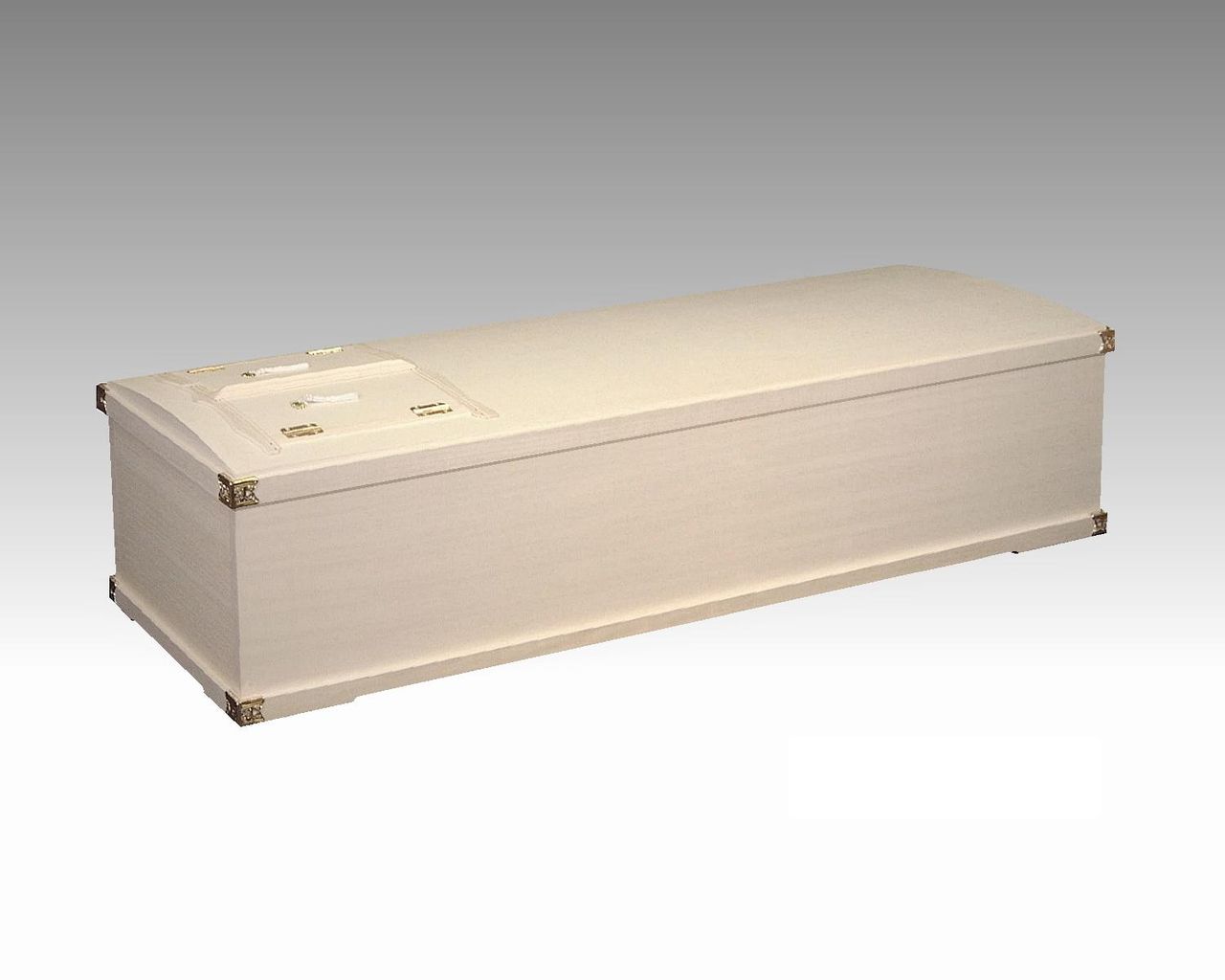
We woke up the next day, and everyone arrived for moving the body to the casket. A man who I figured was the coordinator for the funeral brought a straight (rectangular), narrow wooden casket lined with white silk; it was placed on the floor, sitting on small footstools, beyond Junzo’s now uncovered body. The coordinator waited for everyone to get arranged, and to tie rice-reed ropes (not too dissimilar to what is used at Shinto shrines) around their waists, the stiff strands pointing up and down to indicated heaven and earth.

Then the coordinator brought out a green and purple silk kimono (colors chosen due to Junzo’s preferences), and proceeded to dress Junzo in it. He then placed white cloth coverings over Junzo’s hands and ankles, and slippers on his feet, leaving at least eight cloth strings for family members to then come forward and tie closed. Male family members, myself included, were then asked to come forward and take part of the edge of the top two sheets Junzo rested upon, lift the body up, and place it in the casket. This whole step is called the noukan. The coordinator then covered the body with the blanket used previously, made sure everything was in place, and asked family members to add straw zori sandals and a walking stick to the casket. A box of flowers and petals was then unwrapped, and we were called upon to place these around Junzo’s head until it seemed to float in a pool of color.

The casket was then covered; the top was not on hinges, but was a separate piece, rounded, with small hinged doors above the head. The coordinator hammered four nails almost all the way in at each corner; two rectangular green stones were then given to family members, each of whom used their left hand to tap one of the nails twice. After this, the eldest son was asked to finish hammering in the nails. A white netting was fitted around the casket, and a silk covering around that, both with openings for the doors above Junzo’s head.

JhearseAt this point, male family members were asked to help move the casket to the hearse. The one used for this funeral was western in style, though often a Japanese hearse will have an ornate golden top (see Wikipedia image at right); I saw one as we returned from the crematorium. We all then removed the rope belts and got into cars for the procession. Family members carried items such as the oversized photo with us. When we were ready, the hearse let out a loud, long blow of its horn (not a standard car horn), and took off for the crematorium, all of us following.

The crematorium was in the hills not too far to the south. A beautiful place, I hope to go back there some day to do birdwatching. We collected in a room with two doors leading to ovens, where a metal cart on hydraulics (still radiating heat from the previous cremation) sat waiting. On the other side of the room, Junzo’s photo was placed, and again, incense was lit by all. We were asked to carry in the casket and place it on the cart. The doors above Junzo’s head were opened, so everyone could pay final respects. The casket’s coverings were removed, and the cart was moved into the cremation furnace. The doors were closed and the furnace lit.

The family was then told to wait in one of the buildings nearby, equipped with kitchens and toilets, but mostly common tatami rooms with low tables to sit around. It would be an hour and a half before things would be ready, we were told. We ate snacks and drank juice (saké for those not driving and who wished it), and some of us took walks. I almost wished I had brought my camera with the zoom lens–I know there were some birds I had never seen before.

After the time was up, we were called back in. The cart had already been pulled out, and most of the matter was gone–but a fair number of bone fragments remained, including ribs, vertebrae, recognizable ends of femurs and other parts. They were burned dry, light, and brittle, fragmented but some as much as six inches long. As the family stood and watched, an attendant used a large metal dustpan to collect the bone fragments with a brush, leaving behind remains of the casket. He deposited what he found on a larger metal tray, with the bones from the head in a special part of the tray.

The tray was moved to a part of the room near the shrine with Junzo’s picture, and several sets of rough, oversized bamboo ‘chopsticks’ were handed out. Each family member was called upon to use these to place pieces of bone (not pieces from the head) into a plain white urn. At first, primary family members were asked to do so left-handed; then we came in pairs, using our right hands, two people working together to move individual pieces into the urn. Then primary family members worked to move most of the remaining pieces in, including the dust, which was sifted out by the attendant. This left the pieces of bone from Junzo’s head, which were saved for last–you don’t want them to be in the urn the wrong way up.

The attendant used a stick to compact the bones already in the urn (making slightly uncomfortable crunching sounds), and then the bone fragments from the skull and jaw were added, and the urn closed. The urn was placed in a decorated box. Sachi’s brother was outfitted with a sling which wrapped around his neck, in which the box with the urn was fitted. It was at this point that I teared up more than any other–not just remembering Junzo, but realizing that, if Sachi gets her wish and passes before I do, then I would be doing this for her someday.

Sachi’s brother then walked to the head car with his mother and his wife, as we took the photograph and other mementos with us in the motorcade back home. The urn was placed in the living room where the body had been kept, and we had a light lunch.

Afterwards, we all got in cars again and went to a temple for the actual funeral ceremony. We arrived at the temple and waited for everything to be arranged. Junzo’s remains, along with his photo, were placed upon a dais with other accoutrements, and eventually, we all sat arrayed to one side on strips of thick, bright-red felt carpet while visitors were received. Up until this point, it was a purely family affair. But now, friends, colleagues, neighbors, and other people related to Junzo and/or the family came to pay respects. Each of them made an offering of incense, of the type in the box with the burning coal.

After they had all left, chairs made for tatami rooms were brought out, and we sat through the formal ceremony. The chief priest came out, with his assistant–the same one who had visited the house the night before–sitting on the side at a low desk with metal bowls and a drum along with other devices. The chief priest sat on a low chair atop a floor cushion before the altar with Junzo’s remains, and began chanting. He did so alone at first, but eventually was echoed by or chanted in unison with his assistant. The assistant also made use of the instruments–sometimes the drum, sometimes banging one of two metal pots for a bell sound (one low, the other high), and a hand-held bell on a handle which he would tap slowly and then quickly in three sets of ringing.

Temple01
Templemeal

As the chanting went on, at two different points we were asked by the coordinator to stand, and come forth in line to offer the coal-top incense behind the main priest. Finally, after about a half hour, the chanting ended, as did the ceremony.

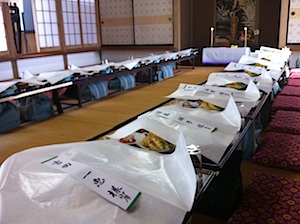
After this, we moved to a dining room with an altar and two rows of low tables. All the meals, previously prepared, lay under white sheets with names written on paper strips atop them. They mixed up my given and family names, so that Sachi’s name was given as “Luis Sachiko.” All but the primary family members were given gift bags, similar to a wedding; the bags, I discovered later, held a small bottle of saké, a rice dish, bean-paste snacks, and a set of towels, along with a card with a small package of tea.

The meals were quite elaborate–grilled fish, meat pâté, sushi and sashimi, tempura, various soups and egg pudding, fruits and so on–maybe as many as two dozen small dishes, common in style but much better quality than fancy inn-style dinners in Japan. There were a few speeches, including one by the head priest, and we all sat down to eat.

After this, I had to get back to Tokyo to catch up on long-delayed work, but after I left, the family took the remains up to the family grave site and placed his remains with all that had gone before him. Before I came home, Sachi called and made sure that, upon entering, I would take a pinch of salt from one of the bowls she had prepared on either side of the door, and throw some on each shoulder and then the top of my head before brushing it off–what you must do before returning to any home after you have attended a funeral.

Thankfully, these two days happened to give a break in the oppressive summer heat; no rain fell during the day, and it was sometimes cloudy, but otherwise relatively cool.

It was quite an experience, and more than most non-Japanese experience unless they are members of Japanese families. While some parts of it were strange to a westerner (like having the body laid out in the living room, or picking out bones of a person I not only knew but to whose body I had shortly before said goodbye), I thought that it was a fairly good way of doing things. In the west, we tend to distance ourselves from death too much, and so fear it perhaps disproportionately. In Japan, from a young age, people are not shielded from this; proximity and contact with the body and its remains seems a sensible thing to expose young people to–though that might just be me.

Categories: Focus on Japan, Focus on Japan 2011 Tags:

It’s Hard to Be Forward-Looking When You’re Always Moving Backwards

June 28th, 2011 2 comments

David Frum, on CNN, explains why conservatives now approve of gay marriage more–but in so doing, also lays out how conservatives, who are almost always wrong on social issues, can slowly migrate to more reasonable positions:

Most conservatives have reacted with calm — if not outright approval — to New York’s dramatic decision.

Why? The short answer is that the case against same-sex marriage has been tested against reality. The case has not passed its test.

Since 1997, same-sex marriage has evolved from talk to fact. If people like me had been right, we should have seen the American family become radically more unstable over the subsequent decade and a half.

Instead — while American family stability has continued to deteriorate — it has deteriorated much more slowly than it did in the 1970s and 1980s before same-sex marriage was ever seriously thought of.

In short, conservatives thought that gay marriage would wreck the tradition of marriage, and when it didn’t, many of them can see that now, so they’re no longer afraid of it. (Ah, if only that were always true of how conservatives see things!) This doesn’t change the fact that conservatives tend to rail against most social progress and have to be dragged, kicking and screaming, into seeing reason. I’d like to hear Frum’s conservative rationale on why they didn’t simply begin from the assumption that gays could have equal rights.

Of course, we liberals could have told them that gay marriage was not a threat from the start–the arguments that gays would destroy marriage were patently ridiculous, and frankly, even a fool could have seen that (see my rant about that from eight years ago). But I suppose that if your church and your entire political fraternity are shouting at you that it’s going to send everything to hell in a handbasket, it might be hard to ignore.

There are still holdouts, people who refuse to join the rest of the crowd. People like Newt Gingrich, for example, still disapprove, but there are signs of change even there–Gingrich, a twice-divorced adulterer, is now saying that gay marriage “muddles” the institution, which I suppose is an improvement over “destroying” or “threatening.”

The thing is, gay marriage is not the only thing that many conservatives have “come around” on. In fact, conservatism, by definition, is about opposing progress and clinging to the past–and that, in social terms, means that if you are conservative, then you are almost always backwards on social issues. Conservatives hold assiduously onto what has been, usually relinquishing their embrace of the past only when it is indeed past.

In the American Revolution, the conservatives were the Loyalists, who wanted to remain subjects of England. Such people were older, wealthy, established land-owners who had sentimental attachments to their British past. It was only after the war was won that conservatives decided that independence was a dandy idea. In the Civil War, the slave-owners were the conservatives, wishing to maintain the traditions of the past, fighting against the newer wave of abolitionism, and resentful of the controlling government that wanted to tell them what was right and wrong, especially that they could not keep their slaves. Only years after the war did conservatives revile slavery. In the battle over women’s suffrage, conservatives opposed; in the battle over civil rights for minorities, conservatives opposed; in the battle over gay rights, conservatives have and many still do oppose. There is a lag there, from the settling of an issue to conservative acceptance of it. If it’s not in the past, it tastes wrong to them.

Now, regarding most of this history, conservatives will tell you otherwise–that conservatives were all for the revolution, because they wanted to preserve traditional rights for the people; while this may have been true for some, it does not change the fact that on the whole, the opposition to the revolution was predominantly conservative in nature. Right-wingers love to point out that Lincoln founded the Republican Party–but ignore the fact that “Republican” and “Democrat” are political, not ideological affiliations, and have shifted over time. Lincoln was not a conservative in his day. But conservatives take credit for freeing the slaves nonetheless–despite the fact that the party affiliation is about as relevant and meaningful to that as is facial hair or top hats.

Again, when it comes to the battle for civil rights, conservatives love to point out that the South was controlled by Democrats at the time, and therefore it was liberals who opposed equal rights for minorities–a patent falsehood, and again a blurring of lines due to politics. The South was deeply conservative, and it was, in fact, the support of civil rights by the Democrats that helped drive these conservatives into the open arms of the Republican Party.

I have little doubt that, in fifty years or so, conservatives will be proudly boasting about how they supported gay rights all along, and it was liberals who somehow opposed them–they’ll probably bring up Log Cabin Republicans and Clinton instituting DADT as examples of proof. They do love to rewrite history with them always being right.

The tide of history, however, shows that almost always, the reverse is true. Conservatives have and probably always will be on the wrong side of history when it comes to social issues, something that comes part and parcel with trying to move backward instead of forward.

Frum simply laid down one cogent theory as to how the evolution sometimes occurs, in the more peaceful of cases, and with the more reasonable of social conservatives. Unfortunately, it does not apply universally and certainly not immediately, else conservatives would be a lot more reasonable on a whole host of other issues. It’s only after they have fought hard and long and have lost, and then after a decade or so of whining and protesting and foretelling doom, that they look around, see how stupid they look, and start claiming that they were with the “in” crowd from the start.

Categories: Right-Wing Hypocrisy Tags:

Pushing the Lie, Again

June 25th, 2011 1 comment

Republicans are revisiting death panels, saying that characterization didn’t go far enough:

Democrats like to picture us as pushing grandmother over the cliff or throwing someone under the bus. In either one of those scenarios, at least the senior has a chance to survive. But under this IPAB [Independent Payment Advisory Board] we described that the Democrats put in “Obamacare,” where a bunch of bureaucrats decide whether you get care, such as continuing on dialysis or cancer chemotherapy, I guarantee you when you withdraw that the patient is going to die. It’s rationing.

— Rep. Phil Gingrey (R-Ga.), June 22, 2011

Number one: Given the false choice, would you rather have your medical funding decided by bureaucrats, who at least might possibly be under the impression that you pay their salary and so they work for you, or by private insurance company lawyers who are paid specifically to deny you any medical treatment they can possibly arrange?

Number two: this kind of “bureaucratic rationing” already occurs under Medicare. I had no idea all of them were doomed to die. Well, eventually–but then, so are we all, no matter what. But I am pretty sure that’s not what people like Gingrey mean. Programs like Medicare demonstrate that when the state controls the system, it is less likely to deny treatments. Private corporations have shown they are more than willing to do so if there’s a buck in it. And if cuts are necessary, plans like the Affordable Care Act will consult doctors, not bureaucrats. Oh, and the ARA allows you to choose between systems, where government-run care would only survive if it did a better job treating you.

Number three: rationing occurs when there is less money to be spent. With private firms skimming as much as 30% off the top, and programs like Medicare being much more efficient than private-sector programs, government-run programs will not have to ration nearly as much as is happening now.

Number four: unless they are sabotaged from within by Republicans, programs like the Affordable Care Act will end up saving us a lot of money. The problem: we’d pay out in taxes more than fees. And Americans hate taxes so much, they’d rather pay a $100 fee than a $50 tax. Just like they fear bureaucrats more than they fear corporate lawyers. I think it’s kind of how people fear terrorist attacks more than traffic accidents, or shark attacks more than crossing the street. We fear what we are told to fear.

We Got This One, At Least

June 24th, 2011 Comments off

Governor Perdue of North Carolina vetoed a Republican bill aimed at disenfranchising Democratic voters:

The right to choose our leaders is among the most precious freedoms we have – both as Americans and North Carolinians. North Carolinians who are eligible to vote have a constitutionally guaranteed right to cast their ballots, and no one should put up obstacles to citizens exercising that right.

We must always be vigilant in protecting the integrity of our elections. But requiring every voter to present a government-issued photo ID is not the way to do it. This bill, as written, will unnecessarily and unfairly disenfranchise many eligible and legitimate voters. The legislature should pass a less extreme bill that allows for other forms of identification, such as those permitted under federal law.

There was a time in North Carolina history when the right to vote was enjoyed only by some citizens rather than by all. That time is past, and we should not revisit it.

Therefore, I veto this bill.

The veto will, thankfully, probably not be overridden. However, it should be noted that Governor Perdue is a Democrat; it would have been much more encouraging had a Republican demonstrated the moral virtue of striking down a bill by his or her own party aimed at illegitimately stripping Americans of the right to vote based on political affiliation.

Sadly, that is not likely, and in many states where the legislature and the governorship are both held by Republicans, it is almost certain that such laws, passed by legislators eager to violate the civil rights of those who would not vote for them, will be happily signed by governors of similar moral depravity.

It should also be noted that for these laws to pass in the first place, almost the entire Republican bloc must vote in unison–demonstrating how very little moral courage exists among the individual members of the right wing of our legislatures.

Getting a Clear Picture

June 24th, 2011 1 comment

It’s pretty difficult to get a completely accurate read on how bad things are after the Fukushima reactor. A great deal of this is due to news stories which focus on sensationalism without actually checking the facts.

Take a recent Al Jazeera story, titled “Fukushima: It’s much worse than you think.” Much of the story may or may not be true, but take this nugget:

In the US, physician Janette Sherman MD and epidemiologist Joseph Mangano published an essay shedding light on a 35 per cent spike in infant mortality in northwest cities that occurred after the Fukushima meltdown, and may well be the result of fallout from the stricken nuclear plant.

The eight cities included in the report are San Jose, Berkeley, San Francisco, Sacramento, Santa Cruz, Portland, Seattle, and Boise, and the time frame of the report included the ten weeks immediately following the disaster.

“There is and should be concern about younger people being exposed, and the Japanese government will be giving out radiation monitors to children,” Dr MV Ramana, a physicist with the Programme on Science and Global Security at Princeton University who specialises in issues of nuclear safety, told Al Jazeera.

Sounds pretty striking. However, when you actually think about it, it also sounds completely bogus. Radiation levels along the west coast of the U.S. barely showed any trace of radioactivity from Japan, and what was found was insignificant in the context of background radiation. For this to result in a 35% spike in infant mortality sounds rather ludicrous, and should not pass anyone’s initial sniff test.

Sure enough, the data was found to be incorrect, if not fraudulent. The essay cherry-picked eight cities which made a writer for Scientific American “pick up a whiff of data fixing,” and the essay used only a four-week period prior to the Fukushima disaster to establish a baseline for infant mortality. Coincidentally, those four weeks showed strikingly low mortality rates, most likely a statistical blip–from the fifth week back, rates were considerably higher on average. When the Scientific American reviewer checked the data, even for just those eight cities, for the entire year, he found that infant mortality rates were actually declining throughout the year, not spiking sharply.

The ten weeks after Fukushima did see a few high numbers, but the four weeks previous were unusually low. The low numbers before Fukushima were not, of course, related to the incident, but were the primary reason a “spike” seemed to appear when only those four weeks were used as a baseline. One could just as easily compare the data for the month before those four weeks and see a similar “spike” occurring two months before Fukushima.

In short, the essay’s claims should never have been published. Sure, the media might not want to wait around for every study to be peer-reviewed, but if you don’t, then you are bound to release, as “news,” completely erroneous data as shown above. This only serves to put all the rest of the claims in the Al Jazeera article in question–what else was not fact-checked? Was the writer going for the sensationalist angle, only choosing to focus on evidence which supported a predetermined conclusion?

This is not to suggest that Fukushima isn’t worse than we think it is–it may well be a lot worse–but it suggests that not all the alarmist information, including that released by “experts,” is as accurate as we believe. That goes for data suggesting that things aren’t so bad as well.

Because the atmosphere regarding nuclear power, even within the halls of science, is so subject to polarized views and infected by bias, added to the fact that there is so much we just don’t know for certain about the subject of radioactivity and health, it is much harder to get a clear picture of how bad things really are.

Rewarding Sabotage

June 23rd, 2011 1 comment

From TPM:

They’ve made it explicit. Democrats are accusing Republicans of trying to sabotage the recovery — or at least stall it — by blocking all short-term measures to boost the economy, even ones they previously supported.

Ya think?

And this is news? It’s been happening since Obama took office. When most economists were saying that we needed boosts in infrastructure and other job- and value-creating spending, and that more tax cuts were the least stimulating, Republicans fought tooth and nail for less stimulus and more tax cuts. While the Dems, and especially Obama, have been far too conciliatory and indulgent with right-wing demands, they have worked in mostly the right direction for recovery (or at least a much better direction), and, were it not for the changes they allowed Republicans to wheedle them into making, we’d be in a lot better shape right now.

Much of it may just be Republicans favoring their more wealthy constituents or following the party line, opposing anything Obama and the Dems propose–but it does, in fact, have the overall effect of sabotaging any economic recovery.

Republicans have demonstrated, repeatedly, that they consider their own hold on power as a far higher priority than the health and welfare of the people and the country. Boehner said it clearly enough: “The single most important thing we want to achieve is for President Obama to be a one-term President.” The Republican leadership knows full well that a wrecked economy will hurt Obama and the Dems while they are in office, and that when Republicans take power back, the absence of them wrecking the economy can be played as them “saving” it. In the meantime, they are quite happy to threaten shutdowns and defaults and everything else that could make the economy tank, knowing that so long as Obama is in the White House, everything they do to trash the economy will be “his” fault.

The real tragic irony is that, in 2010, and probably again in 2012, the people, as a result of this purposeful slowing of the recovery, have rewarded and will likely reward those who harmed them the most.

Misinformed

June 23rd, 2011 Comments off

When Jon Stewart appeared on Chris Wallace’s Fox News show, he made the statement that Fox News viewers are the most consistently misinformed media viewers–which is likely correct–but then added a tag which he probably regretted, saying that this was proved “consistently, every poll.”

Politifact then gave Stewart a “False” rating on their Truth-O-Meter, pointing out that they are not the most consistently misinformed on every poll, pointing to polls which show the statement to be untrue. While Politifact is technically correct, their determination nonetheless gives an impression which is decidedly contrary to actual fact.

In the following video, Stewart both owns up to his own factual misstatement–and proves that, in his more general meaning, he was precisely correct, using Politifact’s ratings on Fox News’ statements as evidence:

I saw the Politifact story before the Stewart piece, and frankly, was disappointed. Yes, they were correct about Stewart being wrong; factually, it is not true that every poll shows Fox News viewers to be the most misinformed. However, the spirit of Stewart’s comment was, as he demonstrated in the bit, very much correct.

In fact, Politifact’s article itself is misleading.

Here’s why: in most of the polls about being informed, the status of “informed” with “high knowledge” is determined with questions like:

  • who is the vice president?
  • who is the president of Russia?
  • is the Chief Justice a conservative?
  • does the U.S. has a trade deficit?
  • which political party has a majority in the U.S. House of Representatives?
  • what is the name of the current U.S. Secretary of State?
  • who is the current prime minister of Great Britain?
  • which company is run by Steve Jobs?
  • which country has an active volcano that has recently disrupted international air travel?

Frankly, in the context of whether Fox News misinforms its viewers, these questions are meaningless. The charge is not that Fox misinforms its viewers about general facts, like who the vice president is, but politically charged facts, like whether the president wants to kill your grandmother.

This 2010 study (PDF), meanwhile, was discounted, because it contained determinations of truth that, while accurate, were challenged–by organizations like Fox News. Questions like:

Is it your impression that most economists who have studied it estimate that the stimulus has (a) saved or created several million jobs, (b) saved or created a few jobs, or (c) caused job losses.

That’s a perfectly legitimate question, but was challenged because, supposedly, it measured whether the respondent is a person “who agrees with the conclusions of experts in government agencies.” That criticism, however, is BS–the questions did not ask if the respondent agreed with the experts, but rather what the experts were saying. Which is a legitimate measurement of knowledge and misinformation.

Nevertheless, this was used to dismiss the results–even though this one survey was the only one that actually measured the political misinformation for which Fox News has become so infamous.

What Stewart should have said was that in a 2010 survey, one designed to measure political misinformation due to bias, Fox News viewers scored worst on almost every single point. The points Fox News viewers were the most misinformed on:

  • most economists estimate the stimulus caused job losses (12 points more likely)
  • most economists have estimated the health care law will worsen the deficit (31 points)
  • the economy is getting worse (26 points)
  • most scientists do not agree that climate change is occurring (30 points)
  • the stimulus legislation did not include any tax cuts (14 points)
  • their own income taxes have gone up (14 points)
  • the auto bailout only occurred under Obama (13 points)
  • when TARP came up for a vote most Republicans opposed it (12 points)
  • and that it is not clear that Obama was born in the United States (31 points)

Many of these points are legitimate for measuring viewer knowledge because they represent knowledge which is necessary to make wise, informed judgments on which policies and politicians are most likely to benefit the country at large; all points measure whether viewers have been swayed by political attacks driven by raw bias.

I think it’s safe to say that, yes, Fox News viewers are, if not the most misinformed, consistently, then they are pretty damned misinformed.

Categories: "Liberal" Media, Right-Wing Lies Tags:

What It Isn’t Good For

June 19th, 2011 1 comment

One thing that has kind of mystified me is why so many, including liberals, seem to be equating the Libyan intervention with the Iraq War. “We’re now at war with five countries,” I hear. Well, if you want to take the greatest liberty in stretching the definition, I suppose so–if being involved in bombing is equal to being at war, then perhaps so. But what we’re doing in Libya is about as far from what we’re doing in Iraq as one can imagine.

This also serves to make a more recent distinction between recent Democratic and Republican wars: Clinton and Obama have limited their wars strategically, intervening where it is both potentially stabilizing as well as humanitarian, but doing so in a relatively risk-free and hands-off manner, using mostly bombing and other forms of support. The last two Republicans, Bush junior and senior, engaged in rather dramatic, major land wars in Asia.

The initial Gulf War was a “good” war, in that it was carried out well and was to good purpose–the flaw was that it was unnecessary, had Bush 41 only paid a bit more attention to whom he was dealing with. The war in Afghanistan again was a “good” war, in that it was something we all agreed was necessary–but again, had Bush 43 only paid a bit more attention, 9/11 would have been foiled and the war would not have been necessary. However, unlike his father, Bush 43 tanked his “good” war, dropping the ball and turning what should have been a conflict of less than a year, maybe two, into a decade-long quagmire. As for Iraq, well, the whole thing was a catastrophic blunder from start to finish.

In contrast, Clinton’s Kosovo intervention was extraordinarily restrained; even when NATO wanted to send ground forces in, Clinton held back, and eventually, the air campaign succeeded. While it is still unclear if Obama’s from-the-air, NATO-led intervention in Libya will also be successful, they share other key similarities, in that they are being carried out more for humanitarian purposes rather than to correct tactical blunders or to serve America’s self-interests.

One other shared feature of these conflicts is their defiance of the War Powers Act. While that act remains controversial, it is law, and it makes me uncomfortable when it is more or less ignored like it is. Clinton dodged it by claiming that funding by Congress implicitly approved it by providing funding; Obama is dodging it by claiming it’s not a direct conflict, but instead we are just playing a support role to NATO.

There are extenuating circumstances, however. In both cases, the wars are “good” wars–carried out not for profit or self-interest, but to prevent oppression. In both cases, the wars are limited, costing relatively little (Libya is costing America no more than $10 million a day, whereas the wars in Iraq and Afghanistan, at their peaks, cost a collective billion dollars per day. In both cases, the wars use only air power, meaning only a minimal risk to our own forces.

One more difference, however, is significant: in both conflicts, while a Democratic president in power tries to use severely restrained, low-cost and low-risk military force to humanitarian ends, a Republican-led force in Congress wants to end the war for purely internal political game-playing reasons stemming from spite and pre-election-year posturing.

This, to me, is the main thing that keeps me from being pissed at Obama–the fact that support from Congress would never be in question were it not for petty game-playing by Republicans. Were it Bush doing this, for example, they would give absolute support for the action. This, to me personally, constitutes effective approval, if not legal approval, and is why I have few problems with what Obama is doing. If Obama is playing games with the War Powers Act, then he is doing it because the Republicans are doing it first–and Obama, at least, is doing it for the right reasons, something which cannot be said about the Republicans.

What bothers me is the precedent–that a future president, for less noble reasons, may start a major land war expensive in both lives and funding, using the same dodge. The problem is, as we saw with Bush 43, even the War Powers Act doesn’t work well when it is enforced, and is only as strong as Congress would be without the act in any case.

Categories: Military, The Obama Administration Tags: