Archive

Author Archive

Quake Under Fuji

March 15th, 2011 4 comments

We just felt a sizable quake–and it wasn’t on the original fault line. This one was right under Mt. Fuji. It came just a few minutes after a different tremor.

Not very comforting…

Update: It was a 6.0 quake, but a “strong 6” on the Japanese effect-based scale. Looks like the quake that preceded it was a 3.0 in the same area. Strictly rumor only, not news-related or from any expert: it’s possibly volcano-related (update–nothing on the news about that, it’s probably nothing volcanic).

10:40 pm: we’re feeling another aftershock.

10:44 pm: another aftershock just a minute ago.

10:50 pm: it looks like the quake just before the big one was actually a 6.2 in Fukushima, at 10:28 pm. After the 6.0 in Shizuoka a few minutes later (10:31 pm), we got aftershocks: a 5.6 in Fukushima at 10:38, a 4.0 in Yamanashi at 10:40, then a 3.6 in Shizuoka at 10:43, followed by a 3.2 in Shizuoka at 10:46, and a 2.9 in Yamanashi at 10:49.

So, effectively, we’re being shaken from both sides here.

11:04: reports on the news coming in from Shizuoka tells of stuff falling off of shelves, some damage near the epicenter.

Under the Japanese Seismic Intensity Scale, in a “strong 6” (which this one was), it is “impossible to keep standing and to move without crawling,” and “Most heavy and unfixed furniture moves and falls.” In this kind of quake, “less earthquake-resistant” houses can collapse and more resistant houses can sustain serious damage.

We’ll have to see how this one turns out.

Give Me a Break

March 15th, 2011 9 comments

This headline on MSNBC’s web site:

Screen Shot 2011-03-15 At 8.16.51 Pm

Really. “Panic grips Tokyo”? Where, exactly, did they get this? Their person on the ground in Tokyo? This is the first graf:

Panic swept Tokyo on Tuesday after a rise in radioactive levels around an earthquake-hit nuclear power plant north of the city, causing some to leave the capital and others to stock up on food and supplies.

Okay. I don’t know how many are “leaving the capital,” but I haven’t noticed any abnormal traffic. Most people probably wouldn’t have enough gas for the trip, and most trains out of town aren’t running. But if people are leaving Tokyo, it’s probably as much for the aftershocks and the supply problems as it is from the radioactivity.

Second, people have been stocking up on food and supplies since Friday, something which did not change today. The lines I showed in my last blog post were simply a morning thing to keep the store from getting too crowded at once, and was the only store in the neighborhood doing it. Things are about the same today as they were two days ago, just a little farther progressed. People are buying because supplies look to be short, not because of radiation levels.There has been no sudden jump in buying or traffic.

People around here, as well as people I know around town, are all calm and coping. Television broadcasts show none of the panic reported above. Yes, some foreign residents are freaked out, but probably that’s because they depend on sites like the one I cite above, read headlines like this, and then react like the article shows.

Panic, my ass. Concern, yes. A few people freak out, yes. But on the whole, “Tokyo” is doing just fine.

Supply Lines

March 15th, 2011 4 comments

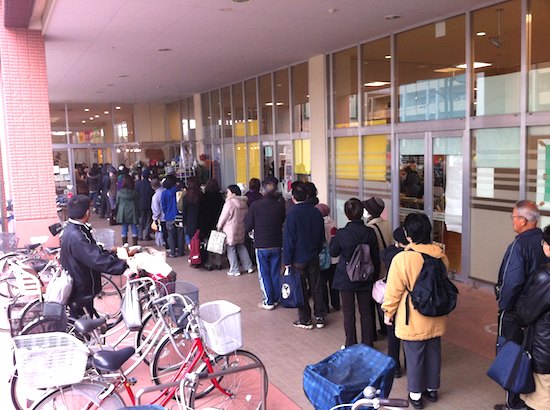
Well, distribution problems continue. Yesterday, gas stations were either closed or had very long lines. Supermarkets have been out of bread products for a few days now, and what comes in quickly goes out. I thought I’d check out the supply in the morning, and found this at about 10:30am:

Supermarket-03-15

I could not see inside enough to figure if they had fully restocked or not, but they won’t be for long, I am guessing. Maybe tomorrow I’ll try getting up a bit earlier and get in the (probably much longer) lines to get something. It is currently kind of hard to tell whether this is purely because of supply problems, or if panic buying and hoarding is playing a role. Since I did not get in, I could not see if prices had been jacked up, but they had not been yesterday when the place was nearly sold out.


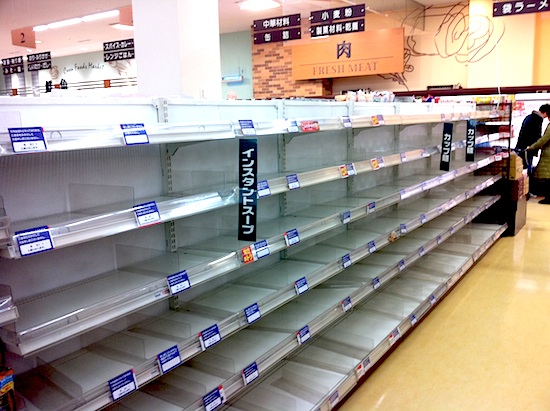
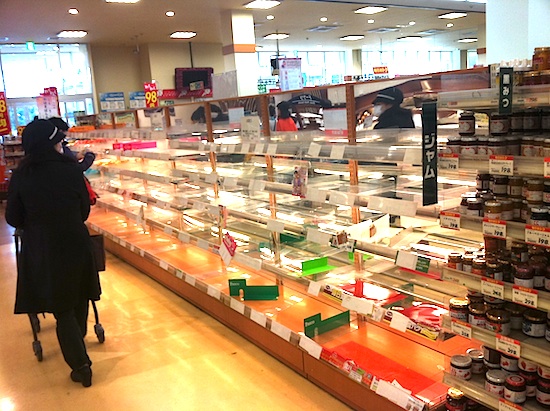
I wrote the above this morning, and Sachi and I just got back from opening a bank account at the bank we’re getting a loan from. After going to the bank, we figured we’d check out the food store below Seiyu (owned by Walmart, incidentally). Their fruits & vegetables remained fairly stocked (seems that there are a lot of farms in the area, so no problems there), but milk, eggs, and bread and other bakery goods were cleaned out–along with meat and other items. In short, meat, bread, & dairy–which often come from up north–are predictably in short supply.

Supermarket-03-15-01

Supermarket-03-15-02

In surprisingly good supply: fish. I am guessing that most of the fleet was safely out to sea, and therefore unaffected by the tsunami, so there was lots of tuna and other seafood available. We got to the store at a good time for the bakery–the shop in Seiyu’s basement was baking stuff and putting it out on the fly (ringing a bell each time new stuff came out), so we could get some muffins, a few pastries, and a “milk bread” confection, all fresh out of the over. People were snapping them up as soon as they came out, but when I got there, they had just put out a lot of stuff and almost no one was there.

Prices remain stable, nothing has gone up noticeably.

In the meantime, fast food and other restaurants are still open, for the most part.

We have not had a blackout in our area yet, despite having been told twice that the power would be cut at such-and-such a time. I can only assume that they are planning for the worst and then doing what is necessary. One is due in about half an hour or so. Internet continues to stay on as it has since the quake started.

* [Probably Misleading] Article to Calm People Down about the Nuclear Thing

March 14th, 2011 22 comments

*I have been reminded that the writer of the below material posts links to strongly pro-nuclear organizations, and may be biased himself. I maintain that the writing is, at the very least, far more factual and probably much closer to the truth than a lot of the stuff we see in the media nowadays. Judge for yourself.

Update: More is coming out suggesting that Josef Oehmen and the people who put up the site are far less than unbiased or expert in the proclamations. It would appear that I got fooled. My apologies. If it’s any consolation to me, a lot of other people were taken in as well. Thanks to Troy and others for staying on top of this.


Here’s a great blog post by Dr. Josef Oehmen, a research scientist at MIT, in Boston, basically telling people that the nuclear situation in Japan is not even close to being as bad as it’s being made out to be by activists and a media looking for the sensational angle.

He explains in layman’s terms how the nuclear plants in question work, and why there’s not going to be a huge radioactive release.

A few excerpts:

I am writing this text (Mar 12) to give you some peace of mind regarding some of the troubles in Japan, that is the safety of Japan’s nuclear reactors. Up front, the situation is serious, but under control. And this text is long! But you will know more about nuclear power plants after reading it than all journalists on this planet put together.

There was and will *not* be any significant release of radioactivity.

By “significant” I mean a level of radiation of more than what you would receive on – say – a long distance flight, or drinking a glass of beer that comes from certain areas with high levels of natural background radiation.

I have been reading every news release on the incident since the earthquake. There has not been one single (!) report that was accurate and free of errors (and part of that problem is also a weakness in the Japanese crisis communication). By “not free of errors” I do not refer to tendentious anti-nuclear journalism – that is quite normal these days. By “not free of errors” I mean blatant errors regarding physics and natural law, as well as gross misinterpretation of facts, due to an obvious lack of fundamental and basic understanding of the way nuclear reactors are build and operated. I have read a 3 page report on CNN where every single paragraph contained an error.

He ends with this:

My assessment:

  • The plant is safe now and will stay safe.
  • Japan is looking at an INES Level 4 Accident: Nuclear accident with local consequences. That is bad for the company that owns the plant, but not for anyone else.
  • Some radiation was released when the pressure vessel was vented. All radioactive isotopes from the activated steam have gone (decayed). A very small amount of Cesium was released, as well as Iodine. If you were sitting on top of the plants’ chimney when they were venting, you should probably give up smoking to return to your former life expectancy. The Cesium and Iodine isotopes were carried out to the sea and will never be seen again.
  • There was some limited damage to the first containment. That means that some amounts of radioactive Cesium and Iodine will also be released into the cooling water, but no Uranium or other nasty stuff (the Uranium oxide does not “dissolve” in the water). There are facilities for treating the cooling water inside the third containment. The radioactive Cesium and Iodine will be removed there and eventually stored as radioactive waste in terminal storage.
  • The seawater used as cooling water will be activated to some degree. Because the control rods are fully inserted, the Uranium chain reaction is not happening. That means the “main” nuclear reaction is not happening, thus not contributing to the activation. The intermediate radioactive materials (Cesium and Iodine) are also almost gone at this stage, because the Uranium decay was stopped a long time ago. This further reduces the activation. The bottom line is that there will be some low level of activation of the seawater, which will also be removed by the treatment facilities.
  • The seawater will then be replaced over time with the “normal” cooling water
  • The reactor core will then be dismantled and transported to a processing facility, just like during a regular fuel change.
  • Fuel rods and the entire plant will be checked for potential damage. This will take about 4-5 years.
  • The safety systems on all Japanese plants will be upgraded to withstand a 9.0 earthquake and tsunami (or worse)
  • (Updated) I believe the most significant problem will be a prolonged power shortage. 11 of Japan’s 55 nuclear reactors in different plants were shut down and will have to be inspected, directly reducing the nation’s nuclear power generating capacity by 20%, with nuclear power accounting for about 30% of the national total power generation capacity. I have not looked into possible consequences for other nuclear plants not directly affected. This will probably be covered by running gas power plants that are usually only used for peak loads to cover some of the base load as well. I am not familiar with Japan’s energy supply chain for oil, gas and coal, and what damage the harbors, refinery, storage and transportation networks have suffered, as well as damage to the national distribution grid. All of that will increase your electricity bill, as well as lead to power shortages during peak demand and reconstruction efforts, in Japan.
  • This all is only part of a much bigger picture. Emergency response has to deal with shelter, drinking water, food and medical care, transportation and communication infrastructure, as well as electricity supply. In a world of lean supply chains, we are looking at some major challenges in all of these areas.

So, everyone stay calm!

It’s No Chernobyl

March 14th, 2011 3 comments

Here’s what seems like a voice of reason:

I wish the anti-nuke crowd would back off the rhetoric. I know this is a golden opportunity for them to scare people off of nuclear. Frankly, the whole nuclear debate is well worth going over, and personally I wish we were going full-on towards solar, wind, and sea power. But right now, people are in a state of near-panic, and activists going around talking about disaster so they can stir up support for their positions are being stupid and irresponsible. They are scaring a lot of people unnecessarily, and making life difficult for people here.

Anyway, I am headed in for work, so I will be offline for as long as it takes. Will be checking in all day long, of course.

We Need the Hitchhiker’s Guide Right Now

March 14th, 2011 3 comments

Well, things are a bit of a mess–more in terms of organization than anything else, it seems. They announced rolling blackouts last night and my school spent most of last night coordinating messages and planning around power and train announcements… so naturally, we wake this morning to find there are no blackouts but the trains are pretty much not running. So we had to just cancel everything today. Thanks, government guys. Smoothly handled!

In the meantime, a lot of people are acting less on information they have and more on information they don’t. The French and Chinese embassies sent out advisories to leave Japan and not to travel to Japan. Well, thanks, guys–now people are seeing those and thinking these governments know something others don’t, and that gets inflated into “imminent nuclear disaster” and so forth. Seems like people are beginning to panic, but mostly because of the effect of other people panicking.

This image was posted on Facebook by a former student, Kaz:

190720 1632789015755 1117549517 31302495 8034485 N

Indeed.

New House Seems OK

March 13th, 2011 4 comments

I went to check out the house, and it appears to be perfectly fine–no broken glass, no damaged concrete or plastic, not so much as a cracked tile anywhere. That’s the general result around here. The trains were running normally, with no crowding on the trains. The people who built our house say that they will not be doing more than just a basic visual check with us this Friday, so it’s pretty much up to us to spot any damage that might not be immediately apparent. I’ll probably ask them to turn the gas on in addition to the water, so we can make sure all the lines are holding up OK. Don’t know what else we can do, aside from hiring an engineer, who would be prohibitively expensive and probably not necessary.

More or Less Normal

March 12th, 2011 17 comments

As northern Japan is devastated, Tokyo is more or less normal. Train lines have come back up, and those who were trapped in the city are now largely back home. The only things that seem different are a few bare areas in markets. Although the meat and fish (much meat in Japan comes from up north; fishing, obviously, may have been affected by the tsunami) were low in supply, they were still there. What was missing: pastry and instant noodles. Instant noodles made sense at least–a quick, easy food with a long shelf life. People may have feared a quake hitting Tokyo, though frankly I don’t see that as being any more a risk than usual. But the pastry? Not sure why that should be absent…

Super01

Super02

Japan and Building Codes

March 12th, 2011 4 comments

About a week ago, Sachi and I visited the offices of the firm that built our house. We saw videos showing the engineering technologies to protect against quake damage. The two I recall specifically are wall panels that protect against structure collapse, and structural posts which keep the building from separating from its foundations.

An article from the New York Times says that Japan’s strict building codes probably saved a lot of lives:

In Japan, where earthquakes are far more common than they are in the United States, the building codes have long been much more stringent on specific matters like how much a building may sway during a quake. …

Japan has gone much further than the United States in outfitting new buildings with advanced devices called base isolation pads and energy dissipation units to dampen the ground’s shaking during an earthquake.

The isolation devices are essentially giant rubber-and-steel pads that are installed at the very bottom of the excavation for a building, which then simply sits on top of the pads. The dissipation units are built into a building’s structural skeleton. They are hydraulic cylinders that elongate and contract as the building sways, sapping the motion of energy. …

New apartment and office developments in Japan flaunt their seismic resistance as a marketing technique, a fact that has accelerated the use of the latest technologies, said Ronald O. Hamburger, a structural engineer in the civil engineering society and Simpson Gumpertz & Heger, a San Francisco engineering firm.

Later today, I’ll be driving over to the new house to check it out, but I will be very surprised if it shows any damage.

I would, however, like to make a small political point here. The building codes and other rules that saved so many lives? That’s what you call “government regulation.” The purpose of which is not to stifle or dominate, but to protect and safeguard. In this case, it kept people from dying as much. In other cases, it safeguards against damage done by people and corporations. Regulation, far more often than not, is a good thing.

After the Quake

March 11th, 2011 9 comments

After the shaking stopped, I tiptoed through the stuff covering the floor, and went through the building, helping the staff tell everyone to get out and collect outside. I quickly grabbed my laptop, bag, and jacket–as well as my bike helmet–and headed downstairs. Everyone was gathered out on the street. Phones were down–and still are, 4 hours later–as was text messaging. 3G Internet was still available, but for 15-20 minutes after the quake, no news services had anything. It took a bit longer than that before I found a Google News story about a 7.9 quake, but no news site would load enough to get other information.

As we waited out on the street, we could see the 40-story high-rise being built to our north, with four giant construction cranes towering over it–and even in the aftershocks, those cranes were swinging around like tree branches in a heavy wind.

I hit an incredibly lucky break of sorts today. As we needed documents from city hall for our upcoming home purchase, I decided this morning, on the spur of the moment, to take my scooter. I hardly ever do that anymore; I drive in maybe only once every two months nowadays. But I did this morning, and it was a fairly major break for me. From what I hear, trains are still not running, and one can only imagine the crowds when they start up again. I have heard that as many as 70 students at my school are still there, and may have to sleep there until trains start up again, maybe not even tonight. (I am Skype texting with one of them as I type this, in fact.)

The first thing I did was to take my scooter to the local gas stand; I didn’t think I had enough fuel to get me all the way home. I actually figured that the gas stations, naturally, would be shut down–but surprisingly, they were not. In fact, far from the long lines I imagined, there was almost no one there. I filled up and scooted over to the school grounds where everyone had gone. People shared stories–being on the subway, having relatives near the epicenter, speculation about the effects, and so forth–and otherwise just tried to recover from the event. Several of my students and I had planned to go to Akihabara tomorrow to buy computer parts of the Computer Making Club; when I suggested we postpone the trip, at least one student–who wants to make her own computer alongside ours–was very disappointed.

After it seemed clear that I would not be of any use, I did what I had been planning to do but was torn over: go home. On the one hand, I felt like a selfish heel, scooting on home while everyone else stood around in a dirt yard in the windy cold with probably no way to get home until the next day. But I also was unable to contact Sachi, and fearing she was even more worried about me than I was about her, well, that won over. By this time, it was about 50 minutes after the quake had struck.

As I started driving home, I noted so many people outside, especially with their dogs. So many had left their buildings and gathered outside. Offices were beginning to shut down, and people in the city were beginning to go home the only way they could–by walking. People were out on the streets in numbers, with crowds at every bus stop. The buses, overcrowded of course, were the only way many people had of getting even close to home. The trains were down, of course, and I certainly would not have wanted to try to flag down a taxi just then.

Interestingly, traffic itself was rather normal. I expected a huge traffic jam, a parking lot from one end to the other–but that wasn’t how it was. Instead, the streets were no more crowded than usual. I drove down Ome Boulevard, and while there was congestion here and there, it was not something I would be surprised at on any day.

As it happened, my brother and his wife live right along the route I was taking, so I stopped by. My sister-in-law was home, but my brother was still at work, and they were communicating by Skype. Just as I left, he indicated he would walk home–a three-and-a-half mile walk, but it was the only way. I got back on my scooter and continued going.

There was really no special damage along the way. Oh, fire trucks were present here and there, and a few old buildings seemed to need some help, but mostly it looked like business as usual. Businesses, in fact, were still open, everything except the trains seemed to be operating as usual. Every red light, I would get out my phone and retry texting Sachi, though it didn’t work all the way home.

Finally, I got home, and Sachi was there, doing fine. Some furniture had moved a few inches, and there was some spilling on the floor, but nothing broke and everything seemed OK. The electricity is still on everywhere I could see, the Internet never went offline, and water is running–but the gas is off, at least in our apartment. There may be an emergency switch somewhere, I’ll have to check that out.

About an hour ago, I got through to someone on my cell phone, but that was the only call that went through–I have not been able to make calls before or since. We had nabe for dinner–a stew you boil right there at the table. We used an IH (induction heating) hotplate, while continuing to watch the nonstop news on TV.

So, we’re just fine here–Tokyo was not hardest hit by far–but we’re still getting hit by aftershocks. A rather big one just hit, the 20th or so quake that, on any other day, would rate its own little blog post. We expect these will keep happening for a while.

Quite a day.

Images from Tokyo, Immediately Post-quake

March 11th, 2011 3 comments

We’re still getting aftershocks every 5-10 minutes. The last one just hit now, and several are recorded as being as strong as 6 on the Richter scale. Another big one could hit, so we have to be careful. The original quake was brought back up to an 8.8.

The images on television are rather shocking; not the quake, but the tsunamis that are rolling in. Buildings along the coast submerged up to the second floor. Fires in places, including Daiba in Tokyo. Right now the death toll is at 19.

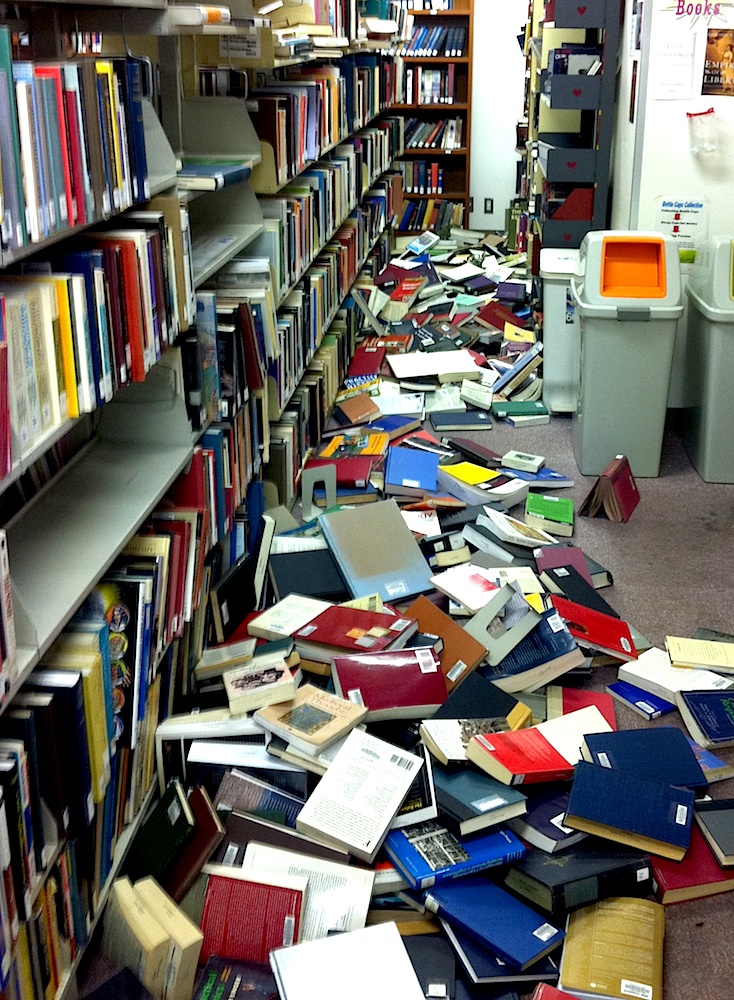
As I mentioned before, we were on the 6th floor of LCJ when it hit, and it progressed in stages. Everyone ducked for cover, getting under desks and in doorways, as papers and books and drinks spilled onto the floor. In the library, the bookshelf braces held, more or less, though books littered the floor. Thankfully, the elevator was open on the 1st floor at the time, so no one at the school was trapped nor had to experience the quake while locked in the car.

People moved out to the street, though not as quickly as they should have, perhaps. After milling around on the street for a while, we all went to the local school grounds, where we could wait for things to settle away from overhanging power lines.

Here are some images from the school; click on each for larger versions. The first is what my office looked like afterwards:

Office01-550

Here are a few images of the library:

Library01-550

Library02-550

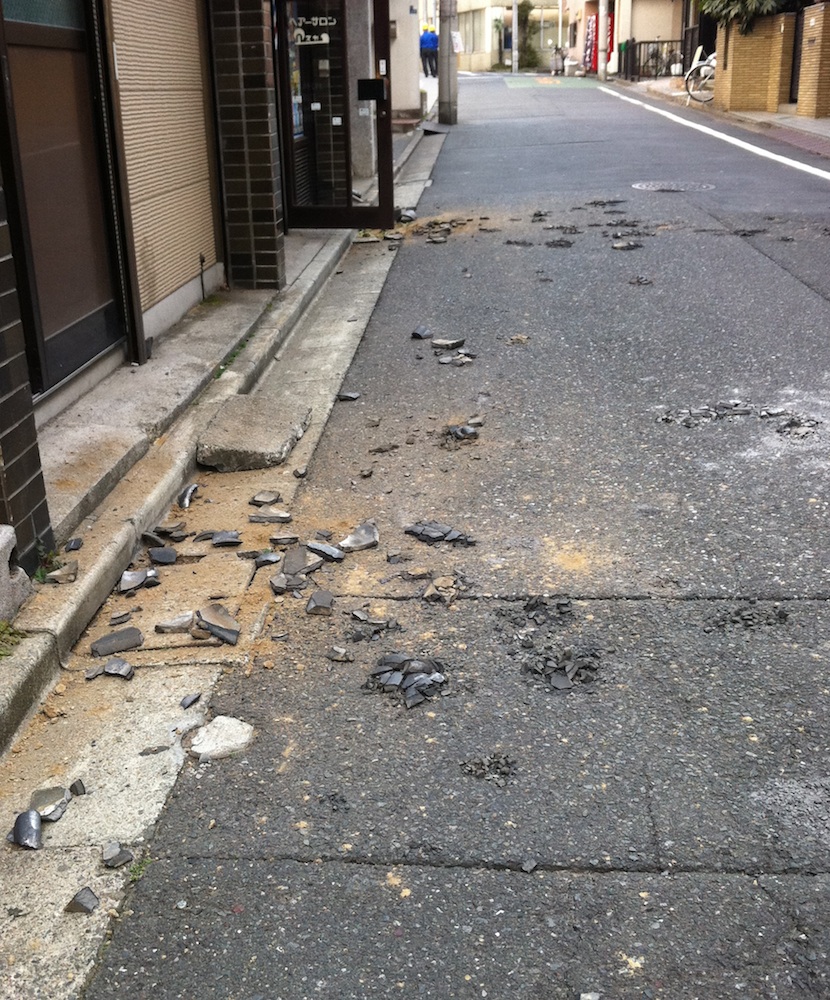
On the way to the evacuation area, a local school’s sports field, we could see some structural damage from a building or two:

Streetdamage01-550

But a little farther north, one street was blocked because a retaining wall for earth in a local temple’s graveyard gave way:

Wallbreak01-550

The death toll went up to 20 while I was writing this, but seeing the films of tsunami, I would be amazed if the toll does not go into the hundreds. It’s still just four hours since the quake hit.

A Big One… Not Centered in Tokyo, But It Seemed Like It

March 11th, 2011 1 comment

I just got home. Luckily, I had driven my scooter in to work this morning, a rarity for me–and it allowed me to get home and see if Sachi was OK, and to let her know I was.

I was in the office on the 6th floor. It started small, like “Oh, do you feel that tremor?” Then it got stronger, in stages, each new level greater than the last, until we finally got to the stage where you knew this was a big one. Books flying off of desks, everyone diving for cover. It lasted long, too. Right away, you could tell it wasn’t local–the slow start, the sideways-rolling motion. But for that minute or two when we were experiencing it, there was the question of whether or not the building would collapse in some way.

Of course, it didn’t. Here in Tokyo, it felt huge, but not so terrible we couldn’t stand and walk unsteadily. Not as bad as being on the ground in Loma Prieta, I’m told. But big. Pictures to come, but our office floor was covered with papers and books.

Everyone was OK. No one around us was hurt. All the students were OK, but everyone was outside, and it was cold and windy today. I imagine they are still trying to get back home–but everyone was OK.

They are now reporting that it was an 8.4 on the Richter scale, hitting at 2:46, followed by offshore aftershocks of 7.0, 7.4, and 6.6. We certainly felt those as well.

For a quake that big in Tokyo, it was about 230 miles distant from Tokyo, about 70 miles off the northern Japan coast.

We just felt a big aftershock right now, the second big one we’ve felt since I got home.

More soon.

I Acted Like Vile, Soulless Scum Because I Am Such a God-Fearing Patriot

March 10th, 2011 3 comments

Newt Gingrich, commenting on the reasons why he cheated on his wife and came to her hospital bed as she suffered from cancer to lay out terms of the divorce, before later marrying the younger woman and refusing to pay alimony and child support:

There’s no question at times of my life, partially driven by how passionately I felt about this country, that I worked far too hard and things happened in my life that were not appropriate.

Wow. He acted like an unspeakably cruel, selfish, and utterly soulless piece of scum because he was such a impassioned patriot. Yeah, that explains it.

At least he has enough shame to equivocate, saying that it’s only partially why he did it. I am assuming that the other, unspoken part is because he has no scruples, virtue, or shame. Goes without saying, I suppose.

Naturally, right after he finished saying the above, he mentioned God about five or six times in quick succession.

Meet the next Republican candidate for president.

Disenfranchising Democrats

March 8th, 2011 5 comments

Republicans these days seem to have no shame when it comes to attempts to outright ban Democrats from voting. There have been a large number of scams, from dishonestly padded “felons lists” to far more devious “caging” scams. On a larger scale, they have successfully attacked organizations like ACORN, which help get lower-income Americans registered to vote, and, using fake voter-fraud claims, have tried to institute “voter ID” laws which coincidentally cause far more Democrats to not vote. Voting machines made by corporations vowing to do whatever it takes to get Republicans elected have shown the tendency to make “errors” which just happen to heavily favor Republican candidates. Republicans have even made public statements about suppressing the Democratic vote.

Anyone who pays attention to these stories knows that this is not a side game, a sometimes thing, or just a practice of people on the fringe: illicitly attempting to disenfranchise voters on the basis that they are Democrats is very much a mainstream Republican sport–and one certainly does not hear much from people on the right in protest of these actions.

Now, in New Hampshire, the state legislator is taking yet another new spin on this right-wing pastime. The Republican state House speaker, William O’Brien, wants to limit the ability of young people to vote, because all too often, he claims, they do so “foolishly”–that is, they vote Democratic:

“Voting as a liberal. That’s what kids do,” he added, his comments taped by a state Democratic Party staffer and posted on YouTube. Students lack “life experience,” and “they just vote their feelings.”

This he told a Tea Party gathering–and it’s not just talk. There are bills going through the New Hampshire legislature which would use college and other residency situations common to young voters to keep them from the ballot boxes.

I am serious when I ask, how long will it be when it becomes so blatant that someone will claim that voting Democratic is a sign of mental instability, and will want to disenfranchise voters on those grounds? I am sure that some on the right-wing fringe already do so, but how long until a politician starts venting along those lines? O’Brien’s rant is dangerously close to exactly that.

Just a Reminder

March 8th, 2011 3 comments

Here is the far-sighted Steve Ballmer, from an interview on April 30, 2007, after the iPhone was announced but before its release:

There’s no chance that the iPhone is going to get any significant market share. No chance. It’s a $500 subsidized item. They may make a lot of money. But if you actually take a look at the 1.3 billion phones that get sold, I’d prefer to have our software in 60% or 70% or 80% of them, than I would to have 2% or 3%, which is what Apple might get.

Hard to believe that was just four years ago. In the same interview, he also called Apple a “one-trick pony” because it is “a hardware company.”

Today, Apple’s iPhone holds 27% of the cell phone market–ten times the 2% or 3% Ballmer predicted–and is challenged mainly by Android, an OS given away for free and used by many cell phone makers. Where is Microsoft? Fighting to remain relevant in the cell phone market, Microsoft’s market share is shrinking, currently at only 10%–down from about 40% when Ballmer gave the interview. What’s more, Neilsen, which came out with those ratings, noted that “an analysis by manufacturer shows RIM and Apple to be the winners compared to other device makers since they are the only ones creating and selling smartphones with their respective operating systems.”

Apple, in other words, is both a hardware and a software company–whereas Microsoft, ironically, is primarily a software company–far more of a “one-trick pony” than Apple. Apple, in fact, is branching out, as a reseller (the highly successful iTunes store now resells third-party music, video, books, and software), an advertising firm (iAds), and yes, is even starting to establish itself in enterprise solutions. Apple, in fact, is spreading out into new areas, while Microsoft is just struggling to hold on to what it has, and is shrinking in some areas. It is telling that despite Microsoft still holding perhaps 85-90% of the worldwide OS market share, Apple now has a market cap of $331.66 billion to Microsoft’s $218.06 billion.

One has to wonder if Ballmer still prefers his position to that of Apple’s.

Because “News” Is All about Backing Your Side and Vilifying the Other Guys

March 6th, 2011 2 comments

This would be hilarious if it weren’t so depressingly normal. In the midst of his outrageous lie-spinning on the Wisconsin protests, Fox News “reporter” Mike Tobin claimed that someone in the crowd “punched” him in the arm. He knew that the Fox camera was being blocked and that what really happened was not broadcast on the air.

As it happened, protesters were filming also–and when the video was shown, it was pretty clear that a guy in a Santa hat simply tapped him on the shoulder. Though it could have been a pat. But a punch? Not even remotely close.

A little later, Fox host Megyn Kelly tried to play up the incident, one she did not witness, calling it an “assault.” When Tobin tried to walk it back a little, Kelly pressed even harder, insisting that it was, in fact, “battery.”

This is a tactic they have picked up: the side which has the violent thugs loses, so they do everything they can–use fake footage, exaggerate wildly, lie outright–to make people they don’t like seem violent.

Just for a little perspective, remember when the woman at the Rand Paul rally was grabbed, wrestled to the ground, and had her head stomped on by a Paul supporter? Did Fox call that an “assault”? Maybe “battery”?

Nope. It was a “scuffle.” A term they used repeatedly. “Assault” was only referred to in the context of legal charges, but the headlines were all about “scuffles.” Which sounds like something kids get into when they call each other names and maybe throw kid-punches at each other.

I wonder, if the Wisconsin protesters wrestled Mike Tobin to the ground and stomped on his head, do you think they would call that a “scuffle”? Considering that someone tapping his shoulder is “assault and battery,” somehow I don’t think so.

Similarly, Fox is pulling out all the stops in demonizing the Wisconsin protesters, repeatedly calling them “angry mobs.” However, when large crowds of bused-inTea Party protesters invaded town hall meetings in which Democratic representatives wished only to speak to their constituents and answer their questions, mobbing the events and angrily screaming as a means of shutting them down, did Fox call them “angry mobs”?

Of course not. They were “boisterous crowds” enacting “democracy in action.” Sometimes they were “rowdy” or even “antagonistic.” But an “angry mob”? Hell, no! Fox got upset when the term was used by Democrats. These were red-blooded American patriots, how dare you call them an “angry mob”!

But those teachers in Wisconsin? Very different story. These are scary people, folks. Lazy, greedy people who get off work at three in the afternoon and take the whole summer off. Yep, that’s actually what they’re saying, in their attempt to make school teachers sound evil and the cause of all our problems. You know who goes home at three in the afternoon and gets summers off? Students. Teachers, actually, stay much later than three o’clock, and when they do go home they have papers to grade and lessons to plan. And summers? Yeah, no teacher ever has summer duties. They all go to Florida and get drunk for three months at taxpayer expense. Yeah, that’s what they do.

Besides, those “angry mobs” in Wisconsin are all “professional protesters” who were “bused in” by mysterious, unnamed left-wing organizations. (Psst! It’s Jews like George Soros!) What makes them think this? Apparently, because some have signs that were well-drawn, even though not professionally printed, and otherwise, just the “sense” they get from the crowd. That’s the word from Bill O’Reilly and Mike Tobin, so it’s as good as gospel.

Watching them just makes one blanch at the feckless parody “news” reporting on the right has become, nothing but a sheer political BS brigade, just making crap up out of thin air. To make the protesters look violent, they took footage from a protest in California, complete with t-shirts and palm trees, and tried to pass it off as violence happening in Wisconsin.

What I found laughable was the fact that they made a big deal about protesters being “bused in”–not only are the protesters local, but when the whole thing kicked off, the ones doing the organized busing were the Tea Party activists–and I am pretty sure that Fox never dismissed them for busing people in, though that’s what they’re famous for.

When masses of Tea Partiers bused in from out of state were shoving and screaming and generally disrupting any attempt at Democratic politicians communicating with their legitimate constituents, they were patriots. When local teachers and workers try to hang on to their median incomes as the Republican governor attempts to send them to the poorhouse for purely partisan political reasons, they are frighteningly violent union thugs.

In other words, it’s all about the message. Because it’s certainly not about the facts.

Selling a Blatant Lie

March 6th, 2011 1 comment

Network neutrality has always been about fairness, freedom, and independence. Which is probably why Republicans hate it so much.

Network neutrality is about everyone being equal on an unfettered, decentralized frontier, intentionally left untouched by invasive rules or controls. It is akin to a free public space where people can do what they wish, no one given priority over anyone else. Currently, it keeps telecoms from taking what has been a public resource from day one, grabbing it as their private domain, and using it to squeeze as much profit from the public as possible. Again, reasons for Republicans to hate it.

Network neutrality has always been the rule of the Internet, you might say that’s a big part of what defines it. It’s an important reason why the Internet has been so successful, as a domain free from outside interference. Network neutrality opponents want to change things, they want to turn it into a privately-controlled commodity, in which corporations would have control over how fast you go, how much you pay, what you do, and how you do it–controls which the government has never tried to impose, a free and unfettered state of being that the FCC wishes to allow to continue.

And yet to hear Republicans talk about it, network neutrality is somehow a new idea, something which will change the Internet into an over-regulated quagmire–when the exact opposite is true.

To trash the idea of network neutrality, they throw vague and unsupported accusations that the concept is somehow connected to things Republicans hate–“government regulation” being the big one. In this case, however, the government regulation is not to stifle or control, but the exact opposite. It’s a regulation which would keep industry’s–and government’s–hands off.

However, here’s Boehner rattling on about the concept, clearly either clueless or an industry shill, but more likely both:

“’Network neutrality,’ they call it. It’s a series of regulations that empower the federal bureaucracy to regulate Internet content and viewpoint discrimination. The rules are written vaguely, of course, to allow the FCC free reign.

”The last thing we need, in my view, is the FCC serving as Internet traffic controller, and potentially running roughshod over local broadcasters who have been serving their communities with free content for decades.

No, it would empower the government to maintain the Internet as the government has maintained it from the beginning. It does not “regulate content,” it ensures that content will not be interfered with. It does not allow the FCC to be a traffic controller, it keeps the telecoms from become traffic controllers. In ensures that free content will be protected from the “local broadcasters” (read: big telecoms) who want to end the whole concept of free content.

Note the language, though. “They” call it that, as if there is some mysterious, nefarious “they.” “Regulations,” “empowering federal bureaucracy,” “regulate,” “viewpoint discrimination,” “vague,” and regulatory “free reign.” Almost every other word in that sentence is a carefully-crafted fright word intended to push scare buttons that the right wing has worked for decades to instill in the people. Almost his entire rant is chock-full of this crap.

“As far as I’m concerned, there is no compromise or middle ground when it comes to protecting our most basic freedoms.

”So our new majority in the House is committed to using every tool at our disposal to fight a government takeover of the Internet.

The government created the Internet, you ignorant sellout. He’s trying to make it sound like the Internet was created by the telecoms, so they should get to “keep” it. “Our most basic freedoms”? What the hell is that supposed to mean? How do you propose that allowing telecoms to control content, restrict the free use of applications, and segregate a public resource so it can charge a premium to users, will “protect our most basic freedoms”? Just the opposite–you and your patrons want to destroy the equality which has been the hallmark of the Internet since its inception. Your plans would open the doors, for the first time ever, to service providers censoring content and working to harass those they disapprove of, a state of affairs expressly forbidden by network neutrality.

“Already, the committee has held hearings to give FCC regulators a chance to explain the need for this intrusion. It won’t surprise you to hear they haven’t been able to give the American people a straight answer.

Again, ”committees,“ ”hearings,“ ”regulators,“ ”intrusions.“ Be afraid and do whatever we say, you dim-witted cattle.

And an ”intrusion“? How the flying frack is a set of rules which essentially says, ”hands off and allow people to do as they please“ an ”intrusion“? Especially compared to the corporate controls you want to institute, giving this massive thing of value to the telecoms for free.

Then Boehner uses a segue to his next line of spouted waste, drawing an analogy between network neutrality and yet another boogeyman of the far right:

”Congresswoman Blackburn has been a national leader on this issue, holding the FCC’s feet to the fire. She has called net neutrality ‘the Fairness Doctrine for the Internet.’

“The ‘Fairness Doctrine,’ that’s another threat to freedom with an innocuous name.”

Yes, heaven forbid that money not be allowed to buy a louder voice. What a travesty to plutocracy that would be. However, aside from the complete disconnect between the two concepts, the Fairness Doctrine is just yet another red herring, a fictional scare tactic, like Obama banning guns, or the return of the New Black Panther Party, or “death panels,” a false specter to galvanize the party faithful.

Even in this age where lies and corruption stand as the mainstay of Republican politics and policy, this outright fictional spew is galling. But this is what we have come to expect from this man–to sell out the American people for money and power. What else is new?

Tilting Even More

February 28th, 2011 3 comments

Remember when, during the Bush administration, Sunday political talk shows used to favor Republican guests, having them on in greater number than Democratic speakers? The claim was that since Republicans controlled all the branches of government, or that the White House was held by Republicans, such a setup was simply natural, and when the balance went the other way we could expect the opposite.

Yeah, well, we knew it was BS back then, so it shouldn’t surprise anyone that it’s still going on despite a Democrat in the White House and Democrats in control of half the Congress. This week,two networks (CNN and ABC) had a pretty even balance of right and left. Three networks (Fox, NBC, and CBS), however, had Republicans only.

Two weeks ago, there were no Democrats among the featured guests. At all.

Search the records, and you’ll see that Republicans dominate over time, with a majority of Democratic guests being quite the rarity.

There’s your Liberal Media™ for ya.

Categories: "Liberal" Media Tags:

Inciting Strife for Political Gain

February 28th, 2011 6 comments

From a Wisconsin Pastor:

In response to previous columns, I have received numerous messages that go something like this:

I work at two jobs to make ends meet, pay almost half my take home pay for medical insurance and don’t even have a pension. Why should I have to then pay for my tax dollars for pampered government employees to receive cushy benefits?

I have great sympathy for these correspondents. As a parish pastor, I’ve encountered many people in just those circumstances, men and women who have worked hard, saved money, and, then, seen their retirement savings disappear because an injury or unexpected illness left them unable to work and forced them to pay thousands of dollars a month for the health insurance needed to keep them alive.

Rather then helping these people, what the governor has done is to goad them to anger against people who do have decent health and pension benefits. And one of the first things he did in office was to lend his support to efforts to repeal President Barack Obama’s health insurance laws, which would have made insurance available and affordable to those not lucky enough to have high-benefit jobs.

So, they’re left with frustration, but not help.

And that was the plan from the start. Make people who are scraping by angry, not at the wealthy, but at the middle class, and so instead of trying to bring the poor up to the middle class, use the anger of the poor as a weapon to further decimate the middle class.

Destroying the unions will not bring one iota of relief to people working two jobs and paying exorbitant medical insurance bills. Quite the contrary, those people need unions themselves.

Categories: Right-Wing Slime, The Class War Tags:

Going on Full Offensive

February 27th, 2011 3 comments

Emboldened by advances made in many areas, and feeling the wind at their backs, Republicans at the state level are letting go with rapid fusillades against Democrats. Republicans across the country are attempting to decimate unions while empowering corporations. Controlling an unusually large number of state houses, they fully intend to gerrymander the crap out of their states, while instituting measures like voter-ID laws, purported to combat imaginary voter fraud while actually designed to keep Democrats away from the voting booth.

This is not just campaigning for a candidate or a party. It’s not just trying to spin news or events. It’s an attempt to abuse political power and the law itself to grab power, to disenfranchise and cut the legs out from under people who believe differently so power can be maintained by a minority.

Meanwhile, on Fox News, they are panting with fear at the massive crowds in places like Wisconsin; they would be cheering American spirit were they Tea Partiers, but now the sheer number of people who are pissed to no end scares the piss out of them.

Almost comically, they make the comparison to Egypt–as if it is a bad thing–and yet somehow miss the commonality that can be applied best to the comparison: that people can be abused so much that they eventually stand up and say, “no more.” Particularly they miss the part about who is being the hated dictatorial abusers.