It’s like God doesn’t like stability at the Fukushima plant or something–so far there have been four, maybe five sizable quakes all centered in or around Fukushima, just in the past half hour. The strongest seems to have been a 6.0, another 5.8, with others in the range between that and 4.0. And just when it seemed like aftershocks were finally dying out.
On the other hand, radiation seems to be fairly under control. The wind has been blowing pretty much straight from Fukushima down to Tokyo for the past 2 days, and radiation in Tokyo has not even doubled normal background levels. Ibaraki shows about 4x normal. One would think that for that much direct exposure via wind for that long, the levels would be higher if things were bad at the plant. Not that they couldn’t get worse, but so far, not so bad.
Gasoline supplies seem to be back. After more than a week of humongous lines at the 5% of gas stations that weren’t closed, today gas stations were back up and lines were short. And while milk was still missing, almost everything else–including toilet paper and bread–was back on the shelves in supermarkets.
This is not to say that everywhere is fully stocked. But it looks like the shortages are no longer a problem.
Power is more stable, but I was wrong when I assumed blackouts were not happening anymore. They are–but my neighborhood remains online, and has not had power go out once yet.
Higher yen could help U.S. companies exposed to Japan
U.S. companies with big sales in Japan like Aflac and Tiffany may see sales pinched in the wake of the country’s massive earthquake, but the yen’s recent sudden strength could offset those losses.
Yes. Never mind the Japanese companies that got literally flattened by the disaster, and how an unnaturally strong yen could devastate an already trashed Japanese economy. No, we have to think about those U.S. companies that might lose a few percent of sales in Japan.
Nice to see that Wall Street still has the right spin on things.
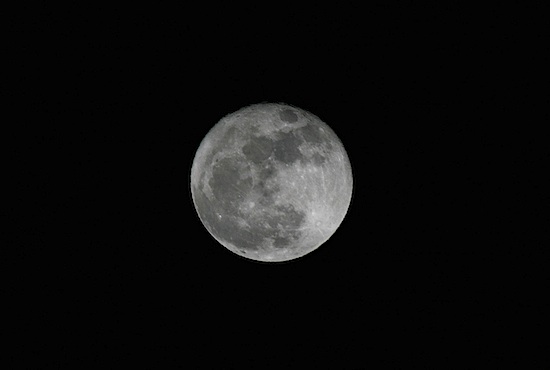
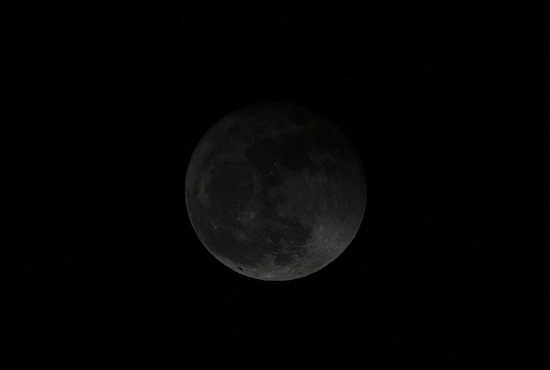
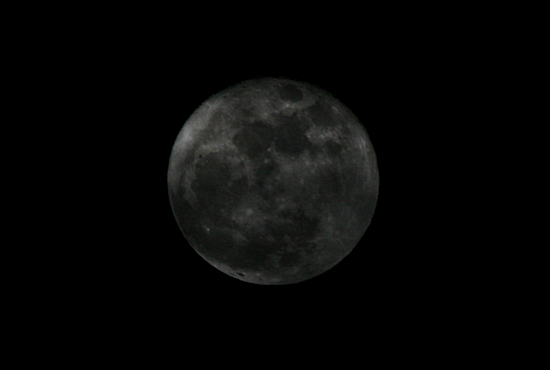
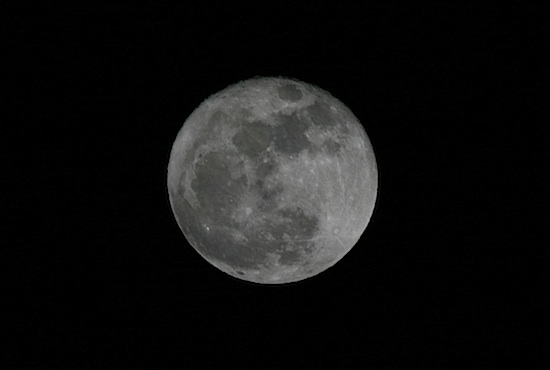
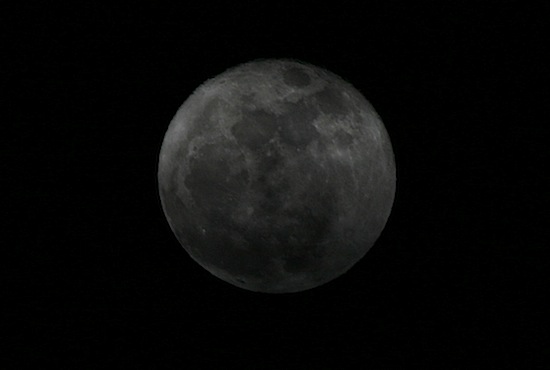
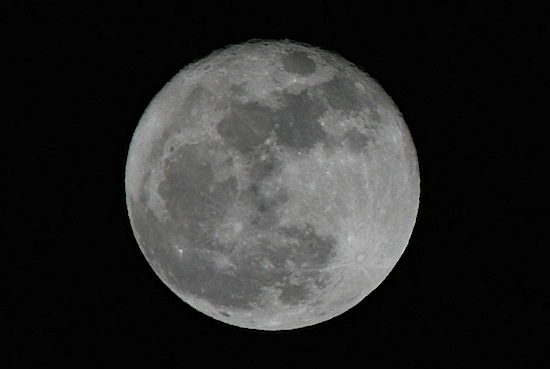
The big full moon is out. I don’t have a telescope, but a 300mm zoom lens will do OK for tonight. Here are some pictures as the moon dodged in and out of fast-moving clouds. Really very pretty, even if it did look quite different to the naked eye. The second to last has a larger version on click.
And then here’s a video of the clouds moving in front of the moon. Don’t be fooled by the poster image for the video, the quality is better than that–but not great. It’s taken with the iPhone 4, no zoom, but imported into iMovie which can crop & zoom. Still, it gives you a small idea of how lovely it was. Just gotta use your imagination a little…
In the meantime, here’s a link to a Google Maps page with links to radiation counters across the country. Oh Google Maps, is there anything that you can’t do? Maybe helping grade my students’ essays. There’s no app for that.
When, exactly, will we be able to tell if the nuclear situation in Fukushima is no longer something to worry about? One article in the British media, which also is repentant about western media coverage, uses the term “stable” in the headline, but that comes from this graf in the story:
The IAEA seems to accept that things are settling down: a senior official at the agency tells Reuters that the situation is now “reasonably stable”.
There’s a huge difference between “stable” and “reasonably stable,” when “meltdown” was everyone’s guess just a few days ago.
So, what, will a siren blow when it’s actually stable? Will the return of toilet paper and open gas stations herald stability? Let’s get our signs straight on this.
I hope that all the American voters who voted out Democrats for supposedly not paying enough attention to job creation are paying attention to the kind of garbage that Republicans are wasting time on instead. Back in 2009, Democrats passed the stimulus bill right away, and while it did not solve every problem, it prevented millions of jobs from being lost and helped bring us back up to where we are now. What has the GOP done to create jobs? Essentially, got rich people loads more money by extending their tax cuts. Problem solved! Worse, the GOP, since Day One, has been spending most of their time on drivel which is as vehemently partisan as it is boneheaded and futile.
Recently, for example, the GOP wasted time trying to defund NPR as a result of a publicity stunt by a criminally irresponsible right-wing punk/prankster famous for wildly misrepresenting the truth. Despite the fact that they knew full well that this would never pass the Senate, the GOP nonetheless wasted swaths of valuable congressional time in session to what amounted to a completely insipid publicity stunt, instead of doing anything to save jobs.
Under a GOP-backed bill expected to sail through the House of Representatives, the Internal Revenue Service would be forced to police how Americans have paid for their abortions. To ensure that taxpayers complied with the law, IRS agents would have to investigate whether certain terminated pregnancies were the result of rape or incest. And one tax expert says that the measure could even lead to questions on tax forms: Have you had an abortion? Did you keep your receipt?
In testimony to a House taxation subcommittee on Wednesday, Thomas Barthold, the chief of staff of the nonpartisan Joint Tax Committee, confirmed that one consequence of the Republicans’ “No Taxpayer Funding for Abortion Act” would be to turn IRS agents into abortion cops—that is, during an audit, they’d have to determine, from evidence provided by the taxpayer, whether any tax benefit had been inappropriately used to pay for an abortion.
Bad enough that the IRS would now be requiring your medical history as part of your tax returns; worse that they would then interrogate rape victims for tax purposes. More importantly, how exactly would the IRS determine that the woman in question spent “tax benefit” money on the abortion, as opposed to just money she earned? If the law has any meaning whatsoever, it would essentially treat any money spent by the woman as potentially part of that “tax benefit.” Meaning that if a woman who had an abortion got any tax break that could be called a “benefit,” she would not be allowed a medical procedure or else would be penalized in the form of higher taxes. Do I even need to mention that these are the same people who are trying to say government should get out of our personal business?
Not that any of this matters–it will obviously be DOA when it gets to the Senate. The point, of course, is that this is all just a massive waste of time, at taxpayer expense, for nothing more than a staunchly partisan attack, when people are out of work and hurting. Instead of doing work to solve any problems faced by the people, the GOP is hard at work throwing their own feces at the opposition like a pack of drug-addled howler monkeys. Not that this is any different from any other time in the past many years.
Will the voters react to this as they reacted to just the perception that Democrats weren’t doing enough to solve the job crisis? Will they get the hint that if Republicans are rewarded for their batshit-crazy routine in 2012, that this will spread to both houses and only intensify?
If history is any indication, the answer is, sadly, no.
It feels like we’ve gone from “It’s hopefully not going to be bad” to “It’s probably not going to be catastrophic.” Along those lines, this is an article from Talking Points Memo about how Fukushima won’t be like Chernobyl. Note that one of the points denotes a difference which is worse in the Fukushima case. The six points, in bullet list form:
Chernobyl’s reactor had no containment structure. [Not that Fukushima’s is top-flight…]
Chernobyl’s reactors had several design flaws that made the crisis harder to control.
The carbon in Chernobyl’s reactor fueled a fire that spewed radioactive material further into the atmosphere. Fukushima’s reactors do not contain carbon, which means that the contamination from an explosion would remain more localized.
Unlike Chernobyl, however, a meltdown at Daiichi could end up contaminating the water table.
Much of the public health impact of Chernobyl was the result of the Soviet government’s attempt to cover up the crisis, rather than moving quickly to inform and protect the public.
Emergency workers at Chernobyl took few precautions, and may not have been fully informed about the risks they were taking.
Like I mentioned, #4 is less than reassuring, less so than a lot of other news we’re hearing.
Amid widening alarm in the United States and elsewhere about Japan’s nuclear crisis, military fire trucks began spraying cooling water on spent fuel rods at the country’s stricken nuclear power station late Thursday after earlier efforts to cool the rods failed, Japanese officials said.
The United States’ top nuclear official followed up his bleak appraisal of the grave situation at the plant the day before with a caution that it would “take some time, possibly weeks,” to resolve.
That would, of course, be bad on so many levels, especially if it means that the current level of uncertainty, that things could get much worse, continues for that length of time. People here are waiting for some sign that things will be all right, that normalcy has a chance to return. The situation as it is is akin to having a loaded gun pointed at you by an unstable individual. Maintaining that for days has been stressful; for weeks would be, well, not fun.
Personally, also not the best time–we are smack in the middle of a home purchase here in Tokyo, with contractual obligations that demand we commit to a half-million dollar purchase within two weeks–or forfeit about $30,000 in lost deposits and realtor commissions. I’m willing to drop the thirty grand if necessary, of course. It’s the uncertainty that makes it a bit more difficult. I’d love to talk to a legal expert about this sort of thing–are there extenuating circumstances in the face of a nuclear crisis that allows for such things to be put on hold?
Imagine this happening in 1990. Local TV and radio would be all people in Japan would have, maybe satellite TV. Imagine phone lines being even more overloaded than they are now, and cell phones not even an option except for those most on the cutting edge, and probably those wouldn’t work, either. Probably most of Japan would be dark as far as communication is concerned. In the current crisis, the people of Japan are probably getting an appreciation for the Internet that people in African and Middle Eastern countries have recently had.
Right after the quake, when phones were not working, the Internet never missed a beat. Within minutes of the quake, I was accessing Google News via the 3G connection on my iPhone, even before the first stories hit the web. People have been able to email pretty much solidly since the quake hit. People have connected over Facebook and kept each other informed over Twitter. Blogs have chronicled life after the quake. innumerable cell phones equipped with hi-def video cameras caught hundreds if not thousands of views of the quake, with countless images taken of, well, just about everything.
In short, we have stayed connected, fully, both ways, all ways. The disaster has been documented as none other before. What a relief this is for so many who otherwise might wait days or even weeks to get news from relatives, or at least those receiving good news; and even for others, it is still better than not knowing for so long. What a resource–both good and bad–of news, allowing us to get information from all directions, for better or for worse.
In so many recent crises, this has been an invaluable resource, even to the point we may not have imagined just a few years ago. I have to wonder what more value we will find from it in the future, and how historians will look back at this time when this network became available and began to show its worth.
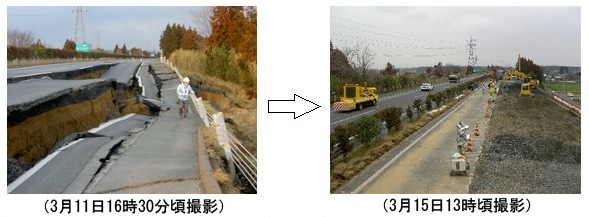
Well, whatever they’re doing or not doing at the nuclear plant, whoever is fixing roads is sure on top of things. In just under four days, they took the road you see at left and repaired it pretty much fully. Good work.
On the British Tokyo Embassy’s web site, they have posted a Q&A with Chief Scientific Officer Professor John Beddington. Below is his take on a “reasonable worst case scenario.” It was one big chunk in the original article, so I have divided it into more easily readable paragraphs.
Let me now talk about what would be a reasonable worst case scenario. If the Japanese fail to keep the reactors cool and fail to keep the pressure in the containment vessels at an appropriate level, you can get this, you know, the dramatic word “meltdown”.
But what does that actually mean? What a meltdown involves is the basic reactor core melts, and as it melts, nuclear material will fall through to the floor of the container. There it will react with concrete and other materials … that is likely… remember this is the reasonable worst case, we don’t think anything worse is going to happen.
In this reasonable worst case you get an explosion. You get some radioactive material going up to about 500 metres up into the air. Now, that’s really serious, but it’s serious again for the local area. It’s not serious for elsewhere even if you get a combination of that explosion it would only have nuclear material going in to the air up to about 500 metres.
If you then couple that with the worst possible weather situation i.e. prevailing weather taking radioactive material in the direction of Greater Tokyo and you had maybe rainfall which would bring the radioactive material down do we have a problem?
The answer is unequivocally no. Absolutely no issue. The problems are within 30 km of the reactor. And to give you a flavour for that, when Chernobyl had a massive fire at the graphite core, material was going up not just 500 metres but to 30,000 feet. It was lasting not for the odd hour or so but lasted months, and that was putting nuclear radioactive material up into the upper atmosphere for a very long period of time.
But even in the case of Chernobyl, the exclusion zone that they had was about 30 kilometres. And in that exclusion zone, outside that, there is no evidence whatsoever to indicate people had problems from the radiation. The problems with Chernobyl were people were continuing to drink the water, continuing to eat vegetables and so on and that was where the problems came from. That’s not going to be the case here.
So what I would really re-emphasise is that this is very problematic for the area and the immediate vicinity and one has to have concerns for the people working there. Beyond that 20 or 30 kilometres, it’s really not an issue for health.
You’ll want to read the rest of the press conference, he says other things as well–but essentially, he sees worst-case as being not disastrous outside the local area.
A quake just hit. It felt more like an up-down quake, meaning it was probably local…
Update: I was wrong, it wasn’t under us. It was a 5.3, centered in Ibaraki, just north of Chiba. And I had just said to Sachi a few minutes earlier, “Hey, there hasn’t been a big quake tonight.” That’ll teach me.
One thing to remember is that when you read the stories about “panic” and how it is “sweeping over” Tokyo and Japan, these reports are by western media outlets, and is usually speaking about foreign visitors they find leaving from the airports. That’s not the Japanese you will find on the streets of Tokyo, or any city in Japan. And it is not the Japanese you will meet in Tohoku. Yes, there is sadness and misery; this is natural. But not panic.
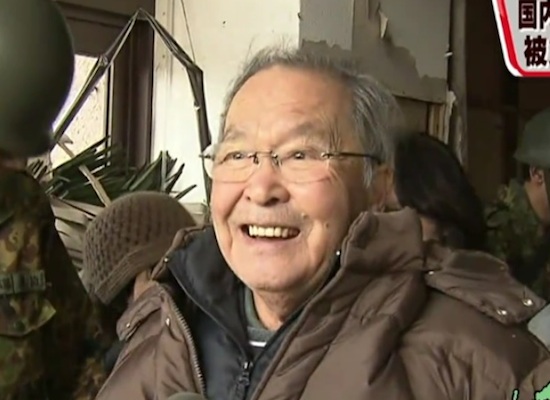
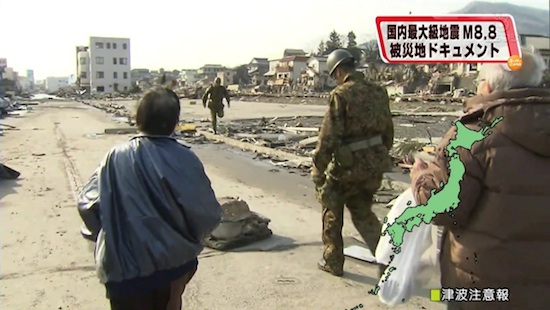
You want to see how real Japanese people are reacting? Here’s one fantastic example–a 72-year-old man who had been stranded with family on the 3rd floor of his house, in one of the towns devastated by the tsunami in Tohoku. As he is rescued by self-defense force personnel, he steps out onto the street, his whole town washed away before him. But he’s got a big smile on his face. “I’m all right!” (大丈夫です!) he announces to a reporter gaily. “I experienced the Chilean tsunami (a similar wave that hit Japan in 1960), so I’m OK!” (チレ津波も体験しているから、大丈夫です!)
As he steps out onto the street with his family and dog, he says with great vigor and spirit, and in a wonderful Tohoku accent, “Let’s rebuild again!” (また再建しましょう!)
Here’s the video:
Indeed, this is not the first time for this in Japan. A giant earthquake hit the Kanto region in 1923. Japan was flattened in the wake of WWII, and spent more than a decade recovering, but that they did. In 1960, the Chilean quake sent a similar tsunami to the east coast of Japan–the one the old man is referring to. Japan has been hit, again and again in the past. And recovered every time. The rest of us overlook this.
Japan will rebuild. It will recover.
The city of Onagawa, 1960, being hit by the Chilean tsunami. Onagawa was the closest city to last Friday’s quake.
This article from The Globe and Mail, forwarded by Steve, details the people’s state of mind fairly well:
In another country, there would be panic, rage and shouts aimed at the government and the sky. But not Japan. Despite the multiple catastrophes that have simultaneously hit this archipelago, a very Japanese calm and politesse has held back the chaos.
As one catastrophe piled on top of another, a very Japanese deference to authority emerged, as well as a national desire to see civility prevail, no matter the circumstances.
Along the crowded highway that connects Tokyo with the tsunami-battered north, people waited in orderly fuel lines hundreds of cars long without any shouting, honking or cutting in line. In the worst-hit city of Sendai, streets were shattered and cars were flung on top of homes by the force of the tsunami, but in three days there was not a single report of looting.
And here in Koriyama, the city closest to the escalating crisis at the Fukushima nuclear plant, residents queued around the block for drinking water being distributed from trucks parked outside a local gymnasium. When an official announced over a loudspeaker that supplies were running low and dozens of families would have to go home without, the line quickly and quietly dispersed.
Most notably, no one panicked and fled south even as the three reactors of the Fukushima plant continued their weekend-long flirtation with disaster. The French and U.S. governments advised their citizens to leave not just the region around the reactor, but also Tokyo 260 kilometres to the south, but most Japanese who live close Fukushima seemed in no hurry to flee.
There is a Japanese word for it: gaman. To persevere.
This quote from Tennyson’s Ulysses comes to mind:
Though much is taken, much abides; and though We are not now that strength which in old days Moved earth and heaven, that which we are, we are— One equal temper of heroic hearts, Made weak by time and fate, but strong in will To strive, to seek, to find, and not to yield.
Our power is due to go out in 15 min. or so. I am getting on Twitter, to see if I can get back in that swing again and to post while the area is dark… if 3G remains up, that is.
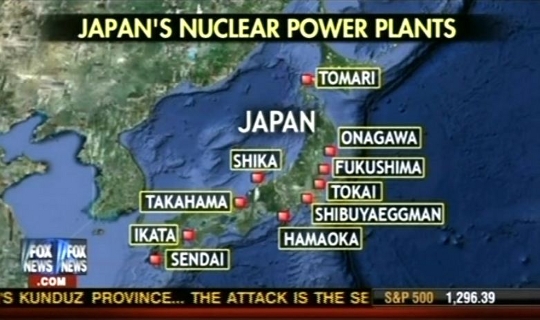
A little comic relief from Fox. At least, I am assuming this really happened–hard to believe, but then again, this is Fox we’re talking about, and the site reporting on it is usually pretty dependable about getting the facts straight. On Your World With Neil Cavuto, Fox reportedly showed a graphic depicting the location of nuclear plants in Japan:
First, that list seems a bit sparse; there are dozens of reactors in Japan. A quick check on Wikipedia (the IEAE site isn’t responding now) shows some of them clustered, but the Fox graphic is incomplete anyway. No big surprise there.
However, one of those names Fox does include seems a little funny: Shibuyaeggman, and it appears situated right here in Tokyo. We have a nuclear plant? And is that supposed to be in Shibuya? And “Eggman”? What the–oh, yeah, this is Fox I’m looking at. Neil Cavuto, even more to the point.
If this report is accurate, and I am betting it is, Fox identified a nuclear reactor existing in a Shibuyanightclub.
I would love to hear how Fox managed this one. I have to say, it makes me feel a bit better about having been taken in by Oehmen & Co. But then, I do expect more from myself, a random guy sitting in his apartment in Tokyo, than I do from the Fox News organization.
Looks like we might actually have a power outage today. The time is unclear, though–the local loudspeakers said 10:20, the TV seems to be saying after noon. We’ll see when it happens.
Like many others in Japan, I am on the mailing list of the U.S. Embassy in Tokyo, and get their warnings, advisories, alerts, and updates. This just came in, from the ambassador:
Since the first reports of trouble with the reactors, American nuclear experts have worked around the clock to analyze data, monitor developments, and provide clear assessments on the potential dangers. While at times we have had only limited access to information, I am personally committed to assuring that our experts have as much access and information as possible, and the necessary resources to understand the situation. I have personally been deeply engaged in these efforts.
After a careful analysis of data, radiation levels, and damage assessments of all units at Fukushima, our experts are in agreement with the response and measures taken by Japanese technicians, including their recommended 20kms radius for evacuation and additional shelter-in-place recommendations out to 30kms.
Let me also address reports of very low levels of radiation outside the evacuation area detected by U.S. and Japanese sensitive instrumentation. This bears very careful monitoring, which we are doing. If we assess that the radiation poses a threat to public health, we will share that information and provide relevant guidance immediately.
I have heard some people worry that the government will hide information to keep the public from mass panic or whatever, but I don’t really accept that. Yes, they’ll try to cover up blunders or foolishness, and they may suggest lame “duck and cover” style solutions–but if a cloud of radioactive vapor is headed our way, I don’t think they’re gonna try to hide it from us.
What may be harder to debate is whether they will let on exactly how potentially bad things can get. I tend to think that the Japanese government may try to hide things that could go badly wrong and would not really help the Japanese people if they knew–but I don’t really see the American government doing that in Japan. I could be wrong. Maybe I am. But I don’t think so.
And so far, I think the U.S. government’s advice to its citizens has been far more helpful and sound than that given by the French and Chinese governments, who seem to be more comfortable with playing it safe and not caring if it gives people the wrong idea.
All original content on this site is owned by and copyrighted by the author. If you wish to reproduce beyond Fair Use provisions, you must leave a comment and ask for permission.

 It’s like God doesn’t like stability at the Fukushima plant or something–so far there have been four, maybe five sizable quakes all centered in or around Fukushima, just in the past half hour. The strongest seems to have been a 6.0, another 5.8, with others in the range between that and 4.0. And just when it seemed like aftershocks were finally dying out.