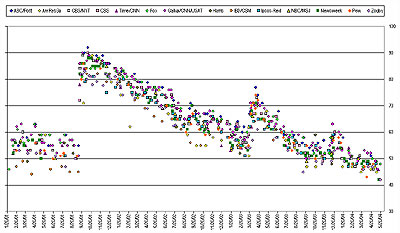
 After Andrew asked about an updated Bush approval polling chart, I went back to Pollkatz, and sure enough, they have an updated chart available (pictured at right, link here). Looking at this chart answered some concerns that I’d had.
Until just last week, I had been worried by the fact that Bush seemed to be unmovable at around 50%, despite all the crises, not to mention the fact that his numbers have always followed a steady downwards trend. So what was with the long hovering at 50%?
The Pollkatz chart, an amalgam of 14 different polls, shows something that I’d been missing: the telescoping of time, and the disorientation of seeing different polls at unpredictable times. The Pollkatz chart demonstrates that Bush’s “hover” was less a hover and more of an early drop and steadiness, and that the three or so months Bush hovered do not really break the trends so clearly demonstrated on the chart. Save a major event between now and November, Bush’s trend should take him below 40%–though he might get a fair bump at convention time; question is, how much, and will it do him any good?
The next question is, as Bush and his people are no doubt painfully aware of these numbers and Bush’s usual trend, what will they try to do in order to get Bush’s numbers up? There are a number of October surprise scenarios, but they seem to be off to an early start with a tried and true strategy: scare the sh*t out of the American people.
Ashcroft–excuse me, “federal officials” have leaked news that al Qaeda is planning some kind of major attack on U.S. soil between now and September. What kind of attack? We don’t know, apparently. But there’s “chatter” out there again.
Why is this most likely a political move rather than one of national security? First, Ashcroft is not raising the alert level. Why not? This is one of the strongest warnings of terrorist action in the past few years, and we’ve gone to “Orange” or “Burnt Umber,” or whatever it is, over less than this in the past. The lack of alert level change seems to belie the seriousness of the warning.
Second, the time span–between now and the election. Bush’s people know full well that Bush’s highest numbers are in his dealings with terrorism–though even they are falling. But playing to this strength would be an obvious move for them to make. Which ties into point number three: how they’re phrasing this. “They saw that an attack of that nature can have economic and political consequences and have some impact on the electoral process,” said a Bush administration official.
The translation: if there is an al Qaeda attack, it is because, like in Spain, they will be trying to make Bush lose. If this impression is successfully implanted into the American psyche, then Bush would automatically benefit from such an attack rather than be blamed for it–after all, if the terrorists are trying to affect the elections to make Bush lose, that would be great publicity for Bush–he could run against al Qaeda rather than John Kerry.
The claim is bogus, of course; if al Qaeda attacks, history seems to show that Bush would be the obvious beneficiary–he has always gotten a boost in popularity in times of crisis (see the above graph for the obvious proof), and the Spain election did not go to the Socialists because the people were shaken by the attack–quite the contrary, they were brought together by it and emboldened–the election was lost by the ruling party because they screwed around with the bombing investigation, lying by saying it was Basque separatists instead of al Qaeda, and they were caught red-handed. They lost the election because the people were ticked off by that improper manipulation of the attack for political purposes.
But by making this terror warning, Bush & Co. are covering their bets: if there is no attack, they benefit by people being afraid and believing that Bush is better at fighting terror; if al Qaeda does strike, then they can say that they tried to warn everyone and did the best they did, and then they can campaign as if the choices are Bush vs. al Qaeda.

 On a nice saunter down to the Tama River today–the weather has been beautiful lately, I couldn’t pass up the chance–I found something which is quite rare in Japan: friendly cats.
