Japan Fun Fact #9: Apartment Hunting, Part I
Looking for an apartment in Japan can be a trying experience. When I first came to Japan, I had trouble because few apartments would rent to me. The first agent I saw showed me three apartments; I did not like any of them. When I asked to see more, I was told that there were no more. Apparently, the city of Toyama, population 300,000, only had three vacant apartments in the ¥60,000/month price range. So I went to another real estate agent. They showed me three places also. All were the exact same as the ones I’d been shown by the first agent. Back at the office where I worked, I asked the receptionist to call a third agent and ask them to show me apartments. They said that they would see me in an hour, then asked the receptionist for my name. She told them–and then was asked to wait. After a few minutes, they said that they would have to wait until the next day to show me any open units. And when they did, they were–you guessed it–the exact same three units as the other places showed me.
It was clear what was happening: before showing me any apartments, they were checking with managers in advance to see if foreigners were allowed to stay. Thus the sudden wait-until-tomorrow change from the real estate agent when they found out they would be dealing with a non-Japanese. And few landlords were willing to let a foreigner live in their units. When I asked agents–two different ones–about all those other, many apartment buildings studding the landscape, I was told uniformly that they were inhabited by yakuza gangsters and prostitutes, so i wouldn’t want to live in any of them. Let me tell you, that town must have been brimming with yakuza and prostitutes.
When I moved to Tokyo, things were different. Not in that discrimination was lesser, but rather in that people were far more open about it. Instead of trying to save me face by making up stories, they just out-and-out told me: gaijin wa dame, literally “foreigners are no good.” That was the exact phrase used by everyone, and its constancy was somewhat startling–no one used variations, just the same exact words.
And I heard them a lot. When I was moving from Toyama to Tokyo, I was on a three-week vacation in which I looked for both a job and an apartment. The job I found fairly easily; the apartment nearly broke me. My method was to visit at least two or three train stations per day, and I would find maybe four or five real estate agencies at each station. At each agency–that is, the ones that let me in, though only a few refused to let me enter–I would look through their bound book of available apartments. I got to know those books pretty well. Each apartment would have a one-sheet, which showed a layout of the apartment and had all the relevant information. First, the amount of rent (yachin), the deposit (shiki-kin), and the “gift money” (rei-kin, more or less an outright extortion fee demanded by the landlord), each denoted in the number of months’ rent each would cost. Typically, the deposit and the gift money would be two months’ rent each. Unspoken but understood would be the additional one month’s rent paid to the real estate agent as a commission for the sale. That means that moving in–including paying the first month’s rent in advance–typically cost 6 months’ worth of rent, which could really put a dent in your wallet.
Also noted on the sheet were the age of the apartment building (I got to recognize the age of units just by the floor layouts, which were different according to age), and which units were available. The latter was most important because which floor you live on makes a big difference. In apartment buildings with just two floors, the second floor was commonly reserved for female tenants, likely for reasons of privacy, to guard against peeping toms and underwear thieves. Finishing up the one-sheet data would be distance from the local station, and special items in the apartment–was there an air conditioner, TV antenna, tatami or hardwood floors and the like.
Back tot he story. I would go to a real estate agent, look through the book, and find a unit which was in my price range, was not too far from the station, and which wasn’t a really terrible-looking place. I wasn’t too fussy, really (evident from the fleabag place I eventually settled for), but I didn’t have much luck, either: despite finding three or four okay-looking units at each agency, I only saw a total of five or six units in the entire two-week period in which I searched. And I enquired about a few hundred places in total. I asked about so many because I was not finding anything I liked–the few places I was allowed to see were really unattractive units, so I kept looking and looking, stepping up my search as time ran out. But even if we assume I am misremembering, there is no way in heaven or earth it was less than a hundred in all–and even at that, I was refused 95% of the time.
The refusal was, as I noted, strangely identical, like there was an agreed-upon expression. Gaijin wa dame. Gaijin wa dame. Gaijin wa dame. Over and over and over again, many times a day. (And Japanese friends would wonder why I didn’t like the term “gaijin.”) I was not presenting myself poorly; I was clean-cut, clean-shaven with trimmed hair, and wearing the business suit I used in job interviews. I spoke Japanese fairly well, and explained at each place that I had lived in Japan a few years and was familiar with Japanese living customs, and knew how to take care of an apartment. I also presented at each place a copy of my new work contract, which showed I had ample salary to pay for the place, and could pay the entire six-months’-rent fee in cash, all right there. In addition to which, I had the all-important guarantor, my new boss (a Japanese national for a major corporation), who would cover any damages should I flee the country. But it seldom made any difference.
One place in particular still sticks in my memory. It was one of the last agencies I visited, so I had the patter down strong. I explained all of my good points to the agent, the experience in Japan, new contract, so forth and so on, and instructed the agent, when he spoke to the landlord, to relate all of these things so that the landlord would know that this was not some gonna-trash-the-apartment-and-ditch-the-country foreigner. I asked the agent if he understood, and if he would relate all of this. He grunted acknowledgment, and picked up the phone and dialed. “Hello? Mr. Landlord? Yes, this is Yaddayadda at the agency. That apartment you have open? Foreigners are no good, right? Yeah, OK. Thanks. Bye.”
Sometimes you didn’t have to wait for the agent to call up the landlord. I saw perhaps half a dozen apartment one-sheets that had it written down right there in black and white: petto, mizushobai, gaijijn fuka. No pets, prostitutes or foreigners allowed.
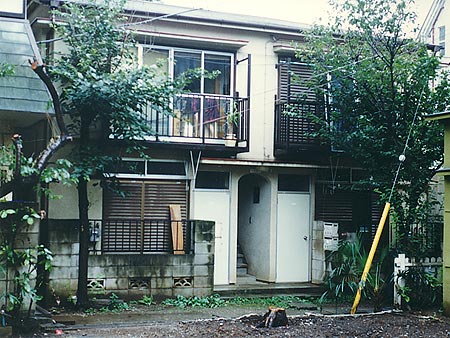
I eventually got a place, because one landlord really did his best to sell me as a tenant. “Hello, Mr. Landlord? Yes, about that apartment. I have a possible tenant. He’s a foreigner, BUT he’s a gentleman. He seems very nice.” And so on. He actually used the word “gentleman,” the English word in katakana pronunciation. He had to push the landlord for several minutes, but finally got me in. I took the place, but it was not exactly the ritz. The good points were that it was just a 3-minute walk to Asagaya Station on the Chuo Line, a short hop into Shinjuku, where my job would be. It was fairly cheap, ¥60,000 yen for a 6-tatami main room and a 4-tatami kitchen (more on that later). But that was about all that was good about the place. The building itself was pretty rickety, and as I would find out later, it was a sieve–it had tons of cracks and crevices, through which, I found to my disappointment, cockroaches entered in droves.
Still, I survived there for two years, until faced with a decision: apartment contracts usually last two years, and if you want to stay longer, you are forced to pay an additional one month’s rent “gift money” at the signing of the new contract. So I instead opted to find a new place. More on that in the next post…