Archive

Archive for January 29th, 2007

Various Photos

January 29th, 2007 5 comments

This post will just be a bit of a hodgepodge of photos I’ve been building up for the past week or so.

First, a slightly-oversized image, but it was the only way to crop it and have the width come out at my blog’s standard 450 pixels. It’s of a table-top stove setup. On the bottom is a mini-gas range, a portable unit that uses cans of gas fuel. The range cost about $17, and each can of fuel costs about a dollar. The first can has lasted two meals so far and seems to be good for a third, so that’s a pretty cheap setup. The grill on top is very nicely designed, rounded so the grease can drop into the gutters along the edge and fall into a water-holding trap below. Cooking with it creates almost no smoke, so it’s good for the tabletop. That part costs about $8, but already, the teflon or whatever coating it is seems to be wearing off after only a few good scrubs; still, it’s bound to be good enough so that the cost per meal will work out to only around a dollar a meal, at worst, and it’ll probably last somewhat longer than that.
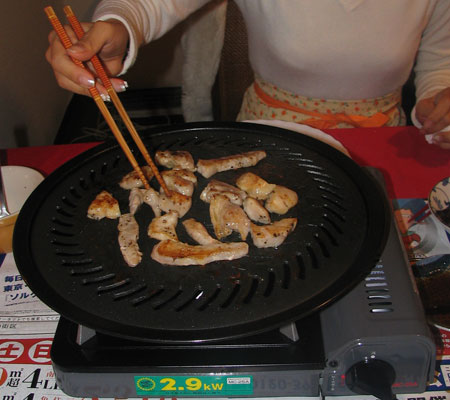
Yakiniku-Portrange

Sachi and I agreed that the meal we had turned out even better than the ones we’ve had at yakiniku restaurants, which can run upwards of $40 or more; the food we got cost maybe $10 all told; factor in a few bucks for the per-meal cost of the tabletop grill, and it comes out to a big savings over going out to eat–and it’s an easy meal to prepare. What you see here is our second meal, where we cooked only meat, which we stuffed into tortillas to make fajitas, along with lettuce, black olives, peppers, green onions and a bit of cream cheese. With the yakiniku meal, we also cooked cabbage and onions on the grill.

Next up, from birdwatching, is a nice Black-eyed Bunting–one with brighter yellow coloring than any of the others I’ve snapped. They’re not the clearest photos I’ve snapped, but then you have to be incredibly quick to get some of these birds–first, you have to find them, and then in the few seconds they stay in one place, you have to zoom in with the camera and find a tiny camouflaged bird (Have you ever tried? It’s hard! This bunting may seem to stand out, but the image is cropped–the bird was only a tiny speck in the viewfinder), and then make sure/hope your settings are right, while trying to keep the camera stable enough because the low light won’t allow better than a 1/30th-second exposure. Yargh.


0107-Blkfcd Bunting1-450

0107-Blkfcd Bunting2-450

Out of a great many more attempts I was able to get this image of a female Bull-headed Shrike:

0107-Bull-Headed Shrike-450

Above the birdwatching field that day: what appeared to be an AH-1 Cobra helicopter, without apparent markings identifying which government it belonged to. The thin body structure made it pretty danged noticeable.
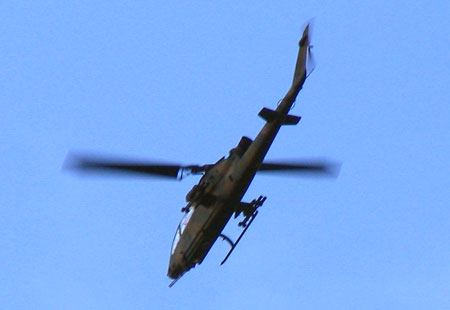
0107-Cobra-Hc

And finally, on a coat hanger I bought today, a tag reading the same in Japanese (phonetically) as in English: Coating Hangar. Sounds like something else entirely, doesn’t it?
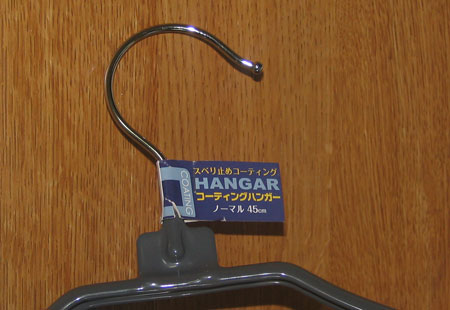
Coatinghangar

Categories: Uncategorized Tags:

Everybody Knows

January 29th, 2007 Comments off

Robert Heinlein once wrote, “If ‘everybody knows’ such-and-such, then it ain’t so, by at least ten thousand to one.” Such “common knowledge” is all too often widely-accepted urban legend.

Miss Laura over at Daily Kos brings up an intriguing possible urban legend: that soldiers returning from the Vietnam War were spat upon. A broader read would question exactly how much soldiers were disrespected. This is an excellent test of the “everybody knows it’s true” fallacy. Certainly, there will always be nut-jobs who will do any crazy-ass thing you can imagine, but the perception is that disrespect for soldiers returning from Vietnam was rife, not rare.

I find the question intriguing because I have always simply accepted it as fact. However, reflecting on what has happened during the current Iraq War, I now have my doubts. I have seen how liberals have not only respect for the troops, but that they have far more respect and love for the troops than conservatives–it is the war they hate, and the president they despise, but not the troops.

And yet, there are endless right-wing diatribes about how liberals hate the troops. The most common is when a liberal specifically attacks the president or the war in general, it is almost instantly transformed by right-wingers into an attack on the troops. This is partly demonstrated in this blog, where I have repeatedly pointed out such attempts (a few examples here and here). The troops, in these cases, are not being disrespected by liberals; instead, they are being used as human shields by the right wing in an attempt to avoid facing up to the real and biting criticisms of the war. If an attack on the war can be transformed into an attack on the troops, then it can be easily disregarded and counter-attacked, like the straw man it is made out to be. My first experience of such a tactic was with Reagan, gutlessly using the honor and sacrifice of the 241 Marines who died in Lebanon as his own personal human shield–deflecting reporters’ question by cowing them, essentially signaling that any question of Reagan’s command decision to deploy them there was equal to saying that the soldiers died in vain.

So now I have to wonder if the whole idea of Vietnam vets being commonly disrespected was indeed true, or was it simply another means the right-wing had of demonizing political opposition on the left? Did it really happen often enough to make it more than just some random nutcase doing something stupid? Or was it only that random nutcase, who was then grabbed by an eager conservative pundit, who then amplified the story, exaggerated it, and it snowballed from there?

The most common retelling of the tale is how anti-war protesters were lined up at airports to spit on returning vets. Miss Laura quotes sociologist Jerry Lembcke’s dissection of that claim:

GIs landed at military airbases, not civilian airports, and protesters could not have gotten onto the bases and anywhere near deplaning troops. There may have been exceptions, of course, but in those cases how would protesters have known in advance that a plane was being diverted to a civilian site? And even then, returnees would have been immediately bused to nearby military installations and processed for reassignment or discharge.

The comments for the entry are even more interesting, up to more than 750 items at present, with the expected assortment of all kinds of replies–including those who claim to have heard that such abuse took place.

However, as one of the people commenting pointed out, such reports are always third-person or more remote–no one ever has a specific, detailed, first-person account of such a thing ever happening. There are, however, several former vets who posted comments who report having heard stories of such things, but never experienced it or saw it happen–and some report having received nothing but respect from anti-war activists.

Another person in the comments points to a relative who at first said he was not disrespected, but whose story changed over the years to reflect the “common knowledge” of how things happened. There are self-avowed hippies who reported loving the troops and trying to get them to not go to the war, and who report not knowing anyone in their cause who acted disrespectfully, and there are reports from people who say the opposite. There are also those who point out things like the phrase “baby-killer” never being mentioned in any of the literature from the period, from either side, not until the Rambo films came out.

All in all, a fascinating debate, and another sad reminder of how slippery history is, of how tenuous our understanding is of what happened even just a few decades ago.

Categories: Political Ranting Tags: