
The Slow Surge
Windows 7 is now “surging forward,” Ars Technica wrote. After just 9 months, it has overtaken Vista, which has been on the market for three and a half years. Sounds impressive, no?
Well, not so much. Windows 7 has so far claimed about 16% of the Windows crowd. And we should remember that Vista started gaining market share well before its official release–at it’s release, it already had about a 4% chunk of the Windows market, meaning that it’s growth is just about 1.3% per month. Better than Vista’s anemic 1% growth, but not by much. And though it has outgrown Vista’s 3.5-year number in 9 months, it did so by decreasing Vista’s share, eating away at Vista as it grew–it did not get there by only outpacing Vista, which is what many might assume from the “overtaking Vista” headlines.
Consider this: Mac OS X v. 10.6, Snow Leopard, got more than 55% of Mac users to switch in the same time period–almost three times the rate. Sure, Snow Leopard was cheap, but this pace of adoption is typical of Mac OS systems.
Another point to consider: where did Win 7’s share come from? Well, it turns out that about 2/3rds comes from XP’s share, and the other 1/3rd is from Vista. Considering that this started with XP having about 78% and Vista about 21% of all Windows users, that means Win 7 is drawing significantly more from the Vista crowd by proportion–Seven stole away about 14% of the XP crowd, but about 24% of the Vista crowd. Not to mention that most of the XP share taken by Seven is simply people buying new computers with Windows 7 pre-installed.
Not to mention that the trend is going to have to change soon: at this rate, it will take Seven a whole 20 months just to equal XP’s share. When official support for XP is finally removed, the trend will likely shift faster, but not by much, as people simply keep using older systems, or continue to re-install XP on new machines.
All this begs the question: why is Windows OS adoption so glacially slow? Mac OS adoption is lightning fast by comparison, even when released at full price. And considering the disaster Vista was, why didn’t most Vista users quickly upgrade to Seven?
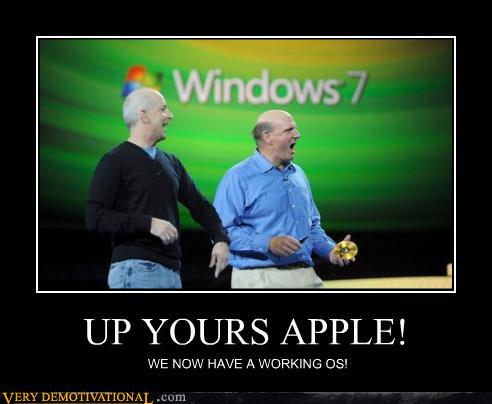 There are several reasons. One is that most XP users continue to use machines that simply cannot support Windows 7. XP users who could upgrade may be staying away because of the bad reputation Vista imparted, making XP users wary. Then there’s the comfort factor, with XP working quite nicely enough, many wouldn’t want to change–the “if it ain’t broke, don’t fix it” contingent.
None of these, however, explain why, after a year or so of being available, three-quarters of Vista users have not made the upgrade.
One reason strikes me as perhaps as a likely explanation: upgrading Windows is not the easy task it is on OS X, and the main reason for that is hardware drivers. Even with Win 7’s better driver support, I have talked to people who tried to upgrade and found that stuff on their computer wouldn’t work right, if at all. A case in point: when we made the DIY computer at my school, we bought a Sony Vaio monitor. The monitor has a built-in web cam. It doesn’t work. Why? Because Sony only released drivers with the OS sold with the Sony. The web is filled with people trying to find drivers for Windows machines.
Now, Windows 7 has much better driver support generally, and so it may not be such a big pain–but as I understand it, there are no guarantees for your machine–there is the potential for trouble, which could by itself keep people from upgrading. Some people may be holding back as part of the Vista backlash, unwilling to trust Seven as much as they should. But others may simply be aware that when they upgrade, they might have to spend hours tracking down drivers and dealing with other issues associated with the new OS. At some point, it becomes a matter of not being worth the hassle.
When you get a Windows device, the OS is not built specifically for your machine, and the companies that made the parts for your computer don’t always do a very good job of providing the latest drivers to support everything. To me, this explain a lot when I see the adoption numbers for Windows.