
The Heckler on Via Dolorosa
So, Romney flip-flopped yet again. Initially faced with having to admit that he was the biggest tax hound in Massachusetts history, he coweringly sent out a flunky to say it wasn’t a tax, causing a huge uproar among the right wing who were salivating at the prospect of beating Obama to death with the word “tax.” Sensing that he had to jump on the bandwagon, Romney joined the chorus and called it a “tax.” He knows that he won’t pay much for the hypocrisy; he didn’t “tax” the whole country as governor of Massachusetts, and the media almost never calls out politicians for lies or rank hypocrisy anymore.
Of course, it’s not actually a tax in the usual sense, unless the money you pay when you evade taxes is a “tax,” or the money you pay when you get caught driving without insurance is a “tax.” The most onerous “burden” will actually be the fact that you have to get insurance–which is mostly onerous to those who want to get the best out of the system without paying full price for it.
Not that the penalty-versus-tax meme lasted long; the economic report came out, and it’s a lot less than we need right now.
Yes, Obama’s job numbers are lackluster. But that doesn’t mean that Romney will do better–quite the opposite, in fact.
Romney is, as predicted, having a field day with Obama’s numbers–but hypocritically so.
Never mind that it is the 21st consecutive month of growth following an economic catastrophe which ignited a depression–all caused by Obama’s predecessor.
Never mind that we are now adding more than 800,000 more jobs per month than when Obama came in to office.
Never mind that despite being handed a far less difficult economy, Bush took two and half years to return to stable job growth, while it took Obama only one year.
Never mind that at this point in his term, again despite far better conditions, Bush had only 12 months of growth, only four of those being over gaining 150,000 jobs.
And never mind that Obama has had to deal with the most extreme opposition in living memory, a Congress actually dedicated to sabotaging his attempts to repair the economy in order to make him fail.
That last is a key point. Yes, Obama could have done better–but not because he acted liberally, rather because he did not stand up the the Republicans to do what he should have known was right.
It is a key point for two reasons: first, as Obama was trying to carry the nation back up, Republicans were grabbing his heels and pulling him back down. And second, had we done what Republicans were clamoring for–more tax cuts for the wealthy, higher taxes on the poor, and less spending on infrastructure and other ways to get the economy pumping again–we would be in far deeper shit than we find ourselves today. As is only sometimes observed, Obama’s poor ratings are not just because he’s more liberal than the right is comfortable with, but also because he’s not as liberal as those on the left want him to be.
Romney, unconcerned with facts, likes to wave around “his record” as governor of Massachusetts:
Romney takes credit for vetoing more than 800 spending items passed by the Legislature, saying he wiped out unneeded programs, cut taxes 19 times, built up a $2-billion rainy-day fund and balanced the budget four years in a row. All of that, he says, shows he can stop overspending. “We can balance our budget and live within our means,” he recently told supporters in Ohio.
He leaves out a few tiny details, however:
But Romney’s telling omits key facts that clash with the agenda of his campaign for president:
• The Legislature overrode most of Romney’s spending vetoes.
• State spending rose by 22% on Romney’s watch, nearly double the rate of inflation.
• Romney increased corporate taxes and state fees by $750 million a year, outstripping his tax cuts.
In short, everything had to get past the Democrats, just as Obama has to now get everything pat the Republicans. And while the Democrats shot down a lot of Romney’s ideas, it was not to sabotage the economy–quite the opposite, it was to help the economy, to improve it. Directly the opposite of Republican’s in Congress during Obama’s term. Romney and the Mass. Dems may have been at odds, but it was a constructive rivalry.
In the end, Massachusetts increased spending and it raised taxes on the wealthy–this is what Romney is celebrating, despite his claims to the opposite. Furthermore, it is not what he would do as president.
The primary moves initiated by Romney that helped Massachusetts improve their economy were fee increases and closing corporate tax loopholes. As president, Romney would not be able to raise funds with fee increases, and he wants to slash corporate taxes, not close their national loopholes.
But that was not the main reason Massachusetts’ economy improved–it was because, at the time, the country as a whole was finally coming out of the recession.
So, Romney’s record as governor really reflects a Democratic agenda being pushed over his vetoes, tax and fee hikes he cannot or will not implement as president, and improvements in a more general economic environment which Romney will definitely not have to benefit from as president.
Just the other day, I got a belated comment to a blog post from April 2010. In that blog post, I pointed out that Democrats should run on a chart showing where Bush and the Republicans had been leading us versus where Obama had taken us.
That is very important, yet something that goes virtually unrecognized because it is the proverbial dog that didn’t bark–despite the economy being shitty, instead of focusing on what Obama could have done, imagine what would have happened had McCain won and Republican had control over Congress.
Anyway, the commenter linked to this chart:
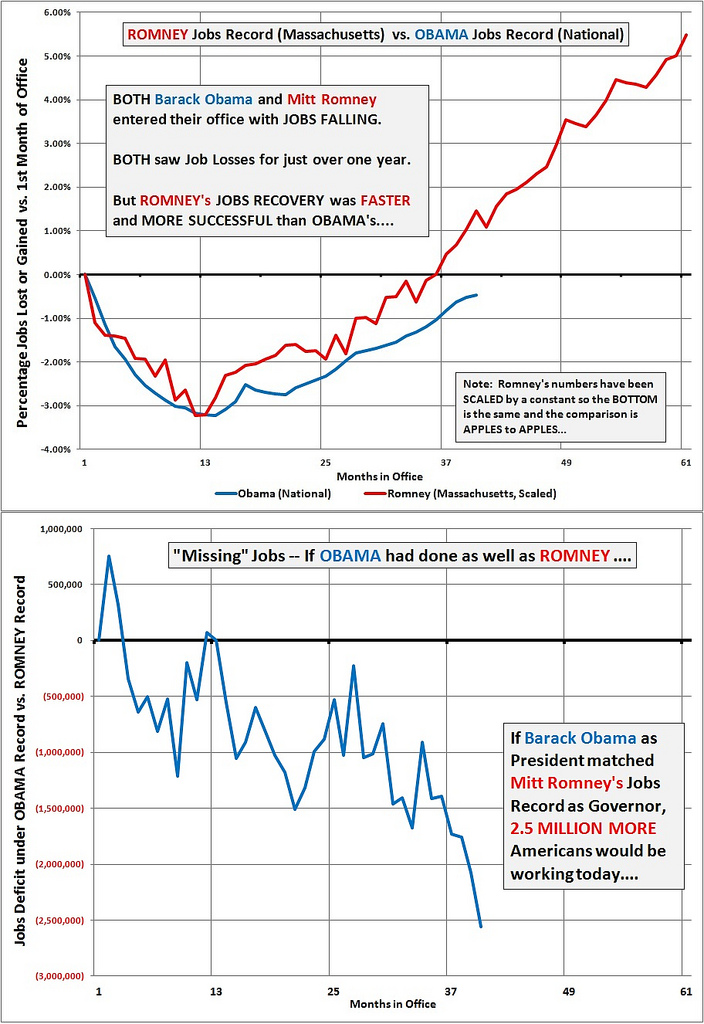
It appears to be a chart the commenter made himself–and seems to be pretty bogus. The claim of measuring jobs by the “percentage of jobs lost or gained vs. 1st month in office” is misleading; this chart does not compare each successive months’ performance to the first month, thus showing performance against the initial benchmark (which would be a fairer way to judge).
Instead, it simply shows the number of existing jobs with starting number keyed to zero. The author pretends fairness by changing Romney’s numbers somehow so the nadir matches Obama’s, but it is far from accurate, for several reasons. For example, it is easier to recover from a stumble than it is to reverse direction when falling at terminal velocity. Obama was handed an economy in freefall and immediately set upon by an opposition bent on making him fail against the backdrop of a sputtering world economy. Romney was handed a state in mild trouble with a Democratic legislature trying to fix things their own way, against the backdrop of an improving national economy. So, yeah, “Apples to Apples” my ass.
Curious as to what the real picture was, I got the numbers on my own and ran them through a comparison that used the initial state as a benchmark against which you could compare future results, and got this result:
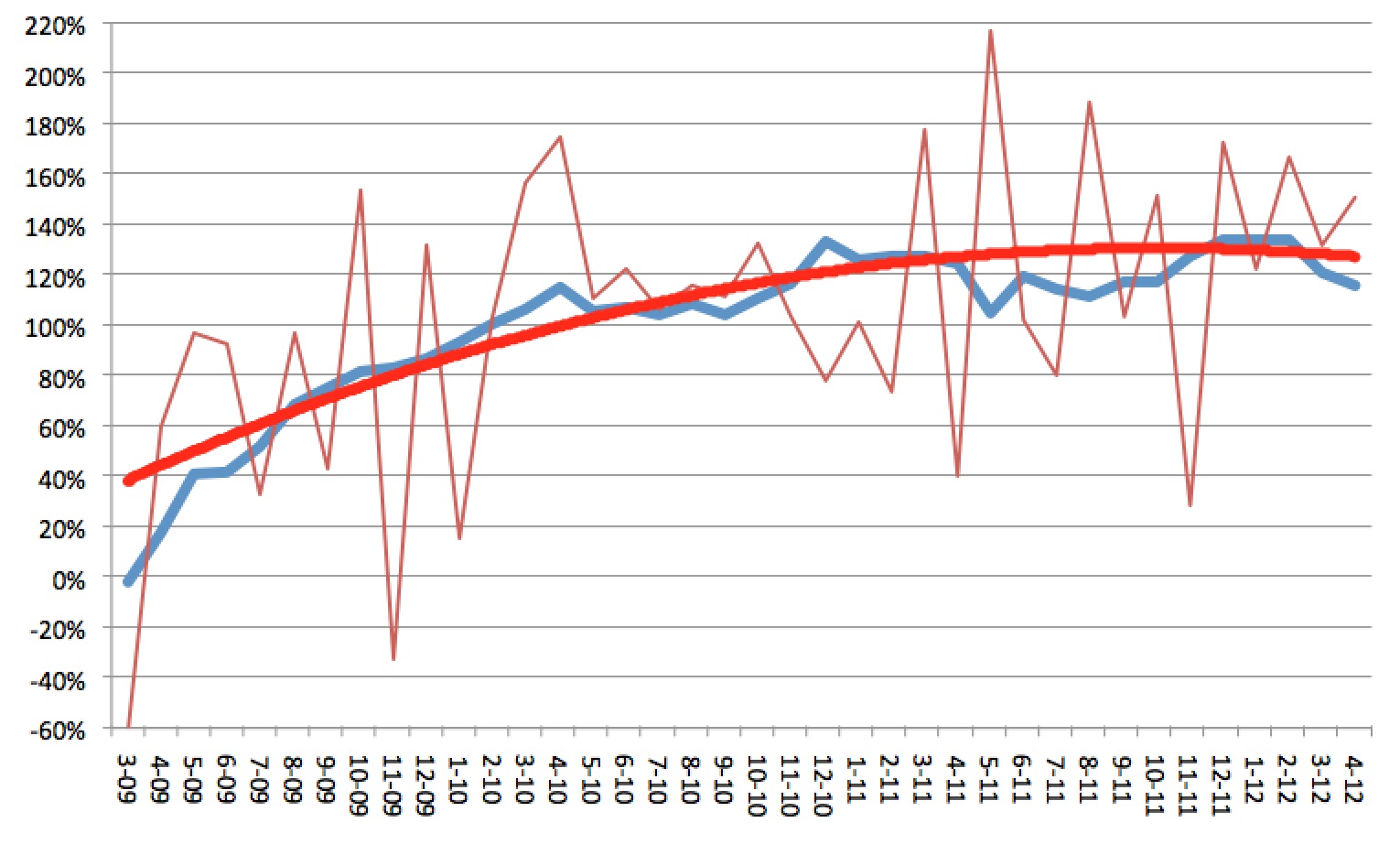
The “100%” mark means that you are gaining jobs as opposed to losing; 200% would mean that you are gaining as many jobs as you were losing at the start. Again, a huge advantage for Romney, as gaining 9500 jobs in Massachusetts is a hell of a lot easier than gaining 750,000 jobs at the national level.
As you can see, this shows a pretty different story than the ginned up chart above. As one might expect, Romney’s numbers show greater month-to-month variation due to the fact that he’s presiding over a smaller workforce. Whereas Obama deals with changes in the tens or hundreds of thousands, Romney was dealing in changes of no more than 15,000 in a single month. To smooth that out, I added a trendline–and interestingly, it tracks pretty much exactly with Obama’s performance.
Which means that Romney, in Massachusetts, got just the same level of job growth as Obama despite (1) starting off with a far less catastrophic situation; (2) having a far lower bar in order to claim accomplishment; (3) having a legislature that’s trying to help you instead of hurt you; and (4) getting buoyed by a greater economic environment. In short, he did exactly as well as Obama despite lacking virtually every great disadvantage that Obama had to face.
Imagine what would have happened if Massachusetts were imploding, were Romney pressed to create impossible numbers of jobs, had the Democrats been pitted against him, resolved to sabotage his recovery attempts, and the nation as a whole been in serious decline. Massachusetts would have been crushed under Romney’s governance.
Faced with that challenge at a far greater level, Obama has done passably well instead of impossibly great, for which Romney blasts him for being an abject failure. Kind of like a guy who directed a community theater play, which got good reviews on account of a great cast, heckling Steven Spielberg for not winning the Oscar.
If Romney becomes president and Republicans maintain control of the House, with Republicans blocking or even controlling the Senate, we can expect (a) even more and bigger tax cuts for the wealthy; (b) mild (obligatory) tax cuts for the middle class, offset by (c) tax hikes for the poor and the middle class in various forms, including forcing the poor to pay or pay more; cutting federal aid, thus forcing either tax hikes at state and local levels or reducing local services which essentially forces individuals to pay more, hitting the poor the hardest; and a much more antagonistic environment against the worker–less pay, fewer benefits, less union protection, less regulation against unfair pay and other worker abuses, etc. etc.
This along with spending austerity measures which Krugman points out is poison to an economy like ours right now.
So, yes, Obama’s job numbers are lackluster. But that doesn’t mean that Romney will do better–quite the opposite, in fact. Only in American politics is it the case where the voters are stupid enough to vote for the Penguin just because Batman hasn’t stopped the Penguin’s minions from wreaking havoc.