Archive

Archive for September 13th, 2014

The iPhone 6 and Carriers in Japan

September 13th, 2014 5 comments

So Sachi and I have been with Softbank since the iPhone first came out in Japan—me because Softbank was the only carrier with the iPhone at that time, and Sachi because she wanted to be on the same carrier as I was. There are good reasons for that: family members get to call each other for free, for example. Also, when we renewed last time, Sachi opted to use my old iPhone 4 (the one I repaired, in fact) for a substantially reduced data fee, something like ¥3000 a month. I believe that was only for family members also.

With the iPhone 6, Apple has upped its prices, however. The low-end iPhone used to go for ¥55,000 ($515), the iPhone 6 will go for about ¥73,000 ($675) in Japan.

So a few days ago, I went to Au, and asked what they could offer. I couldn’t get much information at the time, though, because it was Thursday and they wouldn’t give any info on pricing before the official sign-up period started on Friday at 4:00 p.m. (it had to be timed to start with the U.S. release, which was midnight PST).

Instead, they printed out a sheet showing me what the would offer were I to sign up under the iPhone 5s: ¥5985 ($56) per month with the iPhone discounted to zero—free with the 2-year contract. Then I went to check with Softbank; same thing, they couldn’t give me the new pricing, but they could tell me how much I was paying for my iPhone 5, and it was much higher: around ¥7100 ($66) a month. That’s a $20 difference per month for two contracts, or $480 over two years.

Well, that seemed like a no-brainer. I figured we’d go with Au. I knew we’d have to wait until November, however, since that’s when my Softbank contract runs out (a month after my payments for the iPhone 5 stop).

Then Friday came, and for fun, I thought I would pass by the Au shop on the way home to see how miserably long the lines were.

To my shock, there were no lines. Previously, with almost every other iPhone, there were long lines of people signing up. Not this time. I saw all of two people in the store. Interesting.

I figured I’d go in to get the pricing then. I did, and got a shock: a discount they offered before was now dropped. Monthly pricing: ¥7425 ($70) per month. For the entry 16GB iPhone 6. Softbank was cheaper than that!

OK, I thought. Back to Softbank!

So I went there today to get their new pricing. As it turned out, I had overlooked something: The new entry-level iPhones were free with a 2-year contract… only to people who switched carriers. That was not something that had been in place last time I renewed. Continuing customers pay ¥610 ($5.70) a month, or about $137 over 2 years. That rises to ¥1160 ($10.80) a month, or $260, for the 64GB iPhone 6.

Yikes. That would bring my monthly bill to about ¥7700, or $72 a month, even just for the 16GB model!

OK. Back to Au.

On my way, I thought I would drop by DoCoMo, just to see what they offered. The rep asked me, “Do you want the 2GB monthly data plan, or the 5GB plan?” “Um, how much for the flat rate?” “We don’t offer one!” Buh-bye. (It’s not even halfway through the month, and I have already racked up 5GB; I had no intention of counting packets and pennies all the time.)

When I go back to Au, I am in for a pleasant surprise: not only do I qualify for their ¥0 discount for switching customers, but they neglected to inform me before that I qualified for another discount: I have Au’s Fiber-optic plan for home Internet. This, they tell me, gives me a $14/mo. discount. For the 16GB iPhone 6, that brought me down to ¥5390 ($50). For the 64GB model—which I plan to get—it goes up a similar ¥540 per month, setting the price at ¥5930—about $55 a month. That I can live with.

But I was not through with problems: when you leave a carrier, your number portability is free for only a 1- or 2-month window. After that, you pay a fee of about $100. The problem: iPhones take several weeks between ordering and delivery, and you can only pick up the phone when after the portability window opens.

My Softbank contract only allows me to get off the bus between November 1 and 31. It is impossible to predict how long it will take for an iPhone to be delivered. They say 3-4 weeks, but it might arrive in 2 weeks. Or it could arrive in 6 weeks.

Let’s say I order my iPhone with Au early, on October 1. It arrives October 25. Au allows only 3 days to pick it up, else you lose it and have to re-order. I can’t leave Softbank until November 1, and the handoff has to be immediate. So I lose the phone I ordered, and have to re-order. Only this time, it takes 6 weeks, arriving December 10, and now I have to pay a $100 fee to Softbank to get loose. Argh.

So I have to time my order just right. Find out what delivery expectations are for the iPhone 6, and try to aim for the early middle of November.

Sachi, in the meantime, has a nice 2-month window—but one that started September 1st. So we’ll be going down to Au very soon to order hers, and maybe will wait 3 weeks or so to order mine.

She brought up an interesting point: if you quit your existing contract with your carrier inside the free number-portability window, you can avoid the fee, though you are without cell service until your new phone arrives. That sounds reasonable, though I would not be surprised if the official policy was not reasonable.

Hopefully, I’ll at least be able to get the phone before I leave for the U.S.; that way, I’ll be able to try out the Apple Pay system, and use the new camera for photographing Rica (my Dad’s dog) and other stuff.
Categories: iPhone Tags:

It Was 100% the Violator’s Fault AND You Were Incautious

September 13th, 2014 1 comment

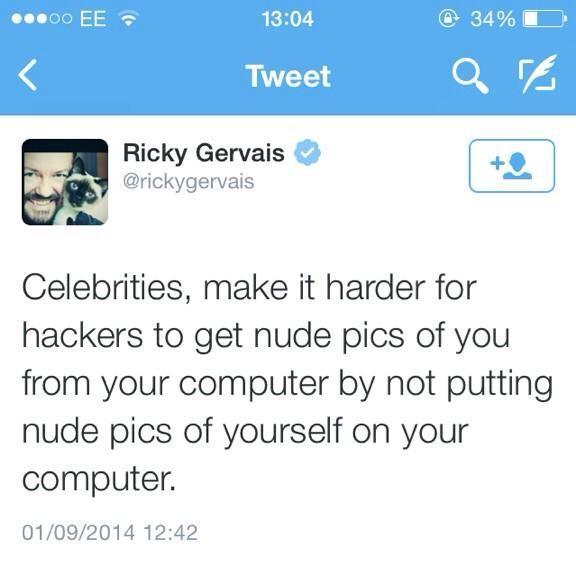
Ricky Gervais caught hell for tweeting this:

Gtweet

This brings up an incongruity which has always kind of bugged me: the idea that somehow pointing out incautious behavior must be interpreted as “victim blaming.”

I understand the principle involved. Women have been blamed for being raped since time immemorial, that blame often being linked to even the slightest or even imagined provocation; as a result, there is great objection to any indication that a woman who was raped was somehow doing anything that, if avoided, could have prevented the rape.

Women should be able to wear whatever they like, should be able to go to any party, drink any amount of alcohol, and should be able to expect not to be raped. Just like any person of color should be able to wear anything they like, walk down any street and into any shop, do any legal behavior, and not get stopped, frisked, arrested, beat up, or shot by police.

The problem is, that doesn’t fully represent reality. This is not to say that the people who are in fact in the wrong should not be 100% blamed, nor does it mean that we should not focus strongly on fixing those societal ills. It also does not mean that victims brought any injustice down upon themselves. However, until what is unjust is eliminated from our society, it is stupid to ignore the fact that such injustices exist and that people should be aware of them and try to protect themselves against them.

Let me give you an example. This will be an extreme example, so, please don’t immediately assume I’m one of those people who blame women for rape. Perhaps it would help if I mentioned beforehand that I agree wholeheartedly that not just rape, but any crime is 100% the fault of the perpetrator. With that in mind, consider the following:

I drive downtown in my nice, brand-new Infiniti G37 Coupe. It’s a really hot day, so when I run into a shop to get a frappuccino, I leave the keys in the car and the engine running so the air conditioning can keep the car cool. When I come out a few minutes later, the car is gone.

Keep in mind: in the above scenario, the person who stole the car was 100% at fault. I don’t care if I literally had shouted before going into the shop, “I’m leaving my keys in my car, no one take it, okay?” There is no excuse for anyone to steal from me.

Does that mean that no one should warn me against incautious behavior? Upon hearing what I did, would you really say nothing about my behavior?

Again, to ward off indignant fury, (a) this was an extreme example, (b) was not meant to mean that women are ever responsible for being raped, no matter how incautious their behavior, and (c) does not even imply that many or even most rapes or other crimes of a sexual nature involve any incautious behavior at all.

Nevertheless, this is not a perfect world; there are dangers out there; and there are times when people do things that open them to some kind of assault by those dangers. And by “open them to dangers,” I am not saying “it was their fault.”

Sometimes the lack of caution, despite the lack of blame, nonetheless can be of a type that honestly could, and even should, be pointed out.

Let me give an example of something much closer to what happened to the people in the recent hacked-photo incident.

Let’s say I purchase a Windows computer as my main computing device. Such computers often come with antivirus software, but only as a demo or trial. After the trial ends, maybe after 90 days, a few pop-ups appear, but I dismiss them as just being ads. I might even take steps to just get rid of them—and I don’t install any anti-malware application in the process. I surf the web without thought to where I am going, feeling that somehow I am safe—maybe I am simply unaware that just visiting a web site can trigger an infection, or maybe I believe that if that should happen, I will notice what’s happening. As a result, a hacker is able to insert malware onto my computer, and then has the ability to hurt me in any one of several ways. One way would be take photos of me in a compromising position with my own webcam, and then distribute those photos over the web.

This is actually a situation where I would have been less incautious than those celebrities, as I did not take nude photos of myself, nor did I store them on my computer, or on any cloud account, or send them to anyone.

In this case, like all other violations, the perpetrator is 100% at fault.

However, it is still fully true that my own actions made it possible for that perpetrator to do what they did. I shouldn’t have to install software to protect me from criminals. I shouldn’t have to worry about whether just visiting a web site could get my computer infected. However, in the world we live in, these are dangers which we should all know about and take steps to protect ourselves. It’s not my fault that the hacker did what he did, I’m not to blame for any of this. And I didn’t take precautions to keep it from happening.

Tell me, if someone knew all the facts, and then told me that I really should have installed antivirus software on my computer, would it really be reasonable for me to flare up in anger and accuse that person of victim blaming?

Not at all. I have a feeling that you would agree. What happened to me would be horrible, the responsibility lies completely with the hacker—and I failed to make my computer secure.

I would even go so far as to say that if we shied away from warning people against their lack of caution, we are simply making them even more vulnerable to attack.

The key point: there is a distinction between “blaming the victim” and pointing out incautious behavior.

Gervais was 100% correct: none of those people should have put nude photos of themselves on their computers. Especially not in a cloud account, or in email or any kind of message to others.

Yes, that sucks: we should be able to do anything we want, and expect privacy. And yes, the fault lies wholly with the asshats who hacked the accounts and stole and distributed the images.

That said, if I were a celebrity, the last thing I would do would be to have naked photos of myself on a publicly-accessible network anywhere, security or no security. Basic truth: no security is 100%. Any security, Mac or Windows, local bank or Vegas casino, can be hacked. If I had to have nude photos, I would store them on a USB drive kept in a safe. If I felt the need to take them and send them to someone, I would simply quash that impulse, knowing that I was a prime target of people who would intercept those images and make them public.

Celebrities, in general, already know that they are targets; they know that they are more vulnerable to such crimes. And they regularly modify their behavior to avoid such violations of privacy and decency. They know that if they do things in public that most people can get away with unnoticed, it will get plastered all over the Internet. Again, that sucks, but Celebrity 101 mandates caution about such things. The nude photos on a networked computer fall into that category.

Gervais wasn’t blaming the celebrities for being victimized. He was pointing out, with stinging irony, that they did something which was rather obviously incautious. Yes, it was insensitive, but it was also true.

We simply have to expand our understanding to make clear that doing something incautious, or even downright stupid, does not in any way excuse someone else from taking advantage of it. Nor is anyone who points out the lack of caution necessarily a villain for doing so.

Categories: Social Issues Tags: