Really?

March 20th, 2008 1 comment

Hillary Clinton, speaking to Michigan voters:

These nearly 2.5 million voters [in MI & FL] are in danger of being shut out of our democratic process. I think it’s wrong and frankly, I think it’s un-American.

I will protect and cherish the right to vote. I will always defend your right to vote no matter whom you choose to vote for.

So, if both those states had voted for Obama and the polls showed they still leaned toward him, she would still be demanding their votes be counted?

Please. We’re not stupid. If there is one thing that Hillary has demonstrated beyond any doubt whatsoever in this campaign, it is that she is willing to do just about anything to win the nomination. Her campaign has already announced on several occasions that states which vote for Obama “don’t count,” she stressed that superdelegates should vote for her even if it overturned the popular vote, and there have been repeated hints that she is geared up to try to flip pledged Obama delegates–delegates who represent people who voted for Obama–to switch to her side instead, effectively negating the votes of hundreds of thousands of people across the country.

You can bet your entire bank account on the fact that she’d be trashing the process if it didn’t benefit her. Are the people of Michigan and Florida aware of this fact?

Categories: Election 2008 Tags: by

Ferraro and Wright, Clinton and Obama

March 20th, 2008 Comments off

If you want a good comparison of the difference between Clinton and Obama, see how each handled their back-to-back crises with Ferraro and Wright. Both denounced what their friends said, both accepted their resignations, neither ultimately distanced themselves too far from the person creating the controversy–so in those ways they acted similarly. But beyond that there was a world of difference. Where Clinton had the opportunity to speak out on both gender and race in a healing manner, she did not; she instead just sat there, waiting for the storm to pass. Obama, on the other hand, did something, something bold and risky, something important and healing.

Clinton only protected herself. Obama looked out for the nation.

Maybe experience is less important than other things.

Categories: Election 2008 Tags: by

Arthur C. Clarke

March 20th, 2008 Comments off

Unless you’ve been living incommunicado for the past 24 hours, you likely know by now that author Arthur C. Clarke has passed away at the age of 90 in his home in Sri Lanka. The first to visualize geosynchronous satellites forming a world-spanning relay for communication, Clarke was a scientist with a flair for exquisitely elegant prose, authoring Childhood’s End, Songs of Distant Earth, and the film 2001: A Space Odyssey. While the concepts in his stories were deeper than the characters he crafted, the beauty of his words appealed to me the most. His death is a loss, but his life has been a wonderful gain for us all.

Categories: Main Tags: by

The Speech

March 19th, 2008 4 comments

Having watched the speech, I believe that even considering my clear bias toward the candidate, it is safe to say that he hit this one out of the park. There are perhaps no singular, memorable lines that will make the clip reel of great speeches, but the speech overall is as masterful as one expects from Obama’s rhetoric.

If you look at this speech, it embodies so much of what is good about Obama. At a time when many politicians would simply being doing damage control, Obama took this challenge and made it into an opportunity to address a larger issue of greater importance. He spoke in a healing manner about an issue which is as conspicuously divisive as it is covertly pervasive; instead of pretending that race is no longer a problem as pipe-dreaming conservatives often do (and as their very reaction to the Obama candidacy so thoroughly disproves), he confronted the issue head-on.

Instead of simply giving bland, feel-good platitudes that might comfort everyone in their falsehood and fantasize that problems don’t exist, he told all audiences, particularly blacks and whites, that we all have problems, we all make misjudgments. Obama has been known to tell you what you should hear instead of what you want to hear, and this was one such instance. Compare this with Bush’s “color blind” America, and Obama towers a hundred feet tall above that small sham of pretense. He would risk being honest where politicians usually run to the safe cover of make-believe utopia.

And that’s another positive here: Obama took a real risk here. Were this speech to fall flat, Obama could have hurt his campaign very badly, perhaps even putting his whole candidacy in jeopardy. This was not something long-planned, it was a real-time reaction, and Obama reacted perfectly. And he did it in a way that did not rely on sound bites, a very real risk; what he said could not be contained in small snippets, it has to be heard in length to be fully appreciated. This gives fuel to his detractors who can easily cut and dismember his speech so as to give a wrongful context (as I saw more than once on CNN today, for example). Instead of reducing the message to deformed ten-word sound bites, he laid it out in full, in a 37-minute speech, banking on the ability of Americans to take in more than the pundits care to dish out.

But most of all, the speech demonstrated Obama’s premiere talent: to take a divisive, controversial issue, contextualize it in a very real way at its core principles, recognize with full respect all the different views and perspectives, and lead his audience along the same path of logic and realization that he has traveled, bringing them all together to a common conclusion. That he does not demagogue or partisanize, that he does not take sides but instead respects all views, is the evidence of his ability to unify. This is not a man who would take such petty partisan digs like Bush or McCain when they call the Democratic Party the “Democrat Party,” to cite a small and spite-filled example. That’s why Obama in his worst hour stands so tall above those partisan hacks even at their best: he reaches out, and does not belittle. He respects, listens, and takes opposing viewpoints seriously. This passage highlights this ability clearly:

In fact, a similar anger exists within segments of the white community. Most working- and middle-class white Americans don’t feel that they have been particularly privileged by their race. Their experience is the immigrant experience – as far as they’re concerned, no one’s handed them anything, they’ve built it from scratch. They’ve worked hard all their lives, many times only to see their jobs shipped overseas or their pension dumped after a lifetime of labor. They are anxious about their futures, and feel their dreams slipping away; in an era of stagnant wages and global competition, opportunity comes to be seen as a zero sum game, in which your dreams come at my expense. So when they are told to bus their children to a school across town; when they hear that an African American is getting an advantage in landing a good job or a spot in a good college because of an injustice that they themselves never committed; when they’re told that their fears about crime in urban neighborhoods are somehow prejudiced, resentment builds over time.

Like the anger within the black community, these resentments aren’t always expressed in polite company. But they have helped shape the political landscape for at least a generation. Anger over welfare and affirmative action helped forge the Reagan Coalition. Politicians routinely exploited fears of crime for their own electoral ends. Talk show hosts and conservative commentators built entire careers unmasking bogus claims of racism while dismissing legitimate discussions of racial injustice and inequality as mere political correctness or reverse racism.

This is a man who can see how people who might disagree with him think and feel. He can understand their resentments and their viewpoints, and can fold them into his argument and make those people feel accepted instead of threatened, so they can then take in the other viewpoints which might otherwise be overlooked. This is not a man who would ever say anything so dumbly dogmatic or arrogant as “You’re either with us or you’re against us.”

Obama was in good form today; I want to say it was his best, but if you watch him enough, you’ll see that this is simply how he is, this is what he does so naturally. That’s why the crowds adore him–not because he’s black, and not even because he can use the right twist of a phrase. It’s the package deal–honesty, integrity, humility, understanding, acceptance, unity, strength, strategy, and perhaps even wisdom. Give me that over a few years’ more experience any day of the week, and twice on Sunday.

“Sunday” being an operative word here; one benefit to this “scandal” and to Obama’s speech is the fact that even his critics are saying he’s a Christian now. They can’t have it both ways, insinuating that he’s a Muslim (as if that would be a horrible thing) and at the same time attacking him for his 20-year relationship with his Christian pastor, his unwillingness to distance himself from his Christian church.

Nor did Obama throw his pastor to the wolves; while he repeatedly conceded that the man said things that offended even him, he placed the words in a brilliantly honest context. He did not try to paint Wright as a perfect man, but as a man with all the good and the bad that people will have, and did so in a way that I am sure so many can understand. One of the best passages of so many good passages from his speech makes it so humanly clear:

Given my background, my politics, and my professed values and ideals, there will no doubt be those for whom my statements of condemnation are not enough. Why associate myself with Reverend Wright in the first place, they may ask? Why not join another church? And I confess that if all that I knew of Reverend Wright were the snippets of those sermons that have run in an endless loop on the television and You Tube, or if Trinity United Church of Christ conformed to the caricatures being peddled by some commentators, there is no doubt that I would react in much the same way.

But the truth is, that isn’t all that I know of the man. The man I met more than twenty years ago is a man who helped introduce me to my Christian faith, a man who spoke to me about our obligations to love one another; to care for the sick and lift up the poor. He is a man who served his country as a U.S. Marine; who has studied and lectured at some of the finest universities and seminaries in the country, and who for over thirty years led a church that serves the community by doing God’s work here on Earth – by housing the homeless, ministering to the needy, providing day care services and scholarships and prison ministries, and reaching out to those suffering from HIV/AIDS. …

Like other predominantly black churches across the country, Trinity embodies the black community in its entirety – the doctor and the welfare mom, the model student and the former gang-banger. Like other black churches, Trinity’s services are full of raucous laughter and sometimes bawdy humor. They are full of dancing, clapping, screaming and shouting that may seem jarring to the untrained ear. The church contains in full the kindness and cruelty, the fierce intelligence and the shocking ignorance, the struggles and successes, the love and yes, the bitterness and bias that make up the black experience in America.

And this helps explain, perhaps, my relationship with Reverend Wright. As imperfect as he may be, he has been like family to me. He strengthened my faith, officiated my wedding, and baptized my children. Not once in my conversations with him have I heard him talk about any ethnic group in derogatory terms, or treat whites with whom he interacted with anything but courtesy and respect. He contains within him the contradictions – the good and the bad – of the community that he has served diligently for so many years.

I can no more disown him than I can disown the black community. I can no more disown him than I can my white grandmother – a woman who helped raise me, a woman who sacrificed again and again for me, a woman who loves me as much as she loves anything in this world, but a woman who once confessed her fear of black men who passed by her on the street, and who on more than one occasion has uttered racial or ethnic stereotypes that made me cringe.

These people are a part of me. And they are a part of America, this country that I love.

This crystallized Obama’s reasons perfectly for me: sometimes people you love say things you disagree with, things that might even make you cringe; but you don’t discard them because of such things, because you know that they are good people, people you have grown to love and respect over your life, people whose goodness and heart you have come to know. And despite the critics’ hollow charges that he “threw his grandmother under the bus” by comparing her to Wright, what Obama did was so much more different: he humanized her, like he humanized Wright. He told a story which, while painful, gave clarity and understanding, and most importantly, the impact of truth to a situation now saturated with distortion and slander.

Andrew Sullivan put it very well:

I have never felt more convinced that this man’s candidacy – not this man, his candidacy – and what he can bring us to achieve – is an historic opportunity. This was a testing; and he did not merely pass it by uttering safe bromides. He addressed the intimate, painful love he has for an imperfect and sometimes embittered man. And how that love enables him to see that man’s faults and pain as well as his promise. This is what my faith is about. It is what the Gospels are about. This is a candidate who does not merely speak as a Christian. He acts like a Christian.

Bill Clinton once said that everything bad in America can be rectified by what is good in America. He was right – and Obama takes that to a new level. And does it with the deepest darkest wound in this country’s history.

Obama did something significant here. He demonstrated a trait that is supposed to be the epitome of Christian: forgiveness. He forgave Wright, and in a way, forgave the country where Wright damned it. This is what we need right now. All we have to do is weather the talking heads and hope enough TV stations see fit to put more than just the sound bites up so that more people can hear the message over the noise.

Categories: Election 2008 Tags: by

Home

March 18th, 2008 1 comment

0308-Kitaikebukuro-450

A view of our building, along with the northern Tokyo skyline, from our table at the Cruise-Cruise restaurant on the 58th floor of the Sunshine Building last night. This time, I left a light on at our apartment so we could identify it more easily. Can you see it?

Categories: Focus on Japan 2008 Tags: by

Because, Who Needs Skin, Anyway?

March 18th, 2008 Comments off

0308-Skinfree 1-450

0308-Skinfree 2-450

You ask me, this is taking exfoliation one step too far….

Categories: The Lighter Side Tags: by

Married!

March 17th, 2008 21 comments

It’s official, if not fêted yet. Sachi and I went to city hall today (which is, after all, a Taian day) and signed all the papers needed. No sweat, we had all the paperwork done, and just had to dot a few “i”s; the whole thing took less than an hour, and we were married. The certificate comes in a week, but it’s all official as of now. (I’ve been telling people, “You can call me Mister Poza now!”) Afterwards, we went to Starbucks and had a coffee and snack, but then Sachi had to go off to work. But we’ll be celebrating better tonight, we have reservations at a nice restaurant–one on the 58th floor of a skyscraper that overlooks our apartment building.

Here are a few snaps from this morning, one before we got married and one just after:

31708-Bm-Home-450

31708-Am-Park-450

…And that’s when a giant white owl sat on her head. Actually, we asked a person sitting in the park to snap this for us, and, well, you get what you pay for. A nice shot, but the owl statue behind Sachi does kind of distract you a bit.

The ceremonial stuff happens in September. We’ll travel to the U.S. and have a small, private ceremony there with some friends and family, and then in late September (another Taian day, naturally) we’ll have a ceremony and reception here in Tokyo, at a nice wedding/restaurant place. The one we saw in Akasaka looked best, though we still haven’t decided.

Anyway, the deal is officially done today, and that’s what’s most important.

Categories: The Wedding Tags: by

Japan to Take Measures that Will Make the RIAA Green with Envy

March 17th, 2008 2 comments

While the details still seem a bit fuzzy, Japan seems poised to deliver a huge blow to file-sharing taking place here:

The nation’s four Internet provider organizations have agreed to forcibly cut the Internet connection of users found to repeatedly use Winny and other file-sharing programs to illegally copy gaming software and music, it was learned Friday.

The move aims to deal with the rise in illegal copying of music, gaming software and images that has resulted in huge infringements on the rights of copyright holders.

Resorting to cutting off the Internet connection of copyright violators has been considered before but never resorted to over fears the practice might involve violations of privacy rights and the freedom of use of telecommunications.

The Internet provider organizations have, however, judged it possible to disconnect specific users from the Internet or cancel provider contracts with them if they are identified as particularly flagrant transgressors in cooperation with copyright-related organizations, according to sources. …

According to the new agreement, copyright organizations would notify providers of Internet protocol addresses used by those who repeatedly make copies illegally, using special detection software. The providers would then send warning e-mails to the users based on the IP addresses of the computers used to connect to the Internet. If contacted users did not then stop their illegal copying, the providers would temporarily disconnect them from the Internet for a specified period of time or cancel their service-provision contracts.

The details given seem strangely incomplete. For example, the article only mentions cutting off people who download “music, gaming software and images”; the music and gaming software were mentioned repeatedly throughout the article, and no mention was made to television shows, movies, or any other kind of computer software. Was that simply a narrow focus chosen by the writer of the article, or are specific industries behind this move?

That narrow focus might indicate a desire to protect primarily Japanese copyright holders–since the most-copied Japanese-owned content is music and gaming software. If this is the case, then the crackdown might be similarly focused. They do mention that the interested parties are “copyright organizations including the Japanese Society for Rights of Authors, Composers and Publishers and the Association of Copyright for Computer Software.” Of course, it might be that this story was leaked by that organization, thus explaining the narrow focus.

However, the question then becomes, “how do they know what’s being shared?” Will they really go to so much trouble to discriminate? Or will they simply detect the signature of a particular type of file-sharing software, or scrutinize accounts which carry a large amount of traffic?

Another confusing sentence in the story is, “They will then begin making guidelines for disconnecting users from the Internet who leak illegally copied material onto the Net.” “Leak?” So, downloading is okay, but uploading is not? The article also notes that “particularly flagrant transgressors” will be the ones shut down.

The article is also vague on what file-sharing software will and will not be monitored for. All of it? The article mentions Winny predominantly, because (unlike the U.S., where Bittorrent is now widely used) Winny is one of the most often-used file sharing programs in Japan.

In one manner, the cooperation by Japanese ISPs makes a lot of sense: file sharers tend to use more bandwidth than most people. Shutting them down, or even discouraging them, could clear up a lot of bandwidth. They might be able to save some money down the road because of this kind of thing. It is hard to see another reason why the ISPs would be so willing to rat out their own customers in favor of, and to the profit of, a third party.

Also, they did note that 1.75 million people used the software; how many people in their customer base are they willing to cut off? Will they be satisfied with simply shutting down a few users, but enough to scare most other people into cutting down on file sharing? Or perhaps, for the ISPs, this will simply be a way of weeding out the less-profitable customers for their service.

Then there is the privacy consideration. In what way have they circumvented that problem, in a way which they were unable to do a few years ago? Are they sure that the Internal Affairs and Communications Ministry, which shut them down two years ago, won’t tell them to cut it out again?

In a country where copyright violation is practiced flagrantly (music & video rental stores sell blank CDs and DVDs right up at the checkout counter), this is a bit of a surprising development. Having read accounts of this in western publications, I see some wondering what legal challenges there will be. If this is actually carried out and if the government doesn’t tell them to stop, then I presume the answer to that will be, “not many.” Japan is not known for that sort of thing, not too much anyway.

It will be interesting to monitor this story and see where it goes.

Categories: Focus on Japan 2008 Tags: by

It’s All About the Money

March 16th, 2008 1 comment

In 1980, Ronald Reagan skewered Jimmy Carter by asking the question, “Are you better off now than you were four years ago?” Well, let’s see how that question has been answered over the past 16 years, shall we? The results [PDF] of an NBC/WSJ poll:

Bowochart

Hmm. Things got steadily better under President Clinton, and steadily worse under President Bush.

John McCain promises to continue the policies of Bush.

Right now, McCain is still doing fairly strongly in match-ups between himself and the Democratic candidates. But that’s probably because the Democrats are the only ones being attacked so far; when McCain comes under cross-party scrutiny, there will be several new points of contrast brought up, this being one of them.

Put this under the header of, “It’s the Economy, Stupid.”

Oh, and by the way, the Liberal Media continues to completely ignore the fact that the McCain campaign is now in outright violation of campaign finance laws. A Republican breaking federal laws in a display of utter hypocrisy? I can only guess that such a thing is now so pedestrian that the press feels it is OK to just ignore it.

Categories: Election 2008 Tags: by

I’m Pretty Sure that the Dayton Marriot Would Be Glad to Play Host

March 15th, 2008 3 comments

Here is how it is going in Iraq, according to the ‘hero’ general Bush used as the legitimizing front for his “surge” strategy:

Iraqi leaders have failed to take advantage of a reduction in violence to make adequate progress toward resolving their political differences, Gen. David H. Petraeus, the top U.S. commander in Iraq, said Thursday.

Petraeus, who is preparing to testify to Congress next month on the Iraq war, said in an interview that “no one” in the U.S. and Iraqi governments “feels that there has been sufficient progress by any means in the area of national reconciliation,” or in the provision of basic public services.

Okay, here’s my question: in the whole process of Iraqi national reconciliation, where the hell has Bush been?

As far as I have been able to tell, Bush’s visits to Iraq have been limited to serving up turkey; if there has been much in the way of diplomatic efforts, it has been very low-level and certainly not well-recorded in public. What has come out seems to show that it is more a military operation than a diplomatic one, and there has not been a great effort by the Bush administration to rally for a grand solution.

I am certainly no expert here. I do not know the intricacies involved. But if anything seems clear to even a layman like myself, it is that diplomacy has taken a rather clear back seat to military control. Where the hell is the Iraqi version of the Dayton Accords? Why hasn’t the Bush administration been making a high-level effort to bring the factions to a settlement? Why hasn’t he staged a grand international conference with those leaders brought together to a table, where things could be hammered out under moderation closely monitored and controlled by the best experts on the region? And why didn’t this get started years ago?

Is there some cultural element I’m missing in which Iraqis resent unifying conferences? I am under no illusion that all we have to do is bring them to some city in the midwest and magically everything would get fixed; what I am saying is that I see no effort on the part of this administration to even try to fix things over there at the diplomatic level. Remember how the Iraqi government had to take a two-month break because it was “too hot” in Baghdad? Where was the high-level diplomatic effort then?

Like I said, I’m no expert. Maybe there are really good reasons why the diplomatic approach has not been in high gear for some time now. But the impression I get is that this administration has, quite simply, been jerking off for the past several years. Someone correct me if my impression is off base here.

Categories: Iraq News Tags: by

RIAA: “Hmm. Suing Customers Didn’t Seem to Work. Let’s Try Forcing Everyone to Pay Us Lots of Money!”

March 14th, 2008 1 comment

The latest display of unfettered greed from the RIAA:

Having failed to stop piracy by suing internet users, the music industry is for the first time seriously considering a file sharing surcharge that internet service providers would collect from users. …

[The] idea is to collect a fee from internet service providers — something like $5 per user per month — and put it into a pool that would be used to compensate songwriters, performers, publishers and music labels. …

“If ISPs do not cooperate voluntarily,” [U2 manager Paul] McGuinness declared, “there will need to be legislation to force them to cooperate,” McGuinness said.

Um, right. Good idea.

Preface: the reports I have seen say nothing about this idea including the legalization of music file-sharing. I would presume that if the RIAA were suggesting that the $5 fee would allow everyone to legally download all the music they want for no extra cost, it would be a huge story and everyone would be covering that angle. From what I have read, they seem to be suggesting that the $5 surcharge only compensates them for what pirates steal, and nothing more; people would still have to pay for their music in addition to this surcharge. Under that assumption:

So many problems, where to start? Oh yeah: the idea of a blanket fee. Unable to target individuals efficiently, and tired of shooting in the dark, the RIAA now says, effectively, “kill them all and let god sort them out.” Charge everyone for the music, whether they download or not; essentially, the RIAA will get their very own federal tax.

Now, you could argue that stuff like this already happens; you pay more for items at stores as a way to cover losses to shoplifting. But at least the stores do this in-house; they don’t ask the oil companies to add a surcharge to gasoline sales on the idea that shoplifters use their cars to get to the stores. A more consistent model would be to add to the price of music sales to offset losses to piracy. Maybe the RIAA doesn’t want to do this because they know that the music they sell is already vastly overpriced. Just as likely is that they know it would dampen sales, whereas a surcharge on ISP services would only dampen the ISPs’ sales.

And we’re talking about huge fees generated. At $5 per ISP contract per month, with about 90 million U.S. households online, the RIAA would get a nice $5.4 billion bonus on top of all the music they sell each year. Cover most industrialized nations, and we’re talking many tens of billions of dollars the RIAA “earns” just for waking up in the morning. Brilliant! And all this without any evidence that they’re actually losing any money to file sharing–and actually some evidence that file sharing is actually generating revenue for them. Even if you believe they do lose money, it can’t even come close to that much money.

The Wired article actually legitimizes this approach somewhat:

The idea is controversial but — as Griffin and Jenner point out — hardly without precedent. The concept of collecting a fee for unauthorized use of music was developed in France in 1851 as a way of reimbursing composers whose work was being performed without their permission in cafes and the like.

The practice spread to the United States in 1914 and currently applies to radio airplay and webcasts in addition to live performances. In a 2004 white paper, the Electronic Frontier Foundation called for it to be applied to file sharing, but the Recording Industry Association of America immediately dismissed the proposal.

Either the writer of the story was just regurgitating what the RIAA was feeding him without checking it out, or he was simply poorly informed. The EFF white paper suggested something somewhat different from what is being suggested by the RIAA today. That 2004 white paper proposed a system in which individual file sharers could pony up $5 a month and in return, they could continue their file-sharing ways unabated. Having ISPs voluntarily buy into the system was one means of doing this–but the key point was that in return for the fee, all customers could then legally download all the music they wanted. As I mentioned above, I see no reference to this in the RIAA’s current proposal; instead, they simply push their idea as an additional compensation for pirated music only, not a blanket subscription-fee service. As for the radio fees, those were applied only to specific businesses who used the product–it was not applied indiscriminately as a tax. Unless I am mistaken, radio stations that do not broadcast music don’t pay the fee. (Could someone confirm that, please?)

The idea of having ISPs collect revenue for the RIAA seems a bit much to ask. Music is not all that is downloaded; if enforced by law, you would have the movie and TV producers, software developers, e-book vendors, and may other parties suddenly claiming they were losing billions to pirating and demanding additional fees be added to the ISPs’ prices until the fees became ridiculously high.

There is one precedent I can think of for this kind of idea: in Canada, a surcharge is added to media players and blank recording media and the money distributed to the music industry and artists; in fact, Canada has recently started to consider the $5/mo. ISP fee, but in exchange for making file-sharing legal.

The actual precedent in making up for revenues lost to theft is crystal clear: costs are added to the specific product stolen, or else added to the prices in the specific vendor’s venue. If the RIAA wants to jack up their own prices to compensate for this, then fine. If the RIAA wants to offer everyone a $5 per month subscription fee for accessing all the music they want, also fine. But to force every user of the Internet to pony up $5 a month, indefinitely, on the unfounded basis that the music industry is losing money it cannot even come close to proving it is actually losing, and to do so while insisting that these same people still pay full price for their music on top of this… like I said, that would be a fantastic deal for the music industry. But realistically, it is a stupid idea with little precedent and no rational justification.

Here’s a different view, by the way:

Categories: Corporate World Tags: by

Do Me

March 13th, 2008 1 comment

A few days ago, I posted about the nice weekend Sachi and I enjoyed, and I mentioned a fun bit of Engrish we saw:

We went home, and I gave Sachi the earrings I got for her main present, then we went off to a very nice restaurant downtown–the Oregon Bar & Grill in Shiodome (unfortunate motto: “Do Me”) City Center in Shinbashi.

To supplement that post, I tried to find some image from the web that had this logo and motto, but couldn’t find anything. Well, I should have been keeping up with Engrish.com, as they had this just a few days before my post:

Do-Me

You’d think that Japan would know by now to vet things like this past native speakers before printing them. We’re not that hard to find, you know.

Categories: Focus on Japan 2008, The Lighter Side Tags: by

Through Apologizing

March 13th, 2008 3 comments

Seth Grahame-Smith goes a lot further than I would, but essentially he is correct in his analysis of Clinton and why Democrats are starting to like the Clintons a lot less than they did before the beginning of this year. I used to favor Hillary for the nomination, and even proposed a Hillary/Obama ticket. At the beginning of January, I noted that I switched from Hillary to Obama, but mainly for reasons that had little to do with dislike for Hillary. I disapproved of her tendency to run to the center, and feared she might be too easily pilloried in the general election, but I was still okay with Hillary in general, despite these worries. But as time went on, Hillary started using tactics and making moves that made me like her less and less–and made me start to feel more and more like Grahame-Smith.

Is this just because I now favor Obama and wouldn’t like anyone who opposed him? Possibly, but I don’t think so. Had Hillary fought a clean race, I could still like and respect her. It’s not that she opposes Obama, it’s how she opposes him. Had I backed Hillary, for example, I just can’t see myself getting as indignant or offended by how Obama is campaigning against her.

And with the way a lot of Democrats and even Independents are now reacting to Hillary, I’d have to say that I am not alone in this. If Hillary wins the nomination and the election, it will be with a lot of votes like mine–people who pulled the switch for her, but not without a great deal of distaste.

Categories: Election 2008 Tags: by

I Don’t Think It’s Been a Picnic for Them Either, Geraldine

March 12th, 2008 Comments off

Hmm. Geraldine Ferraro, a strong Clinton supporter who Clinton has been aligned with, decides to opine on how Obama just got where he is because he’s black. When called out for making statements with racist overtones, instead of acting contrite, she retorts, “I really think they’re attacking me because I’m white. How’s that?”

On the eve of the Mississippi primary. Where 55% of voting Democrats are African-American.

Ouch.

Not that Clinton was really poised to win the state anyway, but this certainly doesn’t stand to give her a huge boost.

Here’s Ferraro’s reasoning:

I think what America feels about a woman becoming president takes a very secondary place to Obama’s campaign–to a kind of campaign that it would be hard for anyone to run against. For one thing, you have the press, which has been uniquely hard on her. It’s been a very sexist media. Some just don’t like her. The others have gotten caught up in the Obama campaign.

If Obama was a white man, he would not be in this position. And if he was a woman (of any color) he would not be in this position. He happens to be very lucky to be who he is. And the country is caught up in the concept.

A few problems here. First, the observation Ferraro makes is less of a contrast than she poses. She is suggesting that women have a harder time getting to places like Hillary is trying to get to than blacks do; however, there was a female VP candidate on a party ticket 24 years ago, and a female Speaker of the House just two years ago–both higher positions than African-Americans have been able to achieve. Blacks have gotten to other places earlier than women–the right to vote, a spot on the Supreme Court, for example–but it is not as if being black is that great an advantage.

This does not jibe with her theory, that all you have to be is black and you can vault ahead, while women have a much tougher time of things. Yes, blacks vote more for Obama, but women vote more for Hillary–and whites vote against Obama in several places as well. To suggest that being a woman is a disadvantage where being black is a bonus is far too simplistic and not altogether accurate in many ways. Both have their advantages and disadvantages. If being black is less of a hurdle than being a woman, the distinction is one of degree, not of complete contrast. And while the media is sexist, it is just as racist; as reluctant as they are to openly touch on racial issues, so are they on gender issues. As for the press being harder on Hillary, you know my opinion on that if you have read this blog; likely this is more a matter of a biased view than any real standard (that possibly applying to me in the reverse direction).

Ferraro’s claim is also insulting to blacks, belittling the challenges and difficulties they faced, suggesting that they somehow have it easy. It rings all to similarly to the white male charge of ‘reverse discrimination,’ where blacks who achieve something got there only because they’re black, only because somehow quotas or Affirmative Action gave them what they have.

And that’s the second big problem with Ferraro’s argument: it is condescending as hell to Obama and his supporters in a way that, despite Ferraro’s contentions, could very rightly be called racist. It says that he did not get to where he is because people like his ideas, nor because he has charisma, nor because of his positive message. No, they like him just because he’s black. The idea of inclusiveness is just a sham that nobody really thinks is worth anything; the positive tenor of his campaign does not really attract people; the quality of his rhetoric does not inspire his followers. No, they just see the color of his skin and open all the doors for him.

That’s not just racist, that’s stupid. It’s the same narrow-minded attack that Republicans tried against Obama from the very start, and it’s wrong. If Hillary had Obama’s talent for impassioned, electrifying rhetoric, if she had the same new-candidate freshness, the same inclusive appeal, the same positive message–Ferraro’s claim is that none of this would get her anywhere. And that’s wrong.

Maybe Ferraro is just cynical; she also said: “I was reading an article that said young Republicans are out there campaigning for Obama because they believe he’s going to be able to put an end to partisanship. Dear God! Anyone that has worked in the Congress knows that for over 200 years this country has had partisanship – that’s the way our country is.” Maybe she just believes that Obama’s popularity must be due to his color because she just can’t accept the idea of being inclusive, of accepting and embracing rather than dividing and attacking. But even that is not enough to excuse Ferraro’s crassness.

Obama vaulted to popularity in 2004 after his speech at the Democratic convention not because he was black, but because of the quality of the speech he made. He made a speech that inspired, a speech with wonderful cadence and appeal, a speech that said we are not red and blue, that we are all one people–this is what got him noticed.

To say that being black is what made the difference, or that none of these things would have helped him had he been white or a woman… it is just as appallingly wrong and bigoted as when the right-wingers tried it on Obama, and failed to get anywhere with it.

That Ferraro thinks she can just blow through the negative reaction, claim reverse racism, and eventually not have to pay any real price–and that she might just succeed–also goes to disprove her claim. Just as Obama’s personal qualities and ideas are more important than his color, Ferraro’s power and standing are showing to be more important than her gender.

Finally, there may be more to this than just a campaign tactic. Ben Smith at the Politico points out that in 1988, Ferraro said:

If Jesse Jackson were not black, he wouldn’t be in the race.

Make of that what you will.

Categories: Election 2008 Tags: by

Notes from the Campaign Trail

March 11th, 2008 1 comment

Big news: Democrats won a special election in Illinois’ 14th District, gaining a seat in the House. Why is that big news? Because the seat was Dennis Hastert’s, the former Republican Speaker of the House, a district that should have been an “easy seat” for the Republicans. Democratic candidate Bill Foster won 52% to 48%.

The fact is, Democrats could win big in 2008. We made huge gains in 2006; expecting only to win the House, we won it by a safe margin and won control of the Senate as well. This time, however, the wins could be even bigger–and not just because so many House Republicans are retiring this year and Democrats are winning special elections which are seen as bellwethers.

The numbers tell the story: in the Senate, there are 35 seats up for grabs–and 23 are Republican seats, with only 12 Democrats having to fight for their incumbency. Even better: a lot of those Republican seats are seriously threatened. Republican John Warner’s Virginia seat could be taken by Democrat and former governor Mark Warner. Al Franken has a good chance to take back the seat that Norm Coleman ungraciously grabbed from deceased Senator Paul Wellstone, capitalizing on smears that Democrats “hijacked” Wellstone’s memorial. John Sununu might lose his New Hampshire seat to Governor Jeanne Shaheen. Boulder Congressman Mark Udall might win the now-open seat vacated by a Republican in blue-shifting Colorado, where the Democratic convention will be held (expect him to make an appearance or two there). Oregon, Maine, and Nebraska could see a switch from right to left as well. And even powerful Alaskan Senator Ted Stevens, in a decidedly red state, could lose his seat to popular Anchorage Mayor Mark Begich, in part due to Steven’s recent scandals.

We thought it was highly unlikely that Democrats could take the Senate in 2006. It seems just as unlikely that Democrats could win a filibuster-proof majority this year. Let’s hope those odds hold true.


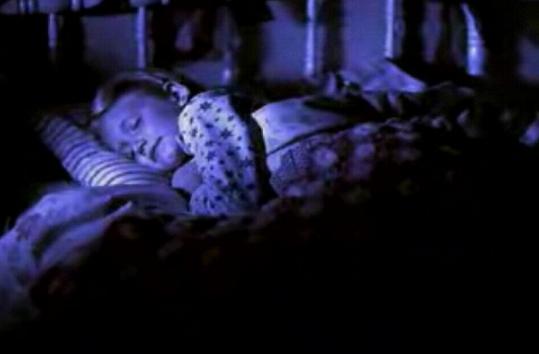
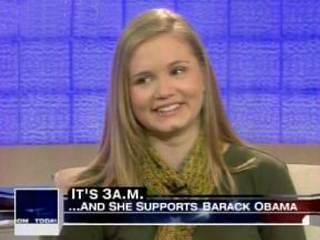
3AmadRemember Hillary’s “3:00 am” girl? The cute little child sleeping in her bed while nasty threats lurked somewhere out there, and could only be dealt with by Hillary? Well, irony has its day: the video was 8-year-old stock footage; the actress will be old enough to vote this year, and is a “big” Obama fan:
Knowles, a senior at Bonney Lake High School who turns 18 next month, has been campaigning for Obama. She attended his rally at Seattle’s KeyArena on Feb. 8. Her mother, Pam, told The News Tribune of Tacoma that Casey cried and trembled after shaking the candidate’s hand.3Amgirl

The next day, she was a Democratic precinct captain for the state’s caucuses. If she plays her cards right, she could go to the national convention.

She thinks the Obama campaign should use her in a counter-ad. Think of the possibilities!

In other good news for Obama on the Hillary front: the New York scandal with governor Eliot Spitzer could help shoot down Hillary’s attacks against Obama by putting her on the defensive, in perception if not in action. The troubled governor is a Clinton superdelegate from her home state.

Recent late-night talk-show quips:

Jay Leno joked last night that Spitzer’s scandal “means Hillary Clinton is now only the second angriest woman in the state of New York.” David Letterman offered a Top 10 List of excuses Spitzer might cite, including the number one excuse: “I thought Bill Clinton legalized this years ago.”


Marshall brings up the perfect example of “Liberal Media” bias: a CNN piece slamming Obama. The piece references a fellow legislator felt that Obama was not a “bold” legislator. The problem? The “fellow legislator” was a Republican; this CNN mentioned. Worse: He works for John McCain in Illinois; this CNN did not mention. Whether they mention it or not, or even disregarding that the guy works for McCain, the question arises as to why CNN thinks it’s newsworthy that a Republican criticizes the Democratic front-runner for president. I am absolutely certain that they could find any number of Democrats who worked in Congress with John McCain who would be willing to testify that McCain is not as squeaky-clean on campaign finance as people think he is, and they wouldn’t even have to limit themselves to someone who works for Obama to find such a person–and yet I see no equivalent stories of that nature out there.

Why not?


I find myself in the bizarre position of agreeing with Bill Kristol:
Perhaps the most obvious way McCain could upend the normal dynamics of this year’s election would be a bold vice presidential choice. … He could persuade the most impressive conservative in American public life, Clarence Thomas, to join the ticket.

Wow! That would be great! Of course, it would never happen, but it would be fantastic! Thomas has a long string of bad decisions that would be easily made sport of on the campaign trail; his age and demeanor would complement McCain’s in the worst way; but best of all, Thomas would have to resign from the Supreme Court before it convened in October, and Democrats would probably be able to stall the nomination of another justice until after a Democrat takes office, relieving the court of one of its most ardently destructive right-wingers. All of which, of course, are reasons why it’ll never happen.

Categories: Election 2008 Tags: by

Slightly Presumptuous

March 10th, 2008 6 comments

Let it not be said that Hillary Clinton doesn’t make as much hay as possible out of every bump she gets. After winning in Ohio and kind-of winning in Texas, her campaign is painting itself as the eventual winner–to the point of pushing for the possibility of a Clinton/Obama ticket. Rather presumptuous, considering that her “victory” netted her very few delegates, and at this point she still trails Obama by 100 delegates, even counting the Supers. And after Obama’s landslide win in Wyoming, it’s just a wee bit too soon to be counting him out quite yet.

After Mississippi (which Obama is probably going to win by several touchdowns), the delegate count will be back to the same levels they were before Ohio, more or less erasing whatever advantage Hillary got last week save for the perception of her campaign not dying quite yet.

Pennsylvania will probably give Hillary a boost, but again, not enough to make a critical difference. She’d have to win by 10% in order to get a net gain of 25 delegates, and Obama would still be ahead by about 110 pledged delegates. Next up are North Carolina and Indiana. Obama should win the former and Clinton the latter–but North Carolina has a lot more delegates and Obama is known for winning by bigger margins. (There is a chance that Obama will do at least fairly well in Indiana, neutralizing any big win by Hillary.) Obama will probably make up some or even a lot of what he will have lost in Pennsylvania on this day. After that we get West Virginia and Oregon. Hillary is set to take West Virginia, but Obama is very strong in Oregon–and again, Obama’s state has more delegates. Obama is likely to make up even more of the Pennsylvania delegate damage, maybe even erasing it by this time.

After that, Clinton may clean up the remainders–Kentucky, Puerto Rico, Montana, and South Dakota, though Obama could very possibly win one or more of those, nothing is sure. But assume that Clinton does win; she probably won’t do it by huge margins, and those four states are worth a total of 137 delegates–which is probably about how many delegates Obama will be in the lead by then. Hillary would have to win 100% to 0% to get ahead in pledged delegates, and of course nothing like that will happen. If she’s lucky, she might pick up dozen or two delegates, but no more, and probably less.

Even if there are re-do primaries/caucuses in Florida and Michigan, Hillary will gain quite a bit (maybe explaining why Obama is lukewarm to the idea of do-overs), but she still won’t be able to jump ahead. She and Obama are tied in Michigan, so she’ll have to settle for what Florida will give her. Florida has 210 delegates, and right now Clinton enjoys a 55%-39% lead. Say she wins by 59% to 41%; it will get her a net gain of almost 40 delegates, sure enough a big win–but still not nearly enough to overcome Obama’s lead. (Also consider the mitigating factor that Obama would probably go balls-to-the-wall in Florida, and for good reason; he could cut into that Clinton lead significantly, as he has done before elsewhere.) Worst case, Obama will still be ahead by maybe 80 or 90 pledged delegates, and assuming the Supers that commit between now and then don’t tilt more to one candidate or the other, he’ll still have a lead overall. Hillary would have even worse luck if the do-overs are caucuses and not primaries.

It will, inevitably, come down to the superdelegates. If Florida’s votes are counted, Hillary could be ahead in the popular vote. So it would be another split: will superdelegates give their votes to the winning of the popular vote or the winner of the delegate count?

Again, it would have to come down to getting the numerical advantage. I would have to say that this could be close and will almost certainly come down to the convention–but even under rosy circumstances for Clinton, she’s the less likely to win this in the end. Virtually everything would have to go her way in order to win this, and then she’d have to sway Obama, after all that, to take the pitcher-of-warm-spit side of the ticket. Conceivable, but not likely.

But she can make it a hell of a lot harder for Obama to win in November–and considering the scorched-earth tactics she’s already demonstrating, it’s likely that she will do just that.

Categories: Election 2008 Tags: by

Out and About This Weekend

March 9th, 2008 5 comments

Sachi and I have been around in the past few days. Yesterday was Sachi’s birthday, so we celebrated. I stopped by Mitsukoshi to pick up a few snacks; usually called “baby castella,” a kind of specially shaped pound-cake mini-snack, except these are filled with maple or caramel-flake flavors, very nice. Plus a bouquet of flowers from a nice florist, not the usual market florist. Then we went to a local “spa.”

It’s not that it isn’t a real “spa,” but more that it is a combination of spa and local bathhouse. These are relatively common, in that you might find one around even medium-sized train station shopping areas. We’re talking about a place that occupies at least three floors of a local building; one floor is set aside for the lobby and men’s baths; another floor exclusively for a more expansive women’s bath; and a third floor for a general-service area, with massage rooms and lounges.

0308-Spa-Jacuzziroom

This one is called the “Resta Spa,” though Sachi and I visited a similar spa in Fuchu that was nearly identical. You pay a nominal “introduction” fee (around $20), and another nominal fee for being in the spa for up to 5 hours.

0308-Spa-Massageroom

Then you can opt for various services, like massages or aromatherapy. Sachi chose for a varied package of services lasting more than an hour, and I just got a 20-minute back massage (you have to be specific about what kind of massage, and it can be great).

0308-Spa-Rlxroom

There is a relaxation room with powered first-class chairs with TV units built in, but I could leave that behind easily–unless you enjoy listening to old guys snore heavily, I am more relaxed in bed at home.

We went home, and I gave Sachi the earrings I got for her main present, then we went off to a very nice restaurant downtown–the Oregon Bar & Grill in Shiodome (unfortunate motto: “Do Me”) City Center in Shinbashi.

0308-Oregon-Bag

A bit expensive, but very good food–one of those multi-course dinners. The view was from the 42nd floor over all of Tokyo, though had I made the reservations well in advance we might have gotten the choice seats looking over Tokyo tower and Roppongi–not that the view over Ginza we had was bad one.

Today, we had a lazy sleep-in day, followed by a visit to Sunshine 60 Cruise-Cruise restaurant, one of the first in a series of visits to places to find a good location for our wedding party this September (though the official stuff gets done next week). A lot of restaurants have special setups for wedding parties, and we’re looking into what the best ones are for our needs and budget. We had a talk with the coordinator there, about costs for various rooms with meals and packages (rental outfits, ceremonies, cakes, dinners, photos, etc.) We’ll visit a few more in the coming weeks to see which one can give us the best deal.

After that, we went to a new favorite Izakaya–a popular Japanese dining format, a restaurant that serves lots of smaller dishes to large numbers of customers in big and/or partitioned common rooms. We’ve tried a few in this area, and found bad ones and good ones. A bad one was a place called “Tapa Sunshine Street”; we went there for a nice meal once, and instead got shafted. Went in the door, got seated in a corner among noisy, smoking groups, and were given our introductory snack. You think that it’s a complimentary snack, but it’s really a cover charge. We ordered beers and those were served promptly–they want you to drink as much as possible as the beer is where they make most of their money. But when we waited more than 40 minutes and none of the ordered food arrived, we got fed up and left–to have to pay about twenty bucks for a glass of beer and a bad snack each. Horrible service.

But we found a much nicer place: Nijyu Maru–though it might be ironically run by the same corporation that owns that “Tapa” dump, it’s a much better-run izakaya. You get seated at your table and use an LCD touchscreen tablet to order food. When Sachi and I ordered, the food came almost too quickly; expecting a wait, we ordered everything we could eat at once the first time we were there, and suddenly found ourselves swimming in an abundance of dishes. Tonight, we ordered more leisurely, and got everything in good time. The touchscreen tablets are easy to use (and becoming the rage in Japan, it seems–more and more places we visit use them), and the food they serve is delicious (especially the Negima yakitori, salted). What I like is the fact that the cigarette smoke is less offensive than most places. Most izakayas are smoking dungeons; after leaving this place, we could still smell the cigarette stink on us, but not nearly as badly as most izakayas, and we didn’t notice it much at all while there. Somehow, the seating and/or the ventilation keep it from becoming too offensive. The prices are reasonable, too–$30 per person for two beers and a more-than-satisfying set of dishes we ordered.

So, a nice birthday weekend for Sachi, and, for that matter, for both of us.

Categories: Focus on Japan 2008 Tags: by

Getting Glasses

March 9th, 2008 2 comments

0208-Glasses

I have always gotten my glasses made in the U.S. One of the reasons is that I was scared off of buying glasses in Japan because they were too expensive. I remember, many years ago, checking out prices for glasses in Japan and getting really high numbers quoted back to me. Maybe I was asking in the wrong places, but it was impression that this was a normal thing. So I have always gotten them when I go to the U.S. for visits.

This time around, however, I lost the prescription I had had made for me before I went to the U.S., and so I was not able to get glasses made when I went back. In the S.F. Bay Area at least, the glasses shops refuse to make a new pair for you without a prescription that is less than a few years old; you cannot simply bring in your existing pair and have them make a new pair based on that.

In Japan, however, there is no such restriction. Sachi and I were at Tokyu Hands and we passed by the “Coolens” outlet. We looked around and found a nice frame (at lower left in the image above; I still like my old pair better, but couldn’t find a similar frame here or in the U.S.), and then asked about getting the lenses made. To my surprise, the arrangement was pretty cheap; their cheapest set, including lenses and everything, is about $50 US. The price on each frame was the price including lenses (with UV and scratch-resistant coatings); you pay more for extras, like getting thinner lenses. But the main thing for me was that they would gladly measure the lenses right there and make a new pair for you, no prescription required. So we ordered the new pair–$92 for the basic pair, with an additional $76 for making them a lot thinner than basic. Not the cheapest in the world, but comparable to the prices I checked out in the U.S., and a lot cheaper than they used to be in Japan.

Can anyone out there confirm my impression that glasses used to be a lot more expensive here, and fill me in on when they got cheaper?

Categories: Focus on Japan 2008 Tags: by

Down into the Sewer, Just Like the Republicans

March 8th, 2008 2 comments

Hillary’s campaign is beginning to become way too Republican-esque for my comfort. First we had the negative campaigning when Obama fought a relatively clean and positive race; when that backfired, Hillary started lying about Obama’s record, often right to his face, claiming she had iron-clad evidence when she clearly did not. Then there was the double-dealing “I respect Obama and am honored to be with him” on TV followed by “Shame on you Barack Obama!” on the campaign trail. Then came the ultra-negative attacks leading up to Texas and Ohio, which finally successfully dragged Obama down into the mud that Hillary had been wallowing in for a while. Then there was the opportunistic grab at what was clearly a conservative dirty-tricks tactic with the Canadian NAFTA scam. And then there were the campaign claims (that she and McCain had “crossed that threshold” for being CinC, but Obama had not) that actually benefit McCain and can help him win, especially against Obama–kind of a scorched-earth tactic.

But a recurring theme in the Clinton campaign is to delve into hypocrisy, especially when attacking the Obama campaign for things her campaign has done, often times to a greater degree. She attacked Obama for criticizing her on health care, which she did against Obama far more often. She attacked him on exaggerated claims on mailers, which she often did. She blasted him for plagiarism, but was guilty of far worse passage-lifting than Obama–and then made the straight-faced claim that it was OK for her to do it. She criticized him for the Harry-and-Louise image, but now has published a far, far more questionable image of Obama which desaturates, darkens, and broadens his face, along the lines of the anti-Harold-Ford ads Republicans stewed up. She attacked him on the Canadian NAFTA thing to great effect, when all along the Canadians said Hillary was there first, doing the same thing.

And now, Hillary is bashing Obama, this time for an aide calling Hillary a “monster.” Forget that it was off the record, forget that it was an offhand comment by an aide. Forget that the aide apologized and was fired. Hillary is making huge hay of this, dragging it to the bank again and again. The hypocrisy? Clinton aides make those kinds of comments about Obama all the time. And nothing ever comes of it.

I am OK with the idea of Hillary being a “fighter,” but not a complete and utter disgrace–in other words, a Republican-style fighter. I’ll still vote for her over McCain of she wins the nomination, but it will be with more than a little disdain and disgust. Clinton took what was a grand and glorious Democratic run, and has dragged it into the sewer. In a clean race, Obama wins. I don’t know if I want to pay this high a price for a Democratic win. I’ll pay it, if I am forced to–but I will not like it.

Categories: Election 2008 Tags: by

Haldane Knew What He Was Talking About

March 7th, 2008 7 comments

Tonight I feel like indulging in a little Quantum physics 101. There’s something in quantum physics which is always fascinating: the double-slit experiment.

Take a light source, like a light bulb. Across the room is photosensitive paper which will get dark if exposed to light. Between them is an opaque wall. In the wall there is a tall, thin slit that can be opened and closed.

You open the slit. As expected, it will expose a section of the photosensitive paper behind it and you’ll get a tall, thin exposure there.

Now, imagine there’s a second slit. Do the experiment again, but this time open both slits at the same time. You might expect that you will expose two slits on the photosensitive paper, one for each opening in the wall. But in reality, you get a series of exposures on the photosensitive paper, as if there were many slits.

This is because when energy travels, it does so as a wave, like waves in a pond. If you drop two stones into a pond, waves go forth, and when the two sets of waves meet, they form an interference pattern. Same thing with the light through the two slits; the light pouring through each slit comes through in a wave form, like the waves from the stones in the pond; the waves interfere with each other, and so form the extra exposures.

Okay, so far we’ve only determined that energy travels as a wave. You’ve heard about “radio waves” your whole life, so this is not too impressive. But when further experiments are done, weird things begin to happen.

The idea of the interference pattern is that large numbers of energy packets are flowing through both slits, so obviously (or so one would think) the interference pattern comes from different light waves coming through each slit. Light wave A travels through one slit, and light wave B travels through the other slit; A and B meet on the other side and interfere with each other.

So someone decided to carry out this experiment with a variation: instead of using a light bulb, a different energy source was used: one that would emit just one packet of energy at a time, a packet of energy that could not be divided. Each packet would have to travel through one slit or the other, with no other packets to interfere along the way. After letting this experiment run its course and enough of packets of energy to pass through both slits, one would expect to see only two exposures, one for each slit, on the photosensitive paper on the far side of the wall with slits.

Except that’s not what happens. Instead, you get the same multiple-exposure interference pattern. And that’s where the weirdness comes in: if only one packet of energy, only one “wave” of light, is issued at one time, what could be interfering with it?

The answer: the energy is interfering with itself.

According to the theory, when you issue a packet of energy and let it go flying across the room, it does not simply follow a single straight path across the room. It takes every path across the room, simultaneously. In the case of the double-slit experiment, the energy packet does not just pass through slit A or slit B, it passes through both slit A and slit B.

But how can one piece of energy go through two slits? Here’s where it gets hairy: every possible path the light could possibly take is taken by a ghost-like probability of the energy packet, each probability nonetheless being “real” enough to interfere with other probabilities. It is as if a near-infinite number of probable versions of that energy packet take off across the room, interfering with each other all along the way. When the packet reaches the photosensitive paper and is forced to make an observable record of its location, the multitudinous probabilities collapse into the one most likely probability, and the impact of the energy packet on the photosensitive paper is recorded.

What’s more weird is what makes the probabilities collapse: observation. Place a detector at each slit that can observe the energy packet going through the slit–before it has a chance to interfere with itself on the other side–and the multiple exposures disappear, leaving only two exposures on the photosensitive paper. Even a detector over just one slit is enough to collapse the probabilities into single, definite paths–somehow the energy packets going through the unobserved slit “know” that observation is going on at the other slit, and behave accordingly.

You’ve probably heard of Schrödinger’s Cat; this thought experiment expresses what is explained above. I prefer to simplify it as a coin-in-a-box. Flip a coin in the air so it will land in an opaque, soundproofed box. When it drops below the upper rim of the box, slap a cover onto the box. You cannot hear where the coin went, how long it bounced around, and being human, you can’t predict which side will come up, heads or tails, just from watching the trajectory and the rate of spin of the coin going into the box. To make absolutely sure, flip the coin in the dark, so you can’t possibly predict how it landed.

The common-sense expectation is that the coin has landed in the box, and is either heads-up or tails-up, and it has a specific location in the box. We assume these things are decided just as if we were watching them, except in this case, we simply haven’t seen the results yet.

But the quantum theory expectation is far different. Once we stop observing the coin, it no longer exists as an object with a specific location. Instead, it exists as a cloud of probable-coins. Half of those are heads-up, and half are tails-up, aside from a small number of probable-coins that rest on their sides along the edges of the box. Probable-coins exist in all possible locations within the box. It’s really just one coin, expressed as a cloud of probable outcomes. And it stays that way until we open the box and observe it–at which time the probable-coins collapse into the most likely probability, which we observe.

That idea really messes with your head. It gives a whole new interpretation to the question, “if a tree falls in the forest and no one is there to hear it, does it make a sound?” According to this theory, if no one is there to hear it, the tree doesn’t even fall. Just probable-versions of the tree fall, and what sound they do or do not make, I won’t venture to guess.

Einstein didn’t like this–probably for many different reasons, but at least because the theory implies that different probable-versions of a particle somehow instantaneously communicate with each other. That is, when the probable-versions collapse, they don’t all shout “Olly Olly Oxen-Free!” to each other. When an observation is made, they simply all collapse, regardless of distance, and that violates classical expectations of how things work.

Einstein tried to disprove this “spooky action at a distance,” but in fact, an experiment performed in Switzerland has shown it to be real, where two “twinned” photons shared information instantaneously at a distance of ten kilometers. We now know that two intertwined particles can share information without paying attention to the speed of light. However, because of the way things work, we cannot use this as a means of faster-than-light communication.

This one effect aside, the whole situation raises bigger questions: is a conscious observer required, and if so, then is consciousness tied in with the fabric of the universe? Is nothing real until it is observed by life forms capable of being observers?

Those into New-Age spiritualism will often might conclude that this is proof of the soul. Scientists will tell you that these are abstractions created by mathematical attempts to explain observable phenomena and do not necessarily translate into real-world conclusions that New-Agers might subscribe to. Science fiction writers use this as a launching point to travel to all sorts of possible explanations, fiction made more fascinating because of its “grounding” in real physics.

In the end, we don’t know what the hell is going on. But it is fun as hell to speculate, to travel to those possible realities, and to know that–to paraphrase J. B. S. Haldane–the universe is not only stranger than we imagine, but it is stranger than we can imagine.

Categories: Science Tags: by