Spot On

November 28th, 2005 1 comment

I don’t often simply quote and run, but these two paragraphs from Jacob Weisberg’s article in Slate state the the case far too perfectly, on a matter that must be spoken and established in all sectors of American society (via Laura Rozen):

Here’s what we do know already, without a congressional inquiry: Members of the Bush Administration were dishonest with the public and with Congress about prewar intelligence. We’ve known this for some time—see, for example, the comprehensive and damning story Barton Gellman and Walter Pincus wrote in the Washington Post in August 2003 (“Depiction of Threat Outgrew Supporting Evidence“). Over the past two years, several incidents of executive-branch dishonesty in the run-up to the war have turned into subscandals of their own: the aluminum tubes that Iraq used for missiles and not gas centrifuges, the yellowcake uranium that Saddam didn’t try to buy from Niger, the mobile biological warfare laboratories that turned out to be hydrogen generators for balloons, the al-Qaida chemical warfare training that was based on a false confession, the meeting with Mohamed Atta that didn’t happen in Prague.

If you examine these and other pillars of the administration’s case for invading Iraq, a clear pattern emerges. Bush officials first put clear pressure on the intelligence community to support their assumptions that Saddam was developing WMD and cooperating with al-Qaida. Nonetheless, significant contrary evidence emerged. Bush hawks then overlooked, suppressed, or willfully ignored whatever cut against their views. In public, they depicted unsettled questions as dead certainties. Then, when they were caught out and proven wrong, they resisted the obvious and refused to correct the record. Finally, when their positions became utterly untenable, they claimed that they were misinformed or not told. Call this behavior what you will, but you can’t describe it as either “honest” or “truthful.”

Pass this on. Get this out. Email the two paragraphs and the link to the story to everyone you know. It succinctly phrases the truth of the matter in a way that’s very hard if not impossible to refute. They lied, repeatedly and intentionally. They knew they were passing on false information. They weren’t misinformed, they knew exactly what they were doing.

Categories: Political Ranting Tags: by

Around the Bay

November 27th, 2005 3 comments

Well, you can’t say I didn’t try. I got up at 6:00 in the morning and set out early. I went to Yatsu Higata in Chiba, doubled back to Sanbanze (I finally found the beach park which is considered the “real” Sanbanze site, after trying a few other locations this morning), then stopped off at Kasai Rinkai Park before heading home at about 2:00 in the afternoon, getting home by 3:00. Unfortunately, I don’t have much to show for it. Yatsu Higata had one species in the Sandpiper category I haven’t nailed down yet, but otherwise zilch, birding was poor there today. Sanbanze wasn’t great, either–the sun was behind the few interesting birds, and most of that location is for people with serious telescopic power–tons of birds, but all of them far off. There was a flock of Eurasian Coots, which I’d never seen before–I’d only seen them in twos or threes. But again, nothing new.

Only Kasai Rinkai had anything noteworthy, and that was not a new bird, but a good look at a familiar one: a Kingfisher that perched close this time. As usual, click for enlargements:

1105-Kingfisher4-450

1105-Kingfisher5-450

1105-Kingfisher7-450

I was lucky with the focus for those shots, not to mention that the bird obliged well for posing. But even better, I got a great movie of the Kingfisher doing its thing: sitting on a branch, diving down, catching some food, eating, shaking off water, then flying off again. The movie was in full-size mode, 640 x 480 pixels and 30 frames per second. The focus wavers a bit, but stays sharp for most of the clip. It’s a 17-second movie, a 2.2 MB download. You must have the most recent version of Quicktime (version 7, free download) installed in order to see it. Click on this image to go to the movie:

1105-Kingfisher-Movie-450

The clicking and beeping you hear in the movie is the other birdwatchers excitedly but quietly photographing the scene. This was kind of special because the bird was no more than fifteen or twenty feet away, and feeding–not a common sight.

I know it might be a bit of a pain to have to download Quicktime 7 to see this movie, but I’m doing it this way because frankly I am very impressed with Apple’s new H.264 compression, intended for high-definition movies. The original movie, in AVI format (which has until now given some of the best compression) was almost 30 MB in size–but with the H.264 compression, as you can hopefully see, there was very little loss in image quality, but the compression got the file down to only 2.2 MB, less than 10% of the original file size. As I said, impressive.

In the next day or two, I’ll go back and post some other photos from today and last Wednesday.

Categories: Birdwatching, Uncategorized Tags: by

The Death Penalty

November 26th, 2005 3 comments

I am against capital punishment. Here’s why.

First, the nature of the punishment itself is irreversible. Yes, imprisonment cannot be reversed–if you’re put in prison for five years, you can’t get that time back. However, you can be released, and possibly given some form of recompense. But there is no return from death, no way to compensate for what was done. The very idea of the death sentence presumes either an infallibility of the criminal justice system, or that killing innocents is an acceptable price to pay for what capital punishment may gain. I accept neither.

Then there is the fact that the death penalty is unevenly administered, poverty and race being deciding factors. Poverty mostly because the ability to hire a top-flight defense attorney will at the very least protect you from the death penalty and perhaps even any punishment at all; it is difficult to see any solution to this problem. But race is a factor for several reasons, none of them necessary. A side factor: an overwhelming number of district attorneys are white, as many as 97%+. This in itself does not prove a disparity in sentencing, but it certainly cannot help. But the real proof is in analyses of how the death sentence is distributed, accounting for the severity of the crime. Studies done in Philadelphia, for example, show that all other factors being equal, blacks are four times likelier to receive the death penalty than whites. The death penalty is more likely to be administered for the killing of a white person than for the killing of a black person, even when the number of killings overall is adjusted for. There is no real question that there is a racial influence where the death penalty is involved. Now, a counter-argument could state that the same is true in non-capital punishment as well, and this is probably true; should we therefore shut down any punishment for any crime where the punishment shows disparity? My answer would be of course “no,” the reason being in the difference in reversibility: one cannot withdraw a penalty of death once administered. This heightens the stakes, making enough of a distinction to differentiate in how we deal with the punishments involved. (Source)

Another factor comes back to the issue of fallibility: we kill innocents. Those in favor of the death penalty try to deny it, skirt around it, but it is true, and there is evidence for this beyond the obvious nature of the fact. George W. Bush, for example, in the 2000 election, tried to claim that there has never been any evidence that an innocent person has been put to death. This is disingenuous, of course: the absence of evidence is not the evidence of absence. Furthermore, who would find proof? Those sentenced to death are overwhelmingly poor, and their families cannot afford investigations; those who prosecute have a strong and vested interest in finding that no errors were made, not the reverse. And to top it off, it is standard procedure that when a person is executed, all evidence pertaining to their trial is destroyed. So, even if well-funded anti-death-penalty organizations were to investigate after a sentence is carried out, there is little chance of success–not because we don’t kill innocents, but because the deck is stacked against finding evidence that we do. We cover up after ourselves, as if knowing what we did was wrong and trying to hide evidence of it.

When Bush made his statement back in 2000, we must also assume that he was intentionally disregarding statistical evidence, of course. When DNA analysis became possible in the 1990’s, a certain number of people on death row were proven innocent of the crimes they were sentenced for, in cases where no other evidence could have cleared them of the conviction against them. Without DNA evidence, these people would have been put to death. Without this analysis available before the mid-nineties, there must have been innocents being put to death. The only alternative is to believe that before the mid-nineties, we never made mistakes in sentencing innocents, but from the 90’s on forward, we suddenly began making lots of them. This is highly improbable, to say the least. Furthermore, not all cases can be proved one way or the other with DNA evidence, and that means that we are still killing innocents.

And recently, there has been positive evidence that we killed an innocent: Ruben Cantu was executed in Texas in 1993 for a murder he allegedly committed when he was 17 years old in 1984. And now, evidence has come to light that Cantu was indeed innocent. The only eyewitness has recanted, saying he was pressured by police to identify Cantu as the killer, even though he was certain Cantu was not guilty of the crime. Cantu’s co-defendent swears that Cantu was not with him on the night of the crime. There was no physical evidence that placed Cantu at the scene of the crime, and the investigators failed to interview people who could have provided Cantu with an alibi. It is suspected that the police framed Cantu, in part because he escaped charges of wounding an off-duty police officer in a bar fight, a charge dropped because of tainted evidence and “overreaction” by police officers. Read the story.

One way to solve the problem of killing innocents would be to allow the death penalty only in cases where there is absolute and overwhelming knowledge of the guilt of a defendant; but even if this is accounted for, the disparities of race and poverty, as well as other factors I will get to shortly, would still make the death penalty unacceptable to me.

Arguments for the death penalty include the idea that capital punishment is cheaper. While this would be true if we practice summary executions without appeals, we do not and should not. The appeals process actually costs more than life imprisonment. Highly fallacious claims for the death penalty give us an either-or choice of executing killers or letting them go loose to kill others; naturally, this is flawed in that there is a third choice, that of lifetime imprisonment.

The apparent stronger arguments for the death penalty concern, first, using the penalty as a deterrent against future crime, and second, the claim that those guilty of heinous crimes deserve the death penalty, and the families of the victims deserve closure and justice. As for the former, there is no evidence that the specter of the death penalty deters crime. Many pro-death-penalty studies claim this, but all are seriously flawed in one or more ways: none probe the actual reaction of any murder suspects to find how they were affected by deterrence, and by definition we cannot directly test the deterrent effect on people who chose not to commit crimes. The studies ignore data from states which contradict their thesis and sometimes focus only on states that have a death penalty; they ignore intervening factors, such as universally declining murder rates. And the results of the different studies are contradictory and inconsistent. (Source–PDF file) If the death penalty has any deterrent effect, it is so negligible as to be lost in the noise of alternate influences and the statistical margin of error.

As for deservedness and justice, that leads to my final and most powerful argument against capital punishment: it is wrong to kill people. Those who claim justice or closure are really talking about what some actually outwardly propose: vengeance. Let’s face it, that’s what we want when we favor the death penalty. We want to kill the bastards who did this to us or our loved ones. The problem is that vengeance is wrong. It is, in my opinion, the greatest source of suffering, violence and killing in the world today. It is an ugly desire, such as selfishness, greed or jealousy. And while we have a system of justice, we do not have a system of vengeance.

It is argued that not carrying out the death sentence is a gift to the criminal; how many times have we heard the criticism of life in prison that the victim got death, and the killer got “life”? But this is fallacious: life in prison is not by any means a reward. It may be desirable to execution, but then it is also desirable to years of painful torture, which would also be desirable for the family of the victim in some cases. Should we do that? Is the idea of the justice system to torment criminals to the greatest extent possible, to simply remove them from society as a danger to others, or somewhere in between?

My opinions on this matter revolve around the concept of responsibility: we are responsible for what we do, regardless of the actions of others. “I hit him because he hit me” is not an excuse. That others do evil is not just cause for us to do so also. People talk about the heinous actions of a criminal and of how the criminal deserves death. This may be true. But it does not obviate the fact that in carrying out such a penalty, we as a society are responsible for killing people when it is not necessary to do so. That makes us killers. It’s not about who the criminal is or how bad he is; it’s about who we are, what kind of society we choose to have, and what we decide to do. And the fact that we killed someone bad does not mitigate the fact that we did it, nor does it lessen our responsibility for it.

In the end, the actions of a criminal do not excuse our imitating them, no matter how we dress it up in custom, ceremony, and the respectability of the justice system. We do not torture criminals: why not? We do not rape rapists: why not? It is because that is not who we are, and such a reaction to rape or torture (however much it would please some people) would demonstrate much more clearly our culpability in committing something which is clearly wrong. We are not the kind of people who rape and torture. We may often, yet wrongly, take pleasure in the idea that a rapist may be raped in jail, or that they may suffer something analogous to torture. But that is only because we hide behind others doing the wrong, just as we feel less culpability when we send captives to other countries to be tortured. It just “happens” to them, we didn’t do it directly, so, good for us. But in reality we are responsible, and it is not right if it happens. We would not be willing to do it directly, how can we be less culpable if we allow others to do it for us?

Am I a bleeding-heart criminal coddler for believing so? No. This philosophy is not borne out of care for the criminal as a human being (god forbid), but out of concern for who and what I am, who and what we are, separate from the actions of the criminal.

Do we wrong criminals by incarcerating them, as in imprisoning a kidnaper? No: incarceration is a means to prevent criminals from committing further wrongs. It is also a penalty, sometimes even applied when a criminal commits a crime unlikely to be repeated. But imprisonment is a deterrent, and so defends us as well, and self-defense is a justified case for penalties.

However, the death penalty itself is not self-defense. It is not a deterrent beyond other punishments. It is therefore a punishment of preference, an act we cannot blame the criminal for. It is our responsibility, our choice. And as such, it is wrong.


Categories: Political Ranting Tags: by

A Few More Shows

November 25th, 2005 3 comments

I figured I’d just finish off the list of new shows I’m interested in. I won’t go into the CSI: New York, because essentially it’s the same show as Miami or Vegas, just different characters–but then, with CSI, the characters aren’t really the stars of the show. They’re interesting and well-played, but the murder and the science (which is not always accurate) are the real draws there. I also won’t get into the Stargate series; the original has worn out somewhat and lost a lot of magic when Richard Dean Anderson left, and the new series is too involved in the original to get into on its own. Instead, let’s look first at Commander in Chief.

CinC, to save typing, can perhaps be viewed as “West Wing Lite.” It centers on Mackenzie Allen (Geena Davis), a political independent, who gets drafted as a conservative president’s vice president, a sop to soccer moms to bring his ticket to the center. They win, and she is more or less tossed aside. But then the president becomes gravely ill–and commands her to resign, so a properly conservative, and male, leader can be put into office to take over when the president dies. That man is Speaker of the House Nathan Templeton (Donald Sutherland), who plays the bad guy in the series. At first, Allen plans to step down, but after a particularly condescending speech to her by Templeton, she changes her mind and takes the presidency. Her husband and three kids are dragged along into it with her, and play a big part in the series.

It’s really West Wing Lite because it centers more on sketchy and sometimes corny melodrama rather than on real issues. And for a series that pretends to be about empowering women, you know that if the character were a man, his family would not be as central to the storylines–the focus on the family seems less a happenstance or an independent choice, and more a matter of she’s-a-woman-so-we-have-to-have-her-family-involved-more. But the real failure of this series is the cardboard nature of everything–the characters, the issues, and the situations. Everything is stark but not deep. The husband is pressed into service as the First Gentleman, but the situation is unrealistic and forced–at first, people seem to assume that he’ll be picking out linen swatches and deciding what’s on the menu for dinner, and his desire to press his manly role is similarly overemphasized. The problems the kids have are also exaggerated and oversimplified. The same can be said for the situations this president meets. Sutherland as Templeton is a classic mustache-twirler, taking every chance to shoot Allen down, stabbing her in the back while claiming to be all lightness and sweet. The issues presented by the circumstances faced are glossed over, not delved into like The West Wing does.

But the worst flaw is the infallibility of the main character. Obstacles are thrown up almost to the point of being comical, and yet every situation is dealt with adeptly and successfully. This president always lucks out and never loses. It always works out in the end. And at the end, we end up learning almost nothing about the issues presented. Aaron Sorkin could make an episode of The West Wing about something as mundane as the census, and manage to make it funny, intriguing, engaging, and informative. CinC struggles to achieve half that, and doesn’t seem to even attempt the other half.

I’ll keep watching it for a while though–series creator Rod Lurie is stepping aside, and successful Steven Bochco (L.A. Law, NYPD Blue) is coming in as the show runner; it’ll be worth it to see if the show can get better than this.

The other show is an unqualified hit: Boston Legal. Despite the strength of the secondary characters, Candice Bergen and Rene Auberjonois, the real stars are James Spader and William Shatner. Spader, introduced on another David E. Kelley show, The Practice, is brilliant in the extremely well-written and -conceived role of Alan Shore. Shore is a rude, gallant, saintly evil, sexually forceful, hedonistic and completely uninhibited silver-tongued attorney, a mass of weaknesses, strengths, and seeming contradictions, prone to burst out joyfully in completely inappropriate behavior. Shore is one of the best characters to come to television in a long time, a character who is endlessly entertaining and promises to be deep and complex–and they got the best actor possible for the role.

Just Spader himself would be enough to make the series worthwhile, but they got an added bonus: William Shatner. Now, I’m not the biggest Shatner fan, but one thing you have to admit, the man has a brilliant sense of his own absurdity and can play it to comic effect to no end. In this series, he plays Denny Crane (motto: “Denny Crane!”), a delightfully arrogant, bombastic, narcissistic, dyed-in-the-wool conservative, an over-the-top male chauvinist, gun-toting, homophobic fuddy-duddy with a combination of mental acuity and fuzziness, the latter brought on by either Alzheimer’s or Mad Cow Disease (he prefers the latter). Shatner plays the role to the hilt, but the role is reigned in to the perfect degree by the writers. Crane, in the hands of different writers or another actor, would be ludicrous and unappealing, but with this team, Crane is human and endearing, not to mention hilarious.

Everyone else helps a good deal, but Spader and Shatner make the show. If you aren’t watching it, pick it up.

Categories: Media & Reviews Tags: by

Good Grebes

November 24th, 2005 1 comment

I went to Kasai Rinkai yesterday, where there were a lot of birds, but no new ones, really. There was a Kingfisher, a Snipe, and a ton of ducks (I think I’ve got all of them already, but I’ll have to check on a few). There was even a Tanuki, a Raccoon Dog. I’ll have some photos from there soon. But I also dropped by Sanbanze, what would be a tidal flats, had the high tide not been in since late morning. I wasn’t able to catch the area at its best–but I did get two new birds, both Grebes–and both surprising to me.

The first I saw was the Black-necked Grebe (Hajiro-Kaitsuburi • ハジロカイツブリ), which stood out from its form and its bright red eyes. Its propensity to dive made me figure it was a Grebe; it was hard to keep up with it. When a Grebe dives, it tends to go in a certain direction. Once you see the direction, when it dives you have to walk thirty feet or so in that direction to be in the right spot when it surfaces. And then to get a photo, you have to lock the focus and shoot fast, else it’ll dive again. These are two shots I got of it, both with enlargements when clicked:

1105-Black-Necked Grebe1-450

1105-Black-Necked Grebe2-450

But the big surprise was the second one. I thought I was shooting the same bird as the first, though this one was much farther off and almost in front of the sunset, so I didn’t see much detail until I got home and looked at it on the computer. It was a Great Crested Grebe (Kanmuri-Kaitsuburi • カンムリカイツブリ), a beautiful bird if you can get a clear, well-lit shot of it. But here are my shots, distant, blurry, and backlit…

1105-Great-Crested Grebe-450

And this last one, with no enlargement:

1105-Great-Crested Grebe2-450

These two make #81 and #82 on my photo-life list for Japan. Sanbanze will definitely be next on my list for birding when I get out to a Tokyo Bay location again.

Categories: Birdwatching, Uncategorized Tags: by

The Invasiveness of DRM

November 23rd, 2005 4 comments

I’m really getting sick and tired of these greedy, grabby media companies trying to control what we do with a product after we’ve bought it. One recent example is the Sony spyware incident, where people who wanted to listen to their legally-purchased songs on their computers discovered that Sony had covertly installed copy-protection software on their hard drives, which could actually be used by hackers to trash said computers. The Sony “DRM” program, called “Aires,” was in the form of a “rootkit,” a kind of cloaked software that hides certain system processes from the user. And while Sony “alerts” you to the fact the software is being installed, it is the typical spyware notice buried deeply in the EULA (End User License Agreement), that notice that pops up and demands you “agree” before you install software. The exact language is:

As soon as you have agreed to be bound by the terms and conditions of the EULA, this CD will automatically install a small proprietary software program (the “Software”) onto your computer. The Software is intended to protect the audio files embodied on the CD, and it may also facilitate your use of the digital content. Once installed, the Software will reside on your computer until removed or deleted.

Frankly, I think it’s time for the laws regarding these contracts be revised. I disagree with the libertarian view that if you don’t pore through every little clause in every contract you must sign (which would occupy half your waking hours if you did so), then it’s your own fault. I believe that common-sense relevancy should demand that stuff like that be written in clear, layman’s language at the top of every contract; burying it in the small print, even if it is clearly written, is nothing less than fraud, proven so by the fact that it was the seller’s intent to bury the information in the first place.

But back to Sony’s spyware: the rootkit Sony employed was not unique. In fact, it was the same kind of software used by hackers to put malware onto your system. Computer-savvy individuals caught on to what Sony was doing, and blogged about it. When the story got out, Sony assured everyone that the files were harmless and that they could be easily uninstalled. However, they provided no instructions on how to uninstall, and a layman’s attempt to do so could cripple the computer. Further, it soon became known that hackers were hijacking the Sony rootkit to spread malware. Soon, Sony was backpedaling like a sonuvagun, distributing software to uninstall the rootkit while sellers like Amazon instituted recalls. And now the lawyers are lining up to class-action Sony’s ass. And in this case, I say “right on!”

Copy-protection has always been a pain. I remember buying a VHS copy of “The Life of Brian” years and years ago. It had the kind of copy protection where the vertical hold would be completely lost if you tried to copy it. The problem was, in order to do this, the media company that sold it to us made the vertical hold on the original so weak that we had trouble watching the original–we had to constantly fuss with the vertical hold control on the TV. Copy protection is never perfect; somebody always finds a way around it. The only people it really hobbles are the people who buy the product and want to use it legally.

And that has always been at the heart of the whole “digital rights” problem–the makers of the media try to control their product long after they sell it or give it away, for fear that after it is sold, it will be taken and redistributed or resold at a later time. That attempt at control causes problems because it tries to reach criminals by running over legitimate users. If there were a way to mark each copy sold so it could be traced back later once a crime had been committed, then fine. However, unable to do that, the content makers instead tried to follow the product all the way along the path of its existence, which intrudes upon the legal consumer’s territory far more often than it ever got in the criminal’s way.

And that brings up the question of how much right the seller of a product has to follow a product after a sale. Not only for protection against illegal copying, but for control over what happens to a product and how it is used once it is privately owned. Because recent developments have companies using “digital rights management” to do far more than just protect against copying.
The latest example of this comes after TiVo announced that they would release “TiVoToGo,” a technology which would allow TiVo users to download recorded TV shows to their video iPods or Sony PSP devices. Predictably, media companies were outraged:

“TiVo appears to be acting unilaterally, disregarding established rights of content owners to participate in decisions regarding the distribution and exploitation of their content. … This unilateral action creates the risk of legal conflict instead of contributing to the constructive exploitation of digital technology that can rapidly provide new and exciting experiences for the consumer.”

But frankly, this is utter bull. I mean, really–“decisions regarding the distribution and exploitation of their content”? Give me a break. Once it’s been delivered to my home, by whatever method, it’s mine. I own it. Not the rights to redistribute, but the rights to privately consume it. It has been distributed and that process is over. Once it’s in my hands, I can do what I please with it, and the producer of the content can go to hell.

Think about it. Plug in any other kind of product into that equation. What if a store that sold you oranges tried to sue a company that made juicers on the grounds that they had rights and controlled what you did with an orange after you bought it? That the orange seller deserved a cut of any sales having to do with changing the form or consumption of the oranges after the sale? That you would have to pay extra if you wanted to do anything with the orange except peel it and eat it straight? That turning it into juice would require an extra fee to the orange grower, or that using the rind in baking confectionaries would be prohibited?

Ostensibly, all of these measures to control media are supposed to be only for the protection against said media being illegally redistributed. The case of personal home use has long been settled, not that the media companies will admit to it. They want to ride the illegal-download horse all the way into your living room, and assert permanent control over the media on the supposed grounds that it might at some point leave your home and go to someone else’s. But you soon find out that it is less about hindering criminals than it is about hindering you, limiting your abilities so you’ll pay them again to do what you should have been able to do in the first place. They don’t just want to control the distribution of the media; they want to control every aspect of how you use the media in the privacy of your home, which is far in excess of their actual rights.

If a media content producer delivers a product to you, I don’t give a damn what they think they still own. So long as I’m not reselling or redistributing the content, I can do whatever the hell I want with it. What right do they have to say that I have to watch it only on my TV and not on my iPod? That’s like saying that I can record it on VHS, but not on DVD, or that I can watch their show on my living room TV, but not on my bedroom TV. You gave it to me or sold it to me, it’s mine. If I want to deep-fry it in the privacy of my home, there’s nothing you can do about it, so get the hell off my property. It’s like a grocer selling you food, but refusing to let go, following you around and objecting to how you prepare it, trying to stop you from frying or baking if he doesn’t approve. Just as you would with such a control-freak kind of grocer, you should tell these media companies to back off and mind their own damned business. Audio and video media are not some magical product which allow the seller to invade your home and micromanage your use of it, and it’s about time that consumers asserted their own rights to be left the hell alone once they get the media.

Some Tama Pics

November 22nd, 2005 Comments off

Here are a few photos I picked up yesterday along the Tama River. First, I was able to get some gull shots; it turns out that the flock of Black-headed Gulls that were scared off by the fisherman last time tend to return to the same spot. So this time, without the disruptive piscatorial intruder, I was able to get closer and snap off a few nice portraits. Again (and I will do this as often as I can), all the pictures have 1000 x 8000 pixel blow-ups when clicked.

1105-Bh Gulls-450

1105-Bh Gull Landing-450

1105-Bh Gull Landing2-450

I also got a good shot of a Grey Heron, and only after looking at the shot later did I realize that a few Wagtails, one of them flying, by pure chance were caught in the frame. Furthermore, one of the Wagtails is a White and the other is a Japanese (less common).

1105-Heron Wagtails-450

Another, closer shot of the Japanese Wagtail:

1105-Japanese Wagtail-450

I also got a few nice shots of Black Kites:

1105-Black Kites1-450

1105-Black Kite2-450

There were four, and they were cavorting about and landing on the riverbank… but I’ve had less than stellar luck getting sharp focus on the birds when they fly against the sky as background, for some reason.

And finally, I got a pretty fair shot of a Meadow Bunting.

1105-Meadow Bunting-450

Categories: Birdwatching, Uncategorized Tags: by

The GOP Continues to Act Reprehensibly, Part II

November 21st, 2005 1 comment

A firestorm was precipitated by a statement last Thursday by Democratic Representative John Murtha of Pennsylvania, a ranking member on the Defense Appropriations Subcommittee, decorated Vietnam vet, and widely recognized expert on military issues. He called for the withdrawal of U.S. troops from Iraq. This was significant because Murtha is most decidedly on the conservative side of the Democratic party, and is respected as a voice in military matters; he is kind of a Democratic John McCain. His statement was a tough one for this decorated Marine Colonel to make, but it was made through an honest assessment of the situation in Iraq, and was a clear sign that serious discussion on the matter should begin.

But the GOP was in no mood to be serious. Scared shitless of being yanked from power next November, they saw Murtha’s statement only within the context of their sorry political asses, and immediately went into piranha mode. Since his statement, the GOP has reacted in a way that is hard to call anything but utterly reprehensible.

First, they forced a vote on a resolution that was a complete and utter sham, butchering Murtha’s thoughtful resolution so it looked like a cowardly cut-and-run without thought to stabilizing Iraq (see details below); the idea was not to consider or debate Murtha’s call, but to string up a straw man and force Democrats to vote against it.

As they were doing this, Ohio Republican representative Jean Schmidt made a direct personal attack on Murtha, claiming an Ohio legislator urged her to insult him: “He asked me… to send Congressman Murtha a message: that cowards cut and run; Marines never do.” This was so outrageous in the context of Congressional debate that the floor erupted in shouting and Schmidt was forced to withdraw her comment.

Then they laid it on thicker, going for the jugular in a particularly sickening and corrupt manner. The GOP has for the past several years all but shut down the Ethics committee, and has fought and delayed indefinitely having any Republican investigated for even the most blatant of offenses. But almost within hours of Murtha suggesting we pull out of Iraq, the GOP started demanding that Murtha be immediately investigated. Why? Because there is a claim that Murtha’s aide told a defense contractor to retain a lobbying group called KSA, and it turns out that Murtha’s brother works for KSA. KSA lobbied for 10 firms, which eventually were awarded $20 million of a $417 billion appropriations bill. There is no evidence that the money was given to the companies due to the lobbying, or that Murtha was even aware of the aide’s statement.

Meanwhile, Vice President Cheney, having come into office straight from the CEO chair at Halliburton, arranged for the company to get billions of dollars in no-bid contracts, and called in the energy industries to write the country’s energy policy in secret, while his case was decided by his fishing buddy Scalia on the Supreme Court. The GOP fights tooth and nail against any investigation into little stuff like that, or the fact that literally billions of U.S. taxpayer dollars have been simply “lost” in Iraq… but the moment Rep. Murtha suggests we should pull our troops out in a reasonable and responsible way, the GOP screams into gear, demanding that investigators be sent up Murtha’s asshole with an electron microscope on the basis of a news report that an aide may have said something to a guy who worked for a place which hired a firm where Murtha’s brother worked. They didn’t even wait a few weeks to make the investigatory act appear even the least bit unrelated to a partisan political smear.

Anyone got a better word than “reprehensible”?

For reference, by the way, here is Murtha’s original resolution, followed by the GOP’s “version.” First, Murtha’s resolution (also in PDF):

MR. MURTHA introduced the following joint resolution, which was referred to the Committee on [blank]

Whereas Congress and the American People have not been shown clear, measurable progress toward establishment of stable and improving security in Iraq or of a stable and improving economy in Iraq, both of which are essential to “promote the emergence of a democratic government”;

Whereas additional stabilization in Iraq by U, S. military forces cannot be achieved without the deployment of hundreds of thousands of additional U S. troops, which in turn cannot be achieved without a military draft;

Whereas more than $277 billion has been appropriated by the United States Congress to prosecute U.S. military action in Iraq and Afghanistan;

Whereas, as of the drafting of this resolution, 2,079 U.S. troops have been killed in Operation Iraqi Freedom;

Whereas U.S. forces have become the target of the insurgency;

Whereas, according to recent polls, over 80 percent of the Iraqi people want U.S. forces out of Iraq;

Whereas polls also indicate that 45 percent of the Iraqi people feel that the attacks on U.S. forces are justified;

Whereas, due to the foregoing, Congress finds it evident that continuing U.S. military action in Iraq is not in the best interests of the United States of America, the people of Iraq, or the Persian Gulf Region, which were cited in Public Law 107-243 as justification for undertaking such action;

Therefore be it Resolved by the Senate and House of Representatives of the United States of American in Congress assembled, That:

    Section 1. The deployment of United States Forces in Iraq, by direction of Congress, is hereby terminated and forces involved are to be redeployed at the earliest practicable date.

    Section 2. A quick-reaction U.S. force and an over-the-horizon presence of U.S. Marines shall be deployed in the region.

    Section 3. The United States of America shall pursue security and stability in Iraq through diplomacy.

And the GOP “version” [PDF] which was forced to a vote:

Resolved, That it is the sense of the House of Representatives that the deployment of United States forces in Iraq be terminated immediately.

Yeah. That’s the exact same thing all right.

Categories: Political Ranting Tags: by

The GOP Continues to Act Reprehensibly, Part I

November 20th, 2005 Comments off

Remember the old days when southern states tried to stop blacks from voting by instituting things like poll taxes? Well, it’s a good thing they don’t happen any more, right?

Well, in GOP-land, we have a case of one-step-forward, twenty-steps-back. Georgia’s Republican-run state legislature passed a Voter ID law earlier this year which requires all voters to present a photo ID in order to vote. For those with a driver’s license, that’s all they need. But for those without a driver’s license–which includes a great many of the state’s poor and black populations, who vote predominantly Democratic–they need to spend a day going to the DMV, and shell out between $20 and $35 for a photo ID.

Fortunately, a judge suspended the law a month ago in time for the elections, calling the law discriminatory in a 123-page opinion:

The photo ID requirement is most likely to prevent Georgia’s elderly, poor and African-American voters from voting…. For those citizens, the character and magnitude of their injury — the loss of their right to vote — is undeniably demoralizing and extreme.

The GOP, of course, claims that this is not about disenfranchising Democratic voters, but about stemming voter fraud–though it often seems, under the GOP definition, that any Democrat voting is a case of voter fraud. They have in the past made grand yet vague claims about voter fraud being rampant in poor and black communities, though in typical fashion do not present any reliable evidence that this is so. In August, Alberto Gonzales approved the voter ID law, showing a clear distinction between the Bush 43 and Clinton administrations–the Clinton DOJ slapped down a similar law in Louisiana in 1994. The current administration and GOP mindset, however, seems far more prone to be hostile to blacks, the poor, and the elderly.

One recent example, in a memo from the U.S. Justice Department, includes a bizarre claim by a Georgia Republican lawmaker:

The chief sponsor of Georgia’s voter identification law told the Justice Department that if black people in her district “are not paid to vote, they don’t go to the polls,” and that if fewer blacks vote as a result of the new law, it is only because it would end such voting fraud.

The newly released Justice Department memo quoting state Rep. Sue Burmeister (R-Augusta) was prepared by department lawyers as the federal government considered whether to approve the new law.

I’ve tried to find the full text of the memo, but cannot–if any readers know where it is, please tell me. I’d love to see the full context of those remarks, and why they were put into that memo. But one thing is pretty undeniable: Burmeister believes that blacks are responsible to a disproportionate amount of voter fraud. Again, no evidence is forthcoming. Burmeister spoke out, claiming that the memo “misrepresented” her, and the DOJ is backpedaling, making the usual GOP claim when an embarrassing memo is discovered that it was only a “draft” and shouldn’t be paid attention to.

As for the part about blacks not voting unless they are paid to do so, I have no idea what she’s talking about. Is she suggesting that the DNC pays black people to go to the polls? Seems so–if not them, then who?

Georgia Republicans are also backpedaling, trying to say they will amend the bill somehow, or change elements like making the ID card free of charge. That may be less bad, but it’s still bad. Forcing people to get photo ID cards still puts a disproportionate burden on some people (by coincidence, of course, predominantly Democrats) to jump through hoops before they can vote. It means setting aside a whole weekday so they can go to the DMV by bus or on foot and wait in the infamous long lines to get an ID card. This is not an easy thing for the people who need it most–mostly people who cannot afford to miss a day of work (which will cost them much more than $20, a cost no one seems to have factored in). It’s a matter of proportion: for a middle-class person, it would likely be equivalent to a much higher fee and somewhat greater effort. For example, what if a law were passed requiring middle-class voters to drive 50 miles and pay a $200 fee in order to get to vote? How would that be greeted?

The fact is, any hurdle, any disproportionate effort imposed on any group of voters would violate the constitution. But the GOP has consistently demonstrated that its supposed high regard for the constitution is outweighed by any chance of solidifying their power base and forwarding their political and cultural agenda.

Categories: Political Ranting Tags: by

Kichijoji Birds

November 19th, 2005 3 comments

I went to Kichijoji today, and visited two parks: Inokashira and Kichijoji Parks. Kichijoji Park was new to me, and while there were a lot of ducks and a few other good birds, what I saw there was really just a subset of what I could see at Inokashira. And there were some pretty nice birds there today. Not any new ones for me, but I got some nice photos of ones I’ve seen before.

First, the Common Moorhen. You can spot these easily along the main bridge across the lake, the same bridge where you line up to rent the pedal-boats. The Moorhens are among the ducks taking food from passers-by along the bridge, on the side opposite the boats. The Moorhens tend to hang back. Before, I saw only an immature one; today, a family of three were out (all images today have enlargements when clicked):

1105-Common Moorhen-450

1105-Common Moorhen2-450

The other nice catch was the Mandarin Ducks. These tend to stick to an area close to the west end of the lake in the park. You can usually find them on the last footbridge before the end of the lake. You might have to detour around a small building, taking a dirt path off the bridge, to find their hiding spot. But when you find them, they are close, and they are glorious. First, a mating pair:

1105-Mandarin Duck-Pair-450

Then one from behind; I like the angle, and the color and texture of the water:

1105-Mandarin Duck3-450

It’s also very interesting to catch them preening and fluffing out–you see more about what their feathers are doing:

Mandarin Preen-450

Mandarin Head Detail-450

Maybe some more later, from Kichijoji Park.

Categories: Birdwatching, Uncategorized Tags: by

Where Do “Munitions” End and WMD Begin?

November 18th, 2005 1 comment

A lot hinges on definitions. What’s a WMD? Nuclear and biological are probably fairly easy to distinguish, but chemical weapons? Gunpowder is a chemical. But chemical weapons are usually identified as non-combustible. The common, layman’s definition of a chemical weapon might be simpler: drop a chemical on someone and they are injured or killed. This would fit into the non-combustible category.

One might ask, however, if the difference is really as big as we make it out. Much talk is devoted to how inhuman Saddam Hussein was for gassing Kurds. Of course, we didn’t give a damn when it actually happened–Hussein was our friend at the time, and we even helped him develop those weapons (we wanted him as a counterweight to Iran). We only saw him as a monster after he invaded Kuwait. Before then, he was our friend and ally, and we overlooked his gassing people. After Kuwait, he was a monster we had to wipe off the face of the Earth.

But I digress. Why are WMD that much more terrible than conventional weapons? Would you rather die in a millisecond at ground zero of a nuclear explosion, or be shot in the gut, dying slowly and painfully? Perhaps that’s not a fully honest question, though. WMDs can be quick and painless, and conventional weapons can be horrifically cruel–but it is probably more often the other way around. And WMDs have a greater ability to kill in large numbers. These are likely the reasons why we abhor WMDs far more than conventional weapons. In addition, of course, to the huge emphasis placed on the unacceptable nature of WMD in popular culture.

But have we used chemical weapons? What about napalm? How about Agent Orange? Would these qualify? Have we been using WMDs on people we fought for decades, and have just been hiding the fact by splitting hairs or ignoring the issue altogether?

And what about White Phosphorus? Also known as WP, or Willy Pete, it has been in the news recently, since American soldiers let it be known that it was used in Fallujah. You remember Fallujah, the really tough place that our government felt was important to get “under control” at just about any cost? We used it there.

The severity of the effects of WP seem to depend on where you read about them. It is described in Wikipedia as if it were a non-lethal weapon, though if you look closely, the article uses words such as “diluted” and “usually” less harmful than napalm. The U.S. military has been describing it publicly as a weapon used to illuminate a battlefield or to create a smokescreen–but less public documents showed that it is indeed used by the military as an incendiary, and is used in “lethal” situations. In fact, the military initially denied using it at all, suggesting that they knew it was not kosher.

The debate has been as to whether WP is indeed a chemical weapon, and therefore a WMD. The substance can burn or even melt skin, damage the eyes, throat or internal organs, and even dissolve the jaw bone. It can be lethal. It was used in shells that exploded over positions in Fallujah, and it appears that civilians were also exposed. An Italian documentary showed civilian corpses, people who evidently died in WP attacks (gruesome photos here, here and here–you’re forewarned). And the way it was used, it was not an explosive–it worked far more like a chemical weapon as defined within the context of WMDs.

But did we really use it? The Italian documentary maker presented a U.S. soldier who spoke about the use of WP. But the U.S. military denied it. Besides, they said, we didn’t sign the treaty which outlawed it.

But a report from the Washington Post at the time of the attacks kind of makes it irrefutable:

Some artillery guns fired white phosphorous rounds that create a screen of fire that cannot be extinguished with water. Insurgents reported being attacked with a substance that melted their skin, a reaction consistent with white phosphorous burns.

Kamal Hadeethi, a physician at a regional hospital, said, “The corpses of the mujaheddin which we received were burned, and some corpses were melted.”

The evidence also seems to suggest that civilians were killed by the weapon as well.

So we might return to the argument about how bad WMDs are, relatively speaking. After all, we Americans do that when we discuss Hiroshima, right? We did it to save lives, more people would have suffered a worse death, and so on. But it is hard for us to talk both sides–that it’s monstrous when our enemies use it, and justifiable when we use it. And the idea that deaths caused by conventional weapons are just as bad doesn’t help much either–we do that kind of thing far, far more often.

In the end, the use of weapons like WP seem to dissolve many of the jingoistic portraits of Saddam as a madman and we as white-hat heroes. The distinctions are less clear. We’ve had torture and rape rooms, too. We’ve likely enough killed more Iraqis than Hussein did, probably even if you only count noncombatants. And we’ve used weapons that were no less horrific and not so different than Hussein’s chemical attacks, and we’ve done this to civilians. And remember, when Hussein used his chemical weapons, we did not make a peep, nor did we call him a monster or decry the use of such weapons until it suited us politically.

WP doesn’t make us into Hussein. But it does serve to show that the lines are far, far more blurred than most would have you believe.

Categories: Political Ranting Tags: by

More in the Genre

November 17th, 2005 Comments off

Earlier I commented on the mystery genre that seems to be catching on, as expressed by The 4400 and Lost–TV shows which revolve around some enigmatic secret, alien or supernatural. There are two new entries this year, most likely given the green light after the roaring success that Lost has enjoyed.

One is titled Invasion, and follows two related families living in Florida after a hurricane hits. During the storm, a great many orange lights emerge from the ocean depths; many people go missing, to turn up nude and apparently unharmed–but, we are to assume, either possessed or cloned, evidently unaware that they are any different than they were before. As time goes on, the orange lights creep up on more people from the flood waters, and seemingly take them over as well.

The main character is Russell Varon, a U.S. Park Ranger; his ex-wife, a doctor who is now married to the town’s sheriff, seems to be one of the first to have been ‘taken’ or ‘changed’ or whatever. They share their two children, while Russell lives also with his new wife, a TV reporter, and her paranoid, conspiracy-seeking brother.

So far, very little has been made clear, about what the orange lights are, whether people are really possessed, what the eventual plans are, etc. It’s mostly been character stories and a lot of X-Files-style running around but at the end of the day you’re no wiser. I’m sticking with the show for the time being, primarily because of Executive Producer Tommy Schlamme, a veteran of The West Wing. I’d like to see what he’s got for this show, but up until now I’m not exactly entranced; it’s the show I’m most likely to stop watching unless it gets better.

The other show is Threshold, which I like a great deal more. One of the producers on this show is Brannon Braga, formerly of the Star Trek series; Braga’s reputation from Trek was less than stellar, but his presence will not persuade or dissuade me in terms of sticking with the show. This one’s appeal is from the writing, the characters, and the premise. It’s no Lost, but it’s a more than acceptable show.

The basic premise is that an alien ship, operating in four spatial dimensions, comes to earth and encounters a fishing boat in the Atlantic. The craft or probe, constantly shifting in shape and emitting a sound like knives scraping against each other, sends out a complex signal that has a disturbing effect: with some people, it immediately and hideously mutilates them physically, killing them. With others, it changes their DNA into a triple-helix, and retasks them to spread the alien signal to as many other humans as possible. Their physical strength, endurance and self-healing abilities skyrocket, and they appear to have the ability to move through higher physical dimensions.

The cast of the show is a crisis management team working for the U.S. government, assigned to fight the alien threat, if that’s what it is (and seems to be). Led by Molly Caffrey, the team consists of an unlikely collection of specialists, including a strongly libertarian medical doctor named Fenway, played by Brent Spiner (Data of Star Trek: TNG); Ramsey, a jaded four-foot-six-inch super-genius; Lucas, a shy, dorky engineer; and Cavenaugh, a typical strong-guy security man. The team is directed by J.T. Baylock, played by veteran actor Charles S. Dutton.

Each episode deals with a newly-reported outbreak of the alien signal or the infection of the triple-helix physiology. Some people are only partially exposed to the signal, and appear unchanged (no DNA mutations, no retasking of purpose), but seem to have a psychic link to the fully exposed infectees, and share a dream in which they walk through a forest of glass “trees,” spying only obscurely an possibly alien figure lurking in the background. Molly, Cavenaugh, and Lucas are exposed from the very beginning when they watch a videotape of the alien craft shot by one of the infectees on the fishing boat; they have the dreams, but otherwise seem unaffected.

The cast is interesting and work well together, and the writing is good. Still, as with Invasion, it is too early to tell if it will grow into something good (both shows have only eight episodes broadcast so far). But Threshold has a much better chance to become something interesting. So we’ll wait and see.

Categories: Media & Reviews Tags: by

Referrer Spam Blitz

November 16th, 2005 7 comments

Well, I’ve pretty much given up on using my stats in any meaningful way. The referral spam I’m getting is simply too overwhelming. As I’ve stated before, the spammers don’t gain a damned thing–not a single link, no Google Juice, no benefit whatsoever, zilch. But that doesn’t stop them from sending massive amounts of referral spam. The top 107 “referring” pages in my stats are all spammers, the most prolific being a child porn site and some strange, undefined quasi-fanfic site; those 107 referrers slammed this site with 6,850 fake referrals in just two weeks. Only a tiny handful of the top 1000 referrers, responsible for over 20,000 hits on my site, are legitimate; hunting them down within the steaming morass of festering spam is hardly worth it.

Until the developers of AwStats (go ahead, tell them) take their heads out of the sand and finally realize that their product is worthless until they institute a simple spam filtering subroutine, I’m just going to have to do without stats except in the most limited of ways (like checking how many times a specific file was downloaded–for example, my brother’s fanfic novel, Harry Potter and the Veil of Mystery, is still enjoying about 160 downloads a month, half a year after I began offering it here). It’s too bad, stats are fun.

Categories: BlogTech Tags: by

Rewriting History

November 15th, 2005 Comments off

Yes, that’s right. The Democrats are rewriting history. Yeah.

“Some Democrats and anti-war critics are now claiming we manipulated the intelligence and misled the American people about why we went to war. These critics are fully aware that a bipartisan Senate investigation found no evidence of political pressure to change the intelligence community’s judgments related to Iraq’s weapons programs.”

—President Bush, Nov. 11, 2005

Except…

“Our executive order did not direct us to deal with the use of intelligence by policymakers, and all of us agreed that that was not part of our inquiry.”

—Laurence Silberman, Co-chair of the Bipartisan Senate Investigation Commission on Intelligence Capabilities, on March 31, 2005; speaking with President Bush in attendance

And let’s not forget…

“The larger point is, and the fundamental question is, did Saddam Hussein have a weapons program? And the answer is, absolutely. And we gave him a chance to allow the inspectors in, and he wouldn’t let them in. And, therefore, after a reasonable request, we decided to remove him from power, along with other nations….”

—President Bush, July 14, 2003

Although…

United Nations weapons inspectors arrived in Iraq today to re-launch the search for weapons of mass destruction.

—News Report, November 18, 2002

And on Tuesday, March 18, 2003, U.N. weapons inspectors were forced to leave Iraq due to Bush’s impending invasion. After the invasion, Bush refused to allow the inspectors back in:

The United States will not permit United Nations weapons inspectors to return to Iraq, saying the US military has taken over the role of searching for Saddam’s weapons of mass destruction.

—News Report, April 24, 2003

Any last words, Mr. Bush?

“It is deeply irresponsible to rewrite the history of how that war began.”

—President Bush, Nov. 11, 2005

Categories: Political Ranting Tags: by

The Mystery Shows

November 14th, 2005 1 comment

With some of the old series I watched having shut down, I started looking for something new, and sampled several series. There are some good ones out there. Here are a few details on the ones I started picking up, all of them related after a fashion:

The 4400: A show that started a little back, it has gone through two “seasons” already–but nowadays, the term “season” seems to mean something other than what it used to. Shows in the 70’s often ran 30 episodes a season; Star Trek: The Next Generation ran 26. Nowadays, major network shows only get 22 (except for the show 24, for obvious reasons). But cable shows, The 4400 among them, only seem to get 12 or 13 per year. The 4400‘s first “season” was a 6-hour miniseries, which was followed by a second “season” of 12 episodes. Nevertheless, it makes up for in quality what it loses in quantity.

The series began with a comet about to hit the Earth and wipe out all life–except it wasn’t a comet. It slowed down, descended upon Washington State, stopped above a lake, and exploded in a flash of light–leaving precisely four thousand, four hundred people standing on the shore of the lake. The 4,400 people had been plucked off the face of the Earth, one by one, over sixty years. Some sixty years ago, some just a few years ago, most in-between–and none had aged a day from when they were taken. None remembered where they had been or what had happened to them. Kept in quarantine at first, the government could not find anything wrong or changed about them, and so released them into the general population. And then they started changing. Some exhibited strange powers, making the show kind of a cross between Close Encounters, Taken, and The X-Men. At the end of the first “season,” we learn (maybe) where they were, but are no closer to understanding exactly what’s supposed to be happening.

The main character of the show is a government agent whose whose son went into a coma when his cousin (the main character’s nephew) was taken. He and his partner are one of many teams keeping tabs on the 4400, who still cluster around Seattle, as their powers get them into trouble, and the rest of the population start getting scared and suspicious of what they are. The show is pretty well written, and though the characters are good, the mystery and how the show handles it are the key to its success.

The 4400 is one of a new crop of shows that centers around a mystery. The X-Files could be seen as the progenitor of this genre, with its arc of government-hidden alien invasion conspiracy providing a central mystery that the show revolves around–“The Truth Is Out There.” Another recent show in the genre is:

Lost: Now in its second season (this show has been granted 24 full hours per year), Lost is the biggest hit among the Mystery Shows. A plane headed from Australia to the U.S. goes off course then crashes on what seems to be a deserted island. There are more than 40 survivors from the middle section; the forward and tail sections of the plane crashed elsewhere. The main cast of the show is made up of 14 of those people (the others not so clearly defined, named, or countable until they are needed as supporting characters). The 14 include: Jack, a doctor; Kate, a fugitive; Sawyer, a con man; Locke, an older man who seems to know everything; Sayid, a former member of the Iraqi Republican Guard; Jin and Sun, a Korean couple; Hurley, a dude whose life has been bizarre lately; Mike and Walt, estranged father and son reunited just before the crash; Claire, a woman 8 months pregnant; Charlie, a rock and roll star; and Boone and Shannon, step-brother and -sister.

Lost is a good show more because of the characters and the incredibly strong writing, though the mystery at the core of the show is a very close third. The ensemble cast each have roles with depth, strong backstories that each get the spotlight in alternating episodes. Every episode centers on one cast member, following the adventures of all on the island while looking closely at one character’s past in flashbacks; the flashbacks are responsible for demonstrating the character’s motivations and feelings, showing why they act they way they do.

The mystery at the center of the show is the island itself. From the very start, it shows itself to be an incredibly weird place. Despite being in the South Pacific, polar bears attack, and some mysterious creature that seems to be a cross between a dinosaur and a piece of demolition equipment crashes down trees and chases people, sometimes catching them and killing them. A strange radio transmission has been emanating from the island for decades. Others live on the island, but who they are and why they are there is unexplained. Strange things are found in the jungle, and strange things happen to the characters–visions, coincidences, all manner of surprises. And oh yeah, the writers have no problem killing off main characters–two have already bitten the dust. But not to worry–more are being added. All good.

While the mystery is very good, the show does have one notable shortcoming, though not too bad: it goes out of its way to avoid looking at certain things. A few times, mysteries arise that seemingly could be solved by asking someone something, but no one asks. Certain characters hold back information for no discernible reason. Things are encountered, but people don’t take as close a look at them as they could. It’s as if the writers are bending the rational behavior of characters so as to dangle mysteries closer in front of us without giving anything away. This is the one frustrating weakness to an otherwise excellent show. But one gets the impression that the show can only go too far before the tension of not revealing enough goes beyond the breaking point. Hopefully, this show will not suffer the same illness that The X-Files did, which was to hold back truth and revelations far longer than the believability of the premise could support, so that the show’s concept became stretched and inaccessible. We’ll have to see how Lost does.

There are two more shows in this genre, copycats of Lost undoubtedly; they are Threshold and Invasion. I’ll get to those next.

Categories: Media & Reviews Tags: by

Birding Day

November 13th, 2005 Comments off

Today I got back to Seiseki, and spent some time at Sengenyama / Tama Reien. At Seiseki, I arrived to see an impressive array of telescopic equipment, including what looked like no fewer than two professional television-studio-quality video cameras. The birders had their heavy artillery out.

1105-Birder-Artillery-450

What were they watching? As it turns out, a Peregrine Falcon (Hayabusa • ハヤブサ) had settled on the riverbed some distance away, and everyone was excited about it:

1105-Peregrine Falcon0-450

After sitting there for about half an hour, it took off, and I managed a few nice shots of it as it did, the first being the best:

1105-Peregrine Falcon1-450

1105-Peregrine Falcon2-450

Not spectacular photos from my teensy camera, but good enough to identify the bird, and so good enough to add to my photographic life list for Japan: #80.

Not much else was happening there, however, so I went to Sengenyama and Tama Reien, adjacent parks good for birding, to see what I could see. However, the birding wasn’t too great there, either. However, there is one area on the northern border of Sengenyama Park (where the park meets the houses) which is fairly productive. I found one place where I could stand very still and a lot of birds (no new ones) would come in numbers, mostly Japanese Pygmy Woodpeckers, Great and Varied Tits, and Japanese White-eyes. Alas, all of these birds are highly active, and rarely sit still for more than a few seconds, making photography problematic. But here are two photos that came out OK–a Pygmy Woodpecker hanging upside down with his head pointed at me, twisting up to feed from a knot in the branch:

1105-J Pygmy Woodpecker-450

And a Great Tit, showing the yellow-green coloring on his back well (even if, as usual, I had trouble focusing on this species–strange, as they contrast so much):

1105-Great Tit2-450

I’m thinking of coming back to that spot with a plate and a bag of bird seed to see if I could attract them to come down and feed in the open…

Categories: Birdwatching, Uncategorized Tags: by

Not the Same Intelligence, Not the Same Will to War

November 13th, 2005 Comments off

Here’s a whopper that Bush has been serving up lately:

“… more than a hundred Democrats in the House and the Senate — who had access to the same intelligence [as the White House] — voted to support removing Saddam Hussein from power.”

The two major lies in that statement: that the Democrats in the Senate had the same intel, and that they approved of the war. The first is an outright lie: they did not have the same intelligence. They had, for the most part, the intelligence that the White House provided them, which is by far not the same thing. One case in point is a story that came out just a few days after the Iraq Resolution was passed in Congress. It turns out that 12 days earlier, North Korea had admitted to having a nuclear weapons program. This intelligence, which may have strongly influenced the votes of members of Congress, was deliberately withheld by the White House; the Democrats in Congress did not have that same intel, and this was known right from the outset.

Another example that has been pointed out more recently is that the Bush administration had access to information that said their intel was not as solid as they were telling Congress; that caveats and reports of sources who were probably fabricating their claims were being withheld. One very specific case in point was the fact that the administration knew that one of their informants, Ibn al-Shaykh al-Libi, was probably lying; this intel was not shared with Democrats at the time, and the information that the administration knew was probably false was used by them to bolster their calls for war.

Yet another example is the perspective we have with the Downing Street Memos, which stated that “the intelligence and facts were being fixed around the policy.” This again demonstrates that the quality of intelligence coming into the Bush administration varied greatly from the quality of intelligence going from the administration to the Congress.

The second lie is a bit trickier: it’s one of those lies which is literally true, but clearly implies something which is completely false. Yes, Democrats did vote for the war resolution. But that’s not Bush’s point: by mentioning this, he is saying that Democrats were in complete agreement with him in going to war. And that is completely untrue.

On October 7, 2002, Bush stated that:

“I have asked Congress to authorize the use of America’s military, if it proves necessary, to enforce U.N. Security Council demands. Approving this resolution does not mean that military action is imminent or unavoidable.”

Bush was making clear that he was not on a rush to war, and that he was seeking the joint resolution from Congress only so as to use it to pressure Hussein to open up to inspections so we could disarm him, and that war was a last resort. This promise was also made clear in a speech by John Kerry just a few days before the October 2002 vote:

“Let there be no doubt or confusion: I will support a multilateral effort to disarm [Hussein] by force, if we ever exhaust those other options as the president has promised. But I will not support a unilateral U.S. war against Iraq unless that threat is imminent and the multilateral effort has not proven possible.”

Here’s what it boils down to: what the Democrats agreed to was not for Bush to rush to war as he did, but rather to give Bush the authority necessary to pressure Iraq into cooperating, and to go to war only as a last resort–a promise which Bush clearly did not follow. So to say now that Democrats were behind him is, to put it bluntly, a bald-faced lie.

The weasel about how Democrats voted for the war also works along the lines of “Clinton / the U.N. / everybody believed that Saddam Hussein had WMD.” As I have pointed out before, this statement, while literally true, is egregiously misleading. Yes, others believed that Hussein had WMD; however, few if any believed that he had “massive stockpiles,” or that he had a nuclear weapon or was close to getting one, or that he was anywhere near enough of a threat so as to do anything more than continue sanctions.

Bush has demonstrated a long-standing predilection for spinning this kind of lie, subtly using true statements to create an absolutely false impression.

Categories: Political Ranting Tags: by

Not-So-Spectacular Birding

November 13th, 2005 Comments off

I visited the Oi Wild Bird Park for what was probably the least impressive bird showing since I started going. I was told that high tide was best, but frankly, it was not good. Strong, gusty winds probably hurt the birding as well. There were still a dozen species to be seen, but most were standards, especially for winter. Cormorants, Grey Herons, and Ducks (Tufteds, Pochards, Mallards, Wigeons, Spot-billeds). There were a few Little Grebes and Eurasian Coots, a lone Common Sandpiper. That’s about it.

On the way in, I got better birding done along the Tama River, to be honest. Spotted a bird of prey that might have been a Kestrel (no time to get a photo), and there were large flocks of Egrets, Black-headed Gulls and Great Cormorants. I saw many ducks including Eurasian Wigeons, and got a nice snapshot of a couple:

1105-Wigeons Quacking-450

At the Oi Park, though, I did see something I hadn’t spotted before. Not a new species, but a new color variation of a Cormorant, from what I understand, their breeding colors:

1105-White Cormorant-450

If the weather holds, the wind dies down a bit and I feel up to it, I’m going to give it another try tomorrow, cutting through Fuchu from Seiseki to maybe Kichijoji, depending.

Categories: Uncategorized Tags: by

Recent Birds

November 12th, 2005 2 comments

Apparently, Winter is the best time for birding in Japan. I’ve been going to the small park in Seiseki Sakuragaoka in the mornings this week, having found it to be a good birding spot, close to where I live. There are always a half dozen or so birders there (usually older gentlemen), and one of them mentioned this morning that while about 10% of the birds found in Japan can be seen during the summer, more than 40% can be see during the winter. So I’m birding more recently, for that reason and because I got a small book this week that details the best birding spots in the Kanto area. By the way, here’s a nice shot of the fellows at the birding spot:

1105-Birders-450

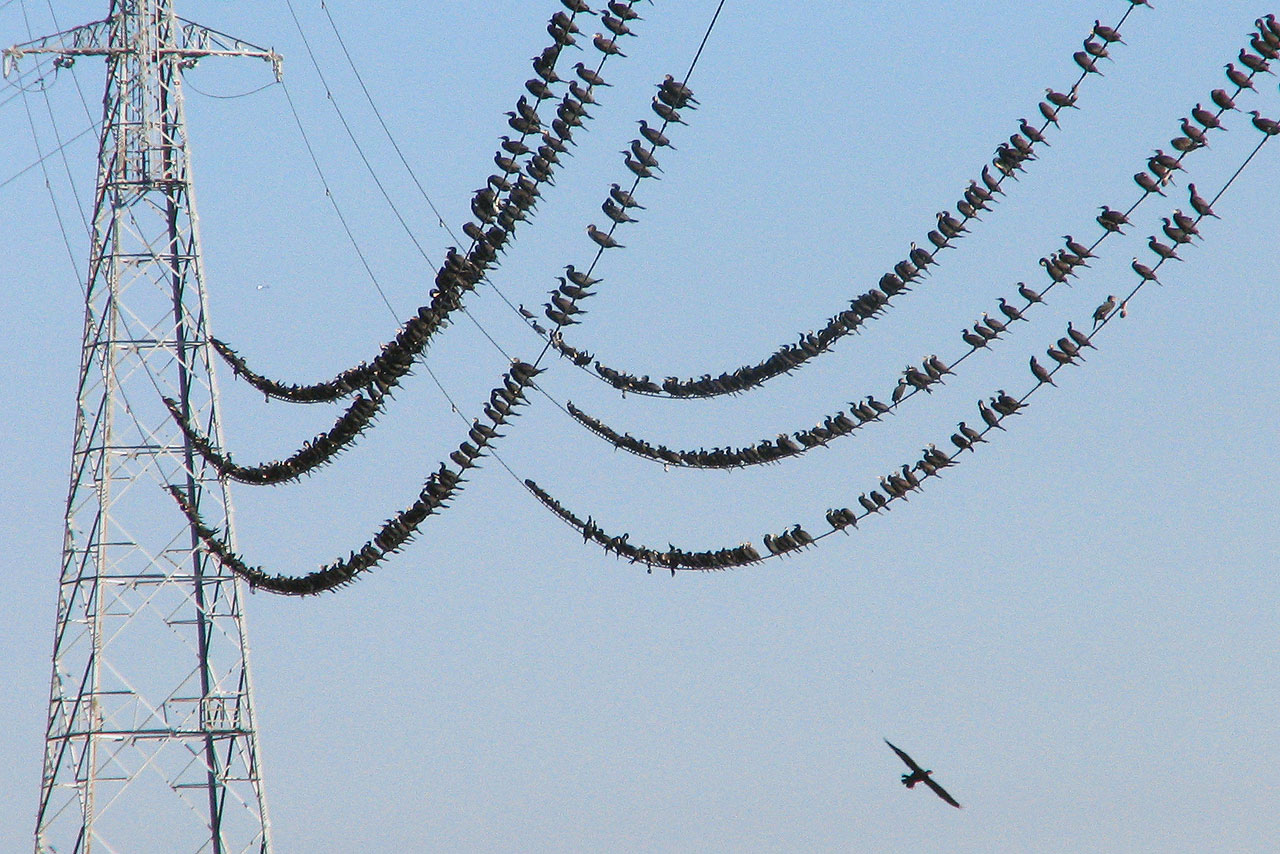
Last Monday, I was able to spot a few interesting bird views along the Tama River. One of them was a flock of Cormorants that had taken up residence along power lines strung across the river. What was impressive was their sheer number. Click on the image for a larger version:

Cormorants On Wire-450

I also spotted some Eurasian Wigeons on the river, which is what prompted me to visit Inogashira earlier:

1105-Eurasian Wigeons-450

This morning, I was able to catch a few birds at Seiseki, though none of then new life birds for me. One of them was another Bull-headed Shrike:

1105-Bull-Headed Shrike-450

Another was a pair of what the other said was another Shrike, but I think they were fooled by the tiny LCD display on my camera–I’m almost certain these are Meadow Buntings:

1105-Unknown-450

1105-Unknown2-450

I also spotted a Kingfisher, which excited me a lot more than it did the others; these birds are always very pretty:

1105-Kingfisher-450

1105-Kingfisher2-450

After that, I went down the river closer to home, and spotted some Azure-winged Magpies:

1105-Azure-Winged Magpie-45

This image has an enlargement when clicked:

1105-Azure-Winged Magpie2-450

Further on down, I spotted a flock of gulls having landed in the distance. I spent a good ten minutes walking down to the river bed to get a good shot at them. Now, at first, I saw fishermen on the river as quaint, but since I started birding more, they’re just getting downright annoying. They’re all over the place, and take up spots where birds might be, and tend to keep them away. But today, after having walked and climbed so far just to get a shot at these gulls, this one fisherman went out of his way to walk up to them and scare them off. Pissed me off quite a bit, I am not shy to say. He probably figured he’d catch more fish with them gone, but how would he like it if he went to trouble to find a good fishing spot and I came up and threw rocks in the water and scared off his fish?

Nevertheless, I was able to walk a bit more down the river and catch a few gulls that hadn’t been scared too far. And it turns out they’re a new life bird: the Black-headed Gull (Yuri-kamome • ユリカモメ), which get their name from their Spring plumage, not their November appearance.

1105-Black-Headed Gull-450

Before the fisherman did his dirty deed, I was able to snap off a few long-zoom shots of the flock, moments before they got shooed off; this is just park of the flock:

1105-Black-Headed Gulls-450

The above two gull shots, by the way, have enlargements when clicked.

That’s all the stuff I had backed up; tomorrow I’ll probably be at the Oi Wild Bird Park, and so there’ll probably be another bird blog entry later.

Categories: Birdwatching, Uncategorized Tags: by

Hee hee

November 11th, 2005 Comments off

Apparently, Fox News Channel sent a reporter out to do a special on global warming, and the documentary formed around the idea that global warming actually is happening. The reporter said it thus:

“After months of research and interviews with many experts, I’ve learned this simple fact: The earth is heating up. And it’s happening much faster than ever before. No one can argue with this.”

Reportedly, Fox chairman Roger Ailes was “charmed” by the reporter and thus did not smite him nor the documentary. But conservative wonk Chris Horner was aghast, to the point where he uttered this hilarious whopper:

“While it is unfathomable that a reputable news network would air so blatantly a one-sided program regardless of any disclaimer, that the ‘fair and balanced’ network would put itself in the position of suspending its motto is stupefying.”

Yes! Imagine that! Fox News, for the first time in history, is going to air something that is not fair and balanced! Alert the media! Run for the hills! To the Bat Cave, Robin! It’s a sign of the Coming of Days, the end of the world!

In all seriousness, this is groundbreaking in that Fox is, apparently for the first time, airing a show in which the right-wing slant does not heavily predominate, and that does seem significant. I wonder what Ailes was smoking when he made that decision.

Categories: Media & Reviews, The Lighter Side Tags: by