If at First You Don’t Succeed, then Impeach, Steal and Recall

August 7th, 2003 Comments off

Various long-term strategies have emerged from the Republican party over the past many years. First it was stealing the language; remember “the L-word”? It sounded silly, but look at all the liberals who call themselves “progressives” nowadays. I felt sick every time a liberal politician fervently denied being a liberal, as if it were some kind of malady; they bought into the language control. Remember the memo to GOPAC from Newt Gingrich, in which Republican politicians were instructed to use specific language when referring to themselves and to Democrats? When speaking of GOP candidates and policies, they were told to use words like “active,” “moral” and “empower”; when speaking of Democratic politicians and their policies, they were told to use words such as “radical,” “abuse” and “decay.”

The came the scandal-mongering. When Clinton came into office, the charge to smear him in every and any way possible came on full-force, and every allegation, rumor and hint of scandal was met with Republican talking heads calling for special prosecutors (see David Brock’s account of the debacle). Feeling burned over having suffered special prosecutors for such trivial things as violating and weakening our foreign policy by selling arms to Iran to pay off hostage takers, GOP dirty trick committees made sure that Clinton was investigated for serious offenses, such as boffing an intern.

Now, the GOP has a new strategy: if you want to gain a political office, but there’s the inconvenient obstacle of a duly elected Democrat occupying the job, then do everything you can to take the office by force.

In an effort to weaken the presidency for a GOP takeover in 2000, Republicans forced an impeachment vote over Clinton’s lying about an affair under oath in a ginned-up sexual harassment case funded and run by Clinton’s political enemies. Then in 2000, when Bush lost the election, the GOP jumped into full gear to steal the election for Bush, sending staff workers to Florida to impersonate irate Floridians, stopping vote counts at every turn, and finally getting the Supreme Court to (s)elect Bush against precedent and against states’ rights policies so beloved by the right wing, voting Bush into office 5-4, strictly along political lines.

And now we have the recall in California, an attempt to steal the governorship of the union’s most populous state by throwing money and political gamesmanship into the ring. Bush tried to characterize this coup d’etat as “the people’s choice.” If you know anyone naive enough to believe that this is a democratic process driven by the popular will, then please send me their email address; I have thirty million dollars in a bank in Nigeria and I need their help.

The process began this February, when a group called “People’s Advocate” started a drive to recall Davis. By May, the drive was going nowhere fast. In steps Darrel Issa, a self-styled “staunch conservative.” Issa, now a Representative from San Diego, made his fortune selling car alarms, and has a rather questionable past record involving car theft. But he also has tons of money (he says he is worth $100 million), and he started making six-figure contributions to the recall effort. That jump-started it, and Issa kept coughing up cash (now more than a million dollars, with $1.5 million in total funding the drive) until enough signatures were collected.

And now we have the celebrity factor–Arianna Huffington and Arnold Schwarzenegger have entered the race as serious contenders (I don’t think anyone is really taking Gary Coleman or Larry Flynt too seriously, and let’s not even talk about Gallagher). Furthermore, there is a big political soap opera developing as legal challenges to the recall effort fly through the courts, while a double-whammy ballot (one vote on whether or not to recall, and another vote on who is elected to replace Davis if the recall goes through) which will be closely watched for any butterfly-ballot irregularities, to be certain. And remember, this vote will be a plurality–the one with the most votes wins, even if it is below 50%.

In case you’re thinking that this is no big deal–after all, it’s just a governorship–just remember the difference that was made by having Jeb Bush in office in Florida. Aside from using the power of the office to campaign for Bush, Republicans took advantage of the political authority of key positions in the state to hand the state to George W.; Katherine Harris alone, by “erroneously” kicking tens of thousands of Floridians off the voting lists–most of them African-Americans and Democrats–as “suspected felons,” cost Gore thousands of legitimate votes, far more than enough to shift the election to Bush, even if the other massive irregularities that all just happened to favor Bush are discounted. Had Republicans not held the governorship of Florida, then Gore would be president as we speak. You can bet your bottom dollar that this fact is not lost on the GOP as it tries to steal the governorship of California in time for the 2004 election campaign. Imagine the glee of the far right if they could use the publicity of having Schwarzenegger in office campaigning for Bush, as Republican staffers and appointees undermine the voting process as they did so thoroughly in Florida.

Having control of California, Texas, Florida and New York will help Bush steal win the next election far more easily.

So if you live in California and are not a registered voter, then register; if you are registered, then vote, and vote down the recall.

Also mark in your vote for Huffington, just in case. She’s cool.

Categories: Archived Tags: by

Experimental Photos

August 6th, 2003 1 comment

A few more photos I’ve taken in the past few days… I use a Canon PowerShot S30 Digital camera and enjoy it quite a bit; at 3 megapixels, it takes photos quite large enough for my purposes, and it has a good many features for a camera in its price range (when I bought it–now the S50 is priced where the S30 was a year or so ago). I especially like the manual control features, and the picture quality is quite good. Keep in mind that the images I publish here are sized down to fit this web page, so there is a loss in sharpness; also, I use Photoshop’s “save for web” feature to bring the file size down, and that takes away from the quality as well.

These photos are among the many I take experimentally, just fooling around–and that’s the other great thing about digital cameras, you never have to worry about the price of film and developing. When I used my Nikon FG, I was always stingy in my shots, knowing the cost. With the Canon, I take literally thousands of shots.

On the train this morning, long enough exposure for the background to be blurred. Taken on the Keio line train from Hashimoto to Shinjuku, pulling into a station along the main line.

Hiromi, at a restaurant late afternoon yesterday. Caught her reflection in the window against the trees outside, just after it started to rain.

I usually like to cut the aspect ration to 2:1 or thereabouts, but this one deserved full play. The best (OK, not spectacular, to be certain) of a series taken at the B1 level of Shinjuku Station at Nishi-guchi, in front of the koban. Ambient light called for a 1-second exposure, so I tried following individuals as they passed by, tracking with them as the background blurred behind them. I’ve added a few more below from this group to give you a feeling for what I was playing with.

Categories: Uncategorized Tags: by

Revisionist History

August 5th, 2003 2 comments

Rule of thumb #47: if someone claims that others are engaging in revisionist history, it is almost without doubt that the accuser is the one doing the revising.

“This nation acted to a threat from the dictator of Iraq. Now there are some who would like to rewrite history — revisionist historians is what I like to call them.”
–George W. Bush, June 16, 2003

“…we gave [Saddam Hussein] a chance to allow the inspectors in, and he wouldn’t let them in. And, therefore, after a reasonable request, we decided to remove him from power, along with other nations, so as to make sure he was not a threat to the United States and our friends and allies in the region.”
–George W. Bush, July 14, 2003

“Revisionist History” is hardly a new accusation; Republicans have been using it for a few decades now, whenever they want to repaint history to go with their policy. Unfortunately, the term is catching. The New York Times published an editorial about how revisionists are trying to show how dropping the A-bomb on Hiroshima was a bad thing. Imagine that.

Categories: Archived Tags: by

Uh-Oh

August 4th, 2003 7 comments
Bush’s Popularity

Take a look at the chart on the right. It comes from the Gallup Organization, showing Bush’s popularity over the last two and a half years. It doesn’t take a genius to see the pattern here: in his natural state, Bush slowly but steadily loses popularity over time; the only times he gains popularity is in a time of national crisis. Note the sudden surges in September 2001, and March 2003. Also note that his popularity is less about him than it is about crises, and the American people throwing in support in times of fear. Compare this with the chart below showing Clinton’s popularity throughout his own eight years; note that Clinton’s popularity did not hinge on crises, and that it displayed a general upwards trend, despite a concerted, lengthy smear campaign run by his political enemies.

Bush’s record is far more worrisome, however. Bush, despite his assertions to the contrary, spends a great deal of money on surveys to see where public opinion stands in regard to him. No one could be blind enough to not see that war, mayhem, and fear mean votes for Bush and his agenda. And it is impossible to miss that assured downward slide during peacetime. At this rate, Bush’s popularity will be at low enough levels on election day 2004 that he would likely lose the election, given the Democrats put someone electable on the ballot.

Clinton’s Popularity

So… who’d like to start a pool to guess exactly when the next national crisis will begin? As White House Chief of Staff Andrew Card let slip in 2002, “from a marketing point of view, you don’t introduce new products in August.” I’d say that we’re on schedule to be on the road to war with someone, likely Syria or Iran, by September of next year. Remember, we have an administration that has taken the stand that it would be profitable for GOP members to “focus on war” in order to win elections–this coming from Karl Rove’s own records, as he told a January 2002 meeting of Republicans that by playing up terrorism and the war in Iraq, they could win more political power.

And it worked for them. Are we so naive as to think they won’t do it again in 2004, when even more is on the line?

Categories: Archived Tags: by

On Vacation Again

August 4th, 2003 1 comment

According to this CBS News story (dated August 6th, 2003–go figure), the president has been declared in good health and “fit for duty.” So, naturally, Bush is off for another month-long vacation.

Yes, our fearless leader is yet again going on vacation at his Crawford ranch. By the end of this particular vacation, Bush will have spent about 20% of his term in office on vacation at his ranch–and he has spent even more time at Camp David, plus a little time off at Kennebunkport. That’s far more vacation time in less than three years than Clinton spent in eight years, and Clinton was criticized for taking too much time off. It’s even more time than Reagan spent during his eight years.

Categories: Archived Tags: by

Night Views of Inagi

August 3rd, 2003 2 comments

Some night views around my neighborhood, taken as I walked back home from the train station where I dropped Hiromi off.

Categories: Uncategorized Tags: by

Graduation Day

August 2nd, 2003 Comments off

I used to preside over graduation at our college, when I served as coordinator for some five years (translate “coordinator” as “dean,” but without a Ph.D.), handing out the diplomas, making the speeches. You probably never imagined yourself doing that kind of thing, but then there you are. I came back to full-time teaching because teaching has always been my desire, and the administrative grind just really wears you out. But graduation was always fun. So now I just watch with the rest of the faculty.

…and there’s good food, too!

Categories: Focus on Japan 2003 Tags: by

Judgment and Character

July 31st, 2003 5 comments

You’re at a bar on a warm Saturday evening in New England, and there is a group at the table next to you. At least one of the members, a 30-year-old man, is drinking several beers; the young woman next to him, only 17 years of age, is not old enough to drink yet.

They finish their drinks, and head for the exit; you note that the man who had been drinking several beers is fishing his car keys out of his pocket, and you wonder if anyone in his party will stop him from getting behind the wheel. After they leave, you may wonder if they get home in one piece, and wonder at the judgment of the driver–after all, he was not so drunk that he would lose the ability to understand that you don’t drive while in that state. You might wonder what kind of person knowingly drives drunk, what kind of character it takes to do that.

You pay the bar tab, and your group’s designated driver takes you home; on the way, you see a car pulled over by a policeman on the side of the road. You see that the driver is being given a sobriety test, and you recognize him: it’s the guy from the bar. Perhaps there is some justice, you think, but wonder how many times that guy drove drunk before he finally got caught.

The night was Saturday, September 4, 1976, and the driver was a future president of the United States. Bush’s passengers were tennis star John Newcombe and his wife, in addition to his underage sister, Dorothy. Bush had indeed, by his own admission, drunk “several beers” before getting behind the wheel. A police officer, Calvin Bridges, reported that Bush was swerving off the road when he pulled him over. Bush failed the sobriety test, and later tested a 1.0 on a blood-alcohol test, just exceeding the legal limit at the time. Maine’s legal limit today is 0.8, and had he been arrested today, Bush would have spent two days in jail for having a minor in the vehicle.
Bush received a $150 fine, and his driver’s license was suspended in Maine for no less than six months (several reports say two years). Bush, however, went to court to have his license reinstated about a month after his arrest, even though he did not take a rehabilitation course that is required for reinstatement. Although, by later confession, Bush was in his heavy-drinking period that would last until he was about 40, Bush testified in court that he drank only once a month, and had “an occasional beer.” The court granted his request remove the suspension on his license.

What is just as questionable as Bush’s decision to drive drunk that night with his underage sister in the car is how Bush related this event to the American people while trying to get himself elected to the nation’s highest office.

At first, he did not relate this to the American people at all; in fact, he lied about it several times.

In 1998, Dallas Morning News reporter Wayne Slater asked Bush if he had ever been arrested. Bush replied, “After 1968? No.”

In November 1999, on Meet the Press with Tim Russert, Bush was asked, “If someone came to you and said, ‘Governor, I’m sorry, I’m going to go public with some information.’ What do you do?” Bush replied, “If someone was willing to go public with information that was damaging, you’d have heard about it by now. You’ve had heard about it now. My background has been scrutinized by all kinds of reporters. Tim, we can talk about this all morning.”

Also in 1999, Bush told CBS News Correspondent Lee Cowan that there was not any “smoking gun” about unrevealed incidents in his past.

In November 2000, Bush told a press conference that he did not go to court about the DUI, when he in fact did so.

And then there was the infamous 1996 juror incident. At that time, Bush was randomly selected for jury duty. Wanting to make a PR stunt out of it, Bush made a big deal about how he was just an ordinary guy, and of course, he would do his duty and serve on the jury. He claimed to the press that it is “a feeble excuse” to say he’s too busy or important. When he was given the forms for jurors to fill out, there is a section where jurors are required to detail prior arrests and court proceedings they experienced. Bush left that section blank. Apparently, the court did not want to bother the governor with such legal niceties, so he was not required to fill it out as everyone else is. But then Bush ran into a bigger snag: by chance, he was assigned to a drunk driving case, and, as a potential juror, he would without doubt be asked, under oath, if he had ever been arrested for drunk driving before.

Time for a feeble excuse to come to the rescue. Bush asked to be dismissed from jury the night before the trial, and was helped by Alberto R. Gonzales, his legal counsel. (Bush later appointed Gonzales to the Texas Supreme Court, and later as a legal counsel in the White House.) The excuse? “It would be improper for a governor to sit on a criminal case in which he could later be asked to grant clemency.” Huh? How often was Governor Bush asked to grant clemency for drunk driving? He was obviously taking positive action to hide his past from the public.

During the previous year, Bush had also taken another step to hide his past: On March 31, 1995, George and Laura Bush were given new driver’s license numbers; Bush’s was #000000005. Bush was born on July 6, 1946, and his license was not near expiration. The reason given for the change was “security,” but there was no precedent for Texas governors doing this. The change destroyed the records of his previous license, which would have detailed any arrests. This bears on the many rumors that Bush was also caught DUI in Texas, which would in turn explain why Bush mysteriously performed community service, for Project P.U.L.L., an inner city Houston program for troubled youths, from 1972. There may yet be other arrests we still do not know about.

And when the arrest came out in public, did Bush take full personal responsibility, as he likes to claim that he does?

Heck, no. He lied some more, of course. He started by claiming, “I have always been honest with the American people.” Uh, yeah, right. He then turned on the person who released the information, calling it a “dirty trick.” The timing of the announcement may have been (albeit a very clumsy “dirty trick”), but the DUI arrest was not. And he even tried a bit of revisionism, claiming that he was not pulled over because of his erratic driving, but rather because he “was driving too slowly.” Makes it sound less damaging that way–but nonetheless is just still another lie.

And how did Bush take full personal responsibility for lying to the American people about it for so long? He used his daughters as a publicity shield. He said he wanted “to be a good role model for his daughters.” Which, of course, is bogus, because any good parent, especially when it comes to alcoholism, knows that the best way to deal with such things with your children is to be honest and up-front. Of course, this course of action might explain why these same daughters have been repeatedly arrested for underage drinking. It might give Bush an excuse for lying to the people, but it also makes him a bad father.

This is the person we have leading our country, sending our young men and women to die in battle, making decisions that will affect this nation’s prosperity and security for decades to come.

Note: Dick Cheney, vice president of the United States, was arrested on DUI charges twice.
Categories: Bush and Character Tags: by

Another Sham of a Press Conference

July 31st, 2003 3 comments

At least this time the reporters seem to have the guts to ask hard questions, but Bush is still reading the names from a carefully chosen list, and he is not allowing follow-ups–he even shut down a reporter a few minutes ago, telling him, “you’re finished!”

And Bush’s answers are still as lame, if not more so. One he just answered was on the rather embarrassing fact that despite two major tax cuts and a third coming through now, the economy is still in the basement and deficits are soaring. He started out by saying that the economy started to turn in March 2000–then paused, with a smirk, expressing the smug, unspoken thought that it was all Clinton’s fault–then went on to list things that depressed the economy, including corporate scandals, and ending with an accusation of the news networks for broadcasting, “road to war, road to war,” which brought the whole store down.

Of course, let us not forget that Bush himself talked down the economy a great deal for a year before he took office (to help him win the election), and for some time after that (to help him sell his tax cut), during which time, he stressed that the economy was in trouble and we were entering a recession–hardly conducive to bringing the economy up. The corporate scandals were to a great degree due to his own party’s policies on corporate self-regulation, not to mention the biggest crooks (still not under arrest) were Bush’s biggest backers. And the “road to war” chant was being pushed by no one more than Bush himself. For him to use these points to excuse himself is ludicrous.

All of that aside from the point that Bush did not answer the question–why his tax cuts were not working. Most have taken place after the events he said were causing the economy to dip–indeed, some were reasons he used to sell the tax cuts–but nonetheless, his tax cuts were supposed to power us out of and above these issues.

Another reporter asked about the “16 words,” and if he took responsibility for it. Bush, clearly prepared for this question, replied that he takes “personal responsibility” for all the statements he made. Which I suppose is why he blames the CIA and George Tenet, why he blamed the British, and why he blamed Stephen Hadley–anyone but himself. So if he is personally responsible, and everyone else had profusely apologized, then where is Bush’s apology? He says he is taking responsibility, but like so much else he says and does for the cameras, it is only for show. It means nothing and carries no weight; such “personal responsibility” is empty.

At least twice in the conference, when defending the Iraq war and the lack of any evidence Bush pushed the war with, he cited the 12 resolutions from the U.N. against Iraq, as if he greatly respected the U.N. and considered them experts on what to do about Iraq. Then he trotted out, for the umpteenth time, the stale rationale that Saddam gassed his own people, saying this time that it was proof that Hussein did have a weapons program. But that was 15 years ago, when Saddam was still our pal. Bush knows full well that the point is whether or not Hussein had a program this year, when Bush claimed he had massive stockpiles.

(By the way, check out this rather interesting article by a former CIA senior analyst on Iraq, which not only clarifies that the villagers were killed in the crossfire between Iraq and Iran, and were not simply murdered by Hussein as Bush asserts, but that it may well have been Iran, and not Iraq, who gassed them. Of course, I would fully expect Bush to shamelessly take advantage of this, and, ignoring the hypocrisy, use it as an excuse to invade Iran.)

So much more–his answer to the question on homosexuality, starting his answer by saying “we’re all sinners,” clearly stating that he believes just being gay a moral crime, followed by his expected stance that homosexual couples must be barred from marrying. As if a gay couple taking the vows will harm the sanctity of marriage, while apparently heterosexual abuse of marriage, such as sky-high divorce rates, spousal and child abuse, and marriages of convenience are of no consequence and need no special action.

The whole process was sickening, right up to his final whimper of an answer at the end about the California recall vote being funded by a right-winger who wanted to take the governorship for himself; among other things, Bush was thankful that Texas had no recall vote, tried to claim that the recall was because of the people’s choice, then said he had no comment.

Like I said, at least there were some hard questions here, but it was still less than a real press conference–and Bush’s replies predictably vacillated between dishonest and lame, too much to comment on fully in one go. Which means, of course, that the press should announce it to be a complete success.

Categories: Archived Tags: by

Diet Fracas

July 30th, 2003 2 comments

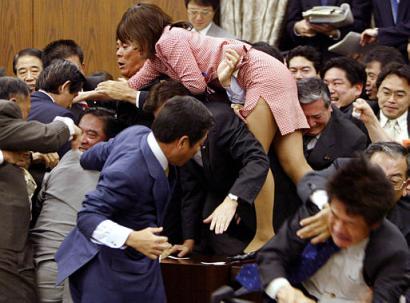
–photo from AP

Quite the scene in the Upper House of the Japanese parliament last Friday. The scuffle was set off when the majority party decided to send Japanese troops into Iraq, a live-fire region. The protesting lawmakers hold that this violates the pacifist Japanese constitution. Now if only we could get this kind of action in the Senate in Washington, D.C.

Categories: Focus on Japan 2003 Tags: by

More (or Less) Character

July 29th, 2003 3 comments

In order to know a person, you have to look at their defining moments, not their publicity or their hype. Here is another glance at the life of George W. Bush. The idea here is to get a true glimpse of his character; when reading, imagine you know this man, and then consider what you think of his morality, his actions, and his personality.

It is the late 60’s, and you are in college, at Yale. One of your schoolmates is a young man from a wealthy family, a frat man, a bit of a jock. His grades are far less than stellar, and the only reason he got into such a prestigious school is because his father went there–a legacy student. (Remember that Bush is opposed to quotas, yet depended on them himself.) In fact, legacy is pretty much how he got into everything at the college, including a highly secretive organization called “Skull and Bones.” He is so unimpressive as a student that one teacher, Yale History professor James Hutson, years later, is amazed to hear that Bush had been in one of his seminars, which only had 15 students.

While at school, he is often drunk and rowdy–not too far off the mark for an average low-scoring jock, but he seems to push the limit at times. He is arrested twice–once for helping pull down the goal posts at a football game, and again when he steals a Christmas wreath off a department store window. One evening you see him so inebriated, he lays down in the middle of the street and then literally rolls himself all the way back to his dorm.

As a frat man, his attitudes are not exactly glowing. In an interview with the New York Times, he defends the practice of taking a red-hot coat hanger and using it to “brand” pledges, young men who desperately want to gain entrance. He says that such painful mutilation is acceptable because it was no worse than “only a cigarette burn.” (It is not known if Bush himself bears such a scar.)

On the Vietnam War, he is so blind to what people are doing and saying that he does not notice any anti-war activity on campus, despite the fact that it is quite ubiquitous. But he is strongly in support of the war, and believes it is the right thing to do; he also feels that it is important for young American men to do their duty and go to the war.

One schoolmate, Robert Birge, tells him he was thinking about going to Canada. Bush replies, “That’s [expletive], that’s irresponsible.” According to Birge, Bush believe that young men should “back up the country and stop whining.”

Soon after that, however, on May 27, 1968, 12 days before Bush’s own college deferment runs out, he does not do the “responsible” thing. Instead, he, his family and their business associates lobby to have Bush placed in a “celebrity” unit of the Texas National Guard. Despite a year-and-a-half waiting list, Bush applies and on the same day is accepted into the 147th unit of the Texas N.G. Also in the 147th are the sons of federal and state politicians, sons of wealthy businessmen, and sons of professional sports players (by coincidence, of course). Bush scores only 25% on the piloting aptitude test, but is instantly promoted to 2nd Lieutenant, despite not going through officer candidate school. Bush is trained to fly the F-102 Delta Dagger, a plane that is slated for the scrap heap, reassuring Bush even further that he will not be called to duty in Vietnam.

Bush claims that he signed up for the NG because he wanted to fly for his country, and has repeatedly claimed he was not avoiding the draft. However, this does not explain why he did not sign up for service in the Air Force or the Navy (as his father did), nor why he actively requested not to be sent overseas while in the NG.

And Bush does not even complete his tour of duty. Apparently, he is well into his drug habit as well as being an alcoholic. When the U.S. military institutes universal drug testing to be carried out at the annual physical exam on each soldier’s birthday, Bush fails to appear. (Ironically, the Guard used his name in a press release about drug use: “George Walker Bush is one member of the younger generation who doesn’t get his kicks from pot or hashish or speed,” the release said. Make up your own “…but alcohol and cocaine, on the other hand…” joke here.) From this point on, he goes missing from his duty and continues to be absent until he asks for, and of course is granted, permission to leave the Guard early so he can go to Harvard Business School. (Here are images of documents detailing Bush’s absences from the NG post.)

What would you think if you knew someone like this? A privileged kid, family pulling strings to get him into and out of everything, admonishing others for shirking duties and then shirking his own in a far less honest way. The criminal record, the hazings, the hypocrisy. Knowing someone like this personally, would you think he would ever be capable of holding a position of great responsibility? How about being the leader of the free world?

Bush, by the way, is the first President of the United States to enter office with a criminal record. Quite a distinction. But more on his non-“youthful indiscretion” years later.

Sources:
http://www.washingtonpost.com/wp-srv/politics/campaigns/wh2000/stories/bushmain072599.htm

Categories: Bush and Character Tags: by

Bush to Blacks: Vote For Me Anyway

July 29th, 2003 1 comment

Well, George is out stumping for black votes. Hard to tell why, it’s kind of like Lieberman appealing to KKK voters. After all, Bush got only 9% of the black vote in 2000, and that’s not including the fact that a disproportionate number of black ballots were thrown out. Bush’s allies had tens of thousands of upstanding black voters indiscriminately trashed from voting lists in Florida, identifying them as felons, and many more felt they were intimidated by police on election day. 650,000 black Americans have lost their jobs in the U.S. since Bush took office, the black unemployment rate is now nearly double the national rate (it was only about 30% higher when Bush took office), and Bush has refused to speak to the NAACP in his 2 1/2 years in office, instead trying to reach out to other black political groups which are less critical of him. Bush touted his AIDS package to Africa, though that is far slower in coming than previously indicated, is being loaded up with an extremist conservative agenda (such as pushing for abstinence over condom use), and, in the end, doesn’t really help African-Americans in the U.S. And it hardly shows that Bush is concerned about African issues, seeing as how he is wimping out of Liberia, causing untold thousands to die there who could easily have been saved had he acted when Kofi Annan asked him to.

Bush’s pitch for overcoming these problems? He “stressed his initiatives to increase minority home ownership, to create re-employment aid accounts and to provide federal support for religious charities.” Oooooo. Sweeeet. That oughta do it. And if it doesn’t, he can have another photo op with Condi and Colin. They’re some of his best friends, after all.

Categories: Archived Tags: by

That’s Difficult

July 28th, 2003 Comments off

Soon after I first came to live and work in Japan, I ran into an interesting social and linguistic difference between Japan and my native country: the ability to say “no.”

It was when I visited a store to purchase a large item, and I wanted to see if they could deliver it to my apartment. I asked the clerk, in Japanese, if they could do that. The clerk gave me a bit of a puzzled expression, you know, the neck-tilting head-scratching gesture, and said, “Mmmm, muzukashii ne.” “It’d be difficult.”

So of course, I ask him, “but is it possible?”

“Hehhhh… sa, hmmmm, muzukashii.”

“Yes, I know it might be difficult. But can you do it?”

“Ano ne, … aahhhh … ya, Muzukashii.”

It took several of these exchanges for me to realize that the clerk was not trying to be obstinate, but rather was simply, out of reflex, trying to avoid saying the word “no.” Neither of us could break through this wall, and so we had the rather amusing feedback loop. Just so when you hear someone in a service position telling you that it will be “difficult” to do something, you’ll know what it means.

Categories: Focus on Japan 2003 Tags: by

Internet Pet Peeve #274

July 27th, 2003 6 comments

You know how sometimes you have to write letters or requests for information using forms on web pages? For example, you want to submit a ticket to technical support; they lead you to a “ticket” web page, where you input your name, email address, and often your password as well–and then type your message.

Here’s my question: why is it that every danged form like that has a “message” field about the size of a large postage stamp??? I hate that. Do the people who make these pages enjoy typing in text boxes only large enough to contain a half dozen words? It makes it impossible to write any message of length. I know that some sites want you to keep it brief, but dammit, just tell us, don’t squeeze us into some ridiculously tiny box. I have even seen these micro-boxes on pages where you are expected to write long messages. What are people thinking?

In designing this site, one of the things I did was to redesign the comments pop-up window so the message box was comfortably large. I wish more people would do that…

Another pet peeve: forms demanding that you include all sorts of useless information, especially email addresses. I hate spam, and I am fully aware that if my email address is accessible anywhere on a page, even if only in the HTML code, spambots can and will find it and I will be inundated with the junk before long. Unless it’s absolutely necessary, please don’t require that kind of stuff.

Categories: BlogTech Tags: by

Book Recommendation

July 27th, 2003 2 comments

If you haven’t read Ender’s Game by Orson Scott Card yet, then do so. It is an excellent book, and perhaps the one science fiction book with the broadest appeal of any that I know. When I first read it, I did so straight through–started on a Friday afternoon, did not finish until Saturday afternoon, no sleep in between.

I personally like the sequel, Speaker for the Dead, almost as much, though many people I know have less enthusiasm for it. However, you might want to stay away from Xenocide and Children of the Mind, the third and fourth novels in the series; although there have interesting characters and concepts, the quality of the story and one’s ability to suspend disbelief take serious blows. Somewhat better, though still not as magnificent as that first novel, are the “Shadow” series of books, focusing on the character of Bean from Ender’s Game; the first novel, Ender’s Shadow, takes place concurrent with the original novel, but from the perspective of a different character. The following novels, Shadow of the Hegemon and Shadow Puppets, continue the (still unfinished) story.

If I had to choose a second-best book by Card, it would have to be Pastwatch: The Redemption of Christopher Columbus. An excellent read, well-researched historically. It regards a group of historians in the future who possess machines capable of viewing events in the past. The novel has many extremely interesting and sympathetic characters, and has at least two startling plot twists. One thing about Orson Scott Card, you know that any story he writes will at least be good. He has an incredible talent for describing his characters’ thought processes, why they do things, what their motivations are. His greatest weakness in characters is a recurring theme in several novels of an abusive older brother whom the main character lets walk all over him; aside from that, it is hard to ever criticize his fiction writing. His non-fiction journaling can be found at his web site Hatrack.com; I find his movie reviews to be quite good, though I personally cannot sympathize with his political views (he is somewhat of a knee-jerk conservative).

What I’m reading now: Phantoms in the Brain, by V. S. Ramachandran and Sandra Blakeslee, an excellent study of the workings of the human brain. The book examines the functioning of our minds primarily through patients with injuries or forms of brain damage that highlight how the brain processes information. A few examples are a variety of phantom limb sensations and the brain’s methods of ‘filling in’ blind spots in one’s field of vision. So far up to page 125, and it’s holding up very well.

Categories: Uncategorized Tags: by

End of the Rainy Season

July 27th, 2003 Comments off

Finally!

This has been one of the longest rainy seasons for quite some time, and good riddance now that it’s over. Yesterday, we got patchy sunshine here in Tokyo, and today, we have nice, sunny weather.

Categories: Focus on Japan 2003 Tags: by

OK, Now They’re Gone

July 26th, 2003 Comments off

They stayed on for several days after they first left the balcony, but eventually the young pigeons did not come back. So now all that remains is a rather messy cleanup job on the balcony, and to proof it so that pigeons don’t nest there again… Still, it was a nice experience to see the birds hatch, grow up and leave the nest.


    taken the day before they left for good.

Categories: Pigeons Tags: by

Got Character?

July 25th, 2003 7 comments

You’re in a Mexican diner in Dallas, Texas. You’re sitting at a table, eating your dinner quietly. At the next table, there is a a couple eating with their four-year-old son at the table.

Suddenly, another man storms up to the small family. He is apparently drunk, and furious. “You fucking son of a bitch!” he shouts at the father. Everyone stops eating and stares at the man. You cringe when you see the young boy.

“I saw what you wrote,” he rants on. “We’re not going to forget this.” You feel shock at this kind of drunken behavior in a public restaurant. You feel sympathetic fear for the man and his wife, being threatened in such an ominous way, as if the man were a member of organized crime and the family could expect thugs to visit them in the night with baseball bats or something.

You might fear the man who stormed in and raved, you might feel disgusted, angry, or perhaps, if you are more compassionate, you might feel pity.

But would you elect him president?

The above incident did in fact happen. It was early April, 1986. The drunk was George W. Bush, and the man and woman with the child were Wall Street Journal editor Al Hunt and his wife, Judy Woodruff. Hunt had written an editorial in which he predicted that Jack Kemp, not George Bush Sr., would win the GOP presidential nomination in 1988.

Think about this person, think about what he did. Drunk or not, could you ever respect a person who did this kind of thing? If someone you knew did something like that, wouldn’t you feel like just not talking to them again? I mean, what kind of person does that kind of thing?

Apologists for Bush try to brush it off as another “youthful indiscretion,” because he had a drinking problem then, and has since turned his life around. But his behavior did not really change.

Consider when bush was governor of Texas, long after he quit drinking.

The case concerned a woman named Carla Faye Tucker. Tucker was a convicted killer on death row, but she was also, like George W. Bush himself, a reformed drug addict and a born-again Christian. She plead for clemency, begged for forgiveness.

Bush, however, was not sympathetic. According to Talk magazine writer Tucker Carlson, Bush mimicked Tucker’s plea for her life. “‘Please,’ Bush whimpers, his lips pursed in mock desperation, ‘Don’t kill me.'” (quote from Time Magazine) During the same interview, then-governor Bush reportedly used the word “fuck” repeatedly throughout the conversation.

Again, would you respect a person who did this kind of thing?

Remember when “character” was the issue in politics, according to Republicans and conservatives in general? It was all about character… but not, apparently, now. The Republican Party shut up about character the moment Bush walked in the door, and for a very good reason. He doesn’t have any. Most people don’t pay attention to what Bush did in his past–but these are not rumors, not fake smear attempts. They are documented facts, and these two are just a small sampling. If most Americans knew exactly who they had allowed take the presidency, they would recoil in disgust.

Categories: Bush and Character Tags: by

Which Religion Was That?

July 25th, 2003 4 comments

News story from the Associated Press:

“An increasing number of Americans believe that Islam is more likely than other religions to promote violence among its followers, according to a new survey….”

From a month ago:

“God told me to strike at al Qaida and I struck them, and then he instructed me to strike at Saddam, which I did, and now I am determined to solve the problem in the Middle East.” — George W. Bush (actual quote)

Categories: Archived Tags: by

Bush Stays Bought

July 24th, 2003 Comments off

Media adoration heaped on Bush is still paying off, apparently. Despite the strong, non-partisan outcry against the recent FCC move to allow fewer rich and powerful people to control more of the media, Bush has promised to veto an important appropriations bill if it threatens to overrule the FCC.

Categories: Archived Tags: by