The Four-Visit Teeth Cleaning

July 23rd, 2003 2 comments

For foreigners living in Japan, visiting the doctor or the dentist can be a stressful experience. Frankly, the quality of medical services seems substandard, especially for such an advanced nation. This is not all due to the insurance system–the fact is, many doctors, and especially dentists, seem to lack sufficient training, or are far too overworked, or perhaps just don’t really care too much about what level of service they provide.

A dentist I visited in my neighborhood is a prime example. I went to that office simply because it was close and convenient. Boy, do I regret that. I lost my second molar on my lower left side, and had to get a bridge because I was not discerning enough. I had gone to that office for minor treatment before and things went fine enough, so when I needed more important work done, I trusted them. But the doctor screwed up, and how. He was supposed to just replace a crown. While removing the prior dental work, he exerted a startling amount of force on the tooth, pushing, pulling, yanking and so forth; but I took it in stride, trusting he knew what he was doing. Some doctors and dentists will do that kind of thing, in my experience. Then he told me to come back after the weekend for the second visit, and gave me a temporary crown, and warned me not to bite down on that tooth.

Over that weekend, I took extreme care to not exert pressure on the tooth. I say this not in pride but in admission to being somewhat neurotic about such things. I chewed only on my right side, and would stop whenever any food migrated to the left side. I did not touch that tooth with anything. But when I visited the dentist on Monday, he told me that the tooth was broken, and scolded me for biting with it. I was rather upset, considering (a) the care I had taken with it, and (b) the violence he had exerted on it the previous Friday. But there was nothing to do about it–he showed me with a mirror, and lo, the tooth was split. I had no choice but to let him yank it.

He asked me when I would make an appointment for him to make a bridge to cover the tooth. I gave him a look, left, and never went back. I got the bridge at a different, reputable dentist (one who speaks English well, by the way).

Dentists in Japan have a bad rep with most foreigners for reasons more than just this. I hardly know anyone who doesn’t have a bad-dentist story or two to tell. An Australian woman I worked with in the countryside told me of a dentist who filled a cavity so badly, the filling actually fell out, and she had to come back to get it refilled. When we visited a restaurant later that week, the proprietor, who enjoyed chatting with customers, sat down at our table and told us the story of a dentist who had come in earlier and told a lamentable story. Apparently, he had done poor dental work on this Australian woman, and had told the restaurant owner that it was because during the first visit, he was so preoccupied looking down the woman’s shirt, he did not do a good job on her teeth. Predictably, my friend was not amused.

I had another nightmare experience of my own a few years back. I went to an office that I had visited during a previous stay in Japan, as it had dentists who spoke English and did a good job. It was a modern office in a Shinjuku high-rise. When I visited again later, however, the dentists were different and did not speak English well, but I decided to give them a try.

I should have been tipped off when the dentist, trying to explain what he would do to me, pointed at my ailing tooth and said loudly, “TOOTH… NERVE… DESTRUCTION!” Knowing the language difficulties many Japanese have, I again took it in stride. But this one, apparently, did not know how to anesthetize very well. Although I insisted to him that I could still feel in the tooth he was trying to do root canal on, he pooh-poohed my objections and carried on. A few moments later, I experienced pain like I had never experienced it before. It was so intense that I literally could not stop screaming for more than a minute. Luckily for them, I had a late appointment and no other patients were in the office. Naturally, I never went there again, either.

One of the more annoying (but far less painful) idiosyncrasies of dental work in Japan is the multiple-visit syndrome. This is also true for doctors sometimes, but dentists are renowned for it. Most patients who come in will have the Kokumin Hoken (National Health Insurance), which has a somewhat convoluted payment system. One way for medical practitioners to milk the insurance system is to require patients to make multiple visits; the more visits you make, the more money they can collect.

In the past, this has resulted in my having to visit the dentist a rather obscene number of times. Root canal, which can be dealt with in three or four visits maximum back home, takes as many as a dozen separate visits here in Japan. Once I just wanted to get my teeth cleaned, and they scheduled me for no less than four separate visits–one for each quadrant of my teeth.

Some sound advice: ask your dentist, in advance, how many visits the work will require. If they tell you it will take any more visits than are necessary (in your past experience), then leave and see another dentist.

But this is not limited to dentists. Recently I had a small bump on my finger and went to a recommended dermatologist in Shinjuku to have it taken care of. They did an excellent job in removing it, but the biopsy results they got back from the lab they used were less than conclusive. So I asked to get the biopsy sample, so I could take it to Keio Hospital, where I trusted their results on that kind of thing better. The dermatologist’s office called me and told me the biopsy sample was ready, so I went over to pick it up–and was annoyed to find that I would have to wait half an hour to see the doctor. I insisted that I was just picking up an envelope, I did not need to see the doctor–but they insisted. Fuming, I sat down and waited. As I expected, when my name was called, I went to the doctor’s office, and all he did was hand me the envelope. As I left, they stopped me, and told me to wait for the calculation of the bill. Well, that was a bit too much for me. It was clear that there was absolutely no reason for me to have waited, and all they were doing was trying to get a consultation fee out of me when no consultation was required–it was a package pickup, fer cryin’ out loud! It wouldn’t have costed me much–410 yen I think it was–but I was already indignant and refused. I told them that I got no medical treatment, and was made to wait for half an hour needlessly, and I was damned if I was going to pay them for that! The receptionist, probably aware that I had them to rights, let up and told me that they would let me go “this time.” Well, they’re not going to get away with it next time, either.

In case you were wondering, the dentist I use now is Dr. Nishibori, 1-30-8 Sendagaya, Shibuya-ku, phone number (03) 3403-8885 / 8886. They’re practically right across the street from Sendagaya Station on the Sobu Line, and they take National Insurance. I got a full checkup and a bridge made there, with only a few small blips; they seem like a good outfit. For example, when it came to doing some root canal work, they referred me to another dentist when they easily could have done it themselves; it was a slightly unusual job, though, and needed special care.
Categories: Focus on Japan 2003 Tags: by

No Oil? Go Fish

July 22nd, 2003 1 comment

As more and more American service people and Iraqi civilians are gunned down and blown to pieces in the “liberated” Iraq, where the war is supposedly “over” according to Bush, death is being delivered on an even more accelerated level in Liberia, thus underlining yet another foreign policy debacle of the Bush administration.

Had Bush (currently on yet another vacation in Crawford, Texas after a trip to raise more millions for his re-election) sent in troops when the “ineffective” U.N.’s Secretary General Kofi Annan pleaded with him to do, peace could have been achieved far more bloodlessly. But here we see exemplified the fact that liberation and humanitarian assistance are far from important in the Bush agenda, despite the fact that Bush & Co. now claim that was their goal all along in Iraq. Liberia, after all, has no oil, so as far as Bush is concerned, they can go rot.

Seeing how his inaction has led to such carnage, Bush, in his now well-established fashion, has found someone else to blame: ECOWAS (the Economic Community of West African States), which he claims he has been “waiting on,” though there is no real reason why that should have stopped the humanitarian action from being enacted weeks ago. Alternately, he is blaming it on Liberian dictator Charles Taylor (who has business dealings with Bush ally and evangelist Pat Robertson in the form of gold mine exploitation in that country), claiming that U.S. troops moving in depends upon Taylor first leaving the country, another rather idiotic condition–Taylor, after all, is the prime reason the peacekeepers are needed in the first place.

It’s a sorry mess, compounded by a growing morass of conservative extremist agenda pouring into the promised African AIDS relief; not a good month on the continent.

Categories: Archived Tags: by

Fireworks Weekend

July 21st, 2003 Comments off

Unfortunately, I am not able to blog much this weekend–despite the long holiday weekend, I have been engaged in a pile of homework to correct, not to mention holding a party where we observed the Chofu City fireworks (quite a display) from my dining room window. All of that is over, but still a lot of work to do. I’ll be back in a day or two when relative calm reasserts itself….

Categories: Uncategorized Tags: by

Out of the Loop Jr. (Or: From “Dubya” to “Dubious”)

July 19th, 2003 1 comment

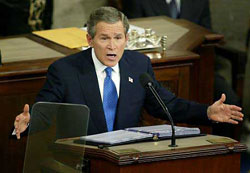
After trying to dismiss it as trivial, and then trying unsuccessfully to pin it on George Tenet, the new White House angle on trying to weasel out of the fact that George W. Bush knowingly presented false evidence to prosecute the Iraq war is quite interesting: Bush, they now claim, did not read “the most authoritative prewar assessment of U.S. intelligence on Iraq.” In other words, like his dad as vice president, he was somehow out of the loop.

"It wasn't my fault, really! I was clueless!"In what appears to be the best attempt the Bush administration can make to clear themselves of an obvious lie to the people, it declassified excerpts from an intelligence report that presented the opinion that Iraq was rebuilding its nuclear weapons program. However, the 90-page report also expressed doubts about the veracity of that same information, calling the claims it made “dubious.” The White House spin? Neither Bush nor Condoleezza Rice read the whole report; “They did not read footnotes” of the document, an anonymous WH official said. They were, however, briefed on the document. Now, maybe I’m naive, but I would think that if the report contained serious doubts about its own truthfulness, that this would at least be involved in a brief.

What this appears to be: Bush and Co. knew that eventually this report would become public, so they are engaging in preventative damage control. Instead of waiting for the document to leak in a far more damaging way, they are releasing it on their own. Instead of allowing the impression to get out that Bush knew the evidence was questionable, and therefore lied to the American people, they can come out first with the story that some aide somewhere forgot to brief Bush and Rice.

This would be a very good move on their part–releasing damaging evidence in a controlled way–but nevertheless, it is still damaging. The president decides to go to war and is never told of serious objections in a report he had in his possession? Sorry, no aides can be blamed here. It was Bush’s and Rice’s job to know that information. And if they want to blame everyone else around them, let us then not forget Bush’s proclamation during the elections, when his intelligence and ability to do the job were being questioned: the president, he and his people said, does not have to be knowledgeable. All he has to do is surround himself with smart and knowledgeable people, and then make the important decisions based on what they give him.

He sold his presidency not just based on his own abilities, but also on the reliability of those around him. Therefore, the abilities of those around him are, essentially, an extension of his judgment and, therefore, his responsibility. Either way, Bush was responsible.

Not, of course, that I buy even for a second the idea that Bush really didn’t know he was selling a con job. I mean, please.

Photo from Lycos/Wired News
Categories: Archived Tags: by

Back After a Jaunt

July 19th, 2003 Comments off

The young pigeons apparently went out only for a jaunt–since this afternoon, they have been back on the balcony, with mama pigeon still feeding them. Apparently, they only left for the morning and early afternoon; I had not guessed that they could fly so well. I’m also interested that they do not show any signs of flying when I come out onto the balcony, though they do edge away a bit–and mama pigeon bolts at any hint that I’m even watching from a window. I guess the squabs are more use to me….

Categories: Pigeons Tags: by

Empty Nest

July 19th, 2003 5 comments

Well, the balcony, for the first time in two months, is finally empty of birds. Went out this morning to check on things, and found no babies–although mama bird was perched on a ledge nearby. I looked around at her field of view, and couldn’t see anything… Hopefully, she was just hanging out, and not watching over a patch of ground where the babies were marooned or something.

It was about time for the more well-developed squab to leave, but his sister (I’m guessing at gender here) still was not fully feathered out, having baby feathers all about (see photo at right); I hope they both were able to fly well enough. I couldn’t find any information on the web about whether or not they return to the nest; I guess I’ll find out. If not, then this is the last Pigeon Update.

Although I got mostly negative comments about the pigeon thing from the beginning, and even had to move the photos to a separate page at the request of friends who felt they were too ugly to keep on the main page, the separate “Pigeon Page” has been the most-visited page on my site (more than 60 hits) aside from the main pages.

Categories: Pigeons Tags: by

Purikura

July 18th, 2003 Comments off

Something which has been all the rage with many young girls in Japan are the “Purikura” (short for “Print Club“)–photos taken of usually two or more people at a special photo booth, decorated with visual baubles and printed out on photo or sticker stock. I mention it now because, eating my Double Burger here at McDonald’s, I have just spotted a gaggle of schoolgirls who not only have some of these pictures (a grid of them, usually 16, printed out on postcard-sized paper, then cut up into smaller-than-postage-stamp sizes), they have tons of them. Books full of them, each page filled with dozens of them. Granted, these are the typical faddish schoolgirls with the ridiculously large loose-sock styles, but the sheer number of stickers each had, representing a great deal of time and money to generate, was rather astounding to me.

I had seen these portraits many times before, but had never seen or heard of where or how they were produced. After dining out in Kichijoji recently, Hiromi took me into one of the places that made them and we took a few. The shop she took me to had perhaps a dozen of the booths, each with different mechanisms and themes. The newest were ones that allowed a great deal of pre-made stamps and photo embellishments to be added.

Although considerably cheaper than a passport-photo booth, it was quite a bit larger and well-designed. It was easy to see what photograph would be produced, and after posing for several photos and choosing the best ones, one is given a few minutes in which to ‘paint’ the photos. There are touch-sheet binders filled with frames, shapes, photos and frills; tap the image you want applied, and then paint it onto your photo where and however many times you want. You are given what seems like quite a short time to make the additions, but I suppose they have to clear out the booth for the next people.

Finally, you choose the size and layout, then wait for the photos to be printed. I was a bit surprised at the complexity of the process, and a bit taken aback that I had paid perhaps twice as much for some boring passport photos not too long ago–you’d think the passport photos, simple by comparison, could be priced quite a bit cheaper.

But then, not quite so many schoolgirls buy quite so many passport photos, pasting them into collector’s albums….

Categories: Uncategorized Tags: by

Pretty Darn Bald-Faced

July 17th, 2003 1 comment

Bush, answering a few questions during a photo-op with U.N. Secretary General Kofi Annan on July 14th, said the following:

“The larger point is, and the fundamental question is, did Saddam Hussein have a weapons program? And the answer is, absolutely. And we gave him a chance to allow the inspectors in, and he wouldn’t let them in. And, therefore, after a reasonable request, we decided to remove him from power, along with other nations, so as to make sure he was not a threat to the United States and our friends and allies in the region.”
Talk about science fiction… (a), Hussein apparently did not have a weapons program when we came into Iraq, as evidenced by the complete lack of evidence, which should have been uncovered long before now; (b), he did in fact let inspectors in, and although there was some lack of cooperation, the inspectors said that they were making more headway than ever before; Bush, on the other hand, chomping at the bit to invade no matter what the inspectors found (his original call for the inspectors to go in was little more than a political sham), repeatedly dismissed the inspectors’ findings and sent troops in anyway; and (c), well, everything else he said, really–“reasonable request”? “…a threat to the United States”? Hasn’t Bush been paying attention? Or does he think that most Americans haven’t?

Sadly, if the latter is the case, then Bush may be right.

Categories: Archived Tags: by

More Pigeon Photos

July 16th, 2003 3 comments

A few more photos are available on the Pigeon Page. They’ve lost almost all their yellow fluff now, and are developing the iridescent plumage around the neck, very pretty. One of them has a few splashes of white on the head, making it easy to identify in the future should they come back to visit.

Categories: Pigeons Tags: by

Chaos and 16 Words

July 15th, 2003 Comments off

“The British government has learned that Saddam Hussein recently sought significant quantities of uranium from Africa.”   –George W. Bush, 2003 State of the Union Address

Ever since the beginning, it has been clear to a great many people that George W. Bush was not just stretching the truth in his campaign to the American people for a war with Iraq; we knew that he was lying outright. The problem was that there was no “smoking gun,” and Bush could squirm out of whatever wasn’t smoking.

Now, far too late to do much good, we have the smoking gun, in the form of the now-famous “16 Words” Bush spoke in his State of the Union address before the Iraq war. Naturally, the Bush administration is trying to play down the matter, trying to claim that the matter is settled, that the claim was “technically correct,” that it “has been blown out of proportion,” and that it “in no way has any effect on the president’s larger case.”

This strategy, blowing off the story, acting like it’s no big deal, then waiting for the press to play along and move on to the next story, isn’t working this time. It seems like the Bush administration was so used to being able to dismiss anything they wanted, now they’re genuinely puzzled as to why this particular thing is not going away. But it will not; you can feel it in the air, the press has already invested too much time on it, and the smoking gun has too much weight behind it.

The central argument of the administration is that the 16 Words were the fault of the CIA, and that Bush was an unwitting victim, but this has already been proven untrue. Yes, British Intelligence did indeed report that Hussein was trying to buy uranium from Niger, but that makes no difference: the CIA, with Joseph Wilson‘s testimony, had told the administration that the Niger claims were false. So even if CIA chief George Tenet failed to object strongly enough to the administration’s choice to include the faulty British intelligence in the State of the Union, it does not change the fact that the Bush administration, against CIA advice and knowing full well that the evidence was false, nonetheless actively decided to include the “16 Words” in the speech, and thus knowingly deceived the American people.

In her many efforts to kill the story, Condi Rice tried to say that it was irrelevant because it didn’t change the larger argument. Even if we go along with her and ignore the fact that the president knowingly lied to America about the Niger story, does that end the whole matter? The answer, of course, is no–because it was not just Niger that he lied about.

A way to understand this can be found in Chaos Theory. There is a concept in Chaos Theory called “Self-Similarity.” It says that patterns, similarities, can be found at various levels of magnitude; the same patterns that can be observed at small size appear again at larger sizes. Take a snowflake, for example: if you look at the snowflake as a whole and then look at a tiny part of the snowflake, one sees the same patterns emerge, the same basic shapes reasserting themselves.

This same recursive pattern can be found in the Bush administration’s push for the Iraq war. The Niger lie is significant not just because of the 16 Words, but because those 16 Words represent a pattern of deception at a number of levels, from the small details to the whole argument. The Niger lie epitomizes the entire campaign, and gives life and body to what was always clear but never came to the point of proving it beyond any doubt–the usual leeway politicians are granted.

The Niger lie was the Bush administration’s stepping over the line. Bush had been dancing, cavorting, thumbing his nose at us, and we accepted it because he stayed behind the Line of the Smoking Gun. But with Niger, he stepped over the line, and now all the other lies come flooding through the breach, carrying the story onward, past the objections of Rice, Rumsfeld, and others. That’s why Rice might say it seems “out of proportion” and believe it, because she’s just talking about the 16 Words.

But it’s more than that, and woe to the Bush administration if it fails to recognize the fact.

Categories: Archived Tags: by

Yum

July 14th, 2003 3 comments

Hiromi and I went to see a movie last night (“Charlie’s Angels: Full Throttle”). Thinking that “Terminator 3” would draw most of the business, we came half an hour before showtime, but enough people had come so that we could not get good tickets for the late afternoon show. No problem, we just switched our plans, bought tickets for the later show, and had dinner before the movie instead of after.

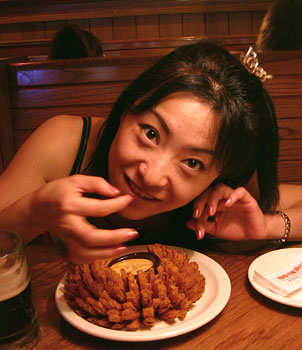
The place we went to for dinner was an “Aussie” joint called the “Outback Steakhouse,” though I’m fairly certain it’s American faux-Aussie style. Wherever they’re from, they have good food. To the right is Hiromi enjoying the onion bloom, a very nice fried onion dish with a dressing dip in the middle. The main other dish we enjoyed were the ribs, very good at this place–the sauce is good , and the meat is tender and practically falls off the bones. Very delicious, if rather unhealthy!

The Outback Steakhouse is located literally next door to the Virgin Cinema complex in Minami Osawa, very close to the Keio Sagamihara Line station of the same name. (The same shopping area has a Cinnabon, a big albeit fattening plus in my opinion.) So right after dinner, we just walked next door and went to the theater, walked in and sat in our reserved seats and enjoyed the film.

Charlie’s Angels: Full Throttle is enjoyable so long as you take it for what it is: a live-action cartoon. Best to suspend disbelief, set your intellect on neutral and just go along with it. Enjoy the Matrix-style stunts and whatever good gags you can find, including some see-if-you-can-catch-them insider jokes. A cute moment was Lucy Liu’s ferret imitation for her father (John Cleese, surprisingly). The IMDb web page linked to above, as always, provides interesting background information, some of it rumored–for example, the reason Bill Murray decided not to return for this film because he could not stand to work with Lucy Liu, according to the trivia section of the IMDb page.

After the film, we had drinks at Starbucks until they closed down and ushered us out, then went to wait for the bus. We must have waited twenty minutes before we realized that we had just missed the last bus, and so headed back for the train station–a circuitous trip for Hiromi back home, but at the time, the only ride available for a reasonable price. Still, it was a great night out.

Categories: Uncategorized Tags: by

Full-Tilt Press Bias

July 13th, 2003 Comments off

“Has the criticism of CIA Director George Tenet been unfairly politicized?”

That’s the question CNN put to its viewers. How biased can you get? During the 8 years of Republicans politicizing each and every rumor, allegation and bald-faced lie about Clinton with the press gleefully tailing along, I do not recall any issue during that time which was characterized by the press in that light, especially so early in the life of the story.

And yet just a few days after the story gets into the spotlight, the story is not centered, as it should be, on the fact that the government ignored clear evidence and decided to lie to the American people in order to drag us into a war we didn’t want. Instead, it is being framed by the press as a story about Democrats unfairly criticizing the president for political gain.

No greater ally could President Bush ask for than the one the press is continuing to provide him with.

Categories: Archived Tags: by

Another Costco Haul

July 13th, 2003 3 comments

As you can see, I’ve been shopping again at the Tama Sakai Costco, near Hashimoto Station on the Yokohama and Keio Sagamihara lines.

This time much of it is fixings for a fireworks party next Sunday (if the rain will give us a break!). The fireworks display is nicely viewable out my dining room window; last year a half-dozen folks came for the party (though it was in October then).

Got some four-cheese ravioli (yum), walnuts (should be for cooking, but they’re great for snacking), limes, mints, Picante Sauce (like a thin salsa), some wine and liqueur, buns (for some polish dogs I got previously), and an apple pie (much better than the rather lame pecan pies they had a year ago, not surprisingly discontinued).

And you probably noticed the DVD player–region-free (you can play both U.S. and Japanese DVDs in it), and cheap–just about 10,000 yen.

The problem in that store is not buying stuff.

Getting it home can be problematic… They have delivery service, but it is based in Kanagawa and serves people in that prefecture best. It’s OK for really big hauls, but for ones like this–just bring your own bags, backpacks, and other goods for schlepping stuff around.

Categories: Focus on Japan 2003 Tags: by

Anybody But George

July 12th, 2003 1 comment

The excuses are flying again, this time in response to the revelation concerning Bush’s State of the Union address. Turns out that Bush’s claim that Hussein was trying to buy uranium from Niger was not just false, but knowingly false. The CIA knew it was wrong. A government representative sent to Niger reported it was impossible. And yet with this knowledge, wanting to fuel the war against Iraq, it was decided that the CIA’s information be ignored and a report from British intelligence be used instead. the question is, who decided to lie? Well, you can guess what the Bush administration is saying:

Anybody but George.

Apparently, a George Bush was out of the loop yet again in the White House. Despite the fact that we should have known that Iraq had no nuclear program and a severely diminished bio- and chemical weapons program, despite the knowledge that there was no tie between Hussein and Al-Qaeda or 9-11, despite the intelligence that said Iraq was no threat to us at all, and now despite the fact that the administration knew the Niger story was a complete lie–despite all these things, George W. Bush made statements completely to the contrary in his State of the Union speech, and in countless speeches before and after, and yet somehow, he never lied.

Really, there are only a few possibilities. One is that Bush knowingly lied to us. The other is that everyone lied to Bush. Neither possibility is good, but you can guess which one the administration is playing.

George Tenet, director of the CIA, is now in the process of falling on his sword. George W. Bush, Condaleeza Rice and Senator Pat Roberts are helping him, making sure the sword is guided directly to his heart and not faked into his armpit. Tenet is the only one who has to fall right now, as the Niger story is the only one with the definitive smoking gun.

But the question should become, who’s responsible for all the other lies? Who’s going to fall on his or her sword when WMD are never found? Who lied to Bush about that? Who’s taking the fall for deceiving bush about Al Qaeda and 9-11 ties?

The “anybody but George” strategy has a flaw in it: used too often, it will give the impression that Bush is surrounded by deceitful liars who keep him in the dark, and/or he is an unwitting, gullible fool. But we know, in our heart of hearts, that neither is true. We know that Bush has been lying. It’s simply that a majority of Americans either don’t want to believe it (for personal, political or other reasons), or they know it and don’t care because it relieves them of being responsible for doing things they want but know are wrong.

Note: Josh Marshall has been closely
reporting on the Niger story in his
“Talking Points Memo” blog.
Categories: Archived Tags: by

Subtlety in Media Bias

July 11th, 2003 Comments off

To note yet another stroke against the myth of a liberal media, take a look at CNN’s latest front-page headline: “Democrats grow bolder in criticism of Bush on Iraq” (story here). Underneath that headline is the note that “Republicans say Democrats are playing politics, trying to make some headway in the upcoming 2004 election.”

I do not recall, in the uncountable times that Republicans accused Clinton of everything and anything to score political points, that the media characterized the political assault and its motives as the chief story; rather, they focused on the charges and whether or not they were true. It was never “Republicans strengthen their attacks: Democrats say Republicans are playing politics”; rather, it was “Clinton accused of [insert accusation here],” followed by details and analysis of the accusation. See examples here and here.

By representing the story as shown above, CNN is effectively putting the actual criticism in the back seat, and is instead highlighting the story as a political move. This may well be, but, as noted, it is inconsistent with reporting styles under Clinton, and ignores very real and well-deserved criticism of the administration. This spin put on the different stories makes the difference between supporting and attacking a political party.

Categories: Archived Tags: by

Leaving the Nest But Not Flying

July 10th, 2003 Comments off

The pigeon babies are nearly grown now. It’s been three weeks, maybe a week left before they leave. They’re running around the balcony, sleeping where they feel comfortable now. Not ready to fly, not just yet…

Categories: Pigeons Tags: by

Poza Consulting Services

July 10th, 2003 1 comment

Here is a link to my father’s site and a reprint of the text there:

Poza Consulting Services

Areas of Expertise:
Audio Tape Authentication (Audio Tape Analysis)
Voice Identification (Voiceprint Analysis)
Acoustic Identification (Analysis of non-speech recorded events, e.g. gunshots)
Enhancement and Transcription of Noisy Audio Tape Recordings

Tito Poza, who is bi-lingual in English and Spanish, has been active in
Voice Identification technology for over 30 years. He has co-authored
encyclopedic articles in both Voice Identification and Tape Authentication
and has testified extensively as an Expert Witness in all areas of
Audio Forensic Analysis.

Poza Consulting Services provides
Consultation, Analysis and
Expert Testimony in the following areas:

Audio Tape Verification and Authentication (Audio tape analysis)

Voice Identification and Elimination (Voiceprint Identification)

Acoustic Identification (Analysis of non-speech recorded events, e.g. gunshots)

Enhancement and Transcription of Noisy Audio Tape Recordings

PCS has been serving the legal and law enforcement communities for over 25 years. Tito Poza has testified as an expert witness over 60 times in state and federal courts in both criminal and civil cases. He has co-authored two encyclopedic articles that provide attorneys with valuable information and insights in the areas of Voice Identification and Tape Authentication in particular and more generally in the broader areas of Forensic Communications and Forensic Acoustics.

To contact Poza Consulting Services:

Voice Phone: 650-325-6242
Fax Phone: 650-328-7904
e-mail poza@poza-consulting.com

Categories: Main Tags: by

Privacy

July 10th, 2003 Comments off

I am by no means the first person to comment on the fact that in the 21st Century and the Information Age, one of the major issues that we will face is that of privacy. As it becomes more and more possible to collect information and monitor any given person via electronic means, keeping a database of where they live, where they work, where they go, what they buy, and so forth and so on–it will be more and more possible to almost passively allow computers to build databases detailing our activities on a daily basis, records to be accessed whenever someone with access (read: government and industry) so desires.

Think about it: records are kept on where you live (city records), where you work and how much you make (IRS), where you go (trail of credit card receipts, hotel registrations, airplane ticket purchases, gas purchases), what you buy (receipts connected to your credit, debit, and bank cards; records from “membership cards” at supermarkets, rental stores, etc. which keep close track of every purchase), what information you access on the Internet (cookies and other tracking information), email you send, whom you talk to and what you talk about (if your email is unencrypted, it can be legally read at many points along its path), medical records, bank records, credit histories, work records, and much, much more.

Computers, able to collate this data by keeping a record of all references to you, will be able to sift through the gargantuan heaps of data on the Internet and other sources and compile data which can be smoothed out manually to build an incredibly detailed record of all your activities–more than you can even recall yourself. That database will be available to be used against you (can you even imagine how that kind of information could or would ever possibly be used for you? Not likely). It will be available to find you, pigeonhole you, persuade you, perhaps control you in subtle ways. Or to blackmail you threaten you, expose you, embarrass you, catch you doing things you should be able to do in private without hindrance, but that others may not approve of.

The right to privacy against this is under concerted attack. Laws are being drafted (thankfully, against the tide of the courts) that can tell you what kind of person you can be, what activities you can take part in between consenting adults in private places, deciding what you are allowed to watch, read, do or speak about, and with whom. Some of it is not legislated; some is simply discouraged with the force of law or popular public pressure. What places in the world you are allowed to go to, what kind of persons you can associate with, what opinions you can hold, what statements you can make even semi-privately. In the building atmosphere of fear, simply speaking out publicly on your rights as an American citizen can get you branded as unpatriotic, making people less liable to talk to you, meet you, hire you, do business with you. We see it around us, with so many Americans getting angry at those who would question the government, shouting others down even with the threat of violence for doing no more than stating a peaceful, rational opinion. Take, as one example, the man who runs the baseball hall of fame canceling a Hall of Fame event because he didn’t like the political views of one actor who had spoken out against the war. Here, an event that should belong to all of us, the celebration of our national pastime, was hijacked by one or a small number of people to do harm to a person who was simply exercising his constitutional rights and asking the country not to go to war. Turning against people for their views takes place every day at the personal level, and so we do not often hear about it widely and publicly, ergo the celebrity example; but this drama does play out all over our country. The point is that by doing things which harm no one and which are our right as Americans, we can be hurt in real ways, denied opportunities, have things dear to us taken away. A lack of privacy is the means to widen what we can be criticized for, penalized for, and threatened concerning; the less privacy we have, the more control others have over us.

Privacy is part of our birthright. Neo-conservatives, claiming to want government out of our lives but in truth hoping they will interfere deeply but selectively, tell us that there is no express right to privacy in the Constitution; Thom Hartmann, however, said it very well in his column at commondreams.org:

In his dissent in the Texas sodomy case, Thomas wrote, “just like Justice Stewart, I ‘can find [neither in the Bill of Rights nor any other part of the Constitution a] general right of privacy,’ or as the Court terms it today, the ‘liberty of the person both in its spatial and more transcendent dimensions.'”

Echoing Thomas’ so-called conservative perspective, Rush Limbaugh said on his radio program on June 27, 2003, “There is no right to privacy specifically enumerated in the Constitution.” Jerry Falwell similarly agreed on Fox News.

Limbaugh and Thomas may soon also point out to us that the Constitution doesn’t specifically grant a right to marry, and thus license that function exclusively to, say, Falwell. The Constitution doesn’t grant a right to eat, or to read, or to have children. Yet do we doubt these are rights we hold?

And he equally well commented on how that right indeed exists, in so many different ways, in the constitution:

[T]the Constitution wasn’t written as a vehicle to grant us rights. We don’t derive our rights from the constitution.

Rather, in the minds of the Founders, human rights are inalienable – inseparable – from humans themselves. We are born with rights by simple fact of existence, as defined by John Locke and written by Thomas Jefferson in the Declaration of Independence. “We hold these truths to be self-evident,” the Founders wrote. Humans are “endowed by their creator with certain inalienable rights….” These rights are clear and obvious, the Founders repeatedly said. They belong to us from birth, as opposed to something the Constitution must hand to us, and are more ancient than any government.

The job of the Constitution was to define a legal framework within which government and business could operate in a manner least intrusive to “We, The People,” who are the holders of the rights. In its first draft it didn’t even have a Bill of Rights, because the Framers felt it wasn’t necessary to state out loud that human rights came from something greater, larger, and older than government. They all knew this; it was simply obvious.

Thomas Jefferson, however, foreseeing a time when the concepts fundamental to the founding of America were forgotten, strongly argued that the Constitution must contain at least a rudimentary statement of rights, laying out those main areas where government could, at the minimum, never intrude into our lives.

We have the right to privacy; there is no question. At minimum, we have the right to do what we please, as consenting adults, in the privacy of our own homes, if it does not infringe on the rights or safety of others. We have the right not to be tracked, databased and kept close tabs on without our knowledge or consent. We have the right to say and do as we please as long as it does not reasonably infringe the rights and freedoms of others, and we have the right not to be constrained by small people who would absurdly abuse the definition of “reasonable.” (The Baseball Hall of Fame president would likely deem it “reasonable” to cancel a popular public event because an actor lobbied against war on the grounds that any dissent “harms” our troops and is “unpatriotic.” All that proved was just how the meaning of “reasonable” can be distorted by someone with an agenda).

Science fiction writer Robert A. Heinlein, who often speculated on the shape of society in the future, once wrote:

“When a place gets crowded enough to require ID’s, social collapse is not far away. It is time to go elsewhere.”
Perhaps Heinlein was much more prophetic on this point than many people gave him credit for. Unfortunately, we don’t have many places to move on to from here, so instead we have to try to turn things around here and now, or at least fight the oncoming tide.

Categories: Archived Tags: by

Discount Don Quixote

July 9th, 2003 Comments off


You might already know about it, but there is a chain of stores named “Don Quixote” which specialize in discount items. Not like Costco–you don’t buy in bulk, and the store is far from being a big warehouse. The shop might actually be large, but it is so crammed with stuff you might feel claustrophobic. The aisles are not regular, nor are they always straight. The stores look like they were designed by a pack rat–hardly any space to move, items crammed into every nook and cranny.

But that’s not a mistake–it’s a sales strategy. The stores are designed so you feel like there’s no end to the items there. Things are divided into ‘departments’ of a sort, but you will, by necessity, have to move through various areas before you get to where you want to go–and you’ll probably see some unexpected stuff you want to buy along the way.

If you want to locate a branch of the store near you, or see what they have on sale, you might want to check out their web site, which includes an English-language version.

Categories: Focus on Japan 2003 Tags: by

Onaka ga Ippai… or Whatever

July 8th, 2003 1 comment

Another language story: during the same homestay I mentioned in the Batman story, I was having lunch with my host mother and several of her friends–four middle-aged, kindly mothers living in a small, countryside town.

Upon finishing lunch, I wanted to say “onaka ga ippai,” or “my stomach is full,” a traditional statement indicating that the meal was enjoyable.

But I mistakenly transposed the initial vowels for the two main words in that sentence, and said “inaka ga oppai.” That roughly translates to “the countryside has breasts.”

Everyone started laughing aloud, and I had to ask someone to explain to me what I had said. At least I learned new vocabulary from it. I had never heard the word “inaka” (countryside) before.

Side note: my host mother had a pot holder in her kitchen that read “Joy Joy Cock.” (In Japanese, for some reason, the word “cook” is borrowed from English, but is pronounced closer to “cock” than “cook.” Why, I have no idea.)

Categories: Focus on Japan 2003 Tags: by