New Gaijin Card

July 7th, 2003 7 comments

Every five years, you have to renew your Alien Registration Card (aka Gaijin Card, or Gaikokujin Torokusho); I just got mine renewed today. (Image at left–sorry for all the distortion, too much personal info there.) For those of you not in the know, all non-Japanese are required to carry these gaijin cards at all times; if a policeman stops you and you don’t have it on you, then by rights he can take you in to the police station, where you must write a “gomen nasai” letter. You also have to get someone to bring in your gaijin card before you can go. If there is no one to bring your card in for you, you must give the police the keys to your place, and they will get it for you–unless they are kind enough to escort you home while you get your card out for them (happened to me once). Foreigners don’t get stopped just for being foreigners as much as we used to, but it still happens from time to time.

Another infamous point about these cards is the fingerprint. Now it is no longer required (it was done away with chiefly due to protests by the sizable Korean-Japanese community), but it was necessary until just a few years ago. A lot of people did not like this, not only because it made people feel like they were being treated like criminals, but also because the print was prominently displayed on the card. In an early attempt to appease card holders, they provided a plastic slip case with a Ministry of Justice logo positioned to cover the print. Rather lame, really…

They fixed a few other things over time, as well. One was the size of the thing–it used to be an actual booklet, many pages long, too big to fit into most wallets. A huge pain, that was…

Categories: Focus on Japan 2003 Tags: by

Smokin’ Crean

July 7th, 2003 3 comments

After getting my new gaijin card, I left the shiyakusho (city hall) and saw a group of people dressed just like the illustration at right. These are the Japan Tobacco “Smokin’ Clean” clean-up team. Japan is getting better and better about smoking, but is still a relative smoker’s paradise. Many restaurants have no-smoking sections, but the smoking sections prevail, and are in nicer areas. Most workplaces, banks, rest areas and other public places are still smoking havens; the major exception is train platforms, which recently became entirely smoke-free.

The whole “Smokin’ Clean” campaign (when you hear it on television, it sounds like “Smo-kin’, CREEEN!”), aside from being a rather glaring oxymoron, is supposed to address the bad manners smokers are often famed for here, particularly littering. Japanese streets, of course, are far less tidy than is commonly believed overseas, and the major component of that street trash is from cigarettes. I long ago formed, tested and proved (well, to myself anyway) the theory that you could go to any place on any street in Japan at random, stop, and when you look around, see at least half a dozen cigarette butts laying there, often many more.

When you observe smokers here, it is not too surprising. Too often used to tossing butts on the street (and rarely even bothering to stomp them out), many seem to have gotten into the tossing habit. On more than one occasion, I have observed a smoker finishing a pack and approaching a vending machine to buy a new one–and instead of using the trash receptacle in or next to the machine, they crumple up and toss the empty pack on the street just a few feet away. Of course, this is nothing compared to the middle-aged businessman smoker, the guy who hawks loudly and spits disgustingly smack in the middle of the sidewalk or train station hallway. Yechh.

Seem like Japan Tobacco has a ways to go to reform the Japanese smoker….

Categories: Focus on Japan 2003 Tags: by

Shinjuku Nishiguchi Monk

July 7th, 2003 Comments off

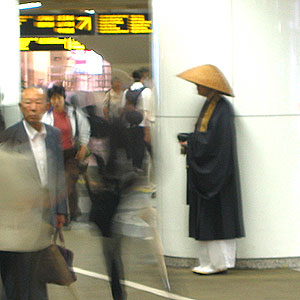
This fellow is often seen standing by a pillar on the very busy basement-level area outside the West Exit of Shinjuku Station. A monk in traditional garb, holding a begging (alms) bowl, with the trademark monk’s hat (“Takuhatsu gasa”). Whenever someone drops some money into his bowl, he rings a bell.

The following text, from the Matsuyama Mokurai web site (a member of the Society for Creative Anachronism), describes this act in detail:

Despite attempting to be self-sufficient, most monasteries would practice alms rounds. Collecting alms was a symbolic act as well as a practical one and, thus, even if the monastery’s warehouse was full, the monks would go beg. … Monks might also stand silently on a street corner holding out their bowls for people to drop alms in. Sometimes ringing a small bell. This was typical of monks on pilgrimage. It is a practice you can still see today. Communication with lay people was usually limited. Monks kept their hats on and did not engage in conversation. Such interaction would cause the alms gift to become an act of favoritism. If kept anonymous, the begging is thus ennobling for both parties.
If you are interested in getting your hands on this kind of garb, or attire for various types of historical Japanese characters, go to this page of Shop Japan.

Categories: Focus on Japan 2003 Tags: by

Mega-GigaHertz

July 7th, 2003 Comments off

One of the best rumor sites for upcoming Apple Computer products is MacRumors. And what they’re saying about the future Apple CPUs is rather surprising.

For the past couple of years, the Mac has drifted rather listlessly in the Motorola doldrums, getting no faster than 1.4 GHz. Now, with the G5, we get an immediate bump up to 2 GHz, though that chip may max out at about 2.8 GHz. In a year, IBM’s PPC 980 chip will be running at 3 GHz, and will max out at about 5 GHz.

If that sounds like a lot, wait till you hear about the following two generations: the 990 (2005-6), which is supposed to range from 6 GHz to 10 GHz, and then the 9900 (2007-8) which, if you can believe it, will run somewhere around 20 to 25 GHz.

Yikes!

But that kind of follows Moore’s Law fairly well, and let’s remember that the features of the G5 were pretty damned surprising to many of us, and yet were indeed true. Still, 25 GHz. Man.

Categories: Mac News Tags: by

Pigeon Relocation

July 6th, 2003 Comments off

To lessen the clutter, consolidate the thread, and relieve those who don’t really like pigeons very much, all the pigeon photos have now been collected on one page. The prior stories will remain, but with a link to the image page instead of the photo.

Categories: Pigeons Tags: by

Batman Is on the Subway

July 5th, 2003 Comments off

Old story time. It was my first trip to Japan, way back in ’83, and I was having a homestay in the countryside town of Iwata, in Shizuoka Prefecture (now the home of the Jubilo Iwata soccer team). After a month’s homestay, I was headed back to Tokyo for a week, and then home. My host father wanted to warn me of the dangers of the big city before I went. Well, compared to major U.S. cities, Tokyo is safe as houses, but to a countryside dweller in Japan, it’s a dangerous jungle.

So he sat me down, and as I could not speak Japanese very well, and he did speak English fairly well, he explained it to me in my language–albeit with a heavy accent.

“Luis,” he started (it sounded more like “Ruisu”), “when you go tsu Tokyo, you musto be bery, bery careful (“kerufuru”). In Tokyo, on za sabuway, zere is… Batman.”

A little taken aback, I reply, “Batman?”

And with a strictly serious expression, he confirmed: “Yes. Batman.”

I could not think of anything to say, so I just repeated: “umm… Batman? Is, uh, on the subway? In Tokyo?”

He nodded vigorously, happy that I understood. “Yes! Batman is on za sabuway, Batman is on za streeto. Batman is everywhea in Tokyo!!”

I then struggled to comprehend as he told me about how Batman would steal my money and attack me. More and more, I felt on the verge of breaking into a giggling attack, until finally I understood that he was trying to tell me about criminals, pickpockets, in other words, bad men, not “Batman.”

Though to this day, while on the subway, I still keep an eye out for someone with a cape.

Categories: Focus on Japan 2003 Tags: by

Careful What You Ask For

July 5th, 2003 1 comment

An evangelist preaching at a church in Ohio asked God for a sign.

He was then struck by lightning, and the church set on fire.

No kidding.

Categories: Uncategorized Tags: by

1st Amendment Covers Us Bloggers–At Least to a Degree

July 4th, 2003 1 comment

The 9th Circuit court decided on Tuesday that bloggers have 1st amendment protection when it comes to republishing information. The same protection that covers ISPs, email providers or Internet content providers covers us as well.

What does that mean? Well, you can still be sued for libel if you intentionally post untrue information which causes damages to another party, but you cannot be sued if information you republish is libelous. However, if someone posts a comment to your blog and that comment is libelous, then, under this new decision, you cannot be held liable for it, even if you “take some affirmative steps to edit the material posted.”

Now, a pertinent question becomes, what about information that you repost from another source? What if, say, you see information on another web site, and you repost it on yours (presumably citing your source and showing quotes or denoting paraphrasing), and the information turns out to be libelous? Are you culpable then?

Not being a legal scholar, I cannot say for certain, but I would presume the answer is “no.” The decision speaks to the definition of being an “information content provider,” which is to say, did you “create or develop” the information? This was addressed in the context of having received an email from someone else and then posting it, and did not speak of actively clipping the information and bringing it to your site yourself. Still, it would seem to be an act of “republishing” rather than “creating or developing.” Or, if you are simply reporting that someone else said this, then you are merely commenting on a fact–unless, of course, you chime in a say that you believe it to be true.

A sticky issue, and not really addressed by this decision by the 9th.

Anyone out there have any opinions on this? Or, better yet, legal knowledge? Can you be sued for libel by reprinting information that was published elsewhere?

Comments are invited.

Categories: BlogTech Tags: by

They Were Actually Serious

July 4th, 2003 Comments off

I read a story a few days back stating that video game producer Activision was suing Paramount for not making enough Star Trek movies. I figured it was just a joke. But no, it seems that the story is true. Do they make James Bond games, too? If so, they may have a case against MGM–after all, they’ve only made 20 of the movies.

Categories: Uncategorized Tags: by

Democrats Finally Begin to Criticize Bush

July 4th, 2003 Comments off

Or at least in a way that gets carried by the media. Maybe this is more a shift in the media’s bias (now that the FCC ruling is done with and looks to be struck down by Congress) than in Democratic rhetoric, but whatever the cause, at least finally some criticism is getting disseminated. It’s all about the “Bring them on” quote he made a few days ago, daring Iraqis to kill U.S. soldiers:

Dick Gephardt: “We’re losing soldiers every day, and he is not putting together the international help and the international coalition to deal with this problem. He doesn’t deal with other countries well, and there’s an arrogance, there’s a state of mind in thinking that drives people away rather than bringing them in to help us…. He’s president, you don’t taunt the enemy…. You try to keep our troops safe, you try to help them in what they’re doing …. This phony, macho business is not getting us where we need to be.”

Sen. John Kerry: [The comment was] “unwise, unworthy of the office and his role as commander in chief, and unhelpful to American soldiers under fire.”

Sen. Frank Lautenberg: [The comment was] “irresponsible and inciteful…. When I served in the Army in Europe during World War II, I never heard any military commander — let along the commander in chief — invite enemies to attack U.S. troops.”

Howard Dean: [The comment was] “incredibly reckless rhetoric…. These men and women are risking their lives every day, and the president who sent them on this mission showed tremendous insensitivity to the dangers they face.”

I still haven’t heard anyone paying attention to Bush’s comment on how “God instructed” him to invade Iraq.

Categories: Archived Tags: by

Secondhand Shopping

July 3rd, 2003 Comments off

I don’t use the secondhand shops today nearly as much as I used to, but they can be a real boon to those of us starting out in Japan, or here for the relative short term. It’s sometimes hard to find any shops like that worth visiting, though.

One fairly major shop I saw recently is part of a chain of secondhand shops. The branch I visited is called “News,” and is on Koshu Kaido (Route 20) just west of Chitose Karasuyama Station on the Keio line, in the outer area of Setagaya Ward (Minami Karasuyama 6-18-4). You can call the company toll-free at (0120) 666-801. They sell all the usual stuff, plus large furniture, western-style beds, scooters and so forth. Prices seemed OK as far as these shops go.

The entire chain seems to have shops all around Tokyo, in places like Itabashi, Sasazuka, Okubo, Suginami and a few other locales. You can visit their main page and get a listing of shops; the site also seems to list some of the items they have for sale, though I would expect these are of better quality and lower-priced than you could expect to actually find in the shops.

Or, if you’re up for a walk from the station, try visiting the weekly Salvation Army sale on Saturday from 9 am to noon at the “Kyuseigun Danshi Shakai Hoshi Center,” located at 2-21-2 Wada, Suginami-ku. Telephone number is (03) 3384-9114. Directions are on this page. The closest station is Nakano-Fujimi on the Marunouchi line (you have to transfer at Nakano Sakaue), though some people take the longer walk from Higashi-Koenji Station.

Categories: Focus on Japan 2003 Tags: by

“Bring Them On,” He Said from 10,000 Miles Away

July 3rd, 2003 Comments off

“Let me finish. There are some who feel like the conditions [in Iraq] are such that they can attack us there. My answer is, bring them on.”
–George W. Bush, July 2, 2003

So says the man who chickened out of Vietnam service by getting into a celebrity unit of the National Guard, then went AWOL while having drunken binges. I am sure that the families of the service men and women in Iraq are all very comforted by the fact that the president is daring the Iraqis to attack their loved ones so that he can sound macho.

Categories: Archived Tags: by

Feathered Out and Home Alone

July 2nd, 2003 Comments off

The feathers are finally coming out, and if anything, these birds are ahead of schedule. The eggs seemed to hatch much faster than the web sites I looked at indicated they would, and the growth of these chicks (or “squabs,” as they’re apparently called) is almost alarming. Another concern was that mama and papa pigeon seemed to have deserted them–no one has been sitting on the nest for two days now, leaving the squabs unprotected almost all of that time. Apparently, however, pigeons do this–the hen will make a second nest somewhere with another clutch of eggs. The folks must still be somewhere nearby, though; once in a while I catch them coming in to feed. It’s only been ten days since hatching, though, and the sites on the web say 18 days before they get left alone.

Must be fast pigeons.

Categories: Pigeons Tags: by

False Intelligence

July 1st, 2003 Comments off

Here’s an excellent article called “The First Casualty” in The New Republic. It details how the Bush Administration shaped, shaded, influenced and tainted the intelligence community’s data and analysis on Iraq in order to justify a war. A few snippets:

“Yet there was no consensus within the American intelligence community that Saddam represented such a grave and imminent threat. Rather, interviews with current and former intelligence officials and other experts reveal that the Bush administration culled from U.S. intelligence those assessments that supported its position and omitted those that did not. The administration ignored, and even suppressed, disagreement within the intelligence agencies and pressured the CIA to reaffirm its preferred version of the Iraqi threat. Similarly, it stonewalled, and sought to discredit, international weapons inspectors when their findings threatened to undermine the case for war. …

“Had the administration accurately depicted the consensus within the intelligence community in 2002–that Iraq’s ties with Al Qaeda were inconsequential; that its nuclear weapons program was minimal at best; and that its chemical and biological weapons programs, which had yielded significant stocks of dangerous weapons in the past, may or may not have been ongoing–it would have had a very difficult time convincing Congress and the American public to support a war to disarm Saddam. But the Bush administration painted a very different, and far more frightening, picture.”

Categories: Archived Tags: by

Hilarious Translations

July 1st, 2003 2 comments

Check out the translations of this web site in Redneck, Jive, Cockney, and Moron. Not quite politically correct, but nonetheless quite a hoot. Courtesy of The Dialectizer.

Categories: Uncategorized Tags: by

Visitor Check for June

June 30th, 2003 Comments off

Well, the end of the month is here, and according to the AwStats on my web site, business is up appreciably. The table for visitors for the year so far is displayed below. Note that I started the current incarnation of this blog in early April:

Month Unique
visitors
Number
of visits
Pages Hits Bandwidth
Jan 2003 6 6 33 52 592.24 KB
Feb 2003 5 5 17 33 416.12 KB
Mar 2003 13 13 36 90 1.42 MB
Apr 2003 79 120 718 1991 12.53 MB
May 2003 442 679 2445 6178 130.60 MB
Jun 2003 717 1907 4979 33384 749.88 MB
Total 1262 2730 8228 41728 895.41 MB

Not bad growth here–almost too fast, in fact. If traffic increases at this rate, I’ll be over my traffic bandwidth limit by October of this year (I’m allowed 3GB/mo. under my current plan). But then again, that’s the whole idea of putting up a web site–getting people to visit.

Categories: BlogTech Tags: by

“God Instructed Me”

June 30th, 2003 1 comment

There was an article in the Israeli newspaper Ha’aretz about the peace talks in the Middle East. Palestinian Prime Minister Mahmoud Abbas met with President Bush, and told Ha’aretz that, after speaking with Bush about Sharon, Bush told Abbas:

“God told me to strike at al Qaida and I struck them, and then he instructed me to strike at Saddam, which I did, and now I am determined to solve the problem in the Middle East.”
Is that scary, or what? And so far, the U.S. press has not seemed to pick up on the story yet. Can you imagine any other president before saying that God instructed him to invade a foreign country and the press not having a field day about it?

One can only hope that the press is at least asking about the quote. Naturally, Bush’s people will claim it was a misquote, especially if it wasn’t, but if the press doesn’t at least partially cover it, this should be yet another proof that the press is covering and shilling for the Bush administration.

Thanks to Sako for the tip on the story.

Categories: Archived Tags: by

And the Excuses Keep on Coming

June 30th, 2003 3 comments

It seems now that the excuses for why we aren’t finding WMD in Iraq are as varied as the falsified reasons for invading Iraq were before the invasion. In the months before we sent forces in, we heard that Hussein had massive stockpiles of chemical and biological weapons and had reconstituted its atomic program; but now a massive, long-term search has brought up only a few empty trucks that even the U.S. State Dept. doesn’t think were for WMD production and a small cache of 12-year-old parts and plans for atomic production, which if anything show that the atomic program was not in fact reconstituted.

So what are the excuses? The weapons are still there, but hidden (said “massive stockpiles” must be damn well hidden to avoid any detection after this time); the Iraqi public and people involved are still so terrified of Hussein they won’t speak (right); the weapons were moved before/during the invasion (read: we may need justification for war against Syria); the weapons were destroyed before the invasion (how stupid is that? If they destroyed the WMD before the invasion, why not shout it to the world and avoid the invasion in the first place?); or the WMD were looted (every single last gas canister and document? And if so, why haven’t we found even the smallest part of these massive stockpiles in looter’s caches that have been found?).

How about this possibility: we were totally lied to.

Categories: Archived Tags: by

Hattori Revisited

June 30th, 2003 45 comments

I wanted to touch on this story as a tangent to the greater current issue of press unreliability and the distortion of truth. It came up in a conversation I was having today having to do with how the view of our world is skewed through the reportage of the mass media. In “Bowling for Columbine,” Michael Moore pointed out how U.S. television overplayed images of black criminals and underplayed white ones. A current version of that in Japan is the kind of crimes committed by members of the U.S. armed forces based here, and how they are amplified in the press–things like a pizza delivery guy getting pelted by a toy plastic pellet gun wielded by someone on an Okinawan base–hardly news, but it gets national coverage because the perp was from a U.S. base.

What might have been the definitive example for Japan-U.S. media distortion, however, was the case of Yoshi Hattori, the young Japanese exchange student shot to death by Rodney Peairs. When it occurred, I was a student at San Francisco State University, and wanting to get the straight details on the case, I accessed the college’s LexisNexis account, and found court transcripts and other records which told a much different story than I’d heard popularly–and which put the incident in a completely different light than how it was represented in the press.

When I ask people to recall how young Hattori got shot, the general recollection was that Hattori went to the wrong address, was met by an aggressive, paranoid homeowner who raised a gun and yelled “freeze”; that Hattori thought he said, “please,” and walked towards him, and then he got shot. That is the general story that was released in the media, and if you do a search on the story on the web, you will find that even today, the story persists.

But it is far from the truth. Vital facts were left out; the story was abbreviated, and was not told from all perspectives. Here’s what I was able to piece together so many years ago from the materials I found.

First off, you should be made aware of two important facts that contribute to a completely new understanding of the case, facts which make the incident and some of its indirect causes far more clear. The greater of these two revelations was that Hattori wore contact lenses, but not on that night: he had lost one lens, and so went without. In other words, his eyesight was impaired. One would think this a fact of great importance to the case, but the press did not touch on it at all. The second fact was the friendly, almost puppylike nature of Hattori himself: when he saw his friends, he had a tendency to run up to them in greeting. This comes into play later as well. You should also know that Peairs’ neighborhood was a high-crime area; that police response time was around 30 minutes (indeed, the ambulance that came for Hattori took that long to arrive). This contributes to Peairs’ state of mind about whether he should handle the matter himself, or wait for law enforcement to arrive.

Here’s what occurred that night, October 17, 1992. Hattori and Haymaker, on their way to a Halloween party, unknowingly arrived at the wrong address (two numbers in the address had been transposed). They walked up to the house and knocked (rang?) at the front door. Mrs. Peairs did not answer immediately because she was putting the kids to bed. She wondered who was at the door that late in the evening, in that neighborhood, with no visitors expected. By the time she got to the front door, no one was there. Hattori and Haymaker, wondering why their friends did not answer, had decided to try the carport door.

Now, a carport is like an open garage, and the door for it is not as “public” as the front door. In terms of personal space and perception, the carport door is somewhat more of an “inside” door, a door strangers do not come to. It is similar to a stranger coming to your side or back door at night–it makes you feel a little insecure. The two boys thought it was OK because they believed it was a friend’s house. But when Mrs. Peairs, just having opened the front door to no one, heard the knocking at the carport door, it was far more worrying to her. She went to the carport door to see who it was.

However, by the time she got there, the boys, again wondering at the delay, had moved away from the door. When she opened the door, Hattori reacted as he did when he greeted new friends: he ran to the door to greet them. From the perspective of Mrs. Peairs, however, this was an entirely different event. She opened a private door to her home, saw two young men–one dressed as a bloody accident victim, the other as a disco star–and suddenly one of them ran at her. Her understanding of context–night in a high crime area, nobody expected, putting the kids to bed, strange youths who ditched the front door and came to an inside door–this made Hattori’s playful greeting run appear frightening. So she freaked out. She slammed the door, ran to her husband, and told him strange young men were at the carport door, and one ran at her, so get the gun!

It is important in understanding what Rodney Peairs did to know that Peairs did not answer the door originally, had not seen what had happened, and did not lay eyes on either boy until he stepped out into the carport with his gun. He entered the situation knowing only what his wife had told him: that strange youths had come to the carport door and one had rushed at her. This left no room for doubt in his mind; he could not possibly know it was a friendly exchange student. Rather, his understanding of the local context along with his wife’s frantic explanation and plea gave him only one clear understanding: young punks outside were threatening his family. Angry and perhaps afraid, he got his gun and went to the carport door.

And here was the critical error, the one that, more than anything else, caused the tragedy to occur–at least the only knowing error: Peairs went out into the carport. What he should have done was to make sure no one had come inside, locked all the doors and windows, called for the police, and waited inside with his gun, using it only if someone tried to enter. Going out and confronting thugs may be in accord with the macho code, but it is tactically unsound and generally unwise.

So Peairs stepped out, expecting that he was dealing with some kind of criminal element in his carport. By this time, Haymaker and Hattori had moved out beyond the parked cars in the carport; Haymaker was trying to explain to Hattori his suspicion that they were at the wrong house; Hattori still hadn’t gotten the idea somehow. Then they heard Peairs call out to them, and say “Freeze!” Peairs raised the gun in plain sight.

Here’s where the missing contact lenses came into play. Most people wonder, even if he didn’t understand “freeze,” why Hattori didn’t see the gun. The missing contacts were why. He couldn’t see. To Hattori, a friend had walked out, and Hattori rushed to greet him. But in Peairs’ context, a clear warning had been given, and a gun had been displayed in plain sight. And yet, one of the young thugs he perceived in his driveway started to run right at him, holding some dark metallic object (it was a camera) in his hand. To Peairs, it could not have been more clear at the time. He fired his gun, and Hattori soon died.

Knowing the whole story makes a difference. With all of these facts stated, the Peairs’ actions are far more understandable. There was still a tragic error and the fault was Mr. Peairs’, but one can see now that Peairs was not the violent, paranoid gun nut he was made out to be in the press. Context and perspective are crucial for a clear view. The public, especially in Japan, was outraged when Peairs was cleared of wrongdoing in criminal court; if one knew the true story, one would not be surprised at all. Although Peairs made the error of stepping outside and was ultimately responsible for Hattori’s death, what he did was within the law, especially under Louisiana’s “shoot the burglar” statute.

Returning to the thesis of this entry, the distortion by the press was obviously a factual one, but also there was the element of degree: the Hattori story remained in the press for years, and for the first 18 months, Japanese papers ran stories on it several times every week. But, like the stories about U.S. military personnel in Okinawa, the story was run way out of proportion to its actual importance.

One day’s second-page layout in the Daily Yomiuri exemplified the imbalance in ironic splendor. I saw it fully a year and two months after the Hattori incident, with Yoshi stories still running regularly. There was a 6-inch article on the continuing Hattori saga, about a planned film project called “The Boy Who Loved America”–talk about your bitterly ironic titles. But right next to it was a 2-inch piece about a death that had occurred just the day before. Somewhere in the Kansai region, a hunter had accidentally shot and killed a 62-year-old woman who was in the hills looking for wild vegetables to use during the New Year’s holidays. The story, though fresh, ran just for that one day, and only got those two inches.

Reading these two articles together, it occurred to me that the Kansai story was in many ways identical to the Hattori story. A man, legally owning a gun and using it for legally allowed purposes (hunting, defending one’s home), mistakes an innocent, on a holiday outing, for an acceptable target, shoots and kills them. The Kansai killing took place in a country where guns are as rare as gun deaths–and yet the incident barely made a ripple in the press. But the Hattori case, already more than a year old, demanded a story three times the length of the new story.

This is not what one could call “balanced reporting.” But then, this is my contention: that the media does not balance, despite their claims to do so. They print what sells. They cater to stereotypes, reinforcing them.

Don’t trust what you read. Don’t trust that you’re hearing all the pertinent facts or perspectives. Don’t trust that anything is presented in proportion.

So how do we get the big picture? We don’t, and that’s what is important to realize: in this information age, we expect that it is possible to get all the facts, but it never is. When you regard an issue, keep in mind that you do not and will never know the whole story. Most people forget this and believe their conviction to be a virtue.

Categories: Focus on Japan 2003 Tags: by

Sawai? Because.

June 29th, 2003 Comments off

Took a trip to Sawai today with Hiromi. Here are a few snaps from the trip.


Hiromi looking out over the river valley.


A little girl has a crack at the temple bell that visitors ring all day.


Hiromi rests her tired feet in the Tama River.

Categories: Uncategorized Tags: by