
All New Ways to have a Heart Attack
 |
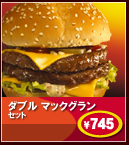 |
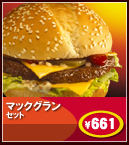
McDonalds just released a new burger over here, the “Mac Grand,” which is essentially a version of the Quarter Pounder, or perhaps more accurately, an attempt to copy the Whopper available at the few Burger Kings here in Japan. The new burger comes as a regular or a double. If you look closely at the picture, the patties look very thick, and the double looks ridiculous–but using the rule of thumb that you can expect half the meat/filling and twice the crust/gristle displayed in any food photograph for fast food, one can get a better image of what the burger really is.
Until now, we had to suffer with the “double burger” at McD’s if we wanted something like this–just a regular burger but with two patties. But now, o glorious day, we now have more meat, a smattering of lettuce, and two sauces. Lo, I can die happy. And obese. I would never go to the place if it were not pretty much the only restaurant near my work, save for a small lunch place across the street that sells an expensive classic-Japanese-style meal which is mostly stuff I don’t like, and a small gyoza place I would love except that the cook is always smoking over his cooking. When I can, I take the 20-minute walk to Subway and get a nice, slightly healthier sandwich.
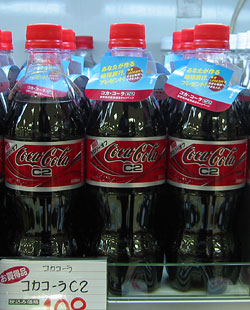 But Mac is not alone in having a new product; Coke has a new version out as well. They usually have just regular Coke and Diet Coke (called “Coke Light” here).
The new Coke product here is a semi-diet Coke called “C2.” Aside from naming their new product after a plastic explosive, Coke is, I think, trying to fool people into thinking that it’s a diet drink. They make a big deal about having less calories, but they express the calories not by how many are in the bottle, but rather how many are in each 100 grams–and give no calorie amount for regular Coke to compare. As far as I can figure, though, C2 has more than half the calories of regular Coke, but is not as volatile as C4.
By the way, there is no caffeine-free Coke here (I have to order from Foreign Buyer’s Club). I think that removing caffeine from a drink is illegal here in Japan. They have “Vitamin” drinks here that come in little brown bottles which have heavy doses of caffeine and, I kid you not, nicotine. Pretty much a standard fix for the salaryman here. The commercials for these little drug-filled drinks are pretty lacking in subtlety. I recall one had a guy drink the tiny one-gulp, and the be immediately engulfed by a high-powered lightning-emitting aura. Another was accompanied by a now-famous song well-known in Japan, which declared, “Can You Fight 24 Hours a Day, Japanese Businessman?!” Well, after downing several charges of drug-laden vitamins, it would probably be surprising if he didn’t die of karoshi (overwork).
Considering new products like Mac Grand and C2, it should be no surprise that there is concern of kids in Japan being overweight. Of course, this is all relative. Japanese people are thin, endemically so. Yes, there are sumo wrestlers, but they grow with great effort and massive overeating. Here in Japan, at 190 lbs. and 5’11”, I am overweight (my doctor said “obese,” thank you very much). But when I would visit our home campus in Wisconsin, I felt downright slim.
A lot of Japanese slimness might be metabolism, but I think it also has to do with diet. There’s not really much sugar here. Donuts do not taste as much like donuts. Frosting is always whipped cream, not sugar-butter icing. There is less meat and much more fish and vegetables than you would see in the U.S. And there is very little diet food. At least McDonalds does not indulge in the massive irony that would be the inclusion of Diet Coke in their menu.
Oh, and by the way, I tried the new Coke. Too sweet–strange for Japan, where sweet foods are usually not popular. Diet Coke still tastes better to me, at least. And I love sweet foods.
You postulate that Japanese are thin because of the lack of sugar in their diets. However, there is a lot of “hidden” sugar in certain processed Japanese foods and the staple of Japanese food, white rice, is quite unhealthy as it has a high glucose index. Genetics may play a role in this but I think there are other reasons.
I believe a big reason why Japanese people are thin is the “stay at home mothers”. This directly influences the quality of the food and the type of diet they eat compared to most westerners who believe they don’t have time to prepare their own food. While many westerners eat out or eat pre-packaged processed foods 2 and possibly 3 times a day, most Japanese eat these types of food only once a day (and sometimes not at all).
In fact, you are complaining that you only have two options for lunch but don’t consider a third option – making your own lunch and taking it in.
As the number of double-income families increases, it’s likely you’ll see more weight problems among Japanese people as they are pushed to eat more pre-packaged and fast food full of added sugar, salt and fats (all of which are used to enhance the flavor of food which has been cooked to death or dried to prolong the period of time which it will be edible).
There is a cost to a lifestyle which affords one a chance to acquire more materially (because of a higher income). I think that the Japanese still live “traditional” enough lives that the problem isn’t as big here as in the U.S. or other western countries but they are on that path.
The picture of the McGrand (Royale with Cheese?) reminded me of this video for the All-in-One with Cheese.
Enjoy…
Shari:
Didn’t know that about “stay at home mothers” and the genetic point is well-taken. On my own eating habits, I was being tongue-in-cheek. I don’t hold neighborhood geography to blame, simply my own laziness. Yours is the serious post, mine was just for fun.
My argument about the stay-at-home theory is that this may hold true in some of the smaller cities and villages, but not in Tokyo. Tokyo, last time I heard, had one resturant per 175 residents. This was not counting the various conveniance stores and grocery stores pre-packaged areas. While admitadelly I do not live in Japan, on my visits to Tokyo I would be amazed if even 10% of the population eats at home from what I have seen. Again, just my own observations.