Archive

Archive for the ‘Focus on Japan’ Category

Blast from the Past

August 13th, 2008 Comments off

I photographed this housewife’s pot holder in rural Japan back in 1983:

Joyjoy

It should be noted that in Japanese, the word for “cook” (the person, not the action), borrowed from English, is homophonous with the word “cock.” Ergo the likely cause of the mistake.

Google Street View: Japan

August 6th, 2008 2 comments

Japan Probe reports that Google’s “Street View” feature is now finally active in Japan. Only in major cities, though–aside from the greater Tokyo metropolitan area and the Osaka-Kyoto area, only Sendai, Hakodate, and Sapporo are included. But in the Tokyo area, almost every street is included–very few blank areas indeed!

As in the U.S., the views are in 360˚ views, which can be scrolled by dragging the cursor over any view. The images seem to have been taken over the past 9 months or so, some even more recently. Take, for example, this image of my school: we moved in in May, and that’s my scooter parked in front.

Gmap-Sv08

In the views, certain parts seem to be blurred out, especially people’s faces, one can suppose to calm fears of intrusion of privacy–though if you’re on a public street, it seems that you can’t expect too much “privacy.” Also, it doesn’t work perfectly, especially in crowded places–but the resolution is low enough that it’s doubtful you’d recognize anyone outside of a specific context (like standing in front of their house). There is a “zoom” feature allowing you to zoom in to any view by two steps, but there’s no increase in resolution–you’re just blowing up the existing image.

I appreciate that Google has this–it represents a lot of effort–but I would much rather they had worked on directions and traffic first. This is a toy, directions and traffic are tools, and very useful ones.

For those of you wanting a few interesting spots:

The base of Tokyo Tower
In front of the Tokyo Metropolitan Government Building
In front of the National Diet Building (the Japanese parliament)
The National Sumo Stadium
Asakusa Shrine Main Gate
Look to the east to see the “turd building” (atop the Asahi Beer building; it’s supposed to be the head of a glass of beer somehow)
Akihabara
Tokyo Dome (not so visible from this angle–but look across the street for the amusement park with roller coasters jammed into a city block in central Tokyo)
Sunshine Shopping Street, near our apartment (must have been early morning for (a) cars to be allowed down the street and (b) pedestrian traffic to be so limited)
Budokan!

Any suggestions or requests? Links to your favorite places of interest?

Light Shows

July 27th, 2008 2 comments

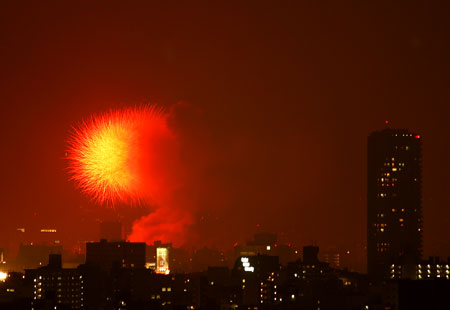
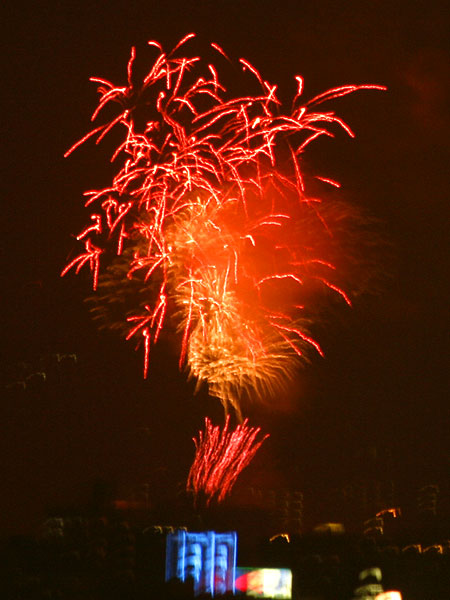
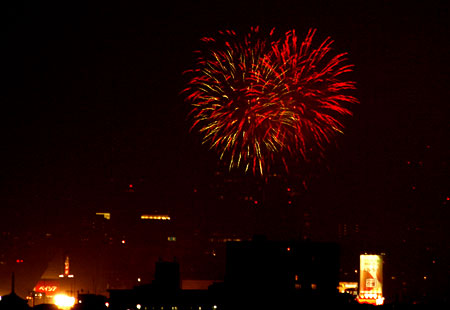
It’s been an interesting few days out the window. Yesterday was the Sumida River fireworks, and today there was a spectacular lightning storm and sunset.

Yesterday’s fireworks show was, actually, a big disappointment. It came on what was arguably the haziest day of the year so far; we could barely see Akihabara from Ikebukuro, and that cut down on the show considerably. Add the smoke from the previous fireworks, and it got hard to see anything. In fact, the haze just got worse and worse as the evening went on; by the end of the show, we could see the fireworks streaking up, only to disappear, and, if we were lucky, the faintest of outlines of a starburst would show through. Most of the bursts, however, were simply invisible.

Here are a few shots from earlier in the show:

0708-Fireworks-1-450-1

0708-Fireworks-2-450T

0708-Fireworks-3-450

0708-Fireworks-4-450

0708-Fireworks-5-450

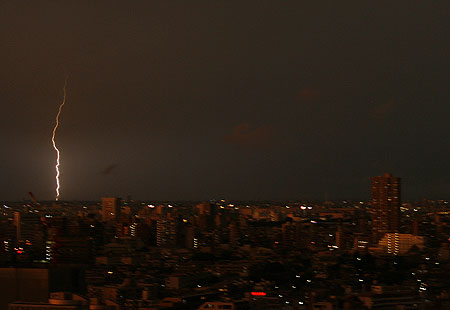
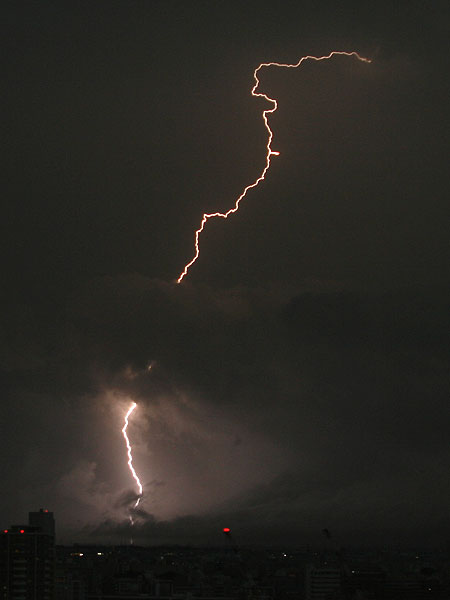
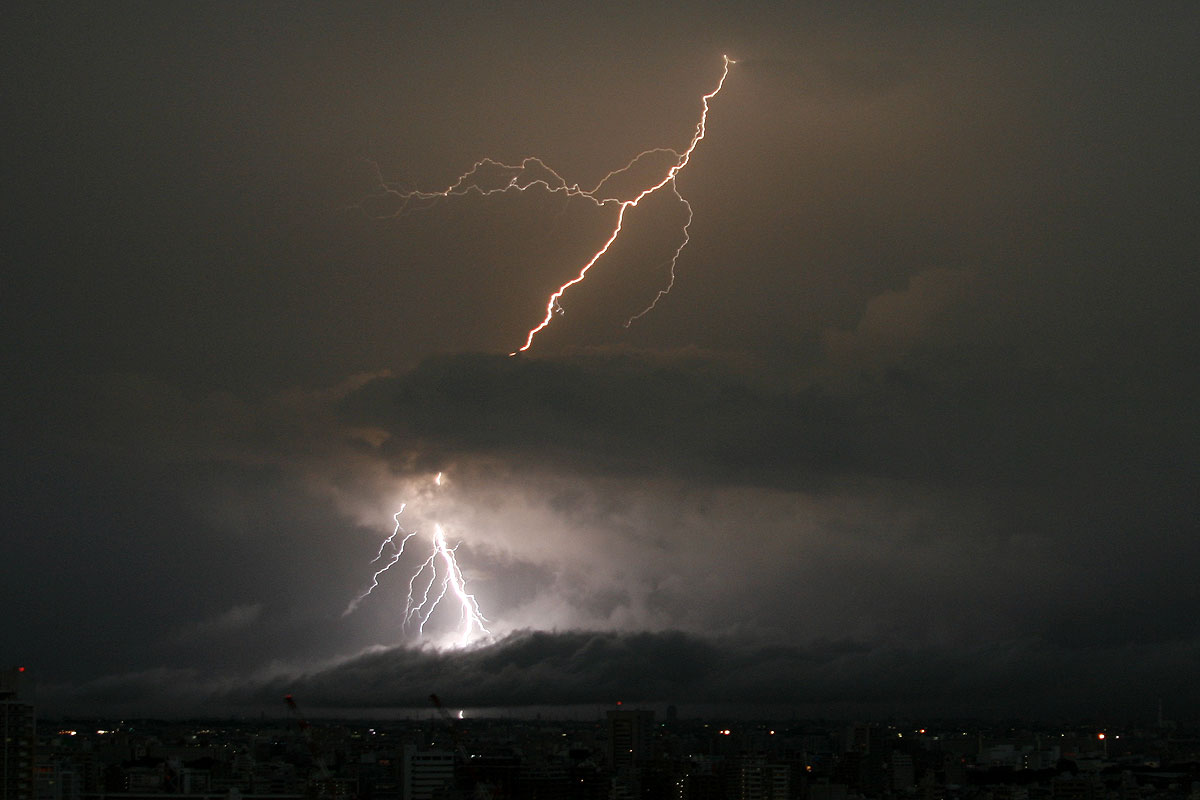
Tonight, there was a much more spectacular light show, and I almost missed it. However, I heard some sounds out on the balcony, and knew that winds had started tossing about a few things we’d left out there. As I went out to batten down the hatches, as it were, I saw a tremendous thunder- and lightning-storm charging by to the north, darkening the sky before sunset.

It was still far too light to take time exposures to catch the lightning, so I tried another strategy: with my finger on the shutter, I waited for lightning bursts to come, hopefully catching some prolonged bursts that way. When that was not successful, I just held down the shutter and took continuous shots, dozens at a time–and that worked. The lightning was frequent enough that I got some good shots. The last one, the most spectacular, is available in an enlarged version when clicked:

0708-Lightning-2-450

0708-Lightning-3-450T

0708-Lightning-1-450

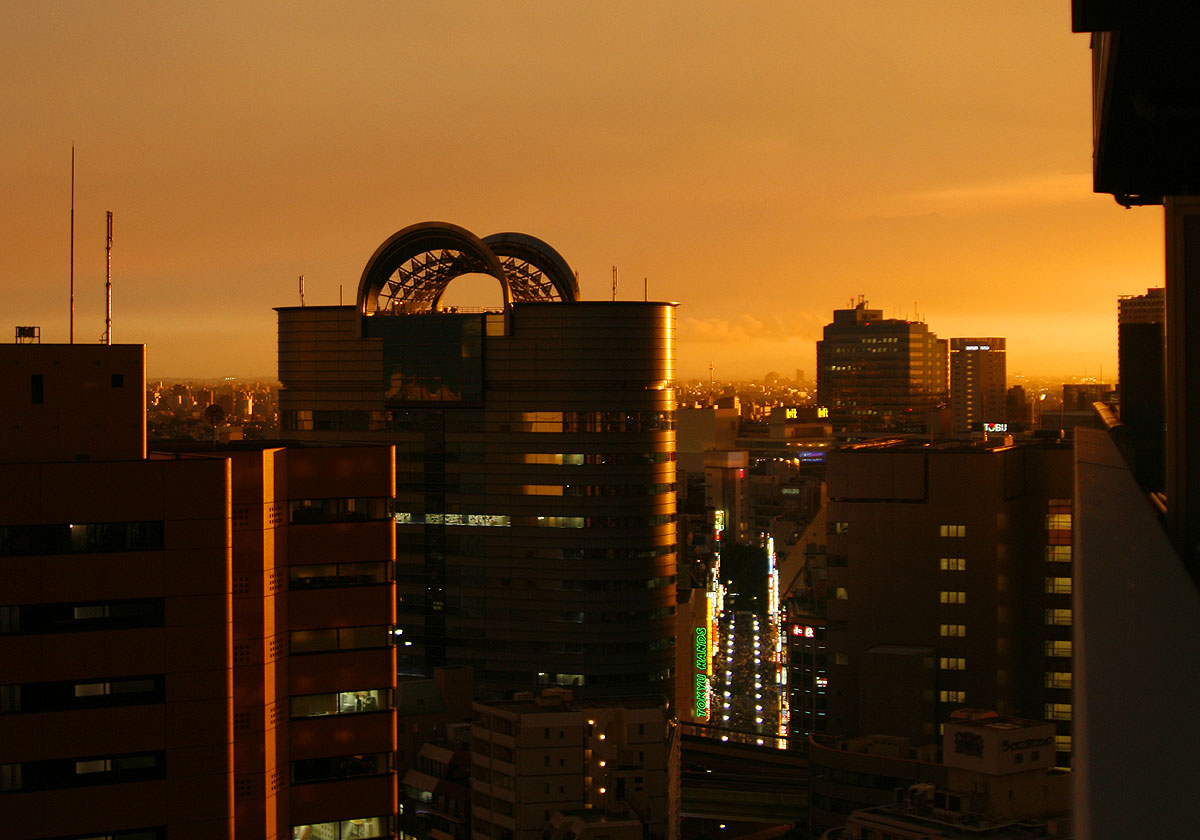
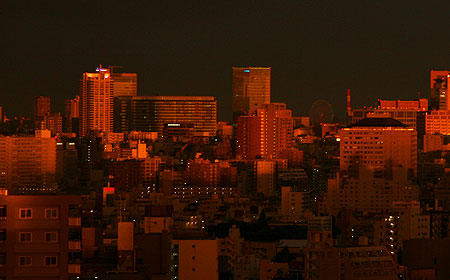
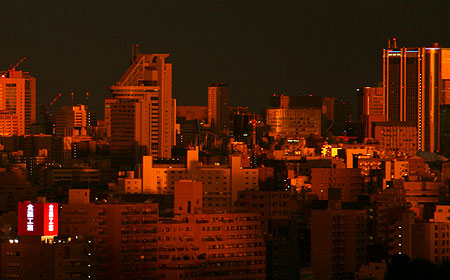
And then, out of nowhere, there came an amazing red lighting. Clouds had cleared around the sun as it set, and even as lightning continued to scatter to the north, a brilliant red and orange wash broke out from the west. As we’re on the east side of the building, I could not see the sunset directly, but that doesn’t mean I couldn’t see some fantastic light effects. Many of the images below–which don’t do the reality justice–are available in larger sizes. I swear, some of them look like images of Coruscant from the Star Wars movies.

0708-Sunset-1-450

0708-Sunset-2-450

0708-Sunset-3-450

0708-Sunset-4-450

The Sunshine 60 building looked almost ominous in the light:

0708-Sunset-6-450

0708-Sunset-5-450

Here is a panorama of Akihabara to Ochanomizu–first cut into two parts, then in full, but reduced in size artificially. Click on the lowest image to see the full-sized image, 1920 pixels wide. The buildings almost look like toy models here.

0708-Sunset-7B-450

0708-Sunset-7A-450

0708-Sunset-7-1920

Categories: Focus on Japan 2008, Ikebukuro Tags:

Another Big One

July 24th, 2008 Comments off

We seem to be getting lots of big quakes in northern Japan. About a half hour ago, Sachi and I felt a rather strong one, which made the furniture shift a little for a few seconds, and doors creaked for a few minutes. Seemed pretty strong even here, and yet it was 300 miles (480 km) distant, up in Iwate, near Morioka (probably hitting less than 30 miles away, though the greatest effect was in various places, maybe because the quake had a depth of about 110 km). The magnitude, originally reported at about 7.2, is now rated as a 6.8 on the Richter scale.

This differs from recent big quakes in that it hit on land, and not too far from populated areas. Since it hit about a half hour after midnight, it might be a bit before we hear about the real damage done.

Categories: Focus on Japan 2008 Tags:

Liveblogging from the Tokko Lecture

July 23rd, 2008 3 comments

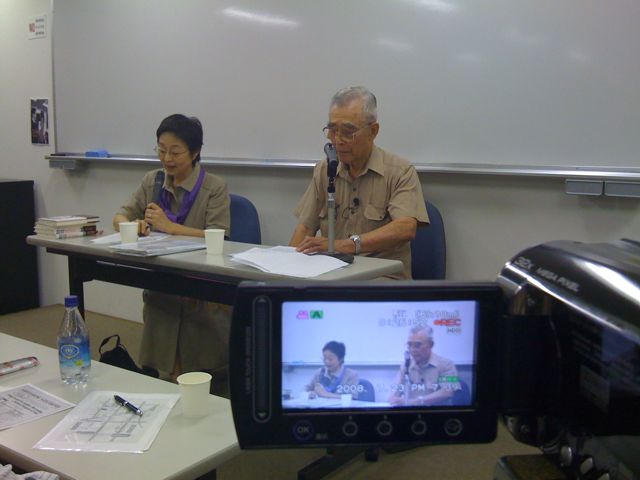
Mr. Iwai is with us right now, giving his lecture on his experiences in the Tokko-tai, the suicide squadrons in WWII. Mr. Iwai was an officer in this squadron who trained others to use manned torpedoes and diving suits to attck Allied vessels.

photo

Mr. Iwai is 88 years of age, and full of energy. He has begun by explaining the weapons used,such as the torpedoes used by the pilots.

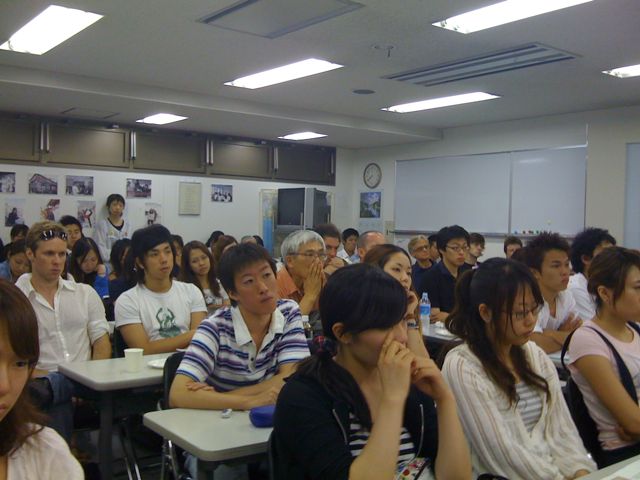
We have a full house tonight, perhaps 70-80 people.

Mr. Iwai himself was not one of the suicide pilots himself, but he trained and traveled with the pilots. Health problems and supply of boats prevented him from operating as one of the pilots. While he was training to perform himself, he was transferred out of the squadron.

photo

photo

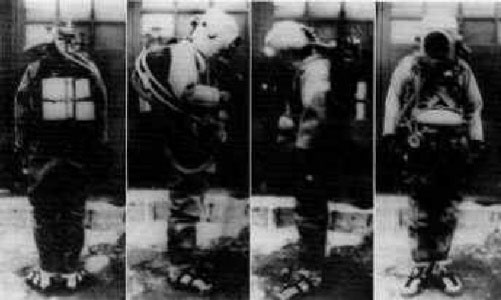
Mr. Iwai then transferred into a new unit, one that used little more than primitive diving suits with mines attached to bamboo poles.

After practicing this technique, Mr. Iwai came to feel that this way of attacking vessels would be worthless. The suits made it impossible to look upwards, as the balance of the suits forced the wearers to lean forward and look down. Nevertheless, as officers in the Imperial Navy, they were expected to perform even if the orders were foolish.

Because of flaws in the suit design, sometimes a corrosive liquid would flow through the air hoses and fill the helmets of the divers, burning their faces and throats, killing them. Mr. Iwai says that about fifty young men died in this way, though records of these events were burned after the end of the war.

He ends with a message that Japan was committing a kind of crime against it’s own people, reminding us strongly of what nations to to their own in times of war. His intention here tonight primarily, however, is to let the young students here understand that these acts are not to be seen as an example to follow, but as terrible acts forced upon the soldiers, in an unjustified war. While the acts of sacrifice made by the soldiers was in itself beautiful and much worthy of respect, the war itself was wrong and should never have taken place.

Categories: Focus on Japan 2008 Tags:

Another Quake

July 21st, 2008 Comments off

This one hit stronger and faster than before… This is immediately reported as a 6.5, same location as the 7.0 we got hit with the other day.

Categories: Focus on Japan 2008 Tags:

Another Big One

July 19th, 2008 Comments off

Sachi and I felt the building start to sway big-time a few minutes ago. There was a big quake, preliminary report makes it a magnitude 6.8 (the TV is saying 6.6) about 150 km off the east cost of northern Honshu, Miyagi Prefecture, maybe 400 km north-east of Tokyo. Still, we felt it pretty big here. Ten minutes later, and the building is still swaying a bit. Now they’re talking about tsunami warnings in Miyagi.

Categories: Focus on Japan 2008 Tags:

Where’s the SoftBank?

July 15th, 2008 1 comment

Today, I demo’ed the iPhone for my two sections of Introduction to Computers (the iPhone is, after all, a computer–that’s my excuse for showing off), and the students were appropriately wowed. I set up a routine to go over the major features one by one in about 20 minutes. There were a variety of gasps and ‘wow’s at various times, and for the most part, the reaction was very positive. They loved the map feature (it usually is the star attraction), and were appropriately impressed by the iPod music and video features, as well as the browsing and App Store features.Ipint Img

To wind up the presentation, I showed them a game which is mildly interesting to play, but great for showing off: iPint (iTunes link), a game where you use the iPhone’s accelerometer to guide a beer down a bar to the waiting hands of a drinker. When you get to the end, the iPhone simulates a mug of beer filling up, and the liquid sloshes when you turn the phone. Then you put the iPhone’s top edge to your lips and tilt it like you would a glass you are drinking from, and it gives the illusion of drinking beer out of the phone. A good finish, and the classes applauded enthusiastically.

Before each presentation, I wanted to find two SoftBank users in the class; I thought we’d try a three-way call and see the image-and-ringtone presentation when calling, and SoftBank users can call each other for free. SoftBank has some 20% of the Japanese market, so out of 30 students I expected five or six to have SoftBank–more, I thought, as many parents pay for the cell phones and they might want that family free-dialing plan SoftBank offers. So I asked… and got nothing. Most were DoCoMo users, most of the rest Au, and a few were Willcom. Not a single SoftBank user among the lot.

When I asked why, the response was pretty clear: for these students, SoftBank was too expensive. Not the monthly plan–SoftBank’s 980 yen White Plan is about as cheap as plans get–but the per call cost. If you go over your limits, the students told me, it costs 42 yen per minute to call using a SoftBank phone, but other providers have lower rates, such as 28 yen per minute. Or so I was told by these students. The White Plan also has no free minutes.

That works out fine for me, as I don’t do an incredible amount of calling, but it doesn’t work as well for these young kids, who make lots of calls. Still, the lack of a single SoftBank customer among the crowd very much surprised me. An overlooked market for SoftBank?

Addendum: I noticed that the Japanese iPhone commercials–by Apple, not SoftBank–have started showing. SoftBank still peppers the airwaves with their ads, but none for the iPhone.

Categories: Focus on Japan 2008, iPhone Tags:

iPhone Hype in Japan

July 10th, 2008 Comments off

It’s a pretty interesting phenomenon here. The line at the Omote-Sando store is now huge, with more than a thousand people in line by now–some reports say 1500, and thousands more expected by tomorrow. Seriously, it’s a Festival environment there, looks just like cherry-blossom viewing or something. Tarps laid out, people drinking beer, the whole nine yards. Masayoshi Son, the head of SoftBank and a bit of a celebrity, is on the line shaking hands and stuff. Here’s the Twitter blog of a guy who got in line a few hours ago, and he’s about 850th in line.

TV and press reporters are all over the place there, and it’s becoming a pretty big media event. Sachi has a news show called ‘Zero“ on, and they had a pretty long segment on it, which included a live report from the flagship line, some demoes of an iPhone they got their hands on, and reports on stuff like the relationship between carriers and cell phone makers–how the makers are usually at the mercy of the carriers, but the iPhone is leading the carriers around by the nose.

Frankly, their handling of the phone was surprisingly clumsy, as if they had just been handed the thing for the first time (which it probably was). For example, they showed the Calculator app, but didn’t turn it on its side; they showed photos, but did not pinch to show zooming. They didn’t even try out maps, one of the most impressive features. They just turned stuff on and looked at it without actually doing anything; for example, they turned on the calendar and just sat there looking at a completely blank list, no appointments. Pretty lame.

But they are playing up the phone itself; this one show had a ticking clock showing how much time remains until the first one is sold. Pretty funny.

Categories: Focus on Japan 2008, iPhone Tags:

If You Don’t Need It…

July 10th, 2008 Comments off

As a SoftBank commercial came on just a moment ago, I just realized that while they’ve been running their usual barrage of White-Plan and Cameron Diaz spots, they have not run one ad for the new iPhone.

But then again, the don’t really need to, do they? Not yet, at least; the iPhone is almost certainly going to sell out for a while, even without a single ad anywhere. Maybe when they start registering unsold stock, they’ll start running some ads.

Categories: Focus on Japan 2008 Tags:

All Set for ID

July 4th, 2008 4 comments

Went down to Samezu today, which for Tokyo is the Mecca of driving: that’s where most people in central Tokyo go to get their driver’s license. Mine was just a few days away from expiring (you get one month after your birthday). As it turns out, this has been my year for renewals–American and Japanese driver’s licenses, and my “gaijin card.”

I really expected a longer ordeal at Samezu. I used to go to Fuchu, out in the less-crowded western Tokyo area, and that would take quite a bit of time, mostly waiting for this and waiting for that. You always have to take a 2-hour lecture if you get a ticket for anything. I’ve been 20 months without a ticket, but it has to be for the whole three years. I remember having to wait a while for that lecture in Fuchu–a long time, in fact, if you came too close to the lunch break–but even if you came early, you had to wait for a while before your session started. It could easily take more than half the day.

At Samezu, though, at least for today, it went quick & slick. Walked in the door at 8:50 am, swept through the lines for vision test, photograph (a much better one this time), payment, and a few other formalities, and was waved into the 9:00 lecture. After the lecture, go up to the 3rd floor and pick up your license. In Fuchu, just that would take up to a hour; here, they fed us through the room in about 5 minutes.

The lecture itself wasn’t too bad–usually these things are practices in boredom and futility, teaching us virtually nothing of importance. Today’s maintained the “useless” tradition, but in a slightly more interesting way. Much of the subject matter was more than just useless, it was so useless it was almost weird. These were all drivers who were forced to attend this lecture because they received citations (even parking tickets). But they spent a full twenty minutes on bicycle safety. I don’t mean tips on how drivers can avoid hitting bicycles–I mean twenty minutes on how to responsibly ride your bicycle. You know, don’t go too fast, stop at stop signs, walk your bike across crosswalks. I started wondering if I was in the right room.

They spent a good ten minutes or so on fatality numbers, and the more usual patter about traffic stuff wholly unrelated to traffic violations, a lot of which I just can’t figure out. But in a surprise move, they spent the last 40 minutes or so showing us a TV drama. Not made for the department, but an actual drama. And strangely, it was probably the most effective part of the lecture. It was about a normal, nice guy who felt he had to drive for some reason even though he was drunk, and he runs over two little kids and flees the scene. He gives himself up out of guilt, goes to prison, and his family falls apart. His daughter becomes so depressed that she won’t go to school; the son gets colored hair and rebels, cutting his father out of all the family photos. His wife has to go scrape and bow and receive endless abuse from the victim’s family; after paying damages, she has to work days as a cook and nights as a construction-site wand-waver. But the shame, the stress, the hard work, and the kids going nuts drives her to throw herself in front of a train. Cut to the guy getting the news in prison.

Most of the film, obviously a tragedy, was spent watching various people writhe in agonizing emotional torment. So, in short, loads of fun, the feel-good movie of the summer and all that. Or, more to the point, the kind of morbid melodrama so deeply loved here in Japan (right after the yo-yo-wielding high school girl-police detective cliche). But you did come out of it feeling like, “well I don’t want to go through that!” And as such, probably did loads more to address the supposed theme of the lecture than anything else, especially the part about not riding your bicycle on crowded sidewalks.

One other note: the guy giving the lecture (probably a retired cop) strangely resembled Takakura Ken, and wasn’t a complete bore. He probably would have served as a better actor than many of those in the TV drama.

One interesting change: licenses in Japan are now equipped with IC chips, complete with a PIN number. They sold it as a way to more effectively renew your card next time, protecting against identity theft or something, but you know the real reason: they want to make it easier to give you traffic citations. Instead of the cop having to laboriously write out the ticket, he can just swipe your card, and presto! He’s off to ticket three times as many people as before. It might even mean that motorcycle cops can ticket people on rainy days, as there wouldn’t be much paper to get wet. But I have the feeling that the cops stay indoors during the rain for other reasons.

Which, of course, leads me to my usual gripe: that most tickets handed out in Tokyo have one purpose only–to generate income. Japanese cops leave the most dangerous places unmonitored, instead setting up ticket traps in places where people break traffic laws which are wholly unreasonable, in completely safe and innocuous ways–but where it’s dead easy to catch them in numbers. I have zero respect for these guys; they obviously don’t give a rat’s ass about safety. If they did, they would be acting in completely different ways. As they are now, they’re just pompous, self-righteous fee collectors.

Case in point: When I lived in Inagi, I went “mentei,” which means you got so many tickets that you went on a kind of probation–I had to stop driving for a month (not so bad, as I was in the U.S.–and driving–for three weeks of that). As of now, as I pointed out, I have not gotten a single traffic ticket in 20 months. Why? Not because of safety–I drive as safely now as I did in Inagi, which is pretty safely–but simply because I now live downtown, where the cops don’t ticket people nearly as much. Most of my tickets before were for “speeding” on long, lonely, deserted, straightaway stretches of country road where the safe speed is at least 50 mph, but the posted speed limit is 25 mph. I usually got caught going a “dangerous” 40, naughty me. Since they stay on your record until you go ticketless for a whole year, they added up over time.

Maybe continued city living (if I can keep on evading the even-more-fee-generating motorbike parking ticket squads) will allow me to go ticketless for the next three years, so for once I can get a renewal without the worthless, time-wasting lecture.


Categories: Focus on Japan 2008 Tags:

Grain of Salt, FWIW

June 24th, 2008 Comments off

From All about the iPhone in Japan:

This is just a rumour at this point, but on a keitai mailing list that I subscribe to, another member indicated that a relative working at a DoCoMo shop had heard the following news today:

> She was informed today by management that DoCoMo signed with Apple to
> provide the iPhone. Her initial impression was that it would be
> offered in the fall before the Christmas rush. BUT also felt there
> was too much secrecy and that perhaps DoCoMo is fighting to offer it
> on or near the July release as well.

Hopefully this will be substantiated by an announcement from DoCoMo before July 11.
If Softbank and DoCoMo both offer the iPhone in Japan, the customer is the winner (more competitive pricing).

– End of rumour alert.

Categories: Focus on Japan 2008, Mac News Tags:

SoftBank Releases Official iPhone Pricing

June 23rd, 2008 5 comments

A few hours ago, SoftBank released their official pricing schedule for the iPhone in Japan. Despite doing two checks on the sites this morning and early afternoon, as well as stopping by both of their east-side Ikebukuro shops while out shopping this afternoon, I just found out about it from Roy leaving a comment. Talk about your watched pot.

Anyway, the news seems to be good. First, the pricing of the phones: ¥69,120 ($640) for the 8GB model, and ¥80,640 ($750) for the 16GB model. Before you gag, those are pre-discounted prices. After discounts (subsidies) applied with a 2-year contract, the costs are ¥23,040 ($215) and ¥34,560 ($320)–which, by the way, are just a few hundred yen off from my blind prediction twelve days ago–not bad! I guessed based on roughly a 10% higher price than in the U.S., which was not too amazing a guess since this is normal for Apple products in Japan.

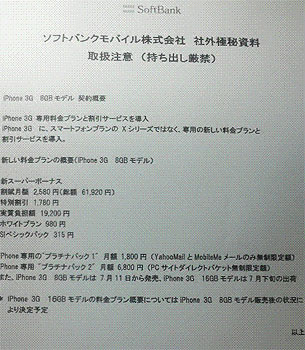
But the bigger news that was welcomed today concerned the price of the data plan. A “leaked” memo (now apparently shown up as fake) had the data plan being ¥6800 yen plus ¥1800 for email, for a total of ¥8600 for the month, not counting the monthly installment for the phone itself and the ¥980 “White Plan” account. That would have totaled a staggering ¥10,540–nearly $100 a month.

According to the official press release, it’ll be ¥980 for the White Plan, another ¥315 for the S-Basic service (which appears to cover all email, not just SoftBank’s internal email), and ¥5985 ($55) for the unlimited data plan, for a total of ¥7280 ($68), not counting the ¥960 or ¥1440 for the monthly installments for the iPhones themselves.

More/edits after dinner, Sachi just set the table!

Categories: Focus on Japan 2008, Mac News Tags:

Lakeland Lectures: Tokkou

June 21st, 2008 4 comments

If you live in the Tokyo area or will be around next month–specifically July 23rd–then drop by my school, Lakeland College Japan, for a special event. We’ve started a lecture series at the college, and after two successes, we’re gearing up for a third which should be special. Mr. Tadamasa Iwai, 88, a former Tokkou-tai officer, will be speaking. The Tokkou were Japan’s suicide bombers during World War II.

Most Americans–and Japanese, for that matter–only know about kamikaze pilots, but there were more than just that kind of suicide soldier. The Japanese navy used suicide bombers in various ways. One was to use a mini-submersible, packed with high explosives, with a human being acting like a living guidance system in what was essentially a large, manned torpedo. Another was to outfit a diver with a pack full of explosives, place him underwater for hours on end, and when an enemy ship sailed past, have him explode himself against the ship’s hull. Illustrations of each:

Torpedo

Fukuryu

Mr. Iwai and his younger brother were both swept up in the wartime fervor of the time, and in that fervor compromised their personal principles and ideals, and became officers in the Tokkou-tai. There, they help persuade other young men to join, compromising their own principles, and leading many to their deaths. After the war, both came to seriously regret their actions.

But what affected them more than one might have superficially thought was 9/11, watching those planes fly into the Twin Towers. One can only imagine how the Iwai brothers felt to see not only the action taken by those pilots, so dramatically public, so similar to those they themselves advocated more than half a century earlier–but just as destructive, the public reaction after the attacks, leading to a fearful and patriotic fervor so much like the one they were drawn into so many years before.

Additionally, the two were angered by the efforts of many Japanese right-wingers who romanticized the roles of Tokkou soldiers, using them as icons to encourage new generations of young Japanese to surrender their own personal principles and become weapons for the state. One manga artist named Yoshinori Kobayashi, for example, has created comics using images of the kamikaze as a way of today promoting “an altruistic spirit of selflessness” among Japanese youth, the kind that led to so much tragedy in wartime Japan.

In 2002, they published a book called “Tokkou,” subtitled (my rough translation) “The Story of Brothers Who Went from Students to Suicide Weapons.” Their primary mission is to speak to as many young people as will listen, and tell them the truth about what things were like, about what was done, and what it meant on a human level. To warn them not to allow themselves to be drawn into the same mistakes.

Frankly, this is a message that all too many Americans should hear. Not that we’re training suicide bombers–but that we are, instead, training our young men to become things just as bad, or worse, for the same reasons. One thought of what has happened at Guantanamo or at Abu Ghraib should be enough to drive that point home. Americans so driven by fear, so intimidated by the national fervor in a time of war, that we believe that almost anything is acceptable–from disassembling our Constitutional rights, to renouncing the Geneva Conventions, repealing Habeas Corpus, starting wars based on thin tissues of lies, and even torturing and killing people under the official banner of national security. Making the same mistakes all over again, allowing our own ideals, principles, and good judgment be compromised in the name of patriotism, security, and war.

So, if you’re in central Tokyo–that’s 7:00 pm, Wednesday, July 23, in the Shinjuku area–mark it down on your calendar. Here’s a link to the PDF file we have for the event, which includes a map to the lecture’s venue. The same information will be available on the lecture series’ web site as well (it hasn’t been updated yet). You should plan on coming 15 to 20 minutes early–I expect it’ll be SRO, so you’ll want to get there in time to grab a seat.

This is an event you won’t want to miss.

Categories: Education, Focus on Japan 2008 Tags:

I Didn’t Blog Daily for the First 39 Years of My life

June 19th, 2008 Comments off

The reason for the title of this article is to demonstrate how a rather impressive (or pathetic depending on your point of view) statistic, namely that I’ve blogged every day for almost the past 5 years, can be made to sound negative. I do this to demonstrate how the news article titled “Survey: 91% of Japanese Will Not Buy ‘iPhone’” is similarly misleading. Here’s how they present the data:

According to a survey by iSHARE, 91.0% of Japanese mobile phone users are not planning to purchase Apple Inc’s “iPhone” mobile phone.

This research was conducted in the wake of the announcement by SoftBank Mobile Corp that it will release the iPhone in Japan (See related article). Targeting Internet users aged primarily 20 to 49, iSHARE asked questions about their intention to purchase an iPhone, as well as other questions and received 402 responses over the Internet.

The survey had been conducted from June 5 to 6, 2008, before pricing for an iPhone handset was announced. Of carriers that the respondents were subscribing to, NTT DoCoMo accounted for 39.8%, followed by au at 26.9%, SoftBank Mobile at 22.9% and the other carriers including Emobile and Willcom at 6.5%.

Asked if they have a plan to purchase an iPhone, 36 respondents (8.9%) said “I am planning to purchase one.” Nearly half of these 36 respondents were SoftBank Mobile users, iSHARE said.

They then make a big deal about how most respondents see a non-removable battery as an issue, though they don’t say if that’s a deal-breaker. But the real misdirection is in the distinct impression they give of most Japanese not wanting to get an iPhone.

If the report is true, that means the iPhone is set to capture almost 10% of the Japanese cell phone market right off the bat–in a country where the iPhone is probably still a largely unknown product. Since half the users are already SoftBank clients, that means 4.5% of Japanese cell phone users would jump to SoftBank from other carriers, increasing SoftBank’s market share from 23% to 27 or 28% within a short span of time. Word of mouth and people seeing others using the iPhone would only increase sales.

That’s hardly negative news.

However, I somehow doubt the veracity of the study; I don’t think the iPhone will sell to millions of Japanese cell phone users right away (though that would be cool). The study doesn’t seem very scientific, had a fairly small sample size, was not universal (it ignored teenagers and those 50 and over), and took place only a day after SoftBank announced they would sell the iPhone, at a time when no pricing plans or tech specs–or even official word that such a device even existed–were available.

Update: I should have guessed: most of the media coverage which picked up on the useless iSHARE survey is blindly picking up on the negative headline, running with the “most Japanese couldn’t care less about the iPhone” angle. Ignoring the fact that 1% market penetration would be seen as a success, ignoring the fact that the survey was taken days before the iPhone 3G was even announced, ignoring the fact that the survey itself was unscientific–in short, the survey was useless, but even if you thought it held meaning, then the meaning was in fact great news for Apple.

Morons. But at least one reporter understood what the basic numbers would mean, even if he didn’t understand the concept of “20- to 49-year-olds.”

Categories: Focus on Japan 2008, Mac News Tags:

iPhone Cost in Japan: Prohibitive?

June 17th, 2008 12 comments

Sbip-LlA couple of pretty bad pieces of news reportedly just leaked out about the iPhone in Japan: it could cost as much as ¥10,800 ($99) per month for the full plan–not counting many of the calls dialed. A 300-minute plan costs an additional $75. Presumably you could still get 40-yen-per-minute calls without the extra plan.
What Japan Thinks published a supposedly leaked pricing plan. According to the document, the 8GB phone costs ¥61,920 ($575), but is discounted (only when certain plans are bought?–it’s unclear) down to ¥19,200 ($180) over a 2-year period, or about ¥800 ($7.50) per month. That’s just for the phone; reasonable.

Then you are able to sign up for the “White Plan,”“ for ¥980 ($9.10) a month, which gives you unlimited free calls to family members, unlimited free calls to SoftBank clients until 9pm, and all other calls are ¥42 ($.39) per minute. I could live with that–I only make about a half dozen phone calls a month to people other than Sachi, and some of them might be SoftBank users. Under this plan, my phone bill might be only a few hundred yen (a few dollars) a month.

But then there’s data–they really sock you for the data plans. For email–Mobile Me and Yahoo only (I don’t use Yahoo, nor will I)–you get unlimited mail for ¥1800 ($17) per month. I would sign up for Mobile Me, and all other email I could forward to my Mobile Me account. But still, $17 just for email.

Then comes the data plan: ¥6800 ($63) for the unlimited data plan. Ouch. I mean, ouch. Maybe that’s a standard fee in Japan, I don’t know–all I know is that I don’t think I could possibly justify that. Fortunately, the iPhone switches to WiFi automatically whenever a network is detected. I have WiFi at home, and I have my old Airport Express base station, which I could easily set up at work. That would cover my data usage most of the time; I would then, presumably, just use only as much data as I absolutely had to, at what I think is ¥76 ($.70) per minute. It would have to be commando raid stuff. But this would normally be how I use my phone–mostly at home and in the office. I don’t think I could justify $63 a month for the odd impulse browsing while I was walking around town. Pricey.

In short, SoftBank’s data plan would break my bank, so I’d have to simply give up on that one. That is, of course, presuming the memo is for real. I have the distinct feeling that SoftBank is intentionally leaking this to gauge reaction. Hopefully there will be widespread dissatisfaction and they will lower the actual offered rates. But, like I said, I have no idea what data plans usually are in Japan, so this might actually be more or less standard. I’m just used to my basic ¥2000/mo call plan with minutes at ¥10 per; keitai rates have always seemed pricey to me. But if I want the iPhone, I may have to get used to them, and/or certain limitations.

Worse news still: only the 8GB model will be released on July 11; the 16GB model–which I have been waiting all this time for–won’t come out for another 2-3 weeks after that. Yargh. However, Sachi and I both planned to go SoftBank upon the iPhone release, and she’s going there less for the iPhone than simply because we can be on the same plan. So maybe she would be willing to let me steal hog monopolize borrow her phone for the first few weeks–a substantial thing for me, much less so for her.

Of course, (a) the memo could be fake, and/or (b) I could be reading the plans wrong. Is the data plan–apparently specially created for the iPhone–a flat rate, or does it build up with use? If it builds up to a ceiling of ¥6800, then what’s the floor, how many free minutes, and how much do you pay per packet/minute within the plan? And what about GPS? Is GPS counted as data? Or is that free?

Anyone who knows more than I do (i.e., anyone in Japan with a keitai) please set me straight….

Categories: Focus on Japan 2008, Mac News Tags:

I Hate Stupid Over-reactions

June 15th, 2008 5 comments

Due to last week’s knifing rampage, “authorities” are suspending Akihabara’s “open street” Sunday. In Japan, many heavily-visited shopping areas close the street to motor vehicle traffic and allow pedestrians to spill into and take over the entire street in order to avoid congestion and create a bit more of an open market atmosphere. Akihabara is not the only place where this happens; in Tokyo, the Ginza and I believe Shinjuku Boulevard also open up on Sundays. In fact, I can see a permanent “open street” from my balcony–Sunshine Street in Ikebukuro. Akihabara has been opening their main drag for visitors for 35 years.

Closing the street is not being done for safety reasons; after all, concentrating people on the sidewalks would, if anything, make it easier to kill more people. Perhaps in the sense of Akihabara Open Street being a famous event so it draws attackers, closing the street might seem useful–until you realize that an attacker looking for a famous area to attack would simply move on to one of the other open streets (which I believe are still open), and lacking those, would move on to other kinds of venues. At best, it would only displace the attack elsewhere. Not to mention that in 35 years, the open street hasn’t exactly been a murder magnet or anything.

No, this seems to be nothing more than an official attempt to make it look like the authorities are doing something. You know, like making everybody take off their shoes at airports. In Japan, this is a common reaction to a tragedy with no easy fix. I recall a while back, after the terror attack on a Spanish railway, some train lines in Japan reacted by removing trash cans from train platforms. Yeah, that really put a dent in terrorism. I bet scores of terrorists threw up their hands in surrender once they noticed the trash cans were gone.

In this case, beefing up and publicizing psychiatric counseling services would probably be a far better and more effective reaction, but would be harder, more expensive, and less sexy. So instead, they’re closing down the open street and beefing up police presence. Unfortunately, that’s another over-reaction: the police are now not only patrolling in gangs, but they are openly wielding nightsticks–not holstered, but always in hand–while stopping people seemingly at random and questioning them.

That ought to do wonders for business in Akihabara–I don’t want to go near the place already.

So we get these stupid over-reactions instead of doing what’s sensible–better psychiatric care (not a cure-all, but it would help) and a more sensible police presence all the time, not just after the fact. They ought to do something other than just make it seem like something is being done.

Categories: Focus on Japan 2008 Tags:

Big One, Even 400 km Away

June 14th, 2008 4 comments

About half an hour ago, Sachi and I woke up to the building swaying: an earthquake, and a relatively sizable one. The building swayed strongly enough for us to notice pretty easily in bed, and the doors made creaking sounds as they swayed (probably what woke us more than the movement). The swaying here lasted for several minutes. The epicenter was 240 miles (400 km) distant.

My usual quake sites report a 6.7 on the Richter, but the TV is saying it was a 7.0; in Japanese quake scale terms, it was a “strong 6,” which is pretty huge. No major news stories on Google News yet.
No tidal wave concerns–it was way inland. Probably not too much fun in Iwate or Akita, in norther Honshu where the quake was centered–but the epicenter looks fairly sparsely populated. Still, probably a few small villages just got wiped out.

Categories: Focus on Japan 2008 Tags:

SoftBank, Day 2

June 11th, 2008 3 comments

BiphnThe SoftBank store I pass on the way to work had iPhone posters up today, announcing the July 11 release date–and pretty much nothing else. You can go inside and put in a reservation for a phone, but I have a feeling that is mostly for SoftBank to (a) gauge interest in the new product, and (b) get new phone numbers and email addresses for their mailing lists. You give your name, mobile number, email address, and what model you want.

But the guy behind the counter will not promise a thing–not even that the application will reserve an early purchase for you. That’s the hope, he’ll tell you, but there’s no guarantee. No price yet, but the guy seemed to think that it was unlikely that the iPhone would be subsidized, and thought that a 50,000 yen (about $500) price was more likely than not. He wouldn’t even say if the usual member plans would apply to the iPhone. It seems that they are trained to say that nothing is certain, assume the worst, and maybe people could be pleasantly surprised later on.

News reports say that the price point will be the same in Japan as it is overseas; this source says they will start at ¥20,000 yen, this one says that “prices in Japan have yet to be decided but they will be comparable to those overseas, according to sources close to the matter.” If this is true, then I’m getting the 16GB model and Sachi will probably get the 8GB one. But I doubt it’ll be ¥20,000; hardware almost never costs less in Japan than in the U.S. In fact, Apple hardware in Japan usually has a 5~15% surcharge over U.S. prices. $199 is ¥21,450 now, so I suspect that ¥23,500 (8GB) and ¥35,000 (16GB) is not too much to expect at the low end.

Th guy at the Softbank store did say that about seventy people had signed the forms for an iPhone at that location since they put the posters up that morning.

Categories: Focus on Japan 2008, Mac News Tags:

Now That’s Keeping a Secret Really Well

June 10th, 2008 1 comment

Well, here’s a hoot: I just called the SoftBank support line, and it seems I knew more about it than the operator did–she told me that the iPhone would be available “later this year,” and insisted that their web page had no press release. Even after I walked her through the process for reloading the web page, she claimed that she still did not see the updated press release. I had to read off the URL for the specific press release, and only then did she see it.

Talk about keeping it super-secret!

I can only guess that they didn’t anticipate immediate calls. I made my call only about ten minutes after they opened for the day–but still, I am very surprised that they were not already getting lots of calls on this.

Update: only a few minutes later, the gal at SoftBank called back. She was very nice, but she didn’t have any details beyond the press release (and not even that until I told her about it!). No pricing or anything else yet. Next call: the Apple Store. Not yet, though, as I have to get ready and go to work. And not that I expect them to have any more info on pricing….

Categories: Focus on Japan 2008, Mac News Tags: