Archive

Archive for the ‘Focus on Japan’ Category

iPhone Japan: July 11 from SoftBank

June 10th, 2008 1 comment

I guess you didn’t want my business after all, DoCoMo–and you may very well lose my wife’s business, too. She mentioned a while back that she wanted to be on the same service as me.

But the big news is the release date; despite what the people at the SoftBank store told me last week, the iPhone will be released in Japan on July 11, much sooner than I expected–exactly the same time as everywhere else, in fact. No information on pricing, but you can bet that I’ll be calling SoftBank soon about that.

Disappointments: it’s still only 8GB and 16GB, and the camera is still only 2 megapixels. What’s with that, Apple? Leaving room for an upgrade a few months later in case sales sag?

Not disappointed: no video camera on the front. Sure, it would have been fun, but far from necessary. The features of MobileMe look a lot more appealing. I’ll probably be finally breaking down and getting that.

Categories: Focus on Japan 2008, Mac News Tags:

My Birthday Suit

June 8th, 2008 5 comments

Sachi got me a very nice Ralph Lauren suit for my birthday, and topped it off with a nice cotton shirt and matching tie this morning.

Bdaysuit

Why, what were you thinking the title meant?

Seriously though, I look like I’m running for office or something….

Categories: Ikebukuro, Main Tags:

Will the iPhone Sell in Japan?

June 7th, 2008 3 comments

Yesterday, my boss wanted to know what his cell phone number was. It’s not forgetfulness–many of us don’t know that because we never call our cell phones or even give the number out very often. I’ve had my cell phone for more than eight years, and I still don’t know my own number. But the problem my boss had was, he had no idea how to get the number from his own cell phone. So he handed the phone to me, the usual go-to guy for tech issues at my workplace, so I could figure it out. Now, on my own phone, I know how to do this–press Function and then Zero–but someone else had to show me–it was not marked in any menu, nor was it self-evident. It was more like an easter egg, in fact. And when my boss handed me his cell phone, I wasn’t able to figure it out myself. Now, the self-number is a no-brainer as far as features go–almost everybody has to access this from time to time. It should be self-evident, or at least not too hard to figure out. But I couldn’t find it. I went through all the obvious feature-access buttons and cruised the menus (most in English, though the phone sometimes jarringly switched to Japanese), tried sub-menu after sub-menu, checking all the logical suspects. After three minutes or so, I had to hand the phone back in defeat; I could not figure it out.

My own phone is not too dissimilar; it also has lots of features that I wouldn’t mind accessing from time to time. However, most of them are so buried in user-unfriendly toolbars and menus that it would be simply far too much work to figure out. Multiple menus with features too similar to each other to figure out why they have different menus, some features buried in seemingly unassociated menus, bad icon choices for many of the menus in the first place. To use any feature, I would have to dig out my manual (Japanese only except for a brief user’s guide in English, so I have to go into Japanese for any non-basic task) and teach myself how to use it.

The problem here is, unless you use a feature every few weeks–and many phone features you would not use so often–you can easily forget how to do it. Plus, if the task you want to do should only take a few moments, but learning how to do it takes up a solid fifteen minutes, then it starts becoming too much trouble to look it up. If your phone has too many features, then you won’t access many of them often enough to learn how to access them.

A new Wired article makes some good points about this, explaining how massive feature creep has overloaded Japanese phones:

Indeed, Japanese handsets have become prime examples of feature creep gone mad. In many cases, phones in Japan are far too complex for users to master.

“There are tons of buttons, and different combinations or lengths of time yield different results,’” says Koh Aoki, an engineer who lives in Tokyo.

Experimenting with different key combinations in search of new features is “good for killing time during a long commute,” Aoki says, “but it’s definitely not elegant.”

Japan has long been famous for its advanced cellphones with sci-fi features like location tracking, mobile credit card payment and live TV. These handsets have been the envy of consumers in the United States, where cell technology has trailed an estimated five years or more. But while many phones would do Captain Kirk proud, most of the features are hard to use or not used at all.

Now, remember that the primary argument saying why the iPhone will fail in Japan is that it will be a yawner next to most Japanese cell phones, which have for some time featured much of what the iPhone offers, and often much more. While the feature sets in Japan have indeed been rich for a long time, that’s not what makes the iPhone special.

What makes the iPhone special is that it is easy to use. I don’t even have an iPhone, and only used one for a few minutes while helping my sister get used to hers last December, but I am fairly certain that I could have found my boss’ number without any trouble had it been an iPhone. Just go to the contacts, I’m pretty sure it’ll be there. Or else go to the settings, it should be there, too. I just expect these things from an Apple product. (Can anyone with an iPhone confirm that you can get your number either of these ways?)

Japanese cell phones are not like this. I tried using some of those feature-rich ones a few times when I passed a cell phone shop and had some time to look. It was painfully hard. I had a tough time understanding what the heck to do even when I got the salesperson to switch the phone to English (it took them a minute or two to figure even that out themselves). After ten minutes with a nice-looking phone, I decided that I did not want to use the damned thing, as attractive as all its touted features were. Not to mention that some of the “great” features are in fact dogs:

“When I show this to visitors from the U.S, they’re amazed,” Hayashi says. “They think there’s no way anybody would want an iPhone in Japan. But that’s only because I’m setting it up for them so that they can see the cool features.”

In actuality, Hayashi says, the P905i is fatally flawed. The motion sensors are painfully slow, and the novelty of using them is quickly replaced with frustration. And while being able to watch TV anywhere is a spectacular idea, there’s no signal in the subways, and even above ground, the sound cuts out every few seconds.

“There’s nothing more annoying than choppy TV noises,” Hayashi says.

Long story short: Japanese phones have far too steep a learning curve, making most features unusable, and many of the features people would use are not as great as they seem.

That’s where the iPhone does its magic. You can do things with it. The list of features may not be as long, but they are good features, and you can use more of them, more easily. The list of usable features on an iPhone beats out the other phones. The web browsing is huge. Email is good, and the keyboard allows for much easier typing. Visual voice mail is a no-brainer. Google Maps with the search features tied in is huge (I know Sachi and I will use that a lot). The GPS almost certain to be included soon will make it even more attractive (I will use that so much when on my scooter). And you can easily forget that this is an iPod, with hi-res (for a handheld device) video, and the iPhone will probably get video telephony with the new models. Then there will be the app store, allowing for huge expandability. And odds are that most Japanese will be able to figure out more of these features, faster and with less reliance on manuals. Certainly, my boss would have never asked me for help that time if he’d had an iPhone.

That’s a big part of why I really want an iPhone myself. Before the iPhone was announced eighteen months ago, all I really wanted was a cell phone that could sync calendar and address book info with my Mac–I would have switched to another phone instantly had I found it (especially if it were bluetooth-ready). The iPhone delivers a great deal more than that. So despite living in the Nation of Advanced Cell Phones, I will wait for however long it takes to get an iPhone. And as soon as Japanese users–conditioned to simply take the standard Japanese fare without question–begin to see and hear about what the iPhone can do, it will take off.

It might take a year or two, but it will eventually trend that way. I seem to recall that when the iPod was introduced in Japan, people similarly predicted it would have trouble catching on because the Japanese market was already saturated with and dominated by advanced, domestic-produced music players. But today, when I walk around town, I see most people using iPods. The success was not immediate, as I suspect the iPhone’s will not be. But the iPhone should succeed despite the naysayers’ reasons, in just the same way as the iPod did before.

Unfortunately, we may need to wait a little longer: I dropped by the SoftBank store a few days ago, and the clerks there said they had no more info that was in the terse press release–but that they doubted the iPhone would be released soon. They have already released their summer line of phones, and new phones require setting up with the service. The clerk said a Fall release was the soonest he expected it, and it might even have to wait until the winter line comes out.

Categories: Focus on Japan 2008, Mac News Tags:

Another Reason to Not Like Japanese Traffic Cops

June 4th, 2008 5 comments

I ran out of gas on the way in to work this morning, so I had to stop and fill up–and as a result, I was running a few minutes late. Still, I took care as usual when driving–did not exceed the speed limit (at least not by any more than everyone else did), and followed the traffic rules.

But then, not too far from work, after just rounding a corner, a motorcycle cop on foot flagged me down and waved me to the roadside. It was the typical speed trap–they have some guy with a radar gun right before the turn, and when you trip the sensor, they pull you over. Except I hadn’t been speeding.

Still, you get the usual range of surprise, fear, adrenaline, and (in this case) anger, when you get pulled over. It is an extremely unpleasant feeling, as your mind races over the fees and the points against your license, and the problems with renewing your license later on. No one enjoys getting pulled over by a cop.

So I pull over and a police woman approaches me. And hands me a package of tissue. What the…? It is accompanied by a flier, telling of traffic fatalities. “There have been a lot of accidents here, so be careful!” she starts out. Exasperated, I explain that I am late and don’t have time for this. She says something I don’t catch, then waves me on.

I was reminded of a story I once heard, of a woman who was driving along and a cop started his siren and pulled her over. It turned out that he wanted to compliment her on her good driving. She was livid. And so was I. The police have no business pulling people over for stuff like that–I was driving within speed limits, safely, and wearing better gear than most (a firmly-starpped-on full-face helmet, where most scooter drivers wear cheapo top-of-the-head-only plastic helmets, often loosely applied). Police must know they scare the crap out of people when they do that. A roadside sign would have done the job better. As I left the round-up, I was not more cognizant of traffic safety–I was seething at the police for needlessly scaring me and making me late, probably concentrating less on traffic safety as a result.

As I have written before, Japanese police, especially traffic police, are widely disrespected, and deservedly so.

Categories: Focus on Japan 2008 Tags:

The Izakaya Experience

June 3rd, 2008 4 comments

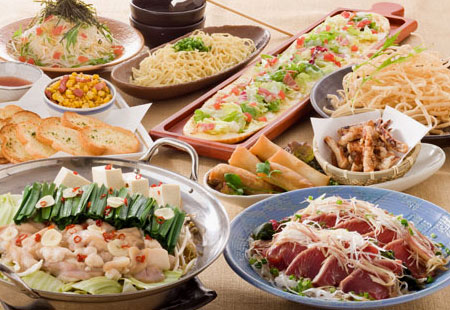
If you’ve never been to Japan, then you probably have not even heard if the izakaya, a Japanese establishment that a great number of people here will frequent, at some time or another. It’s virtually part of the culture; at some point or another, your group will want to eat out, and the izakaya will be a natural choice.

Izakaya (居酒屋, three characters which literally mean stay-liquor-shop) is loosely translated as a “pub,” but is a bit more than that. You don’t just drop by for a pint. It’s kind of a cross between a pub and a full-blown restaurant, being neither of them, nor exactly a cross between the two.

Izakaya-03An izakaya is a place where workers go after the daily grind has ended to socialize. It serves food, but in a communal fashion–small dishes are brought in for everyone to grab from. But drinking is the prevalent activity; this is a place to drink a lot of beer or sours, a category of Japanese spirits doused with fruit syrup to make the alcohol go down more easily. It’s a place where you relax and get down with friends and coworkers, loosening the normal inhibitions, allowing you to talk more openly. Not that most westerners have a problem with this, but it helps a good deal with Japanese sometimes. But mostly it’s a place to go eat and drink after work.

Have you guessed yet that I have been to an izakaya tonight and don’t have much else to talk about?

Nevertheless, these establishments are a solid part of Japanese culture that merit being discussed. Much more than the bar around the corner or the pub down the street, more than a tapas establishment, this is a place almost everybody goes to once in a while–it’s almost a prerequisite to continued residence in Japan.

Some izakaya are ripoffs–they string you out on dishes, taking their time to deliver each course, counting on you to buy more and more of their over-priced drinks while waiting for more food to come–this in the case where you pay for each round of drinks separately, in which case they want to maximize on the drinking while skimping on the food.

But a good izakaya will have a nomi-houdai (all-you-can-drink) course with a solid menu of foods delivered tasty and on time; that was the place we all went to tonight after work. We have visitors from home campus in Wisconsin and wanted to show them a good time. Additionally, we had that rare occasion of fourteen souls and not one dedicated smoker–and the izakaya we chose had a private room for us. In an izakaya, that’s a blessing–one of the worst things about such establishments is the lack of non-smoking areas, so you wind up coming home with clothes and hair smelling like an ashtray.Izakaya-02

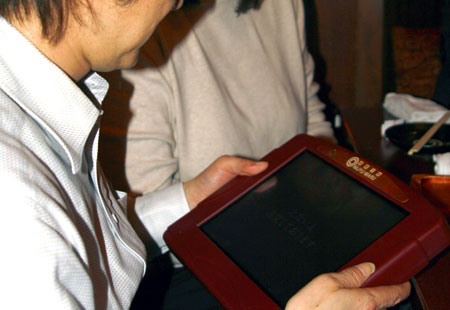
But tonight, we fared pretty well. We went to a joint that Sachi and I had visited a few times in Ikebukuro. When we went, we were taken aback at the prompt service; not enjoying an all-you-can-drink package, we expected the usual stringing-out of food dishes, and so ordered everything at once–and then it all arrived at once. Problem there. The next time, we ordered–using the handy wi-fi tablet menus–what we wanted and when we wanted it, and the food came fast, and well-prepared. A good place. I recommended it for our school dinner, and we were not disappointed. We got the ¥3000 ($29) per person set, which entitled us to two and a half hours of non-stop drinks, along with seven courses of pretty good food in sufficient quantity to satisfy everyone. A good deal.

In case you’re wondering, the place is Niju-maru, literally “two concentric circles,” which is their logo. Odd meaning for the name, but very good food and service.

Categories: Focus on Japan 2008 Tags:

Buggy

May 31st, 2008 5 comments

Sachi and I are getting really, really tired of the bugs. Ever since we’ve moved in, they’ve been around. When we started spraying them, they receded for a bit but never disappeared. Now, they’re back with a vengeance.

0508-Bugs 1

0508-Bugs 2

I don’t know the specific type of bug they are (maybe someone out there can help), but they are small, noiseless, gnat-like bugs. While a friend claims they come out of the drains (we’ve never noticed them around the drains), my own theory is that they came in with the potted plants. When you disturb the dirt, you can see bugs of various sizes (but mostly the same shape) crawling around in there, and there are quite a few of them buzzing around the plants. They’re attracted to moisture, too–when we leave out a damp cloth on the kitchen counter, they tend to zero in on it. So I think they are drawn to the moist soil of the plants, lay their eggs there, and reproduce in that way.

While they tend to buzz around the windows and other light sources, they also have the massively annoying habit of flying right up to your face every minute or so. I just killed one that buzzed my glasses a moment ago, and as I write, Sachi is using our dustbuster (it has a sealed dust compartment) to snap up the ones buzzing in her part of the room. But what is amazing to us right now is just the sheer number. Although you never see more than a few at a a time, there seems to be an endless supply. I smush about a dozen every hour around my computer station, and a trip to the balcony window every hour can lead to your catching a dozen or so. I must have killed 30 or 40 yesterday, and Sachi and I zapped twice that many today, easily–and still they keep coming. It can’t be from the outside, we’re too high up for that.

We spray bug poison in the plant dirt, and will be resorting to a bug bomb on Monday, but if anyone knows of a solution we can use, we’ll be happy to hear it!

Categories: Focus on Japan 2008, Ikebukuro Tags:

Free Pot at Narita!

May 27th, 2008 2 comments

A traveler arrived at Narita two days ago and left the airport with his bags 142 grams heavier than when he arrived. The officials at Narita kindly comped the visitor 5 ounces of marijuana, slipping it into his suitcase and leaving it there.

True story, though the intentions were different. A customs official put the marijuana into the bag as a real-world test for his pot-sniffing dog. The dog failed to find the cannabis, and the official failed to keep his eye on the bag. The customs people are not supposed to do this kind of thing–use actual travelers’ bags in exercises, that is (I’m fairly confident that they’re also not supposed to give away free pot).

This would be more funny if it weren’t for the fact that had this traveler continued on to a country in Asia where such baggage finds are not kindly looked upon, he or she could have been in deep, deep trouble.

The traveler apparently discovered the hashish and returned it to the airport officials. Only in Japan, eh?

Categories: Focus on Japan 2008 Tags:

Bit & Pieces, May 21, 2008

May 21st, 2008 1 comment

If you’re in the mood for sleaze, check out a political ad run by a Republican candidate (and incumbent) for Congress. Basically, it attacks the Democratic candidate’s “San Francisco values,” demonstrating that by having three slutty-looking swingers partying it up, bumping and grinding. I’ve lived in San Francisco and grew up in the area, and this doesn’t come any closer to representing the values of the area than a seedy strip club in Missouri represents theirs. But apparently, this passes for kosher in conservative Missouri politics.

I reflected on how people would react if, say, a Massachusetts liberal were to put out an ad representing rural/heartland values by showing gun-toting redneck hicks drinking beer and picking their noses in front of a pickup truck with a Confederate flag on the side. Such a politician would instantly be excoriated, blasted out of the water as an “elitist.”

What it comes down to is the fact that not just ads showing such “San Francisco” values, but pretty much all criticisms of the same sort–attacking either urban/coastal or liberal values as “elitist”–this is in fact the true “elitism.” The same people who claim that liberals are prancing around thinking they are better than everyone else are themselves the ones with the superiority complex; they think that their values are better than those of others. The values I remember from the San Francisco area were pretty much respectful of a wide variety of views and beliefs; it is an accepting, big-tent culture, with “tolerance” being a major theme. I don’t see much tolerance or acceptance among the brand of people who complain about “San Francisco values.”


A new study:
In the “first nationally representative survey of teachers concerning the teaching of evolution,” the authors show that one in eight high school biology teachers present creationism as a scientifically valid alternative to Darwinian evolution. While this number does not reflect public demand–38% of Americans would prefer that creationism to be taught instead of evolution–it does represent a disconnect between legal rulings, scientific consensus, and classroom education.

Before you think that one in eight is not bad, or even, “what’s wrong with introducing creationism alongside evolution,” consider that this is similar to one in eight Medical School teachers telling their students to consider prayer as a scientifically valid alternative to antibiotics. And then consider whether or not you’d want to be treated at the hospital staffed by graduates of those classes.


Finally! Rumors of the iPhone coming out in Japan. The carrier: NTT DoCoMo, as I predicted. Apparently, all the attention crashed the Apple Insider web site, which I could not access as of this time. However, the rumors only say that Apple is “close to signing deals” with the Japanese and Korean carriers, and has no specifics about when the iPhone will be available–and Japan is rather infamous for getting stuff late.


Uh oh. Conservatives are starting to talk about “character” again. I guess, after eight years, they must miss being able to use the word in public when referring to their candidate for president.


From Virginia:
A federal appeals court panel in Richmond, Va., on Tuesday struck down a Virginia law that made it a crime for doctors to perform what the law called “partial birth infanticide.”

Good. “Partial birth abortion,” a political (not medical) term in this case escalated to “infanticide,” is nothing more than a manufactured straw man intended to stand in for abortion in general. The idea is to vilify the entire practice by choosing the least-commonly practiced (less than one-fifth of one percent of all abortions) but most-easily vilified form of abortion, and making a campaign of it, completely ignoring the medicine or the ethics involved in the process.


Ewww. An off-duty Japanese railway worker was arrested for forcibly kissing a woman on a train right here in Ikebukuro. Reportedly, he was so drunk that he doesn’t remember what happened, which only makes the image worse. Imagine that guy sticking his tongue down your throat–or your wife’s. From the article:
His employer was apologetic about the incident. “We’re sorry about the case. We’ll improve our guidance of employees,” said a spokesman for Seibu Railway.

Yeah. Be sure to give those employee seminars about not to get completely smashed and sexually assault women. That oughta do it. I mean, such “guidance” is stupid: any employee who doesn’t know better shouldn’t be working there in the first place.

No word in the article about whether or not the guy would be fired.

Those Japanese Policemen Are Pretty Darn Smart

May 12th, 2008 1 comment

In Nagoya today, a man was arrested after dousing himself with kerosene. The police kept asking him to change out of his clothes, but he refused. The police didn’t seem capable of getting rid of the kerosene by either removing his clothing by coercion or force, or by shoving him into a shower and washing the stuff off of him.

Instead, they gave him cigarettes and a lighter.

Oh, I’m sorry, I misreported that. According to the news source, the man, who was being held in police custody, somehow “gained access to a lighter.”

Surprisingly, the man caught on fire.

Who could have seen that coming?

Quakes

May 9th, 2008 1 comment

We just felt another one. This was somewhat closer, a 4.5 magnitude quake just north of Chiba City, not far from the eastern Tokyo border.

Meanwhile, quakes continue to rock the same fault off the coast of Honshu that produced the larger quakes yesterday early morning. The USGS reports twenty quakes over 4 in that area, including a 4.9 just an hour ago.

Sites to monitor quake activity:

http://www.tenki.jp/qua/index.html
http://www.hinet.bosai.go.jp/
http://earthquake.usgs.gov/eqcenter/recenteqsww/Maps/10/140_35_eqs.php

Update: we didn’t feel it, but a 5.6 just hit the active area off the coast.

Categories: Focus on Japan 2008 Tags:

Felt THAT One

May 8th, 2008 5 comments

I just felt a quake here (at 1:02 am), which in Ikebukuro above the 20th floor, seemed fairly strong; it was one of those long, swaying types that usually indicates a stronger earthquake some distance away. Sure enough, the quake was some distance off the east coast of Japan, magnitude 6.3. they say there’s no tsunami threat.

The interesting thing is, there seem to have been about half a dozen medium-to-large quakes in roughly the same area over the last 12 hours:

2:39 pm, (5/7/08) M 4.5
6:59 pm, M 4.9
7:50 pm, M 4.6
12:25 am (5/8/08), M 4.6
1:02 am, M 6.3
1:10 am, M 4.2

Damn, there’s another one, feels even bigger than before, but is showing as 5.6:

1:18 am, M 5.6 (correction: M 6.2)

That last one was very shallow, only 100 meters (?) below the surface, again off the east coast in the same area as the others. This is starting to get me worried that it’s building up to something bigger. But it’s really having an effect–it started three minutes ago, and my building is swaying more than before!

Seriously, this is getting creepy.

Update: More quakes registered, though I didn’t feel them:

1:25 am, M 4.1

Plus a few in Tohoku, northern Honshu, under 4.0

Update 2: OK, THAT WAS BIG! A 7.2-magnitude quake, again off the Chiba coast. The place is really rocking now! Woke poor Sachi up. Doors knocked, building creaked. Even felt some up-and-down action at the start.

The TV is saying it was only 6.7, hitting at 1:45 am. The building here is just finishing its rocking, six minutes later. Wow.

Are we finished yet?

Categories: Focus on Japan 2008 Tags:

Climbing Takao, Part II

May 6th, 2008 2 comments

So, Sachi and I climbed Takao-san a few days ago, like I said. We are still recovering; Sachi mentioned that we look like penguins, waddling around because our calves ache so much. We really don’t do this quite so much, and weren’t physically prepared. I mean, I exercise regularly nowadays, but that wasn’t quite enough.

Coming down the mountain that day, it was painful exactly as I expected: my knees hurt like hell, though fortunately they really went out only at the very end, and only when stepping downwards. Sachi’s knees hurt also, but not as much as mine–mine have been bad that way since I was in high school. It was excruciating every time we encountered another set of steps at the end. But we heard a lot of people complaining of similar joint pain. But we didn’t expect the next-day calf pain (maybe next-week calf pain–it’s been two days and it’s not getting better) to be quite as harsh as it is.

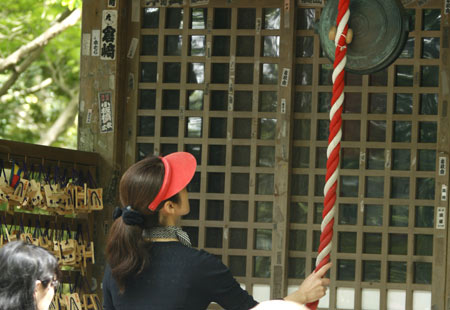
And that’s despite Sachi praying at a temple along the ascent which, appropriately enough, is a special one for foot and leg pain sufferers. But maybe that’s because Sachi just prayed for our mothers, who have leg ailments all the time, and certainly need more help with that than we do….

0508-Takao-Temple

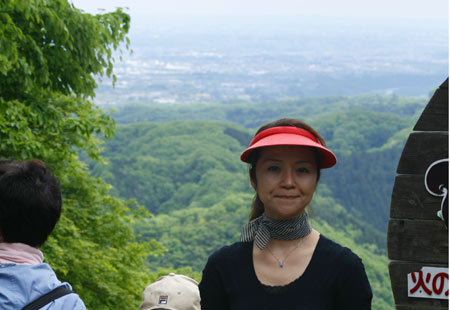
In any case, we continued up the mountain, posing for pictures every now and then.

0508-Takao-Sachi01

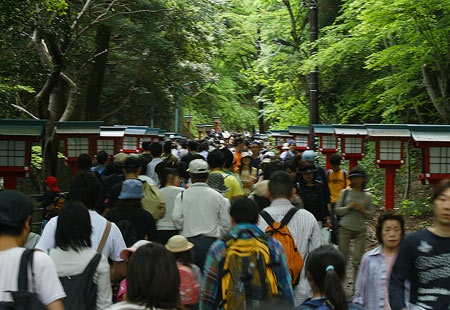
The main trail was crowded right up to the top, and most of the way was fully artificial–cement stairways, paved roads, etc. This segment here was lined with wooden planks commemorating people who made donations to the local shrine. The second shows a nearby path lined with lanterns, each wired up for electricity (electric power lines traced the entire route).

0508-Takao-Crowd03

0508-Takao-Crowd04

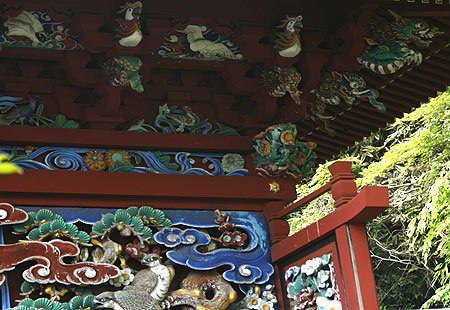
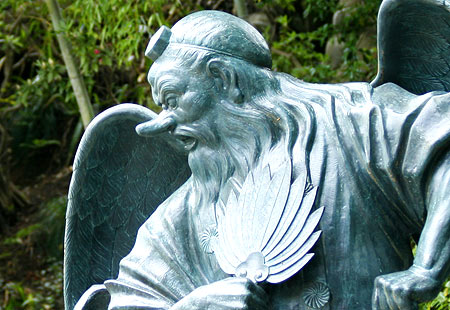
Not that the shrines and temples weren’t pretty to look at:

0508-Takao-Temple Detail

0508-Takao-Tengu Statue

And, of course, more views of the cities below. This was a nice shot of the city below, the kind of shot that has nothing but buildings in view. To get a bigger version with a lot more detail, click on the image.

0508-Takao-Cityview

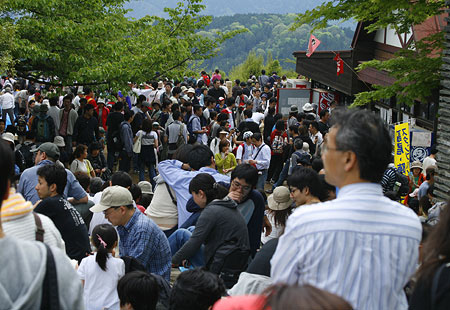
And then, finally, we got to the peak–which looked like a crowded city square.

0508-Takao-Peak

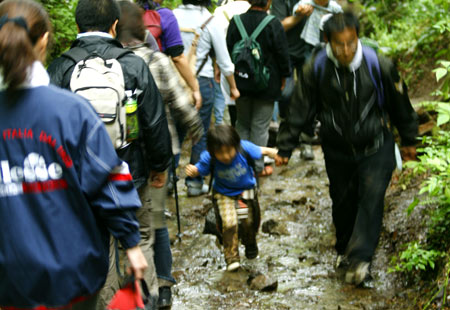
We decided to take an alternate trail down, but soon encountered a problem: the shorter, more nature-oriented path had a long segment which was essentially stepping stones along a small stream. And probably because of the less physically-able climbers, the path was a single-file traffic jam, moving painfully slowly.

0508-Takao-Trail01

We kept hearing these sharp yelps from somewhere down the trail, and after a bit, found out what they were: someone had brought their Dachshund up the trail, and the poor thing just wasn’t built for this kind of path. As they passed us, they were carrying the poor thing, but it was half-wet and still occasionally yelping.

The people coming up were less numerous, and so were forced to take the non-stepping-stone side of the path left by the crowd waiting to progress down; the people going up had wet and muddy shoes and socks.

0508-Takao-Trail02

After a while of this, with no end to the traffic jam in sight, we decided to take a branch course at a junction, despite the other course being longer; it was supposed to take 20 minutes more than the original path, but we figured that without the traffic jam, we’d save a lot more time in the end.

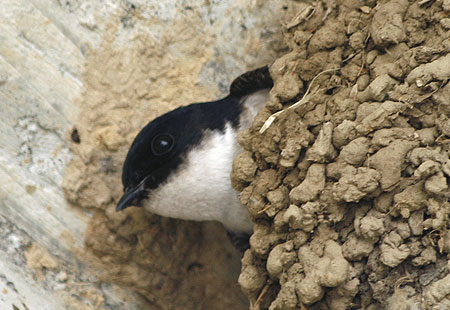
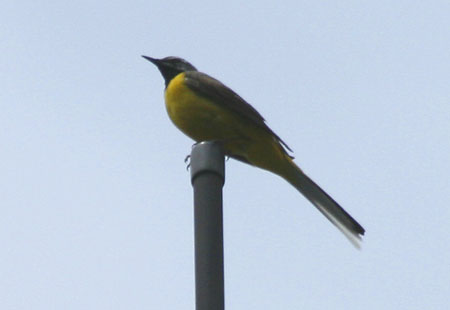
I had hoped to do quite a bit of birdwatching, and indeed, there were tons of birds. The problem: almost none were visible. We must have heard birdsong from maybe twenty different species, but we only saw four or five, including the Asian House Martin, Gray Wagtail, and Varied Tit, as pictured below.

0508-Takao-Asian House Martin01

0508-Takao-Asian House Martin02

0508-Takao-Kisekirei

0508-Takao-Yamagara

All pretty birds, but not all that unusual. The rest were adept at hiding out of view, likely in or atop the greenery of the forest canopy. Maybe a professional birder could have helped us spot some, but I’m just an amateur. Ah well.

I will close with a few more images of Sachi and myself on the trail. For all the resultant muscle and joint pain, it was still a very nice hike.

0508-Takao-Me

0508-Takao-Sachi

Climbing Takao

May 5th, 2008 7 comments

You can always climb Mt. Fuji (I have three times, but probably won’t again), but in Tokyo, the most popular mountain to climb is Mt. Takao, on the western outskirts of Tokyo prefecture, just beyond Hachioji. Takao-san-guchi Station is the last stop on the Keio Line, and drops you off not far from the cable car and chair lifts which can take you half way up the mountain.

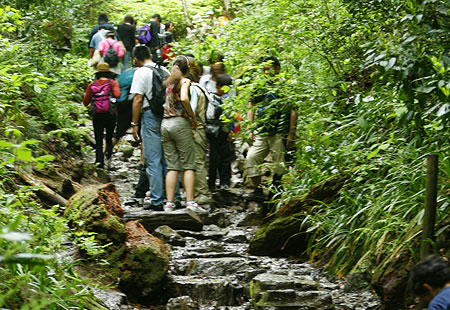
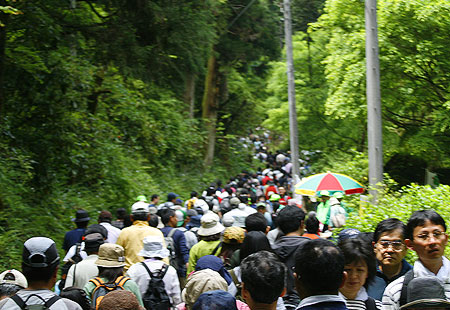
However, if you are expecting a nature hike, understand that the exposure to nature is a bit limited by the fact that you are crowded by the thousands of other climbers on the trails. Mt. Takao is almost more of a tourist exhibit than it is a mountain hike–at least on the main trail, which nearly everyone takes. Sachi and I didn’t know about the other trails when we arrived, otherwise we probably would have tried one. The main trail was jam packed, mostly because it’s Golden Week, I presume.

0508-Takao-Crowd01

0508-Takao-Crowd02

Fuji is the same way–the crowding slows the hike down to a crawl sometimes. For Takao, I’d suggest trying the other trails. They lack the tourist shops and the other attractions, but it’s a lot less crowded and a lot more like nature hiking.

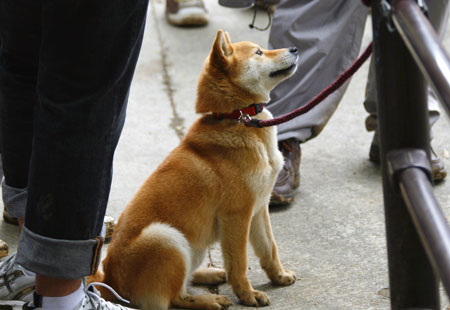
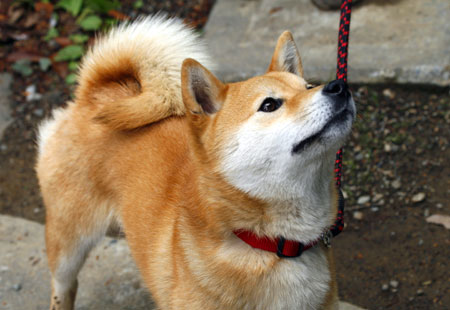
On the main trail, we noticed quite a few people bringing their dogs. Sachi loves Shiba Inus, so whenever we see one it’s time to stop and make friends.

0508-Takao-Shiba01

0508-Takao-Shiba02

0508-Takao-Shiba03

That last one has a larger version when clicked. They are beautiful dogs; we’re getting one as soon as we find a place where we can have one–our current place doesn’t allow pets.

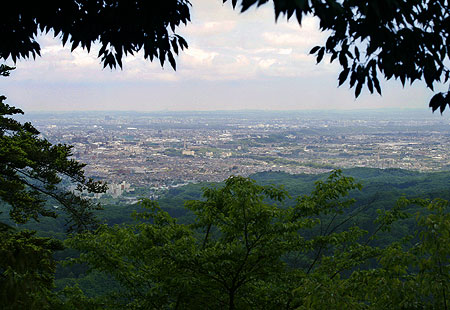
The walk up the mountain does have some spectacular views, which these photos don’t do justice to.

0508-Takao-View01

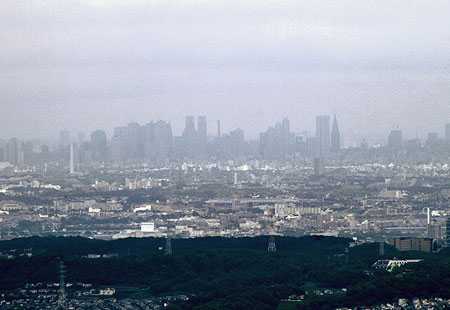
If the weather is clear enough, you can see Shinjuku (below) or Yokohama on the horizon.

0508-Takao-View02

Here’s a stitched-together panorama, with a larger version (2200 pixels wide) when clicked:

0508-Takao-Panorama-550

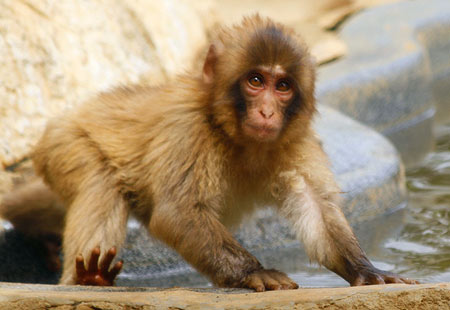
Sachi and I walked up the whole way, as (1) taking the tram up is cheating, and (2) there was an hour-long wait. Just past the top of the tram lines is a nature garden, which, most importantly, features monkeys. There are signs all along the pathway suggesting that wild monkeys can be observed, but either it’s a fake-out to get you to look, or they must not like the crowds. But pay 400 yen and you can get to see a whole bunch in a zoo-like setting.

0508-Takao-Saru01

0508-Takao-Saru02

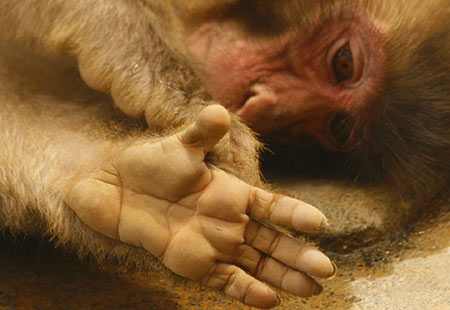
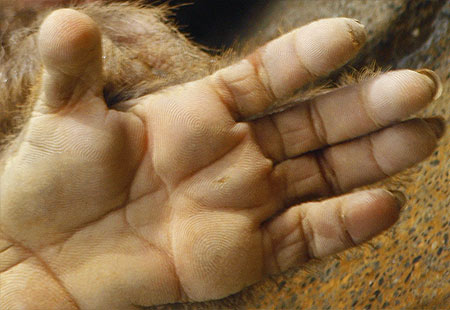
They are fascinating creatures, even these Macaques, for their resemblances to humans in some ways–close enough but still alien enough to be engrossing. Here’s one picking at stuff on the back of its hand, allowing us to see it’s palm; note on the close-up the ridges and valleys of palm- and fingerprints.

0508-Takao-Saru-Hand

0508-Takao-Saru-Hand-Cu

Also in the garden were a lot of flowers, trees, and other plants; this one below (larger version on click) I thought exotic and beautiful, a stunning feature of the garden–until I noticed a whole bunch of them in front of our apartment building this morning, I had just never noticed them.

0508-Takao-Blossom01

This blossom is a lot less attractive; Sachi noted it’s resemblance to a certain body part, which I will not repeat here.

0508-Takao-Blossom02

Enough for tonight. I’ll finish up with the other photos tomorrow.

A Day in Japan

May 2nd, 2008 1 comment

It’s all over the Japanese news today:

A local council employee in Japan has been punished after it was discovered he had accessed porn websites at work more than 780,000 times in nine months.

This is one of those stories that you just go, “Wow, what a perv” over. But something is fishy here: This guy would have had to do nothing but click on porn sites continuously for nine months in order to rack up the numbers they’re claiming. For the 177,000 hits in July, assuming an 8-hour workday, he would have had to open a new porn web site once every three seconds, non-stop, full-time. While this is not impossible, it is highly improbable, to the point where I cannot accept the clearly-implied conclusion.

My boss is dealing with malware on his computer which is automatically taking him to all kinds of spam and porn sites, and if you’re using IE6 with factory settings, then it is likely that closing one window will result in a large number more opening up. The windows open very quickly like this, and even if you hold down the shortcut keys nearly continuously, the right spam script will keep opening them up just as quick if not quicker. It’s quite something to witness, in fact.

What I can imagine is that this guy had such a malware infestation, which his anti-virus software missed and allowed to stay, and the guy, bored out of his gourd with meaningless make-work, spent maybe a half hour each day just playing IE6 Porn Pachinko, watching the windows open and close, maybe even making a game of it. Certainly not productive, but I’ll bet that he didn’t get any less work done relative to what was expected, or perhaps performed by his colleagues.

Surely the media is having fun with this, but there is no mention of any evidence other than the web hits for July and for the 9-month period, and the penalty (a demotion and a $200/mo. pay cut); everything else is pure conjecture. One can only guess that the papers figure this is attractive copy and everyone can have a laugh at his expense.


One way you can tell a news story is brewing is if helicopters start to circle, like buzzards in the desert. As I exercised this morning, I first noticed the buzz over the music from my iPod, and then saw the helicopters, two or three of them, circling Ikebukuro Station. On the way to work, with little time to spare for distractions, I took a side route which bypassed the station so any potential traffic jam wouldn’t slow me down.

And sure enough, the story was there in the news tonight:

Bus plows into pedestrians on sidewalk at Ikebukuro Station

A bus ran onto a sidewalk at Ikebukuro Station in downtown Tokyo on Friday afternoon, slightly injuring three pedestrians, police said.

None of them were hurt badly. I am sure the cameramen on the helicopters were disappointed, despite circling over the area for more than half an hour.


The reason I had no time to spare was that I had to go in to work, grab the boss’s computer, and along with my own, take it down to the Ginza. Not newsworthy, but worthy of pointing out: I love the Genius Bar feature at the Apple Store. Made an appointment last night in less than a minute, and walked in to the store, and saw a tech support person within a few minutes. Less than half an hour later, both computers were fixed. The problem with both: dead batteries. My boss’s had been dead for some time, he just never got around to changing it. The school picked up the tab for that one.

My own computer’s battery had gone from normally functioning to nearly dead within just a few weeks; leave it unplugged for five minutes, and suddenly the power goes out and the thing shuts down–and when I restarted, I had to always reset the clock, re-certify my email domains, and re-input all the passwords. Several times that happened when the power connected came lose when slightly jarred.

That they replaced–free of charge. Apparently, it is a symptom of recalled batteries. My original battery had worked fine for a year, then I got it swapped with a new one when a recall was announced; that worked fine until just a few weeks ago, and now I have another new free battery. Cool.

But the nice thing is having the option of going to the Genius Bar. It was not wholly clear that the problem with either computer was a bad battery–it could have been a power supply issue or something, and ordering new $150 batteries would have been risky. Calling tech support would have entailed the support person spending an hour running me through pointless tests, and then insisting I wipe the hard drive and re-install the entire system before they did anything. Not having the Genius Bar would mean shipping the computer off and not having it for a week or more.

But with the Genius Bar, it was a short, 1-hour jaunt to the Ginza, and access to free goodies that usually come with the personalized service. Had I asked them to replace the “a” and “s” keys on my keyboard–they’re getting pretty worn after three years–I am sure I could have gotten it. They replaced my command key cap last time I went.


I always regret not lugging my camera around with me. I would just buy a cheap 3- or 5-megapixel camera, except I expect there’ll be one in the iPhone I expect to buy in July (if my read of DoCoMo’s new mobile make-over is correct). But because I didn’t have a camera with me today, I didn’t get a photo of a Chinese restaurant near Shinjuku Gyoen-mae Station, named:
Chin Goo

I’ll get it next time.

Oh, wait, I forgot that someone must have photographed it and put it up on the web already; here it is via Google Image Search. Not a great photo, though, I’ll still snap my own sometime soon.

Categories: Focus on Japan 2008 Tags:

Olympic Flame War

April 26th, 2008 4 comments

Sachi and I are watching Japanese TV and a live picture of the Olympic torch run through Nagano. While there are some pro-Chinese groups, there is a very large pro-Tibet contingent in the crowd. People are throwing stuff at the torch bearers (the security includes runners with clear plastic panels to deflect projectiles), and at least a few people have tried to rush the runner. Unlike in European cases, the Japanese police are pretty good at riot control, and are successfully keeping the more active protesters from stopping the run. Japan Probe showed a preview of what the security would look like, and it was pretty accurate.
Categories: Focus on Japan 2008 Tags:

Opening Ceremony

April 22nd, 2008 6 comments

Today was one of our ceremony days. I don’t usually blog much directly about my school, but I figure it might not be a bad idea to start. In the next few weeks, as we welcome the several hundred new students, move into a new building, and start several other new projects, this is probably a good time for me to give some blog time for introducing the college where I teach.

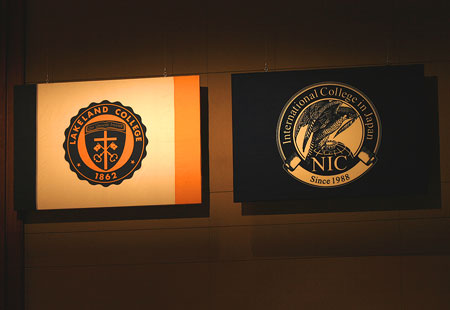
Today’s ceremony is a big gala bash kind of thing that we have every year to welcome the new crop of students to the school. Both my institution, Lakeland College Japan, and our local administrative affiliate, NIC, hold a common welcoming event.

2008-Oc01-Flags

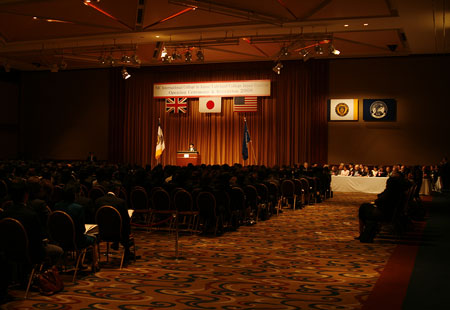
As usual, the party is held at the ANA hotel in Akasaka, near Tameike Sanno and Roppongi (our graduation ceremonies, in contrast, are held at the Century Hyatt in Shinjuku). With all the students, faculty, staff, parents, and special guests, it fills up a pretty large room.

2008-Oc03-Auditorium

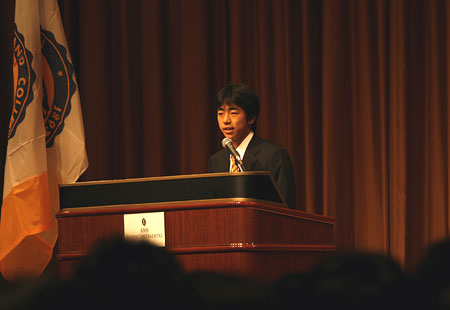
The first two hours of the ceremony are a bit, let’s say, “official”–it is a series of speeches, either in Japanese, or in English with translation. The directors of the NIC, the Vice President of our college, two visiting scholars, two student representatives, and two guest speakers (one a U.S. embassy official, the other a doctor and professor, author of a book on health) each give a speech. You see the two student representatives below, but the longest speech–more than a half-hour–was given by the author/doctor, and most of us in the faculty on the sidelines couldn’t follow a bit of it.

2008-Oc02-Speech1

2008-Oc04-Speech2

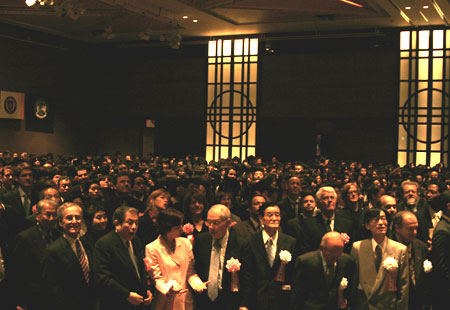
After that, we gather for a huge group shot–this image is a bit washed out because the flash didn’t take on this shot and I didn’t get another chance before we were shooed together for the official shot–but I wanted to include it to give you an idea of the sea of people it formed.

2008-Oc05-Group

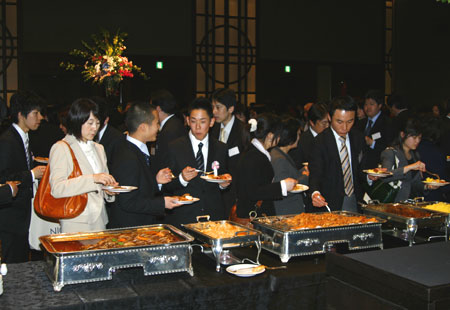
And then the real party started, lasting about four hours. It began with a toast and a buffet lunch–and if you’ve never had a buffet spread at a Japanese hotel event, you’re missing out on a delicious if high-caloric feast… if you’re fast enough to get your share before the food runs out. More than a dozen entrees, all of them very good. I get this four times a year at our various events.

2008-Oc18-Buffet

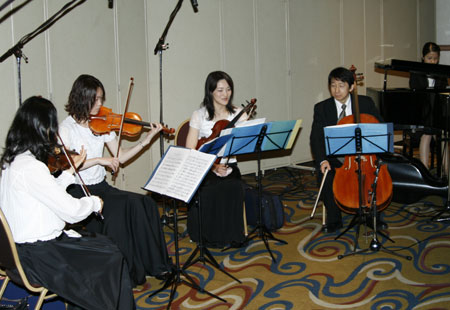
The opening ceremony always has class, including this string quartet (accompanied by piano in this shot) serving as a nice background for the dining.

2008-Oc06-Quartet

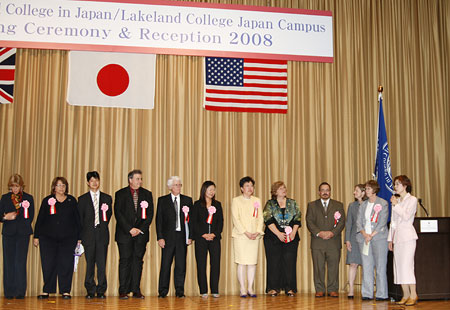
A little more official business–in this case, an introduction of the two or three dozen visiting representatives from consortium schools in the U.S. and U.K. (more on that in a future post).

2008-Oc07-Intro

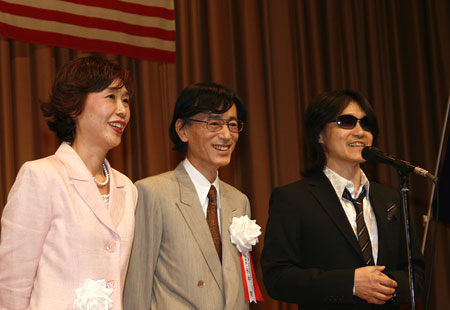
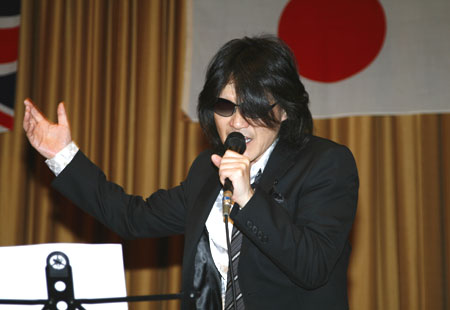
Then came the highlight of the evening: an occasional guest at the opening ceremonies is Toshi, of X Japan fame. X Japan was a very big rock band in the 90’s, and Toshi was a co-founder. The band has recently re-grouped and sold out three Tokyo Dome concerts a few weeks ago. Toshi became a fan of one of NIC’s directors, Hiroko “Zukie” Hirota, after his wife read Zukie’s book and introduced them; he frequently sings at events Zukie organizes.

2008-Oc08-Toshi1

2008-Oc09-Toshi2

After treating us to a song, Toshi showed incredible charm and patience in agreeing to take a group photo on the stage with the students who cared to join in–and was swamped in a rush of 18-year-old fans to the stage.

2008-Oc10-Toshi3

After that came student performances; first was a cheerleading squad, which I happened to catch in an apparent defiance of gravity:

2008-Oc11-Cheer

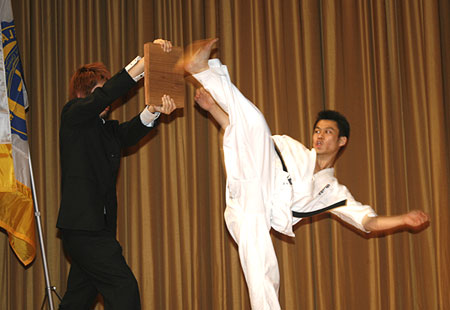
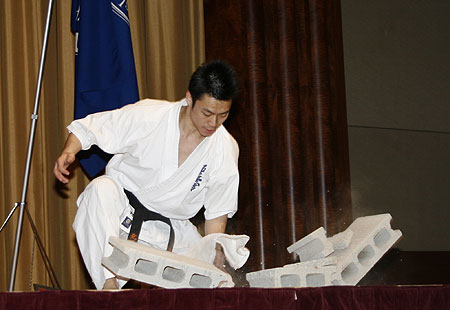
Then a karate demonstration. While breaking the boards never impressed me as they get broken along natural striations in the wood, this guy broke a wooden baseball bat with his foot and a concrete block with his hand. His first attempt that the cinder block didn’t work and you could hear the thunk and see it was not a styrofoam stand-in. Even our librarian, a martial arts practitioner, was very impressed with the guy.

2008-Oc12-Karate1

2008-Oc13-Karate2

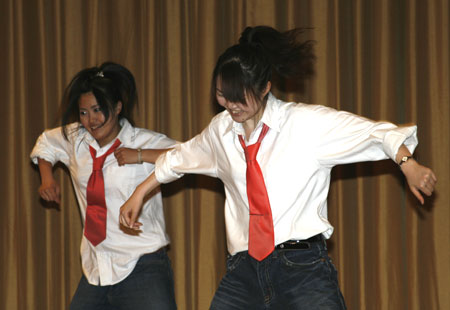
Then came a dance group, two members of which are shown going at it here:

2008-Oc14-Dance

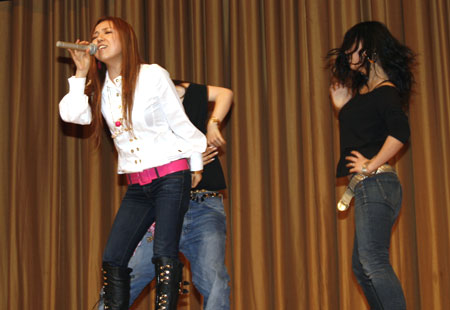
And then another celebrity (a future one, at least), this time one of our own–Hiromi was a student with us six years ago, and releases her first CD soon. (Here’s her blog, where she posted already on today’s event, and on meeting Toshi.)

2008-Oc16-Hiromi2

2008-Oc15-Hiromi1

The evening ended with a few more performances, and then a san-san-nana byoushi clap. I don’t fully understand it yet actually–it seems to be half-cheer, half-good luck tradition. Everyone claps in unison: three sets of three claps followed by a single clap, repeated three times. The father of a former student led everyone, and then we wrapped.

2008-Oc17-337Byoushi

Quite a party, all in all. Welcome, students! And more on my school soon.

Categories: Focus on Japan 2008 Tags:

Right-wingers Behaving Badly, Asian Edition

April 20th, 2008 7 comments

China’s pissed:

“Reaction [in China to protests in Japan] would be huge in comparison to the reaction against protests in France,” in which Web sites called for a boycott of French products sold at Carrefour stores, an international issue expert said, pointing out that negative feelings toward Japan remain strong in China due to historical issues.

A man in his 30s who runs a Web site that is popular with many Chinese “patriots,” told The Yomiuri Shimbun, “Chinese people won’t forgive [Japan] if the Japanese do the same things as the Americans and Europeans, such as making distorted reports about the Tibet issue.”

Well, China asked for it, and now they’ve got it. Seriously, did they expect that they could hold a summer Olympics and not have Tibet take the opportunity of a world spotlight to rebel? And when scattered protests break out in various nations, do they really think that threatening other countries is the way to make things better?

As for Japan, I bet they must really be scared at the threat this guy is making. Because, after all, Japan is so used to and dependent upon China forgiving it. Haven’t the Chinese been just the picture of forgiveness? Not that Japan hasn’t gone the full distance in asking for it, but China has come even less close to giving it.

If nothing else, these Olympics will serve an important purpose: to demonstrate that China is not ready to be an internationally respected leader of any global interest. Hell, they might even outdo the Bush administration.


But then again, Japanese right-wing extremists have been behaving badly themselves:
At a special preview of “Yasukuni” demanded by rightwing groups, some of the 150 members criticized the controversial, but award-winning, documentary about the so-named Tokyo war shrine and even threatened to sue the state for subsidizing part of its production. Rightwing groups arranged the preview so their members could have an opportunity to watch the film before passing judgment on it. Lawmakers demanded and got an earlier preview. …

One in the audience suggested he and his like-minded colleagues should sue the agency and the state, demanding the return of the film’s subsidy. Another said the movie should not be shown in Japan because it would give the impression that the war Japan waged was an act of aggression. “This is no good,” he said. “I absolutely do not want this movie to be screened.”

Mitsuhiro Kimura, one of the preview’s organizers and the president of Issui-kai, a rightist group, “I would like to produce a pro-Yasukuni movie with about ¥15 million” in agency subsidies.

My first reaction is, “right-wing extremists can force the government to give them a special screening so they can trash the film?” How did that happen? Lawmakers getting a screening I can understand, but the extremists? What official say do they have in this?

Of course, the rightists are extremely vocal about such things, and people on the other side tend to shut up, especially when the rightists threaten them with loud, hostile protests and even violence. These extremists have something of a hold over social commentary in Japan, often getting their message out in a louder and more aggressive fashion–and they are not shy about intimidating others.

An interesting contrast would be the 1995 Smithsonian exhibit of the Enola Gay fuselage. When text for the exhibit was released and it seemed to show sympathy for the Japanese victims of the bomb, American veterans and right-wing groups protested that the text was an “attack on America’s conduct in the war,” and successfully got the Smithsonian to tone down the message to a minimalist description. Historians then objected right back–but they did not have the clout that the right-wingers did. Conservatives controlled Congress at the time, and started threatening the Smithsonian with budget cuts and investigations. Intimidation of a different sort, but still intimidation.

And, oh yes–Japan protested as well, as they did with a similar Enola Gay exhibit in 2003. Hmm. Someone want to remind them of this in light of the Yasukuni protest?

It’s not as if Japanese cinema doesn’t get its share of right-wing sops; from heavily anti-American documentaries on the Tokyo Tribunals to a right-wing revisionist love letter for Hideki Tojo, Japanese cinema has without doubt leaned toward right-wingers’ view of history. Even Akira Kurosawa, long neglected by Japanese viewers, enjoyed a popular comeback when he produced a film about Nagasaki which featured Richard Gere delivering a heartfelt apology from America to Japan.

But films which portray the other side of things tend to get this kind of reception in Japan. Not to say that this doesn’t happen elsewhere, but at least in debates on such subjects in the U.S., both sides tend to get heard. Right now, there is some doubt that this movie on Yasukuni will even see the light of a public film projector.

The Anti-Walmart

April 16th, 2008 1 comment

How could anyone resist this sales pitch?

0408-Bike King-1

This is the outside of a used motorcycle shop in Ikebukuro.

0408-Bike King-2

Actually, it refers to prices they offer to buy bikes, so in fact, it makes sense. But unless you know what the shop does, the sign looks like a huge mistake.

Categories: Focus on Japan 2008 Tags:

Bits & Pieces, April 15, 2008

April 15th, 2008 1 comment

In Akita Prefecture, Japan, there is a measure coming before the legislature to ban door-to-door sales to minors and the elderly. Naturally, several categories of businesses (financial, insurance, and retail, according to the report–I’m surprised that newspapers were not mentioned here, as they do tons of door-to-door sales) are whining, saying that this will ruin their businesses. All I have to say is, if these businesses cannot function without conning people of limited capacity into buying their product, then they deserve to fail. Me, I’m waiting for them to go all the way and give “no solicitors” signs the force of law. Oh, wait, they’re doing that too!

The ordinance will also ban door-to-door sales of financial products in which the principal is not guaranteed, including investment trusts, stocks and variable pension insurance, for all people.

Under a proposed registration system, sales people will be banned from visiting homes of consumers who have registered with the prefectural government as people who do not want sales staff to visit. The registered consumers can also display a sign at their homes to keep away sales people.

Yayy! I wonder what real estate prices are like in Akita? Better yet, how about Tokyo legislators getting off their butts? Next: start punishing people who fill your mailbox with ads. Meanwhile, they can similarly outlaw NHK collectors, now that the politicians are calling for NHK to drop all pretenses and become an official propaganda arm for the ruling party. Yeah, I’d love to be forced to fund that, thanks.

(Hat tip to f*cked gaijin)


“Liberal” (turncoat) Joe Lieberman wonders aloud (on Fox Noise) if Obama is a Marxist. Um, yeah, right.

Bonus: Andrew Sullivan points out that in 2006, Lieberman loved Obama, inviting Obama to speak for him in Connecticut. Obama held no different stands then relative to now, so apparently Lieberman loves Marxists. Er, potential Marxists.


John McCain, playing up his imprisonment and torture on the campaign trail, also had this to say:
We cannot ever, in my view, torture any American, that includes waterboarding.

Apparently, everyone else in the world is fair game.

Obama, meanwhile, says this:

We have to be clear and unequivocal. We do not torture, period. … Our government does not torture. That should be our position. That will be my position as president. That includes, by the way, renditions. We don’t farm out torture. We don’t subcontract torture.

I’m glad that McCain’s impressive foreign relations credentials have not turned him into a wishy-washy hypocrite.


Wow. They’re calling it “Bittergate.” Also a “huge political firestorm.” Certainly, Obama suggesting that Pennsylvanians are bitter is not nearly as newsworthy as John McCain violating campaign finance laws that carry a five-year prison sentence, or revelations that the Bush administration approved the crushing of children’s testicles at the highest levels. Yeah, calling Pennsylvanians “bitter” was way out of line, and I can easily see such a huge gaffe wiping those other stories clear off the media’s radar altogether.

Meanwhile, in Pennsylvania, they tend to agree with Obama:

As a native-born, small-town Pennsylvanian, a son of native-born, small-town Pennsylvania parents – one from the coal region, one from Lancaster County – let me assure you that the so-called offensive, condescending things Barack Obama said about the people I come from are basically right on target.

“Bitter” perhaps best describes my late mother, an angry Irish Catholic who absolutely clung to her religion.

Dad, also a journalist, wasn’t really bitter as far as I know, but he sure liked to hunt.

So, despite carping from Hillary Clinton and annoying yapping from her surrogates (really, it’s like turning on the lights at night in a puppy farm), I take no offense.

What’s offensive to me is suggesting that small-town, working-class, gun-toting and/or religious Pennsylvanians are somehow injured by a politician’s words.

Are you kidding me?

Indeed.

No, We Can’t!

April 9th, 2008 3 comments

Obama would be disappointed:

Cannot Change-1A

Cannot Change-2

This was taken at a pastry shop I always pass when I visit my doctor’s office. In case it isn’t apparent, this is supposed to be a sign stating that the cashier can’t make change without a purchase. Funny thing is, you see these signs a lot in Japan. For some strange reason, most are bilingual, though most other signs in supermarkets (except those for style or display) are not–I guess they must get a lot of foreigners asking for change or something. But the weird thing is, I don’t think that I have ever seen a sign stating a no-change policy at a cash register in Japan that was worded correctly. Every such sign I have seen has English which is wrong in some fashion–most often the noun-verb confusion seen here.