Archive

Archive for the ‘Focus on Japan’ Category

Turnabout

November 2nd, 2007 6 comments

Paul Tibbets, the man who piloted the plane that dropped the atomic bomb on Hiroshima, died at age 92 today. There has always been controversy surrounding this, something that I have covered on this blog before. Extremists on both sides see it in black-and-white. On one side, Tibbets was a man who at the very least killed tens of thousands of people. On the other side, he was a hero who helped stop a murderous dictatorship and made unnecessary the deaths of hundreds of thousands of soldiers and millions of Japanese troops and civilians.

The thing is, as I figure it, the man was a pilot sent on a mission to drop ordnance. I just don’t see Tibbets himself as being that central to the issue. You might as well make a big deal over the man who drove Kennedy’s limo when he was shot, or the captain of the ship that brought missiles to Cuba. These people did not decide anything, they were not vital or irreplaceable. Tibbets was not much more than a lightning rod for a military decision made by the president of the United States.

That said, one thing did cross my mind in all this. Let’s say that Tibbets is buried at Arlington. What would Japan’s reaction be if Bush and several successive U.S. presidents made official visits each year to his grave site? It would be interesting to see what Japanese officials would make of such a spectacle.

Categories: Focus on Japan 2007 Tags:

Parade Route

October 30th, 2007 1 comment

I’m beginning to think that Meiji Boulevard, one of the major inner-city traffic arteries, is an official parade route. A few weeks ago, at 7:00 pm–typically a rush time–some major festival occupied half the entire boulevard for at least a two-mile stretch. One would think that a matsuri, which after all depends on foot traffic, could survive on smaller streets instead of completely stopping traffic on major thoroughfares.

Tonight there was another one. At school, we could faintly hear chanting and singing pass by. A half hour later, on my way home, I encountered the cause: a parade, again taking up half of Meiji Boulevard, again at 7:00, causing a major traffic snarl. This parade was complete with a marching band and huge flag banners, and by that time, had traffic snarled up for a good mile behind it. While waiting for a large part of the procession to cross the street at an intersection where traffic lights were diverted for the parade’s passing, another biker told me that it was probably Waseda University celebrating some baseball victory. Swell–thanks Waseda, we are overjoyed with your victory and your decision to celebrate it by causing a major traffic jam.

My question is, why don’t the police–who in both cases were present in large numbers for crowd and traffic control–make these people celebrate in a place that cause far less disruption? And why do revelers want to tie up the only viable route of traffic in an area for thousands of people during rush hour? Especially for the baseball parade, which was not like a normal parade where people expect it and line the sides of the street to enjoy (a planned event for the benefit of the townspeople, with traffic warned and effectively diverted around it); it was instead, essentially, the celebrators by themselves, strutting down Main Street for their own pleasure. No warning, no signs suggesting detour, no reason for drivers to seek out side streets or back roads before they get mired in the traffic jam. Lovely.

Categories: Focus on Japan 2007 Tags:

Nova Files for Bankruptcy

October 28th, 2007 11 comments

I was pretty busy editing together the opening video for my college’s Arts Day Festival, so I didn’t catch the news right away: with something like ¥44 billion (about $385 million) of debt, Nova has filed for bankruptcy. It’s stock has plummeted to 12 yen per share, and trading on it has been suspended; the stock is set to be delisted from JASDAQ. Saruhashi failed to show up to an emergency board meeting and was dismissed. The branches are all closed and all employees are effectively out of work.

From Japan Probe:

Nova schools across Japan have closed their doors, and it is not clear when or if they will re-open in the future. Nova’s official website has been taken down and replaced with a notice in Japanese that announces the bankruptcy and includes a Q&A telling students that they cannot get refunds now because all Nova’s assets are now under protection of the courts. Teacher and staff wages have also been delayed indefinitely.

Japan Probe is also the source of this rather black-humoresque depiction of the Nova Bunny:

Nova-Bankrupt

What is decidedly not funny is the fact that about 4,000 foreign English teachers unlucky enough to have gotten on board with Nova are now up the proverbial creek without a paddle. Some are receiving help from their embassies, but most are getting little more than advice and offers to help contact family members. Qantas is offering the most tangible help, giving Aussie Nova teachers reduced prices on airfares home–but flights are filling up fast, if not already filled.

Of course, few can hope to get another job; the teacher market is likely now ridiculously flooded and way too competitive; it has to be a buyer’s market out there.

Imagine it: you’re not getting paid for the work you’ve done for the past month and a half or so; your landlord is evicting you because Nova pays the rent; there is no job to be found, or if there is, the pay and conditions are likely to be rock-bottom; and you may not even be able to book a flight home very easily. A British couple working for Nova reported to the BBC:

One Nova teacher, Alan Entwistle, 22, originally from the Wirral, told the BBC News website how he and his girlfriend Amy Jenkins were hit by the company’s collapse.

He said: “Neither of us have been paid for October and we’ve been told we’ve got to leave our apartment at the end of the month.

”We’ve ended up pawning some of our clothes. Now we are dependent on Amy’s savings. It’s a heartbreaking situation to be in.“

I am guessing that the rather bombastic union officials are going to be of very little help to the teachers now.

This is kind of like the Hindenburg of the English-teaching community in Japan, and is likely to have a negative impact on the profession for some time. Not a proud time.

Categories: Focus on Japan 2007 Tags:

Hospital Sale

October 27th, 2007 4 comments

I went in to the local city hospital today to get an MRI scan ($51) and saw something weird. As I was leaving (via the Emergency Room exit, not many people there), along the hallway there was somebody selling fur coats. Not hawking them on the sly; rather, he was set up with three or four coat racks, along with a desk lined up along the side of the corridor.

I did not stop to ask, but really had to wonder: what the hell? Selling fur coats in a hospital emergency room corridor?? And, of course, the thought comes to mind: where do they get the coats from? But you really don’t want to go there….

Categories: Focus on Japan 2007 Tags:

False Alarm

October 24th, 2007 3 comments

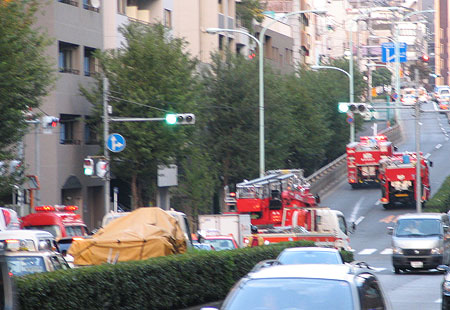
That must have been some false alarm. No fewer than nine fire trucks (and two ambulances) just pulled up outside, filling up the street for an entire block, across from my school.

There were no signs of smoke or other emergency, and then a truck made a loudspeaker announcement that there was no fire emergency.

A few of the fire trucks turning around and leaving in various directions:

1007-Fire1

1007-Fire2

My question is, what emergency would merit so many vehicles?

Weird.

Categories: Focus on Japan 2007 Tags:

Health Care in Japan

October 19th, 2007 2 comments

There is a new entry in Snopes.com which analyzes an email about Canada’s health care system. The writer claims to be a Canadian, but in the first two sentences s/he mentions both Hillary Clinton and Michael Moore, so you are immediately guaranteed that this is a right-wing screed likely to contain wild exaggerations and outright lies. And that’s pretty much exactly what Snopes finds.

It seems that most claims about socialized health care, from both sides, tends to be idealized. There is both good and bad, and when it comes down to it, far fewer differences between the systems than either side would like to admit. One big difference, however, is that in countries with socialized medicine, you at the very least get universal or near-universal access to health care, with both the good and the bad included. Costs, errors, wait times, etc. tend to be the same, except with socialized insurance more people are covered for essentially the same price to the country as a whole, which is a big reason I support the idea.

Here in Japan, I am on the Kokumin Hoken, or the “National Health Insurance” (NHI) plan. It’s the plan you sign up for yourself. There is another system (Shakai Hoken, or “Social Health Insurance”) which depends on co-payments from your employer. Both pay for 70% of all non-cosmetic medical costs, and those costs are kept low because the government here sets prices for treatment. Most doctors, clinics, and hospitals accept National Insurance; it’s not hard to find a place which has what you need.

Let me give you a recent example. A few weeks back, I started developing a few scotomas (blind spots) in my eyes. Having just moved to Ikebukuro, I went to the closest big hospital, Otsuka Hospital, for the first time. I was signed up with minimal paperwork and saw a doctor within one hour, despite having no appointment. (In fact, I do not recall ever having been made to wait more than three hours in a hospital in all my time in Japan.) The doctor did a preliminary exam to make sure that nothing serious or preventable was going on, and arranged for an appointment two days later for a visual field test and further consultation. I came back for the second appointment, took the tests (again within an hour, including the 30 minutes I had to wait for the pupil-dilation drops to take effect). The doc found nothing wrong, but just in case, scheduled me for appointments with their Internal Medicine department to see if arteriosclerosis was a problem (perhaps limiting blood circulation to my retinas), and a follow-up exam and tests a few days after that. Appointment scheduling was a bit crowded, so I would have to wait two weeks for them.

Total out-of-pocket costs (the unpaid 30%) for the two initial visits: $30.

But within a week after those visits, the scotomas seemed to be getting a bit worse, and I was (a) not content to wait another week and a half or so to get treated again, and (b) would have felt more comfortable with an English-speaking doctor, not to mention a specialist. On the web, I found a clinic about a 45-minute drive from home which had a Harvard Med-educated eye specialist. I called and they said that the doc would be holding a kid’s clinic on a Saturday, but I was welcome to drop by. I did, and the doc saw me within half an hour (and again, I got a clinic member card with minimal paperwork, just two minute’s writing). The doc was great, and spoke English very well. After an initial exam, he handed me off to a retinal specialist (who spoke no English but the first doc came and translated when necessary). They performed a fluorescein angiogram (injected a dye into my blood and then took many images of the retinal bloodflow), and found no blockages, leading them to conclude that the scotomas were likely caused by vascular spasms, and the blind spots would fade with time (so far, they have), with a nominal chance of some blind spots remaining. They prescribed medication to help bloodflow and prevent further spasms, and made an appointment for me to visit again the following Saturday.

Total cost for the visit, consultation by two specialists, pupil dilation, fluorescein angiogram, and one week of medicine: $45.

Keep in mind that these were initial visits without an appointment, I was admitted either on the spot or for the next day, never waited for more than one hour, and received prompt treatment from specialists.

This is not to say that all medical treatment in Japan is so great; what it does mean is that you can shop around and find the doctor and/or clinic/hospital that is right for you. You’re never locked into a specific doctor or location, you can see any doc at any location you want, so long as they accept the National Insurance. In my experience, you can usually find the medical service you want and need.

Did I mention that it includes dental? I found a great, U.S.-trained dentist in central Tokyo, speaks English, does great work, and is similarly cheap, but has up-to-date equipment in a nice, clean office, even with a great view of parkland while you’re worked on. And they do good work, too.

Despite not covering cosmetic work (you’ll have to pay full price to replace upper incisors, for example, even if it’s not literally cosmetic), you can sometimes find ways around it. I had a largish mole under my lower lip that would bleed a lot if cut shaving, and I worried about cancer and so forth; I went to a clinic about it, and though they found nothing wrong with it, they volunteered to give laser treatments to get rid of the mole entirely. This was somehow covered and cost little, with good results.

My biggest gripe: no preventive medicine that I can find. The insurance does not cover regular comprehensive checkups. However, you can get around that by going to the hospital and giving a complaint that would result in specific tests which, combined, could get similar results to a general checkup.

Premiums are in the form of a “tax” (not not rolled into other taxes, it’s paid separately), which is approx. 8.5% of your income, with a cap of ¥530,000 ($4600) per year. Alas, I have just reached that cap, and so pay the maximum amount. There are a lot of other aspects and benefits to the program I haven’t gotten into (or needed personally yet).

If you’re healthy and never need work, it can be a hassle to see all that money go to the system. But if you need to see docs relatively often, and you want coverage in case of something catastrophic, I think it’s a fantastic program. Of course, your mileage may vary.

Categories: Focus on Japan 2007 Tags:

Japan and Religion

October 18th, 2007 Comments off

This story about a cult which killed an elderly lady might be catching the eyes of people interested in Japan, and most of us are familiar with the gassing of the Tokyo subway by Aum Shinri-kyo (an attack that my brother and his wife narrowly avoided getting caught in). These kinds of stories tend to be the usual exposure we get to Japanese religion; not much else gets reported on them in the media. Oh, we’ll see the odd movie that shows a Japanese monk with the rounded hat, or a Shinto priest blessing a car, or something like that.

However, Japan is supposed to be a thoroughly religious society. See, it says so, right here on the label. According to the CIA World Factbook, 84% of Japanese “observe” both Shinto and Buddhist religions, and the remaining 16% observe other religions, with 0.7% of those being Christian. I’ve seen other designations that claim Japan is 98% Buddhist and Shinto.

The thing is, none of that is true. In fact, compared to America, Japan is about as non-religious as you can imagine a society being. At my college, we have young people with whom we discuss all manner of subjects, including religion. And few of them have any concept of religion at all. Neither is it only with young people; most Japanese, when asked, will tell you that they are not religious. People I have asked guess that maybe 20% of Japanese people, give or take somewhat, are religious to an extent we would consider being modest or normal in the West.

Oh, yes, everyone visits shrines and temples. However, that’s mostly just social stuff, not really connected to belief. Kind of like celebrating Christmas or having a minister at a wedding, it’s something that people do whether or not they believe. You go to Shinto shrines for weddings, Buddhist temples for funerals. You visit both or either on New Year’s, and each has its festivals and holidays and so forth. Sometimes you just visit because it’s a pretty or interesting place to go to.

Yes, Japanese people will “pray” when they visit; you throw your coin into the offering box, shake the rope with the bell at the top, clap your hands twice, and pray to the kami. But most Japanese seem to treat this the same way that westerners say “god bless you” when you sneeze.

Certainly, there are the fervent believers. Many do take the religions seriously, some make them their calling. But I would say that most Japanese see these religions as either cultural background or an insurance policy, kind of a just-in-case kind of thing. Many Japanese have some kind of belief about the afterlife or the nature of the universe, though that is more of a free-formed personal belief, rather than adherence to a specific religious doctrine.

As for religion itself, most Japanese people seem to treat it far more as a tradition to be upheld, and less like a serious set of doctrines to be followed. Especially Shinto, where there is less focus on morality and philosophy (compared to Buddhism or Christianity). A co-worker said he once met a Shinto priest who, in an unguarded moment, admitted that he didn’t take the whole thing too seriously himself–he did it as much out of familial loyalty than anything else.

Of course, most of the people I am exposed to are younger, and in Japan, that means less focused on religion. As might be expected, when Japanese people reach their senior years, there is more interest in religion, and more probability that the person involved will take it seriously.

Even then, religion in Japan is pretty quiet; aside from the odd Christians, few people will knock on your door and want to tell you about Buddha or Amaterasu. Yes, Soka Gakkai is (unofficially) affiliated with the Komeito political party, but you never hear about religious stuff being pushed in government. No bans on abortion, no mandatory prayer in schools, no abstinence-only programs, no demands for reshaping biology, geology, or history curriculums to allow for the creation of the Japanese islands by Izanagi and Izanami some three thousand years ago or whatever. The worst that happens in that sphere is prime ministers and their cabinets visiting Yasukuni Shrine (where some Class-A war criminals are enshrined), and that’s more of a diplomatic issue than one that actually affects one’s daily life.

All told, religion in Japan is refreshingly distant and hands-off. You’re allowed to indulge all you want; it’s there is that’s your thing, there’s nothing stopping you. But if you’d just as soon keep it at arm’s length and not have it bother you, Japan is much easier a place to live than is the United States, to be certain.

Yes, there are cults, but notwithstanding the extreme cases like Aum Shinri-kyo, they rarely if ever impact your life, unless a close friend or relative drags you into it.

Perhaps a lot of this has to do with there being far less in the way of a dominating holy book; there is nothing on par with the Bible or the Koran when it comes to Shinto or even Buddhism–nothing that dictates the shape of the world. You get the feeling that people in most Japanese religious sects could care less if you’re not interested, and don’t worry all that much about your soul, immortal or otherwise, if you care not to involve yourself. Mostly, it’s a matter of take-it-or-leave-it; there is no public pressure to subscribe to anything at all.

And that’s the way I like it.

Categories: Focus on Japan 2007 Tags:

Japan and Acceptance

October 13th, 2007 2 comments

Tim mentioned this as a topic recently, so I thought I’d have a go at it. I’m no expert in Anthropology, but I do have some on-the-ground experience here in Japan.

The commonly held belief is that Japan is an exclusive society, and that it does not accept outsiders readily. This is true, and then again it’s not. It’s kind of like the belief that Japanese people are “polite.” Yes, they are, sometimes–and sometimes they are not.

A lot of this has to do with cultural differences not happening all in the same way. To use politeness as an example, it’s not as if Japanese people are “x” number of times more polite than westerners in all situations. Yes, in many social situations, Japanese can be polite to the point of obsequiousness. Where a westerner might just say, “sorry,” or “my apologies,” a Japanese might bow deeply and say, “taihen moushiwake gozaimasen,” or “I have absolutely no excuse for this!” On the other hand, if you have had much experience walking in crowded public places, you will probably have been jostled enough or nearly knocked down in such ways that you would expect an apology–but the Japanese person who just hit you just goes along their way as if nothing happened. Or you might see a middle-aged Japanese man in a business suit loudly hawk and spit–right in the middle of a highly-trafficked train station corridor.

It’s the same with acceptance of outsiders; in some cases, Japanese can be exclusive, but in others, they can be incredibly accepting.

One example of non-acceptance is common in the workplace. Foreign workers often find themselves excluded from all kinds of information and decision-making, even when it is open for even the lowliest worker in the office. On many occasions, I have seen or heard of people who were the last to hear of important news or decisions that involved them deeply. They simply were not consulted or told what was going on, even after having worked for the school for some time. Now, part of that example could be connected to language–office meetings are held in Japanese and foreign staff, who don’t speak the language, don’t attend–but that does not explain exclusion fully. Say, for example, a teacher’s schedule is to be changed; the teacher should be consulted first, or at least informed at the same time a decision is made. But to tell that person only after it is announced to part-time office staff who have no actual relation to the decision nor are affected by it–it is hard to see this as anything else than being excluded.

There are other forms of exclusion that come to mind as well: the great reluctance to allow non-Japanese to take on positions of authority or influence, for example. Foreigners are not allowed to become public school teachers (unassisted, at least) or take on public administrative roles of consequence. Japanese corporations setting up overseas have been known in the past to import leadership positions from Japan instead of allow them to be taken by non-Japanese.

And then there is immigration; Japan has always been stingy about allowing foreigners in; it usually allows in the least number of refugees, or is unwelcoming enough so that slots that are offered are often passed up on. It’s a lot harder to become a naturalized Japanese citizen than it is to become a citizen of many other countries.

This is what I had heard of coming into Japan. However, I have had experiences that have since belied an assumption of universal exclusion. One of the first was my host family experience. On my first trip to Japan, I had a homestay with a family, one of many arranged on that trip. But this one family was very, very accepting. They later invited me to stay again, and I visited several times over the years. But after just the first few stays, they invited me to their daughter’s wedding. In doing so, they did not just invite me to the reception, which is normal, but to the ceremony–which is very unusual. The ceremony is usually only a family thing, more private than the reception. The bride’s family sits along one side, the groom’s along the other, everyone in order of family seniority and closeness to the bride. I was seated as if I were the bride’s brother–not a small statement to make, especially in the presence of the groom’s family. And this was a countryside family, relatively conservative. At another time, when I visited and mentioned my mode of transportation while living in Tokyo, they started talking about that car that their daughter wasn’t using anymore–and I had to shut that line of conversation down as they seemed ready to give the car to me!

Sachi’s family has shown me similar acceptance. Part of this may be a family’s desire to please their daughter, but again, this is a conservative countryside family, and their acceptance upon meeting me was nothing short of full-hearted. It seemed much more than just the desire to please a family member. That kind of acceptance doesn’t come easily, and is not easily explained by a cultural predisposition to distrust outsiders.

Then there are examples of individual acceptance; people who are virtually xenophiles, people who accept you because you’re a foreigner, and not always just because you represent language practice (why are they so eager to practice language in the first place?).

There is a great deal of acceptance of foreign culture, if not the people themselves. Non-Japanese language is accepted almost too much into Japanese, with loanwords and English peppered liberally into Japanese. Foreign and especially American TV shows and movies are extremely popular. Ever since the Meiji period and after WWII, foreign styles have been adopted into Japan in almost every category one can think of, from clothing styles to education to administrative practices and so on. In fact, Japan has a long history of adopting things foreign–even the system of writing is adopted from the outside. China was a main source of cultural importation in the past, America and the West in general in the present. Baseball is now a Japanese national sport on par with Sumo, with Soccer catching up fast.

How can all that be in an exclusionary society?

Looking at the examples of personal decisions to accept or exclude, however, leads to the question: how much is simply the personal predisposition to accept or exclude? What is the difference between exclusion and simple xenophobia, or perhaps racism? There is certainly quite a bit of that in Japan, as I have blogged on a few times before. But that leads to a very uncomfortable question: can the rather common Japanese exclusion all be traced back to racism? Well, one possible answer is simple exposure: what you have become used to, what you know, is easier to accept. And Japanese have not been very much exposed to non-Japanese people.

Some of this is self-reinforcement, not becoming used to something because you’re not used to it. At one of my earlier jobs teaching in Japan, I was approached by my American boss, the teacher supervisor. He sought me out because of my experience in Japan, and asked me about a hiring situation. He had interviewed many teachers, and one stood out as most qualified–but she was African-American, the spouse of a serviceman at Yokota Base. My supervisor asked me if I thought that the students would be put off by her because she was black. My response was twofold: first, you can’t hire on that basis, and second, if the students are nervous about being around black people, it’s because they simply haven’t been around black people. By denying them the experience, you’re reinforcing the discomfort that exists in the first place.

The supervisor decided to hire the teacher, and she became quite popular with the students. But the question from my supervisor highlighted for me the entire question of acceptance, exclusion, and its causes.

Categories: Focus on Japan 2007 Tags:

Union Probe

October 6th, 2007 Comments off

David Markle over at Japan Probe has a pretty good rundown on how the General Union is not doing much in the Nova crisis, plus an analysis of the union itself. It gets deeper into the nature of the union than I have seen in my two experiences observing the NUGW (once at a workplace in the 90’s, and recently at a school associated with my workplace), but generally confirms what I have seen.

In a previous article on the Nova situation, I left a long comment on the union and its worth, in response to a mention of the union in the article. In short, the NUGW can be an albatross for a workplace, doing far more bad than good. They immediately turn the negotiating situation into an acrimonious one, make ludicrous demands, and grandstand as much if not more for their own high profile than for the good of the teachers. In the end, they leave the workplace more tense, restricted, and distrustful–and usually accomplish little or nothing at all for the teachers. In short, the union is good for little unless you’re really at the end of your rope with your employer.

If you’re interested in getting a better idea of what the union does and what it’s like, read both linked articles and their comments.

Categories: Focus on Japan 2007 Tags:

Probably Not a Breakthrough

October 6th, 2007 2 comments

From the Chosun Ilbo, via Japan Probe:

A Kyoto court ruled partially in favor of a Korean woman who sued a Japanese landlord for refusing to rent a room to her. A Kyoto district court ruled that refusing to rent a room to a person due to her nationality is illegal and ordered the landlord to pay the woman W8.65 million (US$1=W916) in compensation.

Courts have taken a dim view of refusal to let rooms to foreigners since an Osaka court in 1993 ruled this went against the constitutional stipulation of equality before the law. But in reality, Japanese homeowners often reject foreign tenants citing differences in the lifestyle and customs. Counsel for the plaintiff said the ruling was a “head-on attack on discrimination based on nationality” and predicted it would help eradicate unfair discrimination against foreigners.

In case you’re wondering, the award comes out to ¥1.1 million, or about $9,500.

Now, seeing this, I kinda wish that option had been open to me in the past. Maybe it was, and I just never tried, but somehow I don’t believe it would have been so easy or assured; this woman may have simply gotten lucky with her judge, who clearly seems to want to make an example.

Also, the 1993 ruling mentioned may have something to do with things; the first four times I went apartment hunting were before that time, and I recall anti-foreigner sentiment, even in printed form, was rampant. Some fudosan-joho (apartment fliers, or the sheets of paper that each describe an apartment, giving all the info on it) would actually have written on then, “ペット、水商売、外人不可”–“No pets, bargirls, or foreigners allowed.” Rental magazines like “Apaman” would have a notation for which apartments accepted foreigners. I recall in my first few forays into apartment hunting, better than 95% of the apartments I asked about replied, “gaijin wa damé,” or “foreigners are no good.”

In later years, I heard less of this, and have not seen anything written that refuses foreigners–but even just this year, when Sachi and I were looking for a place, we still got refused because of my nationality fairly often–though rental agents would be a bit more circumspect in terms of that kind of thing, calling the landlord out of our hearing, and not saying “foreigners are no good” directly. I thought this was simply because of Sachi’s presence, but perhaps legal decisions since 1993 had some influence on that.

Also, if you read the last paragraph of the Chosun Ilbo story, it shed a bit of light on what may have allowed the woman to sue in the first place:

The woman signed a contract to rent a room through a real estate agency in January 2005. But after she paid the deposit to the landlord and commissions to the realtor, the landlord changed his mind since she was a foreigner.

I am fairly confident that the contract having been signed was a pretty significant element of the decision. I rather doubt that if someone simply refuses to even consider me for the stated reason that I am a foreigner, it would be pretty hard to make any claims; probably the landlord/rental agent filter could be used as an excuse, that there was a “miscommunication” or something.

Which also makes me pretty sure that housing discrimination will continue more or less unabated–they’ll just be sure not to leave any conclusive evidence of it, like they do in the U.S.

Which leads to the question: if they’re going to discriminate anyway, would you rather they be upfront about it, or that they hide it behind excuses? I would think the former manner is at least more honest and less problematic for the victims: one of the biggest problems with masked racism is that you have to wonder if every bad thing that happens to you is because of racism, as you are no longer able to discern between racism and simple bad luck.

Categories: Focus on Japan 2007 Tags:

Bye bye, McNova

September 20th, 2007 4 comments

The infamous Nova language school, the most well-known of all the McSchools in Japan, looks like it’s on the verge of collapse.Nova-Usagi

Nova has been looked down upon in the teaching community in Japan for quite some time. It has been seen as a school that skimps on quality, mistreats its instructors, and short-changes its students. It is best know for its slogan, “Ekimae Ryugaku” (“Study Abroad Right Near the Train Station”), and its rather bizarre, pink, parrot-billed rabbit mascot.

Nova seems to have been a lightning rod for bad news stories over the years. In 1994, when two Nova teachers were caught possessing drugs, Nova demanded that all of its foreign teachers submit to drug testing (Japanese employees were not included in the testing). This set off a firestorm of protest, and boosted Nova’s teacher union to new heights. It was universally seen as a bad move–not only discriminatory, but also a public statement of lack of faith in their employees.

Last Winter, however, seven Nova teachers were arrested on drug charges–unrelated, of course, but still it did not look all that great. One has to wonder if the school’s eagerness to hire untrained teachers with the barest college degrees and working-holiday visas (the easiest to arrange for working in Japan) may have had some part in this–you hire whomever comes off the boat, you can’t be too surprised if you get some bad apples.

To add insult to injury, in March this year, a 22-year old female Nova teacher was found murdered, likely by one of her students, who remains at large.

But Nova’s real business troubles came about early this year. Nova had apparently been cutting the number of teachers it made available, creating teacher shortages during peak hours, and was investigated by the Ministry of Trade, Economy and Industry as well as other government and consumer organizations. Apparently, Nova was making fraudulent promises to students, and failing to honor cancellations students were entitled to, in violation of Japanese commercial transaction law.

After failing to make their case in the courts, in June Nova was banned from selling long-term contracts for six months. And since then, the company seems to have been spiraling down the drain. It is closing down 100-200 of its 900 schools.

But that’s not the part that seems to signal a collapse of the entire business. If the school were simply restructuring, that might be a sign of survival. But many of the branches that are shutting down may be doing so because landlords are complaining of non-payment of rent. Japanese employees are leaving the school in droves, according to the same story. And to top it off, many teachers are complaining that their pay is late in coming this month, after 2000 of its Japanese staff were not paid on time the previous month.

All of these are signs of a business in the process of self-destructing. Maybe I’m wrong, but I have seen these signs before.

Except for the impact on the thousands of employees who would lose their jobs, Nova’s disappearance from the language-school scene would not be a great disaster in itself; it’s not as if it was a model of great instruction or peerless business administration. It would be missed probably only a bit more than the long-defunct Bi-Lingual school, the one that advertised using ink ribbons and photos of foreign male teachers and young Japanese female students almost kissing. The education community can do with fewer schools like that.

The problem, however, is one of consumer confidence in the industry in general, especially if Nova closes its doors suddenly and leaves countless students hanging with paid-for lessons that will never be delivered. That has happened before.

In fact, it happened a long time ago to the side of the education industry I work in–American colleges in Japan. Back in the 1980’s, when Japan was flush with cash and seemed poised to rule the world, a few dozen American colleges and universities decided that it would be a great idea to set up branch campuses in Japan. Many schools did this without due consideration of all the factors involved, and that wound up hurting everyone later on.

First of all, most American schools had to partner up with a Japanese organization to handle the administrative and financial side to running a college in Japan, and many of them chose poorly. That, and the timing was bad–when the Japanese economy went south in the early 90’s, many of the partner companies went under, leaving the American colleges high and dry. Many closed their doors suddenly, leading to a collapse in consumer confidence, which led to the demise of most of the remaining schools (along with grade inflation and other problems).

Only a few schools survived, my own being one of them (primarily thanks to a serious partner organization and a doggedly committed home campus), but the mid-90’s were tough years. When I first arrived at my school in the late 90’s, we were at the nadir, with only several dozen students in the academic program. The first graduation ceremony I presided over, in fact, had all of two students receiving their diplomas. Things got much better over the following three years as we nearly tripled our student body, and graduating classes swelled to dozens of students per semester. (I’d love to claim cause-and-effect from my taking over the school, but that would be succumbing to the “post hoc ergo propter hoc” fallacy we teach our students to avoid.) Yes, enrollment hit a snag in 2002 after 9/11 scared students, but the school has done surprisingly well since then, especially in the face of a quickly-diminishing youth population in Japan.

However, for a while there, our school, like so many of the others, hit upon hard times–not because the school was deficient in any way, but rather because of the poor image that collapsing businesses left in their wake; we suffered by association. When there is a notable default and sudden closing-of-doors in the industry, it hurts everybody in that industry. Of course, my school is far distant enough from the Nova-class conversation schools that it won’t affect us (who knows, we might even benefit as people seek out more dependable schools), but the English Conversation industry is fairly certain to take a major blow over this–and that industry has already seen bad times in recent years.

When I came to teach in Japan at that level in the mid-80’s, it was not too hard to find a fairly well-paying job, and managerial jobs paid very well indeed. Today, pay for such jobs is depressingly low, and many jobs require teachers to take on classes with small children, something relatively rare back in the 80’s.

Nova is a disaster waiting to happen. The only question that remains, it seems, is how many others they’re going to take with them when they implode.

Categories: Focus on Japan 2007 Tags:

Tasty Seal

September 17th, 2007 2 comments

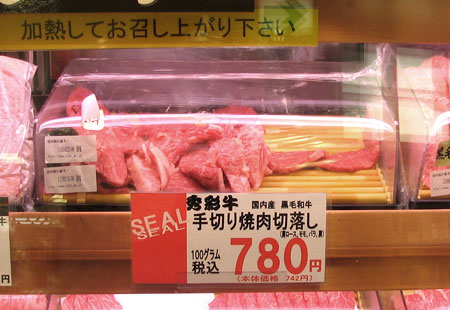
Saw this yesterday at a Seibu department store meat shop, in the basement food arcade.

0907-Seal Meat1-450

0907-Seal Meat2-450

In case you’re wondering, all the other signs like this in the display case said “SALE.” This was the only one with the misprint.

And yes, it was a misprint. I asked.

Out the Window

September 16th, 2007 3 comments

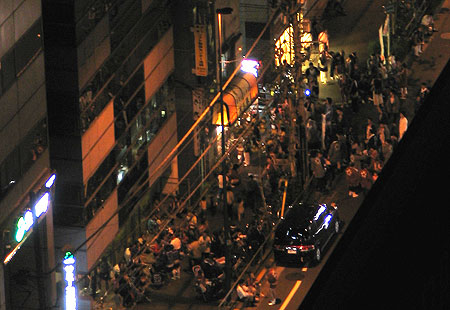
One thing I’ve noticed looking out our window here in Ikebukuro is that you ca see more than I cold see before in Inagi. Sure, you can see farther, but there is also more happening. As Sachi and I sat down for dinner tonight, we heard something, a sound that could have been anything, like a dog barking… but it was much too regular, far too rhythmic. So I opened the balcony door, looked out, and saw a small, local temple festival on the street less than a block from our place.

0907-Wasshoi-450

You know, nothing special. Just another local festival.

It’s a nice view, even if you get tired of the city lights, which I haven’t.

Categories: Ikebukuro Tags:

The Squeaky Wheel and All That

September 8th, 2007 2 comments

Something I just realized about my cell phone: those ninnies over at Willcom seem to have slipped me a new battery. The old one was rated at 60% efficiency–it wouldn’t hold a charge for too long, but was enough to last the day on stand-by, which was good enough for me. I only asked that they repair the contacts to the charger, and when I originally went in, they claimed that a battery replacement would cost more than the “point” credits I had built up could pay for.

I’m also pretty sure that they did this in response to my getting upset at having been jerked around. I had never looked at it and noticed, but the battery is incorporated into the back panel of the phone. My phone previously had a lot of scoring and wear on the back before. Now when I look at it, it’s clean and new–on the battery part only.

0907-Batton-450

The thing is, I happened by chance to see that the old battery was still in place after the main repairs had been completed. When I came in to pick up the phone, I checked out the repairs (you can see in the image above that the battery contacts–the gold insets at the bottom–were changed), and happened to note that there was all that wear and tear on the back. Later, when I got upset and let them know it because they made me come back again and again and again, they must have said, “This gaijin is pretty pissed off–let’s give him a new battery for free.”

The weird thing is, they didn’t tell me. Not a word. They didn’t point it out, though they had every chance to. When I picked it up for the last time, I did notice it looked nice on the back, but figured that this was just a change in the casing only. It was only later, when I noticed that the phone held more of a charge than usual, that I figured out what they had done.

Usually, I would expect them to announce such a thing, by way of reiterating an apology and saying, “look, we gave you a new battery.” Maybe they just figured that I’d notice it and appreciate it anyway. Not that I don’t–but I would have just as soon kept the old battery and not dealt with all that hassle. It’s not like I’m keeping this phone for one minute longer than the new iPhone is released in Japan.

One extra note here: did I get the new battery because I’m a foreigner? I hear this a lot from Japanese people I know who are familiar with foreigners in Japan. I hear it a lot: “Oh, you got that service because you’re a gaijin. They would never do that for a Japanese.”

Is this really true? Somehow I have the feeling that it’s not true as often as I hear–that instead, foreigners get these things more often because we ask for them, or complain more loudly. Anyone out there have more experience with this, and an opinion?

Categories: Focus on Japan 2007 Tags:

Dang

September 7th, 2007 1 comment

We slept right through it, but that must have been one heck of a typhoon. I had tied down the cover on the exercise machines, and I mean tight. Polyethylene twine, tied off in multiple knots, up and down the machine in four or five different places. I did not imagine that it was possible for it to come off; the wind itself tended to flatten the cover against the side of the machine.

But when we woke up just now, the cover was completely off, hanging on to the machines by just a string.

I hope those things don’t rust….

Categories: Focus on Japan 2007, Ikebukuro Tags:

Typhoon #9

September 6th, 2007 3 comments

We’re really getting pummeled by this typhoon. Not disastrously, not right here, but sure as hell noticeably hit. The wind is something else out there, crashing and breaking over the north side of our building, spraying rain horizontally over our balcony windows. Sometimes we feel the walls shake and shudder under the pressure of the wind. The region is reportedly getting 400 ml of rain tonight, as the eye of the storm passes just west of our location, or it will over the next eight hours.

And this is just the edge of the storm.

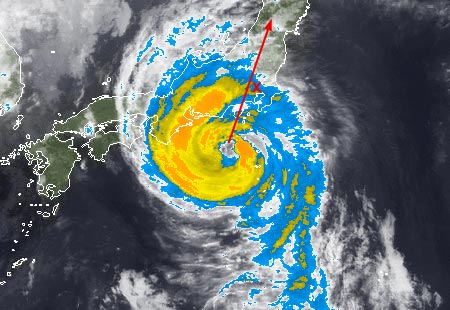
They’re saying that this is the strongest storm to hit Japan in three years, and it’s heading pretty much straight for Tokyo. To give you an idea:

Typhoon9Path

We’re the red “X” here in Tokyo. The red arrow shows the predicted path of the typhoon.

Yikes.

EDIT: I just got back in from tying down a few things on the balcony. My exercise machines are out there, and I had covered them–securely, I thought–with a tarp cover made for motorcycles, fits the elliptical trainer just about right. When I came out to look at it an hour later, I saw that the cover was half blown off, when I thought that would be impossible. So I went out again, with gales of wind billowing the cover tarp almost ridiculously, and tied the cover onto the machines with polyethylene twine. That stopped the billowing and should hold.

But standing out there was pretty impressive–sheets and sheets of rain moving horizontally at high speed in the wind.

I have to wonder what the heart of the storm is going to look like.

Categories: Focus on Japan 2007, Ikebukuro Tags:

NHK

September 2nd, 2007 3 comments

As you might already know, “public television” in Japan is expressed as NHK (“Nippon Hosou Kyokai,” or “Japan Broadcasting Corporation”). NHK has two basic channels, general and educational, as well as satellite versions. It is controlled by the state.

One of the big controversies around NHK is how to fund it. It is funded by viewer fees, collected by agents of NHK who come to your door (though many give via automatic bank payments). However, a lot of people don’t pay those fees, for whatever reason. The law as currently written requires payment, but does not allow for any punishment for non-payment. Because a lot of people don’t pay, it’s causing a stir in government; some are suggesting that penalties for non-payment be assigned, and that fees be cut by 20% to make it more palatable.

All of this comes across to me as exceedingly stupid. If you’re going to make it mandatory, then why not simply add the money to the national budget and collect via taxes? A lot cheaper, a lot simpler, and far easier to enforce.

Categories: Focus on Japan 2007 Tags:

Neighbors

September 1st, 2007 Comments off

There’s an American who lives on my floor that I met for the first time several weeks ago. Very friendly, very outgoing; seems like a really gregarious, sociable guy. I’ve seen him around on a few more occasions; once walking into the building with another guy, and a few other times I’ve seen foreign men leaving his apartment. I didn’t know if it was the same guy or if each one was a different person. I assumed that he did business out of his apartment.

Well, it turns out I was right, sort of. I met him on the elevator again today. Again, just as friendly as ever. On the way down, I asked him about his work. He said that he ran several businesses. “One of them is a male escort business,” he said matter-of-factly. “I’m on my way to Starbucks right now to meet a guy about that. If I find him acceptable, I take him back to the apartment,” where, I assumed, they would work out the details of the work. I did not ask further.

Interesting who you meet in the hallways.

Categories: Focus on Japan 2007 Tags:

One of Those Days

September 1st, 2007 3 comments

Warning: this is another post where I moan and whine about something minor that ticked me off. Feel free to skip over it.

For quite some time, my PHS cell phone had trouble charging, mostly because the contacts on the bottom where you rest it on the charger got worn through. I blogged on it before. I finally got it repaired… but didn’t know the hassle it would produce. First it was one of those runaround things, where the shop I bought it from said it was the service provider’s (“Willcom”s) responsibility; Willcom said it was the phone maker’s responsibility; and then the maker said it was Willcom’s responsibility.

The big trouble for me was the hassle of having to go to the Willcom shop. The closest one is located on the West side of Ikebukuro. If you know Ikebukuro, then you know that it’s not easy at all to get from one side to the other. Add to that the fact that the parking enforcement mercenaries seem to be out in full force in West Ikebukuro; I nearly got ticketed a few weeks ago when I went by scooter. Which means going by bicycle is necessary–but going by bike involves getting on and off the bike repeatedly to walk it up and down stairs and crap like that. So it’s no fun making the trip.

I had already made the trip once (I had to wait in line for ten minutes to get served) to find the shop and be told that it was the maker’s responsibility. Now, with the maker telling me to go back to Willcom, I fully expected them to deny responsibility again. What happened instead (after another wait in line) was almost worse: they accepted the responsibility to have it repaired. Which means I wasted a trip and time calling the maker; they essentially lied to me the first time. They accepted the phone for repair and gave me a loaner… but told me it would take an hour to have it fixed. So I had to waste an hour sitting there waiting for them to get around to doing a switch (which later they admitted could be done in 10 minutes). I couldn’t go back home, despite how close it was, because by the time I got back, I would have to turn around and leave again immediately.

After a week’s time, they called me back to say the phone was ready. So I went back… and was told to wait for another hour for the number to be switched back (this after waiting in line for fifteen minutes). Why didn’t they do that before I acme in preparation? Maybe they couldn’t have two phones like that at the same time, I don’t know. But I needed to get back home faster than that, so in frustration, I told them I’d pick it up later; they said, no problem, come and pick it up anytime.

So I just went back to pick it up. Guess what?

That’s right. It wasn’t ready. The server was down, they claimed. But they offered me the loaner back until they could get it cleared up. Why hadn’t they called me up when they discovered this, so as not to make me waste another trip? No answer, they just bowed very deeply in apology. Which was more frustrating–I didn’t feel like accepting any apologies, I just wanted not to be forced to waste more time and effort.

I stressed to them that the next time I came back, I just wanted to show up, be handed the phone, and then get out. They offered me the loaner back, but I was having none of that–I knew that they would again make me wait for as much as an hour while they tried to switch yet again. At which point they said they could do it in ten minutes. The hell with promises from these clowns, I thought. I said no, keep the loaner, make sure that my phone is reset and ready to be picked up without the hassle, before you call me and tell me to come over yet again.

Frankly, I can’t wait to get an iPhone and be rid of PHS. The one good thing it has going for it is that it’s cheap–I get a 2000-yen-a-month contract and 10-yen-per-minute calls. But PHS has weak signal strength, not as comprehensive coverage, and (now I have discovered) crappy service.

Rant over. What else is happening in the world today?

Categories: Focus on Japan 2007 Tags:

Back Streets of Akihabara

August 31st, 2007 6 comments

Akihabara is not what it used to be. It used to be the Mecca of electronics, the place where you could bargain and haggle. Well, you might be able to haggle in some places, but not like before.

I remember, years back, wanting to buy a Japanese word processor–back before PCs were commonplace in Japan, when everyone used these electronic type-writer like machines just for typing and printing. A “Wapuro.” I went to several stores in Akihabara, and asked prices. These prices were always listed for an item, but were almost always marked out in red–you had to ask for the price, and could usually talk it down somewhat. Each time I got the price for a store, I wrote down the store’s name and the price in a notepad, so I could remember who had what for how much. After going to four or five places, I noticed something: the prices I was given were lower for each successive store I visited–the first shop had the highest price, the last had the lowest.

I finally figured it out: each time I visited a new store, the salesman was getting a peek at the notepad I was carrying, checking out the lowest price, and then beating it by a little. I had been haggling down the price without ever realizing it. But that’s what Akihabara used to be–not just the little stores, but the big chain stores as well.

That no longer holds true. Akihabara is different today. Maybe you could haggle, but I don’t think you’d get nearly as far as you could have twenty years ago. Instead, you usually don’t even have to go to Akihabara; you can get good and sometimes even better prices by visiting the electronics chains like Yodobashi, Bic, or others like them in Shinjuku, Ikebukuro, or elsewhere. There’s even a new chain, Labi, which just opened up a big store in Ikebukuro. For a straight-out electronics purchase, I would usually go to places like these.

Akihabara has also transformed from an electronics heaven to mostly an anime and gaming heaven. On the main drag, at least, most of the stores seem dedicated to video gaming or some form of anime-related electronics/media. A shop bearing the name “DVD” in big letters likely won’t be selling any DVD players, but instead game DVDs.

But if you want to buy something unusual, Akihabara is the best place for it. For example, I wanted a region-free DVD player, one that could handle Divx files. For that combo, Akihabara was probably the best place; I found a good machine for it. That could be found in the bigger shops, ones that had duty-free sales for non-Japanese.

Similarly, I needed to get a USB keyboard–with an English, not Japanese, layout. I found a shop in Akihabara that specialized in keyboards, and had a few dozen English ones. For that, you have to go to the back streets.

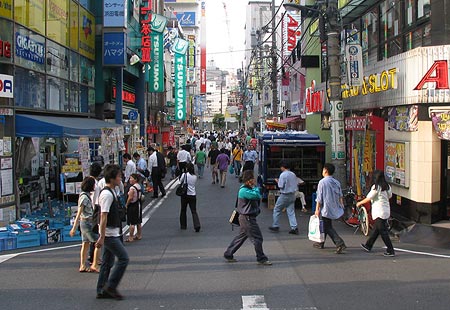
0807-Akibs1-450

Instead of shopping on the main drag, take a cross street to the streets behind the main drag, on the other side from the Yamanote Line. Here, you’ll find the real electronics heaven. Lots of little stores selling all manner of stuff in all manner of ways. A lot of shops will have these dirty plastic or cardboard bins chock full of cheap stuff, from knock-off products to cheap imports. I bought a 4-button mouse that was identical to a nice one I bought made by Logitech; everything was the exact same, except for the maker’s logo. The Logitech I had bought on sale at Yodobashi for ¥2000; this knock-off was for about ¥600.

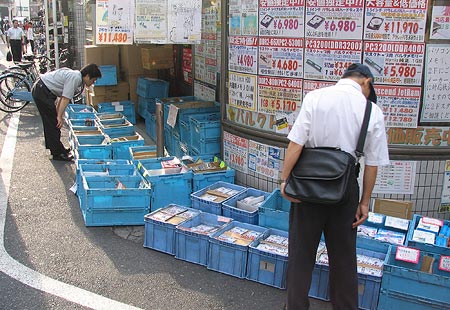
0807-Akibs2-450

It seems that almost anything can be found in those bins, from cables to removable drives to gadgets and toys to, well, whatever.

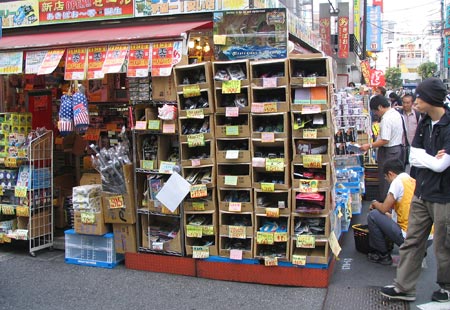
0807-Akibs3-450

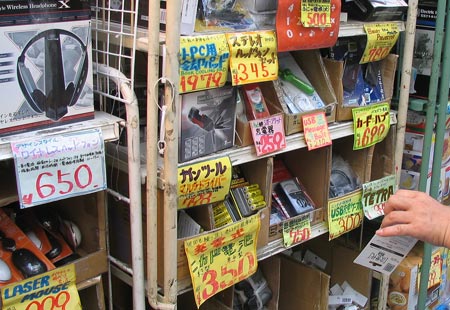
There was a ¥1000 3-megapixel digital camera with USB port that I was sorely tempted to try out, just for fun. A ¥650 set of wireless headphones. Any number of mice from ¥500 yen up, but the most expensive ones were still cheaper than the cheapest ones at the major retail outlets.

0807-Akibs4-450

A lot of the shops get way too techy for the ordinary buyer, though–for example, there are lots of shops which sell stuff for people to make their own PCs.

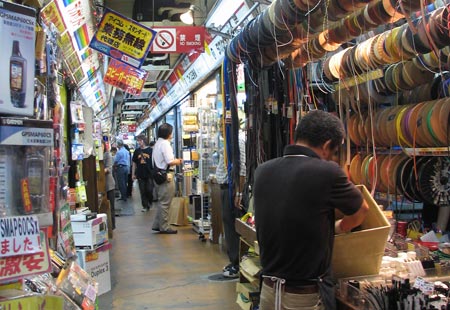
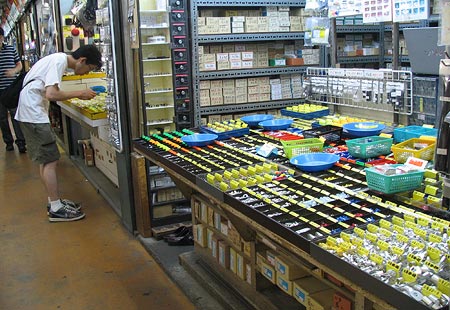
But if you really want elemental electronics, try visiting the place I refer to as The Maze. Very close to JR Akihabara station, it’s a building on a fair-sized plot of land that long ago was converted to stalls in narrow aisles open to the outside.

0807-Akibs5-450

0807-Akibs6-450

In here, you can buy loads of just about anything and everything electronic–not computer-related, necessarily, but electronics-related. There are shops which sell nothing but wiring, or nothing but LED lamps and other lighting bits and pieces. One shop sells nothing but old but functioning radio tubes, some priced in the hundreds of dollars. For the home electronics-engineer hobbyist, this place is a treasure trove. You can also find larger components and systems, especially surveillance cameras/closed-circuit TVs, GPS systems for cars, and stuff like that.

These places are the main reason to go to Akihabara these days… unless some big new anime-based video game is going to be released. But I like the back streets better.

Categories: Focus on Japan 2007 Tags: