Archive

Archive for the ‘Focus on Japan’ Category

Snow Day II

February 3rd, 2008 1 comment

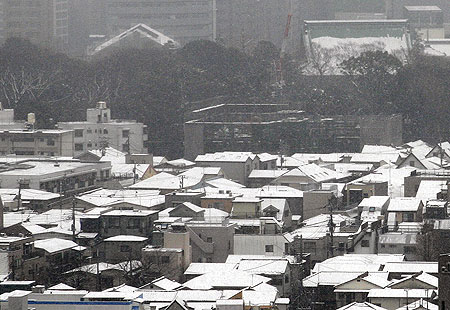
It snowed about ten days ago; when I blogged on it, it was just a light dusting in the morning. It continued to be somewhat heavier than that, but still didn’t amount to much. Today has been a bit more snowy; it started early morning, and has continued all day, leaving a much thicker layer of white over Tokyo. And it figures, too–the first day I planned to really get back to birding, and this hits us. So I have to be satisfied with snapping a few photos of snowy central Tokyo out the window.

0108-Snow Day-02

0108-Snow Day-04

0108-Snow Day-03

0108-Snow Day-05

So, Sachi and I are holing up in our cozy apartment, watching TV (Sachi loves Boston Legal) and generally being lazy. Usually Sachi goes for homeopathy lessons at a private school, but they cancelled classes today. As I may have pointed out before, Tokyo doesn’t tolerate snow well–most likely half the train lines are out right now.

News reports have several train lines out of service, dozens of flights cancelled, the Shinkansen (bullet train) slowed or halted, at least 16 snow-related injuries, highways closed, and a major marathon race with 20,000 participants in western Tokyo called off.

They say that 3 cm of snow has fallen. That’s a hair over one inch. Those of you in regions that operate normally through several feet of snow can stop laughing now.

Staying home can have its benefits, though; I get more of Sachi’s cooking. We do split cooking duties, but there’s little use denying she’s a lot better at it. Last night, it was pasta with chicken and pork with a tuna sashimi salad and strawberries in yogurt flavored with fresh lemon juice on the side. The photo doesn’t do it justice.

0108-Dinner-02

Categories: Focus on Japan 2008 Tags:

Things Like That Can Get You Noticed

February 2nd, 2008 2 comments

I remember back to my days as a model in television commercials. Well, okay, I was in one commercial. But I also did some voice-over work for radio ads, and had a gig as the host for a half-hour TV show. Not an ongoing TV show in a half-hour format, but rather just a show that was on for a single half-hour. Well, okay, it was kind of an infomercial. I think I still have that videotape around here somewhere.

Even still, that all sounds rather impressive, much more so if you’ve ever seen what I look like, or heard what I sound like. My secret: I was almost the only game in town. That helps a lot.

This was back in 1985 to 1987, in my first few years living and working in Japan. I got a job teaching English at the Toyama YMCA. Toyama Prefecture, on the Japan Sea coast halfway down Honshu, had a population of one million; three hundred thousand lived in Toyama City, where I lived and worked. And in the entire prefecture, there were only about thirty non-Asian foreigners around, and I was one of them. So when a local TV station wanted a foreign model for a local car dealership commercial, or a foreign voice for a local radio ad, they didn’t have many alternatives to turn to. So I got the gigs.

This comes to mind because I just finished writing answers to questions for a spot in The Japan Times to be published in a week or two. They have a new “blogroll” feature they’re trying out, and I was asked if I would participate. The feature focuses on Japan bloggers, and I guess I qualify–I told them that Japan is not the main focus of my blog, but being based in Japan is a big part of it, it seems. I doubt that this blog would be getting that kind of attention otherwise; like I said, it helps to be part of a smaller population if you want to get noticed. Not that there is a dearth of blogs in or about Japan, but it is a sub-group of relatively limited population, especially compared to the now-burgeoning blogosphere.

The evolution of this sub-group also brings to mind a comparison with how I have fit into communities in Japan since coming here a few decades ago. Back in 1985, I was one of a very limited sub-group; being outnumbered 10,000 to one in a city where most people look radically different from you is quite the experience. Back then, I used to turn heads every day. A lot of double-takes, a lot of whispered, “Ah, gaijin da!” Groups of teenage kids would dare each other to speak English to me, and once I even scared a little girl silly by smiling at her and saying, “Konnichi wa!

Moving to Tokyo changed that. It was refreshing to not be noticed so much any more, to walk down the street and not cause a stir. To have local residents be bored at the sight of me much more often than startled or amazed. Not being noticed can be a big thing after being the center of attention for a few years.

Not that I was the center of anyone’s attention in the blogosphere, now or back then. I started this blog when blogs were pretty new, and average-Joe blogs were just taking off. I joined a webring called “Japan Bloggers” when there were only a few dozen members. You can still find blogs out there with archives going back before 2003, but not a whole lot. Still, blogs were not exactly rare, and with American politics evolving like it was, a lot of people found a reason to go online with their thoughts.

Nevertheless, it was a lot less crowded of an arena back then. Today, it’s very easy to get lost in the stampede. So being a member of a still relatively-limited corner of the blogosphere can get you noticed.

Categories: BlogTech, Focus on Japan 2008 Tags:

Air Raid

February 2nd, 2008 1 comment

0108-Mba-Cm

Having the TV switched on to Japanese channels like Sachi has a lot allows me to observe a lot of stuff I had not seen before. One of them is what products are being pushed. And one that I find interesting is that the MacBook Air is being advertised a lot in Japan. It’s the exact same manila-envelope ad which you see in America. Which makes me wonder if the speculation is true, about the MacBook Air being targeted at Japanese consumers as a way to increase the Mac’s languishing market share here.

Categories: Focus on Japan 2008, Mac News Tags:

Japanese Variety Shows

January 30th, 2008 5 comments

Since Sachi and I moved in together, I’ve been seeing a lot more Japanese TV, and have noticed certain features and patterns that I had seen before, but had not really thought much about. This applies primarily to the Japanese Variety Shows, the ones that include guests and maybe some special segments. However, a lot of these features seem to apply generally to many TV shows.
Jvar-Subs

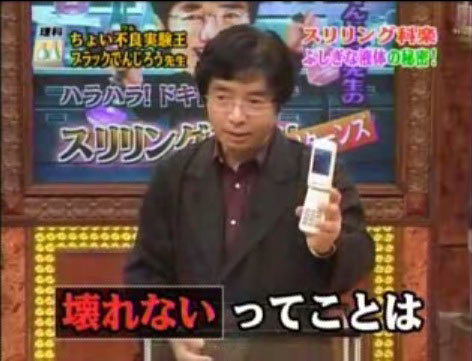
1. Subtitles. A lot of what is said on these shows is subtitled, usually in large, bold, and sometimes colored text. We’re talking Japanese subtitles for Japanese speech. The subtitles will appear even when everyone is speaking perfectly clearly. They do not appear for every word spoken, and do not appear to be for better understanding–they simply seem to be a form of punctuation.
Jvar-Panel

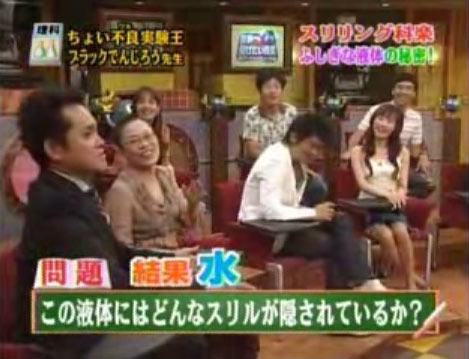
2. Lots of guests. There may be a few star guests, but often there’s a whole panel, sometimes more than a dozen guests seated in two tiered rows, with two or three hosts running the show. Panel discussions seem to be the norm for many of these shows.
Jvar-Water

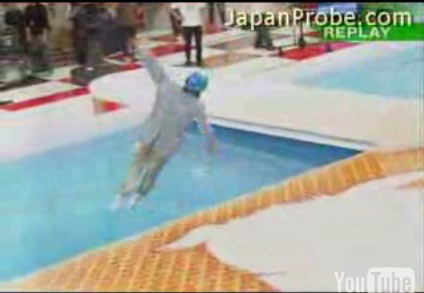
3. Crazy Games. A lot of shows include bizarre games, like dressing up as a giant piece of sushi and walking a tightrope over a vat of oatmeal or something. A lot of these gags, for some reason, involve pools or vats of water, and many involve costumes. Today, Sachi was watching a show where the contestants had to dress up as celebrities (one painted himself gold, put disks over his eyes, and was supposed to be C-3PO), then jump off a platform holding onto a latex-like rope-swing which would snap under too much pressure, and navigate their way to a rolling cylindrical pillow over a pool of water; after rolling the pillow to the end, one would have to jump onto a floating yellow ball and maintain balance. The games are usually made to be virtually impossible. Another segment had a man dressed as a priest surrounded by men dressed as nuns; the priest had to throw himself about five feet forward onto a medium-sized exercise ball, belly-first. And, oh yeah–there are often a lot of men dressed up in drag.
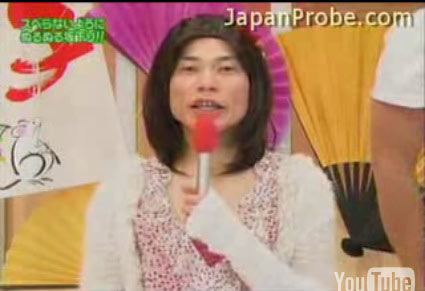
Jvar-Drag

Jvar-Inset

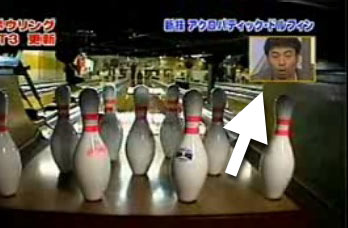
4. Picture-in-Picture Reaction Shots. When they switch to a video of something or another, there is an inset frame in one corner that shows reaction shots of guests, usually switching from one guest to another every 5-10 seconds.

5. Motion Picture Soundtracks. Few if any of these shows seem to have original music. Instead, they just steal stuff from elsewhere. In the course of one hour, you may hear bits from a few dozen different movie soundtracks. If the show’s director finds a music cue they like, be prepared to hear it every few minutes.


This all plays to a conclusion I came to long ago about Japanese entertainment: it is so formulaic as to make the most formulaic of all U.S. entertainment appear stunningly unique. In my experience, with few exceptions, Japanese samurai dramas, detective dramas, romance dramas, variety shows, etc. are all very similar, following very close to a basic set of rules. For example, in Japanese romance dramas, the girl almost always dies in the end, for some reason.

Maybe that’s one reason that U.S. TV series can be so popular in Japan: there’s not much local competition that stands up. Especially in production value–American TV shows often look expensive, with a cinematic feel, excellent special effects, and solid sets and designs. Japanese shows rarely have the same innovation or quality of production that you see coming from the U.S.–and that’s a shame. Because when Japan gets the chance, they can come up with some of the craziest shit imaginable.

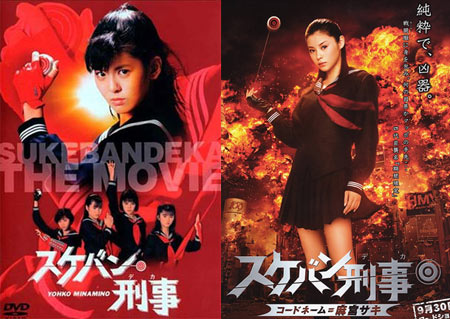
My favorite Japanese TV show–not that I watched it more than a few times, but because it made me laugh like hell–was a teen-idol detective drama titled “Sukeban Deka,” which roughly translates to “Delinquent Female High School Student Police Detectives.” They were “delinquent” because they used makeup and accessorized, in addition to their smoldering, resentful, and pouting attitudes. Each girl had a unique weapon; the most famous was the girl with the badass yo-yo.

Near the end of an episode, this small, diminutive Japanese teenage girl in a sailor uniform would be surrounded by a dozen or more big, hulking, hairy, tattooed yakuza gangsters. Then she’d pull out her badass yo-yo. “Stand back!” she’d warn, but the yakuza gangsters would foolishly ignore her. She’d snap back her hand, and then let go the badass yo-yo. We’d get a shot of the badass yo-yo with the background whizzing by (WHISH-WHISH-WHISHHH!!). Then the badass yo-yo would bash one of the yakuza gangsters in the noggin. Half the yakuza would then flee in terror, while the 16-year-old delinquent female high school student police detective would pick off the rest one by one with the badass yo-yo, with all the exaggerated sound effects you’d expect in a kung-fu movie.

It was the funniest damned thing I have ever seen.

The TV show went on to become three if not more major motion pictures in Japan. The posters below show one of the original movies, and a more recent remake.
Sukebandekamovies

Categories: Focus on Japan 2008 Tags:

Tokyo Snow

January 23rd, 2008 1 comment

0108-Tokyosnow-01

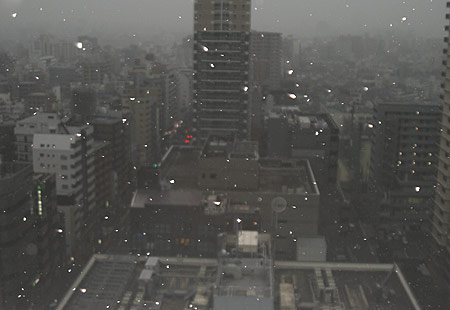
Finally… the first snow of the season in central Tokyo. Came late this year. Still, it looks like more of a dusting than anything else. To even photograph it, I had to settle for catching snowflakes with my flash; none of the snow is staying frozen on the ground, not yet at least. And though it’s been snowing for about an hour at least, I can still see dry spots on rooftops.

Even so, I betcha some train lines in the city get stopped because of it. Tokyo does not respond well to snow.

Categories: Focus on Japan, Focus on Japan 2008 Tags:

Maybe I Should Start Applying for That Permanent Resident Visa NOW

January 21st, 2008 10 comments

Oh, great–rampant xenophobia in Japanese government circles may make life a lot more difficult for me. And not just by taking my fingerprint and photograph at Narita, a relatively quick and painless annoyance. I mean in a big way: they might soon start requiring specific levels of Japanese-language proficiency for residency visas.

And why?

Officials are quoted as saying that adding a language requirement to the visa application process could help to combat illegal immigration or terrorism.

Oh yeah, right. Because a terrorist willing to give up his life for his cause and spend a decade or more planting himself as a sleeper agent would never go to the trouble of learning the language. (Not to mention that every act of terrorism ever committed in Japan was committed by Japanese, never by foreigners.) And let’s not forget those illegal immigrants, who will, what, be taking the test before they officially apply as illegals? This is nonsensical, just more anti-foreigner sentiment from the same crowd that inflate crime rates among foreigners–who, ironically, commit fewer non-immigration crimes than Japanese do. And they could likely stop immigration better by simply locking a door or two (link to story about a Chinese man who simply walked out of Kansai airport, through unlocked doors and right past the guards).

The thing is, they’re not just saying this should be implemented for long-term residents, but anyone wanting to come in on a work visa (some reports say this is the primary target of the new restriction, in fact). Which is monumentally stupid. Can you imagine what would happen to the English-language industry if this passed? Hell, most schools want teachers who don’t speak Japanese, worried that a teacher might resort to using it in class. Certainly, the whole Nova-class of language schools would suddenly find itself out of luck, unless somehow the new restrictions would leave working-holiday visas unaffected. But schools at every level would be hit a s well; right now, it’s hard enough to find adjunct professors to work at my college. I am now subbing for my boss and will be handling the hiring process this semester; if I had to narrow it down to only the ones proficient in Japanese, I wouldn’t be able to put teachers in our classrooms. And the government’s own JET program would probably have to shut down.

But what about other industries? Let’s say you have companies like Siemens, Microsoft, or Morgan Stanley who need to send one of their management staff over to take a position in an English-speaking office; how would these companies fare if every employee they sent over would have to pass a Japanese-language test demonstrating fluency first?

I can only hope that the work-visa element torpedoes the whole concept, or else I’m gonna have to start taking lessons, and soon. It’s not that my Japanese is all that bad–my friends and co-workers say that it’s pretty good, in fact. The thing is, it’s almost purely spoken and non-formal–which is the last thing they’ll test for. And knowing Japanese bureaucrats, they’re gonna go for writing proficiency and technical grammar crap that’ll be more or less useless in my “integration” into Japanese life (I’m doing just fine as I am, thank you very much), but will present a huge obstacle to getting that permanent residency visa.

Don’t get me wrong–I’m not one of those I-have-the-god-given-right-to-live-in-your-country-types, nor do I approve of people living in a country without learning its language. I just disapprove of adding a language test for the wrong reasons, and the likelihood that it’ll be the useless-but-obstacle-raising kind. If it consisted of talking to an immigration agent for ten minutes and testing everyday-language use, then no problem. But I’m pretty sure that that’s the last thing they’ll make it be.

Which means that it would probably be best if I got the visa as soon as I get married this year–which coincidentally will be about the same time that I reach my unbroken ten-year mark living in Japan, which is also usually considered a requirement, or so I have been told by some.

Categories: Focus on Japan 2008 Tags:

Driving Differences Between Nations

January 3rd, 2008 Comments off

Well, we’re back from Japan. I just took a little scoot down to the supermarket, and that reminded me of the times I thought of blogging on driving between the two countries.

One thing you might know from reading my blog is the disrespect I have for Japanese traffic police, and the way traffic is managed in this country. Traffic lights are often set up to alternate red and green every other light, causing traffic to stop and idle unnecessarily–with the light switching to red usually just as cars arrive at the intersection. I can’t say how many times I have been caught by a red light just as I arrive, and see no traffic come from the cross street–only to see several cars arrive on the cross street just as it turns red for them.

In the U.S., at least in my hometown, sensors are used extensively, buried under the road at most intersections, including probably all major ones. If no traffic is at a cross street, the light will turn early. Turn lanes detect when the lane goes empty and lets straight traffic through. At night, some lights remain open for the major traffic route unless a vehicle trips the magnet the other way–meaning that traffic moves as efficiently as possible. For all I hear American drivers complain, traffic lights in the U.S. are done so that traffic runs far more smoothly than in Japan. Yes, one does get tired of all the speed bumps, but that’s a small price to pay. And there are more stop signs in the U.S. (I recall seeing few if any 4-way stop signs in Japan), but that strikes me as a safer way of managing things.

Then there are the speed limits. For the past year here in Japan, I have been mentei. That means that I got enough traffic citations that I exceeded the allowed number of points. Six points means you’re mentei–damned easy to do, as 13 mph (20 kph) over the speed limit here is two points off (regardless of the base speed limit). 16 mph (25 kph) over and it’s three points. You even get points for minor parking offenses. Worse, you get punished for living near the countryside areas. Speed traps are rare or non-existent in city areas; with a few exceptions, you can speed comfortably in the city. It’s when you come to the isolated, two-lane countryside road with little traffic, long and straight stretches with no pedestrians and few cross streets–that’s where you get the tickets.

Part of it is the ludicrous speed limits they set. In the U.S., less than a week ago, I was driving down such a road between Los Gatos and Saratoga; the speed limit was 50 mph (80 kph), a speed reserved in Japan only for toll expressways. In Japan, roads like the one I drove down in the U.S. have a speed limit of 25 mph (40 kph). Virtually everybody “speeds” on those roads (you feel downright stupid going 25 mph on such a road) and it is perfectly safe–so naturally, that’s where the Japanese police set up their speed traps. Live in the countryside, you’re bound to have a worse driving record. On more than one occasion, I drove just over 38 mph (60 kph) on such roads, and got ticketed. Two points per.

The thing is, those points stay on your record if you get more points within a certain time period. They can stay on for as long as a year each time you get a new ticket. In other words, you get caught speeding in June, and then again May the next year, both citations stay on your record for a full year after the last ticket. After one and a half decades of driving without going mentei, I finally “hit the jackpot” last year. Not because I was driving dangerously, but because I passed through one too many speed traps.

So I had the choice of taking a test (Japanese only) or losing my license for 30 days. As chance had it, those 30 days were to encompass a period during which I would be in the U.S. (driving, no less!) for almost three weeks. So I took the 30 days.

After that, you have to stay ticket-free for one year, lest the prior tickets remain to be held against you. During that time, the limit for going mentei is lowered to four points, with violation of that leading to 60 days suspension. My one-year period ends in the next day or two; I have been ticket-free for that year. Had I gotten a ticket today, I would have had to wait another year for those points to disappear and to get out of the danger zone. Another ticket in December 2008 would kick me into the next level of mentei.

Fortunately, as I mentioned, I have remained ticket-free for the past year. Which is not to say that I drove more safely–I had been driving safely when I went mentei. What I had to do was to follow the rules, which often have little to do with actual safety. Also, the fact that I moved to the inner city made things much easier–I had to worry about parking, yes (not easy since starting this year, they went ultra-fascist on parking, focusing primarily, as always, on scooters), but I hardly had to worry about moving violations at all.

If I make it without a ticket for the next day or two, then I am back at the starting point, with my slate clean; like everyone else, I will have the six-point limit. However, I will be punished next license-renewal time. If you have tickets on your license, you have to pay more fees and sit through hours and hours of insipid “driving safety” lectures which–like everything else in the Japanese traffic “safety” system, have nothing whatsoever to do with actual safety. The last lecture I sat through, to the best of my ability to understand, did not include a single explanation of a safety rule. It came across as more of a way of bureaucratically slapping you around for being such a baaad boy or girl, for falling into that speed trap.

Categories: Focus on Japan 2008 Tags:

Free Information Society?

December 14th, 2007 Comments off

NomoreidiocyIn America, you hear of lawsuits by the RIAA to sue for “damages” by 70-year-old grannies downloading gangsta rap at 2:00 am, so as to recover the “lost revenues” due to piracy. You don’t really hear that in Japan so much. Yes, movie theaters always play the “Save Our Movies” anti-piracy movies, but they’re a joke. The image at right is from the latest campaign. The first had a girl crying black tears which became a pirate’s skull; the second had a comically stupid series of images of a dastardly movie pirate stealing films to the terror of those around him. You’d think that the RIAA was making inroads into Japan.
The fact is, in Japan, you’d have a hard time suing anyone. The court system here is very different from the U.S. People who are clearly the victims of wrongdoing might spend decades in court, and if they win, instead of getting millions of dollars, they might–if they’re lucky–walk away with a few thousand. So the idea of mass lawsuits here is rather unlikely.

Now, Japan is no pirate’s haven like China. When I was in Shanghai, I saw pirates selling $1 movie DVDs on every other street corner. Were the police to care, they could easily catch these guys, but obviously, government policy is to turn a blind eye.

Japan is not nearly so brazen. I have never seen pirate software or DVDs on sale here. Private piracy, however, is almost condoned. Unlike the U.S., music CD rentals are allowed. And when you go to the music/movie rental store, you will see blank CDs and DVDs on sale right at the register, like an impulse buy. The message is clear: you wanna copy that disc? Go ahead. Nobody’s stopping you. Often, when my students have music they want to include in a presentation, they use a blank CD-R that has something from the rental store on it.

Which leaves me wondering about Japan’s future as a “free information society.” In truth, Japan seems quite ready to adopt all the DRM technology that’s becoming ubiquitous in the U.S. Already, I am having trouble buying video games available only in Japan for my nephews, because the games are increasingly region-encoded. Which makes no sense, as these are games that never make it to the U.S.–region encoding just denies the content maker more sales.

But in Japan, that’s how it sometimes is: you follow the stream and flow, whether it makes sense to you or not. It seems that in Japan, there’s no big bugaboo or hullabaloo about private, individual piracy in the home–but they are just fine with adopting DRM that makes it very difficult.

It’s kind of like the laws against explicit pornography; while they now allow for pubic hair, genitalia are still strictly forbidden, carefully pixelated out–despite the fact that explicit images are easily found via the Internet, with not any thought given to censoring them.

Like so many things in Japan, it’s all about form, and little to do with substance.

Categories: Focus on Japan 2007 Tags:

Dog of a Movie

December 13th, 2007 4 comments

The other night, Sachi and I went to see a film she’s been waiting for: “Mari to Koinu no Monogatari” (“The Tale of Mari and the Puppies”). The reason Sachi wanted to see it was that Mari and the puppies are Shiba Inus, and Sachi loves Shibas. Through Sachi’s influence, I have grown to like them a lot too, and the puppies, you’ll have to admit, are basically just little furry teddy bears that are cute as hell.

The story is based on a real family that was caught in the 2004 Niigata earthquake. The basic plot involves a family consisting of a father, grandfather, and a son and daughter; the mother died some years before. They live in a rural town. On their way home one day, the kids stumble upon an abandoned puppy, and the little girl falls in love with it. At first, they avoid taking care of it and keep it far from home because their father hates dogs. Eventually, things work out and the dog is accepted into their home. Some time later, the pup, Mari, has grown into an adult and has three puppies of her own.

The the quake hits; the son is safe at school, the father survives the quake in town, but the daughter and grandfather are trapped under their collapsed home. Mari eventually runs off and finds some Jietai (Self-Defense Force, or Japanese military) rescue workers, who rescue the girl and her grandfather, but the dogs have to stay behind in the abandoned village.

The rest of the movie is the little girl trying to get back so she can rescue the dogs. If this were a romance film, someone would die at the end, but this instead being a heartwarming kids’ story, you can guess what the conclusion is.

The main reason we went to see the movie was to enjoy a few hours of cute dogs, and we got enough of that. The rest of the movie was pretty lackluster. Quite frankly, there should have been more dog stuff; despite the title suggesting that it’s a story about Mari and her three puppies, probably 90% of the movie was centered on the family; there wasn’t as much cute dog pron as there should have been.

Also, according to this account, most of the story was fabricated; there is no mention of two kids, just the old man and his son (he’s called “grandfather,” but in Japan, that’s often a name people will attach to an old man). Apparently, the puppies were born on the day of the quake, and were not bigger and fluffy when it happened. Nor was the old man dug out by Jietai; rather, he was inspired by the dog to dig himself out. And since there were no cute kids involved, about 60% of the rest of the movie is pure fabrication, in addition to what else was fudged. But I guess that’s not too unusual for “true story” movies.

The cast was so-so, except for one outstandingly bad actor–Yasuda (Masanobu Takashima), the Jietai soldier who comes to care deeply about the little girl getting her dog back. When he rescues the girl and her grandfather, they are flying back on a helicopter full of injured and desperate people who have seen their village destroyed–but when he sees the little girl crying because she sees her dog chasing the helicopter, he dramatically punches the wall of the helicopter in outrageous frustration. The rest of his acting was similarly hammish and forced.

Even the dog playing Mari was pretty unexpressive, or more likely, the filmmakers did a bad job of getting any expression from the dog.

In any case, here is the trailer for the movie on YouTube:

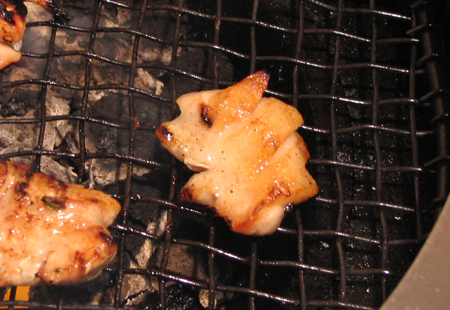
After the movie, Sachi and I went out for yakitori. By chance a piece of chicken on the grill looked like this:

1207-Yakishiba

That looks suspiciously like a Shiba Inu head! And it was tasty, too.

See’s in Japan

December 12th, 2007 4 comments

As Sachi and I get ready for the trip to the United States, something we’re planning to buy in the U.S. is See’s candies. If you don’t know about See’s, then I pity you–they sell, in my opinion, the best chocolates in the Universe. I taste a Godiva’s or any other chocolate, and it pales in comparison. See’s is the ultimate chocolate, bar none.

Which is probably why I am so fortunate that they are not readily available in Japan, or I might be tempted more often. Even in my trips back to the U.S., I have to control myself. I have it down to a ritual: bring back a few pounds of candies, and ration them out to one piece a week, enjoyed slowly and thoroughly. Back in my skinny I-can-eat-anything days, I would easily down a whole pound of the stuff in a week, maybe three different purchases in the week on my way back from working at Green Library at Stanford. A bag full of a dozen or more pieces, and I would chomp through them in minutes, and then get ready for dinner.

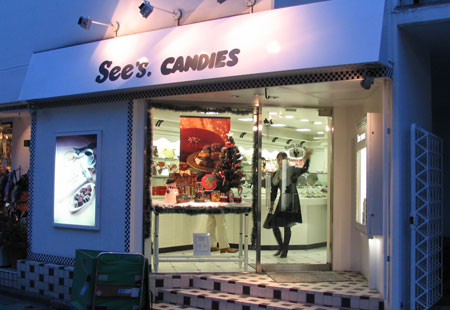
As I said, they are not readily available in Japan–but they can be gotten. If you are completely insane, or desperate. Or obscenely wealthy. They have a See’s Candy shop in Harajuku, on a side road on the north side of Omote-Sando Boulevard, nearer to the Omote-Sando Station end of the street.

1207-Sees1

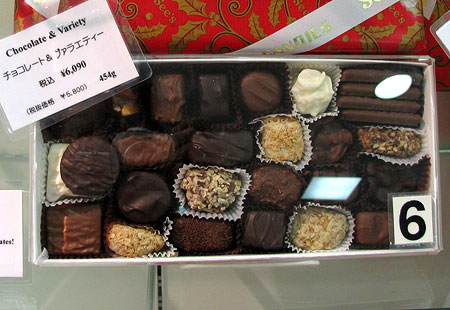
It’s not just the location that makes it less accessible: it’s the price. See’s in the U.S. is currently $14.50 (¥1620) per pound. In Japan:

1207-Sees2

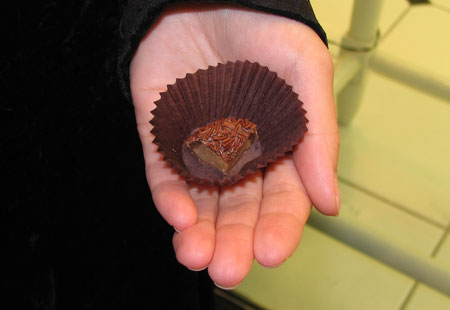
Yes, you’re reading that correctly: ¥6090 per pound, or nearly $55 per pound in U.S. dollars. Nearly four times the price in the U.S. Sachi and I had, between us, a Butterscotch Square, a Scotch Kiss, and a Vanilla Caramel Nut square. Each candy averages less than a cubic inch. Theoretically bite-sized, we made them last a bit longer. And for good reason–we paid about ¥930, or almost eight and a half dollars, for those three little pieces. Nearly three bucks for one candy.

One last comparison: in the U.S., See’s traditionally gives out a free sample to each customer. You can even request a specific candy to try. Here in Japan, for their exorbitant prices, you’d think they could afford to give you at least that much. But not really. They give out samples, but each is a piece cut into quarters–every customer gets a quarter of a piece of candy.

1207-Sees3

In reflection, one can understand the logic. For example, in Sachi’s and my case, we bought three pieces; were they to give us each a full candy as a sample, that would have equalled two-thirds of our purchase, or supposedly $6 worth of candy.

Not that they can’t afford it; my brother and his wife had some See’s air mailed to them recently, and it cost less than half of what it would have from the Harajuku store; surely See’s can cut that cost even further. They are profiting from the position as a luxury product.

Just as well; I would likely lose more than a few years of my life were I to buy the stuff and eat it more often.

Categories: Focus on Japan 2007 Tags:

Asukayama Park

December 1st, 2007 5 comments

Sachi and I took another of our weekend walks to nearby neighborhoods today. It’s becoming a bit of a new habit of ours; we started with an evening walk to nearby Otsuka Station, and got more ambitious with a walk back from Rikugien, then a walk around Meiji Jingu and Harajuku. Today we followed up by going to Oji, mostly walking around Asukayama Park before walking back home via Meiji Boulevard. Using the Google Maps Distance Calculator, I figure that we walked 4.5 miles (7.2 km) all told. Not bad. As usual, I have photos.

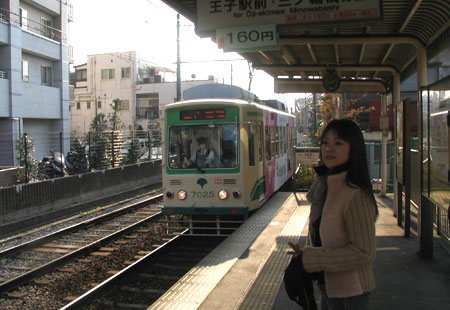
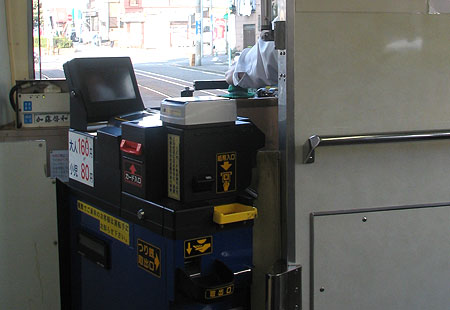
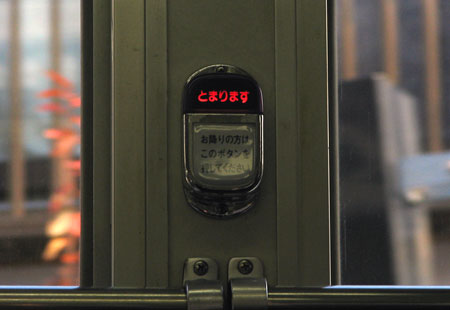
We started by taking the train in–we figure that it’s best to leave the long walk for the return, so we can avoid getting too tired too soon. This time, we used the Toden Arakawa Line, a light rail line that goes from Waseda, through Ikebukuro, all the way over to Arakawa near Minami Senju. The light rail is run like a bus line, with a single price no matter how far you go, paid at the door. Even the interior looks like a bus, from the money box to the stop buzzers.

1207-Asukayama-Toden-01

1207-Asukayama-Toden-03

1207-Asukayama-Toden-02

1207-Asukayama-Toden-04

1207-Asukayama-Toden-05

1207-Asukayama-Misc-03

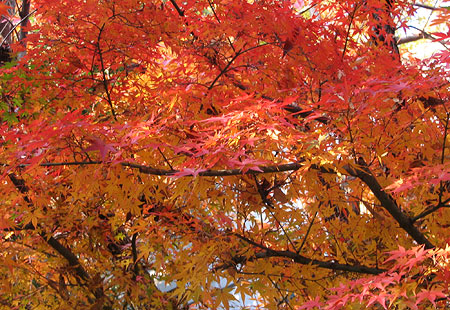
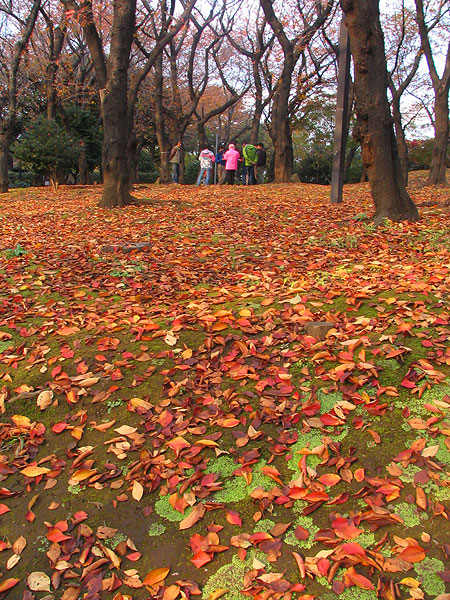
Asukayama Park, along the west side of Oji Station, is a very nice, largish park with tons of trees (including lots of Cherry Blossom trees, should be pretty in Spring). There’s a historical residence and garden, a large playground for kids, and some nice paths through green-filled areas. They make very good use of what space the park has. And we are still enjoying the Autumn colors, of course.

1207-Asukayama-Misc-02

1207-Asukayama-Misc-08

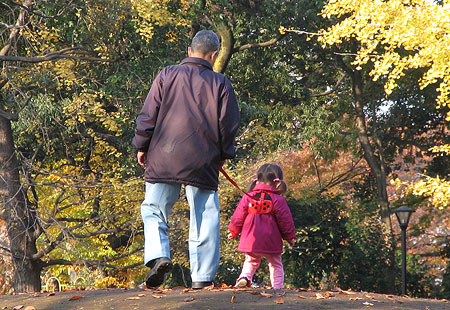
We spotted some grandpa leading his granddaughter around on a leash.

1207-Asukayama-Misc-01

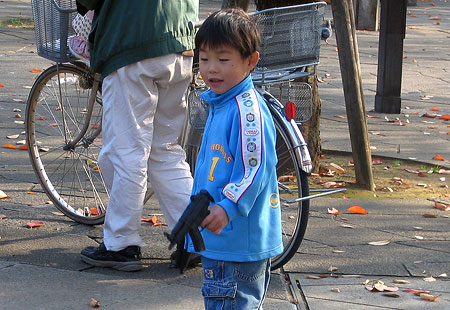
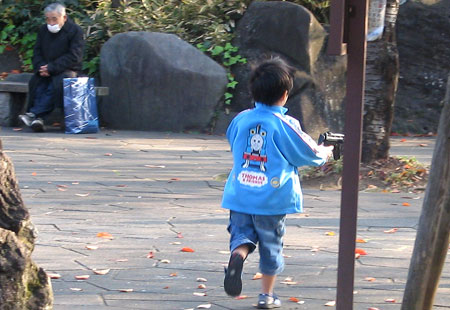
And there was a little kid running around shooting pigeons and passers-by with his two guns.

1207-Asukayama-Misc-04

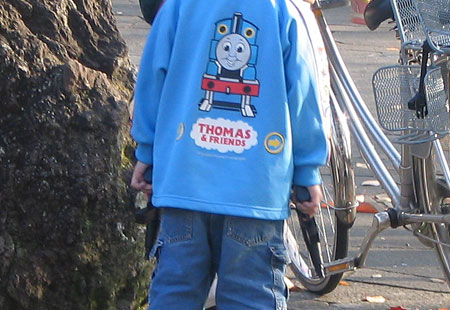
Wearing his gang colors, I presume:

1207-Asukayama-Misc-05

1207-Asukayama-Misc-06

There was also a group practicing Taiko drumming:

1207-Asukayama-Misc-07

And we spotted what has to be the nicest-looking public restroom ever:

1207-Asukayama-Restroom

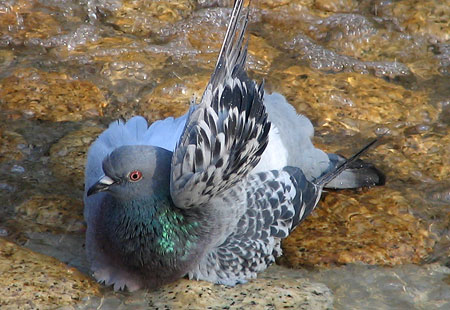
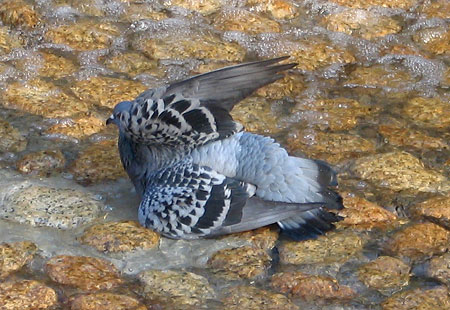
Then there were the birds. Pigeons all over the place, but we spotted one doing something bizarre in a pond:

1207-Asukayama-Pigeon-03

The bird was wading in the pond, its belly fully in the water, and was constantly taking one wing and extending it fully over its head, until it rested over its other side. It was like some kind of pigeon yoga. At first we thought it was injured, but it showed no other signs of injury, and alternated between left and right wings. It was really weird to watch.

1207-Asukayama-Pigeon-04

1207-Asukayama-Pigeon-02

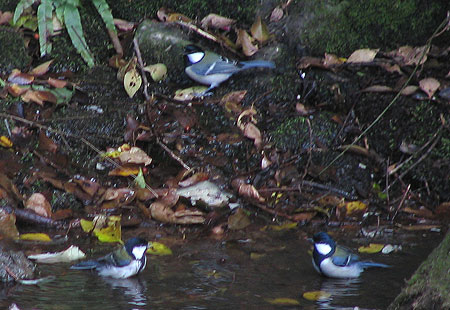
When we got to the small pond set against the eastern slope of the park, we saw dozens of Mejiro (Japanese White-eyes) and Shijugara (Great Tits) bathing and drinking.

1207-Asukayama-Shijugara-01

1207-Asukayama-Mejiro-03

1207-Asukayama-Mejiro-04

1207-Asukayama-Mejiro-01

To close out, a snapshot of Sachi and me at the park.

1207-Ls01

Categories: Focus on Japan 2007 Tags:

Meiji Jingu, Part 3

November 25th, 2007 Comments off

OK, the remains of the images from our walk through Meiji Jingu and Harajuku.

This guy was very much into his dance routine. He had attracted a crowd of onlookers, and either he didn’t care or he was too into his routine to notice. It did not seem to be a performance for the crowd, as he was facing his vehicle the whole time. Kinda creepy, actually.

1107-Meiji Jingu-40-450

1107-Meiji Jingu-41-450

The “Free Hugs” people were also there, as they often are. Don’t know what their total deal is–whether they’re religious, lonely, or just feel that more hugs will make a better world.

1107-Meiji Jingu-43-450

This is Takeshita Street. Many visitors to Harajuku only walk the main street, Omote-Sando; this street is a few blocks to the north, parallel to Omote-Sando. And crowded as hell. Lots of hip designer shops and everything.

1107-Meiji Jingu-44-450

One of the shops on a back street near Takeshita. No way of telling whether they intended to describe a piece of furniture, a sexy body part, a double entendre, or if this is just another case of Engrish.

1107-Meiji Jingu-47-450

Here’s some definite Engrish from a menu at Lion’s Beer Hall:

1107-Meiji Jingu-45-450

I’ve heard people say that the Chef’s Special is great!

1107-Meiji Jingu-46-450

The sauce, apparently, did not achieve total saucehood. I opted for the “quasi-sauce” under the “peckish” section of the menu.

During our walk back from Rikugien yesterday, we spotted a blimp and had trouble identifying it. We saw the same blimp today several times. Apparently it makes daily runs over Tokyo; if you live in the area, you may have seen it.

1107-Meiji Jingu-48-450

1107-Meiji Jingu-49-450

Sachi and I were curious as to how much it would cost to ride the thing. I went to their web site and checked it out. There are nine seats on board, and cruises run from 90 minutes to two hours. The cost, per person, is ¥126,000 to ¥147,000 (about $1150 to $1400). Flying round trip between Japan and the U.S. is cheaper. So, we’ll likely pass on that one.

Categories: Focus on Japan 2007 Tags:

Meiji Jingu, Part 2

November 25th, 2007 Comments off

Apparently, this weekend’s holiday stretch served for some as the year’s Shichi-Go-San (“7-5-3,” literally) celebrations, where 3- and 7-year-old girls and 5-year-old boys are dressed in kimono (the boys’ are called hakama), given special candies, and brought to shrines to pray for their long life and success. Officially on November 15th, it is possible to celebrate the tradition a bit early or late; there was a lot of evidence of families getting it done a bit late.

1107-Meiji Jingu-16-450

1107-Meiji Jingu-17-450

1107-Meiji Jingu-18-450

1107-Meiji Jingu-19-450

1107-Meiji Jingu-20-450

1107-Meiji Jingu-21-450

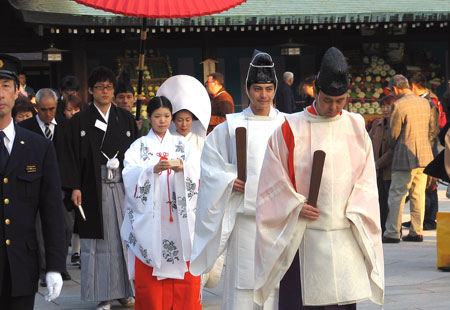
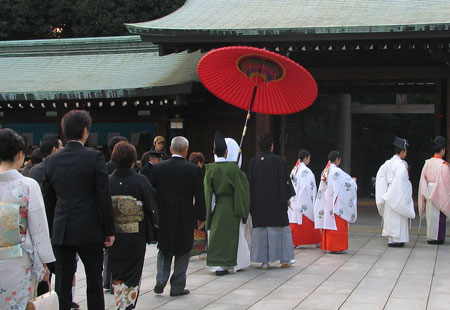
We also saw some weddings in progress. The bride and groom would follow the priests and shrine maidens leading a procession of family across the center of the shrine every so often–a very public kind of wedding. This is a common thing at the shrine; you see them all the time. It led me to wonder how much it costs to get married there; there are no reports on cost that I can find on the ‘net.

1107-Meiji Jingu-22-450

1107-Meiji Jingu-23-450

That’s mom holding the bride’s hand.

1107-Meiji Jingu-24-450

1107-Meiji Jingu-25-450

1107-Meiji Jingu-26-450

Here are other miscellaneous images from the shrine:

1107-Meiji Jingu-27-450

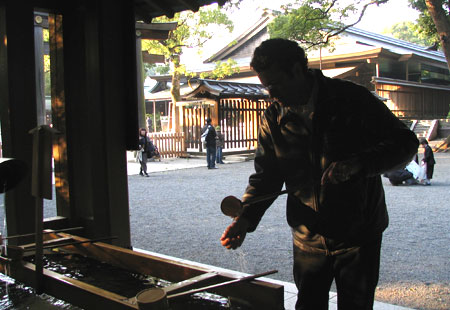
When you enter a shrine in Japan, you’re supposed to wash your hands in a little purification ritual. Wash one hand with the other, then reverse, then take a sip of the water (usually people pour into their hands first, then sip).

1107-Meiji Jingu-28-450

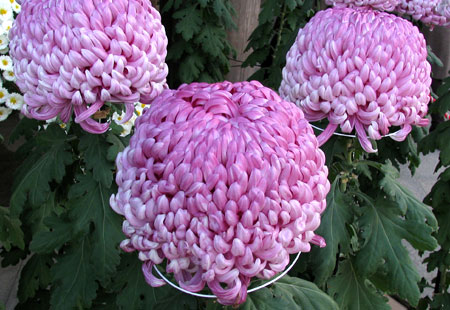
Chrysanthemums on display; there were a lot there, in kind of a show or something. The Chrysanthemum represents the imperial family in Japan.

1107-Meiji Jingu-29-450

There was also some kind of produce festival going on, with giant heaps of vegetables and various farm produce from different prefectures around Japan.

1107-Meiji Jingu-30-450

1107-Meiji Jingu-31-450

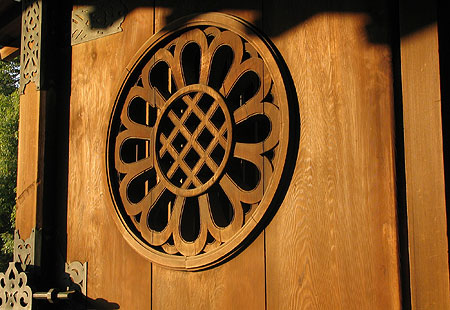
Beautiful woodwork on the shrine doors, caught just right in the late afternoon sunlight.

1107-Meiji Jingu-38-450

1107-Meiji Jingu-39-450

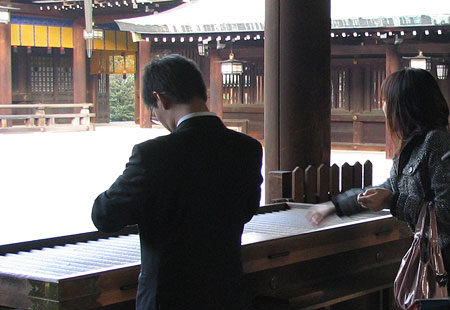
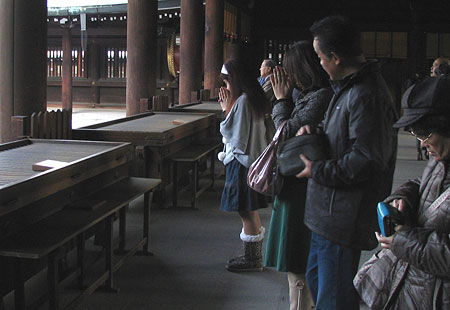
The deepest area of the shrine visitors come to always have the money boxes; you throw in your coins, clap your hands twice, then pray. For the three days at New Year’s, Meiji Shrine is swamped. A special train platform that leads directly into the park is opened, and the crowds are dense for the whole time. It is so hard to get past the crushing throngs at the very front where the money boxes are, many people simply give up trying, and instead toss their coins from several meters back. The shrine lays out tarps around the money boxes to catch the excess, but you have to assume that a lot of people near the front get pelted with coins on the backs of their heads.

1107-Meiji Jingu-34-450

The south gardens, requiring a ¥500 yen fee to enter.

1107-Meiji Jingu-35-450

1107-Meiji Jingu-36-450

1107-Meiji Jingu-37-450

1107-Meiji Jingu-33-450

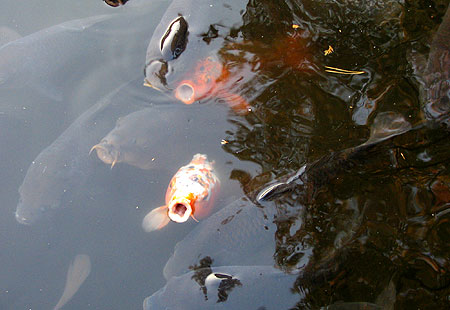
Carp in the south garden lake. These things grow to huge sizes. Conditioned to receive food from humans, they cluster when they sense anyone walking up, their gaping maws shoved out above the water in the hopes that some morsel-tossing human has good enough aim.

1107-Meiji Jingu-32-450-1

That’s more than enough for one post. I’ll post Part 3 soon, with some images from after the shrine visit.

Categories: Focus on Japan 2007 Tags:

Meiji Jingu, Part 1

November 24th, 2007 Comments off

Sachi and I went on another walk-about-town today. This time we chose Meiji Jingu and Harajuku; on the way back home, we stopped at Lion’s Beer Hall and had dinner out.

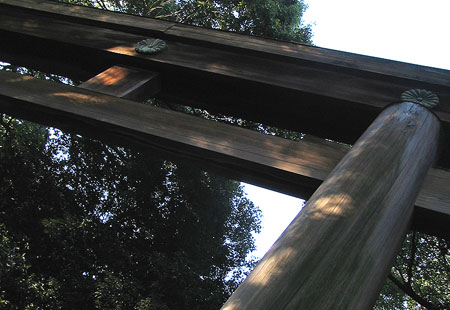
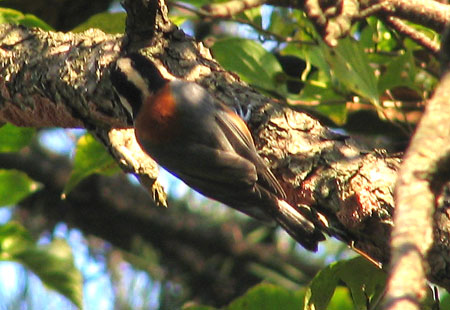
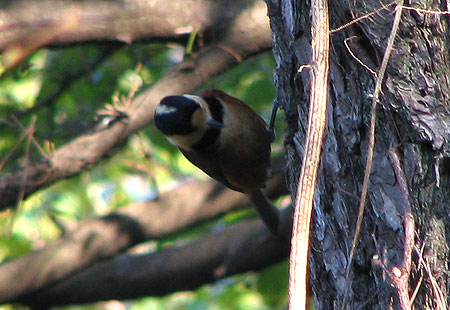
It was a pretty productive day in several ways. Meiji Jingu turned out to be very good for birdwatching today (especially the open fields at the north end; look for birds along the treeline and the lakeside). I ran into a small flock of colorful Varied Tits in a tree, which often pecked at the tree trunk like woodpeckers and jumped to the ground to forage. There was a Kingfisher in the south gardens, and I spotted a fully-colored male Daurian Redstart, a first for me. At the shrine proper, we saw several marriages in progress, and a lot of people dressed up.

In Harajuku, we looked around for winter stuff for me–gloves, a scarf, and a wool cap–but found too little that was satisfying, and all priced too high. Then we ran across a big Daiso, a shop which is usually 100-yen (like a 99-cent shop), but this one had stuff for more than that, including a wool cap and a pair of gloves for 200 yen each, and a scarf for 300 yen. So, mission accomplished.

1107-Meiji Jingu-01-450

1107-Meiji Jingu-02-450

1107-Meiji Jingu-03-450

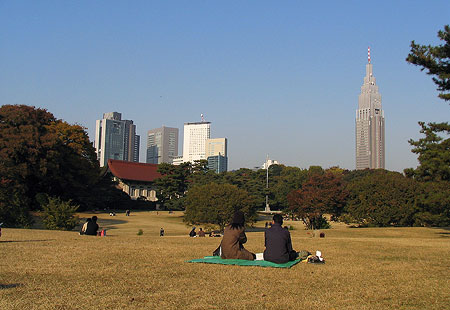
The north side of the park. It was nice to sit down and soak up the sun. The rest of the park is in such shade from the trees that it’s easy to think it’s almost evening. There was a police or security guy here whose job, apparently, was to walk up to couples who were snuggling too much and tell them to knock it off.

1107-Meiji Jingu-05-450

There were at least half a dozen Varied Tits flitting around and under a tree along the field’s treeline. Usually skittish birds, they were unusually easy to photograph. Several seemed to be pecking away at the trunk and the larger branches.

1107-Meiji Jingu-04-450

1107-Meiji Jingu-06-450

1107-Meiji Jingu-07A-450

I was startled to see this Daurian Redstart. I was walking along the edge of the pond and bam, there he was, just sitting there. I’ve spotted females before, but never males in full plumage like this one. And he was very much agreeable to posing for quite some time.

1107-Meiji Jingu-07-450

1107-Meiji Jingu-10-450

Kind of reminds you of Dennis Rodman, doesn’t he?

1107-Meiji Jingu-11-450

1107-Meiji Jingu-12-450

1107-Meiji Jingu-13-450

These Mallards were okay, but I just like the whole photo, especially how the water turned out. Click this for a larger image.

1107-Meiji Jingu-14-450

I caught this Kingfisher at extreme range. He had staked out the lake in the southern gardens (you have to pay ¥500 per person to get in).

1107-Meiji Jingu-14A-450

I’ll finish up here for today, and post tomorrow with photos of the shrine proper, and a few other things we spotted as well (including some Engrish).

Categories: Birdwatching, Focus on Japan 2007 Tags:

Rikugien

November 23rd, 2007 1 comment

Sachi and I visited a nice park a few stations down from where we like. The park, Rikugien, was created in 1695 and donated to Tokyo City in 1938. It costs ¥300 to get in.

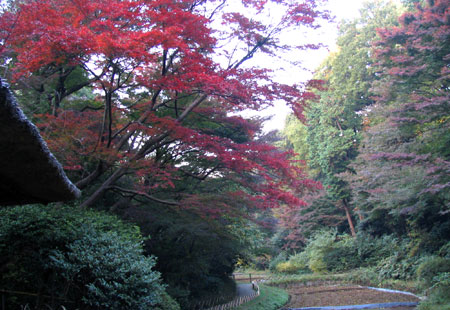
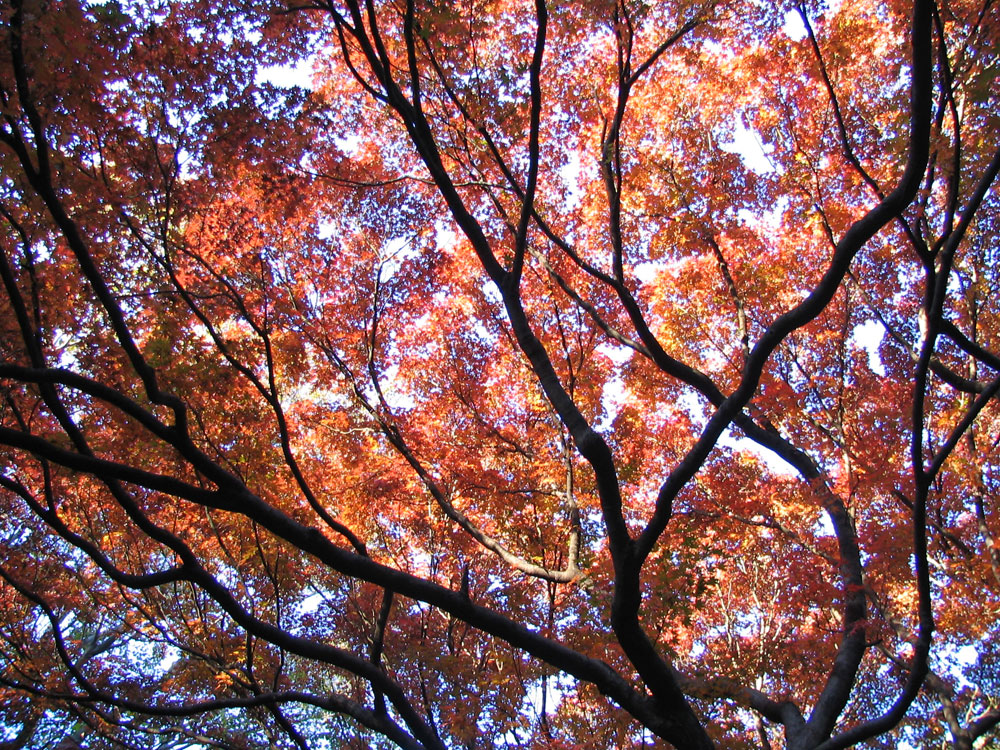
A lot of people were taking photos of the trees showing their autumn colors; there were some really beautiful sights in the park. A few of the pictures below have 1000-pixel blow-ups if you click on them.

1107-Rokugien-10-450

1107-Rokugien-08-450

There were a lot of people at the park today. Probably this was due to the day being the start of a 3-day holiday weekend, along with some sort of evening “light up the park” festival, which Sachi and I did not stick around for.

1107-Rokugien-12-450

1107-Rokugien-13-450

1107-Rokugien-02-450

1107-Rokugien-01-450

1107-Rokugien-11-450

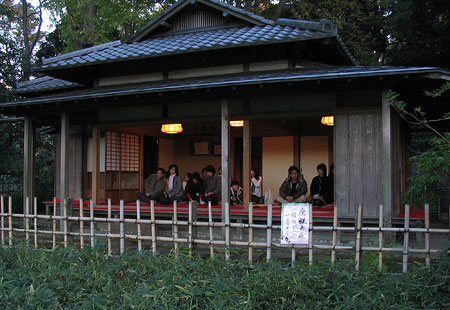
There were several tea houses in the park; you could buy some tea, and sit and enjoy the view.

1107-Rokugien-14-450

I like this one. The sun was setting behind the trees, and made it look like a fire was burning behind them.

1107-Rokugien-09-450

1107-Rokugien-07-450

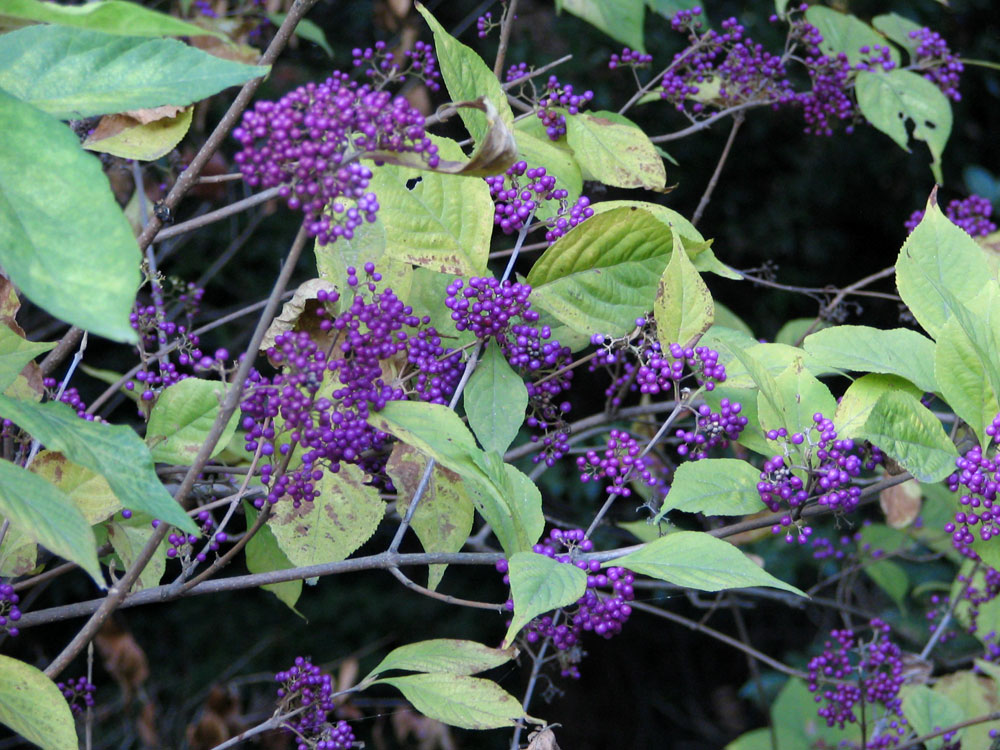
This bush is called “Murasaki Shikibu,” in part after the famous author of “The Tale of Genji,” and in part because “murasaki” is Japanese for “purple.”

1107-Rokugien-16-450

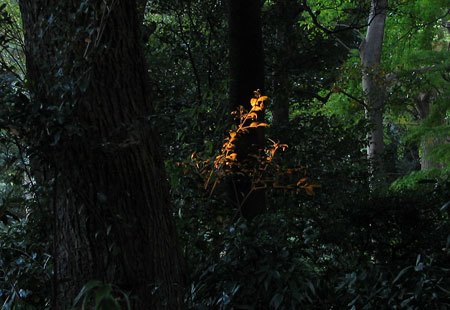
This single branch stood out, as it alone in the whole area was lit by sunlight.

1107-Rokugien-06-450

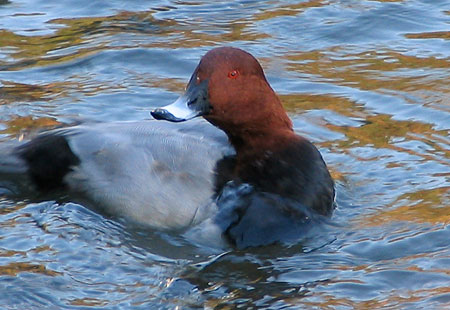
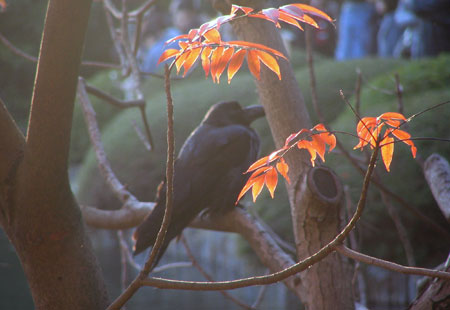
Birdwatching at the park was not bad, though all the birds were regulars, including tons of Bulbuls and Crows. There were the usual Spot-billeds along with Tufted Ducks and a few Common Pochards like this one.

1107-Rokugien-05-450

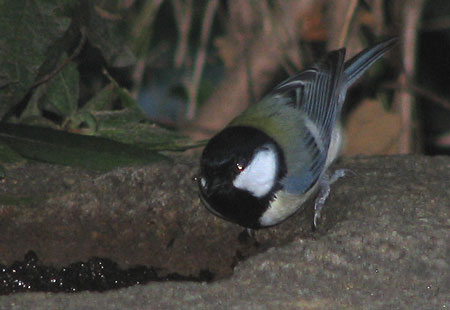
Sachi and I sat not far from a small water source, and enjoyed this Great Tit coming to drink.

1107-Rokugien-04B-450

1107-Rokugien-03-450

1107-Rokugien-15-450

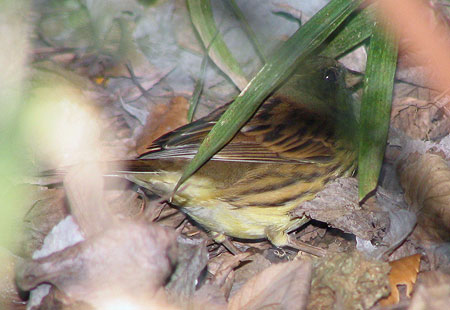
Just as we were leaving, we heard movement in the brush, and I caught this Black-faced Bunting foraging on the ground, as they are apt to do.

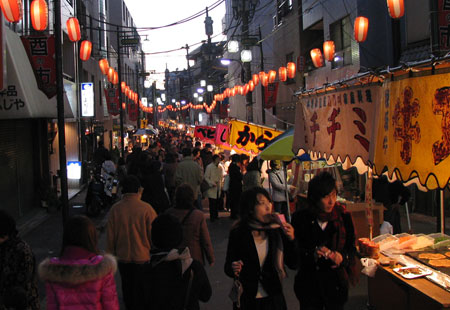
All in all, a lovely day. But on our way 2-mile stroll home, we ran across a small local festival, and decided to enjoy the length of it. These are always linear deals, with stalls lining the length of the festival, often repeating. Sachi and I bought a steak shish-kabob (okay but too fatty/gristly), and a small bag of “baby castella,” little bite-sized pound-cake style goodies cooked in a waffle-like grill (tasty!).

1107-Festival-01-450

1107-Festival-02-450

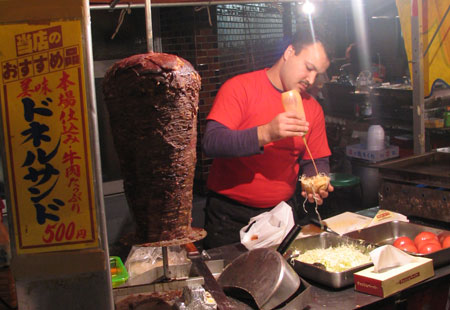
Why do those Near Eastern guys always have stands with those huge spits of meat?

1107-Festival-03-450

Very realistic toy guns are popular with some Japanese; these were sandwiched between video game cartridges.

1107-Festival-04-450

Umm, okay.

1107-Festival-05-450

The actual shrine the festival was based upon.
Categories: Focus on Japan 2007 Tags:

Eating Well

November 19th, 2007 Comments off

Apparently, the Michelin guidebook people have now crowned Tokyo to be the world’s new “culinary capital.” That may be so, but you know what? If you want really great food, going to a ritzy restaurant in downtown Tokyo may not be the best deal. Instead, think about staying at an inn in a resort town. Not big hotels, but little places with a dozen or so rooms. Sachi and I took two trips–one to Karuizawa last August, another time to Nasu Kogen in March this year. Both times, the food was excellent–just fantastic meals, multi-course dinners better than I’ve seen in expensive Tokyo places. Sachi is able to browse the tourism web sites and find coupon deals for places; the Karuizawa stay, for example, was $375 for two people for a 3-days-2-nights stay. Eating at top restaurants in Tokyo two nights in a row will cost you more than that. Of course, there’s no guarantee that any particular inn will have superb food; two places is nowhere near a representative sample, and maybe Sachi and I just got lucky. But considering that you also get a nice weekend holiday in a resort town out of it, it might not be a bad risk to take sometime.

That Could Make It a Bit Easier

November 19th, 2007 Comments off

The new Japanese immigration requirement for all non-Japanese passport holders (except for generational foreigners) to be photographed and fingerprinted seems to have a slight amelioration: instead of having to use the crowded “foreign passports” line, there will be a special “re-entry permit holder” for those who live in Japan but don’t qualify for quick pass-through. Via Debito.org:

Naritanewbooths

We’ll still have to go through the photograph/fingerprint nonsense, but–depending on how many booths they open up for us–the lines may not be so insufferably long.

Still, Sachi and I will be separated at the immigration lines, whereas before we could have gone through together.

Categories: Focus on Japan 2007 Tags:

Movie and a Dinner

November 17th, 2007 2 comments

Sachi and I just got back from a very nice night out. We saw Stardust, an unexpectedly very well-made fantasy flick, with equal parts of romance, comedy, and adventure, with a magical environment. Very good movie; it’ll make you laugh. And quite a cast: Ian McKellen, Peter O’Toole, Robert DeNiro, Michelle Pfeiffer, and even Ricky Gervais, along with a lot of new and not-so-well-known cast members.

Then we went out to The Hub, a British-style pub with branches all over Tokyo. They serve pretty good Fish & Chips, one of the only places in Tokyo to do so. Their food is great, but as can be expected in any pub in Tokyo, the cigarette smoke is oppressive. Despite catching the best seats, a pair at the farthest end of the “no smoking” section, we came out reeking of cigarette smoke. Next time we’ll have to see if the place does take-out.

Still, it was a nice Saturday night out.

Categories: Focus on Japan 2007 Tags:

Unpainted

November 9th, 2007 1 comment

Paul just blogged on painting the walls of your house, and as I read it, I thought about whether or not this would ever apply to me. And then it struck me: I have never seen painted walls in Japan. At least not that I can recall. Every apartment, house, and office where I took notice, wallpaper was used. Usually it’s plain, textured wallpaper. A few times I have seen walls that look like a texture was sprayed on. But I do not recall ever having seen a painted wall. As much to the point, I have never seen much of a house-paint display in any “home center” store in Japan.
Sachi confirms this: painted walls in a house are a special thing in Japan. They exist, but are not common at all.
Hmm.

Categories: Focus on Japan 2007 Tags:

It Wasn’t To Keep the Pavement Clean, That’s for Sure

November 6th, 2007 6 comments

Japanese people remove their shoes when entering a home, that much most everybody knows. But this one took even me by surprise, even after all these years in Japan: Japanese people remove their shoes before committing suicide.

This afternoon, less than a mile from where Sachi and I live, a woman committed suicide by jumping off the roof of a department store. Even more unfortunately, she landed on a man on the sidewalk below–not surprising, as it’s a busy sidewalk. The woman died, and the man was knocked unconscious and is in serious condition at a hospital.

They knew fairly quickly it was a suicide, however, because they found the woman’s shoes on the roof from which she fell.

I asked Sachi about that, and she was unsurprised by the shoe thing–it appears to be common knowledge. But Sachi could not explain why it is considered normal or appropriate to take off one’s shoes in a case like that. Is it traditional? Is it ritualistic? Is it representative of something? Or is it plain old fastidiousness? Do only jumpers do this? What about people who suffocate themselves in cars, do they remove their shoes first?

Anyone who knows about this, let me know.

Categories: Focus on Japan 2007 Tags: