Archive

Archive for the ‘Focus on Japan’ Category

Japan Fun Fact #5

December 6th, 2004 5 comments

Ib2002
Photo from Japan Guide.

Japanese people typically do not take showers in the morning; they take a bath in the evening. The “bathroom” in Japan is exactly that; the toilet is always in a separate room, except in small apartments where there is a “unit bath.” The bathroom (again, aside from unit baths) consists of a large tub and a shower area. Most Japanese sit down on a stool for the “shower,” but don’t always use the shower head. One soaps up outside the tub, and either showers to rinse off or uses a small plastic bowl filled with water, poured over the head or shoulders, to rinse. Then one luxuriates in the tub, which has a water intake and outlet to circulate the tub water through a heating system to keep the water warm. In many Japanese families, the same water is kept for everyone (usually father first, smallest child last).

A few myths about Japanese bathing to be dispelled: first, Tom Clancy’s Debt of Honor (his last even semi-readable book, before he descended into mediocrity) aside, Japanese typically do not go to bath houses, especially with work colleagues. Sometimes people might enjoy the luxury of a special bath house, but otherwise bath houses (“sento“) tend to be for people with no bath at home. Second, Japanese rarely bathe in mixed-sex baths. It may be true still in a few small countryside villages and a few scattered hot springs (“onsen“), but not in most places in Japan. There is probably more mixed bathing in California, to be honest.

Categories: Japan Fun Facts Tags:

Japan Fun Fact #4

December 4th, 2004 Comments off

Back when I was a student at SFSU, even though I lived relatively close to campus and there was a major bus line that would take me right there, it was all too often a crap shoot as to whether I would be able to actually ride the bus. Sometimes it would never show up. Other times it would be so full the driver wouldn’t stop. Sometimes it would be 20 minutes late then three buses would come crowded together. Living relatively close to school didn’t change things much; you would make the decision to walk to school, and then the bus would show up and you would not be able to get to a stop in time to catch it. Not altogether a pleasant service in terms of reliability.

In Japan such things rarely happen. Just as trains are punctual and stop on a dime, so are buses. If the bus is two minutes late, it’s a surprising thing. Yes, it costs about $2 and they don’t give transfers, but that’s just Japan for you.

Jbus1

Bustix2

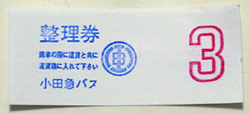
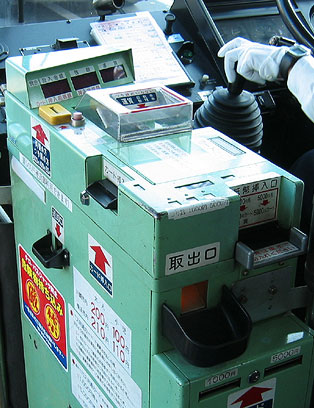
Buses in Japan have different flavors, but the most common is the pay-as-you-leave type. When you get on a bus, you get on at the back (as passengers leave via the front). You see two machines(see photo at below left); one hands out small paper-slip tickets (see at right), and the other takes prepaid bus pass cards (available in 1000, 3000, and 5000-yen denominations; you can’t usually buy a weekly/monthly pass for unlimited rides). The pass cards handle everything automatically. The paper slip tickets have a number printed on them. There is no one price for the bus trip; you pay more if you ride longer. There is an electronic display board at the front which shows the current fare for whatever number your paper ticket shows. The number, naturally, increases as you go on.

Bustix1 Bustix0

When you decide to get off, you push the button, as is normal (I’ve never seen pull-strings on Japanese buses), and at the stop, you go up to the front to pay your fare and get off the bus. The machine at front is able to make change (a nice alternative to American buses!) and sometimes even sell bus passes. Otherwise, it either accepts your bus pass and shows how much you have left on it, or there is a money drop-slot over a conveyor belt to take your paper ticket and the money for the trip.

My only problem with the bus is that the schedule often makes no sense. Where I live, there is only one line, going to the train station, and buses come every twenty minutes. Express trains also come every twenty minutes. So you figure that it’d be natural for the two to be coordinated. But of course not! The buses drop you off at the station about two minutes after the express leaves–wasting 15 minutes of your time. Nice if you want to have a cup of coffee, visit the ATM machine, and study the train lines before departing, but usually people don’t need to do that.

Categories: Japan Fun Facts Tags:

Those Darn Historians

November 29th, 2004 1 comment

This from Kyodo News via Japan Today:

Education minister Nariaki Nakayama on Saturday said history textbooks used in Japanese secondary schools contain passages that are extremely “self-torturing” and suggest “Japan has done nothing but bad things.”

He told a news conference he should judge textbooks from a “neutral” standpoint given his capacity as minister in charge of screening textbooks. “Every country’s history has light and shadow. While we must reflect on bad deeds, we must not conduct education on the basis of a self-torturing historical perspective that everything that has been done was bad.”

So, exactly what is he referring to when he says that “everything” done was reported as bad? Was the Unification under Oda, Hideyoshi and Tokugawa represented as evil? Was the Meiji Restoration written as a bad thing? Was Japan’s post-war economic miracle never mentioned? Was the atomic bombing of Hiroshima and Nagasaki related as a bad deed done by the Japanese people?

I have the feeling that when Nakayama refers to “everything” done, he means “everything bad” that was done. For which he himself gives the answer: we must reflect on bad deeds. But by exaggerating to the point that “everything is represented as bad deeds,” he’s claiming an excuse to whitewash (excuse me–“view from a neutral standpoint”) some of the bad stuff–and you can guess primarily what he’s talking about. And no, it’s not the wars of the 6th and 7th centuries over the Soga clan’s rise to power. Something a lot more recent. Care to guess?

Categories: Focus on Japan 2004 Tags:

Japan Fun Fact #3

November 28th, 2004 4 comments

Some words get bounced back and forth between languages. A good example of this is karaoke. The word is a combination of the Japanese “kara,” meaning “empty” (as in karate, or ’empty hand’) and the English “orchestra,” shortened in Japanese to “oke,” the Japanization–minus the “r”–of the first two syllables of the word. (When compound foreign words are used in Japanese, each element is typicallly shortened to two syllables, as in “seku-hara” for “sexual harassment.”) As a result, we get a hybrid Japanese-English word, karaoke.

What’s funny is that when the word gets mangled even further when brought back into English. The original Japanese word is pronounced “kah-rah-oh-keh.” In English, it gets pronounced “carry-okie,” with the English “orchestra” bent almost beyond recognition.

Not that this kind of bending of Japanese pronunciation in English is uncommon. Many Japanese words spoken by English speakers are unrecognizable to Japanese people. Saké is pronounced sah-keh, not sah-kee. Kamikaze is pronounced kah-mee-kah-ZEH, not kah-mah-KAH-zee. And “harry-carry” is a completely mangled form of “hara-kiri,” pronounced “hah-rah-kee-ree,” with hard “r”s. But we do pronounce tsunami, sushi and tabi correctly. Though “Mt. Fuji-san” is redundant, as “san” means “Mt.”

Just so you know.

Categories: Japan Fun Facts Tags:

Japan Fun Fact #2

November 26th, 2004 Comments off

I never encounter it in daily life any more, and a lot of younger Japanese have never even heard of it, but in the 1980’s, there used to be an expression called “Christmas Cake.” Back then, the expression was used to describe unmarried Japanese women over the age of 25. In Japan, cake is a ‘tradition’ at Christmastime (along with love hotels and boxes or cooking oil, see this post). If it doesn’t get sold by Christmas–the 25th–then nobody wants it, is the idea. A rather rude and sexist idea, but it was the 80’s and at the time I was living in rural Toyama, and so it came up. I remember one young lady, named Miki, who worked in the office of the school I worked at. She married some guy through o-miai, a matchmaking tradition often used until recently in Japan. A matchmaker would try to match the bride a groom; the couple would usually not meet too many times before making up their minds to get married. At the wedding, in fact, the matchmaker usually has a special place in the ceremony.

All of this came back to me recently when I stumbled across the topic in this news story, which reports–and I have observed personally–that women in Japan today don’t worry about their marriage age as much, and Japanese men are not quite so obsessed with age when choosing a spouse–significant reasons why the term “Christmas Cake” isn’t heard much anymore.

Categories: Japan Fun Facts Tags:

Japan Fun Fact #1

November 23rd, 2004 1 comment

The name “Godzilla” (who will make his ‘sayonara’ appearance in Godzilla: Final Wars coming out in a few weeks) is not a randomly chosen one. In Japanese, by the way, it is pronounced “Gojira,” and is not about God or reptiles. It is a composite of two words: “gorilla” and “kujira” (Japanese for “whale”). We can only assume that, in the story, a gorilla mated with a whale, before or after being zapped with radiation. Gojira became “Godzilla” when the film was first brought to the United States. The film series was prompted by a 1954 incident in which a Japanese fishing boat was exposed to fallout from an American H-Bomb test at the Bikini Atoll, killing 1 of the 23 crewmen and making the rest seriously ill. For the Japanese, Godzilla has represented nature’s revenge against the nuclear weapons that America used against Japan at the end of WWII.

Categories: Japan Fun Facts Tags:

Ambush

November 17th, 2004 2 comments

Saw these fellows laying in wait the other day. The embankment they’re next to overlooks an underpass. The underpass has two lanes, separated by a yellow line. On days with good weather and heavy traffic, these guys wait up here on their perch, scouting the traffic below. They’re looking for motorcycles that cross the yellow line. A completely innocuous offense, never any danger–the underpass is no more dangerous for lane-changing than anywhere else on the street where there’s no yellow line, but it’s a rule, and the rules rule here. So it is a technical offense, and you can get a ticket for it. So the cops take up their perch and hand out a steady stream of tickets.

Their position is well-chosen: though it’s not clear in the photo above, they’re overlooking the bottom of the underpass just after the road that crosses over it (see right). To see them, a driver would have to look up over their left shoulder just as they come out from under the overhead street, and none do; the cops, meanwhile, have a bird’s eye view of people as they drive by. In other words, it’s shooting fish in a barrel.

The ticketing in fact makes no real sense. The offense, as I mentioned above, is a technical one and poses no more danger than any regular merge in traffic. It’s not a high-danger area–I go past there every day, and that’s not where accidents happen or where traffic is at its trickiest. Furthermore, there will never be any end to offenders–too many new people going through. Nor will it “teach a lesson” to any regular drivers–the cops are always in the same place, every time, so when a driver spots them once, they know where the cops will always be–which in fact frees the drivers to break traffic laws elsewhere, confident in knowing where the cops are located.

The only reason they are in that location is because it’s easy to catch and fine people. Period. That’s it. I’ve noted this kind of thing before, in this post from a year and a half ago. But it’s nice to note that their consistency hasn’t waned. Too bad their incompetence or uselessness hasn’t either.

Categories: Focus on Japan 2004 Tags:

Arts Day Festival

November 15th, 2004 1 comment

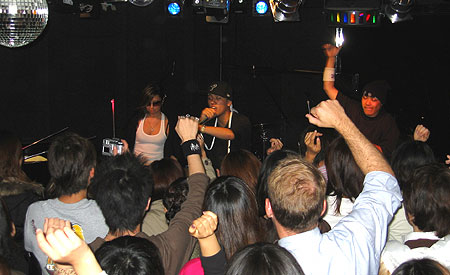
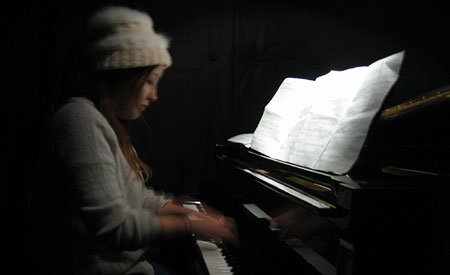
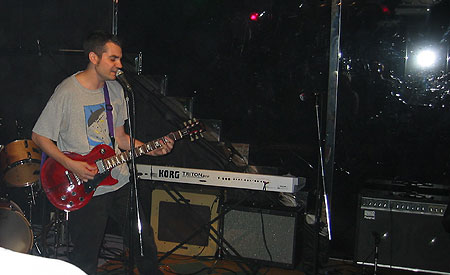
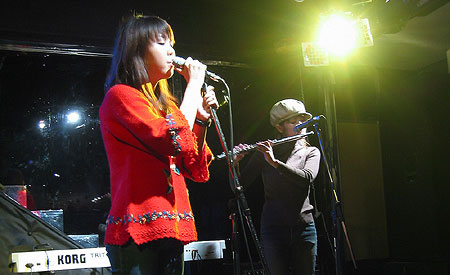
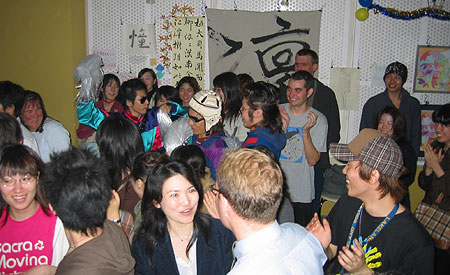
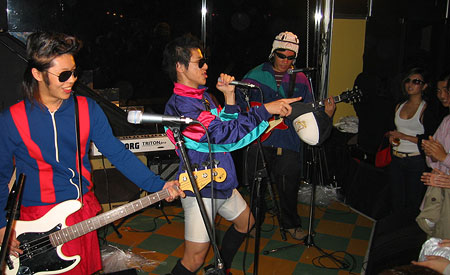
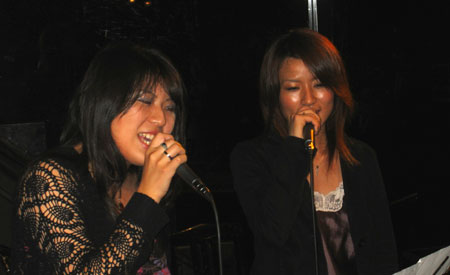
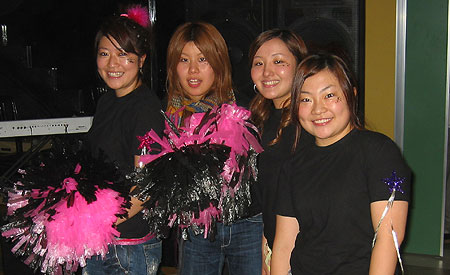
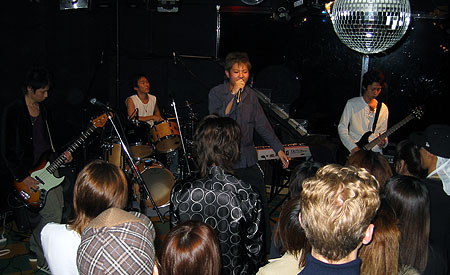
Some images from this year’s Arts Day Festival at the college where I work. You’d be surprised by the talent that exists around you but you don’t know because you don’t see it… until a day like this. Or like the first Arts Day last year.


A gospel choir


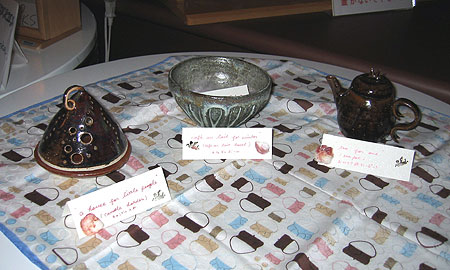
Pottery, among various crafts displayed by the students


A hip-hop group


Iyo at the piano


Roger rockin’ down


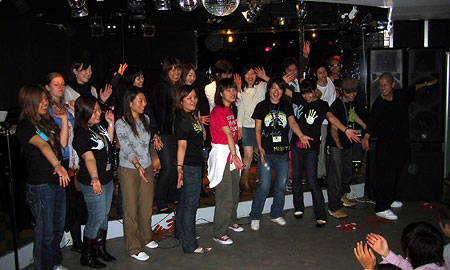
An appreciative crowd, with more artwork displayed along the walls


A cheerleader group


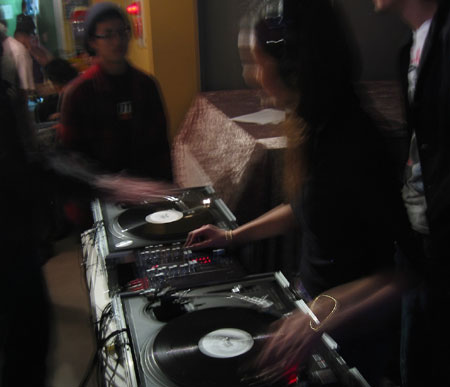
…and a versatile deejay.

My own contribution was a 16-minute video of the students preparing for Arts Day, shot by Iyo, Hitomi and Moto, which I edited together, adding music, transitions, and effects. The video is linked to by the image below. It is a QuickTime movie (QT required, if you do not have it installed already), and although compressed and reduced in size, is still 44 MB, at 17 minutes running time. After watching it, you may have a better idea as to why I did not blog much in the past week or so–it took a lot of time to put it together using nothing more than iMovie.

Note: the movie was not displaying properly, but is now fixed.

Categories: Focus on Japan 2004 Tags:

You Don’t Miss It

November 8th, 2004 2 comments

Something happened to me tonight that rarely ever happens in Japan: I got panhandled. When I lived in San Francisco, and especially when I went downtown, panhandling was a daily nuisance–and you quickly learned never to give them anything, unless you enjoy being followed around for ten minutes by an annoyingly persistent bum making ever-increasing demands for larger denominations to be handed over. I once tried to give a guy what spare change I had, and he kept upping the ante with slick sob stories and lies about when local eateries closed, until he finally tried to convince me to give him $20, but he’d pay me back–he actually told me that he’d just been released from prison and so he really needed the money, but if I gave him my address he’d be sure to mail me back the money. Really, he actually tried that on me. I don’t know if he was an idiot, or if he thought I was.

But here in Japan, it almost never happens. The first time it did was way back in the 80’s when I was traveling in Japan, and a street person approached me as I finished buying a train ticket and asked for change–a good perch for him, people could not easily deny they had change after collecting it from the machine. There may have been one other time in the intervening years, but if so it has receded far enough into distant memory that I cannot recall the specifics. So it was a bit of a jar to have someone come up to me tonight and ask for money. I don’t know if the panhandlers target foreigners, but I suspect they do–I have the feeling that other Japanese would probably simply ignore him. Not from callousness, but rather because his behavior is unusual and strange, and the automatic reflex is to ignore such things, pretend they aren’t happening. As for me, I had just finished dealing with an enormously frustrating situation (another story) and did not feel quite so generous–regretted in hindsight, actually. But not too much. Just like some elderly people on the train tend to spot me on the rare case I get a seat and come to stand right in front of me because they’ll know I’m most likely to give it up, I often tend to resent it when I feel I’m being hit up because of my ethnicity.

Fortunately, I don’t have to deal with the panhandling every day here. It’s something you don’t even realize is missing until you see it like I did today. But you really don’t miss it.

Categories: Focus on Japan 2004 Tags:

Finally

October 31st, 2004 Comments off

Something I’ve been waiting for for quite some time: a fiber optic connection to the Internet. Living out where I do, it usually takes a while for new stuff to get out here. This time, it’s F/O. Though this is probably not straight F/O, more likely vDSL, a combination of F/O to the building and then DSL into the building and to the room. They’ll have a rep here this weekend to take orders. The max claimed speeds are 16 Mbps and 70 Mbps (both “best effort”), and if I can get near even the 16, that’ll be a big improvement over now. Currently, I subscribe to a 26 Mbps ADSL service, but due to my 3km+ distance from the telephone office, the real speed is only 3 Mbps.

Categories: Focus on Japan 2004 Tags:

Another Quake in Niigata

October 27th, 2004 Comments off

Just a few minutes ago, another sizable tremor hit, and NHK has just reported that it is yet another powerful aftershock–a “6-” on the Japanese scale, maybe a 6.0 M quake or above on the Richter–at the same location in Niigata, where 31 people died, 3,400 were injured and more than 100,000 were made homeless. This tremor was predicted, but is not good news for those in the area, their situation already made worse by heavy rains yesterday.

Categories: Focus on Japan 2004 Tags:

Niigata Hit Hard by String of Quakes (Felt Across Central Japan)

October 23rd, 2004 1 comment

We are in the process of being hit by a string of strong earthquakes right now. At least one is a 6.8 (Richter scale, it seems) centered in Niigata, but it was felt strongly here. About 3-4 minutes later, I felt another smaller one, and then just now, another strong one, just as strong as the first. And these are up-and-down, not side-by-side quakes.

More as it comes in.

Update: just a few minutes later, I’m on the phone with my brother, and another one hits. that’s three fairly good-sized quakes, ranging from at least 5.5 and up to 6.8 on the Richter. I would not want to be in Niigata right now.

NHK is reporting that the last quake was also a 6+, though they only say it’s a 5.9 on the Richter.

Update (6:20): Tenki.jp is reporting that the second big quake I felt was a 6.2 on the Richter. They also report the other two quakes.

Update (6:35): Another one! This one just past 6:30, and it felt stronger than the others! I heard the NHK guy in Niigata on TV report it first, camera shaking and all, and then felt it here just a few seconds later.

Damn.

One TV station says it was a 6.3 (NHK concurs), [update: another quake I didn’t feel here but was a 5.0 in Niigata; another also hit later] making the sequence:

5:56 pm: 6.8 M
6:03 pm: 6.2 M
6:12 pm: 5.9 M
6:34 pm: 6.3 M
6:36 pm: 5.0 M
6:51 pm: 5.1 M

No reports of damage or injury yet, but this quake hit in the countryside some miles south of Niigata City, so it could be a few hours before we get solid info on exactly what the damage is up there.

Update (7:00): The quake is now being reported in the international press, the best item issued by The Scotsman. Trains have stopped across the region (not a weekday, but still a heavy traffic time).

NHK is now reporting some building damage in Niigata, a broken water main, and a minor train derailment, possibly a bullet train. At least five injuries in one area have been reported, but no fires.

Update (7:22): Correction, ten people with injuries and counting. Reports of mudslides and collapsed houses are trickling in.

Update (7:48): At least one death has been reported, as well as a number of fires. 50-60 people are now reported injured. We are hearing of collapsed walls and fences and other damage. Some areas are affected by a power outage, other reports have electricity on but street lights out. The derailment was indeed a bullet train, with cars #1 and 9 going off the tracks, but it seems like there’s not much damage there, no injuries on the train. There is also a report of a partially collapsed expressway. The train left Tokyo at 4pm, and was scheduled to arrive in Niigata at 6. Aftershocks–some of them over 5 on the Richter scale–continue to rock the area. A 5.2 hit at 7:36, and now reports are coming out of a low-6 quake hitting at 7:46.

Categories: Focus on Japan 2004 Tags:

Never Tear Your Popliteal in a Typhoon

October 20th, 2004 3 comments

So I’m walking to the train station, I see the elevator opening while I’m still a little distance from the entrance, and I take off at a jog to catch it.

Suddenly, something hits my left calf muscles hard. Like a small, heavy metal ball had just been thrown at high velocity smack at the center of the calf. I turn around to see who did that, but no one is there, and within a second I realize sickeningly that nothing hit me–rather, something in my leg had just snapped. Never a jolly thing, that.

It’s not that bad at first, just like most muscle strains and pulls I get, but I know that it’ll hurt like heck in the morning. By the time I get home, it’s already too painful to walk on anymore. No swelling or bruising, just debilitating pain, that’s all. I ice it, bandage it up, and elevate it on an old bundled-up blanket while I sleep, after figuring out (okay, my father figured it out) that it was the popliteal muscle, or tendon, or ligament or whatever, not that I’m too sharp on how those are different from each other. My level of understanding is, essentially, something snap bad go ouch, hurt long time no walk. This kind of thing apparently happens when you start off on a run or the like, and is more likely if you suffer pains in the muscle beforehand, which I had, twice in as many weeks.

The next morning I wake up early and go to the hospital, and the doctor turns out to be more of what I expect from the Japanese medical schools than the doctors I have been lucky enough to get recently. This guy essentially echoes everything I told him that I found out already on the web, but he gave me painkillers and crutches. Not much else he could have done, I suppose. He did seem willing to do an MRI, but I figured it would be way expensive and in the end would mean pretty much nothing.

All this as typhoon #23 is starting to hit, meaning I can’t depend on traveling in good weather, and with crutches, that means no umbrella. And I have to get to the station from home, from the other station to work, from the main office to another school a good 15-minute brisk walk without crutches away, then to the station, and then station to home. So I took five taxi rides. That or get soaked and have both my arms be incredibly sore tomorrow.

Hopefully, the tendon or whatever will heal quickly (my dad’s research says it’s a vestigial muscle anyway, and we can do without), and this will be the last d*mned typhoon in a way-too-long-and-wet typhoon season.

Sorry. I’m just not a rain person.

Categories: Focus on Japan 2004 Tags:

Not Even in Fiction

October 14th, 2004 3 comments

Japan has a bit of a blind spot when it comes to World War II and the decades of imperial expansion that preceded it. Although many of its citizens know about the time, look upon it with disapproval, and are not apologists, there is a distinct segment of society that is strongly against recognizing the sins of Japan’s past, and the majority of people in Japan seem to go along with it. Japan, like so many other countries, claims to follow Santayana’s warning: “Those who cannot remember the past are condemned to repeat it.” And like so many other countries, it heeds the warning wrongly. Santayana was telling us that we should remember the bad things we have done so that we can learn not to do them again. But nations tend to greatly dislike remembering their own misdeeds, led by nationalists and self-proclaimed patriots who assert national pride, but just as often suffer from denial.

Instead, nations profess to follow Santayana by remembering the misdeeds done to them by others. We all do it. Americans remember Pearl Harbor, but many protest when too much attention is paid to Hiroshima–not to mention the uproar we see now when anyone talks about American atrocities in Vietnam. Israel remembers the Holocaust, China remembers Nanjing, and so on. We memorialize and even aggrandize our victimization, and whitewash or tone down the darker parts of our own past actions. It is my assertion that this interpretation of Santayana is not just mislaid, but is opposite to his warning and can lead to the very condemnation he foresaw. If a nation feels victimized, it feels the right to go beyond ordinary means to defend itself, to the extent of paranoia. If a nation forgets its misdeeds, it feels more certain that it can do no wrong because its people look at the past and see few or no wrongs. This is a dangerous combination that makes a country feel threatened and righteous in going to extreme ends to ‘defend’ itself–in short, it leads us to exactly the fate Santayana warned us against.

I have witnessed both elements of the equation a fair amount in Japan. Hiroshima and Nagasaki are memorialized here far more than Pearl Harbor in America; survivors of the American invasion of the southern islands such as Iwo Jima describe the terrible experiences they suffered; and the primary mention of Japan’s incursion into mainland Asia tends to be about Japanese people left behind after the war who suffered for so many years in Soviet prison camps. So much of Japanese suffering is focused on to a great extent, even in children’s fiction–I remember early on in my Japanese language studies being made aware of a manga, a graphic novel written for children called “Barefoot Gen,” which relates in grotesque detail the suffering of people in the atomic bombing of Hiroshima.

But today, a similar manga is being censored because the storyline includes a reference to the Rape of Nanjing as an actual historical event. You see, a strident segment of Japanese society vehemently believes that the Rape of Nanjing was a false story created to put Japan down, to shame it after World War II ended. No amount of documentary evidence, including photographs, countless eyewitnesses and even the writings and admissions of Japanese soldiers themselves can dissuade these nationalists from their belief that it is all a hoax. But unlike those who deny the Holocaust, those who deny the Rape of Nanjing here in Japan are not scoffed at, dismissed, or censured, No, those people here tend to be the ones who hold public office.

This is why the publishers of the Weekly Young Jump, a widely read manga, have decided to cut the story, which is a serialized story of a bureaucrat during the 30’s, a serial carried by the publication for the past two years. This edition was to treat the Massacre as a historical fact, and would include a photograph. But that won’t come out, and it was not due to massive public protest, but rather by a group of 37 local politicians who claim that the massive killing spree never took place, and who protested at the publisher’s office last week. The publisher now calls the photo to be used a “fake” and says the story and the photo will be edited.

Those of you who have doubts might want to read Iris Chang’s “The Rape of Nanjing.” For those who want rebuttal, this Japanese site provides one.

Categories: Focus on Japan 2004 Tags:

Damn, That Felt Big

October 6th, 2004 1 comment

The quake we just felt was a 5.8 on the Richter scale, depending on who’s saying, but it felt big
–the biggest one I’ve been in so far (again–they seem to be getting bigger as time goes by, or maybe just closer), this one almost up to get-the-hell-under-a-door-frame-now big. That one shook the whole apartment visibly–not quite enough to throw things off tables or out of cabinets, but it was close. So far, no reports of serious damage.

The quake was close, in southwestern Ibaraki, right close to where Tokyo, Saitama and Chiba are in proximity to Ibaraki. As far as I can figure, it was just 50 km (30 mi.) from central Tokyo, about 75 km from where I am.

Yikes.

Categories: Focus on Japan 2004 Tags:

On Ichiro, Baseball, and Japan

October 3rd, 2004 Comments off

I am very happy for Ichiro and his accomplishment; he seems like a nice guy, a great sportsman and is destined to be a major Hall-of-Famer.

As for the reaction of sports fans and the baseball establishment here in Japan, my enthusiasm is a bit more muted. The reason for that is the lack of reciprocity. Japan loves few things as much as a Japanese who travels to America and is a success, especially in breaking records or winning at a popular game. And I would be absolutely fine with that–if the reverse were just as sportingly accepted. But the fact of the matter is, much of Japan despises the foreigner who intrudes and threatens to break a native record. It is not openly spoken of, but it is acted out, by both sportsmen and by the fans.

When I first came to Japan in 1985, I remember the American slugger Randy Bass had come within one home run of breaking the record in Japan. The record holder was Sadaharu Oh, Japan’s Babe Ruth, who got 55 homers in 1964. Bass came within one home run of that record in the last few games of the season, and the last opponent his team played was the Yomiuri Giants–managed by Sadaharu Oh. A standing order was given to the pitchers: walk Bass. For two games, he was intentionally walked, and not allowed to try for the record. And it was generally understood that if it had been a Japanese player, he would have been pitched to. And the Giants were not in contention for the Japan Series, as I recall, so it was not strategic in that sense.

Can you imagine an American baseball manager in the same position? Imagine an American player, turned manager, telling his pitchers to walk out someone who challenges his record. The manager would be booed out of the stadium, even by the home crowds. But add to that a racial element, that he’s denying the challenger the record because of his race… there would be riots. It would be considered the nadir of sportsmanship.

But maybe that’s just Sadaharu Oh. In 1985, a lot of Japanese were behind him, but in 2001, when American Tuffy Rhodes had tied Oh’s record and was threatening to break it, other teams gave him shots, were fair to him. But the last two games of the season were against the Fukuoka Daiei Hawks–managed by Sadaharu Oh. And again, the American player was shut out. Oh claimed that he was “out of the loop” on the decision to pitch around Rhodes, just as he claimed in ’85, but there’s no doubt in anyone’s mind that the orders came directly from him. To his credit, Japanese baseball commissioner Hiromori Kawashima stated publicly that Oh’s actions were “completely divorced from the essence of baseball, which values the supremacy of fair play.” But no disciplinary action was taken against Oh, who still manages the Hawks today. If you ask me, he should have been fired and removed from any halls of fame he has been inducted into.

But it was not only the home-run record being denied, it was an entire system of treatment towards non-Japanese players. Umpires called strikes according to a much-expanded foreigners-only strike zone. Pitchers beaned foreign players far more than they did other Japanese. Fans would often shout racial epithets. And sports newspapers would alter the word 外人–gaijin (“foreigner,” or “outside person”)–to read 害人 (also pronounced gaijin, but meaning, literally, “harmful-person”) to the extent that the word itself had to be banned in the sport.

It was not just in baseball, either; sumo also reacted this way to successful Americans. When Akebono, Musashimaru and Konishiki, all Americans, made the top ranks of sumo, there was a great deal of resistance. Every time one of them won a match, the reaction by the fans were muted. Whenever a Japanese wrestler won against one of them, the crowds went wild, throwing their seat cushions around the arena in abandon, even when the winning wrestler was not all that popular. It kind of turned me off of the sport.

As always, please understand that I am not one of those moan-and-whine Americans who just hates everything about Japan–quite the contrary, I love Japan and I love the people here. But I won’t turn a blind eye to any flaw in the nation’s character here, any more than I would to national flaws in America. These things can only be changed by talking about them openly.

Maybe the game and the fans here have changed in the past 20 years, regardless of what Oh did a few years ago–but frankly, I don’t think it has changed all that much (ask Alex Cabrera, who ran into the same wall in 2002). When I see a foreign player in baseball or sumo (soccer doesn’t count–it’s not long-standing here, so there are few native records of note to break) do well and not only not be hindered, but to have as strong a following and as deep an acceptance as Ichiro has in the U.S., I will be impressed and encouraged.


Categories: Focus on Japan 2004 Tags:

Making the Bigs

September 30th, 2004 Comments off

Foreign universities based in Japan are soon to be accepted by Monbusho, the Japanese Ministry of Education. This is a big thing, as up until now, foreign university campuses based in Japan–even those with full U.S. accreditation–were not considered real colleges by the Japanese government. Students at these schools were not given privileges enjoyed by most Japanese students, particularly student discounts on train and bus passes and other student prices. Additionally, credit earned by these schools would usually not be transferable to Japanese colleges.

In order to be recognized by Monbusho in the past, one’s curriculum had to be at least partly in Japanese, and a good many other labyrinthine requirements had to be met.

With the new rules, foreign colleges in Japan can now have roughly the same privileges while not being bound to strict Japanese-style regulations, so long as the country of origin has their embassy representatives visit the schools and vouch that their curriculum is identical to the home campus’.

Branch campuses of foreign schools in Japan exploded in the late 1980’s before the economic bubble had collapsed; about three dozen U.S. colleges and universities had accredited campuses here. That soon changed as the economy went south, Japanese financial backers backed out, and standards plummeted. Schools started shutting down without warning, leaving students stranded in mid-semester. This snowballed into a nationwide distrust of the schools, which led to further recruitment losses and closures, until there were only a handful remaining. With the closure of Minnesota State in Akita last year and the closing of the University of Illinois at Carbondale in Niigata soon, there will be only two accredited American colleges remaining in Japan, both in Tokyo: Temple University, and Lakeland College (Japanese site)–the school where I myself work as an assistant professor.

Our school has been doing very well; our student body tripled in just four years after I started working here (not cause and effect, alas), although some of that gain was lost after 9/11 hit right as our 2002 recruitment drive was starting, and then the very next year, Bush started pushing for war in Iraq. Those incidents made many Japanese students and their parents nervous about safety issues. Since then, however, things have stabilized and numbers are again rising. The new expected Monbusho acceptance should go a very long way to helping us boost those number higher than before.

Additionally, Lakeland College has begun a new Study Abroad Program (Japanese page), in which American students come to live in Japan for four to eight months, while still earning credits from a U.S.-accredited college.

Categories: Focus on Japan 2004 Tags:

Don Quixote Has Changed

September 30th, 2004 Comments off

At least the store in Shinjuku on Shokuan Dori , which runs parallel to and north of Yasukuni Dori. They’ve cleaned up the image somewhat. For those of you unfamiliar with the chain, Don Quixote (Don Kihote in Japanese) is a chain of retail outlets that specializes in having tons of stuff of all kinds for cheap prices. Sort of like Walmart in the U.S., but with narrower aisles and less fascism.

Part of Don Quixote’s image is the cramped, closed aisles stuffed with all variety of merchandise, laid out in an almost maze-like fashion so that one never knows what one will run into next, and every shopping experience tends to be different from the last. Imagine a

The new makeover has cleaned up that image while still embracing the fundamental principal. The store is now much cleaner and feels less cluttered, with major aisles now much wider–though the meandering nooks and crannies are still there. Their food section is now much expanded, included a wider variety of foreign imports than before. Still not National Azabu or even Kinokuniya Supermarket, but if you haven’t been there for a while, you might want to check–though I don’t know if the makeover is limited to that one store…

Categories: Focus on Japan 2004 Tags:

Typhoon

September 30th, 2004 Comments off

Once again, I’m staying up way beyond the time I should. But I looked out the window and saw the typhoon moving away. It swept over us this evening, dropping heavy sheets of rainfall for hours, sometime even splashing against my dining room windows so i couldn’t see outside. (And took out satellite TV reception several times….)

And now we have post-typhoon clarity outside, starry skies and a receding swarm of clouds lit by the occasional flash of lightning within.

Should be good weather tomorrow.

Categories: Focus on Japan 2004 Tags:

Oh, Well, Naturally

September 26th, 2004 Comments off

Four years. For four long years I’ve been getting this hick-town-quality cable service. For four years I’ve paid them for really bad cable. Very few channels. Almost none of the good channels. For four years I’ve filled out and sent in those questionnaires about which channels they should get, and for four years they’ve consistently gotten nothing but the bottom of the barrel. Before I went to all the trouble of switching to satellite, I even asked them, point blank, when is there any chance of even one or a few stations getting changed. Nowhere in the foreseeable future, they told me. Not going to happen, they told me.

So I went out and paid about $300 to get the satellite installed. Just today I gave them back the cable tuner, closing my account (it had been prepaid until this date). And just today I open the new cable TV guide in the mail that arrived yesterday–they sent it to me for next month despite my cancelation. And now guess what?

That’s right. From November 1st, just a month away, they’re going digital (with an analog converter supplied), and they’re adding every single channel I wanted. Seventeen new channels, in fact. And they’re reducing their rates on top of that.

Do I have the worst timing you’ve ever heard of, or what?

Well, it’s not a complete loss. The Toshiba DVR/DVD recorder I got wouldn’t have worked with their service–probably–and the fact that it auto-records everything is something I have really started to appreciate.

But still, this couldn’t have happened one month earlier, or six months later? No one could’ve mentioned to me when I asked directly about this huge change which obviously they have been planning for a long time? I mean, for crying out loud.

Categories: Focus on Japan 2004 Tags: