Archive

Archive for the ‘Focus on Japan’ Category

Pay Garbage

September 18th, 2004 1 comment

When I first moved into my apartment building, something I considered a nice feature of the complex was the garbage removal. They had these big metal bins with covers so you could toss your garbage outside any day of the week, and not worry about the smell or crows getting at it. It was also easier for the garbage collectors; they could simply attach the bins to a lifting device on their truck, and it would all just slide in. They did it fast and didn’t have to get their hands too dirty.

But then, the city leaders of Inagi, in their infinite wisdom, decreed that bins like that could not be used. So we had to switch to the standard Japanese-style throw-your-garbage-by-the-side-of-the-street method, which stinks up the area and attracts crows and cats who fish through the garbage and make a mess, increasing maintenance costs. It’s harder for the trash collectors, too; they now have to sling every bag by hand, dealing with spillage and stink.

I would have thought that the city couldn’t go one worse, but I was wrong: now they’re telling us we have to pay for each bag of garbage thrown out. We can no longer use any garbage bag we please (say goodbye to pull-string bags, or to using grocery store bags, they get wasted now), we have to buy city-made bags at fee-inflated prices. It’s still relatively cheap–80 yen (about 75 cents) for ten grocery-store-size bags, 150 yen for double that size, and 300 yen for double that–but the point is that a price has now been set, meaning that price can easily go up anytime the city wants more money, and they inevitably will. This kind of thing should be paid for with tax revenues, at least then they can be honest about raising taxes. Though it is possible that this is a follow-up to the less-than-successful campaign of a few years ago when they tried to make everyone use transparent garbage bags and require people to write their names on each bag.

The change begins everywhere in Inagi City on October 1, and applies to burnable and unburnable garbage. Are there any other cities where they’re doing this?

Categories: Focus on Japan 2004 Tags:

Aftershock

September 7th, 2004 1 comment

A rather sizable aftershock, 6.4 on the Richter scale, has hit in the same place that the 7.3 hit just the other day. That one could be felt way over here in Tokyo as well, though it was more of a sharp jolt, and didn’t last very long.

Japan quake info can be found at Tenki.jp or at Hi-net.

Categories: Focus on Japan 2004 Tags:

Sizable Quake in Wakayama

September 6th, 2004 1 comment

Considering that Wakayama is about 400 km (250 miles) distant, and that I felt the tremor fairly strongly at that distance, I would not particularly want to be in Wakayama right now.

Preliminary reports put the quake at 5 on the Japanese scale. The Hi-net and Tenki quake web sites are still short on details. A tidal wave warning (up to 2 meters high) for the Pacific coast around Wakayama (near Osaka) is now being issued.

Update: Okay, the magnitude-5 reading was for land only, that was the strongest reading people had on the islands. The actual quake was out at sea, and was a 7.3 on the Richter scale, and happened right on the major continental plate boundary in the Pacific. Tidal waves up to 2 meters are due to hit in a few minutes and throughout the next hour.

Further update: Turns out there were two quakes, one at 6.8 and the other at 7.3. At least fourteen people have been reported injured, but damage and casualties are very low because the epicenter was in the ocean. So far, the tsunamis seem to be very mild. Nevertheless, more than 6,000 people in several seaside towns have been evacuated.

Categories: Focus on Japan 2004 Tags:

Well, That’s Something I Should Have Done Long Ago

September 4th, 2004 3 comments

The satellite installer guys are here now, and they got a really strong signal–I can get satellite after all. Four years after using the crappy local cable… I just had been told it was not possible before, so I didn’t try. Well, better late than never. Now to join SkyPerfecTV, quit the local cable, get the tuner box integrated into my maze of A/V wiring, and then maybe get that Toshiba DVR/DVD recorder…

Update: Unless…. A storm hit tonight–and the SkyPerfecTV reception fell to zero. Several times. I asked the installers specifically about this sort of thing, how much reception will be lost if there’s a storm, and they said, “just a bit.” Well, I don’t call 100% “a bit.” On the other hand, the weather service is saying that the rain hitting Tokyo now is unusually strong–and the regular cable did fizz out a few times itself. But it’s not encouraging. Anyone else out there have satellite TV, and your reception goes bad in bad weather?

Categories: Focus on Japan 2004 Tags:

The Guy From Kojima Denki

August 21st, 2004 3 comments

So, as I mentioned in my previous writings on getting satellite TV, I had the people at the electronics store come over to check if I could get SkyPerfecTV. It’s in question because there’s a large building next to mine that might or might not be in the way–looking at SPTV’s web page with a map locater, it might be blocking the satellite by just a few feet in one direction. So I went to the electronics store and asked them if they could do a check. It’ll cost ¥2000 ($18), they said. I told them that was OK, better than going through the hassle of buying and only finding out then that I couldn’t do it.

Now, $18 is not a king’s ransom, but since they tell me they guy could figure out if I’m able to get reception, I figure the guy will come over with a little electronic doohickey that could measure the satellite signal strength or something. So I wait the few days for the guy to come. (“Between 2 and 5pm,” they said–and he came just at 5pm. Typical.) The doorbell rings, I open up, and this scrawny little guy walks in. No gizmos. He pulls out a compass. Goes to the window I show him. Climbs outside, holds up the compass, says I won’t be able to get the satellite signal–the next building is in the way. But in saying so, he points in a direction that seems fishy to me. I tell him there’s another window, and he takes that in surprise, like he wouldn’t expect a place to have two windows. He checks from the other window and says, “Oh yeah, sure, you can get it from here! No problem! It’s perfect.” This sounds great to me–except he’s now pointing in an even more westerly direction than before to indicate where the satellite is. He’s pointing in a much different direction that SPTV’s web site indicates–they say it’s more to the south.

So I take him inside and show him the SkyPerfecTV web site, I show him the map page with the arrows showing the direction of the satellite. He looks at it, and something seems to dawn on him. He goes back to the first window, looks at his compass again, and proclaims I can get the signal in that direction, the direction from the web page; reception will be OK, he promises. But the direction he shows me now is way off from the direction he showed me originally. So I question him about how he got that–and he starts talking faster, using words I don’t know.

Here is where I explain to him that he has taken no readings that could possibly be even as accurate as the measurement I made on SPTV’s web page, and so how could he really know if I could get it or not? Unsure how to answer, he leaves, makes a phone call, and comes back. “You can’t get reception,” he explains. “The next building is too tall.” Now it’s time for me to explain to him that I never expected to see over the building, but rather just to the east of it. Again, he’s unsure about it. He goes outside and makes another phone call. He comes back in and proclaims, “it’s too close to call.” Well, hell, I could’ve told him that! I paid ¥2000 to have this joker who knows less than I do to tell me what I already know? I would at least expect him to know the general area of the sky which the satellite is in.

Fortunately, when I called up Kojima and told them about the fiasco, they promised to refund my money. Problem is, I won’t have time to collect on that before I leave on vacation. Hopefully in early September, they’ll still remember me and agree to give the money back. But for now, I’m still just as much in the dark. I just can’t figure out why they think they can do that, charge ¥2000 to have a guy who doesn’t know a satellite from a skyscraper to tell you fairy tales. Hopefully their guy who installs the units will know just a bit more then this guy. What scares me is that he might be the same guy.

Categories: Focus on Japan 2004 Tags:

The Streets of Tokyo

August 17th, 2004 8 comments

Believe it or not, the street you see at right is a two-way street. Go ahead. Look at it. See if you can figure it out. And for perspective, that white truck parked in the back on the right, it’s a mini-truck, no wider than an American postal jeep. And even two of those would have a hard time passing each other on this street–and yet, I saw a good deal of opposing traffic pass here.

Every twenty or thirty meters, there is an indentation in the street (you can see it at left in this photo, behind the parked scooters; the orange posts mark it). When cars come from opposite directions, the car most conveniently placed to get into the indentation does so, while the car from the other direction squeezes by. I know, but somehow they do it. No wonder you don’t see Winnebagos in this country. Once I rented a truck to move my stuff from one apartment to another–and got stuck on a street wider than this one. When he saw the trouble I was having, the driver of the car going the other way actually got out and volunteered to drive the truck down the street for me while his friend maneuvered his car. Embarrassing, but I couldn’t have made it otherwise–it takes real driving talent.

You might also notice the slight crook in the street in the photo here. Japanese streets are, more often than not, go in all directions; it is less common for them to be laid out in grids. And even those grids are more often than not irregular, with greatly differing block lengths, and tons of T-intersections, one-way streets, and dead-ends. But most streets seem to tilt and angle without any hint of planning or design, like they just grew there. And with no street names (except for large boulevards), no street signs (except for major intersections), and a confusing jumble of block numbers and area names, navigation can be extremely confusing. Take, for example, the sign shown at left. That’s what the intersection looked like, honestly.

Add to that the fact that some neighborhoods are designed with one-way streets and prohibited turns such that it is impossible to exit save by one labyrinthine path; that streets are rarely more than two lanes in one direction, and usually not that; that sidewalks are sparse and properties have six-foot walls along the street, creating blind corners galore; and despite the expenses and difficulties of driving, multitudes seem to have cars, creating traffic jams all over; and top it off with scant parking, some pay parking lots charging a few dollars an hour… I am constantly amazed that people drive cars in Japan.

Oh, and gas runs about $4 per gallon.

Categories: Focus on Japan 2004 Tags:

Turning Over a New Cicada

August 6th, 2004 2 comments

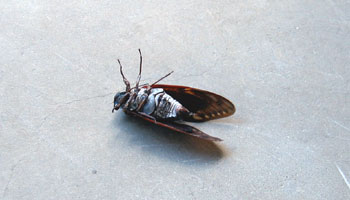
Every summer in Japan you get cicadas, or “semi” (蝉) in Japanese. Not the type that come out once every 17 or 18 years, this bunch comes out every summer, and man, do they make a lot of noise. The Japanese characterize this noise as, “meeeee, meeeee, meeeeeeee.” To which I then comically note how selfish they are. That is what Japanese people refer to as an “Oyaji gyagu,” (親父ギャグ) or an “old man’s gag.”

The cicadas, meanwhile, are everywhere, buzzing and mating. And as the mating cycle dies down, you start seeing a lot cicadas on the ground. But just because you see them belly-up, it doesn’t mean they’re done for–these cicadas, it so happens, have a very tough time righting themselves once they’ve got six legs in the air. I’ve seen them do it, but usually they just lay there, immobile and apparently dead.

So the thing to do–unless you really hate cicadas, that is–is to gently nudge them over with a toe, to get them righted. But be prepared to jump away, though: the cicadas will, unless really close to death, immediately start buzzing up and away in the apparent random fashion that bugs are wont to do.

Categories: Focus on Japan 2004 Tags:

Kamakura

August 2nd, 2004 1 comment

From the 12th to the 14th centuries, Japan was ruled from Kamakura by the Minamoto shoguns. Today, it’s a seaside resort (near Enoshima), and is famed for having a large, outdoor statue of Buddha. And that’s where I went last Friday with a friend. After enjoying some really good noodles (they make ’em in front of you) at a shop in Yokohama’s Chinatown, we headed over to Kamakura in the hopes that maybe the on-and-off Typhoon (#10) weather would clear well enough so we could enjoy the beach. Alas, no–even though we reached the beach and the sun was out, the waves were too high; a red flag was flying, meaning you can’t go in there, bub. And laying on the beach didn’t work too well, either–the sun was just too danged hot to stay under it for too long.

Still, we enjoyed the town, and went to the Tsurugaoka Hachimangu Shrine, where the photos below were taken, save the last one. We didn’t go to the shrine per se, but visited the lotus flower gardens named after the Heike and the Minamoto (two clans that battled each other), each with different-colored lotus flowers. The place has quite a bit of wildlife–the trees are filled with herons, large white long-necked birds, and the ponds are inhabited by rather lively turtles that come up out of the pond when people come to feed them.

While taking a leisurely walk around the neighborhood, we came across a shop with a rather imposing name:

And we took a side trip when we saw direction to a temple called “Komyoji,” supposedly one kilometer distant. However, despite following directions, we never found it–only new signs to other temples and shrines, which we decided not to follow. After all, “fool me once, shame on me, fool me, can’t get fooled again.” Or something like that.

But what we did find was a local temple that had this rather imposing fellow guarding the outside. He seemed rather annoyed to be having visitors, so we quickly prayed and skedaddled.

One of the topics that came up from seeing the Heike pond, by the way, was the Heike Crab. It’s a crab found in Japan with the face of a scowling samurai on its carapace. I remember first seeing it in Carl Sagan’s “Cosmos” series quite a while back, as an example of accidental forced evolution. The idea is that of the crab that were being collected by the fishermen, one had a mutation that made its carapace look a little like a face. Superstitious, the fishermen who caught this crab and its descendants threw it back–so it survived and reproduced, more than the others. Over time, successive mutations made the face more and more like a scowling face of a samurai, the best carapace a crab could wish to have to avoid being eaten.

The legend of the crabs is that they were created after a terrible water-borne battle between the Heike and Minamoto clans, which the Heike lost. The dead samurai, lost to the waters, are said to have be reborn as the crabs–hence the name “Heike Crab.” The crabs with the human faces happened to emerge in that area at about that time. And it was that battle which led to Minamoto dominance and the beginning of the Kamakura Era.

Just a little fun fact there.

Categories: Focus on Japan Miscellaneous Tags:

DAJ Members: The F-9/11 Segment is Airing on CNN Today

July 25th, 2004 Comments off

Mark and Vincentvds alerted me that the CNN story on us is airing today. Atika Schubert said our segment would be on Friday, but it seems to have been kicked back to today. It has aired a few times already, and will probably air more. It is appearing on World News, which will be on again at 4:00, 5:00, 6:00, and 8:00pm. I don’t know if the segment will air each time, some of the times, or not at all again today, but I have the feeling it will.

I will also try to transfer this and what I have of the NTV report to digital video and host them on my site–I’ll let you know when I can do that.

A Scorcher

July 20th, 2004 Comments off

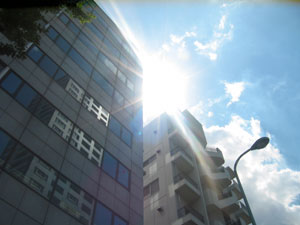
It’s 38 degrees C (100 F) out there, but it feels even hotter. If you’re out in the sun, then just forget about it. A breeze doesn’t help much, it’s just a blast of hot wind.

This is the kind of day I thank goodness we have air conditioners. Sorry if that’s not too environmental, but this heat is downright oppressive…

Categories: Focus on Japan 2004 Tags:

This Is What I’m Talking About with Japanese Police

July 20th, 2004 Comments off

A man in Soka City, Saitama Prefecture rushed to a police koban (a mini-police station) for help, but was tackled by three yakuza (gangsters) in front of the police box as the policeman on watch stood by. One of the men said, “This is our own matter. It’s got nothing to do with police.” The policeman was urged to “Do something!” by a rescue worker at the scene to help a different injured person. The officer reportedly walked towards them as the three gangsters dragged the man off, dumped him into a car and drove off. The man was later found severely beaten, with “broken arms and legs.” The policeman’s excuse? “He didn’t enter the police box and didn’t request help.”

I don’t really think anyone can count on Japanese police in a serious situation. Even in minor situations, they are not effective. They consistently stop regular scooter and motorcycle drivers for doing things like making a right turn at an intersection with three lanes as opposed to two lanes, or for crossing lanes over a yellow line even when there is no other traffic on the road–but they do not lift a finger to stop or penalize bosozoku bikers (ill-mannered biker thugs who ignore pretty much all traffic and safety laws, and adjust their bikes so as to make them as noisy as possible) as they brazenly scream through residential areas at 2 o’clock in the morning.

Police in Japan have a good reputation because of high arrest and conviction rates, but that is due more to sleight of hand than real police work. Police here will usually refuse to file reports on crimes that likely cannot be solved; many victims of muggings, assault, robbery and molestation are told to simply forget the whole situation, especially when they cannot describe the attacker. Convictions are high because judges here usually take a prosecutor’s decision to charge someone as evidence of proof of wrongdoing; additionally, police here can hold a suspect for 23 days without a charge or access to an attorney (or for multiples of 23 days, by “releasing” then re-arresting them), and have been known to sometimes apply beatings or other methods of intimidation or torture, in order to force a confession.

Please don’t get me wrong, I love Japan, and it really is a safe place. But not because of the police.

Categories: Focus on Japan 2004 Tags:

Barbecue Party

July 19th, 2004 1 comment

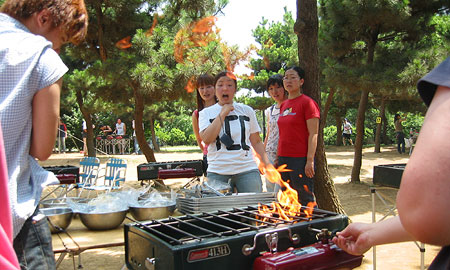
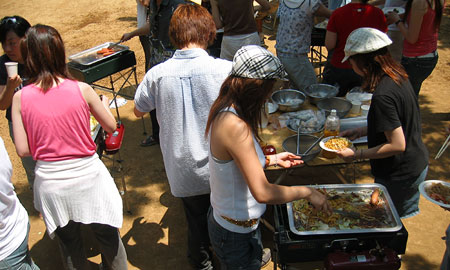
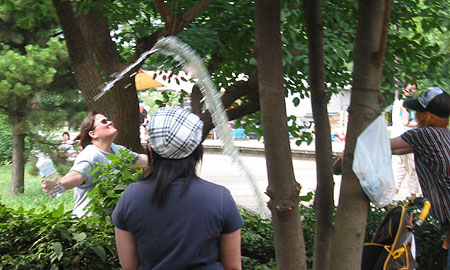
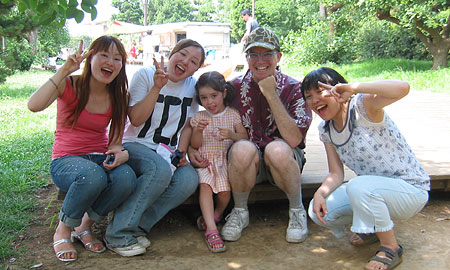
Yesterday, as one of my school’s yearly events, all students who wanted to went to a bayfront park on the newly-built Daiba island for a barbecue. Could have used some actual barbecue sauce and maybe some ribs, but otherwise it was a perfect event. A bit hot–in the low 90’s–but that just made the water fun more appealing.


Too high a flame!


Getting ready some sprouts, sausages, yakisoba, steak and salad…


Ruth getting splashed after ambushing some students


Cheezu!

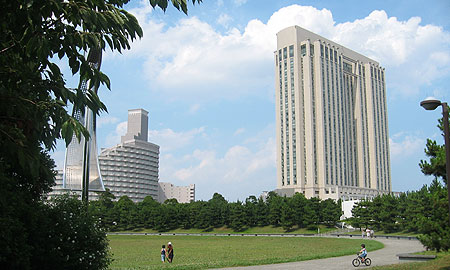
And one more, this a landscape from the park. Remember those matte painting shots from Star Trek episodes? This skyline really brought that to mind, looked as much like an artist’s rendering as it did like real buildings… and there are some more exotic buildings over on that island, let me tell you. Like an architect’s playground.

By the way, a thumbnail page with 64 photos from the event is available here.

Categories: Focus on Japan Miscellaneous Tags:

A Fairly Big One

July 17th, 2004 1 comment

…Or at least a long one. An earthquake just hit, lasting at least a minute, and it was pretty strong. Will update when I know more.

I felt it while laying down in bed for a rest (before going out on a Costco run), and it felt stronger than most I recall. I went out to the kitchen, where I have a hanging lamp that I use as a primitive earthquake meter, and it was going pretty strong–and then noticed that an open door was swinging a bit as well, and the building was creaking.

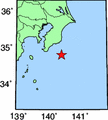
Update (3:19pm): Okay, reports are coming in that it was a 5.2 off the coast of Chiba (image from HiNet. Apparently, it was felt strongest in Yokohama (from reports on NHK so far).

Update (3:30pm): Tenki.jp is now reporting that the quake was 5.5 on the Richter scale. NHK shows that Chiba and south Kanagawa felt it strongest (using the Japanese quake strength scale), and that there is no expectation of tidal waves.

Update (7/18): HiNet has reclassified the quake as being 5.8 on the Richter scale; other reports hold it at 5.5.

Categories: Focus on Japan 2004 Tags:

Another Earthquake

July 10th, 2004 Comments off

It just happened a few minutes ago. It was a 4.5 on the Japanese scale, according to Hi-Net, though Tenki.jp claimed it was a 4.9. It was located in Ibaraki–but still strong enough to shake the apartment here in West Tokyo. (Update: Hi-net revised their figure upwards to 4.9.)

Categories: Focus on Japan 2004 Tags:

Because There Aren’t Enough Places to Smoke In Japan

July 10th, 2004 Comments off

I Went to Akihabara today to try to find some computer equipment for the school. Every time I go there, I am less and less impressed; really, the electronics stores in Shinjuku are better stocked and with better prices. There was a store called “Liberty” which sells used DVD movies for cheap (¥980 and up), which might be something to visit once in a while, and if you hunt long enough, you might find some cheap junk at some stores in the back alleys, but other than that, I don’t see much use to visiting the place. Maybe 20 years ago some deals could be found and some merchants were willing to dicker and bargain, but now it’s pretty tame.

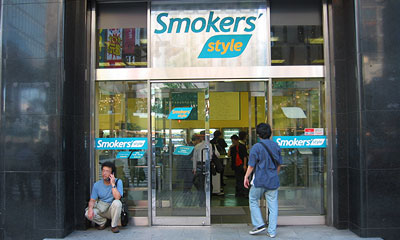
I did find an interesting new sight, however: a place called “Smoker’s Style” (pictured below). Apparently, a place where they could dwell in smoking heaven while working on their computers, eating snacks and drinks bought from the machines, and so forth.

God knows they need a place like that. After all, with 90% of the coffee shops and restaurants being only mostly smoking (who could stand to be in a place where non-smokers were allowed a corner of the room?), smokers need places like this now more than ever.

Apparently, the room was created by Japan Tobacco, Inc., because, in theory, smoking was banned on Akihabara streets (though not in cafes or restaurants). Funny, because I saw dozens of people smoking on the streets, as well as about a dozen cops walking around, and no one being ticketed. I also saw no prominent no-smoking signs.

Japan Tobacco is still half-owned by the Japanese government (the Finance Ministry, specifically–they owned two-thirds until a month ago, when they sold off 15% of the company for $2.2 billion), and while one part of the government is making the very Japanese-style shallow acts of outlawing smoking on a few streets, another is fighting back with lounges like these. All kind of bizarre, meaningless, superficial–in other words, business as usual.

If you want to keep up with smoking news in Japan, this page is where the action is at. Roughly 53% of Japanese men smoke, the highest percentage among industrialized countries, and Japan is among the nations that tried to block an international antismoking treaty (the U.S. and Germany were the other two holdouts), until revisions watering down the treaty were introduced. So what will Japan do? Increase the warning label on the cigarette packs (maybe) and consider changing the name of its “Mild Seven” brand to one that does not include the word “mild.” Goody.

Categories: Focus on Japan Miscellaneous Tags:

Buddhist Kittens

July 5th, 2004 Comments off

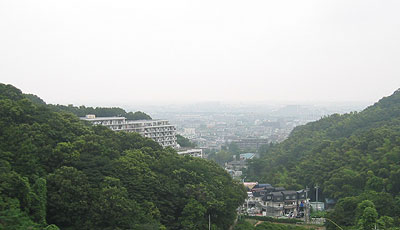
On a recent trip up into the local hills, I wandered on to the grounds of a Buddhist temple. That’s where they tend to be, on the outskirts and often on the high ground (though the Shinto shrines then to be on hilltops more often). You can find temples and shrines just about anywhere in Japan, from the pocket shrines set into tiny spaces between buildings in the city to sprawling establishments almost like parks in their own right.

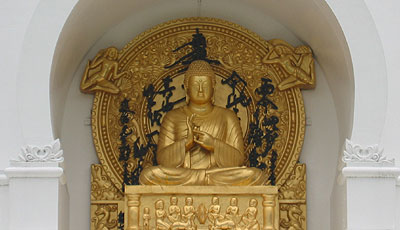
While up in the hills, I found an interesting place–more than just the standard temple building with perhaps a bell outside (the kind they strike 108 times at New Year’s). This place was more of a modern-style temple, a bit flashier than most, perhaps belonging to a newer sect than most (they have quite a few here, some of them even a bit outlandish). This one, as you can see below, had a newish-looking, clean white structure with an alcove housing a rather attractive gold Buddha, with black calligraphic text behind it.

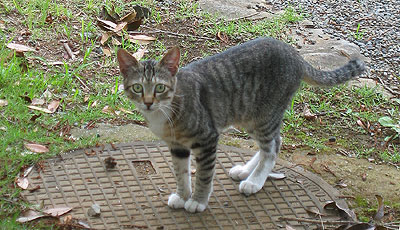
The temple also had cats. I guess they feed the strays or something. As there are few children around and probably just nice, charitable temple staff to feed them, they aren’t too shy or skittish; the one kitten well on its way to becoming a full-fledged cat, pictured below, walked right up to me. In fact, because of the time it takes my camera to power up, I missed by maybe 5 seconds a beautiful photo: one of the many crows in the area happened to land just a foot away from the small cat, and for several seconds, they just stood there, looking at each other, like “what are you gonna do?” Maybe it’s the local version of the lion and the lambs. Man, I wished I could’ve gotten that shot.

Categories: Focus on Japan 2004 Tags:

Pears and Grapes

July 4th, 2004 3 comments

Sometimes I just like to step outside, pick a direction, and see what’s down the road. I don’t do it every day, but when the weather is good and there’s nothing else to do, it’s fun to explore. All too often, having lived in Japan for more than 13 years now, I forget that I’m living in a foreign country and haven’t seen a lot yet. I’ll stop where I am, look around, and realize that I’m in Japan. It sort of hits you that way sometimes.

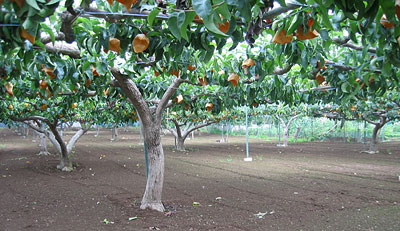
This time I went to the edges of town, near where the railroad runs against the nearby cliffs and hills, and noticed more and more the little farms that traded off occupancy of the lots with suburban houses built on the less expensive real estate on the fringes of town. There are lots of little farms all over Tokyo, in fact, and you’ll find them in the darndest of places–an artifact of high property sales taxes and low property ownership taxes, subsidies to small farmers and so on–the farmers have been represented fairly well in government.

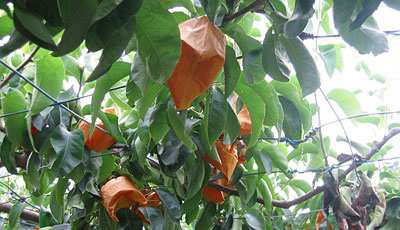
What I saw more and more were small orchards of trees kept at a low height, maybe 6 feet or so, and hanging from the trees were small paper bags. When I got to wondering what was in the bags, I asked a lady at a small fruit stand (they sell a lot from the mini-farms and -orchards at stalls), and she told me they were pears. Not grapes? They can be wrapped too, she replied, but they’re wrapped in different paper.

Too bad I’m not a big pear fan….

Categories: Focus on Japan Miscellaneous Tags:

About Japanese Elections

July 1st, 2004 6 comments

Long-time BfAD visitor Pat alerted me to this article in the English-language Asahi, written by Jane Singer, the Western wife of a Japanese politician. The article seeks to explain what politicians are doing and why they do it, at least in part–if not fully–for the purpose of calming the protest by foreigners in Japan about the loudspeaker truck barrage. A very interesting read, though I do have some comments:

A Diet and a local election campaign of course differ vastly in scale and organization, but all campaigns must abide by regulations aimed at curbing fraud and vote-buying. Election management committees and local police keep an eagle eye on a candidate’s activities during the official campaign period (17 days for Upper House elections, 12 days for the Lower House, 9 days for prefectural posts). The rules forbid many of the campaign activities, like television advertising for a particular candidate or, for the most part, ads in print media, that are sine qua non for elections in other major democracies, although advertising a political party is allowed. Campaigning door-to-door is prohibited, campaigns can use only one sound truck and one microphone at a time, and outdoor campaigning is restricted to the hours of 8 a.m. to 8 p.m.

While Ms. Singer does not necessarily endorse these measures, she does not contest them, either–perhaps because it would not help her husband’s campaign or status as a politician.

But I certainly would disagree with the need for the exact restrictions. For example, television or print ads. Politicians make speeches on NHK Educational–very democratic (as you sometimes see the loonies in there too). And if that’s not enough, then in exchange for licensing, private TV stations should also be made to allow for such statements. Or, if necessary, the government can fund each candidate who receives a certain number of petitions or other prerequisite to a limited amount, forbidding any other funding for advertisements. Singer notes that parties can run ads–I just saw one today for the Jiminto, the ruling party–and it featured Koizumi, a specific candidate–which kind of puts a hole in the anti-corruption net–and the idea that corruption is not rampant in Japanese politics despite these restrictions is, of course, wishful thinking. Despite the freedom-of-speech questions, I fully approve of restrictions on advertising (I do not see money as equalling freedom of speech in any case), but completely banning it, to me, is a far less attractive alternative than banning the loudspeaker trucks. As I noted a year ago, at least you can turn advertisements off.

The door-to-door ban is a fair idea, I’ll admit–especially if it keeps the party reps from doing the business. If it were allowed for candidates only, I’d be OK with it–just a half dozen doorbell rings to fend off, rather than weeks of non-stop noise pollution.

However, the rules on loudspeaker trucks I cannot abide. The trucks are restricted to 8am-to-8pm shifts (I can personally attest that some politicians break this rule), and though she does not detail this, the trucks are “cautioned” from doing their thing in front of schools, hospitals, or nursing homes. Those restrictions are far too lax. First of all, not everyone has the same sleep patterns. One reason many foreign residents may complain is because many of us are teachers, often with late schedules. And we’re not the only ones who sleep later than 8am. As a result, a great many people have their sleep interrupted for weeks on end. But more than that is the disruption for infants–can you imagine what it must be like to get an infant to sleep with those trucks blasting by every few minutes? Limiting the trucks to predominantly public and shopping areas areas (in front of train stations, at shopping streets and so forth) would be best–I mean, whatever happened to the famous Japanese “wa”?

And if that is not possible, then turn the damned volume down! Who says that it has to be up so high? I’m rather high up (equivalent to the 6th floor or so relative to the street, and even if I set my TV to blaring levels, the volume of the sound trucks still competes hardily with the audio right there in my apartment. If it’s that loud, then it’s too loud. I can hear the trucks clearly when they are half a kilometer away and more–and there are two schools closer to me than that (so much for the school zone rule). The obvious solution (which Professor Dolan speaks to) is to limit the vans to a reasonable sound level: enough so you know when they’re out in the street in front of you so you can go look if you want to, but no louder. And I certainly would not be averse to forbidding the trucks from entering parking lots for apartment complexes and driving at 5 kph through every last lane, keeping the high volume in your ears for 5 minutes at a time.

Singer’s article does explain a few things, though:

When voters visit the polling place, they write their candidate’s name directly on the ballot, rather than just check a box or punch out a chad. So the need to ensure name recognition despite the restrictions on promoting the candidate may help explain why the uguisujo (nightingale women), as female campaign van announcers are charmingly called, spend so much of their on-air time repeatedly warbling the candidate’s name.

That explains that. But it also calls into question why they can’t do it another way. Not that it would make the loudspeaker trucks much more bearable if they varied their message.

Singer’s observations are also sometimes amusing:

After an hour or so, the driver received an urgent call from the campaign office. A local resident had called to complain that my hand-waving “lacked sincerity.” For the rest of the drive, I leaned halfway out the van’s side window, endeavoring a full-arm flourish that left my shoulder aching for days. My efforts were praised by the campaign staff.

I have to admit, this sounds quintessentially Japanese, not just that windowsill observers would note and call in a complaint about lackadaisical hand-waving, but that the call would be treated as “urgent,” and–well, I can just visualize the Japanese campaign staff earnestly praising the candidate’s wife on how strenuously she waved. “Good waving!” “Yes, that was an excellent job. Sugoi!” “Yes, I’m impressed, too.”

Categories: Focus on Japan 2004 Tags:

Early Sunrise

June 30th, 2004 1 comment

Here in Japan, with no Daylight Savings Time, and living in Tokyo, which is on the west edge of an already overextended time zone, you get early 4 am sunrises–a bit of a problem for late-night-owls like me. But at least I get to see the sunrise sometimes without waking up at an ungodly hour. Nonetheless, it does seem such a waste. I have heard that DST has been suggested in Japan, but that some people reject it because they feel that it would only give their companies another excuse to make them work an hour later each day.


Click on the image for a larger (800 px. wide) version.

Categories: Focus on Japan 2004 Tags:

All New Ways to have a Heart Attack

June 23rd, 2004 4 comments

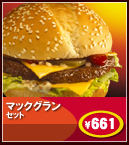
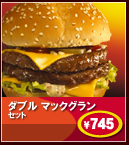
McDonalds just released a new burger over here, the “Mac Grand,” which is essentially a version of the Quarter Pounder, or perhaps more accurately, an attempt to copy the Whopper available at the few Burger Kings here in Japan. The new burger comes as a regular or a double. If you look closely at the picture, the patties look very thick, and the double looks ridiculous–but using the rule of thumb that you can expect half the meat/filling and twice the crust/gristle displayed in any food photograph for fast food, one can get a better image of what the burger really is.

Until now, we had to suffer with the “double burger” at McD’s if we wanted something like this–just a regular burger but with two patties. But now, o glorious day, we now have more meat, a smattering of lettuce, and two sauces. Lo, I can die happy. And obese. I would never go to the place if it were not pretty much the only restaurant near my work, save for a small lunch place across the street that sells an expensive classic-Japanese-style meal which is mostly stuff I don’t like, and a small gyoza place I would love except that the cook is always smoking over his cooking. When I can, I take the 20-minute walk to Subway and get a nice, slightly healthier sandwich.

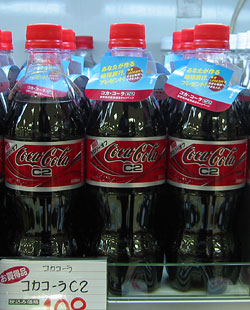
But Mac is not alone in having a new product; Coke has a new version out as well. They usually have just regular Coke and Diet Coke (called “Coke Light” here).

The new Coke product here is a semi-diet Coke called “C2.” Aside from naming their new product after a plastic explosive, Coke is, I think, trying to fool people into thinking that it’s a diet drink. They make a big deal about having less calories, but they express the calories not by how many are in the bottle, but rather how many are in each 100 grams–and give no calorie amount for regular Coke to compare. As far as I can figure, though, C2 has more than half the calories of regular Coke, but is not as volatile as C4.

By the way, there is no caffeine-free Coke here (I have to order from Foreign Buyer’s Club). I think that removing caffeine from a drink is illegal here in Japan. They have “Vitamin” drinks here that come in little brown bottles which have heavy doses of caffeine and, I kid you not, nicotine. Pretty much a standard fix for the salaryman here. The commercials for these little drug-filled drinks are pretty lacking in subtlety. I recall one had a guy drink the tiny one-gulp, and the be immediately engulfed by a high-powered lightning-emitting aura. Another was accompanied by a now-famous song well-known in Japan, which declared, “Can You Fight 24 Hours a Day, Japanese Businessman?!” Well, after downing several charges of drug-laden vitamins, it would probably be surprising if he didn’t die of karoshi (overwork).

Considering new products like Mac Grand and C2, it should be no surprise that there is concern of kids in Japan being overweight. Of course, this is all relative. Japanese people are thin, endemically so. Yes, there are sumo wrestlers, but they grow with great effort and massive overeating. Here in Japan, at 190 lbs. and 5’11”, I am overweight (my doctor said “obese,” thank you very much). But when I would visit our home campus in Wisconsin, I felt downright slim.

A lot of Japanese slimness might be metabolism, but I think it also has to do with diet. There’s not really much sugar here. Donuts do not taste as much like donuts. Frosting is always whipped cream, not sugar-butter icing. There is less meat and much more fish and vegetables than you would see in the U.S. And there is very little diet food. At least McDonalds does not indulge in the massive irony that would be the inclusion of Diet Coke in their menu.

Oh, and by the way, I tried the new Coke. Too sweet–strange for Japan, where sweet foods are usually not popular. Diet Coke still tastes better to me, at least. And I love sweet foods.

Categories: Focus on Japan 2004 Tags: