Archive

Archive for the ‘Focus on Japan’ Category

New Photos from Japan

October 6th, 2003 Comments off

Here are a few more photos I have taken around town lately.

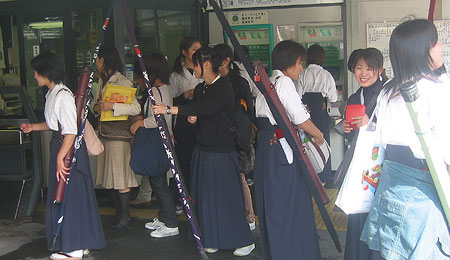
This fellow, photographed outside Minami-Tama station on the Nambu Line, is an excellent example of the transition in telecommunications. When I first came to Japan, many people depended on payphones; I did, from time to time. There was an array of public telephone types, with different colors and abilities for connections (remember trying to hunt down a phone booth that could dial internationally?). And the prepaid telephone telephone cards were a big deal, sometimes used as business cards, and sometimes sold “recycled” by shady characters atop train platform staircases.

Today, most people use their cell phones instead–and in the case of this guy, in exactly the same spot he’d use if speaking on a payphone.

Right after I took the shot of the fellow at the phone, a squad of female Kyudo archers came by. You see students like this from time to time, dressed in their traditional hakata pants and keiko-gi shirts (apparently the tabi shoes are optional). If you’d like to know a bit more about Kyudo, go here.

Categories: Focus on Japan 2003 Tags:

Shinjuku Skyline Sunset

October 2nd, 2003 Comments off

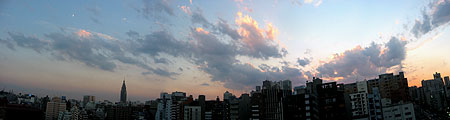
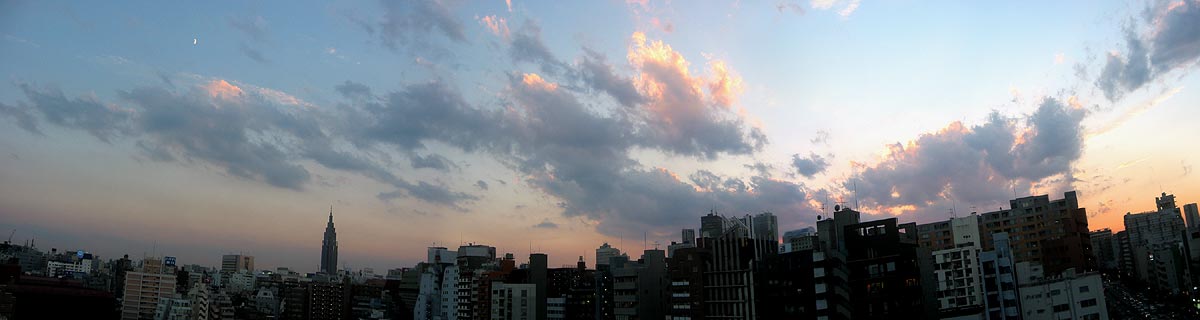
Got a nice photo of the sunset tonight from the roof of our 9-story school building. This is a composite of three separate photos. For space purposes on this main page, I can’t show the full-size image. However, if you would like, I have available a larger version (1200 pixels by 320 tall, better for computer screens) available.

Categories: Focus on Japan 2003 Tags:

Dinner Out

October 2nd, 2003 Comments off

Once or twice a week I’ll stop by a place on the way home. If I’m willing to go out of my way for a treat, I’ll go to Akiyoshi yakitoriya in Ogikubo. But on my train line home there is a sushi place I drop by, a place I believe is called “Ganso” Sushi (possibly “Genroku”), a “Kaiten-zushi,” or conveyor-belt sushi joint.

This particular place is reasonably priced–about a dollar per plate (two pieces per plate) and up, with my favorite, maguro, being on the cheapest plate. But what I like about this place is that you don’t have to eat the stuff on the conveyor belt, and can instead order new plates to be made for you. This is a big thing for me–I hate having to choose from the hour-old fish that’s starting to turn dark from dryness. Ganso has always let me order fresh–with the singly, highly disappointing visit I made when my father was in town and they shoved the old stuff in front of us (we came during lunch, so the policy may have been different).

I always thought that I was rather stodgy in my selection–I always have maguro, six or eight plates of it. One after the other, maguro maguro maguro. Sometimes people stare.

Tonight I dropped by for, of course, some more maguro. Had to wait a few minutes for a seat to open up, and two did at once. So the other solo guy who’d walked in just after me sat down on the next stool. But this guy made me feel a bit less like the most unusual customer in the shop. He ordered eight plates of the same kind of fish, more than my six for the night–and then ordered ten plates of ika (squid) all at once. The chef had to ask twice to make sure he’d heard right.

I left before he was able to scarf down all the squid, but he was making admirable progress. And for all I know, he ordered another ten plates after I left.

Categories: Focus on Japan 2003 Tags:

Small Things I Like About Japan

September 30th, 2003 Comments off

The norm of many foreigners in Japan (usually the short-termers) is to talk about the things that are wrong with the country, and like any country, there are indeed a lot of things wrong to focus on. But what about the better things? Well, people often mention the bigger things, like greater public safety and on-time trains. But here are a few nods of recognition for the lesser positives that are nonetheless appreciated.

English. Okay, this is not so much a small thing, but still not huge, and not acknowledged enough. When I hear people complain that English should be in more places in Japan, I think of how spoiled people tend to be; English is available in so many places, especially considering that only about half a percent of the population consists of non-Asian foreigners. In the U.S., bilingualism usually is triggered when a much more substantial portion of the populace in non-English speaking. But despite the relative sparsity of native English speakers in Japan, there is a wealth of English to help us, from signs in train stations, bilingual ATM machines, materials in city offices, English speakers at business help numbers, and more. Recently, I bought a cell phone which included an abbreviated English manual, and had the option of switching all displays into English.

Stalls in Public Toilets. Ever been sitting in a stall in a public restroom in America, and someone outside peers in at you from the crack between the door and the frame of the stall? Not exactly a comfortable moment, that. Well, in Japan, that doesn’t happen. Toilet stalls in this country were designed for privacy. The doors go all the way to the floor, and bevels on the door ensure that there is no crack for strangers to peer at you through. An added nod to privacy, though less certain as a positive because of the water it wastes, is the “courtesy flush” that men’s urinals automatically set off by infrared sensors. This masks the initial sounds, and for many people, helps get the old waterworks running as well.

Walk and Shop. The relative lack of cars as a means of popular transportation means that things tend to be more localized in Japan. In the U.S., one usually has to drive to the market, or at least suffer a long walk (well, suffer on bad weather days, at least). In Japan, things are still smaller and more localized, despite recent trends towards mall-ization. Almost anywhere you set down here, there will be some small businesses where you can get what you need. Convenience stores are everywhere. Supermarkets are more easily found. Restaurants, or at least fast-food joints, are more likely to be nearby. And vending machines, sometimes looked down upon, are nevertheless quite handy at times.

Department Store Clerks. Ever been to a department store in the U.S. where you had to hunt down a clerk to give your money to? And when you found them, you had to wait behind three or four other people buying half the store with a personal check? And forget about asking someone a question. In Japan, clerks are all over the place in department stores. Yes, less so that in the booming 80’s, but still they can commonly be found, usually just by standing where you are and turning 360 degrees or less. It’s only at the high-volume stores like Yodobashi Camera, or the lower-cost value stores like home centers, that you have to really look for someone to ask a question–but even at these places, there is no shortage of cashiers.

More to come as I keep my eyes open for them–and that would be a good thing for all of us to be on the lookout for here in Japan–the little things that make life easier here, that usually go unappreciated.

Anyone have observations they’d like to contribute?

Categories: Focus on Japan 2003 Tags:

Watching TV As You Drive

September 24th, 2003 Comments off

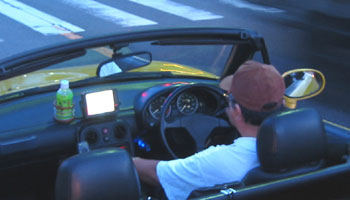
I’ve noticed that a lot of cars have little TV screens for the DVD navigation system–but all too often, I noticed that people are watching TV instead of the navigation maps. Makes me wonder exactly how safe these drivers are. You see enough people smoking or talking on cell phones–watching TV is not a distraction you really want to add. In the back seat, for the kids, maybe….

Categories: Focus on Japan 2003 Tags:

Sunset, Sunrise

September 24th, 2003 Comments off

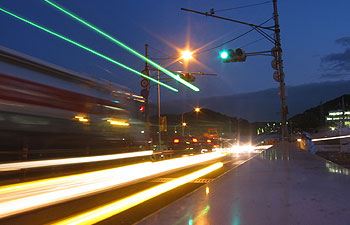
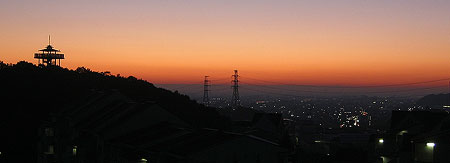
Some photos taken in the past few days. First, I caught a sunset–not great as a sunset, but some interesting photos within nevertheless. Then a sunrise, after a very late night up, taken from my dining room window.

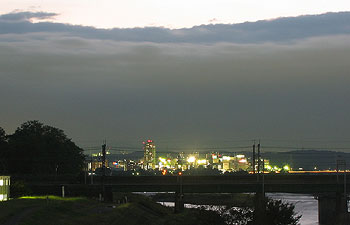
Seiseki Sakuragaoka, on the Keio Main Line, seen from the bridge. A time elapse shot, about 10 seconds.

An egret in the water below. This shot is not reduced in size, but rather is a crop from a much larger photograph; otherwise, I would never have gotten it so close up. A “digital zoom,” I suppose you could say.

A nice two-second elapse shot, a truck rolling by.

And the shot out my dining room window. A nice view, I just wish it got sunsets rather than sunrises–I’m not awake for enough of the latter.

Categories: Focus on Japan 2003 Tags:

Quake: 9/20/2003

September 20th, 2003 Comments off

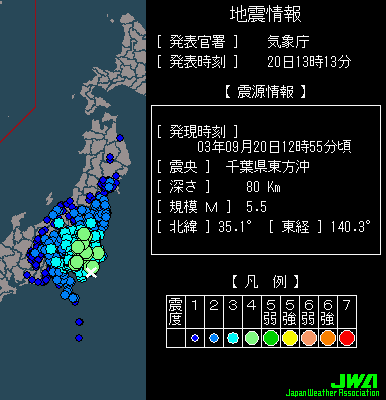
A pretty strong quake just hit. I had just been on the phone with my father and sister for a few minutes when I felt the room shake. It wasn’t violent, but it was a pretty darned respectable shaking, probably the strongest I’ve felt in Japan so far. The glass doors on my video cabinet were shaking, and the ceiling lamp was swinging quite a bit. It has been announced on NHK as a 5.5 quake (don’t know if that’s Richter or Japanese scale), 80 km deep under southeast Chiba prefecture, just east of Tokyo. That’s not the biggest quake I’ve felt since in Japan, but it was the strongest because it was the nearest big quake.

Tenki.jp and Hi-net are both not responding, probably deluged by people like me, trying to access their pages to see about the quake.

More as it comes in.


Here’s a map that came from the Tenki.jp site, which is now responding again:

Categories: Focus on Japan 2003 Tags:

Connected

September 17th, 2003 Comments off

I find it ironic that I live in Tokyo, where Internet access is perhaps more advanced than anywhere in the world–heck, I even teach computer classes–and yet I’m stuck at about 1.5 Mbps, which for the uninitiated, means I can download almost 200KB per second, or the equivalent of a floppy disk in 7 seconds (which, ironically, is faster than a floppy drive could read all of that data to my hard drive). To many in the U.S., this may sound pretty fast; broadband speeds in America are now fairly slow, slower than they were 2-3 years ago in fact. My father pays about what I do for a 300 Kbps (0.3 Mbps) DSL connection; to get even close to my speed, he’d have to cough up $70 a month or more.

A bit about Internet connections first (those in the know skip to the next paragraph). While data on a disk is measured in bytes, transmission speeds are measured in bits, which are one-eighth of a byte. 100 KB (kilobytes), for example, is 800 Kb (kilobits, that’s a lowercase “b”). The slowest connection nowadays is referred to as “dialup,” or “analog,” which means you stick your telephone line directly into the back of your computer and then dial the telephone number of your Internet service provider (ISP). This gives a theoretical maximum of 56 Kb per second, more realistically about 40. The next step up is ISDN, which allows you to dial up the Internet on your computer while at the same time using the phone to call someone; it uses a digital line, and gets you up to 64Kbps. Then there’s a big jump up to DSL, which ranges from just over a megabit (Mb) per second to 12 Mbps, and soon up to 26 Mbps. And finally, fiber optic cables, which go considerably faster than that–top speed of 100 Mbps.

Up to about three years ago, Japan was hopelessly behind. We were stuck with either analog dialup or ISDN, which sucks because both require not only a monthly charge for the telephone line but you also have to pay by the minute–Japan has no free local telephone calls. Meanwhile, in the U.S., my father had DSL and was getting about a megabit of broadband DSL, which you can stay connected to all day long, no phone charges incurred.

Then things flip-flopped. The U.S. hit its current economic slump, and American DSL providers started raising rates and lowering speeds. Japan, in a program to help the country out of its decade-long economic crisis, completed a new phase of its Internet infrastructure plan and got DSL, quickly followed by fiber optic. DSL speeds started out at 1.5 Mbps, then got upgraded to 8 Mbps and 12 Mbps, and recently they started selling 26 Mbps (more than 3MB sent per second at theoretical top speed!). DSL costs only about $20 per month here, including ISP fees. I have the 12 Mbps service, but because I live in a nice, big place in a remote, gree area, I am more than 2 km from the switching station and so my speed is degraded, probably at about 2 Mbps–but I’m not complaining, er, too much.

I looked into getting fiber optic, but the cables are big and stiff and cannot be fitted into most older buildings, like mine. If it were possible, I could get 100Mbps (12.5 megabytes per second) for about $70 a month, same as my father in California would pay SBC for a connection 1/100th as fast. However, I can get fiber optic at the school where I work. We got the connection for the school a year ago, and it is fast. So fast, in fact, that we can’t get near the top speeds because almost no one else has such a fast connection to send the data. But I have pulled down data from Apple’s web site at 2 megabytes per second. What’s funny here is that my school of 300 students or so has had this for a while now, and I see CNN articles about how a 40,000-student university in the states is bragging about their new 100 Mbps connection.

There is hope for my apartment in the Tokyo outback, though. A new service, called VDSL (yeah, I know), may be available in a year or two; VDSL brings fiber optic to a local phone switch, then converts to DSL. I’ve been told that we could get 18 Mbps by then.

Categories: Focus on Japan 2003, Main Tags:

One More of the Moon

September 10th, 2003 2 comments

I just can’t resist. Took this one only a few minutes ago. Came out very nice.

Categories: Focus on Japan 2003 Tags:

Beautiful Sunset

September 10th, 2003 2 comments

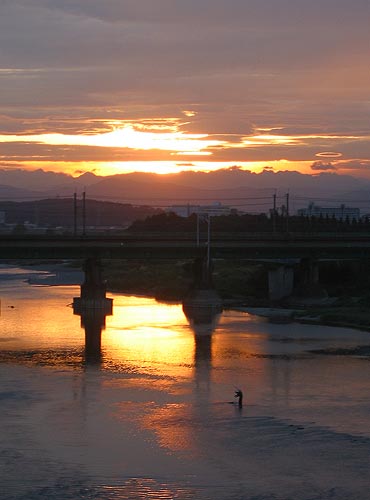
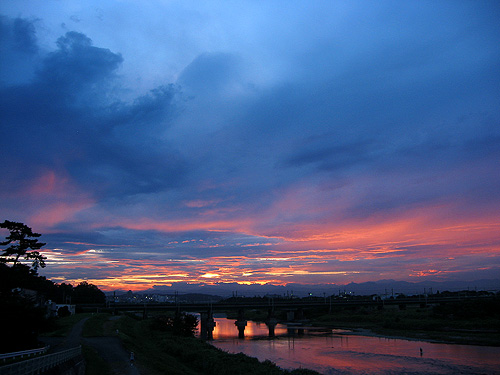
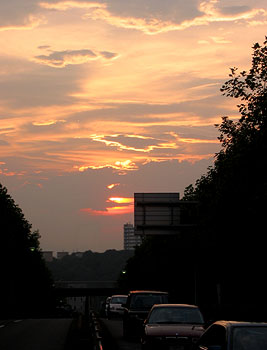
Got another beautiful Sunset on my way home again tonight. My new schedule lets me get home earlier than before, and I’m seeing some nice ones. The first one I caught early, but was not in place to take great pictures–but I was able to get to a good bridge in time, and got the following ones there.

This last sunset shot I was able to capture blind–my digital camera’s battery had quit twice, and only let me take shots with no viewfinder. But it turned out great:

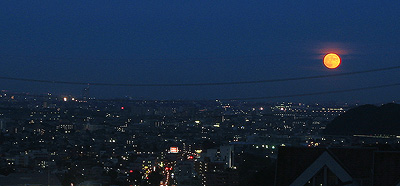
And then, when I got home, I got a great moonrise to boot.

Categories: Focus on Japan 2003 Tags:

Gyoza Update

September 10th, 2003 47 comments

In subsequent variations on the gyoza recipe that I’ve attempted, I’ve discovered a few things that help round out the rough edges to the formula.

First off, when using meat, it is important not to use lean meat; this results in the gyoza being dry. Some fat content in the ground meat is desirable.

Second, use cheese. A good amount of shredded mozzarella, I’ve found, can help contribute to a softer texture.

Third, remember that gyoza is a malleable thing; you can change the ingredients and their amounts to your taste.

Categories: Focus on Japan 2003 Tags:

Sunset

September 6th, 2003 Comments off

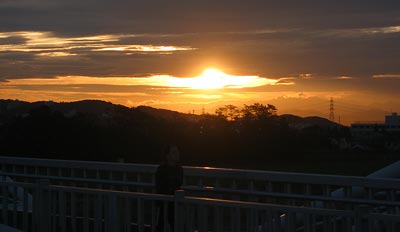
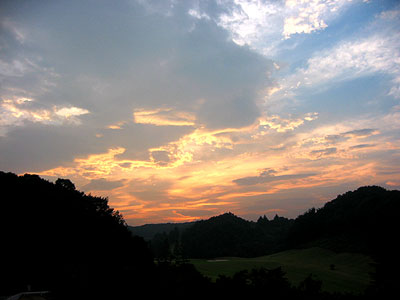
A beautiful day today, and a beautiful sunset to match. Caught a little of it as I was out today, on my first 3-day weekend this semester (got a 4-day schedule this time, it’ll be a nice four months). The weather here in Tokyo has been nice and sunny, and pleasantly warm–not the usual stifling heat and humidity. We can only hope that this holds up. For now, a week of nice weather is forecast. Ahhh…..


Categories: Focus on Japan 2003 Tags:

Lost in Translation

September 5th, 2003 Comments off

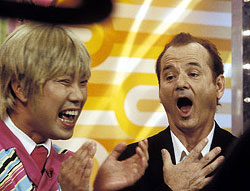
Check out the trailer for the new movie Lost in Translation starring Bill Murray. Murray plays a celebrity who gets $2 million for making a whiskey commercial in Japan, and meets a woman there with her photographer husband; friendship ensues, so the blurbs say. The big attraction to me is that the whole thing is set in Tokyo, and promises to have a lot of very amusing interaction between Murray and Tokyoites. It is slated for a September release in the states, but I can’t find any published release dates for Japan. It opens in some countries as late as December, though. (IMDB page)

Categories: Focus on Japan 2003 Tags:

Lightning Storm

September 3rd, 2003 1 comment


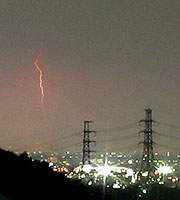
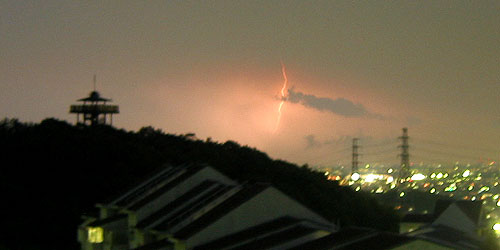
As I was heading home tonight, I noticed that the sky was growing more and more threatening. When I walked in the door, I felt lucky to avoid being rained on–but as it turned out, rain was not on the menu. Lightning was.

Soon after I sat down to relax, I noticed some lightning outside. Well, nice and normal–I like lightning. I like to listen to the thunder, too. Once there was a lightning storm at my work, real close by, and I went outside to watch and listen. One bolt cracked down and hit a lightning rod atop an apartment building just a block away, right in my view–the blast of sound was just about instantaneous. Now, that’s entertainment!

Tonight, it was far away, but something was strange. I noticed some lightning out of the corner of my eye as I sat in my living room. Then again a few seconds later. Then again, and again. I thought I was imagining it–sometimes, reflections off the frames of my glasses can appear to be something else. But when I went to the window, I was right–there was a hellacious lightning storm going on in central Tokyo

Lacking my digital video camera (at school, for a project), I got out my trusty digital camera and took some shots of it (above right, and below). Unfortunately, it was hard to catch the full feeling of it–it was far too light for a good time-exposure shot. But the camera has a movie mode, so I took several 30-second movies (the time limit for higher-quality movie files). I then edited some of the shots together; they are available here. Like with the Bon Matsuri movie, you must have Quicktime and/or the ability to view MPEG-4 files. This movie is only about 500KB in size, and is reduced in size–but you’ll get a better idea about the storm from it.

Categories: Focus on Japan 2003 Tags:

Calling James Bond

September 2nd, 2003 Comments off

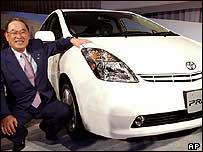
Toyota just released a new car, it’s environment-friendly Prius (which I have heard good things about), this time with 10% better gas mileage than the last model, and with an interesting new feature: it parks itself.

Apparently, if you get into a tight parking situation, the car will do the job for you with built-in sensors detecting the close-by obstacles. It was only mentioned that the parking assist works “when reversing into parking spaces”; I am not yet clear on whether or not it parallel parks (which would impress me a lot more). The “intelligent” parking system is a $2000 add-on, and includes a DVD-navigation system.

Toyota has sold about 120,000 of the Prius model, and expects to sell another 74,000 next year.

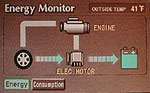
The hybrid car runs on both gas and electricity, using flywheels for the brakes to gather up the energy that would otherwise be dissipated as heat. Especially while driving in the city (with short starts and stops), the energy returned from the brakes helps to sustain the battery for longer periods and increases energy efficiency.

I wouldn’t mind having one of those puppies.

Categories: Focus on Japan 2003 Tags:

Bon Matsuri

August 30th, 2003 Comments off

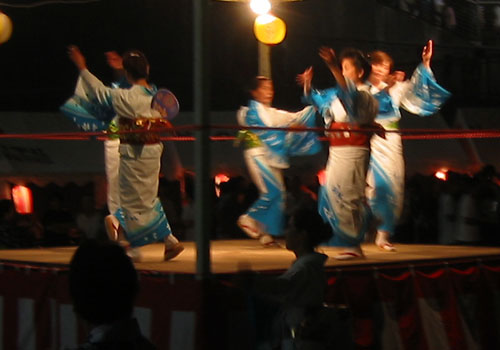
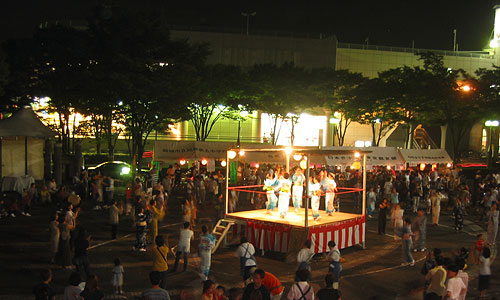
My neighborhood had the annual Bon Matsuri today. I should have been paying attention to the notice board, but instead I found out by hearing the music playing from my apartment window. On my trip down to the supermarket, I stopped by and took a few photos.

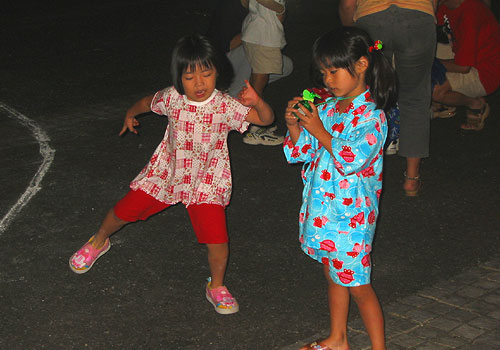
The dancers…

And some kids who will be up there in a few year’s time.

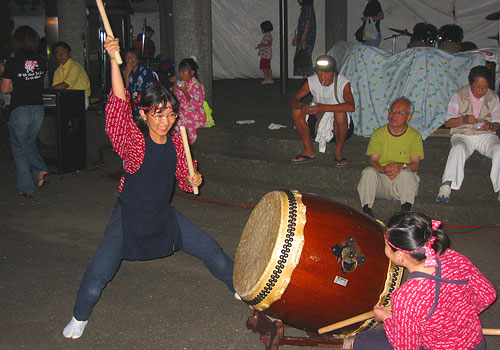
And a group of kids very talented at the taiko drums, both hitting the drums and tossing and twirling the sticks.

A small movie (240 x 360) of the dancing can be seen here. The file is an MPEG-4 Movie, so you will probably have to have an MPEG-4 codec (or an OS X Mac) to view it. The file is 1.7 MB, 43 seconds long. You may have to wait a minute or two before it loads and starts playing. Enjoy!

Categories: Focus on Japan 2003 Tags:

New Cell Phone

August 29th, 2003 4 comments

Japan is rather cell-phone crazy. My folks have a couple of cell phones, but compared to the feature-rich array of phones in Japan, theirs look positively boring. Walk down a city street in Japan, and it seems like there will always be a person or two in sight talking on their phone. Even more so, watch people on trains: many will have their cell phones open (see photo at right), reading or writing email, looking at photos. When Hiromi and I went to Otaki Falls, a couple came down into the waterfall pocket valley and immediately took photos of everything with their cell phones.

When I most recently came to Japan to work and live in 1998, I held back getting one, figuring that it would only make me more accessible to staff at my school to call me in to do more work, and wouldn’t be very useful for me. But after a year and a bit, I caved in and bought a simple model, and the base calling plan (2000 yen / $16 a month, 10 yen / 8 cents per minute for calls). That worked fine for me, but after four years, my phone–basic when I bought it–was looking more and more like a fossil. Also, having started this blog, I began to get interested in the idea of moblogging. At first, I waited for Bluetooth-enabled models to come out–there are some great Sony-Ericsson phones, like the P-800, which can work great with Macs. However, after waiting more than 6 months, I realized that Bluetooth phones are just not happening in Japan anytime soon. In fact, the number of Bluetooth-enabled cell phones in Japan fell from two models to zero while I watched.

So I figured that it was time to break down and buy. I tried doing the best research I could with the limited consumer-oriented review material available in Japan, and settled on a phone using the same carrier / plan I was already using; they have a phone, just recently released, which fit my bill. It’s the DDI-Pocket H” H-SA30001V (Japanese language site).

Staying with the same plan helped me avoid the hassle of canceling and re-signing up for phone service; with the new phone, I have the same number and the same calling plan prices I signed up for four years ago. It also made it easy for the people at the store to transfer the phone book data from my old phone into my new one–a pleasant surprise, as I had no idea that was possible, and they didn’t tell me that they did it–I found out by going home and finding all my numbers there.

But be careful when deciding what to do when you switch–there are two options if you stay with the same carrier. One option, in which you keep the same phone number and calling plan, costs 2000 yen more. The option which seems costs less keeps you with the same carrier, but allows you to change the phone number and calling plan. However, the cheaper plan has hidden costs: a 2000 yen fee for cancellation, a 2000 yen fee for re-signing, along with a few other fees as well, making the deal more expensive than the first option.

Features of the SA3001V that attracted me included the CCD camera, the postage-stamp sized external LCD screen, the phone-to-PC data transfer ability, and, something I had not expected, the ability to switch all menus to English! (See left.) The phone also has the usual extras, such as calculator, schedule book, alarm clock and so forth. Another nice feature they have is the ability to match ring tones and photos with phone numbers; if, for example, my friend Andrew were to call from his cell phone, I would hear a specific ring tone and see his photo flashed on the mini-LCD screen before answering the call.

I did find out some facts about the camera which showed up the advertising to be a bit misleading. One, for example, was the claim that the CCD camera has 110,000 pixels, suggesting the ability to take photos with dimensions like 300 x 370 pixels. It turns out that this phone camera actually takes photos the same size as all the others–144 x 120 pixels–so I guess the “110,000” number has to do with the digital zoom feature, and has nothing to do with the actual photo size.

Also, there are quite a few freeware programs allowing you to engage in data transfers, but they are all (of course) in Japanese. The one I tried to install on my English-language Windows machine crashed on install. The Mac version did install, but only works under OS 9.2 (not in Classic mode). After spending a few hours banging my head against the wall, I finally got it to work, and was able to use the “H Tonya” to edit my phone book. Frankly, this is a big thing for me, because I absolutely hate having to key in my entire phone book using those danged tiny buttons, especially when I have to first switch to English for every entry, and then cycle through up to eight characters to get the single one I want.

Another nice feature is the addition of a slim, English-language summarized version of the instruction manual. With only 40 pages of notes, it pales to the 577 pages in Japanese, but it is far more than I had hoped for. It looks like Sanyo, the phone maker, is realizing that there are non-Japanese speakers living in Japan and some concessions would be helpful for them.

So I haven’t used or even found out about all the features yet, but so far, it’s worth the investment. I hope it hold up over time.

Now to figure out moblogging, once I can find the time….

Categories: Focus on Japan 2003 Tags:

Tokyo Butterfly (Okay, “Moth”)

August 22nd, 2003 Comments off

I found a moth on the stairway this evening, quite a pretty one. Being this close to the forest, we get tons of insects flying and crawling in, especially at night.

Categories: Focus on Japan 2003 Tags:

Foggy Night

August 18th, 2003 1 comment

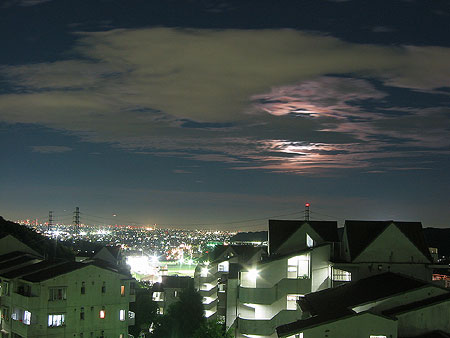
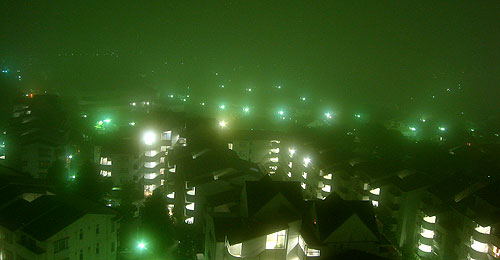
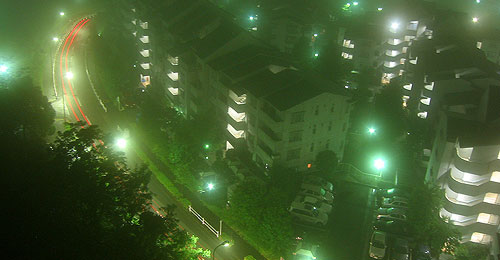
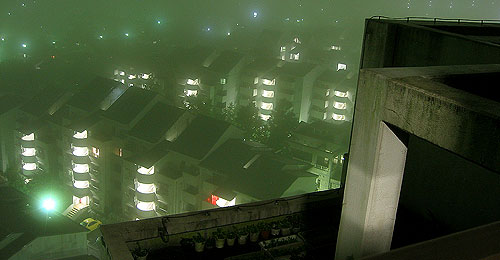
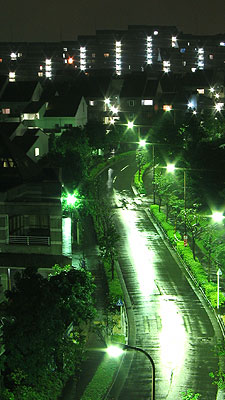
We had unusually foggy weather up here on the heights tonight. A few 15-second time exposures to show off the view.

Categories: Focus on Japan 2003 Tags:

Rainy Season, Part II (And, Let’s Hope, The End)

August 17th, 2003 Comments off

Um… well, maybe the rainy season isn’t quite over yet. After just a few days of sunshine, we got a typhoon, and then a few days after that a 5-day rainstorm that will last through Sunday. It is the middle of August, and yet we not only have rain but low temperatures as well. Temps were in the low 20s C (low 70’s F).

However, the rain is supposed to break Sunday night, and at least a week of sunny weather is supposed to come from Monday. Too late for many Japanese revelers–the O-Bon season was at its height last week, and most people had that time off. The slowly-recovering Japanese economy has taken a bit of a hit from this: sales of beer and other cold beverages, summer clothing, air conditioners and other hot-weather items have fallen. I myself just picked up a pair of short pants and two nice short-sleeve cotton shirts, all for less than $30, at a department store in Minami Osawa the other day–discounted due to poor sales.

The rice crops have been hit by the weather as well, but not as hard as in 1993, when Japan had to resort to the unbelievably radical measure of actually importing some rice. I remember that time; I was here. I remember especially that American and even Australian rice, though imported, were very hard to find in pure form. Any foreign rice that neared or matched the quality of Japanese rice was mixed together with long-grained Thai rice, thoroughly unpopular here, in an attempt to protect the impression Japanese people have that Japanese rice is the best in the world and cannot be equalled.

Anyway, we won’t see anything as drastic as rice imports, but all the same, the toll is being taken. The question is, what does this unusually cool summer bode for the Fall and Winter?

Categories: Focus on Japan 2003 Tags: