Archive

Archive for the ‘Focus on Japan’ Category

Hyottoko

January 17th, 2004 Comments off

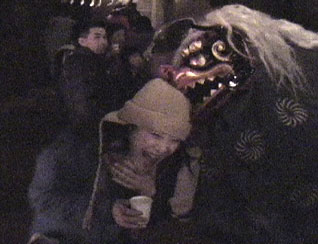
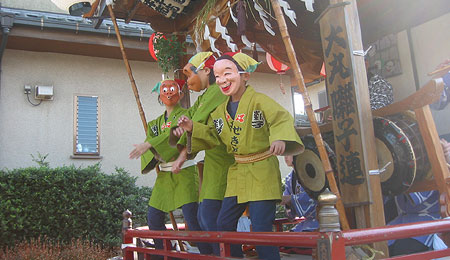
If you watched the QuickTime video I posted of the New Year’s “hatsumode” visit to the local shrine, then you undoubtedly noticed the young people in the strange masks (above and below) dancing about in a rather stylized fashion. These are known as “Hyottoko,” as you may have heard Hiromi exclaim in the video.

Hyottoko is an abbreviation fo “Hi Otoko,” or “Fire Man,” from the idea that this character blows fire from a bamboo tube (hence the mouth shaped as it is). Their dance is considered comical, and is said to have been used as long as 900 years ago to amuse troops fresh from battle. The female equivalent is known as “okame,” though I didn’t see any at the shrine. As far as I know, there is no special tie between Hyottoko and New Year’s, but it was fun to have them there; you may have noticed one of them doing the shishi-mai head-biting thing on me in the video. I’m guessing that a lot of mixing and matching of traditional entertainment was going on there. Whatever the case, it was fun!

Categories: Focus on Japan 2004 Tags:

New Year’s Celebration

January 16th, 2004 Comments off

It’s a little bit late, but distractions kept me from this project for a while.

Every year at New Year’s Eve, I go to a local shrine–somewhat of a private tradition since I first came to Japan. I really enjoy the people, the music, the local atmosphere, the free sake. One year (on the millennium, in fact) I spent New Year’s back home in the U.S., but everyone went to bed at 11 pm, and I just sat there watching Dick Clark on TV and thought, hey! I could be at a shrine right now!

When I moved to this town, I thought I had found the perfect shrine, a place atop a hill near the train station, with a view of Tokyo and a beautiful temple just below in a pocket valley (I’m a bit out in the boonies, though still close to Tokyo proper). But when I went there one New Year’s Eve, I found the place deserted–I guess they went out of business some time ago, though the shrine still stood. The temple was in business, but it was just people ringing the bell. I was about to go home, disappointed, when I saw fireworks a bit of a ways off. Well, I followed the fireworks and found the shrine I go to now.

It’s a great place. They shoot off the fireworks–real sky-reaching stuff, not the kind you buy at the store–and they have pretty much everything else, too. The sake (including kids’ sake, non-alcoholic and, to me, really bad-tasting), a traditional band, the shishi-mai dance, a nice bonfire, with nice trinkets, charms and arrows (for luck) on sale. The works.

This year, Hiromi made her way over to join me, and we brought a video camera along. What kept me from doing this until now, a few weeks after the fact, was that I knew that editing together the video would take several hours–but tonight I finally had enough free time, and got the darn thing done. The movie, a little over two and a half minutes long, is available on this page, for anyone who has QuickTime software installed. Be warned, the movie is a touch over 5MB in size; if you have a dial-up connection it will take forever. Broadband (DSL or cable) is recommended.

I hope you enjoy. Until next year….

Categories: Focus on Japan 2004 Tags:

Fuji and the Red Moon

January 8th, 2004 Comments off

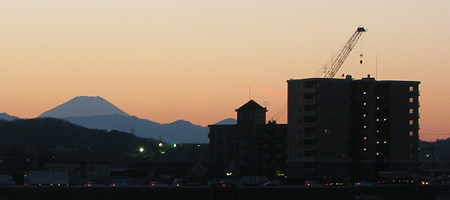
Okay, I promise I’ll get back to political blogging soon. But a few more photos first. It was a very clear day today (doubtless due to the chilling cold), which afforded a very good view of Mt. Fuji. I had to go out of my way a bit to get a photo, though–what used to be a nice shot of Fuji from the riverside has become obstructed since last winter by a construction job across the river–spoiling the view for local residents at exactly this spot, sorry to say (I’m not one of them). Still, not too far away and you get a shot again. That’s progress for you.

And as I walked up to my apartment in my own building a while later, the moon was just rising over the horizon, a beautiful shade of orange. Talk about the Red Planet–here’s my own shot at that orb, or the closest imitator.

In the meantime, the first week of school is keeping me busy. And while I go easy on my own blogging, my students are starting up theirs–three sections of Introduction to Computers, and all fifty or so students have the assignment to blog once a week for the next thirteen weeks, on the topic of computers. Feel free to visit and perhaps comment, but please be kind and courteous (when was the last time you blogged in another language? These kids are amazing) if you interact.

The class I teach is pretty fun for me despite the workload; the students all get very creative with their projects, and it’s always fun to introduce a lot of the new technology and see practical advances for everyone. By the end of the semester, the page I linked to above will also sport the students’ web pages–one of the other projects they all must do.

Categories: Focus on Japan 2004 Tags:

But They Always Visit This One

January 3rd, 2004 Comments off

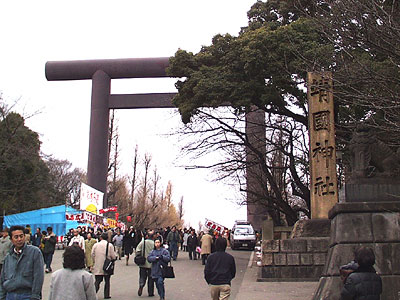
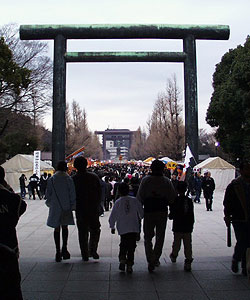
Prime Minister Junichiro Koizumi visited Yasukuni Shrine on New Year’s Day, something referred to as Hatsumode in Japan, visiting a shrine to pay one’s respects and to pray at the outset of the new year (I just did that myself–I’ll blog on it as soon as I get the video on to my computer). Koizumi’s visit is classed as an “official visit,” which somehow apparently makes it a political act instead of a religious one, which would violate the separation of church and state here.

Now, one might think that the prime minister visiting a shrine on New Year’s might be kind of like a U.S. president going to church on Christmas, and normally you’d be right; it’s just the choice of shrines that makes the difference. Imagine, for example, that a U.S. president visited a church that advocated white supremacy, and that it was not just one president or one time, but a string of presidents visiting the same church for more than a quarter century.

That’s kind of like what’s happening here in Japan. Yasukuni Shrine (English site), originally called Tokyo Shokonsha, was built in 1869 at the time of the Meiji Restoration, when the Tokugawa Shogunate collapsed and the Emperor was, at least nominally, reestablished as the head of the country in a constitutional monarchy with a parliament (“Diet”). Yasukuni was run by the military as a shrine for the fallen soldiers of national wars, and after WWII, many soldiers of that war were enshrined there–but in 1978, fourteen class-A war criminals from WWII, including wartime prime minister Hideki Tojo, were interred there as well. Since that time, Yasukuni has displayed exhibits extolling the virtues of the war dead, and has taken somewhat of a nationalistic view of Japan’s actions during that period of time (one example is that WWII is referred to by the shrine as the “Greater East Asian War,” a name used by nationalists who rationalized the war as a movement to free Asia from European rule; other examples include the reverence paid to the war criminals and the shrine’s attitude that the war crime tribunals were a “sham”).

And there’s where the problem arises: the shrine kind of represents Japan’s reluctance to see WWII as a war of Japanese aggression, but rather as a justified war, a view in which the suffering by Japanese people and soldiers is emphasized and the atrocities committed by Japan are either de-emphasized or completely whitewashed and denied. In 1975, prime minister Miki visited the shrine, followed by Fukuda in ’78–after which the war criminals were enshrined. Then PM Suzuki visited in 1980, and Nakasone in 1983, ’84, and ’85–after which he stopped, due to the magnitude of protest from abroad, primarily from China and South Korea. Things were quiet until 1996, when Ryutaro Hashimoto visited again. In 1999, there was an attempt to band-aid the controversy by removing the war criminals, but the shrine refused to do so. (An excellent chronology of events can be found here.)

Koizumi sparked the controversy anew in 2001 when he visited the shrine, and has now done so four times since. Most visits by prime ministers have been in August during the O-bon season, in which the dead are honored; to my knowledge, this is the first New Year’s visit.

The aspect that sticks out here is that Yasukuni seems to be the shrine of choice for these prime ministers (we’re overlooking numerous visits made by other government officials); there is certainly no shortage of shrines to visit, and then there is the possibility of simply not visiting a religious institution at all. But the fact that so many prime ministers have chosen this particular shrine (instead of the more famous and innocuous Meiji Shrine, for example) seems to indicate a high-level endorsement of the nationalistic view of Japan’s wartime role–and at a time when Japan is beginning to assert a military presence overseas and is considering repealing the postwar constitution’s article on a defense-only military and the renunciation of war… well, one can see the objections that might be raised. Yes, Yasukuni is the memorial to almost all of Japan’s war dead since the shrine was erected, about 2.5 million Japanese, so it is a sort of Arlington National Cemetery. One might expect some nationalism if you regard it that way, but Japan’s history is different, and its refusal to apologize formally and definitively, make sincere reparations and take on a national attitude of remorse and disapproval for the nation’s actions (more like Germany has done) makes Japan’s situation a unique one.

The bright side to this is that there is no ongoing violence in this vein, so it is possible that Japan’s role in WWII and the decades preceding may be forgotten and forgiven over time. However, visits like Koizumi’s a few days ago are certainly not helping things much.

Categories: Focus on Japan 2004 Tags:

Christmas in Nagoya

December 25th, 2003 Comments off

A 26-year-old Gifu man who made more than half a million dollars playing the stock market earlier this month went to the observation deck of Nagoya TV Tower and threw a million yen’s worth (about $10,000) of paper money to the street below late Tuesday afternoon. The money was in one-dollar U.S. currency and old 100-yen bills. The 100 yen bills have been out of circulation for decades and is no longer legal tender; the man apparently bought them off the Internet.

“I have too much money. I don’t need it,” the man said. “I wanted to give some back to the world.” The gesture of generosity was not against the law, but police did take him in for questioning. He was able to throw most of the money through the metal grates on the tower, but left a good amount on the observation deck floor as well. About $1,000 was returned by passers-by, and the police gave it back to the man.

Categories: Focus on Japan 2003 Tags:

Mad About Cows

December 24th, 2003 1 comment

Well, the first mad cow disease case has been reported in the U.S., and Japan, within hours, slammed the doors and immediately instituted an effective ban of U.S. beef imports–not a small deal as Japan is America’s biggest importer “by value”–meaning that expensive beef products are more often imported. Most of that is likely for restaurants, because U.S. beef is for darned sure not prominently featured in Japanese supermarkets.

The supermarkets I have shopped at over the years feature Japanese beef, with Aussie beef coming in second. American beef, when it shows up, is usually a lower-grade and therefore no threat to domestic beef. This echoes the rice market, which, when forced to import rice several years ago due to a poor domestic crop, made certain that almost every bag of cheap, high-quality American rice sold in the country was mixed with a low-quality Thai rice (with some Thai commentators reporting that it was animal-feed quality), a long-grained version very much disliked in Japan–needless to say, Japanese consumers didn’t like it.

The closure of such imports is likely to last for a while, and may very well be as much motivated by protectionism as by health; a single case of mad cow disease was found in Canada in May, and though the U.S. has started lifting imports, Japan is keeping its market shut tight–even to the point of threatening reprisals against countries who do not provide guarantees that Canadian beef isn’t coming through them.

The problem with Japan’s attitude is that it is hardly one to throw stones: Japan has had nine cases of the disease in a bit more than two years, and not all at once, and has handled its own house very sloppily. The first case was on September 10, 2001 (the day before the 9/11 attacks). The most recent cases have been in the past few months. Furthermore, Japan’s handling of the disease outbreak has been dismal. European experts hired by the Japanese government in 1998 warned Japan that its beef industry regulations were insufficient before the first case was reported; the government not only ignored the warning, but it also quashed the publication of the warning.

When the first outbreak did occur, not only did the Japanese government fail to adequately warn people about the dangers, not only did they refuse to ban MBM (meat and bone meal) feed that is a likely cause of the disease until fully a month later, but–get this–they actually allowed the diseased cow to be sent to a plant to be converted into MBM!

When I heard that, I decided I would not eat any more domestic beef in Japan–a decision well-founded, it seems, from Japan’s unsurprisingly consistently botched handling and continuing outbreaks of the disease. Since U.S. beef in supermarkets is rare and not very good, I usually get Aussie stuff (McDonald’s in Japan also uses Aussie beef).

So it is a bit much for Japan to be so drastic with other countries when a single case is reported–especially since the U.S. has not used MBM produced from cow offal in feeding cattle for some time. I would expect the ban to be continued for quite some time, no matter what the determination in the case.

Categories: Focus on Japan 2003 Tags:

Another Graduation

December 8th, 2003 1 comment

Well, we do have two of them every year. This was what kept me busy yesterday (today it was grading, and I just finished). This ceremony was a very good one. As of the past few years, we’ve moved up and into the Century Hyatt for our ceremonies; we used to do it in local hotels (the first I presided over myself had all of two graduates!), but our graduating classes have grown to a size that cannot be hosted by the other hotels. And the Hyatt is a classy place.

Machiko Wada, one of our senior students, and one of our very best at that, gave the valedictorian address, and moved everyone to tears; many of the students, both young women and me, were openly crying, and I definitely heard a lot of sniffling behind me.

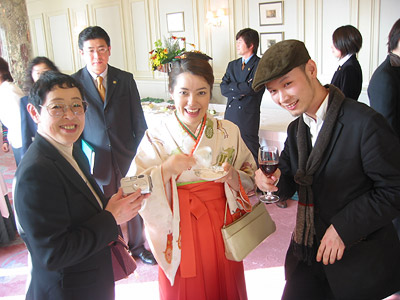
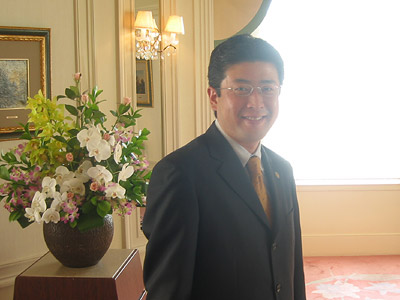
Afterwards, we moved up to the 27th floor and a very nice new room for the Graduation/Christmas party. For me, as kind of an unofficial photographer (as always), it was great because the light was perfect for taking photos–I got nearly 200 of them, so maybe a few dozen are good enough to print. Here are a few.


Machiko giving her address.


Many of the students wore traditional outfits, including these students’ kimonos.


As always at the Hyatt, the food was first-rate.


Then came the perennial Bingo game. Machiko’s lovely grandchildren were rapt players.


A graduating student, accompanied by a parent and a former graduate.


Yoshi, one of our hardworking office staff.


And Masako, who made my job so much easier when I was coordinator, winning first prize in Bingo: two passports for Tokyo Disneyland. It would be hard to think of someone who deserves them more–and she has two daughters who’d love to go, too.

Categories: Focus on Japan 2003 Tags:

NTT Doesn’t Make It Easy

December 4th, 2003 Comments off

As part of trying to make my Internet connection better, I am trying to switch to another DSL provider.

My ISP has been AT&T, and they have been very good–they have been my ISP since I was on a dial-up connection back in ’98. Up until now, I have used NTT Flets for the DSL connection, primarily because they were first into my area (I live in a relatively unknown town next to Tama), and I wanted to get away from ISDN as quickly as I could. But that also caused a problem.

NTT has always, or at least is seems, managed to jigger the setting up of systems so as to benefit themselves most, taking advantage of their position of advantage as the primary telephone company. When the new “MYLINE” service was set up, it was billed as a way of making things simpler–but to me, it seemed like it just made things more complex, and if one did not go through the process, NTT would collect you up as their customer by default. I am not certain of that, but that was my impression.

It is certainly my impression as far as DSL services are concerned. I have wanted to change DSL providers for some time, for several reasons. First, Flets does not provide some services as part of their overall package, such as IP Telephony. Also, I currently pay two fees, one to NTT, and one to AT&T; it would be substantially cheaper for me to consolidate those services and pay one company one fee.

So some time ago, almost one year before now, I started asking–and learned a disturbing fact. I could not switch DSL providers without having three weeks or more of interrupted service. The way NTT has set things up, I have to first end my service with them–and only after the service has ended may I apply for the new service (I have chosen KDDi for their English-language services). And it takes around three weeks, possibly a bit more, possibly a bit less, for the new service to be established.

The only logical reason for this gap is to assure that two companies do not provide DSL service at the same time. Even assuming that this is absolutely necessary, three weeks is an absurd length of time to require between services; most people would not wish to be relegated to dial-up service for the interval, and so would stay with NTT, which always has enjoyed the advantage of getting all the early adopters. Which, I presume, is NTT’s intention.

I personally know someone who simply misled the providers, telling the new one that the prior DSL connection had been terminated when it had not been–and that person enjoyed only a day or two of broken service between them. So it is clearly possible, and the three weeks clearly not necessary. I wanted to follow this friend’s example, but KDDi made it clear that they would have to actively check to see that the prior service had ended.

As it happens, I will be going back to the U.S. for almost three weeks this month, so that provides me with just the break I need. Still, I may have trouble getting reconnected when I come back–late on December 30th–with the holidays so close. But the service people at KDDi have been very good, the rep I spoke to spent a couple hours today helping me plan a way to set things up so there was the greatest chance of things running smoothly; he really went out of his way to help, which made me feel even better about going with that company–how a firm treats its clients has always been a big consideration for me in choosing whom to do business with.

So, with luck, I will not be cut off from high-speed service for long.

I should note here that DSL is improving here in Japan yet again: the old system of 1.5 Mbps, 8 Mbps and 12 Mbps that so far outstripped services in the U.S. is already outdated here. KDDi had even stopped giving their 24 Mbps service because now they have something faster. They offer two speeds: 26 Mbps, and 40 Mbps. Rather impressive speeds. I chose the 26 Mbps package for two reasons: first, as I live about 3 km (2 miles) from the telephone switching station, all speeds come out to about the same for me, just a few megabits per second. But more importantly, the 26 Mbps package provides a fixed IP Address (rather than a global one), making it easier for me to improve my chances at achieving easy voice chat with others. Both speeds have a total cost of about $35 per month, including DSL, ISP and modem/router rental.

Still waiting for vDSL so I can get higher speeds, but for the time being, this will do. Just hope it goes smoothly, and NTT doesn’t find a way to muck things up….

Categories: Focus on Japan 2003 Tags:

Japan Christmas Past

November 28th, 2003 Comments off


Speaking of Christmas in Japan, I recalled this photo taken many years ago–1989, if I am not mistaken–of my workaround for the Christmas Tree problem. Since full-sized trees are so expensive, and I am not too fond of fake ones, I compromised and got a bonsai. It was affordable because it was already on its way out, not having been well-maintained at the garden shop I bought it from. But it made a quite nice tree, matching my apartment at the time in size, no less. I even made a popcorn-and-cranberry wrap for it, though I do not clearly recall what I used for cranberries, as they aren’t sold here in Japan, at least not that I was able to find.

Anyway, I thought this made a very charming compromise between Japan and America during the holidays.

Come to think of it, it was ’89–that’s a trans-bay world series cap I got as a gift, sitting under the tree (next to it, really), and the Loma Prieta of ’89 interrupted the series.

Categories: Focus on Japan 2003 Tags:

Christmas in Japan

November 25th, 2003 10 comments

Well, it is exactly a month before Christmas, and I’ve noticed people putting up their Christmas decorations recently; scattered apartments and houses around Tokyo putting up lights, stores with the usual displays, playing Christmas carols for store music. Even though Japan is predominantly Shinto and Buddhist, with Christians forming a minority 1% or so, Christmas is nonetheless a middlin’-to-big thing over here, for much the same reason it is in the U.S.: commercialism. But with a Japanese twist.

The traditions in Japan are different, however; first of all, almost nobody has an actual Christmas tree. Trees in Japan are way too expensive, and there are no Douglas Fir farms in the hills that I know about. If anyone has a Christmas tree in Japan, it will be made of metal and plastic, readily stowed away in a closet from January, waiting for the next holiday season. And, to the best of my knowledge, even if a Japanese family has a tree, presents don’t get put under it; it is simply a decoration. No cranberry-and-popcorn strings, either (I always loved making those with the family), rather just some ordinary store-bought garnishes. I’ve never seen tinsel here.

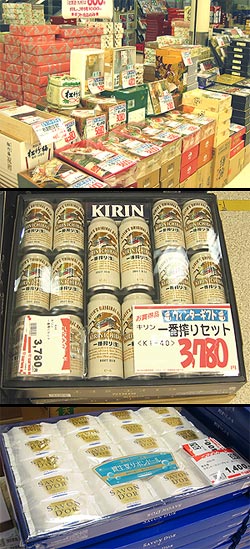
Presents are exchanged, though Christmas is not exactly the reason: it is bonus season. In Japanese employment, one’s meager salary is usually bolstered by bonuses, traditionally given out twice a year–once in summer, once in winter. The summer bonus marks the Chugen season, the winter one is called Seibo. Each one is marked by a special gift section created in stores across the country, sometimes taking up as much as half of a floor of a department store. In such gift areas you’ll find a plethora of items, popular ones including small rolled hams, and a wide variety of product packs–a 20-piece soap package, a 15-can beer package, packages with assortments of cookies, coffees, salad oils, fruit juices, canned seafood, and countless other consumer items. One buys gifts here and either gives them or has them delivered to the recipients. The Seibo gift centers are already open for business.

Next is a tradition also made in Japan: Christmas Cake. Don’t ask me why, probably a confectioner thought it up, just like they thought up White Day for bakers (White Day comes a month after Valentine’s Day–Valentine’s is for chocolate, which women give to men; White Day is for men to give cookies or other treats to women, and is supposed to have been created simply as a way to sell sweets). At Christmas time, people who choose to celebrate have a Christmas Cake. It even became a metaphor in the 80’s–women who had not married by age 26 were rather callously called “Christmas Cake,” meaning that nobody wants to buy the old cakes after the 25th of December. That attitude has changed, by the way, and most young people today have never even heard of the expression.

And for some reason, Chicken is the meal of choice. Turkey just isn’t popular here, I suppose, and ham isn’t exactly the same, either. I found out early on that if you want KFC on the 24th of December, you’d better make a reservation (yes, you heard me) if you don’t want to wait two hours for your order to be filled, or better, just go another day. KFC is swamped on Christmas Eve. Good thing I always vacation in the U.S. every Christmas (coming back to Japan before New Year’s–I like that holiday here). Not that I eat at KFC anymore–they usually refuse to let you choose which pieces you’re going to get.

One other Christmas tradition in Japan: romantic evenings at a romantic restaurant, followed by a visit to a love hotel (or perhaps any nice hotel would do). Again, I don’t really know why, but having a date on Christmas Day is considered a must for young couples. This article refers to a love hotel in Kanagawa which has permanent Christmas decorations in order to attract visitors. Some say there is an urban legend that if you confess your love to your special someone on Christmas Eve, your wish will come true.

But to many in Japan, Christmas is simply a secular affair, if an affair at all. Some make something of it, others do not. Here is an interesting sampling of responses in a kind of “man-on-the-street” survey in Tokyo. And here is an interesting article from the Japan Times last year about Christmas in Japan, including some history behind it.

Categories: Focus on Japan 2003 Tags:

Rain Geta

November 21st, 2003 1 comment

Spotted these on the platform while waiting for the train–rain geta. Geta are the traditional Japanese clog shoes, basic wooden platforms atop two wood blocks, with a thong on top. This is the first time I recall seeing a pair covered in clear plastic for rainy weather. They were worn by an elderly lady in a classic dark-tone kimono. An interesting modern touch on a traditional costume.

Categories: Focus on Japan 2003 Tags:

Arts Festival

November 15th, 2003 Comments off

Well, the school had its Arts Festival yesterday, and it was amazing to see the talent so many of our students have. Not just your usual skits at the talent show–we have some serious composers, musicians, singers… One student, for example, played original piano compositions that were astounding. I was in back when another started singing “The Heart Must Go On,” and I swore that I was listening to a recording of Celine Dion. Paintings by some of the students I honestly mistook for art that the live house had purchased, and there was a fantastic brass section that performed “In the Mood.” Seven students made up a punk rock band, playing a popular Japanese song called “Train, Train” that had many of the students in the audience acting like groupies at a concert. And one of my former students, who I knew was talented, surprised me in showing an array of talents I never expected, from keyboard artist to trumpeter to half a dozen other talents.

Even a few teachers took the stage, including one that recited comic poetry and sang a great a cappella piece, and another who played solo electric guitar and composed a hilarious blues piece based on his classes. And my own contribution–a 17-minute video I edited from footage some students and I shot–went over very well, starting off the show.

Find below some photos of a few of the acts with the audience.

Categories: Focus on Japan 2003 Tags:

That’s The Ticket

November 12th, 2003 1 comment

In the United States, speed traps are usually cops on motorcycles or in patrol cars, hiding around a corner or behind bushes or other cover–usually a one-man operation. In Japan, they work in teams. I was able to observe one in action today, not too far from a station I use.

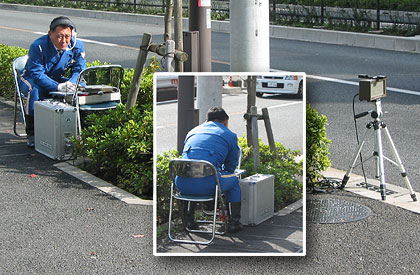
Here’s how it works: one cop, in this case, shown in the photo at top, finds a spot–usually behind signposts and/or telephone poles–and sets up shop. The radar detector goes out front, and the policeman, working with the control gear out of a metal suitcase, hides crouching on a chair behind his cover. He is in radio contact with a team of fellow officers about two blocks away. The team is located strategically so that a speeder cannot turn off somewhere or otherwise get by. A motorcycle cop stands ready to pursue anyone who tries to get away.

The cop in the chair detects someone going too fast. His gear displays the speed, and it radios the signal to the first guy’s counterpart (see bottom photo, guy sitting on a similar chair). The team gets a warning shout over radio from the guy up front, telling them that a speeder has just passed by. The team dispatches a pair of policemen–one regular cop, and one motorcycle cop–into the street to flag down the driver, and pull them into a nearby parking area (I caught the tail end of this in the photo at middle right). The driver is then taken to a folding table with chairs set up where seated officers get their information, give them a lecture, and write out the citations.

In the times I have seen this setup, I have noted that it is never in a place where speeding might be a problem. I know of many streets–a few right in front of police stations, no less–where the hazards are great: speeding cars, blind corners, pedestrians crossing at all places, the works–and there is never a speed trap or even an officer on patrol. In the places where they could do the most good. Instead, the traps are set up on long, wide straightaways with absurdly low speed limits. The street pictured here is a wide (for Japan) two-lane boulevard with little foot traffic (it’s an industrial area). I walked its length and maybe saw one or two pedestrians in total. Very little cross traffic. In other words, probably the place one would least have to worry about accidents happening.

And the speed limit is 40 kph, or 25 mph. This kind of street would be at least a 45 mph (70 kph) zone in the U.S. For the type of street it is, the speed limit is ridiculous. And so, naturally, everyone speeds. I believe that this is called “shooting fish in a barrel.”

The few other times I have witnessed speed traps in Japan, they have always been like this. Not for safety, not for public service. But for the sole purpose of writing out tickets. If this were a sometimes thing, like in the U.S., it wouldn’t be so bad. But from what I have witnessed, traffic cops never give out tickets for the purpose of safety. Just for revenue. And that’s completely wrong. These police should be at the dangerous locations, making the streets safer. I covered this in a previous entry, “Seasonal Fair-Weather Daylight Enforcers,” though I did not have artwork on the speed traps at the time. But the criticism still stands. It is almost emblematic of Japanese police, traffic or otherwise, to make more of a show than to actually keep the peace. They can do much better than this.

Categories: Focus on Japan 2003 Tags:

Crime and Foreigners in Japan

October 28th, 2003 3 comments

Life in Japan as a foreign resident is much better today than it was back in the 80’s. The creature comforts, imported goods and so forth are better, as I have commented on before. But more than that, in the 80’s there was a notable racial component to things as well; foreigners were sometimes seen as a source of crime and disease; police often stopped foreigners for no immediate reason other than that they were foreign. That happened to me many times, usually riding my bicycle; the police would accuse you of having stolen it. In those days, with so much antipathy focused on foreigners, the bad news accentuated and the good news muted, you were sensitive to such things. I recall one day I was stopped near Musashi-Sakai Station for “bicycling while foreign,” and was actually surrounded by four or five cops. I remember seeing passers-by shooting glances at me, and guessed what they were thinking, that this scene confirmed the fears stoked by newspaper bias and politicians’ speeches shouted from the tops of loudspeaker trucks.

This happens a lot less today.

There are, however, some remainders from that time, and this week a few of them have popped up. One of them was an editorial from the Japan Times that was very reminiscent of the 80’s; in fact, it could be an exact clone of an editorial from that time. It comments on high crime rates of foreigners in Japan, but like so many similar reports in past years, it exaggerates quite a bit. It mentions high numbers of crimes, but it does not mention crime rates; and if one calculates the crime rates, one finds what has always been true: crime rates of non-Japanese in Japan have always been lower than that of the native population.

Another facet of the problem has been how the Japanese media gives weight to some stories and less so to others. I commented on the story of Yoshi Hattori, the young boy who was shot to death in the U.S., and how this was amazingly over-reported in Japan, the story dragging on for much longer than a year, while a story about an elderly Japanese woman shot in Japan was virtually ignored despite the unusual nature of the shooting.

Yesterday, a similar example of bias appeared in the news when an American sailor was shot on the streets of Hiroshima. Initial reports here in Japan not only failed to identify the assailant as Japanese, but omitted certain details–his basic description, along with the language he spoke, all information available from the start–details that would have suggested that he was Japanese, thus giving the impression (by local standards) that the shooter was probably another American serviceman. The story was given short thrift in the papers yesterday, and today’s Yomiuri has nothing about it at all. Only subsequent on-line articles reveal that the man spoke Japanese, and still fail to identify him as a national. Foreign publications, like this Stars and Stripes issue, give a more detailed accounting. Japanese newspapers, it should be noted, seldom fail to identify a suspect as a foreigner even if it was only a suspicion of such.

One thing that is clear: if the races had been reversed, and it was an American who had shot a Japanese, there would be no other news story for this day or any other for weeks; it would make international headlines, and Japan would be rife with protest and anger.

Categories: Focus on Japan 2003 Tags:

Fall View

October 26th, 2003 Comments off

Had a busy day today, not much time to blog. Had the chance to visit the tower atop the local hill (the one that blocks my view of Shinjuku!), and found that not only had I picked a very nice day to climb, but that it also happened to be the last day the tower is open this year. The tower is usually closed and locked, open only on Sundays during about 4 hours in the afternoon–and even then, only for a few months. For the first few years I lived here, I didn’t even think it opened at all.

But I got a good view today; below is a panorama (click it to see the larger image, about 1000 x 300 pixels). The fall colors are turning, and they’re just going to get better.

Categories: Focus on Japan 2003 Tags:

Mmmmmmaahhhh…. Suuuuushiiiii…..

October 25th, 2003 Comments off

When I tried to find a decent, cheap sushi place in the U.S., it was very hard to do. Most places charge several dollars per plate, a lot more than the dollar-a-plate I’ve become used to in Japan. The best I could scrape up was a few all-you-can-eat places in San Francisco, and they were still more expensive, in the end, than the Japan dives (even if I starved myself prior), and the quality just didn’t match up.

Before I came to Japan, I thought as many Americans do–that I would really hate it. Raw fish? Come on. And you know what? I still do, much of it. Sorry. Especially the maki-sushi (rolled sushi) or any other kind with seaweed. Never got used to that stuff. But there is one kind that I do like, and I like a lot: tuna. That’s either in the standard form–red tuna, or maguro–or in the high end menu selection, fatty tuna, called toro.

Toro, when you get good stuff, is heavenly. Tastes like butter, almost. I get it whenever it is priced reasonably at the supermarket. It comes in slabs; I chill it while I cook rice, then as the rice cooker indicates that the rice is done, I take it out, slice it (you need a really sharp knife), and eat it as sashimi, the rice on the side. Of course, I can’t afford to get what is called “oo-toro,” the highest-quality toro, but “chu-toro” (literally “medium fatty tuna”) is often available and I get that every few weeks.

Strangely, the toro available at the kaiten (conveyor belt) sushi joints is, almost uniformly, not very good. I’ve never ordered the 6-dollar-a-plate variety, but the 3- or 4-dollar varieties never have the right taste. A friend of mine who lived in Osaka once treated me to toro at a good sushi place near where he lived, and that was great–but the conveyer-belt places can’t seem to get it right.

But they do the regular tuna just great, and so that’s what I usually load up on when I stop by the place, every week or so on the way back from work. They know me there now, just like the folks at Akiyoshi yakitori-ya do. I’ll come in, order two plates right off the bat. They combine the two into one plate, putting the four sushi together, and the two plates one on top of the other. If the first set tastes good, I’ll order another four to six plates. I’ve come to notice, however, that they give me the best sushi first….

When you’re finished, they tally up the plates you’ve left stacked; price per plate is determined by the color and pattern on each plate. Since maguro is the cheapest, the tab usually comes out to a bit more than 6 or 8 dollars. Not bad.

Categories: Focus on Japan 2003 Tags:

Crossing the Chuo

October 21st, 2003 2 comments

One of the many places I’ve lived in Tokyo was Koganei, for two and a half years. I lived in Higashi-Koganei, near Asia University. I used to ride my bicycle in the area quite a bit, in particular to a Home Center (a kind of store, like a cross between Home Depot and Walmart; not as big, but big for Japan) on the south side of the tracks. So I know what it’s like to cross the Chuo Line–and yet, from the news I see, it is now even harder than ever before. More on that below; first, a bit of background.

Crossing the Chuo was always a chore. First of all, trains in Japan are much more widely used, so there are a lot more of them. Back home in the Bay Area, a train crosses an intersection every thirty minutes to an hour. Here in Tokyo, it’s once every few minutes on the busier lines. Second, the barriers at railroad crossings in Japan go down long before they would in the U.S., sometimes almost a minute before the train comes. And if the crossing is next to a train station, just forget about it; even though the approaching train will stop at the station before it crosses the intersection, the barriers go down just as soon–so people at the intersection have to wait not only the one minute for the train to get to the station, but also the time it takes for people to get off and on the train, then for the train to start up again–and finally cross the intersection.

To make things even worse, there are times when the trains from either direction are staggered–you wait a few minutes for a train one way to get through, then just as it passes, the lights indicating a train is coming from the other direction light up. Then just as that train passes through, an express train from the first direction lights up that way again. Choose the right intersection close enough to a station, and you can get caught like that for what seems to be an endless time. My own record for that is waiting for five trains to pass, each one on the heels of the other. That’s not counting the one time when there was a slowdown due to an accident, with trains lined up behind each other; the trains were so close and so slow, the barriers stayed down for more than half an hour (in the rain, of course). Finally, everyone at the intersection just got fed up, lifted the barrier and went through when it was clearly safe to do so.

But now, things are worse. JR East, the railway company that runs the line, has begun construction on an elevated line for the Chuo. The plan to get the work done involves laying extra tracks beside the original ones, thus widening the railroad crossing. This requires more warning time before each train comes, which has been causing great traffic jams. The elevated line, ironically, is intended to relieve traffic congestion caused by the difficult crossings. I guess it has to get a lot worse before it can get a lot better.

I first noticed this trouble when flipping through channels, and saw one station at a railroad crossing, showing how ridiculously wide it had become–taking even some young people more than 20 seconds to cross, impossibly long for some elderly people. I didn’t note at the time where it was, but then I started seeing it on the news more and more, and so started paying attention.

The crossing most in question is the one on Koganei Boulevard (Kaido), next to the busy Musashi-Koganei Station. The crossing is usually 56 feet (17 meters) wide, but due to the construction, it has been widened to about 120 feet! that’s 35.7 meters. kind of hard to believe, but you understand when you see it. It’s wide. Vehicles have become trapped in there, causing crossing guards, always on duty, to signal the emergency stop for approaching trains. The same guards are constantly having to hold up the barriers for the later pedestrians to get through. Elderly people, frightened into moving faster than they should, often trip and fall.

It’s worse if you’re waiting to cross. As mentioned before, back-to-back train passes make for long waits, and the widening of the tracks makes them even longer. The TV show I saw tonight clocked one wait at an entire hour before the barriers came up. Drivers just give up and go elsewhere.

Pedestrians don’t have that option, so Musashi-Koganei Station has started issuing special passes to people so they can enter the station, walk to the far end of the platform, use the stairs to cross the tracks, come down the length of the opposing platform, and then depart the station on the other side. At other stations, people are lucky enough to have pedestrian overpasses (still a major pain to bike riders), or even better, elevators up to the overpasses.

I’m just glad I don’t live in Koganei these days… I hope they finish the elevated tracks as soon as possible–but JR East is saying that it will take six months just to install temporary devices, such as approaching train sensors so the gates don’t go down so early. Lord knows when the work on the tracks will be done; years away, no doubt. The entire project, in four parts, is due to be completed in 2011.

Categories: Focus on Japan 2003 Tags:

More Things I Like About Japan

October 12th, 2003 2 comments

I first came to live and work in Japan since 1985. Since then, there have been a slew of improvements for foreigners looking for a touch of home. A few:

International Telephone Calls. KDD used to have the monopoly on that market, and rates used to be ludicrously high, especially calling from Japan to America. I remember that I used to have to call my parents through the international operator, calling collect. I would give the operator our family’s cat’s name, and tell her I was trying to reach someone with our dog’s name at my parents’ number. When my dad got the message that our cat was trying to make a collect call to our dog, he knew it was me saying, “call me now.” He would then refuse the call and give a coded answer as to when he would get back to me, which the operator passed back to me.

Even then, we’d have to keep our conversations short, else dad would get charged $50 a pop or more. Now we use a lot cheaper services, and we may even start using Messenger’s audio linkup (or iChat) soon, making the conversations completely free.

Internet Access. This really wasn’t even on the radar screen in 1985, and it was depressingly poor in Japan up until just a few years ago. But then it took a quantum leap, just as America’s service started to falter. Two or three years ago, I was still forced to use ISDN (max speed, less than 64 Kbps), and had to covet my folks’ 300 Kbps ADSL connection in the San Francisco Bay Area when I visited them at Christmas time. Now, my dad is paying more than before for a crummy half megabit, while in Japan, DSL speed is now up to 26 Mbps for just about $30 a month, and if your building can accept the cable, 100 Mbps fiber optic can be had for about $70 a month–what my dad pays for his now-slower ADSL.

Unfortunately, I live more than 2 km from the telephone station, so my 12 Mbps ADSL is really only about 2 Mbps. But at my college, our LAN has a dedicated fiber optic connection, and man, that thing is blazing fast. The main thing limiting it is that almost no one else has a line that fast. But I have gotten download speeds as fast as a few megabytes per second from big sites, like Apple.com. Sweet.

English-Language Media, for that matter. I remember when it was hard to get any English-language books, magazines or newspapers–you had to get them through Kinokuniya for outrageous prices, else have them shipped from the states (I usually bought them on my trips back home). And on TV, all we got was the Wednesday night bilingual (like the SAP deal in the U.S.) movie, usually something stupid like Death Wish 3, and we were grateful for it. This is not one of those I-used-to-walk-ten-miles-in-the-snow stories, I really mean it, I watched that garbage, and so did most of my foreign friends, because that was about it on TV. There was the video rental place, and you can bet we used it.

Now, we have cable TV with CNN and options like Super Channel. There is Amazon.com, and Amazon.co.jp, and of course, there’s the Internet for all kinds of media. A lot nicer. It does make a difference.

Cheaper and More Available Foreign Foods. First we got the Foreign Buyer’s Club in Kobe, which has, for a long time, been a good place to get imported foods. They still will deliver to your door for a 1000 yen flat fee, even if you order 20 cases of Diet Caffeine-Free Coke. Where else can you get sunflower seeds in the shell? Or a ton of other stuff, for that matter.

And now, Costco is making a big entry, with four stores in Japan now (Fukuoka, Chiba, West Tokyo, and Hyogo) and growing–they say 50 stores in the next decade or so may open. Next: maybe Saitama. It’s a godsend for me, with the West Tokyo store opening a year ago just a few stops away from me on my train line. just went there today, getting some bagels (real ones, not the kind you usually find in Japan) and whipped cream cheese, four-cheese ravioli, microwave butter popcorn, a bag of cheap lemons, a big net of garlic cloves, five rotisserie chicken legs and thighs (fresh baked) and some other nice stuff. There’s a 4,000 yen yearly membership fee, but for what you get at the prices they have, you can’t beat it.

And even local stores have a lot more imported stuff, a lot different from the protectionist 80’s when an imported can of beer–when you could find it–cost almost twice what it does now. A lot of foods, snacks and other groceries you can get which you couldn’t before.

Plane Tickets. I remember the shock of calling a travel agency and being told that my round-trip ticket to California and back would cost about US$2,000. Sure, you could get cheaper tickets, but not by much. Many of you who were here in those days will remember the old “yobiyose” tickets. Essentially, they were three-leg plane tickets bought overseas and then sent to people in Japan. For example, the ticket would go from Hong Kong to Tokyo, then to San Francisco, and then back to Tokyo. The buyer in Tokyo would just toss out the first leg and use the second two. And still the ticket would be a lot cheaper than one bought in Japan. Others would just buy one-year open-ended tickets in their home country, and just make sure they went back every year, buying a new ticket each time.

Somewhere along the line, the pricing system changed, and now it’s a lot cheaper–perhaps even cheaper coming from Japan. I just got a round-trip, non-stop ticket for my Christmas visit home to the S.F. Bay Area for 47,000 yen (plus about 10,000 yen for airport, airline and sales taxes). That’s $430, or $520 with taxes–not too shabby.

All of this makes life quite a bit easier in Japan–a nice place to be, all on its own.

Categories: Focus on Japan 2003 Tags:

Amped Up

October 8th, 2003 1 comment

It is nice not to have the lights go out like they used to. No, I’m not talking about living in California or New York, but rather here in Tokyo, where power outages are very rare indeed. Instead, I’m referring to the low amperage allotted to apartments in Tokyo, and how my breakers used to trip all the time.
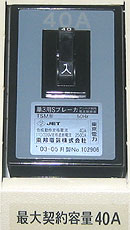
Used to be that whenever I had an air conditioner and the clothes dryer going at the same time, then SNAP! Out the lights would go. Time to grope my way to the breaker box and switch the power back on, then to reset half the clocks in the place, and fiddle all the other settings around the apartment which got wigged out.

Eventually, I got tired of this. I’m not a big energy hog, but there are times when I want to use more than just a few appliances at a time, thank you. And thirty amps just wasn’t enough. So I called up the energy company, and it turned out they can upgrade–though in my case, only to 40 amps. Good enough; I asked them to come over, and the electrician installed the new breaker in just a few minutes.

It costs a few dollars more a month (my basic energy usage hasn’t gone up in itself), but it is very nice to be able to run the nuke wagon with the TV and cooler going and not find oneself suddenly in a dark room.; I haven’t had a single breaker trip since the upgrade.

Categories: Focus on Japan 2003 Tags:

And a Few More

October 7th, 2003 Comments off

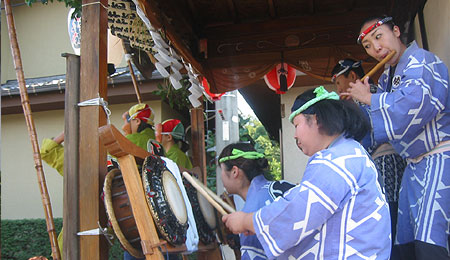
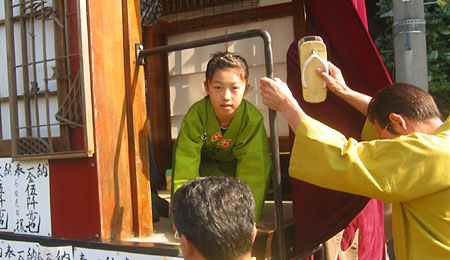
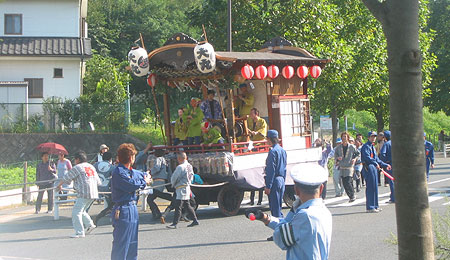
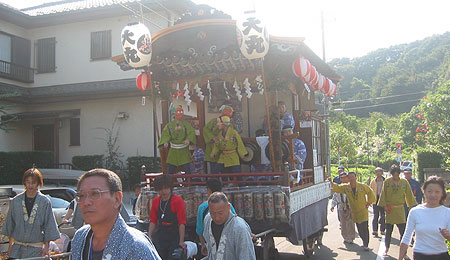
On the way back from Minami-Tama station, a local festival troupe passed by. I still don’t know what it was all about, but it was fun….

My favorite of all the photos was the second one. A bright sky background led to a very nice effect above the mikoshi. If you would like to see a larger rendition of the photos, click here.

Categories: Focus on Japan 2003 Tags: