Moving Day
Ah, Vanguard Tower. 21st floor. Great view. Almost 3 years. Way too much rent money. We’ll miss it all. Especially the rent money.

Gotta pull the Internet cables now. See you in Hibarigaoka.
Ah, Vanguard Tower. 21st floor. Great view. Almost 3 years. Way too much rent money. We’ll miss it all. Especially the rent money.

Gotta pull the Internet cables now. See you in Hibarigaoka.
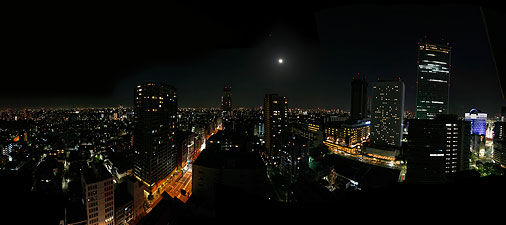
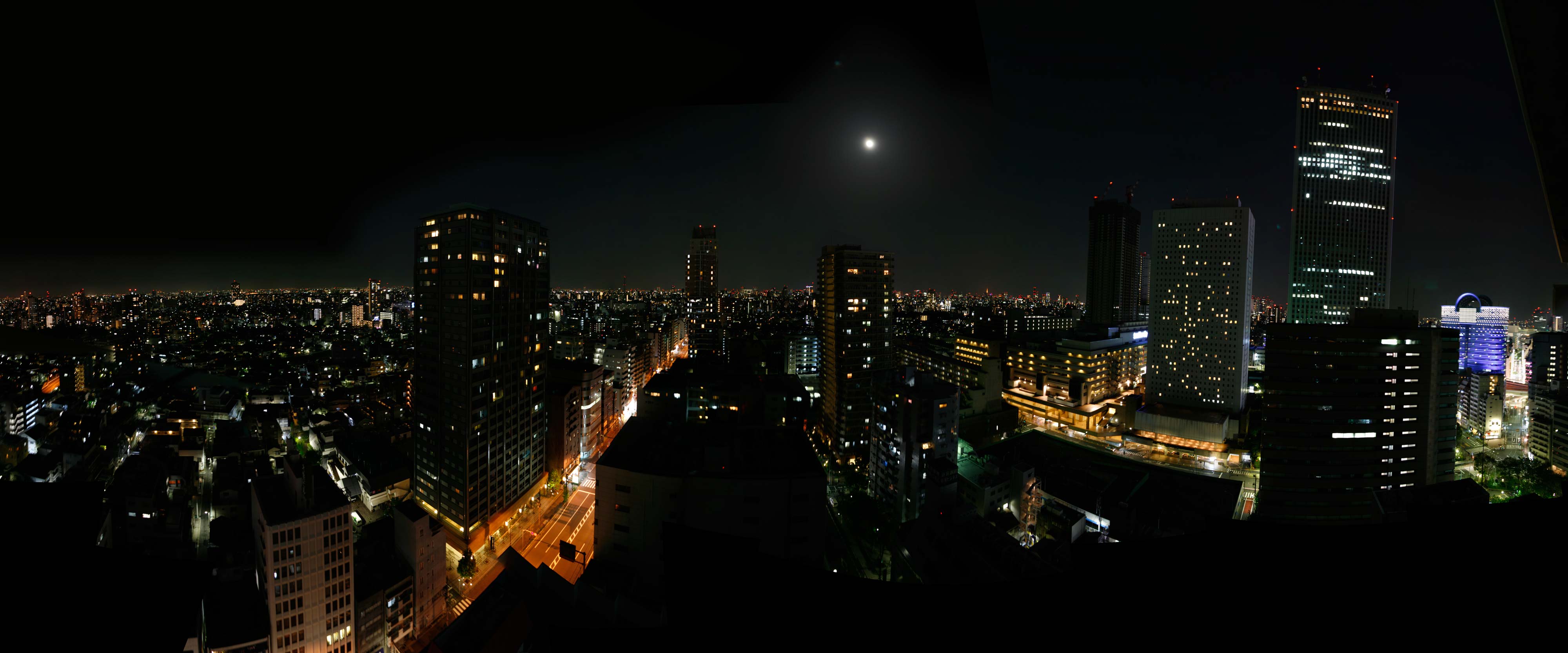
Been taking a few photos to remember the place by. Here’s a stitched panorama of the nighttime view from the balcony, taken tonight. The image runs from north at far left, through the eastern view, to the south and almost fully to the west–about 260 degrees, in all. The tallest building, on the right, is the 60-story Sunshine City building; the small blue building to its right is the Amlux Building (which blocks the view of Mt. Fuji from this perspective); to the left of Sunshine is the Prince Hotel. The bright light in the sky is the full moon. Tokyo Tower is a tiny thing in this image, barely a single pixel; it is halfway between the building below the moon and the tall, dark building to it’s right.

The 500-pixel image above doesn’t do the panorama justice, of course; so here are links to a 2300 x 1024 copy, or for a better view, one which is 4000 x 1667. And for those who want to see the bearings, here is a titled 4000 x 1750 version with the cardinal directions and major landmarks pointed out. Enjoy.
You may have seen reports that the iPhone now commands 72% of the smartphone market in Japan, and if you read this blog as well, then you may be wondering why I haven’t commented on that yet. Here’s the reason why: the smartphone market in Japan isn’t all that big. I knew that the iPhone’s penetration in Japan wasn’t even close to 72% just from what I see on the street. Sure, I see an encouraging number of them–one can spot several during any subway ride nowadays–but absolutely not a majority. So far from one, in fact, that it was immediately apparent that the sub-market Apple got 72% of must not be all that big. And here’s a blog post showing that to be true: Apple’s actual share of the cell phone market is 4.9%. That sounds just about right–1 out of 20 seems to match what I see on the trains and on the streets these days.
Now, if you go from being incredibly impressed at 72% to being greatly unimpressed by 4.9%, remember that the iPhone was supposed to fail horribly in Japan, whose people were supposed to hate it, and that 4.9% in less than two years is a rather impressive showing, especially in such a tough and competitive market, and when your product is only sold by the least popular of the top three service providers.
It will be interesting to follow the iPhone over time, and see how the iPad–even more of a cypher for Japan before the fact–does here as well.
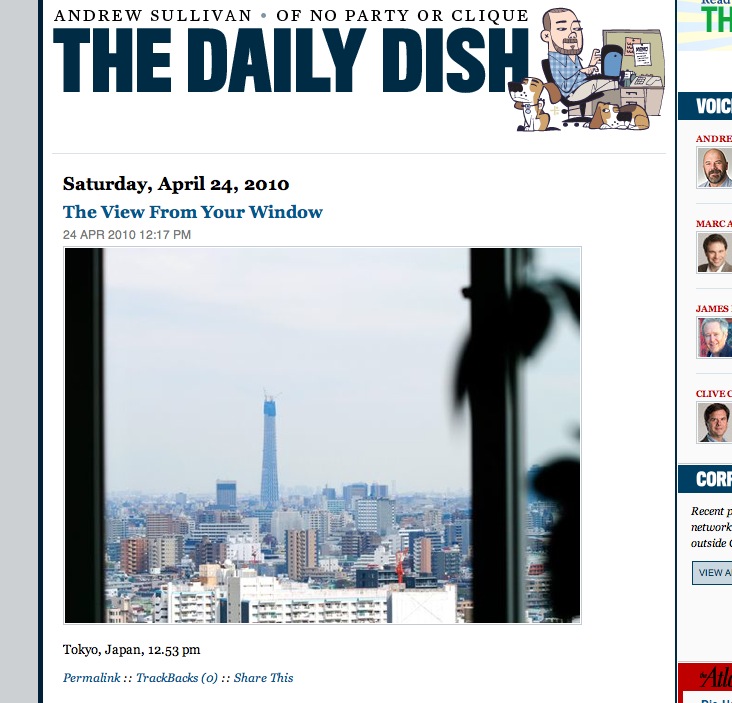
We’re leaving next week, and so it’s appropriate that The View From Our Window has now been memorialized in Andrew Sullivan’s The Daily Dish:

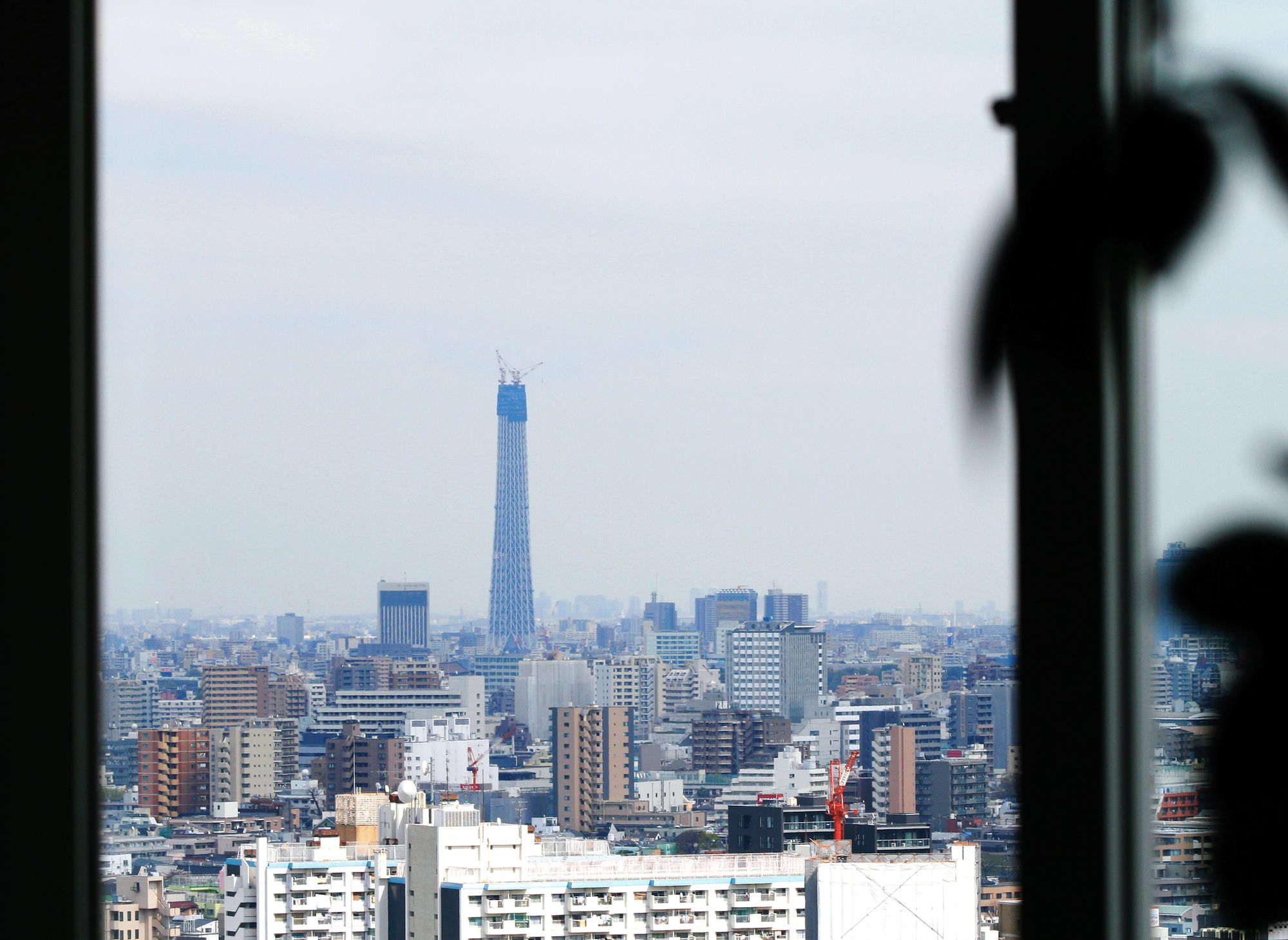
The original here (click for enlargement, 2K pixels wide):
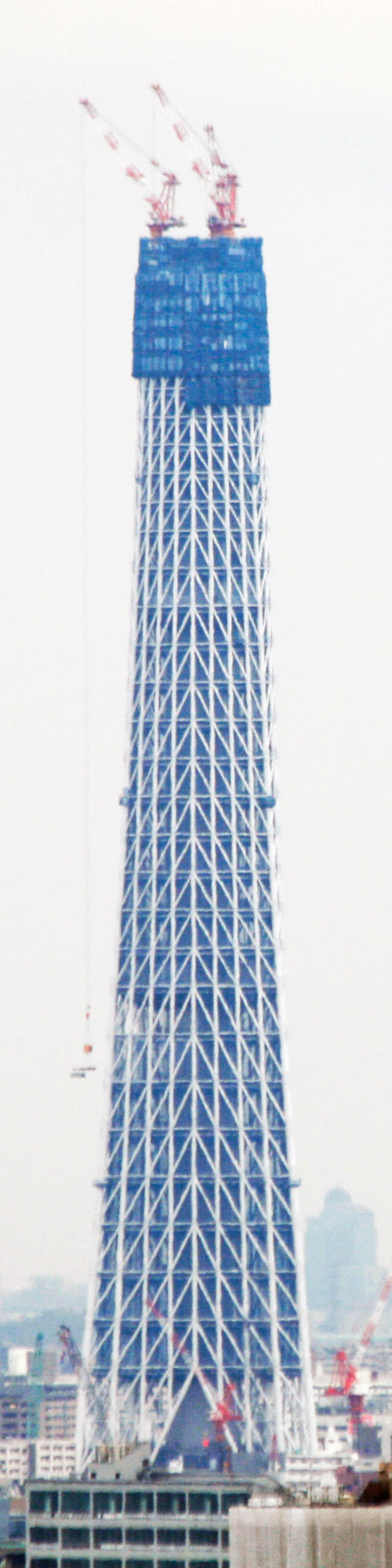
And here’s the post from last week, a photo taken about the same time, super-zoomed up on Tokyo Sky Tree under construction.
We’re leaving Ikebukuro–and our nice view–in a few weeks, so we won’t see the Sky Tree (I still hate that name) develop more than the 350 meters it is right now, unless we go somewhere else that affords a view. So here’s a nice, tall view of the tower a nice, tall view of the tower as it currently stands.

Today, Sachi and I took on the moving company situation. Sachi did most of the work, actually. She called several places, and only two were willing or able to send people over today. So we saw one at about noon, and the other just past 3 pm, and got estimates.
The first guy failed to impress us from the start. To begin with, he ran about an hour late. Worse, he didn’t contact us to let us know; about 45 minutes after the appointed time, we finally called the company to find out what was up. Soon after, the guy called us, no doubt having received a call from his office in response to our own call.
When these guys come to your apartment, they go through the place counting everything up. Each item has a point value assigned to it, and the total number of points determines the number of trucks and how big they are, and in the end, the price. As an interesting side point, it brought up how Japanese and Americans tally numbers differently. In the U.S., we make four vertical lines, and then cross them with one diagonal stroke to make a group of five; in Japan, they spell out the kanji “正,” which has five strokes, one stroke being drawn at a time as a way of counting each item.
Anyhow, after the guy finishes the count, we all sit down and he hands us some reading materials while he adds things up. There are a lot of variables: air conditioners cost extra to take down and re-install; they will take care of throwing out stuff you don’t need (like furniture), but that also comes at a fee; then there are four or five different sizes of trucks, and buildings often restrict the size (in our case, we are not allowed to bring in any truck over 3 tons). So we spend time talking about that as well.
So this first guy comes forward with an offer: 300,000 yen. Yikes! I blanched when I saw that–$3250 for a move about 12 miles distant. I am pretty certain, however, that this guy was intentionally giving us a high figure. We live in a pricey location, so he maybe thought we’d pay the amount without thinking. If not, he could then slash the price and act like he’s doing us a special favor. In the end, he went down to 190,000 yen (a bit over $2000). However, it was a bit of a struggle, with him constantly calling his office and asking about availability of trucks. He had this crazy scheme of of using three trucks–two 2-ton trucks and one 4-ton truck–and using the 2-ton trucks to carry stuff out of our apartment, meet up with the 4-ton truck to load it up, and then send the 2-ton trucks back for a second load, and all three would then go and unload at the new place. Weird.
We also came up against another hitch in terms of the moving day: the auspiciousness of the day involved. In Japan, there is a kind of astrology of sorts for the calendar called Rokuyo, with each day having one of six designations. Taian days are the luckiest; that’s when everyone wants to do stuff. Especially weddings–Sachi and I got married (both civil and ceremonial weddings) on Taian days. Butsumetsu are considered unluckiest. When we were discussing which day to move, the 3rd of May came up, but Sachi was very reluctant: that’s Butsumetsu. And it wasn’t just her; the moving company charged least for that day, doubtless because nobody in Japan wants to move on that day. We only got the price down to 190,000 yen by getting the salesman to give us the Butsumetsu rates for the day before.
Later, the second guy comes. He also is late, but immediately calls us at the appointed time to let us know how late he’ll be. (Just 15 minutes, as opposed to an hour late for the other guy). He goes through the same routine, albeit with a nicer, easier manner than the first guy. Chats at first, then counts the stuff, then sits down and calculates while we go over the time-killing materials. Then he gives us an estimate: about 190,000 yen. Very promising: he started where the other guy finished. Sachi, fortunately, is very good at haggling (a particular weakness where I am concerned), and talked the guy down to 157,500 ($1700). I am pretty sure that, like most salesmen, he had this figure pretty much set from the start based on some formula or another. We figured that we would probably not get a better deal elsewhere, so we signed. The guy brought up some cardboard boxes and tape and we committed.
Both salesmen asked how much the other one bid, with the first guy desperately trying to find out if he could salvage the deal when we called him up later to tell him the bad news. Maybe if we were a bit more ruthless, we could have played them off of each other, but neither of us is that “good” at negotiating–or at least, we don’t want to be.
So now the move date is set; we went downstairs and handed in the papers informing our current building when we’ll leave. But there are now a tsunami of other things to handle, packing just being one of them. We have to now cancel phone, electric, water, cable, and Internet service, and get them arranged for the new place. Then there are the official papers–tax and residency registrations, licenses and IDs, bank and other notifications that have to be dealt with. A ton of paperwork, in short. Then we have to finish buying stuff for the new place–an electronic toilet seat and washlet/bidet, a gas stove/range for the kitchen, lamps for the ceiling, and various furniture (cabinets, desks, chairs, etc.) that will be appropriate for the new place. Thank goodness we have about $7500 in deposit money coming back–we’ll need it. The deposit for the new place is a lot less as the rent is less, and will be payable over three years. That, plus the $1000-a-month savings in rent will more than cover all the expenses.
It snowed last night. Not much, but it did. Around 5am Sachi and I heard something hitting the bedroom window, like sand, except there’s not sand around. Sachi woke up and said she saw it snowing, even enough to collect on rooftops for a short time.
This is a damn crazy Spring we’re having here. For more than a month now, the weather, aside from being unusually cold, has also been annoyingly flirtatious. We get one or two days of weather with sunny skies and 70’s temperatures, and then back to a week or so of rain and temps in the 40’s and 50’s. Last night’s snow is simply part of the latest ebb.
It has me wondering if we’re just skipping Spring this year…
P.S.: nobody tell Fox News, they’ll claim global warming is fake again.
Looking for a nice apartment? One is about to open up in Ikebukuro. A 2LDK, about 70 square meters, building is less than three years old. Nice hardwood floors, under-floor heating, 21st-floor view from northeast to the south, plenty of balcony space. It’s opening up after we leave around the start of May. Down side: pricey, at 250,000 yen a month. (Ouch! Did we pay that much for so long? What were we thinking?)
We got the Ikebukuro place when we still had two incomes, and could easily afford it. Not any more… so we’re moving farther out, to Hibarigaoka, as I mentioned earlier. Not that we absolutely have to, but it’s hard to justify living in the place we do any more. After my permanent residency comes through, and we find a bank that’ll give us a loan, we’ll start looking again for a house to buy–but that could take a while, and this will be our domicile until we move into a place we own. The apartment we decided on is the same place I outlined in this blog post. But today we were able to go inside after the renovation was finished, and decided that, yes, this would do for the next year or so.
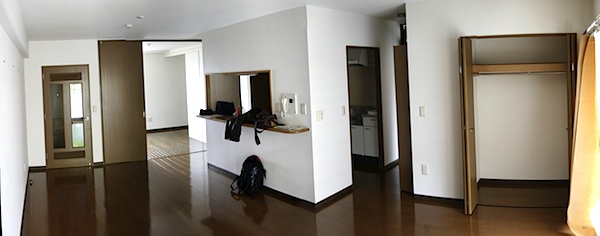
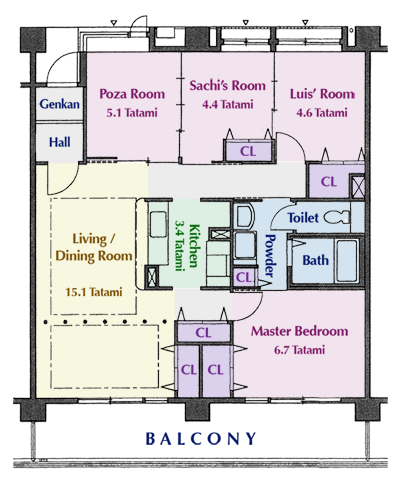
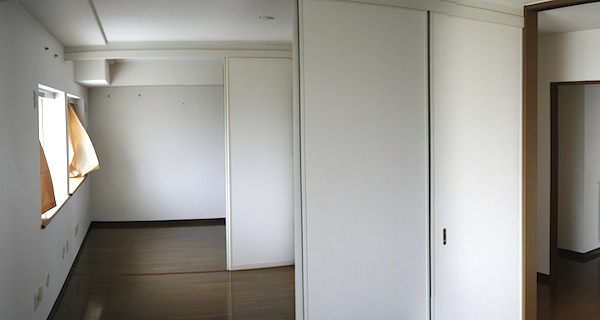
Here’s a stitched-panorama shot taken from the south-west corner (lower left corner of the yellow-colored living/dining room as seen in the map below):


The down point: we’ll have to buy some new stuff. We have two air conditioners, but the new place needs at least four. On our way home, we stopped at “Labi” and found a model on sale for 35,000 yen–a very low price for a heating/cooling conditioner, and that price comes with installation. We still have to purchase at least two more ceiling lamps, a gas cooking stove, a shoes cabinet for Sachi, and a few other pieces of furniture. Tomorrow about 3 different movers will come through and give us estimates on how much it’ll cost to pack up and transport all of our stuff to the new place. Due to size restrictions on visiting trucks, we’ll have to limit ourselves to 2-ton vehicles; it’ll take at least two to make the trip.
After we get a mover who’ll commit to a moving day during Golden Week, we will sign the contract with UR and officially give notice on moving out of our current place.
Here’s an interesting article in Business Week about how Japanese publishers are apprehensive about Apple’s iPad, and how it might jeopardize their lock on the market. Currently, what amounts to a cartel sets and rigidly controls pricing of books, pricing which retailers are forbidden to vary from. And it profits the publishers very well: 700 out of every 1000 yen goes to the author & publisher, 70 yen going to the author and 630 to the publisher (natch). They do not want to give up their fat profits by letting competition get involved.
They saw what happened to the American music industry and, like most other industries which leech off of the creative energies and needs of others (i.e., “publishing”), fear that consumers will get a taste of what fairer pricing is like, and will demand more of the same. Kind of like every other industry since the music industry. Most publishing seems the same that way–more or less a solid front of publishers fixing prices to assure large profits.
Frankly, I think they worry too much. It’s not like their ranks will break, or that a smattering of independent authors will tear down their monolithic front. Japanese music labels forced Apple, after long delays, to accept both higher and tiered prices (songs go for $1.60 and $2.15, albums for as high as $21.50). Which was stupid, because Japan allows CD rentals, and most young people–who might otherwise pay for cheaper music–instead rip the rental CDs cheaply. I can’t imagine the publishing industry being any different. God forbid they should allow the customer to buy an e-book with the identical profit for the publisher, with printing and distribution costs waived–we can’t have that. Especially in an economy like we have right now.
Good thing the iPad is not just an ebook reader–it would fail in Japan if it were, if only because the greed of the publishing industry will make it difficult if not impossible to make ebooks thrive.
An advertisement for a girls’ private junior/senior high school seen at Komagome Station, Tokyo:

Seriously, can you get much creepier than that?
Well, we laid our claim on the apartment with UR yesterday, so if we find that we indeed like the place, and if we don’t find a better place in the next month, we will likely be moving in sometime in late April or early May. We still want to look at a few places we’ve singled out from UR’s rather considerable inventory, in particular a place 9 minutes’ walk from Kokuryo Station on the Keio Line. However, I must say that I am more and more enamored of the Hibarigaoka situation–the large apartment, the quiet surroundings, the nearby shopping, the station and line. But something better could pop up, you never know. For example, there’s a building at a station called Oizumi Gakuen on the Seibu Ikebukuro; it is virtually right next to the station, and the area looks nice. Alas, when we asked, no units of the size we’re looking for were available. However, should something come up, we will be interested. And something else could crop up elsewhere that we didn’t expect.
Right now, we’re just biding our time on Hibarigaoka. The current people move out in three days (we saw moving boxes stacked up in the windows when we were in the area), and then UR will reform the place until April 16. We will not be allowed to view the actual apartment interior until then. We could, in theory, see it that day, make our decision, and sign the contract all at once, and then we could move in no sooner than one week later. That would allow us to move before Golden Week, and before I start working again after the Spring Break.
The problem is leaving our current place. We must give 2 week’s notice, and once given, we can’t take it back. So if we were to move into the new place on April 23 or 24, we would need to give notice of leaving our current place around April 10–a week before we even see the new place. And if, for some unforeseen reason, we don’t like the new place, we would be stuck–forced to move out of our current place a week later, and would have no place to move into. So, instead, just to be 100% safe, we will hold off canceling our current lease until after we’ve seen the Hibarigaoka unit, and instead will move either during Golden Week (should we be able to get a moving company to take us then), or just after. Less than ideal, but not unworkable.
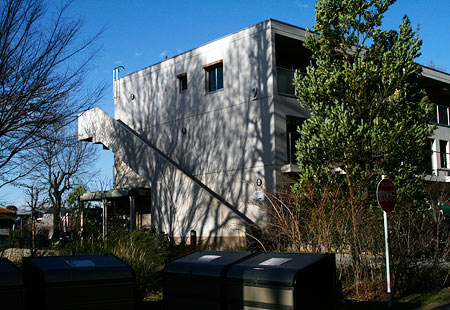
Just for fun, here are some photos from our trips to check out the apartment and the neighborhood. First, the stairs to the third floor: the first and second floors are 2-story “maisonettes,” so the stairs go straight up to the third floor:

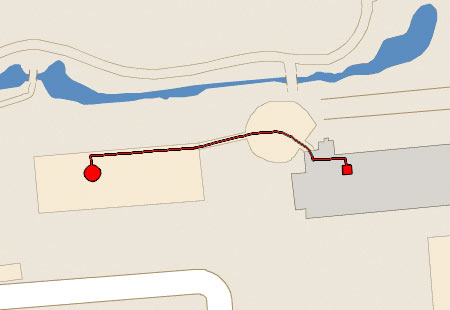
Alternately, the elevator is in the next building over. See the little map below; the stairs start from the lower left side (where one comes in from the street); to take the elevator, you keep going to the next building, take the elevator up to the 3rd floor, then cross over that little circular building between.

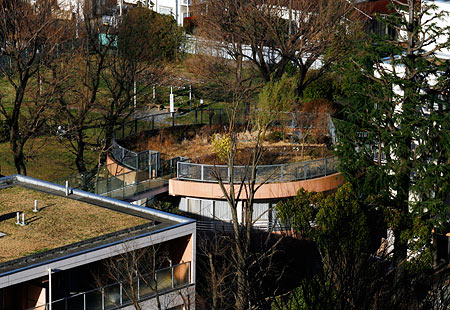
Here’s the circular building, with the garden on top.

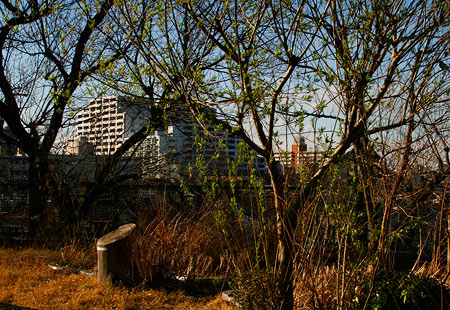
Doesn’t look like much now, but later in spring it should green up nicely. The bird feeder is in there, and it seems like a nice little spot to sit and rest outdoors in nice weather.

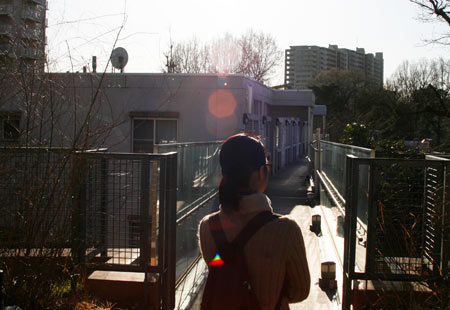
From there, you cross a small plexiglass-sided bridge to get to our unit.

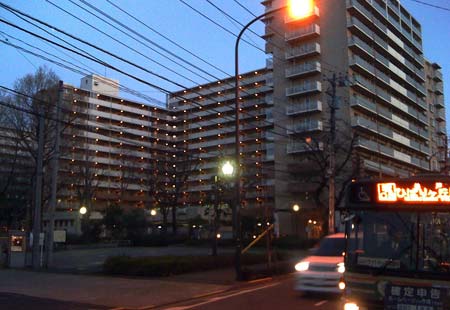
Here’s a shot of the taller building to the south of the place we signed up for, from the bus stop across the street. Our place is just out of frame to the left.

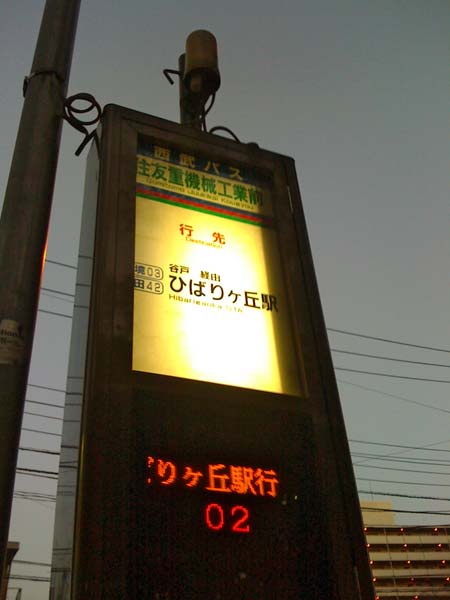
The bus stop has a radio connection and a timer telling you how long before the bus gets there. I would presume that it is in contact with the bus and lets you know how far out it is (I saw the same system in Inagi), but as we watched, it went down to 0 minutes … then no bus … and then it went to 9 minutes … and then the bus came a minute or two later. So we’ll have to see about that. If it is just a slightly-off system and we get used to its quirks, it’ll be nice to know exactly when the next bus will be along.

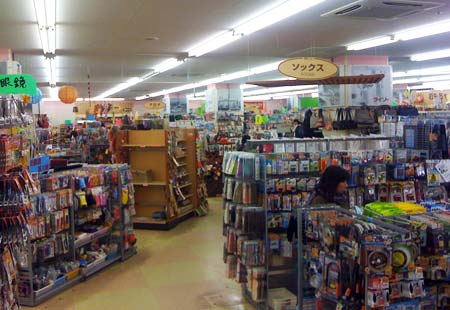
Here’s a shot of the Daiso. It’s around a largish city block, and so maybe 4-5 minutes’ walk away. But it’s a very nice and very large supermarket, a sizable pharmacy, and a huge discount shop–effectively a 100-yen shop, but with items going up in price to 1000 yen.

One nice thing about this is that the Costco run will be easier for me. In Inagi, it was a dead-simple 20-minute run over wide, straight country roads (alas, speed trap-infested ones), but from Ikebukuro, I have to plow through most of Tokyo’s traffic to get to the closest Kawasaki branch. From Hibarigaoka, however, the Iruma Costco is close enough so that the drive may be cut down to 30-40 minutes. This coming weekend, I may ride out to Hibarigaoka to check out the neighborhood again, but then ride out to Iruma and time the ride. Alas, it’s even farther from the train station than is usual for a Costco, so train runs might not be an option.
It may sound like work, but for me, it’s always fun to check out new living areas.
As is usual with a house-hunt, plans have changed a bit. Nothing final, but some developments. First, Sachi and I have switched preference from the first apartment I featured here a few days back. While it was a nice apartment, there were a few minor down points. While we were OK with the first floor, that was not a big plus for us. It was a touch on the small side for us, though it would have sufficed, to be sure. The toilet room was placed too centrally for my taste; I don’t like toilet rooms that feature sound from that room so prominently to the rest of the apartment. All these are minor points. A slightly bigger problem was location; at the far side of the development, it was pushing more than 15 minutes in walking distance to the train station. A potential problem was a construction site on the other side of the building. Plus points were the fact that it was brand-new, there was a Seiyu supermarket a few minutes away, and it was among park-like territory, with nice birds flying about.
Sachi and I can’t move house until at least mid-April, however, and putting a claim on the apartment would have necessitated that we move in earlier than that. So we waited for a week (risking the place being snapped up), and in that time, did a bit more looking around. One thing we found was another project in Hibarigaoka–same station area–but an older development, this one about ten years old. But we found that for just about ¥14,000 a month extra, we could upgrade from a 3LDK to a 4LDK–from 84 m2 to 89 m2.
The problem: we can’t even see the place until mid-April. The current tenants won’t move out for another 5 days or so, and UR won’t give us a peek until the reforming is done on April 16th. We’d love to tell them it’s OK, we won’t be scared by a little mold on the walls–but they were sticklers about it. So all we have to go on is the floor plan and a look at the unit from the outside. Here’s the floor plan:

The “Poza Room” is where Sachi does her aromatherapy / reflexology stuff. Sachi and I would each have a room to ourselves to use as office / den / workrooms. Sachi might use the feature of opening up the rooms between her work room and the “Poza Room.” (I might use the door space for shelves.)
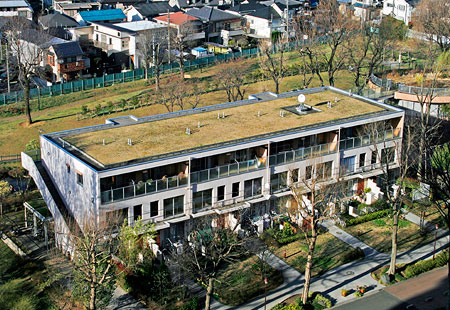
Here’s a view from above:

The new place in Hibarigaoka has some nice pluses. It’s on the top floor of the building; admittedly, it’s a three-story building, but noise from above tends to be the most notable, so having no one above is nice. It’s big, with a significantly sized living-dining room combo and a kitchen with an open counter to the dining room, and four rooms aside from that. The three smaller rooms are together and actually can be semi-combined by opening sliding doors. The hallway space is mostly adjunct to the other rooms, opening things up more. The kitchen opens to both sides, as does the bath, accessible directly from the master bedroom. There’s a small park on one side, the rest of the development on the other. There’s even an elevated nature area right outside, complete with bird feeder, which I think I could load and attract some nice birds with.
The down sides include the age of the building–at ten years, it’s not new. There’s a lot of green–including on top of the building–though as you can see above, it mostly turns brown and bare in the winter. The park outside is nice, but it was filled with kids at the time we were there, a bit of a noise potential. And the 14-story buildings are right in the southern-facing view; not only does a third-story apartment lack a good view, it is easily blocked.
However, the sun mostly stays above the buildings to the south, and strategically-placed trees help with the general effect. Moreover, the local amenities are not to be sneezed at: it’s on Yato Blvd., a good north-south road leading straight to Hibarigaoka and Tanashi Stations; there’s a bus station right out front; there’s a 24-hour supermarket right across the street, and on the far side of that block, a large combination supermarket / pharmacy / Daiso (discount store) open till almost 11pm.
The distance from the station is roughly equivalent to the place from last week–at 12 minutes walking (I timed it), it’s at least a few minutes closer, and along the main road too.
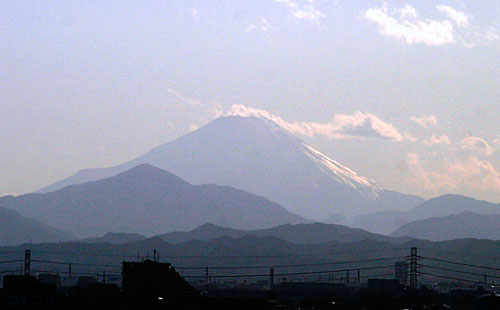
In the development in question, we were able to see a room–but only one that was a bit small for us. It was, however, on the 13th of 14 floors. The view was magnificent–north of Tokyo laid out behind you as you come in the front door, and from the balcony, all of south Tokyo laid out–from the skyscrapers of Shinjuku on the left, to Mt. Fuji on the right. Fuji was even in view when we visited:

But then we thought back on the two and a half years we’ve spent in Ikebukuro: despite having a great view, we almost never actually look at it. We do, however, use the floor space in our apartment on a regular basis. So as nice as the view may be, floor space trumps it.
In the room we saw, though, we could get an idea of how ten years looks on the building, and what the fittings are like. Similar to many UR housing developments, the materials are pretty basic and relatively unattractive. Still, it’ll do.
So, will we go with the new place? Probably what we’ll do is put our claim on it. Since it is just now opening up, it gives us more time to look for another place. UR allows you to place a claim on a room, but if it’s open, you must make a final decision within a week. However, since this place won’t be open for viewing until mid-April, we get to keep our hold without a commitment until then, allowing us to spend the next month looking at possible alternatives, seeing if anything else opens up.
So, that’s probably what we’ll do–pass on the place I blogged about last week, and sign up for this other place tomorrow–then take our time looking at still more places. Whee!
(This post covers the move Sachi and I plan to make soon; if you know much about the location or anything else we’re considering here, advice, information, or other input in the comments would be greatly appreciated!)
At the beginning of this year, Sachi and I decided that it was time to move. For two and a half years we have been living in our apartment in Ikebukuro, and that’s much too long. Don’t get me wrong, we love it–but it’s way too pricey. When we moved in, we had two incomes and could easily afford it–it actually was less than our previous rents combined. But then Sachi stopped working, for a short time we thought, but then the short time got longer. We really should have moved to a new place a year ago, but I guess we just got complacent. As a result, we’ve been treading water financially–at least in terms of salary and the bank account, with the Apple stock taking over as the only factor increasing our assets.
So from the beginning of the year, we started looking into the idea of buying a home. We chose an initial direction–Musashi Kosugi, just on the other side of the Tama River from Tokyo on a good train line–and started to look around. We got a realtor we liked who started looking into properties for us, and began the process of applying for a bank loan.
As it turned out, the loan didn’t go through; what may eventually decide it for us is my obtaining permanent residency in Japan. That should not be a problem–after 12 straight years living here, with the career of college professor, and married to a Japanese national, I’m more or less a shoo-in. I applied a few weeks ago, but it could take 3-6 months, and even after that, the loan could take a bit more to clear, and then just finding a place we’d like to buy could take even longer–maybe even a year or more. Meanwhile, our money is going down the rent drain.
So we’ve decided to move to a new place in the meantime, and mid-April–when I have a break from school, and Sachi finishes getting her license in aromatherapy–seems like the perfect time. It’ll mean moving out of Ikebukuro, where we have enjoyed the benefits of living in central Tokyo, not to mention a nice apartment on the 21st floor with a great view–but you get what you pay for, and pay for what you get.
One of the nice things about the place we have is the landlord–or the lack of one. We live in a building run by “UR” (Urban Renaissance), a public agency which has the very attractive features of solid, modern units, relatively low rents, no usurious “gift money” for landlords or commission for real estate agents (which combined is usually equal to three months’ rent!), and absolutely no problems with being a foreigner. You do pay three months’ rent as a deposit, but they are very honest about refunding it–they gave me back nearly all my deposit when I left my place in Inagi, despite a lot of damage to the place over time. If we move out of this UR apartment and into another one, we’ll actually come out with more money, as the rent will be lower and the deposit difference will be well in our favor.
After checking around, we have found what looks to be a good candidate, in a place called Hibarigaoka. It’s on the Seibu Ikebukuro Line, the second express stop out, just 15 minutes from Ikebukuro. Even better, there seem to be four trains per hour that run through to the Fukutoshin Line, which goes more or less straight to my work–two of them express trains (at worst, the train ride would be 40 minutes–perfect for watching a TV episode on an iPad…). The station area is pretty nice, with a fair amount of shopping and resources. It is a bit far out, roughly as far as Tanashi, Koganei, and Chofu–even almost as far out as Inagi, where I used to live, but on a much more straight line in to central Tokyo. Ome Boulevard runs right past that area, and to test it out I rode my scooter from Hibarigaoka to my school, and it took only a bit longer than half an hour–as with Inagi, the scooter would be faster. Catch a few lights, and it’d be a bit under 30 minutes. As an added bonus, it might even get me back to birdwatching; the place we’re looking at seems to have good birds right where it is, but the location is also a very short scooter ride from Koganei Park and Tama Reien, two good birding spots.
The apartment we’re thinking of is part of a renovation project they’re undertaking in Hibarigaoka, and about time. There’s a very old housing project there consisting of almost 200 buildings, and they look horrifyingly bad–just completely rusted, stained, run-down–as close to “slum-like” as I’ve ever seen in Japan. These are being torn down and replaced with new buildings.
We were first drawn to a unit which looked great–93 square meters, 4LDK (four rooms in addition to the main “LDK,” the living-dining-kitchen). And it is a good unit–but there’s a reason it hasn’t been snapped up yet: noise. It is right on a well-traveled road with buses constantly running through, and there’s a huge construction project going up right across the street. The windows are all double-paned glass and it’s not that bad, but it’s too much of a risk to take on just a short inspection. Too bad–as the unit is also just a few feet away from the neighborhood supermarket. But if noise were not a problem, it would have been snapped up by someone in any case, and still not an option for us.
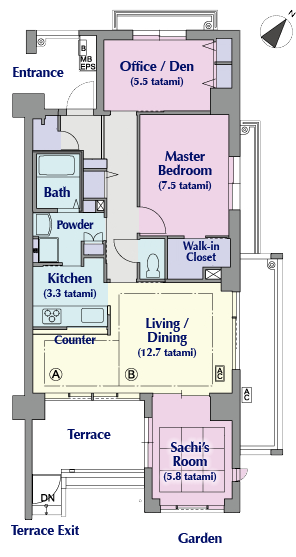
But when we came to check that one out, we also took a look at another unit which is now our prime candidate (pictured at right). It’s 85 square meters, 3LDK with a good-sized bedroom. Although the living-dining area is a tad smaller than our current place, it is bigger overall by about 12 square meters. We would use the extra room as an office or den, where my computer and other stuff would be set up; what I marked as “Sachi’s Room” is where she’d do her business with visiting clients. The rooms are all quite large–most places have rooms that max out at 6 tatami, whereas these rooms start at almost that size.
The unit is on the first floor, but it’s away from major traffic and has very nice landscaping all around (tons of cherry blossom and other nice trees). There’s a unit above us, but that’s it; the apartment is at one end of the building, and the other side is the entrance hall, so no neighbors to make noise there. Three sides of the apartment is windowed and it looks very nice. The terrace is wide enough to put a table and eat outside when it’s nice. They even have screen doors installed–something most apartments don’t have, and that costs you more. It’s a bit farther out from things–about 14 minutes’ walk from the station as opposed to the 10 minutes for the unit we originally were interested in, and it’s a 3-4 minute walk from the supermarket (a nice, large Seiyu open till 1 am), but that’s not a big problem. There will be construction one building over (the next stage of the renovation of the project), but it’s on the far side of the building and so shouldn’t be too bad. We probably won’t even have trouble with neighbors’ cigarette smoke drifting in (knock on wood).
There is one big down point: the toilet. Note from the map that it’s smack in the middle of the apartment, where the, um, toilet noises will be quite audible for most of the apartment. Worse, the toilet is plain-jane, no washlet with electric seat and bidet, something which Sachi and I now would have a very hard time doing without. But the noise issue is something we can live with I guess, and we can always buy a washlet–expensive, but not overly so.
One nice thing: the rent is $1000 per month lower than what we pay now. Not only will that save us a bundle in rent money on a monthly basis, helping to save up for the down payment on the house we’ll eventually buy, but it also means that when we move, if we get our full deposit back (which I suspect we will), we’ll have $3000 left over after paying up the new deposit. That’ll help pay for the washlet, the moving costs, and leave a nice chunk of change left over.
An interesting addendum: the unit I just described is in Higashi-Kurume City. Interestingly, the first unit we were interested in is in Nishi-Tokyo City–the city limit cuts through the development, with different city rules and regs–trash pickup is different, for instance, and we would get to use the local library almost across the street from us–only available for nice Higashi-Kurume folk, not those shifty Nishi-Tokyo riffraff.
If we move to this place, it’ll probably be around April 15~20, when I’m on break and after Sachi finishes her current training, so the timing would be good. We might even be greeted by the cherry blossoms, I’d have to check when they’re in bloom this year.
So, anyone have any input? Higashi-Kurume, Hibarigaoka Station on the Seibu-Ikebukuro Line, a UR apartment, 1st floor in a new building, etc. We haven’t committed yet, but will have to soon if we want it.
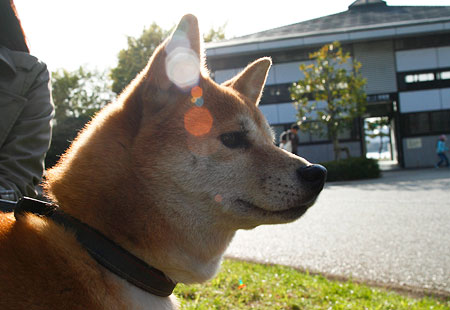
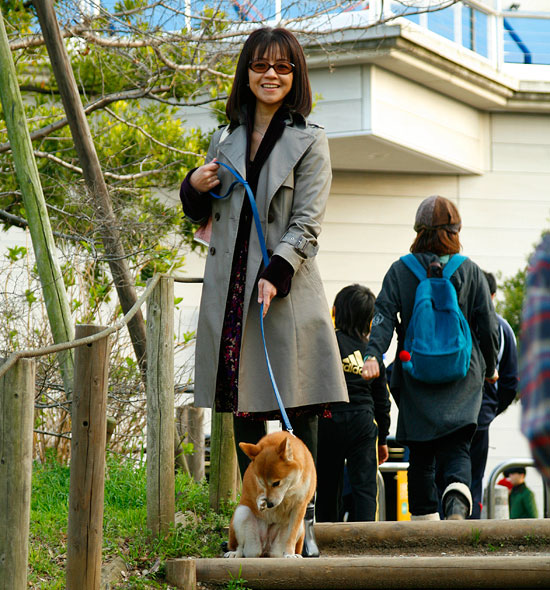
For Sachi’s birthday and our wedding anniversary, I thought that a night out would be fun–but the main attraction would be a rental Shiba. We’ve done the doggie rental thing before, but both times the Shibas available were more of the cream-colored variety; Sachi prefers the red Shibas, as do I. There’s a shop in the bayside entertainment area called Odaiba called “Puppy the World” which features rentals, and this time they had a very pretty pooch named Yuri which I asked them to hold for us. We picked Yuri up a 3pm and took her out for a stroll by the beach.

The Hero Shot

When you rent a dog, they give you a little pouch with plastic baggies and tissues; the dogs are not pre-walked and inevitably take the first opportunity to “take care of business.” What they should include in the pouch is ziplocks, as the smell is a bit much for the whole time you’re with the dog. But it’s fun anyway.

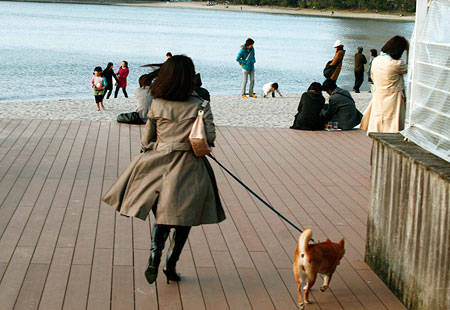
Okay, I’ll run a bit. Just a bit.

Y’har.

Oh yeah. Riiiight there!
Yuri was not a big activity fan; her preference was to stick to the side of the paths or go into the grassy areas and spend 95% of the time with her nose half an inch from the ground–standard doggy protocol, I guess.

Why aren’t you guys into this dirt and grass stuff? It’s great!
One thing that Sachi and I notice about the rental dogs, however, is eye contact–or lack of it. I think the dogs see people renting them as vehicles to get out and about more than anything else. Yuri, at least, was very patient with our petting and scratching and fussing, even when she wasn’t as into it as she was in the images above. But she rarely looked us in the eyes, keeping her gaze fixed primarily on other dogs in the area. (Which she usually regarded with suspicion and standoffishness.)

Sizing up the local Poodlery
But even when there were no other distractions, she didn’t respond to us directly, which made the experience feel a bit disconnected. That ended when we brought her back and the shop guy gave us a treat we could break into half a dozen small pieces and feed Yuri (feeding the rental dogs without permission is a strict no-no). When food was involved, Yuri suddenly seemed to recognize that were were there and she paid lots of attention to our signals at that point, and after. Tells you something.

Huh? Food? Oh, hey, you guys do exist!
Interestingly, she had very specific rules about where she would go. The sandy beach was a definite “no.” And when we tried to go beyond a certain point down the boardwalk, she dug her paws in and refused to go a step further. It was not a random stop, either; twice we went to the same area, and twice she stopped and refused to go beyond the same point. Bad memories from a different set of clients, perhaps. So it was mostly back and forth within a fairly small area.

End of the line guys. About, face!
It kind of reminded us, however, of the difference between renting a dog and having your own: the rental dog is just not that much into you. A lot of doggie joy involves your relationship with the pooch, something notably absent in the rental experience. So while we enjoyed ourselves and very much like the photos that came out of it, this will probably be our last rental before we eventually get geared up for actual Shiba ownership, maybe a year or so down the line.

Sachi and I definitely felt a jolt just now, and in our building, something that sharp tends to be either powerful or close. According to my sources, it’s a 6.8 off the coast of Fukushima, roughly 275 km northeast of Tokyo, about 50 km off the Fukushima coast. They probably felt that but good in Fukushima and Sendai…
Update: Reports now put the quake at 5.7. I was wondering why it wasn’t getting more coverage.
I went to Immigration yesterday and submitted my application. It consists of my tax records for the last three years and Sachi’s for the past one year; a letter proving employment from my work as well as the gensen-choshu-hyo (the Japanese version of the American W-2 form); a letter stating my reasons for getting permanent residency; a copy of our family registry; my passport and alien registration card; and a 2-page form similar to those you fill out for a work visa. There is also a guarantor form, which they gave me there but is not due until they call me back in.
The process was surprisingly similar to any other visa application–go to the immigration office, fill in the application, submit the forms at the same counter for temporary visas, and then they have you write your address on a postcard to notify you of when you have to come back in. It took about two and a half hours on a Wednesday afternoon, not counting travel time. It was remarkably pedestrian–I expected to meet with an official and to have them ask me questions or some such–I though the process would be much more personal.
As for my chances, I am more or less a shoo-in: a college professor, twelve straight years in Japan (ten is usually enough), and married to a Japanese national. I hear they’ll allow you to get residency after five years if you’re married. Some people say it takes just a few months; one person I spoke to said it took them one and a half years. Let’s see how I do.
Wow. This morning, a big quake–7.3 on the Richter scale–hit close to Okinawa, sending the people into a tsunami scare. This afternoon, an even bigger quake–this one an 8.8–hit between the Chilean cities of Santiago and Concepcion.
And on the premiere movie channel on cable TV in Japan, Movie Plus, two movies are being shown: “10.5” and “10.5: The Apocalypse,” two TV Movies about massive earthquakes striking the planet in close succession.
Spooky.
Today, after finishing work a bit late, I got suited up and ready to go home. As I left the building, I walked up to my scooter, parked–as always–next to the side of the building. But the helmet wasn’t there. Huh, I thought, I must have left the thing upstairs. Didn’t make too much sense as I usually take it up to the office only when it’s raining, which it wasn’t–otherwise, I lock it to the bolt under the helmet well.
I supposed that I must have absent-mindedly taken it with me this time. So, I turned around, went back up to the office… and it wasn’t there, either. I looked a bit more closely, thought of strange places I might have put it, but… it’s a big item, a full-face motorcycle helmet. You can’t hide it very easily.
At that point, I started considering scenarios about where I could have left it. Did I take it to the elevator, put it on the floor to take off my jacket, and then forget it there? Maybe a student saw it and put it somewhere. Or did I take it to class for some bizarre reason? Or maybe it was in the office, but I put it on a desk without thinking and someone put it away somewhere? I went up and down, trying to figure out where I could have placed it. Nowhere, it seemed.
Finally, I went back out to the bike. Could a car have sideswiped it, hitting only the helmet and knocking it off the bike, depositing it in the street where someone disposed of it? No, there would had to have been more damage to the bike had that happened; at the very least, the mirror would have been bent.
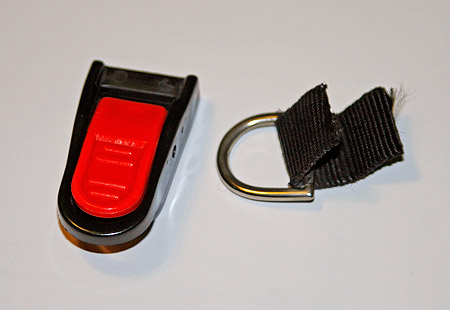
But as I looked more closely at the bike to look for damage, I noticed something: the helmet’s chinstrap clasp was still there. I unlocked and opened the helmet well, and lo, the end of the chinstrap was still locked to the bolt.

All that’s left of the helmet.
Someone had come along with a sharp blade, and sliced the helmet off at the closest possible point to the lock, close enough that barely any strap was left. That would require holding the hemet back while maneuvering in with the blade under the edge of the seat. Probably a practiced hand.
But that puzzled me even more: who would bother slicing off that helmet? Seriously, it’s no prize. About the cheapest full-face helmet I could find, oversized for Japan, and old & worn to boot, the face shield plastic scratched. Not a prize to be coveted, even if they could easily and cheaply replace the sliced chin strap. And they left the clasp, which was hanging by a thread and easy to take–an item which would cost more to replace than just some length of strap. Not to mention that slicing it so close to the lock makes little sense–it’s harder to do and doesn’t seem to help them at all.
There are only two possibilities I could think of. The first is referred to in Japan as “itazura,” a prankster or vandal. I have never understood that mentality: you don’t know this person you’re hurting, will not be around when the deed is discovered, but you will ruin something of theirs or steal it to no benefit of your own, greatly inconveniencing or angering them. Is it the thrill of doing something wrong? I know some people get jollies by imagining how mad someone will be, but seriously, I just don’t get it.
Not to mention that had an itazura wanted to be destructive, they would have been far better off slashing the seat itself, or slashing one or both of the tires. It would have been easier to boot. They didn’t–instead they carted off an old helmet, more work for them, and a much lesser expense to me.
But as I stood out there with a student and staff member who were helping me puzzle it out, another possibility occurred to me. The staff member asked if my scooter would be OK outside overnight, as I couldn’t ride it home. In Japan, it’s illegal to not wear a helmet on a motorbike, so I was kind of stuck. But then I realized that the helmet theft might have been designed to do exactly that: get the scooter to be left outside overnight. The school is not on a major street, but there’s enough traffic out there most of the day to discourage the theft of something as big as a 125-cc scooter. But if the scooter were still there at 3:00 am, then maybe a small flatbed truck loading up a scooter wouldn’t be noticed as much. How to make it stay put? Just slice off the helmet and trash it somewhere so the owner couldn’t ride off with it, and the bike would be much easier to steal later on.
So as a precaution, we made room in one of the building’s storage rooms right nearby and locked the bike up for overnight. Just in case.
Tomorrow I hope to contact the cops at the local koban, not in hopes of getting the helmet back, but instead to alert them as to what’s going on–and maybe they’ll be able to tell me what the most likely purpose of the crime was. But I don’t count on them to do anything about it–not their usual gig, to be honest. In fact, I could have driven the scooter home if I wanted–cops never stop bikes at night except in highly unusual cases; I am pretty sure I could have driven straight home had I wanted. But the night air right now is freezing cold–I’d have been seriously uncomfortable bare-headed (and fully expect to be when I drive the scooter home tomorrow using my spare helmet, which is essentially just a plastic cap).
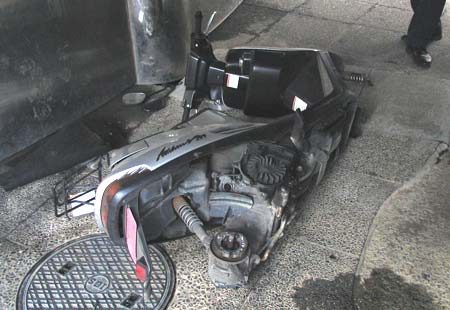
This is not the first time something like this has happened to me here in Japan. Three and a half years ago, someone stole my last scooter from the parking place on the first floor, carted it off to a shielded location in a nearby mini-park, and stripped it for parts:

A few years earlier, I had to pay for repairs when someone had apparently jammed a screwdriver into the ignition, making it impossible to start. Not an attempt to steal, apparently, but either an itazura having fun, or else a local bike repair shop looking for business. Apparently it was a common enough form of vandalism that current models now have an “itazura guard,” a metal plate you can slide to cover the ignition with by using the back of your key.
Apparently, Japan is not the safest country ever for motorbikes.
This reporter makes an interesting observation I hadn’t thought of before: Japanese people don’t do ebooks. You just don’t see them here. And the idea is that it’s not because they just haven’t arrived, but rather that Japanese people are not really that interested in them. From what I can gather, Japanese do read quite a lot (though not as much as 30 years ago), but most ebook reading is done on a cell phone. What drives most ebook reader sales in Japan is obvious–I knew even before I looked it up that manga would be what drives the ebook reader market. They come out often, and come in thick tomes that resemble gaudy, small-format telephone books. The bulk, graphic format, and large number of constant releases would make manga a natural ebook target.
So people do read ebooks here. And from what I found from a quick search, the market is taking off–it just hasn’t developed nearly as much here as it has in America. So the question is, will the iPad change that. The answer might be similar to what we saw with the iPod, then the iPod Touch, and then the iPhone: an initial lukewarm reaction, everybody says that Japanese people aren’t interested… and then a few years later, you start seeing them everywhere.
Sometimes being caught between countries sucks. I want to buy software item “A” in English. You can buy it in America just fine. In Japan? Not available–just in Japanese, sorry. And retailers in the U.S. won’t ship it to you, as it violates the license for the Japanese seller, even though the language makes it a different product. And the Japanese seller can’t be bothered to sell an English version, even if it’s a download which would be dead simple to sell. Seriously, they’d just have to spend five minutes altering their web site, and they’d have more sales. But nope, can’t be bothered.
It is especially frustrating for my college, an American college in Japan. We are essentially a bubble of English language, a small bit of American soil in the heart of Tokyo. Our model is to replicate the experience at home campus. Except, of course, that those who sell software and media usually don’t recognize this. Can’t have the U.S. version, Japanese version doesn’t fit, you’re outta luck too bad.
I fear this will be the case with ebook purchases, in that we have lots of students here who would love to use ebook readers for textbooks, but international licensing agreements will probably frustrate us. Because of our location, we won’t have access to the textbooks we need–America won’t sell and Japan won’t offer.
Essentially, being a stranger in a strange land is a niche that businesses haven’t paid enough attention to, something which makes zero sense in a digital world. There are some businesses which address us, but they usually see us as prey more than customers, people who are left out and so will pay a premium to get what everybody else takes for granted.
Apple is one of the few businesses which has done a fair job of addressing this. When Apple makes software, they allow for a variety of languages to be used. Their OS software, whether for computers, the iPhone, or iPad, comes with at least a dozen base languages built-in. Apple’s software architecture allows for “localization,” or various languages to be built into every software package. Switch your OS to a new language, and all apps with that language in their localization files will automatically run in that language. Which means that if I buy Apple software in Japan, it simply runs in English for me, because my OS is set to that language.
You see this in a few other places–for example, the “Ultimate Matrix” Blu-ray set is sold in English, but put it in a Japanese player and it switches languages. Unfortunately, such setups are rare. Windows, for example, refuses to do this, and even many Mac software makers stodgily refuse to localize, instead issuing different packages for each language.