Archive

Archive for July, 2003

Pretty Darn Bald-Faced

July 17th, 2003 1 comment

Bush, answering a few questions during a photo-op with U.N. Secretary General Kofi Annan on July 14th, said the following:

“The larger point is, and the fundamental question is, did Saddam Hussein have a weapons program? And the answer is, absolutely. And we gave him a chance to allow the inspectors in, and he wouldn’t let them in. And, therefore, after a reasonable request, we decided to remove him from power, along with other nations, so as to make sure he was not a threat to the United States and our friends and allies in the region.”
Talk about science fiction… (a), Hussein apparently did not have a weapons program when we came into Iraq, as evidenced by the complete lack of evidence, which should have been uncovered long before now; (b), he did in fact let inspectors in, and although there was some lack of cooperation, the inspectors said that they were making more headway than ever before; Bush, on the other hand, chomping at the bit to invade no matter what the inspectors found (his original call for the inspectors to go in was little more than a political sham), repeatedly dismissed the inspectors’ findings and sent troops in anyway; and (c), well, everything else he said, really–“reasonable request”? “…a threat to the United States”? Hasn’t Bush been paying attention? Or does he think that most Americans haven’t?

Sadly, if the latter is the case, then Bush may be right.

Categories: Archived Tags:

More Pigeon Photos

July 16th, 2003 3 comments

A few more photos are available on the Pigeon Page. They’ve lost almost all their yellow fluff now, and are developing the iridescent plumage around the neck, very pretty. One of them has a few splashes of white on the head, making it easy to identify in the future should they come back to visit.

Categories: Pigeons Tags:

Chaos and 16 Words

July 15th, 2003 Comments off

“The British government has learned that Saddam Hussein recently sought significant quantities of uranium from Africa.”   –George W. Bush, 2003 State of the Union Address

Ever since the beginning, it has been clear to a great many people that George W. Bush was not just stretching the truth in his campaign to the American people for a war with Iraq; we knew that he was lying outright. The problem was that there was no “smoking gun,” and Bush could squirm out of whatever wasn’t smoking.

Now, far too late to do much good, we have the smoking gun, in the form of the now-famous “16 Words” Bush spoke in his State of the Union address before the Iraq war. Naturally, the Bush administration is trying to play down the matter, trying to claim that the matter is settled, that the claim was “technically correct,” that it “has been blown out of proportion,” and that it “in no way has any effect on the president’s larger case.”

This strategy, blowing off the story, acting like it’s no big deal, then waiting for the press to play along and move on to the next story, isn’t working this time. It seems like the Bush administration was so used to being able to dismiss anything they wanted, now they’re genuinely puzzled as to why this particular thing is not going away. But it will not; you can feel it in the air, the press has already invested too much time on it, and the smoking gun has too much weight behind it.

The central argument of the administration is that the 16 Words were the fault of the CIA, and that Bush was an unwitting victim, but this has already been proven untrue. Yes, British Intelligence did indeed report that Hussein was trying to buy uranium from Niger, but that makes no difference: the CIA, with Joseph Wilson‘s testimony, had told the administration that the Niger claims were false. So even if CIA chief George Tenet failed to object strongly enough to the administration’s choice to include the faulty British intelligence in the State of the Union, it does not change the fact that the Bush administration, against CIA advice and knowing full well that the evidence was false, nonetheless actively decided to include the “16 Words” in the speech, and thus knowingly deceived the American people.

In her many efforts to kill the story, Condi Rice tried to say that it was irrelevant because it didn’t change the larger argument. Even if we go along with her and ignore the fact that the president knowingly lied to America about the Niger story, does that end the whole matter? The answer, of course, is no–because it was not just Niger that he lied about.

A way to understand this can be found in Chaos Theory. There is a concept in Chaos Theory called “Self-Similarity.” It says that patterns, similarities, can be found at various levels of magnitude; the same patterns that can be observed at small size appear again at larger sizes. Take a snowflake, for example: if you look at the snowflake as a whole and then look at a tiny part of the snowflake, one sees the same patterns emerge, the same basic shapes reasserting themselves.

This same recursive pattern can be found in the Bush administration’s push for the Iraq war. The Niger lie is significant not just because of the 16 Words, but because those 16 Words represent a pattern of deception at a number of levels, from the small details to the whole argument. The Niger lie epitomizes the entire campaign, and gives life and body to what was always clear but never came to the point of proving it beyond any doubt–the usual leeway politicians are granted.

The Niger lie was the Bush administration’s stepping over the line. Bush had been dancing, cavorting, thumbing his nose at us, and we accepted it because he stayed behind the Line of the Smoking Gun. But with Niger, he stepped over the line, and now all the other lies come flooding through the breach, carrying the story onward, past the objections of Rice, Rumsfeld, and others. That’s why Rice might say it seems “out of proportion” and believe it, because she’s just talking about the 16 Words.

But it’s more than that, and woe to the Bush administration if it fails to recognize the fact.

Categories: Archived Tags:

Yum

July 14th, 2003 3 comments

Hiromi and I went to see a movie last night (“Charlie’s Angels: Full Throttle”). Thinking that “Terminator 3” would draw most of the business, we came half an hour before showtime, but enough people had come so that we could not get good tickets for the late afternoon show. No problem, we just switched our plans, bought tickets for the later show, and had dinner before the movie instead of after.

The place we went to for dinner was an “Aussie” joint called the “Outback Steakhouse,” though I’m fairly certain it’s American faux-Aussie style. Wherever they’re from, they have good food. To the right is Hiromi enjoying the onion bloom, a very nice fried onion dish with a dressing dip in the middle. The main other dish we enjoyed were the ribs, very good at this place–the sauce is good , and the meat is tender and practically falls off the bones. Very delicious, if rather unhealthy!

The Outback Steakhouse is located literally next door to the Virgin Cinema complex in Minami Osawa, very close to the Keio Sagamihara Line station of the same name. (The same shopping area has a Cinnabon, a big albeit fattening plus in my opinion.) So right after dinner, we just walked next door and went to the theater, walked in and sat in our reserved seats and enjoyed the film.

Charlie’s Angels: Full Throttle is enjoyable so long as you take it for what it is: a live-action cartoon. Best to suspend disbelief, set your intellect on neutral and just go along with it. Enjoy the Matrix-style stunts and whatever good gags you can find, including some see-if-you-can-catch-them insider jokes. A cute moment was Lucy Liu’s ferret imitation for her father (John Cleese, surprisingly). The IMDb web page linked to above, as always, provides interesting background information, some of it rumored–for example, the reason Bill Murray decided not to return for this film because he could not stand to work with Lucy Liu, according to the trivia section of the IMDb page.

After the film, we had drinks at Starbucks until they closed down and ushered us out, then went to wait for the bus. We must have waited twenty minutes before we realized that we had just missed the last bus, and so headed back for the train station–a circuitous trip for Hiromi back home, but at the time, the only ride available for a reasonable price. Still, it was a great night out.

Categories: Uncategorized Tags:

Full-Tilt Press Bias

July 13th, 2003 Comments off

“Has the criticism of CIA Director George Tenet been unfairly politicized?”

That’s the question CNN put to its viewers. How biased can you get? During the 8 years of Republicans politicizing each and every rumor, allegation and bald-faced lie about Clinton with the press gleefully tailing along, I do not recall any issue during that time which was characterized by the press in that light, especially so early in the life of the story.

And yet just a few days after the story gets into the spotlight, the story is not centered, as it should be, on the fact that the government ignored clear evidence and decided to lie to the American people in order to drag us into a war we didn’t want. Instead, it is being framed by the press as a story about Democrats unfairly criticizing the president for political gain.

No greater ally could President Bush ask for than the one the press is continuing to provide him with.

Categories: Archived Tags:

Another Costco Haul

July 13th, 2003 3 comments

As you can see, I’ve been shopping again at the Tama Sakai Costco, near Hashimoto Station on the Yokohama and Keio Sagamihara lines.

This time much of it is fixings for a fireworks party next Sunday (if the rain will give us a break!). The fireworks display is nicely viewable out my dining room window; last year a half-dozen folks came for the party (though it was in October then).

Got some four-cheese ravioli (yum), walnuts (should be for cooking, but they’re great for snacking), limes, mints, Picante Sauce (like a thin salsa), some wine and liqueur, buns (for some polish dogs I got previously), and an apple pie (much better than the rather lame pecan pies they had a year ago, not surprisingly discontinued).

And you probably noticed the DVD player–region-free (you can play both U.S. and Japanese DVDs in it), and cheap–just about 10,000 yen.

The problem in that store is not buying stuff.

Getting it home can be problematic… They have delivery service, but it is based in Kanagawa and serves people in that prefecture best. It’s OK for really big hauls, but for ones like this–just bring your own bags, backpacks, and other goods for schlepping stuff around.

Categories: Focus on Japan 2003 Tags:

Anybody But George

July 12th, 2003 1 comment

The excuses are flying again, this time in response to the revelation concerning Bush’s State of the Union address. Turns out that Bush’s claim that Hussein was trying to buy uranium from Niger was not just false, but knowingly false. The CIA knew it was wrong. A government representative sent to Niger reported it was impossible. And yet with this knowledge, wanting to fuel the war against Iraq, it was decided that the CIA’s information be ignored and a report from British intelligence be used instead. the question is, who decided to lie? Well, you can guess what the Bush administration is saying:

Anybody but George.

Apparently, a George Bush was out of the loop yet again in the White House. Despite the fact that we should have known that Iraq had no nuclear program and a severely diminished bio- and chemical weapons program, despite the knowledge that there was no tie between Hussein and Al-Qaeda or 9-11, despite the intelligence that said Iraq was no threat to us at all, and now despite the fact that the administration knew the Niger story was a complete lie–despite all these things, George W. Bush made statements completely to the contrary in his State of the Union speech, and in countless speeches before and after, and yet somehow, he never lied.

Really, there are only a few possibilities. One is that Bush knowingly lied to us. The other is that everyone lied to Bush. Neither possibility is good, but you can guess which one the administration is playing.

George Tenet, director of the CIA, is now in the process of falling on his sword. George W. Bush, Condaleeza Rice and Senator Pat Roberts are helping him, making sure the sword is guided directly to his heart and not faked into his armpit. Tenet is the only one who has to fall right now, as the Niger story is the only one with the definitive smoking gun.

But the question should become, who’s responsible for all the other lies? Who’s going to fall on his or her sword when WMD are never found? Who lied to Bush about that? Who’s taking the fall for deceiving bush about Al Qaeda and 9-11 ties?

The “anybody but George” strategy has a flaw in it: used too often, it will give the impression that Bush is surrounded by deceitful liars who keep him in the dark, and/or he is an unwitting, gullible fool. But we know, in our heart of hearts, that neither is true. We know that Bush has been lying. It’s simply that a majority of Americans either don’t want to believe it (for personal, political or other reasons), or they know it and don’t care because it relieves them of being responsible for doing things they want but know are wrong.

Note: Josh Marshall has been closely
reporting on the Niger story in his
“Talking Points Memo” blog.
Categories: Archived Tags:

Subtlety in Media Bias

July 11th, 2003 Comments off

To note yet another stroke against the myth of a liberal media, take a look at CNN’s latest front-page headline: “Democrats grow bolder in criticism of Bush on Iraq” (story here). Underneath that headline is the note that “Republicans say Democrats are playing politics, trying to make some headway in the upcoming 2004 election.”

I do not recall, in the uncountable times that Republicans accused Clinton of everything and anything to score political points, that the media characterized the political assault and its motives as the chief story; rather, they focused on the charges and whether or not they were true. It was never “Republicans strengthen their attacks: Democrats say Republicans are playing politics”; rather, it was “Clinton accused of [insert accusation here],” followed by details and analysis of the accusation. See examples here and here.

By representing the story as shown above, CNN is effectively putting the actual criticism in the back seat, and is instead highlighting the story as a political move. This may well be, but, as noted, it is inconsistent with reporting styles under Clinton, and ignores very real and well-deserved criticism of the administration. This spin put on the different stories makes the difference between supporting and attacking a political party.

Categories: Archived Tags:

Leaving the Nest But Not Flying

July 10th, 2003 Comments off

The pigeon babies are nearly grown now. It’s been three weeks, maybe a week left before they leave. They’re running around the balcony, sleeping where they feel comfortable now. Not ready to fly, not just yet…

Categories: Pigeons Tags:

Poza Consulting Services

July 10th, 2003 1 comment

Here is a link to my father’s site and a reprint of the text there:

Poza Consulting Services

Areas of Expertise:
Audio Tape Authentication (Audio Tape Analysis)
Voice Identification (Voiceprint Analysis)
Acoustic Identification (Analysis of non-speech recorded events, e.g. gunshots)
Enhancement and Transcription of Noisy Audio Tape Recordings

Tito Poza, who is bi-lingual in English and Spanish, has been active in
Voice Identification technology for over 30 years. He has co-authored
encyclopedic articles in both Voice Identification and Tape Authentication
and has testified extensively as an Expert Witness in all areas of
Audio Forensic Analysis.

Poza Consulting Services provides
Consultation, Analysis and
Expert Testimony in the following areas:

Audio Tape Verification and Authentication (Audio tape analysis)

Voice Identification and Elimination (Voiceprint Identification)

Acoustic Identification (Analysis of non-speech recorded events, e.g. gunshots)

Enhancement and Transcription of Noisy Audio Tape Recordings

PCS has been serving the legal and law enforcement communities for over 25 years. Tito Poza has testified as an expert witness over 60 times in state and federal courts in both criminal and civil cases. He has co-authored two encyclopedic articles that provide attorneys with valuable information and insights in the areas of Voice Identification and Tape Authentication in particular and more generally in the broader areas of Forensic Communications and Forensic Acoustics.

To contact Poza Consulting Services:

Voice Phone: 650-325-6242
Fax Phone: 650-328-7904
e-mail poza@poza-consulting.com

Categories: Main Tags:

Privacy

July 10th, 2003 Comments off

I am by no means the first person to comment on the fact that in the 21st Century and the Information Age, one of the major issues that we will face is that of privacy. As it becomes more and more possible to collect information and monitor any given person via electronic means, keeping a database of where they live, where they work, where they go, what they buy, and so forth and so on–it will be more and more possible to almost passively allow computers to build databases detailing our activities on a daily basis, records to be accessed whenever someone with access (read: government and industry) so desires.

Think about it: records are kept on where you live (city records), where you work and how much you make (IRS), where you go (trail of credit card receipts, hotel registrations, airplane ticket purchases, gas purchases), what you buy (receipts connected to your credit, debit, and bank cards; records from “membership cards” at supermarkets, rental stores, etc. which keep close track of every purchase), what information you access on the Internet (cookies and other tracking information), email you send, whom you talk to and what you talk about (if your email is unencrypted, it can be legally read at many points along its path), medical records, bank records, credit histories, work records, and much, much more.

Computers, able to collate this data by keeping a record of all references to you, will be able to sift through the gargantuan heaps of data on the Internet and other sources and compile data which can be smoothed out manually to build an incredibly detailed record of all your activities–more than you can even recall yourself. That database will be available to be used against you (can you even imagine how that kind of information could or would ever possibly be used for you? Not likely). It will be available to find you, pigeonhole you, persuade you, perhaps control you in subtle ways. Or to blackmail you threaten you, expose you, embarrass you, catch you doing things you should be able to do in private without hindrance, but that others may not approve of.

The right to privacy against this is under concerted attack. Laws are being drafted (thankfully, against the tide of the courts) that can tell you what kind of person you can be, what activities you can take part in between consenting adults in private places, deciding what you are allowed to watch, read, do or speak about, and with whom. Some of it is not legislated; some is simply discouraged with the force of law or popular public pressure. What places in the world you are allowed to go to, what kind of persons you can associate with, what opinions you can hold, what statements you can make even semi-privately. In the building atmosphere of fear, simply speaking out publicly on your rights as an American citizen can get you branded as unpatriotic, making people less liable to talk to you, meet you, hire you, do business with you. We see it around us, with so many Americans getting angry at those who would question the government, shouting others down even with the threat of violence for doing no more than stating a peaceful, rational opinion. Take, as one example, the man who runs the baseball hall of fame canceling a Hall of Fame event because he didn’t like the political views of one actor who had spoken out against the war. Here, an event that should belong to all of us, the celebration of our national pastime, was hijacked by one or a small number of people to do harm to a person who was simply exercising his constitutional rights and asking the country not to go to war. Turning against people for their views takes place every day at the personal level, and so we do not often hear about it widely and publicly, ergo the celebrity example; but this drama does play out all over our country. The point is that by doing things which harm no one and which are our right as Americans, we can be hurt in real ways, denied opportunities, have things dear to us taken away. A lack of privacy is the means to widen what we can be criticized for, penalized for, and threatened concerning; the less privacy we have, the more control others have over us.

Privacy is part of our birthright. Neo-conservatives, claiming to want government out of our lives but in truth hoping they will interfere deeply but selectively, tell us that there is no express right to privacy in the Constitution; Thom Hartmann, however, said it very well in his column at commondreams.org:

In his dissent in the Texas sodomy case, Thomas wrote, “just like Justice Stewart, I ‘can find [neither in the Bill of Rights nor any other part of the Constitution a] general right of privacy,’ or as the Court terms it today, the ‘liberty of the person both in its spatial and more transcendent dimensions.'”

Echoing Thomas’ so-called conservative perspective, Rush Limbaugh said on his radio program on June 27, 2003, “There is no right to privacy specifically enumerated in the Constitution.” Jerry Falwell similarly agreed on Fox News.

Limbaugh and Thomas may soon also point out to us that the Constitution doesn’t specifically grant a right to marry, and thus license that function exclusively to, say, Falwell. The Constitution doesn’t grant a right to eat, or to read, or to have children. Yet do we doubt these are rights we hold?

And he equally well commented on how that right indeed exists, in so many different ways, in the constitution:

[T]the Constitution wasn’t written as a vehicle to grant us rights. We don’t derive our rights from the constitution.

Rather, in the minds of the Founders, human rights are inalienable – inseparable – from humans themselves. We are born with rights by simple fact of existence, as defined by John Locke and written by Thomas Jefferson in the Declaration of Independence. “We hold these truths to be self-evident,” the Founders wrote. Humans are “endowed by their creator with certain inalienable rights….” These rights are clear and obvious, the Founders repeatedly said. They belong to us from birth, as opposed to something the Constitution must hand to us, and are more ancient than any government.

The job of the Constitution was to define a legal framework within which government and business could operate in a manner least intrusive to “We, The People,” who are the holders of the rights. In its first draft it didn’t even have a Bill of Rights, because the Framers felt it wasn’t necessary to state out loud that human rights came from something greater, larger, and older than government. They all knew this; it was simply obvious.

Thomas Jefferson, however, foreseeing a time when the concepts fundamental to the founding of America were forgotten, strongly argued that the Constitution must contain at least a rudimentary statement of rights, laying out those main areas where government could, at the minimum, never intrude into our lives.

We have the right to privacy; there is no question. At minimum, we have the right to do what we please, as consenting adults, in the privacy of our own homes, if it does not infringe on the rights or safety of others. We have the right not to be tracked, databased and kept close tabs on without our knowledge or consent. We have the right to say and do as we please as long as it does not reasonably infringe the rights and freedoms of others, and we have the right not to be constrained by small people who would absurdly abuse the definition of “reasonable.” (The Baseball Hall of Fame president would likely deem it “reasonable” to cancel a popular public event because an actor lobbied against war on the grounds that any dissent “harms” our troops and is “unpatriotic.” All that proved was just how the meaning of “reasonable” can be distorted by someone with an agenda).

Science fiction writer Robert A. Heinlein, who often speculated on the shape of society in the future, once wrote:

“When a place gets crowded enough to require ID’s, social collapse is not far away. It is time to go elsewhere.”
Perhaps Heinlein was much more prophetic on this point than many people gave him credit for. Unfortunately, we don’t have many places to move on to from here, so instead we have to try to turn things around here and now, or at least fight the oncoming tide.


Categories: Archived Tags:

Discount Don Quixote

July 9th, 2003 Comments off


You might already know about it, but there is a chain of stores named “Don Quixote” which specialize in discount items. Not like Costco–you don’t buy in bulk, and the store is far from being a big warehouse. The shop might actually be large, but it is so crammed with stuff you might feel claustrophobic. The aisles are not regular, nor are they always straight. The stores look like they were designed by a pack rat–hardly any space to move, items crammed into every nook and cranny.

But that’s not a mistake–it’s a sales strategy. The stores are designed so you feel like there’s no end to the items there. Things are divided into ‘departments’ of a sort, but you will, by necessity, have to move through various areas before you get to where you want to go–and you’ll probably see some unexpected stuff you want to buy along the way.

If you want to locate a branch of the store near you, or see what they have on sale, you might want to check out their web site, which includes an English-language version.

Categories: Focus on Japan 2003 Tags:

Onaka ga Ippai… or Whatever

July 8th, 2003 1 comment

Another language story: during the same homestay I mentioned in the Batman story, I was having lunch with my host mother and several of her friends–four middle-aged, kindly mothers living in a small, countryside town.

Upon finishing lunch, I wanted to say “onaka ga ippai,” or “my stomach is full,” a traditional statement indicating that the meal was enjoyable.

But I mistakenly transposed the initial vowels for the two main words in that sentence, and said “inaka ga oppai.” That roughly translates to “the countryside has breasts.”

Everyone started laughing aloud, and I had to ask someone to explain to me what I had said. At least I learned new vocabulary from it. I had never heard the word “inaka” (countryside) before.

Side note: my host mother had a pot holder in her kitchen that read “Joy Joy Cock.” (In Japanese, for some reason, the word “cook” is borrowed from English, but is pronounced closer to “cock” than “cook.” Why, I have no idea.)

Categories: Focus on Japan 2003 Tags:

New Gaijin Card

July 7th, 2003 7 comments

Every five years, you have to renew your Alien Registration Card (aka Gaijin Card, or Gaikokujin Torokusho); I just got mine renewed today. (Image at left–sorry for all the distortion, too much personal info there.) For those of you not in the know, all non-Japanese are required to carry these gaijin cards at all times; if a policeman stops you and you don’t have it on you, then by rights he can take you in to the police station, where you must write a “gomen nasai” letter. You also have to get someone to bring in your gaijin card before you can go. If there is no one to bring your card in for you, you must give the police the keys to your place, and they will get it for you–unless they are kind enough to escort you home while you get your card out for them (happened to me once). Foreigners don’t get stopped just for being foreigners as much as we used to, but it still happens from time to time.

Another infamous point about these cards is the fingerprint. Now it is no longer required (it was done away with chiefly due to protests by the sizable Korean-Japanese community), but it was necessary until just a few years ago. A lot of people did not like this, not only because it made people feel like they were being treated like criminals, but also because the print was prominently displayed on the card. In an early attempt to appease card holders, they provided a plastic slip case with a Ministry of Justice logo positioned to cover the print. Rather lame, really…

They fixed a few other things over time, as well. One was the size of the thing–it used to be an actual booklet, many pages long, too big to fit into most wallets. A huge pain, that was…

Categories: Focus on Japan 2003 Tags:

Smokin’ Crean

July 7th, 2003 3 comments

After getting my new gaijin card, I left the shiyakusho (city hall) and saw a group of people dressed just like the illustration at right. These are the Japan Tobacco “Smokin’ Clean” clean-up team. Japan is getting better and better about smoking, but is still a relative smoker’s paradise. Many restaurants have no-smoking sections, but the smoking sections prevail, and are in nicer areas. Most workplaces, banks, rest areas and other public places are still smoking havens; the major exception is train platforms, which recently became entirely smoke-free.

The whole “Smokin’ Clean” campaign (when you hear it on television, it sounds like “Smo-kin’, CREEEN!”), aside from being a rather glaring oxymoron, is supposed to address the bad manners smokers are often famed for here, particularly littering. Japanese streets, of course, are far less tidy than is commonly believed overseas, and the major component of that street trash is from cigarettes. I long ago formed, tested and proved (well, to myself anyway) the theory that you could go to any place on any street in Japan at random, stop, and when you look around, see at least half a dozen cigarette butts laying there, often many more.
When you observe smokers here, it is not too surprising. Too often used to tossing butts on the street (and rarely even bothering to stomp them out), many seem to have gotten into the tossing habit. On more than one occasion, I have observed a smoker finishing a pack and approaching a vending machine to buy a new one–and instead of using the trash receptacle in or next to the machine, they crumple up and toss the empty pack on the street just a few feet away. Of course, this is nothing compared to the middle-aged businessman smoker, the guy who hawks loudly and spits disgustingly smack in the middle of the sidewalk or train station hallway. Yechh.

Seem like Japan Tobacco has a ways to go to reform the Japanese smoker….

Categories: Focus on Japan 2003 Tags:

Shinjuku Nishiguchi Monk

July 7th, 2003 Comments off

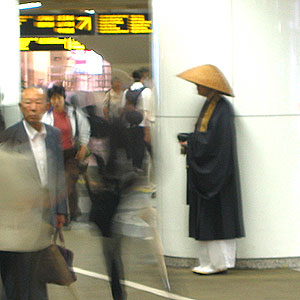
This fellow is often seen standing by a pillar on the very busy basement-level area outside the West Exit of Shinjuku Station. A monk in traditional garb, holding a begging (alms) bowl, with the trademark monk’s hat (“Takuhatsu gasa”). Whenever someone drops some money into his bowl, he rings a bell.

The following text, from the Matsuyama Mokurai web site (a member of the Society for Creative Anachronism), describes this act in detail:

Despite attempting to be self-sufficient, most monasteries would practice alms rounds. Collecting alms was a symbolic act as well as a practical one and, thus, even if the monastery’s warehouse was full, the monks would go beg. … Monks might also stand silently on a street corner holding out their bowls for people to drop alms in. Sometimes ringing a small bell. This was typical of monks on pilgrimage. It is a practice you can still see today. Communication with lay people was usually limited. Monks kept their hats on and did not engage in conversation. Such interaction would cause the alms gift to become an act of favoritism. If kept anonymous, the begging is thus ennobling for both parties.
If you are interested in getting your hands on this kind of garb, or attire for various types of historical Japanese characters, go to this page of Shop Japan.

Categories: Focus on Japan 2003 Tags:

Mega-GigaHertz

July 7th, 2003 Comments off

One of the best rumor sites for upcoming Apple Computer products is MacRumors. And what they’re saying about the future Apple CPUs is rather surprising.

For the past couple of years, the Mac has drifted rather listlessly in the Motorola doldrums, getting no faster than 1.4 GHz. Now, with the G5, we get an immediate bump up to 2 GHz, though that chip may max out at about 2.8 GHz. In a year, IBM’s PPC 980 chip will be running at 3 GHz, and will max out at about 5 GHz.

If that sounds like a lot, wait till you hear about the following two generations: the 990 (2005-6), which is supposed to range from 6 GHz to 10 GHz, and then the 9900 (2007-8) which, if you can believe it, will run somewhere around 20 to 25 GHz.

Yikes!

But that kind of follows Moore’s Law fairly well, and let’s remember that the features of the G5 were pretty damned surprising to many of us, and yet were indeed true. Still, 25 GHz. Man.

Categories: Mac News Tags:

Pigeon Relocation

July 6th, 2003 Comments off

To lessen the clutter, consolidate the thread, and relieve those who don’t really like pigeons very much, all the pigeon photos have now been collected on one page. The prior stories will remain, but with a link to the image page instead of the photo.

Categories: Pigeons Tags:

Batman Is on the Subway

July 5th, 2003 Comments off

Old story time. It was my first trip to Japan, way back in ’83, and I was having a homestay in the countryside town of Iwata, in Shizuoka Prefecture (now the home of the Jubilo Iwata soccer team). After a month’s homestay, I was headed back to Tokyo for a week, and then home. My host father wanted to warn me of the dangers of the big city before I went. Well, compared to major U.S. cities, Tokyo is safe as houses, but to a countryside dweller in Japan, it’s a dangerous jungle.

So he sat me down, and as I could not speak Japanese very well, and he did speak English fairly well, he explained it to me in my language–albeit with a heavy accent.

“Luis,” he started (it sounded more like “Ruisu”), “when you go tsu Tokyo, you musto be bery, bery careful (“kerufuru”). In Tokyo, on za sabuway, zere is… Batman.”

A little taken aback, I reply, “Batman?”

And with a strictly serious expression, he confirmed: “Yes. Batman.”

I could not think of anything to say, so I just repeated: “umm… Batman? Is, uh, on the subway? In Tokyo?”

He nodded vigorously, happy that I understood. “Yes! Batman is on za sabuway, Batman is on za streeto. Batman is everywhea in Tokyo!!”

I then struggled to comprehend as he told me about how Batman would steal my money and attack me. More and more, I felt on the verge of breaking into a giggling attack, until finally I understood that he was trying to tell me about criminals, pickpockets, in other words, bad men, not “Batman.”

Though to this day, while on the subway, I still keep an eye out for someone with a cape.

Categories: Focus on Japan 2003 Tags:

Careful What You Ask For

July 5th, 2003 1 comment

An evangelist preaching at a church in Ohio asked God for a sign.

He was then struck by lightning, and the church set on fire.

No kidding.

Categories: Uncategorized Tags: