Archive

Archive for August, 2004

Shanghaied in Shanghai

August 31st, 2004 Comments off

As I type, I am in Shanghai International Airport, sitting in front of a departure gate display, as this is the only available power socket, or so the information guy tells me. The flight leaves in about an hour and a half, and I figured that I’d get in some last-minute blogging.

This morning was a bit of an adventure. Wanting to get to the airport on time for an early departure hour, I decided that I would not hassle with the buses (have to catch the train to some place or another, identify the right bus, puzzle out the schedule, etc.), and instead would take a taxi ride.

So I woke up at 5 am, got everything packed (one camera battery pack unaccounted for, probably somewhere hidden in my luggage), got cleaned up, dressed up, and then headed out with Ken to the street to catch a taxi, by which time it was 6:15 or so.

There I hit the first snag: not many taxis seem to cruise that street in the morning. After waiting several minutes, then walking for a few more, we finally spotted a cab and flagged him down. Ken handled the translation for me, and we seemed to get across to the driver that I wanted to go to Pu Dong Airport, taking the A4, A20 and A1 expressways, and learned from the driver that it would take one hour. Ken had a bit of trouble, though, because the driver spoke with a Shanghai accent so strong that even I could hear it. But we seemed to communicate everything OK. So I got into the cab, said goodbye and thanks to Ken, and the driver sped off.

In the wrong direction.

At first, I figured that he was simply headed for a convenient cross street. After a few minutes, that possibility soon withered away and died. I tried to indicate to the driver that we were, indeed, going in the wrong direction. He seemed undeterred, and when I showed him the map and said, “Pu Dong Airport,” he nodded vigorously, and repeated, “Pu Dong!” and kept going in the exact opposite direction as the airport. I gave him a few more minutes, in case he had some miracle maneuver under his hat, but no. He kept on going the wrong way. And I also had just noticed that he had not activated his meter yet.

I insisted then that he was going the wrong way, by eloquently pointing again at the map, pointing behind us, and saying “Pu Dong Airport! That way!” a bit louder (that always works). He again tried to reassure me (I think), but this time added a bit of extra information: he slid his ID placard aside and revealed the placard of a different driver. That worried me, but perhaps explained it–that he was going off-shift, and had to pick up the other driver. The problem was, where was he going to do that? After one minute? After an hour? I got out my watch, and pointed to it, hoping to express the idea that I was on a tight schedule and had no time for detours. He tried to express the idea that it would only take a few minutes. Very upset, and considering whether to stop him, get out, and flag another taxi, I waited as he went further from my destination.

The problem with switching cabs, of course, was that it might be hard to find another, and I don’t speak Chinese–so there was a chance that things would just get worse. As I pondered this, the driver turned down a side road, a very deserted-looking country road, a dirt road in fact, and for a few seconds I feared that maybe I was going to get robbed or something. But within a few seconds, I spotted someone who looked suspiciously like another taxi driver walking toward us, and sure enough, the first driver stopped and let him in. He also did not speak English, but at least we were now turned around and headed in the right general direction.

After a mile or so, the first driver stopped, got out, and the new driver got in the driver’s seat, and we were off again, sans the first driver. The new driver confirmed via the map I had and sign language that he would take A4, A20, and A1, so I relaxed a bit–until he turned on the meter. Since we were several miles out from where I was picked up, I insisted he turn it off again until we got back to where I had flagged the cab down in the first place. And as we reached that point, there was Ken–20 minutes later, still standing there, now waving the cab down–I got the driver to stop and talked to Ken. He had seen me going off in the wrong direction and had worried, but twenty minutes? At the crack of dawn? With no guarantee that I’d be heading back this way? That’s a friend.

So Ken talked to the new (and more clearly-speaking) driver, established that everything was OK, and bade me off again, this time in the right direction. The ride then took about 45 minutes, and I got to the airport on time. But that’s as much excitement as I’d like to experience for an international trip. Let’s hope it calms down from here.

Note: It did. Got back, despite a really bad landing by the NorthWest pilot–even worse than the one to Shanghai (what, is it training week or something?), my luggage popped out almost right away, had a Frappuchino while waiting for the train (not a long wait), and was back home sooner than could’ve been hoped. Whew.

Categories: Travel Tags:

Angel in the Tower

August 30th, 2004 Comments off

I’ve decided to relatively slack off these last few days, and get more blogging done in the U.S. The Internet connections here are just far too slow to keep up with this pace, and I’ll be back very soon in any case.

The other day, Ken and I went to a large tower in Shanghai, the Oriental Something-Or-Other Tower, the usual obligatory high vantage point of any big city you visit.

I will be posting several photos from there soon, of course, but I thought I’d post at least one now that I really like. A small girl, waiting pensively for her family to finish their viewing activities. I caught her in profile, using a zoom in relatively low light, but it came out nicely anyway.

Categories: Travel Tags:

Rave Reviews

August 29th, 2004 Comments off

One thing visitors quickly learn about in China is the existence of pirated DVDs. For a dollar and under, you can get DVDs of new or old movies; I mentioned this a few days ago.

What I didn’t mention is how they seem to slap together the cover art, especially for newer movies. It looks legit, but if you read carefully, sometimes the writing is strange, or even not connected to the DVD’s movie at all.

Today I saw one that was hilarious, for a movie called “Laws of Attraction.” Obviously they lifted a review of the film and put it on the back of the DVD cover. But they also obviously could not understand what the review said. See for yourself:

Categories: The Lighter Side, Travel Tags:

Points of Amusement 1

August 28th, 2004 Comments off

Just as it is in Japan, in China there are occasional misuses of English. Here are a few I’ve noted in the past week:


This sign becomes more clear when one notes that the sign below it reads “Fire Hyd Rant.”


A similar sign–they just don’t know how to refer to a fire hose correctly.

The following are not exactly language errors, but do seem a bit useless:

After all, if a person is going to throw themselves in front of a moving train, forbidding it is not exactly going to do much good. As if someone would plan to jump, see the sign, and then decide that they did not want to risk breaking the rules.

Here’s what was seen on a package of potato chips:

There are also things not linguistic in nature, but still rather amusing. For example, how Chinese males cool off in the hot and humid weather. In Japan, you rarely see a shirtless man, but here in China, they are fairly common, which makes sense; I don’t see how Japanese salarymen survive humid weather in the 90’s in full business suits.

Anyway, in China, some men will take off their shirts, but others will do something that can have a comical effect:


And that’s not just a special case you see here. That’s what I’ve seen dozens upon dozens of males in China, child and adult, do to cool down. Always the same, too–shirt rolled up to the chest, bellies exposed–just like pictured above.

The big, protruding stomachs really make the difference.

Categories: Travel Tags:

Hangzhou

August 27th, 2004 3 comments

For today’s adventure, Ken and I went to a place he likes to go on some days off, a lakeside city called Hangzhou (“Hahng-zow”). We made sure to get up early so we could catch the train–it’s a two-hour ride from Shanghai (I write this as we are taking the train ride back).

On trains in China (or at least hereabouts), you can get “hard” or “soft” accommodations (seats or sleepers), the “softness” referring to the luxury of the appointments. Not exactly the difference between “first class” and “steerage,” but still, there is a difference. We’re taking the soft seats, of course.

There’s not really too much to say about Hangzhou; it’s a nice city, fewer beggars and hard-tactic salespeople, but otherwise much like Shanghai–except you’ve got the lakefront, which is very nice. I’ll let the photos below explain a lot of it. Shopping streets, a long lakefront park, that kind of thing. We walked, boiled in the heat, stopped to drink every so often, ate lunch (KFC–I can’t get popcorn chicken in Japan), ate dinner (ramen, Japanese-style). Went back to the station.

Still, another day well-spent. Tomorrow, we take a day off, sleep in, shop locally, watch videos. I have got to give my feet a rest. They’re killing me. And that’s with good shoes.


They were selling bubble guns, and this lady was kind enough to demonstrate


For some reason, the KFC clerks were dancing outside… don’t know if it was a promotion or a hobby…


Ken was able to chat with some very charming young women at the pagoda


A crowd gathered in the park around a man singing to musical accompaniment


A very nice Starbucks here

More photos later…

Categories: Travel Tags:

The Bund and Nanjing Road

August 26th, 2004 1 comment

One of the sights to see in Shanghai is a double, Nanjing Road and the Bund. Nanjing Road is a shopping street, and the Bund is a riverfront area famous for its view. If you like upscale shopping more than downscale, then Nanjing Road will suit you better; this is not as much a place for bargaining as Xu Jia Hui market, save for some back alleys where you can do some bargaining. But some things don’t change, like the endless stream of Rolex salesmen and a good supply of beggars. One of them really hounded us, a woman with a baby, who not only followed us for a few blocks, repeating “Xie xie” (“shay-shay,” or “thank you”), but also resorted to grabbing our arms, trying to pull us back to stay and give her some money.

Down an alley way between some of the regular stores we could spy a cheap-market area, like a mini-Xu Jia Hui. We went in to get an electric plug strip, a “brick” with a surge protector. On the way out, we stopped at a DVD shop, which had the usual display of pirate DVDs. This place, however, did not just have the thin cardboard holders with the DVDs, but also had more substantial, thick cardboard holders, like fair approximations of some commercial DVD cases. We asked what the difference was between the two, and were told that the ones in the thin cases were about one dollar apiece, while the thicker ones on the wall were $4 each. Why the difference in price, we asked; the guy in the shop replied, in an eagerly sincere kind of voice, “the more expensive ones are real!” Ken and I both laughed, as it was all too obvious that the “real” ones were just as fake as the others, given that they included titles like Spiderman 2 and Catwoman, movies still out in theaters and not yet released on DVD. In fact, the “real” ones were likely of lesser quality, as new releases are theater-camcorder versions, while the older titles are direct rips from commercial DVDs.


Nanjing Road

Other than that, I don’t have much to say about Nanjing Road–for the serious shopper, maybe it has its charms, but I found little to do there. The Bund was more interesting, visually, at least. There was a beautiful view, definitely a nighttime sort of thing rather than a daytime one, for all the lights on display. There were a lot of people there, most for the light show. We enjoyed it for a while, then had some dinner at a small pasta shop on the way back, then took the train as far as it would go and finished the trip with a $5 taxi trip the rest of the way.


Views from the Bund at night

On the way back, Ken and I were finally able to ask someone–as it was, a taxi driver–what the price of gas is in China. We’d seen lots of gas stations, most of them the Sinopec brand, but they never showed a price. After much gesturing and figuring of vocabulary, we got the idea across to the driver, and he told us that the price was Y3.4 per liter, or roughly $1.60 per gallon. But the driver said that prices had gone up this year, as they probably have everywhere, and said the cause was the Bush administration and the action in Iraq. Not angrily, but just matter-of-factly.

Also in the taxi, I noticed some stores that I had not expected to see–including an Ikea store, of all things. There was also a UniQlo store, a popular clothing store chain from Japan, which Ken said is considered kind of pricey here, though in Japan it is more of a discount place. Other than that, I noticed several food store imports, including of course McDonald’s and KFC, and then there is Starbucks, Pizza Hut, and the Japanese beef-noodle chain Yoshinoya.


One other thing–when on the train into town in the early afternoon, I noticed something that I hadn’t noticed before: a nuclear power plant. Not a big deal, but it was a bit surprising to see the twin towers that in the U.S. have become synonymous with nuclear plants.

Tomorrow: Ken and I visit Hangzhou, a city to the south with some lovely lakeside views.

In a day or two: how Chinese guys cool off on hot days, and some pretty funny “Engrish,” Chinese-style.

Categories: Travel Tags:

Downtown Shanghai

August 25th, 2004 Comments off

Due to a combination of matters of convenience and difficulty, I’ve decided not to take the side trip to Beijing this time around. Mainly it’s due to limited time. Though the span of this trip is ten days, the first day I got here late evening and the last day I’ll leave early morning, so it’s really eight days. Traveling to an from Beijing would take the better part of a day each way, and so in the end 10 days would get pared down to 6 and change; either I’d spend too little time in Beijing or too little in Shanghai, and the side trip would add several hundred dollars to the trip cost, seeing as how I’d have to pay for plane fares and hotels for two. So it’ll just be Shanghai this trip.

In any case, the itinerary for the second day was seeing people, dining, and shopping. First stop: Xujiahui (pronounced Shoe-jaw-hweh), where we went to Starbucks and were able to log on–though the connection was even slower than at the local Internet cafe. Then we met up with two more of Ken’s friends, girls going by the English names Kitty and Flavour (Ken tried to talk Flavour into using the name Isabella, but she really prefers Flavour). Then it was off to the Oriental Market at Xiang Yang, a maze of stalls selling stuff at very cheap prices, so long as you negotiate well.


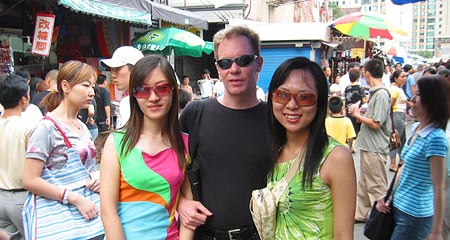
Flavour, Ken and Kitty at Xu Jia Hui market

As you walk through the area, the level of people reaching out to you, following you around, and calling after you rises far above the normal street level of this activity. And if you should happen even to pause to look at some stall, much less show interest in a specific item, the stallkeeper will jump out and start the sales process. First lesson: never agree to the asking price. I bought some cheap-looking plastic add-on to my glasses that would flip down and cover them with dark lenses. When I asked the price, the woman said it was 120 Yuan ($15). Without consulting Ken or his friends, I countered with Y30 (about $4)–which was a mistake. Kitty and Flavour showed surprise, saying it was worth only Y5 or Y10 (I simply hadn’t expected the lady to mark up the price that much). I then haggled it down to ten (the ultimate bargaining chip is to start to leave, which is when they almost always cave in), but the lady was pissed, though trying not to show it in her expression. When I paid, she gave me back change so that she kept Y30. When I again insisted on ten, she complained that I’d said thirty, and tried to give me back only another ten so she could keep twenty, but I finally got all the change back from her. A rather inauspicious start to my haggling experience, but instructive.

It was kind of funny how some things worked. A lot of people were selling watches (including a hilarious watch with Mao waving his hand), and the hawkers would show you what was on display; when you showed non-interest in them, the hawker would look around and whisper conspiratorially, “Rolex?” and uncover a box full of Rolex knock-offs, crowing as if this were valuable treasure and as if dozens of other hawkers had not already shown you their stash.

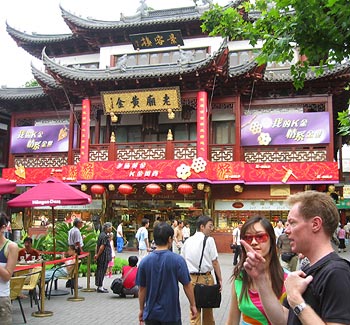
After the market, we went to Yuyuan, am area with again, a lot of shops–but this time in an area of very nice architecture and a park in the center. This area was more expensive, so we did less shopping and more of just looking around, and stopped for a bite to eat as well. The garden area was nice–there is an apparently famous crooked bridge over the pond, but the architecture, a classic style from centuries ago (from what I could pick up, that is), was the show-stealer.
Later, Ken and I met up with another friend of his, Jasmine, who speaks amazingly good English despite never having traveled (apparently it is very hard for ordinary Chinese people to travel abroad), and we bored Ken with a lot of computer talk while we searched for a good restaurant to have dinner at. We were now in Xintiandi (Sheen-tyan-dee, or “New Century”), which is apparently kind of like Roppongi is in Tokyo, a high-priced area where all the foreigners hang out. A lot of nice places, but the prices can be easily ten times higher than local joints–and yet still, a fancy dinner for three came out to about $20 per person, the price of a low-to-midrange meal in Tokyo.


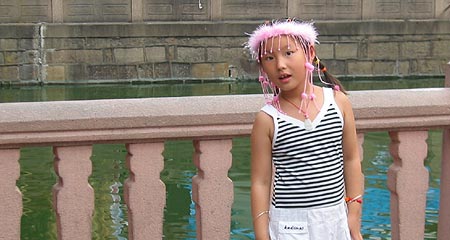
A young girl who agreed to pose quickly for me. She’s wearing a popular headdress, a lot of kids and some adults have them. The girl caught my eye by staring at me–a lot of people do because foreigners are still often uncommon–but they always respond happily when waved back to.

After the night’s festivities, we headed home-but because the outlying light rail shuts down at about 8 pm, we took the bus from Xujiahui. The bus ride, which should have taken half an hour, instead lasted more than an hour, in part because of the same aggressive salesmanship seen in most other parts of the city. On buses, there is a driver and a fare collector. The fare collector sits behind the back door of the bus, and aside from collecting the twenty-five or forty cents from passengers, he spends most of his time leaning out the window shouting at people out on the street. Apparently buses in China are less of a systematic thing and more like taxis, each bus vying to get more warm bodies through the door.

So every few minutes, we would pull aside to a stop–many times not at a stop–and wait between one and ten minutes while the conductor shouted and wheedled. The driver would help out by pulling out a little each time, as if to leave, prompting the prospective customers to hurry up and get on board–so they could wait another five minutes until we actually pulled out from the stop.

Add to this the fact that the buses seem to have no shocks, the seats are narrow and hard, and for most of the trip the malfunctioning backup beeping signal was going off in our ears, and the bus experience is not nearly as nice as it could be.

Begging is also something that you see a fair amount, often a woman and her child, with the child asking for the money. The most noticeable account was on the train into Xujiahui, when a woman led her boy, perhaps eight years old or so, through the train, the boy calling out for alms. This pair saw a great deal of success, mainly due to the fact that the boy was badly deformed. This was not too different from what I experienced in Spain, minus the kid.

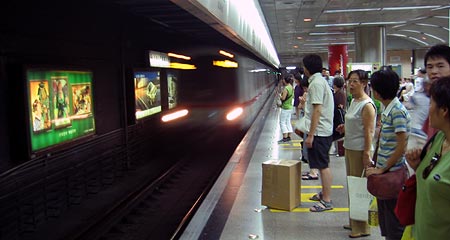
But the trains are otherwise a pleasant alternative. They are cheap (usually about 40 cents), come often when they are running, have comfortable seating, and are clean. The down side is the early shutdown, added to the sparseness of train lines. In a city of millions, perhaps on par with a good part of Tokyo, Shanghai has only a handful of train lines to Tokyo’s multitudes. But more are being built; Shanghai is quickly building up and up and up. You can see this especially in the construction of housing. Massive forests of apartment/condo blocks are everywhere, and just as many seem to be under construction.

Between and among these towers ride a large number of two- and three-wheeled bikes, manually or fuel-powered. In many cases, on most large roads, they have an adjacent side road (as big as a medium-sized road in Japan all by themselves) reserved for them. But at intersections, the bikes and cars mix dangerously, each vying for control of their part of the road. Even for someone like me, now well used to traffic in Tokyo, this place seems chaotic and dangerous, taxis sweeping in and out everywhere within inches of bicyclists, pedestrians weaving between slow-moving traffic, hastily getting out of the way of taxis which seem intent to go on through despite human obstacles. Not the perfect traffic environment, but survivable (hopefully) for another six days.

Categories: Travel Tags:

To Qingpu and Back

August 24th, 2004 6 comments

I got on at Starbucks–from downtown Shanghai today.

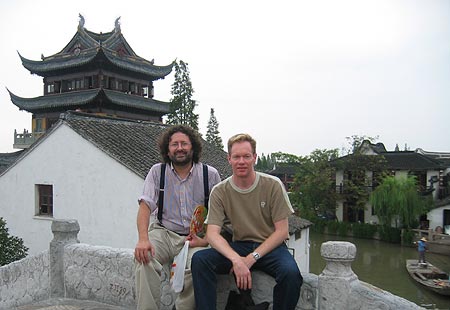
Qingpu (pronounced “Ching-pu”) is a town near a small historical village on the banks of a river in the northwest area of Shanghai, and where Ken and I went today, guided by Ken’s student Fanny and her friend Sally (not their real names, but nicknames assumed for our convenience), who are native to that part of town.

Before going out to the village, we ate lunch at a nice place in town, a good number of medium-sized dishes that we all shared, and didn’t quite finish–apparently that’s not uncommon, maybe a slight show of prosperity, ordering more than you can eat. There was one dish, a spicy chicken, that was very attractive visually–but not quite so great to eat. Served in a basket, it had as many cooked peppers as chicken, but the chicken itself came in small pieces, and each one contained a small bone. A bit too much trouble.

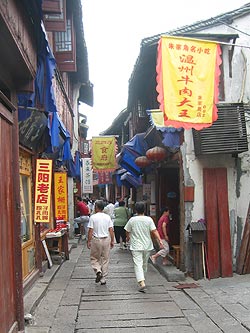
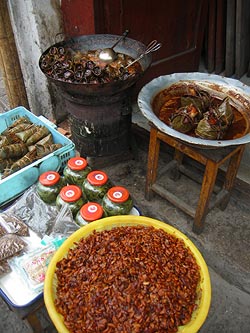
After lunch, we headed out for the historic site. The village itself, named Zhu Jia Jiao, is supposed to be about 300 years old, and consists of a network of canals (with Venetian-style gondolas and their rowers) and small streets laden with tiny shops where their keepers beckon you endlessly to take a look at their wares. A lot of special region-specific pork dishes and other foods for take-home were available, but there were a wide variety of other shops, many with items for sale at $1~$3, including items that appeared like jade and ivory but obviously had to be fakes. Any number of tourist trinkets were available, but we were able to avoid purchasing–even with hawkers as persistent as those we found.

To give you an idea, as we entered the village, we approached the river and saw a sign that indicated that people would release fish into the river, probably for good luck. And several women approached, trying to sell us baggies filled with small fish, including goldfish. They followed us down a longish street–perhaps more persistent than usual because we were foreigners, a group that usually splurges more. They kept getting in front of us, practically insisting we buy some fish to release into the river. You just have to avoid eye contact and not make any moves to your wallet–these people tend to key in on any move that could indicate a sale.

One place we did indulge ourselves was a small archery room, where primitive bows and ten extremely primitive arrows were available for 5 Yuan. I took five shots, and Ken and Fanny shared the other five. Kind of fun, but the equipment was far from accurate, and most of the shots missed. But it was fun. We also indulged in a gondola ride for half an hour through the canals and under the main bridge on the river, and went into a temple which is supposed to bring good luck to those wishing to have children–not going for that purpose, of course.

On the way back, Ken and I took a “chicken bus,” as he’s come to call them. They’re buses that go along rural routes, which we needed as Qingpu is a few hours away from Ken’s place by bus. One time, when Ken took the bus, a passenger next to him had a bag on the floor, which soon began moving around of its own accord. The other passenger soon kicked the bag–and upon doing so, a loud squawk came from it, and Ken realized that there were chickens–plural–inside. Ergo, the “chicken bus.”

I didn’t see any chickens when we rode it back from Qingpu, but the ride was considerably slow, long and bumpy as hell–not the kind of ride I’d prefer to take every day. In theory, we were supposed to transfer to another bus midway, but neither Ken nor I felt like continuing that ride, and so we got another taxi (this time just 60 Yuan, or $7.50) to go back to Ming Hang, this time to midtown where we ate some McDonald’s (I wanted some predictability), and then walked back.

By this time, it was about 8:00 pm. On the way, we not only cruised by a lot of shops, but a ton of street vendors, selling, mainly, pirated DVDs and music CDs (a dollar apiece), jewelry, wallets, small pictures, and–for some reason–remote controls, like for your TV or VCR. A few strange stalls, like one run by a fellow who looked like he came from a Middle Eastern country, governing a huge mountain of nutcake of some sort–a salty mix of pieces of nuts in a gummy matrix, topped by candied walnuts, sweets, and dried fruit. A bizarre-looking concoction, probably popular somewhere in the world, but not quite our cup of tea.

An interesting day for the first full day in China, but not all that happened–a few more observations I’ll fill out in future posts, like the scrawling of spray-painted ads all over the place, a wealth of demolished buildings and uncleared rubble in many places, endless housing projects, ostentatious entrance signs, and a preponderance of bicyclists, scooter riders and three-wheeled bike barges on streets where traffic is more of a struggle than a flow.

Categories: Travel Tags:

On a Slow Network to China

August 24th, 2004 Comments off

I have just successfully logged on to the Internet here in Shanghai. Ken’s personal DSL has been switched off for the vacation season, and I got a scare that maybe blogging would be difficult, as you cannot put USB Flash or a CD-ROM into the computers at the Internet cafe–so I’d have to come to a hot, smoky room full of people playing video games, and uploading photos would be impossible.

But fortunately, the people here are incredibly nice–and they allowed me to hook up my Mac (a platform apparently rare in China) directly to their network, with a tech guy typing in the IP addresses and everything. Got on the network no problem–and now I can upload a blog entry typed offline earlier in the day, as well as upload photos and check on my email accounts using Eudora, again for offline consideration if I want.

The lady in charge, a Ms. Ke (pronounced “Kuh”) just came over, and in her best English, welcomed me to the cafe and expressed a hope that I’d come every night–a definite possibility, especially if the Starbucks WiFi does not work out (and the closest Starbucks that has WiFi is an hour by train and bus each way, so…).

Still, the network here is slow. Ken tells me that any DSL around here can be relatively glacial (definitely much less than a megabit), and this cafe spreads the connection between a few dozen people. Just getting my email took ten minutes (though that was padded out by more than a hundred spam). That means that photo uploads from here may be pretty slow, so for the time being I can only append a precious few each time. I’ll post more when I get back to Tokyo.


Ken and I in Qingpu Village today.

Categories: BlogTech, Travel Tags:

First Night in Shanghai

August 23rd, 2004 Comments off

Got into Pu Dong Airport somewhat late last night, partly because it was a late flight, and partly because the flight was delayed. My friend Ken, who’s putting me up in his spare bed and acting as my tour guide for the week, was patiently waiting as I came in at 9:30, and was even more patient as I got in a long line to change money. I had tried changing yen to Yuan in Tachikawa Citibank back in Japan, but they couldn’t do it. No problem, I though, I’ll change it in Narita, plenty of time. But at Narita, they couldn’t change to Yuan either. I’m thinking maybe it’s some political thing, some monetary restriction due to friction somewhere, something like that. Either way, it got me worried–if I didn’t get Yuan at Pu Dong Airport, I was afraid I’d never get it at all.

But my worries were unfounded–the airport bank clerk said I could change yen to yuan in town, but still, it was good to get local money in my pocket. And I really have to get used to the local currency–8 Yuan to the dollar, roughly. And the biggest denomination is 100 Yuan, or about $12. Makes for a big stack if you’re carrying hundreds of dollars.

In addition, many things are dirt cheap here. After getting into town by bus (Y18, $1.50), we had dinner at a small noodle place (beef noodles with a licorice-flavored broth!), and then as it was raining and taking the train/bus/walk would be a hassle, I agreed to spring for the taxi ride–which took more than half an hour. That kind of taxi ride would cost easily ¥5000 in Japan, or about $45, but here it was just 100 Yuan, or about $12, or not too much more than I pay for the 4-minute taxi ride from my apartment to the local train station in Japan.

On the way in, we had the driver stop so I could jump out and get some water, and Ken asked me to get a few “cold ones” for him. I thought he meant beer. He meant water, but I got enough of that too (trying to avoid tap water here as much as I can). But the beers were pretty cheap, 6 Yuan (75 cents?) for a 640 ml bottle which would have cost 4 or 5 times more in Tokyo. I got a few smaller cans which I thought were beer, but wasn’t sure–they were in the same section of the cooler, but with a strange English brand name and the rest in Chinese, I could not identify them as beer. Until later, that is, when Ken pointed out that the brand name “REEB” was “beer” backwards. Ah. Okay.

No photos yet, but you can’t snap many at night (unless you wanted to see Ken slurping noodles). I’m not able to connect to the Internet just yet, and may not be able to today–it’s still tentative–but I’ve decided that if access is limited, then I’ll just blog offline, add the entries when I get a chance, and then backdate them to the right time and day.

In the meantime, I am in the relative lap of luxury in China–Ken’s place is in a dormitory for foreign teachers, and they get special amenities that most people here don’t, like hot water and air conditioning. Cool. Literally. ‘Cause outside it’s rather hot and humid.

Ken has made an arrangement with one of his students out in the countryside so that we can get shown around a small village on the outskirts of the city today–probably a big photo op as well as a nice time. The photos may have to wait, though–if I can’t eventually get to a Starbucks and make the WiFi connection work, then photos will be harder to upload.

Categories: Travel Tags:

News Bits

August 22nd, 2004 Comments off

A few more tidbits before I fly off for China. I probably won’t be doing too much political commentary for the next week or so, unless I can get a good connection to the web at Starbucks (there are 39 in Shanghai–I shouldn’t be surprised) and can surf the web pretty well there. We’ll see.


Barak Obama is going to walk away with this one. Among all Illinois voters, he has a 40-point lead over Alan Keyes, dominating the polling 65-to-24. Obama has an overwhelming 96-to-3 lead over Keyes among black voters, and he even trumps out Keyes amongst moderate conservatives and those who consider themselves “fairly conservative.” Keyes’ only lead over Obama is among the “very conservative,” no surprise there–but even they only favor Keyes by 19%, or 55-to-36. When 36% of ultraconservatives go for the Democratic challenger, you know that you’re an outright loser.


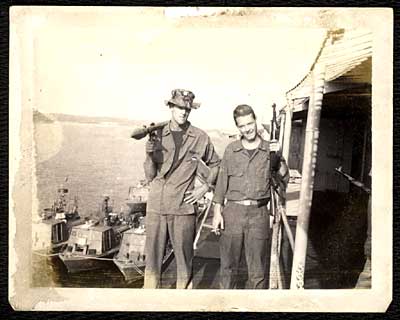
Kerry is getting even more support over the Swift Boat thing: William Rood (now a newspaper editor in Chicago) commanded a swiftboat alongside Kerry on February 28, 1969, when Kerry won the Silver Star. The Swift Boat Vets group attacking Kerry claimed that he exaggerated about what happened, but Rood tells a different story:

Kerry’s critics, armed with stories I know to be untrue, have charged that the accounts of what happened were overblown. The critics have taken pains to say they’re not trying to cast doubts on the merit of what others did, but their version of events has splashed doubt on all of us. It’s gotten harder and harder for those of us who were there to listen to accounts we know to be untrue, especially when they come from people who were not there.

…

Ambushes were a virtual certainty, and that day was no exception.

The difference was that Kerry, who had tactical command of that particular operation, had talked to Droz and me beforehand about not responding the way the boats usually did to an ambush.

We agreed that if we were not crippled by the initial volley and had a clear fix on the location of the ambush, we would turn directly into it, focusing the boats’ twin .50-caliber machine guns on the attackers and beaching the boats. We told our crews about the plan.

The Viet Cong in the area had come to expect that the heavily loaded boats would lumber on past an ambush, firing at the entrenched attackers, beaching upstream and putting troops ashore to sweep back down on the ambush site. Often, they were long gone by the time the troops got there.

The first time we took fire—the usual rockets and automatic weapons—Kerry ordered a “turn 90” and the three boats roared in on the ambush. It worked. We routed the ambush, killing three of the attackers. The troops, led by an Army adviser, jumped off the boats and began a sweep, which killed another half dozen VC, wounded or captured others and found weapons, blast masks and other supplies used to stage ambushes.

Meanwhile, Kerry ordered our boat to head upstream with his, leaving Droz’s boat at the first site.

It happened again, another ambush. And again, Kerry ordered the turn maneuver, and again it worked. As we headed for the riverbank, I remember seeing a loaded B-40 launcher pointed at the boats. It wasn’t fired as two men jumped up from their spider holes.

We called Droz’s boat up to assist us, and Kerry, followed by one member of his crew, jumped ashore and chased a VC behind a hooch—a thatched hut—maybe 15 yards inland from the ambush site. Some who were there that day recall the man being wounded as he ran. Neither I nor Jerry Leeds, our boat’s leading petty officer with whom I’ve checked my recollection of all these events, recalls that, which is no surprise. Recollections of those who go through experiences like that frequently differ.

With our troops involved in the sweep of the first ambush site, Richard Lamberson, a member of my crew, and I also went ashore to search the area. I was checking out the inside of the hooch when I heard gunfire nearby.

Not long after that, Kerry returned, reporting that he had killed the man he chased behind the hooch. He also had picked up a loaded B-40 rocket launcher, which we took back to our base in An Thoi after the operation.

John O’Neill, author of a highly critical account of Kerry’s Vietnam service, describes the man Kerry chased as a “teenager” in a “loincloth.” I have no idea how old the gunner Kerry chased that day was, but both Leeds and I recall that he was a grown man, dressed in the kind of garb the VC usually wore.

The man Kerry chased was not the “lone” attacker at that site, as O’Neill suggests. There were others who fled. There was also firing from the tree line well behind the spider holes and at one point, from the opposite riverbank as well. It was not the work of just one attacker.

Rood backs up Kerry’s story over O’Neil’s, and was in a position to do so. His story comes across as credible, not trying to give an omniscient I-saw-and-know-everything account, but rather a slightly removed view you would expect from someone being where he stood, with caveats and admissions of lack of knowledge. And yet, everything in the article confirms Kerry’s story, and punches yet more holes in O’Neil’s. (The Trib also has posted these photos.)


That’s not stopping the Swift Boat Vets Against Truth from continuing their attacks, however. A second ad is being aired, and this one is even more boldly false, showing video of Kerry on video, apparently accusing all vets of war crimes–when in fact, that video is edited, cutting out the part where Kerry explains that he is reading admissions by other soldiers of what they had done. Kerry is fighting back, not only showing up the lies and deception, but also pointing out the numerous ties between the Swift Boat Vets and the Bush administration, from the money ties to the direct support from the Bush campaign.

Like Bush’s outrageous attacks on John McCain in 2000 (you think John McCain would’ve just sat there for seven minutes?), these attacks on Kerry are having an effect in the polls–but the story is not over. As more and more honorable people come forward to defend Kerry, and as more and more of the SBV claims fall to tattered shreds, one can only hope that this will in some way backfire on Bush–but that is far from certain. Lying smears and nasty attacks all too often work. Had they not, we might have had President McCain, and things would have been a hell of a lot better than they are now.

Categories: Political Ranting Tags:

The Great Iraqi Giveaway

August 22nd, 2004 Comments off

A month and a half ago, I reported that between one to four billion dollars had apparently been looted from Iraq.

Time for an update.

The figure is $8.8 billion. Maybe up to $13 billion now, I’m not sure if the previous stolen booty is included in the new total or not.

Well, at least now, it is. Far from acting fast and tightening up the cash drawer in Iraq, the Bush administration apparently just decided to allow the scope of the fraud to widen. Now it’s not just oil revenues, it’s billions paid to “Iraqi ministries,” though lord only knows where the money really went to. Read the current telling of the story.

And of course, what will the media focus on next week? Probably the Swift Boat Veterans thing again. Those guys are worth their weight in gold to the Bush administration, smearing Kerry like mad and diverting attention away from Bush’s corruption and scandal.

Categories: Political Ranting Tags:

The Guy From Kojima Denki

August 21st, 2004 3 comments

So, as I mentioned in my previous writings on getting satellite TV, I had the people at the electronics store come over to check if I could get SkyPerfecTV. It’s in question because there’s a large building next to mine that might or might not be in the way–looking at SPTV’s web page with a map locater, it might be blocking the satellite by just a few feet in one direction. So I went to the electronics store and asked them if they could do a check. It’ll cost ¥2000 ($18), they said. I told them that was OK, better than going through the hassle of buying and only finding out then that I couldn’t do it.

Now, $18 is not a king’s ransom, but since they tell me they guy could figure out if I’m able to get reception, I figure the guy will come over with a little electronic doohickey that could measure the satellite signal strength or something. So I wait the few days for the guy to come. (“Between 2 and 5pm,” they said–and he came just at 5pm. Typical.) The doorbell rings, I open up, and this scrawny little guy walks in. No gizmos. He pulls out a compass. Goes to the window I show him. Climbs outside, holds up the compass, says I won’t be able to get the satellite signal–the next building is in the way. But in saying so, he points in a direction that seems fishy to me. I tell him there’s another window, and he takes that in surprise, like he wouldn’t expect a place to have two windows. He checks from the other window and says, “Oh yeah, sure, you can get it from here! No problem! It’s perfect.” This sounds great to me–except he’s now pointing in an even more westerly direction than before to indicate where the satellite is. He’s pointing in a much different direction that SPTV’s web site indicates–they say it’s more to the south.

So I take him inside and show him the SkyPerfecTV web site, I show him the map page with the arrows showing the direction of the satellite. He looks at it, and something seems to dawn on him. He goes back to the first window, looks at his compass again, and proclaims I can get the signal in that direction, the direction from the web page; reception will be OK, he promises. But the direction he shows me now is way off from the direction he showed me originally. So I question him about how he got that–and he starts talking faster, using words I don’t know.

Here is where I explain to him that he has taken no readings that could possibly be even as accurate as the measurement I made on SPTV’s web page, and so how could he really know if I could get it or not? Unsure how to answer, he leaves, makes a phone call, and comes back. “You can’t get reception,” he explains. “The next building is too tall.” Now it’s time for me to explain to him that I never expected to see over the building, but rather just to the east of it. Again, he’s unsure about it. He goes outside and makes another phone call. He comes back in and proclaims, “it’s too close to call.” Well, hell, I could’ve told him that! I paid ¥2000 to have this joker who knows less than I do to tell me what I already know? I would at least expect him to know the general area of the sky which the satellite is in.

Fortunately, when I called up Kojima and told them about the fiasco, they promised to refund my money. Problem is, I won’t have time to collect on that before I leave on vacation. Hopefully in early September, they’ll still remember me and agree to give the money back. But for now, I’m still just as much in the dark. I just can’t figure out why they think they can do that, charge ¥2000 to have a guy who doesn’t know a satellite from a skyscraper to tell you fairy tales. Hopefully their guy who installs the units will know just a bit more then this guy. What scares me is that he might be the same guy.

Categories: Focus on Japan 2004 Tags:

The Assault on the Middle Class Continues

August 21st, 2004 1 comment

In their continued attack against the middle class, the GOP and President Bush ponder how they will institute a national sales tax, probably at around 25%. The anti-progressive tax would, in theory, replace the federal income tax, and would represent the greatest tax cut for the wealthy imaginable, a veritable Death Star for tax cuts for the rich. It would shift the tax burden squarely on the middle class and the poor.

Bush and the GOP are already spinning like mad, giving the new plan the name “Fair Tax” and claiming that it would make the middle class “invisible” to taxes. Invisible?? When you pay 25% extra on everything you buy? In addition to whatever state sales taxes you might pay?

The GOP stance is an absolute fraud, pure and simple. Wealthy people would be paying a miniscule proportion of their income for the tax–and would likely be rewarded immediately with big-ticket exemptions (under the guise of aiming those exemptions at the middle class, of course–SOP). The poor would find their tax burden skyrocketing, as just about everything they purchase would become about 25 % more expensive–including food, which for obvious reasons has always been exempt from state sales taxes. Everyone in the middle class would suffer similarly.

The idea has been so unpopular that Bush almost immediately flip-flopped on the issue, saying he didn’t want people to think he was raising taxes. No, we’ve got to get those tax hikes through in stealth mode.

This is a seriously bad idea–not just for the above reasons, but because it will target taxes at purchases, which will hurt sales and be poison to the economy. Japan instituted a 3% federal consumption tax back in 1989, and hiked it to 5% in 1997–and both times, their economy dragged, contributing to a decade-long recession.


On another front, the Bush administration, after losing four congressional votes on the issue, decided to use strict executive authority to enact their overtime overhaul. Republicans are trying to paint it as something that will just take overtime away from a few thousand wealthy people earning over $100,000 a year, and that a lot of other people will get more overtime. Few people getting overtime now believe this, however.

One thing is for certain: it’s not what the Bush administration wants you to think. First of all, how many people who make over $100,000 a year get time-and-a-half? Like the law that says that rich people have the right to sleep under bridges, one can only suspect that this is a false-front way of making it look like a burden only on the wealthy.

Workers earning less than $24,000 will be exempt, but that leaves a huge hole between $24K and $100K, occupied mostly by the middle class. Who in that hole will lose overtime? That’s the problem: the rules are torturously labyrinthine in that area, and even experts say they’re unclear. Some examples of people getting their overtime pay cut include “pharmacists, funeral directors, embalmers, journalists, financial services industry workers, insurance claims adjusters, human resource managers, management consultants, executive and administrative assistants, purchasing agents, registered or certified medical technologists, dental hygienists, physician assistants, accountants, chefs, athletic trainers with degrees or specialized training, computer system analysts, programmers and software engineers.” See the pattern? No? What, are you blind? Obviously the pay cut is aimed at.. er,… uh, whah?

And what if your job is not on that list? Does your pay get cut, or not? You’ll probably find out when your employer cuts your pay–the rules are so unclear that they say employers should determine who gets the cuts on a “case-by-case basis.”

Now, the claim is that this is intended to cut down on lawsuits concerning overtime pay, but this is doubtful: the vague and seemingly random targeting of the pay cuts will, in all likelihood, create countless more disputes and spark a tidal wave of suits. The real aim of the law, it would seem, will be to cut down on the chances of employees actually winning the overtime claims so many businesses despise.

The fact is, the rules confuse a great many people, but many distrust the new regs on the basis of its source–the anti-labor administration–and its backers, the people who pay the wages:

Monday’s change is the culmination of decades of lobbying by business groups representing retailers, restaurants, insurance companies, banks and others that have been hammered by workers’ overtime lawsuits, many of them successful.

I can relate to that. When I worked at a movie theater in college, my own employers withheld overtime pay, claiming they just didn’t have the money for it (businesses never ‘have the money’ to pay employees), and promising future redresses that of course never materialized. I sued them in small claims court, and won.

I would be willing to bet good money that far, far more than the 107,000 workers will lose overtime, and apart from savaging middle-class wage earner’s income, this stands as the first step of many to do away with overtime completely.

Add to this the refusal of conservatives to allow for even a mild increase in the minimum wage, and their incessant drive to give more, more, and even more tax cuts to the wealthy, and it becomes all too evident that the GOP is the friend of the wealthy only, and has nothing but contempt and abusive intent towards the poor and middle class.

Categories: Political Ranting Tags:

Bits and Pieces, August 20, 2004

August 20th, 2004 Comments off

Iraq continues to be important for some, that is to say, the families of at least 20 people. George W. Bush may want us to forget about it until November, but the death toll is rising. 20 casualties in the past five days, double the death rate for coalition forces throughout the war.

This probably has something to do with the fact that the Iraqi soldiers that Bush wants us to believe are handling things–that’s what happens in sovereign nations, right?–are deserting by the hundreds. We point them to go into Najaf and kill their fellow Iraqis, and go figure, a lot of them are not extremely hip to the idea. And the powers that be don’t really want that known:

At an Iraqi national guard base near the border of Sadr City, the vast Baghdad slum that serves as al-Sadr’s support base and recruiting ground, 1st Sgt. Khalid Ali described the death threats he and other Iraqi troops have received from the Mahdi Army. …

But when Ali was asked about the number of guardsmen who have quit since al-Sadr’s latest uprising, U.S. Army 1st Lt. Vernon Sparkmon cut him off.

“Certain things, you can’t discuss,” Sparkmon told Ali. “If somebody asks that question, that’s, like, classified stuff.”

Oooookay. And by the way, “like”? “Stuff”? Has the military gone Valley Girl?


In the meantime, the Iraqi Olympic team, which Bush & Co. have been using as their poster boys for a happily-invaded Iraq, are not quite so happy about Bush using them for political gain. Apparently, Bush has been airing ads which say, “At this Olympics there will be two more free nations – and two fewer terrorist regimes.” The Iraqi athletes, however, do not feel the same way:

Speaking after winning their group stage at the Games in Greece, one player said he would take up arms against US troops in his country.

And the team attacked Mr Bush for running re-election campaign adverts featuring the Iraqi team.

“Iraq as a team does not want Mr Bush to use us for the presidential campaign,” said midfielder Salih Sadir. “He can find another way to advertise himself.”

Not exactly what Bush wants you to hear, but real nonetheless–and keep in mind, Bush & Co. want you to think that these were the most oppressed people under Saddam, and most grateful for U.S. liberation.


On another front, the Swift Boat Veterans for Smearing Kerry are not having that great a week. The New York Times and Washington Post (admittedly left-leaning publications, but hardly rags) have been tearing them to shreds. In short: the operation was funded by friends of Karl Rove and big-time GOP and Bush donors (most from Texas, wouldn’t ya know), and the claims made by the veterans are falling apart faster than you can say “smear campaign.” In case you need a scorecard, here’s one.

And at least for show, Kerry has condemned an ad run by MoveOn.org criticizing Bush’s record (no lies in them, BTW), but Bush still refuses to disavow the Swiftboat smear campaign. How long that can last, who knows–but when even Bill O’Reilly starts casting doubts, you know the case is weakening.

Another good-news point, Kerry has started hitting back hard against the attack ads. This is what he’s known to do late in his campaigns, not to let the other side get away with crap, and to fight back harder and harder. And it seems the time is ripe: Kerry is doing well in the polls, and has a huge electoral lead (Bush seems tied or slightly in the lead because his support is deep in some states, which is bad for him electorally); many say that the race is his to lose. Considering that Kerry got no post-convention bounce and that in the past two weeks has been outspent massively by Bush, this is a rather surprising, yet welcome, sign.


Other news: Oil is at $49 per barrel, perilously close to the psychologically critical $50 mark (some say $65 is not out of the question)–and a record high, and bad news for the economy. About 60 newspaper editors printed an “astroturf” (fake grass roots) form letter from Bush’s web site. A 55-year-old social studies teacher just wanted to see the president speak, but had her ticket ripped up in front of her face, because of a small Kerry/Edwards sticker on her blouse. See, she was a real security threat. Senator Ted Kennedy was “accidentally” put on a terror-alert list that prohibited him from flying, and despite repeated attempts to get Ridge to take his name off the list, the well-known Massachusetts senator was banned from flying for weeks. Yeah, an “accident.” Lots of al Qaeda terrorists named “Kennedy” are menacing the nation, I bet. Somebody in the Bush White House having fun, no doubt.

Categories: Main, Political Ranting Tags:

Great Sunrise

August 19th, 2004 3 comments

I just happened to look out the window at the right time this morning and caught a fantastic sunrise. Five of the better shots are displayed below–but the size restrictions of a blog column make the photos too small to really appreciate. Click each one to see a larger (1000-pixel wide) version.


Note the blueish highlights underneath the red clouds.

Categories: Uncategorized Tags:

Scoring Some Pimenton and Chorizo

August 19th, 2004 2 comments

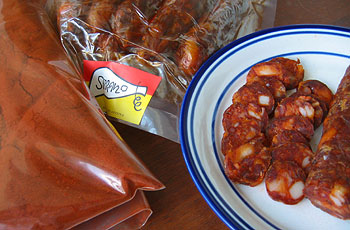
As I’ve written before, I’ve been looking for a good source of pimenton, that lovely smoked hot paprika from Spain. And though it is very hard to find in Tokyo, I did find an importer who had some and was selling. It was, in fact, almost comically like a drug purchase.

I went to the importer’s office, which was really an apartment in a building in Kami-Meguro. It didn’t feel like a business at all, but like visiting someone’s home. When I was presented with the spice, it was not pre-packaged–it was put into a ziploc. And I almost laughed when they guy opened the baggie and invited me to take a taste. “Mmmm,” I thought. “Some good quality shit here. I’ll take half a kilo.” I swear, that’s how it came down. The illusion shattered when they gave me a printed receipt.

I’m not sure why they had to use the baggie, but it may have been because I wanted the picante, the hot pimenton, rather than the dulce, or “sweet.” Apparently most people in Japan who use the stuff prefer the sweet variety; the importer told me that when he makes chorizo, he uses the hot variety. Thus he probably was selling me his leftover “stash” from making chorizo. If I’d wanted dulce, they could have sold it to me in the bag from the maker, La Dalia.

And when he mentioned that he made chorizo, my ears perked up, and when I asked, he happily showed me the different kinds he made, proudly pointing out that there are no additives used in his product. In Spain, where he lived for five years, he says the chorizo usually is made with chemicals to preserve it. So I wound up buying a kilo of those (which was a lot more expensive than the pimenton). When I got home and tasted it, it was good, but not as good as other chorizo I’ve had. He may have varied the recipe to better suit Japanese tastes (though it is far, far closer to Spanish chorizo than the bland stuff they call “chorizo” in stores here), or the chorizo may have been intended more for cooking than for eating straight, which I prefer. I’ll be trying the chorizo in future cooking attempts, see how it works out.

In any case, if you want some pimenton at a reasonable price in Tokyo, try Mr. Hiroshi Ojima at Serrano–but call first (03-3713-2171) to see if he has what you want. If you want to know how to get there, drop a comment and ask for directions (leave an email address, masking it if you like with a URL; if you do that, the email address is secure. You can also ask me to immediately delete the comment as well).

Categories: Main Tags:

Japanese TiVo?

August 18th, 2004 6 comments

Right now I’m considering switching from cable to satellite TV, but that’s not the main topic of this article. One piece of technology I’ve been waiting for is a TiVo-like easy-programmable device.

For those of you who don’t know about TiVo or its poor (but superior) cousin ReplayTV, these are hard-disk-based video recorders, belonging to a new category of home electronics, the “DVR” (Digital Video Recorder). Instead of saving recorded shows to VHS or even DVD, they save the video to a hard disk. The advantages are many: you can “pause” (“Time Slip” in Japanese) live TV while the digital recorder saves the ongoing programming into the hard drive; you can save up to a couple hundred hours of programming on the disk, no need to keep them on tapes and wonder what tape is free, what tape has what programming and other hassles; you can access any part of any recorded show very quickly; but best of all, the service usually includes an interactive program guide.

The program guide (called “EPG,” or “Electronic Program Guide” in Japan) is kind of the like the “what’s on” channel on cable TV in the U.S. On a grid displaying time horizontally and channels vertically, it allows you to access any part of the schedule. But with the HDD recorder, you can use that guide to program the recording of a show. For example, go to the program guide and find the “West Wing” slot, hit “program” and tell it how often, and your DVR will handle the recording of that show from then on–often including information such as episode title, summary, and whether or not it’s a repeat. My father uses this in the U.S., and I’ve been more than a little envious.

For me right now, well, I’ve got cable TV and pretty crappy cable at that. Not too many channels, and the channel can only be changed directly via the tuner. Which means that if I want to record a show, I not only have to set the VCR to tape the show, I also have to set the cable tuner to jump to that channel at that time. And aside from the extra work, the cable tuner is hard to program and de-program. Unlike a VCR which will only record from programming if switched off, the cable tuner will always switch to programmed presets, whether the tuner is on or off–which means that unless you de-program the cable box, it will skip to the programmed channel even if you’re watching another show. In short, it’s a huge hassle.

Hopefully, not any more, though. Toshiba now makes a machine (the RD-XS53) which, through a “control cable,” will control the satellite TV tuner as well as its own recorder functions. So like with TiVo or ReplayTV, you just have to go to the channel guide, choose a show, and then forget about it (you can also program the recorder from your PC). But it has some other very nice features as well: it can record two different shows simultaneously (so long as they don’t require the same tuner), and it has a built-in DVD-R/RW/RAM recorder, so you can save anywhere from 1 to 8 hours of programming on a single DVD-R (depending on the recording quality). So just leave the DVR to record a few months’ worth of shows, and for the ones you like, compile them on $3-a-pop DVD-Rs, which now cost about the same as, and record just as much as standard VHS tapes. You can watch these DVDs in your DVD player, or on your PC, if it has a DVD drive. Alas, it is not possible to directly put the video files on your PC, despite the network connection–copyright issues, I’m guessing. No biggie, though.

The major drawback, and possibly a deal-killer for me right now: the Toshiba machine costs ¥148,000 yen (about $1350). There is a lower-end model for ¥104,000 ($950), but it lacks the ability to mesh with SkyPerfecTV. For a while I thought the low-end model could do the satellite TV control, since the guy at Yodobashi and the sales guy at Toshiba both seemed to indicate that was possible when I asked about the two models together. But after my first call to Toshiba, I did more studying, noticed a small asterisk, and called again–and found out, sure enough, only the more expensive machine could do the satellite TV interface. Major difference there. The Toshiba guy was downright sheepish in admitting it to me.

So I might just go with the SkyPerfecTV for now and wait for the Toshiba models to get upgraded and priced down in 6 months or so. But it’s tempting, I have to admit.

One other problem for me, though–to get SkyPerfecTV, which is necessary for the cool programming features (not to mention far better programming than my local cable TV outfit), you need to have a line-of-sight to the satellite, which is relatively low in the southwestern sky–and there’s a building smack in the way from my apartment. However, at the east-most window ledge of my apartment, the SkyPerfecTV satellite map seems to indicate that I juuuuust might be able to peek around the building, just enough to catch the satellite. So, out goes the call to the local electronic shop’s technician, to tell me if I am go or not on the satellite.

And yes, I am a bit much of a couch potato and electronics geek, so no need to tell me so via comments.


Update: I went to Kojima Denki, and they had the high-end model on sale for ¥120,000 ($1090) or thereabouts. The actual standard selling price for the model is ¥135,000, but Yodobashi sells at suggested retail and “gives” you the extra hundred bucks on your point card, so you’ll spend it there. Kojima had it listed for 135, but with a kind of red writing diagonally over the price–which is an old Akihabara thing which means you ask the sales staff, they’ll tell you the real discount price.

120 Puts it back into my ballpark, but only if I feel extravagant… which I might, if I can get SkyPerfecTV.

Categories: Gadgets & Toys Tags:

The Streets of Tokyo

August 17th, 2004 8 comments

Believe it or not, the street you see at right is a two-way street. Go ahead. Look at it. See if you can figure it out. And for perspective, that white truck parked in the back on the right, it’s a mini-truck, no wider than an American postal jeep. And even two of those would have a hard time passing each other on this street–and yet, I saw a good deal of opposing traffic pass here.

Every twenty or thirty meters, there is an indentation in the street (you can see it at left in this photo, behind the parked scooters; the orange posts mark it). When cars come from opposite directions, the car most conveniently placed to get into the indentation does so, while the car from the other direction squeezes by. I know, but somehow they do it. No wonder you don’t see Winnebagos in this country. Once I rented a truck to move my stuff from one apartment to another–and got stuck on a street wider than this one. When he saw the trouble I was having, the driver of the car going the other way actually got out and volunteered to drive the truck down the street for me while his friend maneuvered his car. Embarrassing, but I couldn’t have made it otherwise–it takes real driving talent.

You might also notice the slight crook in the street in the photo here. Japanese streets are, more often than not, go in all directions; it is less common for them to be laid out in grids. And even those grids are more often than not irregular, with greatly differing block lengths, and tons of T-intersections, one-way streets, and dead-ends. But most streets seem to tilt and angle without any hint of planning or design, like they just grew there. And with no street names (except for large boulevards), no street signs (except for major intersections), and a confusing jumble of block numbers and area names, navigation can be extremely confusing. Take, for example, the sign shown at left. That’s what the intersection looked like, honestly.

Add to that the fact that some neighborhoods are designed with one-way streets and prohibited turns such that it is impossible to exit save by one labyrinthine path; that streets are rarely more than two lanes in one direction, and usually not that; that sidewalks are sparse and properties have six-foot walls along the street, creating blind corners galore; and despite the expenses and difficulties of driving, multitudes seem to have cars, creating traffic jams all over; and top it off with scant parking, some pay parking lots charging a few dollars an hour… I am constantly amazed that people drive cars in Japan.

Oh, and gas runs about $4 per gallon.

Categories: Focus on Japan 2004 Tags:

The Content of Their Character

August 16th, 2004 8 comments

“I have a dream that my four little children will one day live in a nation where they will not be judged by the color of their skin but by the content of their character.”

–Dr. Martin Luther King, Jr., Aug. 28, 1963

Look up that quote in a search engine and at the top of the list you will not see sites that have a full transcript of the speech, but rather a majority of conservative sites arguing against Affirmative Action.

And quite frankly, I am sick of hearing conservatives use the famous Dr. King quote to attack Affirmative Action. It is a disingenuous and dishonest attack. The right-wing claim is that since it judges people by the color of their skin, it is in itself discriminatory and hypocritical. Here is just one example:

Affirmative action is the 100% polar opposite of King’s dream. Affirmative action judges individuals based only on the color of one’s skin and certainly not by the content of their character, their achievements, qualifications or anything else. Affirmative action is a step backwards by justifying the very racism it was established to thwart.

There is no doubt about it: affirmative action creates discrimination. Those who argue for a color-blind society while supporting affirmative action are presenting a hypocritical belief. It appears that supporters of affirmative action are comfortable with discrimination, provided it is directed towards white men.

The rather glaring flaw in this argument–like in almost all conservative arguments against “Affirmative Action”–is that it completely ignores the constant presence of racial discrimination by whites against minorities. By conveniently disregarding any preexisting racial bias and treating what they call “Affirmative Action” in a vacuum, they make the case that since things such as quotas use ethnicity to decide immediate favor, it is racist and therefore hypocritical coming from those who state that they oppose racial discrimination.

What conservatives ignore, of course, is that quotas (which is what we’re really talking about here, not Affirmative Action; see this post) are a reaction, not an action purely unto themselves. To address a reaction and yet fully ignore the action which prompted it is nonsensical.

Imagine that a conservative Japanese person argued that America was wrong because it attacked Japan during WWII, killing millions of Japanese people and conquering the country. What would an American say in reaction to that? Naturally, the reply would be, “you attacked us.” Taken out of context, an American invasion of Japan seems unjustified. Add the component that the Japanese attacked first, and there’s your justification.

But in the conservative argument against quotas, the initial action is removed from the equation, making it seem unjustified. Additionally, the claim will be made that the liberal ideology precludes the idea of taking action based on ethnicity. This is true only if there is no justification; in the context of quotas, where there is a preexisting discrimination that must be redressed, the conservative claim is utterly false. If that were not the case, then America could have been justifiably criticized for entering WWII.

Dr. King’s statement about his dream of how people should be judged is a hope for the future nature of society free of racism, not for the nature of redress in a society filled with discrimination. King was calling for the end of racial discrimination, not for the end of redress in a discriminatory society. In a society without racial discrimination, quotas would indeed be a wrong thing. Today, they are not.


Recommended reading: Rush, Quotas, and the Discriminatory Double Standard, which explains the nature of Affirmative Action and quotas and their differences, why they are justified, and how they are unfairly attacked.

Categories: Political Ranting Tags: