Archive

Archive for December, 2005

The City and the Stars

December 31st, 2005 1 comment

Time to recommend a book again. This time, one by Arthur C. Clarke, one of my three favorites when I was younger (Heinlein and Asimov were the other two, in case you were wondering). Arthur C. Clarke is the verbose one. His writing is poetic, polished and intelligent; reading it is like driving a really nice sports car. Furthermore, he has a talent for creating situations and environments which challenge you to embrace and encompass them, ideas that inspire awe and wonder. That said, his characters lack a certain variety, and there is a somewhat cold repetitiveness of style.

Michael Chricton exemplifies the extreme end of this flaw. While interesting, all his stories tend to be the same: a group of disparate and highly intelligent people are brought together in an environment where high technology has wrought terrible problems; they explore, theorize, discover, elucidate, and eventually about half of them die violently. The end.

Clarke is not so strikingly repetitive, but he does not range far from his base; he revisits more generalized themes and impressions. His novels tend to focus on grand, poetic mysteries, with intelligences far greater than our own, mysteries of tremendous age, artifacts of unimaginable size and scope. His protagonists tend to all be cooly rational, and even his characters with flaws tend to be calm and reasonable. His novels are about discovery, awe and grandeur.

1205-TcatsThe City and the Stars definitely fits this profile, but it does so in a fascinating way. Set in the extreme future, the billion-year-old city of Diaspar, thought to be the last remnant of mankind, is frozen in a stagnant but wondrous state. With technology that can do almost anything, the last humans live in a utopian state. Death has been beaten, and Clarke outlines a wonderful system by which these immortals can escape boredom. After a thousand years of life, a person selects which memories they wish to carry forward, and then is converted into stored energy patterns for a hundred thousand years. They awaken as a nearly-full-grown adult, but without access to their memories, and spend decades learning everything anew as a blank personality. After a certain time, their youth ends and their full memories return, and they pick up life where they left off, perhaps with a new perspective from having experienced life afresh. People are resurrected randomly enough so that they rarely encounter the same people in consecutive lives. Everything is safe and luxurious; people can indulge in any pastime or career they wish, with an endless supply of art, knowledge, and philosophy. Any item can be summoned at a thought, any adventure created in perfect simulation. The people have fallen into such an idyllic slumber that they now fear even the idea of the outside, a fear that even goes beyond the legendary past when faceless invaders beat a triumphant mankind back to its home planet, forbidding it to strike out into space again.

Of course, the story must be about the one citizen who rebels. Alvin is a curiosity: he is the first person to be born in Diaspar in ten million years, with no memories or past lives. His existence is part of a mysterious and ancient plan laid out by those who created the City, emphasized by Alvin’s prime characteristic: he wants out. And that’s where the story begins.

As is usual with Clarke’s novels, you are offered a wealth of speculation and scenarios on grand ideas that allow you to explore issues you might never have considered before. Would you want to be immortal, considering the pitfalls? Would you pay the price? Would you be satisfied with the necessities forced by immeasurably long life? And of course, Clarke serves up grand mysteries, a billion years’ worth of history for your imagination to fill in, strange planets only briefly described that you might wonder at what else exists there. He creates environments that you’d love to explore, and leave it up to you and your imagination to do so or not.

The City and the Stars is at the very least an engaging read, and along with Childhood’s End, one of Clarke’s best novels. Strangely, however, the novel is no longer printed by itself, but bundled with another of Clarke’s books, The Sands of Mars. Why, I don’t know. But it’s worth it to read this story, at least.

Categories: Media & Reviews Tags:

Flying with a Broken Foot

December 30th, 2005 5 comments

It was two weeks ago that I came back home to California for a vacation with the family, and it wasn’t all that easy. I had broken my foot just ten days earlier, and was still in the process of getting used to the crutches that I would be using for the following month or two. I also made the mistake of trying to take the train from home to the airport.

At first, it seemed simple: taxi to the train station, train to Shinjuku, transfer to the Narita Express (NEX), get to the airport, and wheelchairs to the gate. The taxi and first leg of the train trip went without a hitch, and I was confident that all would go well. But not so fast, there bub. At Shinjuku, I had to get from the Keio Line to the JR NEX. Not so easy. First, a station worker sent me off on a wild goose chase that took me an easy 300 meters off course, telling me that an elevator was where it wasn’t, routing me way farther off my path than needed. 150 meters away from my destination, 150 meters back. Then another 100 meters or so to the ticket counter at Shinjuku. Those distances may be less than I count, but as I was on crutches all the way and was porting a heavy backpack, you will hopefully excuse the possible misjudgment of distance. Suffice it to say it was a long way on crutches, and by the time I got to the ticket office, I was sweating bullets and my good leg was killing me.

And then there were 20 people in line. All of whom, despite carefully not seeing the disabled guy in obvious serious discomfort, failed to offer me the chance to get ahead in line. There we no chairs, no place to rest. So I had to crutch-wait in line while post-exertion sweat doused me and I tried vainly to balance on crutches alone to give my good foot a break. Then there was the inevitable foul-up in the ticket (the clerk for some reason did not sell me the basic train fare, only charging me for the express surcharge. I found this out only after I had hobbled into the station, and tried to enter a coffee shop for a quick seating respite–bad idea, the place was a smoker’s refuge, choked with cigarette smoke.

From there, it got better–I asked for them to reserve a wheelchair for me at Narita. What I got, after a few minute’s wait, was two guys who came with a wheelchair right there, escorting me to the tracks. Good thing, too, because the car I was taking was waaay at the other end, and we got there only a few minutes before the NEX got there. After a nice train ride in, three guys were there to meet me at the airport terminal station, right outside the door, to wheel me to the check-in, and then an airline wheelchair to get me to the gate.

Then my luck gave out again: the “bulkhead seat” I had so ardently struggled to get from the airline turned out to be a bad move. Instead of being a spacious seat (one the airline claimed was reserved for injured people), it actually was more cramped than a regular seat. The bulkhead in front of the seat was just as close as a normal seat back in plain economy would be, but instead of having leg room under the seat ahead, the bulkhead just went straight to the floor, leaving perhaps the least foot space of any seat on the plane. And they gave me this seat as a confessed favor, knowing I had a broken foot.

I had to plead with the flight attendant for a regular seat–and got one, thirty-three rows back, farthest away from an exit or lavatory. Swell. Actually, that would be “swelled,” which my broken foot most certainly was, after I got through the flight. I had to either tuck my broken foot under the seat in front of me, where it could never extend fully, or on the floor in the narrow aisle, where it was in constant danger of being tromped on. Not pleasant.


I write this as I am flying back, and this time the trip is going much better. First, I was able to call the airline and get a seat in “Economy Plus,” which is basically Economy with three or four extra inches (a “special holiday gift,” the airline guy called it, though I’m sure O’Reilly would have been outraged by the agent’s attack on Christmas). Or, more accurately, “Economy Plus” is what regular Economy class used to be before they jammed the seats together; the “plus” means you get the old kind of seats. But believe me, that makes all the difference. Strangely, the bulkhead seats are in that section, despite the fact that they were even more cramped than Economy Normal.

A small aside–I got the wheelchair treatment at SFO to the gate, but the guy was really weird. He made very bizarre sounds unexpectedly. He’d be wheeling me along to my gate, and then suddenly he’d start making a sound like a sheep baa-ing. Or he’d suddenly blurt out the name of a celebrity for no reason and then shut up. Very surreal.

Anyway, after being wheelchaired in and seated first for today’s flight, I could tell that under-the-seat stretching would suffice, at least nominally. I still expected a swollen foot, but I’d be a bit more comfortable on the 10- to 11-hour flight.

But as the boarding continued, it became clear that this would not be a full flight, as it almost always is. In fact, seated on the right aisle seat in the center row, I had two seats free to my left, and a whole window-side row of three seats open to my right. That remained after the doors closed, and so I snagged the three window-side seats. That hasn’t happened for a long time.

So the flight has been going smoothly. Though you should know that airline seats are not designed for laying down across them–even with the seat arms up, the seat edges protrude up a bit, making for a bumpy bed. But I won’t complain too much about that. At least I can elevate my foot decently, even sitting up in one seat with my leg up on the third seat’s arm rest. Hopefully, not so much swelling this time.

Also, for the ride home–if I can catch the last one–I’ll be taking the Limousine Bus. Although the last bus headed for my neighborhood leaves about an hour after the scheduled landing time, I found on my trip in that being in a wheelchair means that you not only get wheeled in by staff, but they also wheel you past the security, immigration, and customs checkpoints reserved for flight crews. That’s fast. And on the way in, my luggage was tagged as priority, and so my suitcase was brought out in the first wave. Hopefully, I’ll get that again, and will have time to takkyubin (express-deliver) my luggage home overnight for $20 a pop, and catch the last Limousine Bus out to my area. From there, a quick taxi ride should bring me to my front door–no train transfers.

I’ll tag on an epilogue when I get home.


And here I am. The flight arrived on time, and I got wheeled around everywhere again. As before, the Japanese wheelchair service was better than on the U.S. side; where SFO wheeling was just one person, Narita supplied two people, who took me not only through immigration, baggage claim, and customs, but to the Limousine Bus window, the baggage express delivery service, and even up to the 4th floor to get me a Starbucks Frappuccino–they insisted. Then they got me to my bus stop, and I was off.

Certainly, for a broken foot, the Limousine Bus/taxi combo made a lot of sense; after such a long trip, doing a station transfer at Shinjuku on crutches would have killed me. As it was, I only had to hobble about 30 or 40 meters from where the bus let me off at Seiseki Sakuragaoka to the taxi terminal, then to my doorstep. In terms of cost, it kind of came out even, with the train narrowly beating out the bus (about ¥4500 for the train/train/taxi, and ¥4800 for the bus/taxi), though the bus had better seating than the Narita Express regular. On time, the bus actually beat the train; even with a fast non-injury-delayed train station transfer, the train option would have taken over two hours, while the bus/taxi combo got me home is almost exactly two hours.

So now to get back into the local time zone…

Categories: Travel Tags:

The Dharma Project

December 29th, 2005 1 comment

When I last blogged on the Mac going Intel, someone made a comment that made me stop and think: essentially, that if one could run Windows apps on a Mac, that there would be no reason to make a native Mac port. Just write for Windows, and you’d get everybody; the Mac people could just switch to Windows to run your app.

There wasn’t much I could say to that, really. I could argue that the Mac OS is more stylish, intuitive, etc., and while that might be a draw for users to go to the Mac, to a software company looking at the bottom line, these would probably not be nearly important enough to spend time and money for a Mac build. A better argument would be that the Mac OS is usually 2-3 years ahead of Windows in adding features, so developers that want to be more at the cutting edge would have an incentive to port to the Mac–not to mention security and other advantages. Whatever way, it seems inevitable that the Mac will allow a simultaneous Windows boot–but I couldn’t imagine that Steve Jobs would overlook a hole as big as the one my commenter mentioned (one that is now being discussed at length in many Mac forums).

This is where Dharma comes in, formerly called “Yellow Box.” It’s a development environment which allows programmers to develop Windows and Mac OS X versions of software with much greater ease. It’s just a rumor at present, but it would make sense. It would be an equally if not more appealing alternative to simply making everything Windows-only. It would be more universal (not everyone with a Mac would also run Windows), and would be less expensive than a full second version of the software for another OS. Other enticements would be a better programming environment; I will not pretend to understand, but I’m reading many programmers saying that they’d love to program using Apple’s Cocoa environment. If true, and if using Yellow Box for that purpose would allow programmers to produce a Mac port with much greater ease, you’d probably see far more Mac-compatible software than you do now, and more reason for users to make the switch.

As evidence that it’s more than just a rumor, this image has started showing up–one of Apple’s Safari browser running on Windows. Unless it’s a well-made hoax, this matches up with reports that Yellow Box could allow for good multi-OS ports being produced with relative ease.

It is still far from the time we can know if such a strategy would be effective, or if it is even true. Maybe Jobs has something else in mind entirely–but one thing for sure, he’s got to be aware of this eventual possibility, and must have a strategy for dealing with it.

Categories: Mac News Tags:

Impeachment Poll

December 28th, 2005 9 comments

The Rasmussen organization released a poll stating that 32% of the American people support president Bush being impeached. This is significant for a few reasons. First, Rasmussen polls usually provide Bush with some of his highest approval numbers (they currently have Bush at 50%, despite other polls averaging below 45%). And second–and most interestingly–the poll was taken on December 9 and 10, before the NSA spying scandal became news.

Other polls have found even similar results. A Zogby poll from early November found 51% of likely voters supported Congress considering impeachment if Bush “did not tell the truth about his reasons for going to war with Iraq.” That is up from 42% supporting impeachment from a Zogby poll in June, and equal to an Ipsos poll in October which found that 50% approved of impeachment.

All of this is before Bush admitted to an act which, despite massive arguments to the contrary by the administration, was illegal. So how is Bush doing in the polls now? We don’t know–because no trustworthy polls have been taken since the scandal broke. Rasmussen came out with Bush’s improbable 50% rating just a day or two after the NSA story broke, before it became a big deal, even if you discount Rasmussen’s bias. And there have been no major polls since that time. So we’ll have to see if Bush either took a hit, stood still, or somehow garnered support in the wake of the initial story breaking. It would be hard to imagine, however, that somehow fewer people would support impeachment now than they did a few weeks ago.

However, we may not get a full picture from all sources. The Washington Post, once known as a “liberal” newspaper but now with a notable conservative bent, is currently refusing to poll on the impeachment issue. The stated reason by polling director Richard Morin is that a question about impeaching Bush “is biased and would produce a misleading result.” This, however, is highly inconsistent with a poll the Post took in 1998, which asked about the Lewinsky scandal: “If this affair did happen and if Clinton did not resign, is this something for which Clinton should be impeached, or not?” Not only that, they also asked:

“There are also allegations that Clinton himself lied by testifying under oath that he did not have an affair with the woman. If Clinton lied in this way, would you want him to remain in office as president, or would you want him to resign the presidency?”

“If Clinton lied by testifying under oath that he did not have an affair with the woman, and he did not resign, is this something for which Clinton should be impeached, or not?”

Since Morin’s obviously inconsistent reply about such a poll being “biased” and “misleading,” he has changed his tune, and now says he won’t poll on the question “because it is not a serious option or a topic of considered discussion.” He said, on a December 20th online chat, that he would not poll on it until a “member of congressional Democratic leadership or any of the serious Democratic presidential candidates in ’08 are calling for Bush’s impeachment.” Of course, the day before he wrote that, Senator Boxer, a high-ranking Democrat, spoke forcefully on the matter. Not to mention that the Post poll on Clinton’s impeachment came out only two days after the story broke. So it’s pretty clear that Morin simply doesn’t want to poll on the question.

It is clear that a bias exists here. It’s OK to poll on Clinton’s impeachment, but to poll on a Bush impeachment when the matter is so relevant is verboten. Damn that liberal media, so soft on Clinton and never giving Bush a break!

Categories: Political Ranting Tags:

All of the People Some of the Time

December 27th, 2005 1 comment

See if you can decode this statement by John McCain to an MTV audience:

“Every young American should be exposed to every point of view. I’m not saying [intelligent design] should be taught in science classes. But I’m saying young people should be exposed to it. I also believe that God had a hand in creation. I certainly don’t believe the Earth was created in seven days. But when I stand on the rim of the Grand Canyon and look at that grandeur, I detect the hand of God there in the time before time. I see no reason why students should not be exposed to all theories, recognizing that Darwin’s theory’s certainly one that is generally accepted in most of the scientific community. I think it’s not inappropriate to say there are also people who believe this. Let the student decide.”

This is what I hear: “Intelligent design blah blah blah I’m not getting behind this BS but I want to at least minimally please the right wing core blah blah blah students rock.”

I mean, really–“let the students decide”? Decide what? Not whether to have ID in science class according to his earlier statement, but if not that, then what? Or is this code for “ID is not science and doesn’t belong in the science class but let’s get it in anyway wink wink”? In a true academic environment, the students don’t decide the curriculum–but then, McCain’s statement was probably never intended to mean that students should have any say, but rather that parents, and through them, right-wing school boards and churches should. Steve Benen commented on this aptly:

In related news, McCain said he’d like to see students decide whether to believe the earth is flat, the South won the Civil War, the value of pi is exactly 3, and one can contract the AIDS virus through tears and sweat.

Maybe all the parents who want their children to learn only what is popular and/or approved by the church or the right wing should get together and occupy a deep-red state so only their kids get this claptrap. And then they can collectively wonder at why their kids score lowest on tests, and can’t think straight or get jobs when they grow up.

On the other hand, probably McCain’s “let the students decide” is more like a general utterance designed just to please students and the MTV crowd. Just as the “ID is not science” to please those who want science to be secular, and “the hand of God” to please the fundies. You can’t please everyone but it really sounds like McCain is trying.

That makes you believe he’ll probably try a run for the presidency in 2008. And he’d be the smart choice for the GOP–but he also clearly is not willing to give the fundies what they demand, which is full obeisance and compliance. They’re willing to forgive a veneer of independence, but not nearly as much actual free agency as McCain would probably need. Which means they may get Frist and trash McCain, in the style of when they backed Bush. Which would be great; while McCain is probably the least objectionable Republican to Democrats, he’s also too much of a party man and a GOP apologist to stem the tremendous damage that the GOP would continue to inflict on the country. He’d be a hundred times better than Bush, but he’d still be bad as he’d fully enable the GOP. And if someone like Frist were the candidate, the Dems would stand a much better chance of winning.

Interlude

December 27th, 2005 3 comments

As we rest this week in the holiday season, we have a chance to ask what will inevitably happen in the NSA spying case. Colin Powell went on the air and was as damning as he’ll ever be, considering the apologist he is for the administration. He said that it wasn’t necessary to avoid the courts, but Bush didn’t do anything wrong. That’s about as much as you’ll get out of him, but that is significant because of the tint. The shade of something off, which a few Republicans are already allowing.

One thing is pretty clear: Bush did violate the law. Can’t really get around that. 4th Amendment and all that.

The question is, will Bush get nailed for it? Such a thing is always a political question, and as such, is unclear. During the holiday respite, less is being reported and done concerning all this. That will change after the New Year’s break ends. But how will it progress? Where will things fall?

So far, Bush has been able to avoid general outrage by drowning the public in excuses, hoping everyone will find one or two that they’ll accept. Republicans control the Senate, which means no impeachment; the Republicans control the Congress, which means no serious investigations. Naturally, the first thing that Bush will try is to ride this one out, and hope the media will avoid the temptation of a hot but damaging story, and that the public will not care enough. The second will be to fight it out, allowing the Congress to drag their heels and eventually begin “independent” investigations which won’t get very far. Maybe accept censure, and act like that’s enough. Or perhaps call for an investigation themselves, like in the Valerie Plame case, hoping that like Plame, it will drag out for so long that by the time it ends, it’ll be 2008 already. That may be the best ultimate strategy: look like you’re doing something, then string it out beyond the 2006 elections so the impact will be minimal. They should be able to obfuscate enough by denying access to most information on the grounds of national security.

That’s the Bush-gets-away-with-it scenario, best as I can figure it. The other scenario, where Bush gets clobbered, involves events perhaps less likely, but nevertheless possible. Especially concerning details about the spying. If it included calls between Americans and other Americans, or especially if there was any political use of the eavesdropping, like monitoring communications by politicians, that could be enough to tip the scales and make even conservative Americans face the obvious. The media has pretty much been allowing the fiction of some semblance of legality to pervade, but if legal experts start pointing to statutes and precedents and say that Bush broke the law, that could create big problems for Bush and the GOP. If the Democrats are smart enough and crafty enough to keep the investigation in the limelight, this could become a major issue for the 2006 elections. If it’s seen as bad by enough people, then Congressional Republicans–already in trouble with unpopularity and scandals even aside from this one–could find themselves looking really bad if they refuse to investigate, or otherwise cover for the president. That could force enough Republicans to agree to Democratic demands for openness and strong measures. And if the Democrats win back the Senate next year, that could open the doors for impeachment, especially if the investigation has progressed far enough to reveal some ugly stuff.

So, we have the range of Bush getting away scot-free, or Bush being impeached–and all possibilities in between. Depending on how the media, the experts, and the people react; how the right wing will balance this in an election year; and how much more information will come out, and how damaging it will be.

Bluetooth Mouse – The Logitech V270

December 26th, 2005 2 comments

Lbtm1

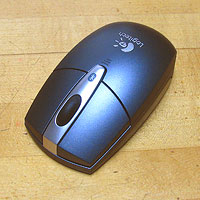
Why isn’t this technology used more? Beats me–I think Bluetooth is great. I waited for maybe 6 months for MacAlly to release their perpetually-coming-soon BTMouse (which some online stores perpetually advertised as “shipping in 3-10 days”), and then gave up rather unhappily when they finally fessed up that it was not coming soon at all. But Logitech came out with their version, the V270, an optical Bluetooth mouse. There are other mice out there, but most of them are mini-mice. Microsoft has a full-sized Bluetooth mouse, but (1) it’s a bit too big and clunky, and (2) it’s made by Microsoft. Apple has it’s new Mighty Mouse, but they went wrong with the scroll wheel/button, and tried to stay too true to the one-button-mouse form.

Lbtm2BThe V270 has it about right: the right size (slightly smaller than a regular mouse, but still palm-sized), a nice plain form, the obligatory (though not universal, apparently) on-off switch, and simplicity of use. For Apple, that is. It comes with an install disk for Windows, but on a Mac you just “discover” it and it works. It also comes with a very nice little zipper pouch, made of good material, simple and not overdone.

After using for a bit, it seems perfectly fine as a mouse. It tracks well, doesn’t jump or go berserk. The only problem is with distance. Even if the thing does work at 30 feet, one must have a clear line-fo-sight or it won’t work. With the computer on the sofa and the mouse higher on the kitchen counter, I couldn’t control it, because the bulk of the counter was in the way. And unless you’re in a really big room, you’re not going to find a flat surface with a direct line of sight with the computer thirty feet away–not that you could see the computer screen clearly from that distance, anyway. What I will do is click the mouse button, usually to advance Powerpoint slides, and that works fine as far as I get the mouse indoors.

The only other drawback I can think of is that it’s a 3-button mouse, the third button being the scroll wheel. Especially for a cordless mouse which would be of more use as a button-clicker rather than a desk-scroller, you’d thing at least a 4th button would be easy to add and much more functional.

On the brighter side, this is a true Bluetooth mouse, meaning that you don’t need a USB dongle sticking out of your laptop all the time, an easily-lost bit of really unnecessary extra hardware.

Categories: Computers and the Internet Tags:

Scary Christmas!

December 25th, 2005 4 comments

Bensanta
Okay, this guy might be the new Pope, but there’s no denying it: he looks evil. In fact, he looks like a cross between Dick Cheney and Darth Sidious, dressed as Santa.

I mean, can you imagine being a six-year old kid and seeing that mug coming at you? It’d be enough to give any child nightmares.

“Come to the dark side, and we will rule the world together! Heh-heh-heh haaa!”

Seriously. How could they let this guy out? Was there no one to take a look at him before he went before the cameras, and say, “you know, I don’t think so.”

Photo by Canadian Press.

Categories: The Lighter Side Tags:

And It’s Even Bigger

December 24th, 2005 1 comment

According to the New York Times, Bush’s illegal spying encompassed a far greater scope that Bush has admitted to so far:

The volume of information harvested from telecommunication data and voice networks, without court-approved warrants, is much larger than the White House has acknowledged, the officials said. It was collected by tapping directly into some of the American telecommunication system’s main arteries, they said. …

Since the disclosure last week of the N.S.A.’s domestic surveillance program, President Bush and his senior aides have stressed that his executive order allowing eavesdropping without warrants was limited to the monitoring of international phone and e-mail communications involving people with known links to Al Qaeda.

What has not been publicly acknowledged is that N.S.A. technicians, besides actually eavesdropping on specific conversations, have combed through large volumes of phone and Internet traffic in search of patterns that might point to terrorism suspects. Some officials describe the program as a large data-mining operation.

A great concern here is the fact that the eavesdropping now potentially includes almost all communications passing through the U.S.; that most of it is tracked by computers is hardly a consolation. Two disturbing facts remain: first, the eavesdropping was done illegally when a legal course lay available; and second, the potential for abuse is now exponentially greater than it was when only a few thousand individual acts of eavesdropping we were considering.

Phil Karn, a computer engineer and technology expert at a major West Coast telecommunications company, said access to such switches would be significant. “If the government is gaining access to the switches like this, what you’re really talking about is the capability of an enormous vacuum operation to sweep up data,” he said.

Essentially, they’ve set up the telephone and Internet networks to be their own giant Google search engine. This is not limited to just al Qaeda operatives, this is peering into your email, listening in to your phone calls.

Categories: Political Ranting Tags:

The Scattergun Defense

December 24th, 2005 Comments off

Can you list the defenses the Bush administration has made for his Spying-on-the-People crime? There are so many, and every single one is a tissue-thin lie. And yet the media continues to regurgitate them as if they haven’t been challenged. That goes beyond lazy reporting and into the realm of complicity. Much of this is repeating what I’ve blogged on before, but an overall tally I think clarifies the Bush strategy: the scattergun approach, or to obfuscate by quantity of arguments. If you give enough excuses, people will lose track of the fact that all of them have been discredited, and will believe at least one or two of the many. Certainly the “liberal media” is playing along. Here’s the list as I have it:

  • It wasn’t illegal; Bush has such powers in the Constitution and in U.S. law – (No such authorization in the Constitution or U.S. law has been detailed; to the contrary, the 4th Amendment and the 1978 Foreign Intelligence Surveillance Act (FISA) say that it is illegal)
  • It saved us from terrorist attacks since 9/11 – (No evidence to that effect has been forwarded; there was an 8-year lull in al Qaeda attacks in the U.S. between 1982 and 2000 which was not won via illegal eavesdropping; alternately, the current anti-terror program has not stopped a multitude of al Qaeda attacks overseas)
  • Congress voted to give Bush the power – (To the contrary, Bush specifically asked for those powers and Congress turned him down)
  • Getting a FISA warrant would have slowed down the administration’s ability to act – (False: Bush could have gone ahead on any warrant immediately, getting a retroactive warrant from the FISA court, which approved 99.98% of them)
  • Bush has been safeguarding Americans’ civil liberties – (All talk and no action; to the contrary, Bush has challenged and abused American civil liberties)
  • The power will never be abused – (Power is always abused, as this spying case clearly demonstrates; the Homeland Security power was abused in the Texas redistricting political battle, as one other recent example)
  • Those who revealed the story aided the enemy and put the country at risk – (False: Al Qaeda has been well-aware that its communications have been under observation)
  • FISA restrictions prevented the administration from getting 9/11 data that could have prevented the attacks – (False: the Bush administration never asked for the warrants that could have uncovered the information that Bush says FISA prevented them from getting)
  • The classic Bush defense chestnet: Clinton did it – (And Carter too, so they claimed–but both claims were false, omitting a key provision that U.S. citizens could not be included in warrantless searches)

So while there might seem to be a profusion of defenses that make it seem that Bush’s actions were not illegal, every single one is false, and not a single one excuses, authorizes or explains what Bush did. The overall quantity of arguments does not in itself result in a strong defense–to the contrary, that all of them are lies only emphasizes how weak the administration’s case is.

More appallingly, the media has been falling for it, constantly reporting the defenses as if they had not been thoroughly discredited, or as if they were “opinions” that merited reporting simply because they exist.

Bush … broke … the … law. That’s what it comes down to.

Categories: Political Ranting Tags:

Futurama to Return?

December 24th, 2005 4 comments

Futurama-OtherOh be still, my nerdling heart. Nothing is certain, but with the return of Family Guy and the success of DVD sales, Futurama could indeed find its way back to your TV screen, at least via your DVD player. Whether it will return as a direct-to-DVD feature or as a full-fledged TV series is unclear, though I would definitely enjoy the latter. I have all the DVDs, and would gladly buy more.

For those of you who don’t know about Futurama (HEATHENS!), it’s an animated series made by Matt Groening, creator of The Simpsons. It’s about Philip J. Fry, a delivery boy who, at the turn of the (current) millennium, is depressed by his fate to be a delivery boy. By chance (or maybe not), he is cryogenically frozen and awakes in the year 3000, deliriously happy to become… a delivery boy! But in the future! He immediately befriends an alcohol-fueled robot named “Bender” whose fate is to bend things, and a one-eyed alien (or maybe not) space-captain babe named Leela. He finds his great-to-the-umpteenth-time nephew, a decrepit old Professor Farnsworth, and through him the crustacean (and yet somehow Jewish) Dr. Zoidberg, the professional-limbo-dancing Rastafarian accountant Hermes, and Amy, a clutzy rich-brat exchange student from Mars. The show is just as rich with cultural gags as its cousin The Simpsons, except that all the famous people from the 20th century are now heads in jars. The series included guest voices Dick Clark, Pamela Anderson, Al Gore, Stephen Hawking, Lucy Liu, Sigourney Weaver, John Goodman, Hank Aaron, and almost the entire cast from the original Star Trek (some of them making more than one appearance).

The show was consistently funny, and remains at the top of my own list of Shows That Should Be Brought Back. And believe it or not, Starsky & Hutch, The Dukes of Hazzard, nor Miami Vice are not on that list.

Categories: Media & Reviews Tags:

Not at Home

December 23rd, 2005 1 comment

Bush has been claiming that he was authorized by Congress, under the war powers granted him to fight the War on Terror™, to fight that war within the borders of the U.S., and therefore his authorization of eavesdropping in the U.S. was legal.

Except now it has become clear that he’s lying, again. The administration actually asked Congress to include the words “in the United States” to the war powers act, and Congress refused to do so. Tom Daschle wrote:

This last-minute change would have given the president broad authority to exercise expansive powers not just overseas — where we all understood he wanted authority to act — but right here in the United States, potentially against American citizens. I could see no justification for Congress to accede to this extraordinary request for additional authority. I refused.

Legally, that amounts to a prohibition against what the Bush administration claims it was expressly allowed to do. And since they asked and were turned down, they can’t claim that they assumed the U.S. was in-bounds for them.

Another lie is that the secret eavesdropping has been responsible for there being no terrorist attacks over the past four years. How so? The U.S. was not attacked by foreign terrorists between the 1992 World Trade Center bombing and the Millennium attacks–that’s eight years of no attacks, without the illegal wiretapping. Was Clinton an anti-terror genius? Certainly no convincing evidence (if any at all) has been forwarded to suggest that the illegal spying resulted in any safety gains.

Then there’s the case which Bush cited, saying that FISA restrictions caused them not to be aware of certain intel that could have stopped 9/11. Complete bull–FISA would have approved, had they been asked. It was the Bush administration that failed to go after the intel in the first place.

…And on a different topic but similar theme, as a reader of Josh Marshall points out, what happened to all the terror alerts? There were frequent terror alerts all the way up to the 2004 elections… and since then, not a single one. Golly gee, I wonder what’s up with that?

Categories: Political Ranting Tags:

iPredict

December 22nd, 2005 3 comments

So the current consensus is that it is all but certain that Jobs will introduce the new MacTels at the MacWorld Expo in San Francisco two weeks from now. Probably it will be a Mac Mini and/or an iBook with a Yonah processor.

Not as much ballyhoo is being made of this as I would expect, and I don’t understand why not. This could be a huge move by Apple, and possibly could deal a serious blow to Microsoft, even though it may seem like Apple is sidling up to the software giant.

Here’s why: in the past, switching meant a big investment: new machines, new OS–but mostly, new software, which could cost thousands of dollars.

With MacTel, you can switch with simply your next natural purchase of a new CPU box, which you would do anyways.

All of this depends, of course, on Apple providing a smooth and slick way to easily switch between operating systems. That when you start up your new MacTel, both Mac OS and your choice of Windows or Linux would start up simultaneously, and you could just jump between them at a button’s touch–probably with a Command-key that you could customize.

The key to this could be a new Intel announcement about something the call the “Intel Virtualization Technology“:

Virtualization enhanced by Intel Virtualization Technology will allow a platform to run multiple operating systems and applications in independent partitions. With virtualization, one computer system can function as multiple “virtual” systems.

Since Windows will run natively on Intel chips, it is probable that by a keystroke, possibly using the Mac OS’s fast user switching capability, you could go from iMovie on OS X to MS Access on Windows XP in a flash, or if you wish, by a nice 3-D transition. Apple would probably be smart to bundle Windows with any new Mac purchase, seeing as how many Windows install discs are keyed to one piece of hardware and won’t work on other Windows-ready machines.

The benefits should be obvious. Malware attacks Windows, not the Mac, and spread via Internet activity, especially email. So a user could do all their web and email work on OS X (as I do now). Similarly, the iLife suite is far better than the scattered 3rd-party software for Windows that achieves the same end, so that would also be Mac-based. On the other hand, business-based apps as well as gaming would occupy the Windows side of the partition. But with easy switching, that would be a very fine distinction, and the two would flow almost seamlessly.

Almost. The control-versus-command hotkey dichotomy would confuse a good many people until something could be worked out. Perhaps the keyboard could be mapped so that the Windows control key could be the same as the Mac command key; the Mac’s control key could then be a secondary one. Any way you look at it, some keys would change place, but at least you wouldn’t have to re-learn the keyboard every time you switched between OS’s.

But that’s just the beginning, and where the real battle begins. After a few years, if enough people are using hybrid Mac-Windows machines, the question for developers would become whether Mac or Windows was the best place to plant their products–at least enough to create a Mac port of the app. This has been a big strike against Apple, maybe the biggest, that software makers haven’t seen enough of a market in the Mac to cater to that community. Yes, Explorer and Office will not be made for the Mac anymore, but Apple is very close to finishing their own office suite, and Explorer has always been a terrible browser in any case. Other reasons may also push 3rd party companies to the Mac, including security and the difference in environments.

It will also be a question of whether users will prefer Windows or Mac OS. Today, many prefer Windows, but do so as they claim that the Mac OS is “harder to use.” I don’t know how many times I’ve heard that, and wondered in amazement. The Mac OS is clearly easier to use (fewer steps, more consistency and intuitiveness, better visual interface). The perceived “difficulty” is due to the fact that these people are simply used to using Windows, and the Mac OS runs differently. That will likely change as more people get around to using the Mac–especially after they try doing a simple find-file with the two systems.

It won’t happen suddenly, but I would expect the Mac’s market share to increase a great deal within the next two to three years. At the very least, this new shift will change the whole OS paradigm.

Categories: Mac News Tags:

Time Was Not an Issue

December 21st, 2005 3 comments

Okay, I’m still hearing people in the media buying into Bush’s lie about expediency being a reason for the secret illegal eavesdropping. Let’s get this straight: the FISA courts were not in any way, shape or form slowing down the ability of the intelligence community to get wiretaps. The administration had full authority to issue a wiretap immediately, and then take up to three days to apply to the FISA court retroactively.

Amazing that this information has been out there for days now, and very prominently, and yet journalists are still buying into Bush’s lies, repeating them to the public.

Categories: Political Ranting Tags:

FISA Judge Resigns in Protest Over Bush Violations

December 21st, 2005 Comments off

The Washington Post is reporting that FISA judge James Robertson, appointed by Rehnquist to the 11-member panel to issue warrants for eavesdropping under the 1978 Foreign Intelligence Surveillance Act (FISA), resigned in protest over Bush’s 30 authorizations to conduct thousands of illegal wiretaps. Robertson had privately voiced concerns over what Bush did, and apparently felt that Bush made his panel into a Potemkin Court, a sham.

Categories: Political Ranting Tags:

Lies, Lies, Lies

December 21st, 2005 Comments off

Okay, how many outright lies can you find in this statement by Bush today?

In order to protect America, the United States Senate must reauthorize the Patriot Act. The terrorists still want to hit us again. There is an enemy that lurks, a dangerous group of people that want to do harm to the American people — and we must have the tools necessary to protect the American people. The Patriot Act passed overwhelmingly shortly after the September the 11th attack. It has been an effective tool; it has worked.

And the same as we protected the American people using the Patriot Act, we’ve also protected their civil liberties. There is extensive oversight on this very important program. The Patriot Act tore down the wall between law enforcement and intelligence communities, which makes it easier to connect the dots before an attack. The Patriot Act also gave law enforcement tools to investigate terrorism that they have already got to investigate other types of crimes.

The Patriot Act is scheduled to expire at the end of this year. The terrorist threat is not going to expire at the end of this year. The House has voted to reauthorize the Patriot Act, and they left town, because they thought their — because their business is finished. The Senate is still debating this issue. A majority of the United States Senate supports reauthorization; a minority of senators is filibustering and preventing the Senate from voting to renew the Patriot Act. The Senate Democratic Leader recently boasted about killing the Patriot Act. This obstruction is inexcusable. The senators obstructing the Patriot Act need to understand that the expiration of this vital law will endanger America and will leave us in a weaker position in the fight against brutal killers. It’s important that the Senate act quickly on these two bills.

Here is the most overwhelming lie: that the Patriot Act is being killed. It is not. The GOP tried to push through a version of the Patriot Act which makes permanent some provisions which threaten civil liberties. Democrats and some Republicans were against that, and simply want sunset provisions; the GOP and Bush utterly refused.

Here’s where the lie is thickest: the Democratic and Republican coalition offered to extend the Patriot Act for three months so the details could be worked out. The GOP and Bush again utterly refused. But there was no reason for them to do so. It is completely within their power to extend the Patriot Act. They chose not to, so they could make political hay out of it. So the majority of what Bush is saying above is knowingly false.

What other lies are there? “We’ve also protected their civil liberties.” Do I even need to explain? “A minority of senators is filibustering and preventing the Senate from voting to renew the Patriot Act.” First, Cheney came back to D.C. specifically so he could cast a tie-breaking vote on this issue, unnecessary if it was just a “minority.” In fact, now it is being reported that there is a majority who will vote for the 3-month extension, should the GOP leadership allow such a vote to occur. 52 Senators, including 8 Republicans, signed a letter urging the extension. So it is hardly a “minority” and absolutely no one is “preventing” the Senate from extending the act. They are preventing the passage of an extreme version of the act.

Most of the lies Bush spoke this morning, both specific and general, stem from these issues.

Fundamentalist Rage

December 21st, 2005 1 comment

Well, Judge Jones himself predicted that the ID’ers would try to brand him as an activist. And here they go–from the Discovery Institute in Seattle, an organization bent on pushing ID:

“The Dover decision is an attempt by an activist federal judge to stop the spread of a scientific idea and even to prevent criticism of Darwinian evolution through government-imposed censorship rather than open debate, and it won’t work.”

“Judge Jones found that the Dover board violated the Establishment Clause because it acted from religious motives. That should have been the end to the case. Instead, Judge Jones got on his soapbox to offer his own views of science, religion, and evolution. He makes it clear that he wants his place in history as the judge who issued a definitive decision about intelligent design. This is an activist judge who has delusions of grandeur.”

Of course, if you read the decision, you’ll see that it is taught, going no further than is necessary. Every step is mandated and covers the legal arguments made before the court. There is no question but that if Judge Jones had failed to cover any of his points, these same fundamentalists would then be using those gaps to claim victory.

Not to mention that Jones is not “stopping the spread of debate” in any way, shape or form.

“Anyone who thinks a court ruling is going to kill off interest in intelligent design is living in another world. Americans don’t like to be told there is some idea that they aren’t permitted to learn about. It used to be said that banning a book in Boston guaranteed it would be a bestseller. Banning intelligent design in Dover will likely only fan interest in the theory.”

Which, of course, is an inane statement. Jones did not ban anyone from learning about ID. The same students can spend every waking moment studying ID if they so please. Judge Jones simply ruled that it was not part of a science curriculum. Neither, I believe, does it purely ban ID, rather, it bans school boards from requiring it.

And again, he is not attempting to kill off interest or stop ID from developing; in fact, he states clearly that “[we do not] controvert that ID should continue to be studied, debated, and discussed.”

“Discovery Institute continues to oppose efforts to mandate teaching about the theory of intelligent design in public schools. But the Institute strongly supports the freedom of teachers to discuss intelligent design in an objective manner on a voluntary basis.”

This is a rather blatant lie. If they opposed efforts to mandate ID, why are they not in favor of this opinion? Further, they suggest here that ID cannot be discussed in the science classroom. I am fairly sure it does not do that–the ruling stated clearly that “it is unconstitutional to teach ID as an alternative to evolution in a public school science classroom” (italics mine). A teacher should be able to bring up the ID argument without problem.

In short, these people are full of it. But there is some base, visceral enjoyment in seeing these people get hopping mad and braying this contrived pap as uselessly as a dog barking at the moon. Reason won out this time–sorry, Charlie.

Categories: Political Ranting, Religion, Science Tags:

From the Mouths of Chimps

December 20th, 2005 3 comments

Boldface mine:

Secondly, there are such things as roving wiretaps. Now, by the way, any time you hear the United States government talking about wiretap, it requires — a wiretap requires a court order. Nothing has changed, by the way. When we’re talking about chasing down terrorists, we’re talking about getting a court order before we do so. It’s important for our fellow citizens to understand, when you think Patriot Act, constitutional guarantees are in place when it comes to doing what is necessary to protect our homeland, because we value the Constitution.

—George W. Bush, April 20, 2004

Clearly, they do not value the Constitution.

Categories: Political Ranting Tags:

Judge Says “No” to “Intelligent Design”

December 20th, 2005 3 comments

It’s official: U.S. District Judge John E. Jones III has handed down his decision in the Dover School Board case on ID, and he says it has no place in science classes. Jones ruled that ID was not science, and could not uncouple itself from its creationist underpinnings. I have yet to get my hands on a copy of the ruling, but from what initial reports say, the judge was almost contemptuous of those trying to get ID in the science class:

The citizens of the Dover area were poorly served by the members of the Board who voted for the ID Policy. It is ironic that several of these individuals, who so staunchly and proudly touted their religious convictions in public, would time and again lie to cover their tracks and disguise the real purpose behind the ID Policy.

This case is significant because it will act as precedent nationwide and will influence other courts, should ID’ers elsewhere try the same tactic in getting creationism into the public science classroom. Even better, since the people of Dover chucked out the entire 8-member school board that brought the case and replaced the entire board with Democrats, it’s clear that the new school board will accept this ruling and of course not appeal, meaning that the ID’ers will have to work that much more to impose religious doctrine into public schools.

More on this as I get more information.

Update: the decision is now available online. It makes for excellent reading, and acts as an exhaustively researched and well-written analysis of ID, a seminal view of all the arguments for and against. Excerpts include:

…we conclude that the religious nature of ID would be readily apparent to an objective observer, adult or child. …

The weight of the evidence clearly demonstrates, as noted, that the systemic change from “creation” to “intelligent design” occurred sometime in 1987, after the Supreme Court’s important Edwards decision. This compelling evidence strongly supports Plaintiffs’ assertion that ID is creationism re-labeled. …

After a careful review of the record and for the reasons that follow, we find that an objective student would view the disclaimer as a strong official endorsement of religion. Application of the objective student standard pursuant to the endorsement test reveals that an objective Dover High School ninth grade student will unquestionably perceive the text of the disclaimer, “enlightened by its context and contemporary legislative history,” as conferring a religious concept on “her school’s seal of approval.” …

In summary, the disclaimer singles out the theory of evolution for special treatment, misrepresents its status in the scientific community, causes students to doubt its validity without scientific justification, presents students with a religious alternative masquerading as a scientific theory, directs them to consult a creationist text as though it were a science resource, and instructs students to forego scientific inquiry in the public school classroom and instead to seek out religious instruction elsewhere. …

After a searching review of the record and applicable caselaw, we find that while ID arguments may be true, a proposition on which the Court takes no position, ID is not science. We find that ID fails on three different levels, any one of which is sufficient to preclude a determination that ID is science. They are: (1) ID violates the centuries-old ground rules of science by invoking and permitting supernatural causation; (2) the argument of irreducible complexity, central to ID, employs the same flawed and illogical contrived dualism that doomed creation science in the 1980’s; and (3) ID’s negative attacks on evolution have been refuted by the scientific community. As we will discuss in more detail below, it is additionally important to note that ID has failed to gain acceptance in the scientific community, it has not generated peer-reviewed publications, nor has it been the subject of testing and research. …

As referenced, the concept of irreducible complexity is ID’s alleged scientific centerpiece. Irreducible complexity is a negative argument against evolution, not proof of design, a point conceded by defense expert Professor Minnich.

And one of my own pet arguments:

ID is at bottom premised upon a false dichotomy, namely, that to the extent evolutionary theory is discredited, ID is confirmed. (5:41 (Pennock)). This argument is not brought to this Court anew, and in fact, the same argument, termed “contrived dualism” in McLean, was employed by creationists in the 1980’s to support “creation science.” The court in McLean noted the “fallacious pedagogy of the two model approach” and that “[i]n efforts to establish ‘evidence’ in support of creation science, the defendants relied upon the same false premise as the two model approach . . . all evidence which criticized evolutionary theory was proof in support of creation science.” McLean, 529 F. Supp. at 1267, 1269. We do not find this false dichotomy any more availing to justify ID today than it was to justify creation science two decades ago. … we believe that arguments against evolution are not arguments for design.

The judge concludes:

After this searching and careful review of ID as espoused by its proponents, as elaborated upon in submissions to the Court, and as scrutinized over a six week trial, we find that ID is not science and cannot be adjudged a valid, accepted scientific theory as it has failed to publish in peer-reviewed journals, engage in research and testing, and gain acceptance in the scientific community. ID, as noted, is grounded in theology, not science. Accepting for the sake of argument its proponents’, as well as Defendants’ argument that to introduce ID to students will encourage critical thinking, it still has utterly no place in a science curriculum. Moreover, ID’s backers have sought to avoid the scientific scrutiny which we have now determined that it cannot withstand by advocating that the controversy, but not ID itself, should be taught in science class. This tactic is at best disingenuous, and at worst a canard. The goal of the IDM is not to encourage critical thought, but to foment a revolution which would supplant evolutionary theory with ID.

Both Defendants and many of the leading proponents of ID make a bedrock assumption which is utterly false. Their presupposition is that evolutionary theory is antithetical to a belief in the existence of a supreme being and to religion in general. Repeatedly in this trial, Plaintiffs’ scientific experts testified that the theory of evolution represents good science, is overwhelmingly accepted by the scientific community, and that it in no way conflicts with, nor does it deny, the existence of a divine creator.

To be sure, Darwin’s theory of evolution is imperfect. However, the fact that a scientific theory cannot yet render an explanation on every point should not be used as a pretext to thrust an untestable alternative hypothesis grounded in religion into the science classroom or to misrepresent well-established scientific propositions.

The citizens of the Dover area were poorly served by the members of the Board who voted for the ID Policy. It is ironic that several of these individuals, who so staunchly and proudly touted their religious convictions in public, would time and again lie to cover their tracks and disguise the real purpose behind the ID Policy.

With that said, we do not question that many of the leading advocates of ID have bona fide and deeply held beliefs which drive their scholarly endeavors. Nor do we controvert that ID should continue to be studied, debated, and discussed. As stated, our conclusion today is that it is unconstitutional to teach ID as an alternative to evolution in a public school science classroom.

Those who disagree with our holding will likely mark it as the product of an activist judge. If so, they will have erred as this is manifestly not an activist Court. Rather, this case came to us as the result of the activism of an ill-informed faction on a school board, aided by a national public interest law firm eager to find a constitutional test case on ID, who in combination drove the Board to adopt an imprudent and ultimately unconstitutional policy. The breathtaking inanity of the Board’s decision is evident when considered against the factual backdrop which has now been fully revealed through this trial. The students, parents, and teachers of the Dover Area School District deserved better than to be dragged into this legal maelstrom, with its resulting utter waste of monetary and personal resources.

To preserve the separation of church and state mandated by the Establishment Clause of the First Amendment to the United States Constitution, and Art. I, § 3 of the Pennsylvania Constitution, we will enter an order permanently enjoining Defendants from maintaining the ID Policy in any school within the Dover Area School District, from requiring teachers to denigrate or disparage the scientific theory of evolution, and from requiring teachers to refer to a religious, alternative theory known as ID. We will also issue a declaratory judgment that Plaintiffs’ rights under the Constitutions of the United States and the Commonwealth of Pennsylvania have been violated by Defendants’ actions. Defendants’ actions in violation of Plaintiffs’ civil rights as guaranteed to them by the Constitution of the United States and 42 U.S.C. § 1983 subject Defendants to liability with respect to injunctive and declaratory relief, but also for nominal damages and the reasonable value of Plaintiffs’ attorneys’ services and costs incurred in vindicating Plaintiffs’ constitutional rights.

Excellent. Just excellent.

While ID proponents may well try to frame this as judicial “activism,” a quick read-through dispels any doubt whatsoever about that being the case. This is obviously well-grounded in law and reason. Even if it were challenged by appeal, It’s pretty clear there would be zero chance of it being overturned.

Categories: Political Ranting, Religion, Science Tags:

Impeach Bush

December 19th, 2005 1 comment

This story on MSNBC lays it out simply but well: Bush broke the law when he repeatedly authorized warrantless eavesdropping by the NSA within the United States. It is in violation of the 1978 Foreign Intelligence Surveillance Act, not to mention the fourth amendment to the Constitution of the United States of America.

His excuses are all as false as he is. He stated that revealing his violation of law only helps terrorists by alerting them that they’re being listened in on–but this is something the terrorists are already well aware of. He made the argument that getting a warrant can be “too slow,” and in cases like these (all several thousand?) we have to move fast–but that’s an outright lie, as FISA not only provides warrants quickly and almost without exception, but they even allow investigators to apply for retroactive warrants, meaning they can act immediately and get a FISA warrant later. He claimed that such acts are within his Constitutionally mandated powers, but that is pure bull; he is granted no such powers. He said that Congress gave him the power–but the power they granted him was clearly military, and was not carte blanche for violating any law he pleased. Bush’s spray of excuses mirrors his attitude before the Iraq War, when he made the claim that the Constitution gave him the power to go to war without congressional approval. He was wrong then, and he’s wrong now.

Even John Dean of Watergate fame concurs: Bush is “the first President to admit to an impeachable offense.”

So will Bush be impeached? God knows he deserves it. But Republicans control the Congress, and it is highly unlikely that they would allow for or vote for an impeachment of Bush, no matter how clearly he violated the law. So the only thing that could remain would be to press the issue and shame both Bush and the GOP. In what I read as a good sign, the Republicans have not issued their usually inevitable press releases and talking points, meaning that in an election year, they may not be too eager to cover up for him–though they will just as likely not trash him, either. Only should the Democrats win back the Senate next year, then impeachment could be a real possibility. But not too likely before then.