Archive

Archive for May 14th, 2007

No Parking

May 14th, 2007 1 comment

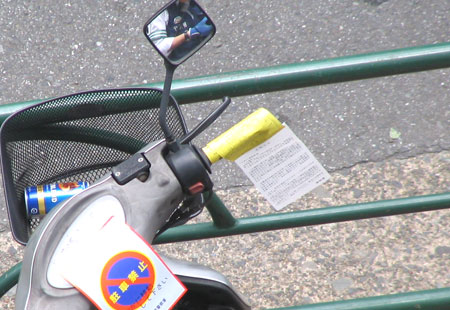
This whole parking thing has gotten out of hand. They have really gone hog-wild. It’s not just in Shinjuku or in the high-traffic areas; I can’t even park my scooter on a normal street anymore without getting ticketed. Before, using a scooter was great; parking anywhere was not a problem. And I’m not talking about cluttering up a street, but parking in a place which still leaves a broad two meters or more of sidewalk open for traffic.

Case in point: I came to visit Sachi and parked in front of her apartment building. There is a space next to a pedestrian overpass, where there is a traffic “shadow,” an area where no one would walk or ride their bike even if it were clear (see photo below). A less offensive parking space is hard to imagine. But the ticketers came along and started writing out their citations… not because it was a nuisance, not because anyone complained, not because anything was being blocked… but simply because they could, because there’s a profit in it. If the bike were parked next to the building where it was blocking foot traffic, they’d have no complaint–I know, because I just asked them, and they told me to park it in a traffic spot because it was not a public traffic spot. So I did that, and now it’s parked next to some little stools on a pathway next to this building, where it could easily bget in the way of someone who wanted to rest there… but I won’t get a ticket for that.

0507-Biketicket1-450
Note the sidewalk, how there is more than two meters open, and how the bikes are parked in the traffic shadow behind the fencing. The tickets won’t clear up the space, either–it’ll just fill up with ordinary bicycles. So what’s the point?

0507-Biketicket3-450

And neither is this going to clear up the sidewalk, even in places where the sidewalk is narrow: they are only ticketing motorized bikes. Scooters and motorcycles. Not bicycles, even though they take up virtually the same amount of space, and are far more numerous. Apparently, you can’t hand out a citation for a bicycle that generates profit. So they get a free pass. At worst, a notice is left on the bike, and if it stays affixed for several weeks, then it gets carted away. My scooter got a notice and was almost ticketed within just a few hours.

0507-Biketicket2-450
It’s not just me, either. I moved my bike with minutes to spare, but this guy didn’t. He just took the ticket off his bike’s handlebar, the one behind him to our right, and is now he’s futilely complaining to the ticketers about how he was just visiting a nearby building for a few hours, so what’s the deal? Note the bicycles here don’t even get a notice to warn them to move.

If you park a scooter even for one day, it gets ticketed, which means a steep fine and points get taken off your license. Which stays on your record for a full year, or longer if you get other violations before that year is up.

Nor is it a simple matter of finding the right spot. The building superintendent steadfastly refused to allow me to park in any of the many open spots around the building where no one goes. Buildings in Japan have zero accommodations for visitor parking. They have completely closed off all parking places for scooters, except for the pay-parking lots–and that can run $10 a day or more, for parking in a space barely larger than a bicycle takes.

In short, Tokyo has changed from a scooter-friendly place to a scooter-hostile zone. It would be slightly better if there were a reason for it other than sheer profit for the ticketing agencies. I’m just lucky that there’s a sliver of a space next to my workplace where I can park. Otherwise I’d have to park far away and pay for the privilege.

Categories: Focus on Japan 2007 Tags:

Uncool

May 14th, 2007 Comments off

The Politico has a pretty good article explaining why the country is shifting left. However, there is one statement in particular that I have contention with:

When conservative Fox News introduced its own satirical program, modeled after Stewart’s, it received a critical beating. The cultural zeitgeist had shifted. Of all people, former Vice President Al Gore is considered kind of cool, while Bush and Vice President Cheney have become not just unpopular, but are objects of ridicule.

That last part about Bush and Cheney is what I disagree with (though I have to wonder–Al Gore is “cool”? Hmm.) The thing is this: Bush and Cheney were objects of ridicule when they came into office, or at least quickly thereafter. Nobody seems to remember that in his first eight months, Bush was going down in the polls as quickly as he has in years since. He started out around 55% and after eight months was at about 50% and declining. He was seen as weak, laughable, and not good for the country. He was violating treaties, bullying his way around Washington, and essentially making an ass of himself.

The Politico’s argument, as with conventional wisdom, would have you believe that Bush and Cheney are now uncool because of the recent shift to the left. But Bush and Cheney were uncool from the start; remember, they lost the 2000 election by half a million votes, and “won” only through election fraud and a right-leaning Supreme Court. A half million more people voted for the “uncool” Al Gore. It was never that Bush and Cheney were more popular.

Remember the political cartoons of the time, how Bush was a kid sitting in Cheney’s lap? How the comedians were going wild making fun of the two? How they were the object of national, and international scorn?

The only thing that changed was 9/11 and fear. That’s what created the artificial upwards zoom in the polls. Bush was never actually popular, never really “cool.” He was simply the guy in office when everybody suddenly got the crap scared out of them.

As I have pointed out many times before, Bush’s poll numbers have shown a striking regularity of pattern: he gets a lift in the polls only from artificial, external events; otherwise, he always progresses in a predictable, downward pattern, until he hits bottom and levels out (which is where he is now). Bush received poll bounces after 9/11, the start of the Iraq War, the capture of Saddam Hussein, and the huge campaign blitz of 2004. That’s it. The pattern can be seen clearly on this graph. It really is unmistakable, and rather remarkable–I don’t know if any other president has shown so clear and true a pattern as this. Had it not been for 9/11, Bush would have reached 40% by sometime in early-to-mid 2003, and never would have recovered, losing the 2004 election handily.

To sum up, Bush and Cheney have not “become” unpopular–they never were in the first place. It is only the wearing off of 9/11 and the resulting fear that is allowing their intrinsic unpopularity to reassert itself.

Categories: Political Ranting Tags:

Subtle Distinctions

May 14th, 2007 22 comments

From a recent story on how the RIAA is sending out letters to hundreds, possibly thousands of college students, demanding that they cough up $3000 for music they’ve downloaded:

But the students coughing up the cash question why they’re the ones getting in trouble.

“They’re targeting the worst people,” UNL freshman Andrew Johnson, who also settled for $3,000. “Legally, it probably makes sense, because we don’t have the money to fight.”

Bingo. Hit the nail on the head. That’s exactly why they’re being targeted. It would not be surprising to me if the RIAA actually did a financial check on the people it sued, making sure that none of them were capable of a strong legal defense. The $3000 number in itself should be questioned: why that amount? Probably because it is just enough that many people would pay it, but not enough that putting up a legal fight would be worth it.

The perfect definition of a nuisance lawsuit. Though there is a better name for it: extortion.

Johnson got his e-mail in February, with the recording industry group’s first wave of letters targeting college students. He had downloaded 100 songs on a program called LimeWire using the university network.

The money to settle came from the 18-year-old’s college fund. He’ll work three jobs this summer to pay back the money.

Johnson compares what he did to people driving 5 miles per hour over the speed limit.

“It’s not like I downloaded millions of songs and sold them to people,” Johnson said.

There is a point to be made here. I have commented before that when it comes down to it, downloading music for free is illegal–you are getting value for no money. So why is it so common? Why do so many people, perhaps numbering in the millions, join in the activity? The answer was given by Mr. Johnson: because it is seen as equivalent to going 5 miles per hour over the speed limit.

Why that perception? It has to do with how we get our media. So often it is free. We get TV shows broadcast into our homes for free. We can videotape them and keep them. We can even record shows on a DVR which allows you to clip out the commercials and save the pure media to DVDs–essentially getting for free what you pay a lot for from the store. And that’s not illegal. (Edit: Okay, maybe it is illegal. But it is so widely considered as legal and so universally done that the distinction is academic–and it is never prosecuted. It simply proves the lines and perceptions are even more blurred than I thought.) You can do the same with movies. As long as it is broadcast to your home and you record them for your own viewing, there’s nothing wrong at all with that. You can do the same thing with music over the radio. We get free news on TV, radio, and the Internet.

So why is it illegal if I get the exact same media over the Internet? What is the difference between my getting a TV show from my TV, clipping the commercials, and saving it on a DVD, and getting the same show from a download service? The end result is exactly the same, no difference at all, except the type of effort I put into collecting the media.

Legally, the answer is fairly clear: one was obtained through a licensed distributor, packaged with commercials, which in fact paid for the product. That I was able to clip out the commercials was a technical loophole. Downloading from the Internet for free is different: the product is not licensed for distribution, and there is no payment made to the content owner for the distribution.

The thing is, this distinction is virtually invisible to the consumer. We tend to ignore commercials, see them as intangible, abstract things which are to be disregarded for the most part (unless there are talking frogs or whatnot). They are discardable. Take those away, and the distinction vanishes. That’s the “5 miles per hour” that Mr. Johnson was talking about. Because we have grown up disregarding and even looking with scorn on commercial interruptions and intrusions, seeing them as annoyances to be avoided and not integral tools for delivery of content, most normal people do not see them as something that makes or breaks any kind of legality.

If I can legally record a song as easily and identically as I can download it from the Internet, then there is no great moral warning flag telling me that what I am doing is wrong. So people are color-blind to the difference. That’s why so many people see nothing wrong with downloading music.

As I said, legally, technically, it is wrong. But does that change when massive perception says differently?

Now, here’s the interesting part: the same subtle shift also applies to the RIAA. Technically, what the RIAA is doing seems legal–it is suing people for illegally accessing their property. However, just as their legal targets are getting otherwise legal content in an illicit method, so is the RIAA. The methods they are using to get money from people are as illicit as the music their targets are downloading. Blindly suing thousands of people, not really knowing whether they deserve to be sued? Using nuisance-lawsuit methods to essentially extort money from people, designing the “settlement” so that people will give in even if they didn’t do anything illegal? Crafting legal tactics that keep their illicit strategy from being exposed in court?

In a very real way, the RIAA is doing something far worse than any of those college students. Even if the students that the RIAA is targeting know what they are doing is illegal, they know how frivolous an offense it is. The RIAA, on the other hand, knows exactly how dishonest and illicit it is to be doing what they are doing–just as they by now must be aware of the fact that illegal downloading of music has no actual impact on their income.

Edit: I would add one final note–piracy could be ended overnight by using the tools now available on the Internet. How? Targeted commercials. Content providers are now getting addicted to the sale of content that until now has been in that consumer-oriented “free” zone, paid for with commercials. But selling media begs for piracy, which will always win out, as Steve Jobs has noted. The way to defeat it: give away media for free, along with targeted commercials. We hate commercials because they are almost always for stuff we’re not interested in. But that’s so 20th-century–broadcasting commercials blindly to an audience where 97% of the viewers turn away in disinterest. The Internet allows for targeted advertising. Get people to register for all the TV and movies and music they can eat by filling out a survey, which includes the kind of commercials they like to watch, including stuff they plan to buy. If commercials were all movie previews and computer ads, I would more likely watch them, and so would most people. That could easily cover the costs. I outlined it in more detail here, almost three years ago.

Categories: Corporate World Tags: