Archive

Archive for March 17th, 2011

The Internet and the Earthquake

March 17th, 2011 2 comments

Imagine this happening in 1990. Local TV and radio would be all people in Japan would have, maybe satellite TV. Imagine phone lines being even more overloaded than they are now, and cell phones not even an option except for those most on the cutting edge, and probably those wouldn’t work, either. Probably most of Japan would be dark as far as communication is concerned. In the current crisis, the people of Japan are probably getting an appreciation for the Internet that people in African and Middle Eastern countries have recently had.

Right after the quake, when phones were not working, the Internet never missed a beat. Within minutes of the quake, I was accessing Google News via the 3G connection on my iPhone, even before the first stories hit the web. People have been able to email pretty much solidly since the quake hit. People have connected over Facebook and kept each other informed over Twitter. Blogs have chronicled life after the quake. innumerable cell phones equipped with hi-def video cameras caught hundreds if not thousands of views of the quake, with countless images taken of, well, just about everything.

In short, we have stayed connected, fully, both ways, all ways. The disaster has been documented as none other before. What a relief this is for so many who otherwise might wait days or even weeks to get news from relatives, or at least those receiving good news; and even for others, it is still better than not knowing for so long. What a resource–both good and bad–of news, allowing us to get information from all directions, for better or for worse.

In so many recent crises, this has been an invaluable resource, even to the point we may not have imagined just a few years ago. I have to wonder what more value we will find from it in the future, and how historians will look back at this time when this network became available and began to show its worth.
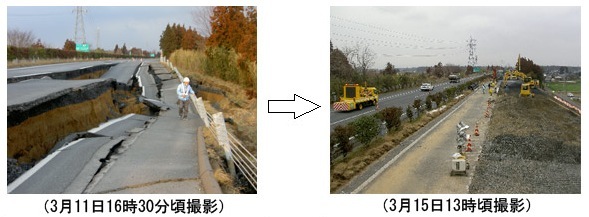

Roads Being Fixed

March 17th, 2011 Comments off

Well, whatever they’re doing or not doing at the nuclear plant, whoever is fixing roads is sure on top of things. In just under four days, they took the road you see at left and repaired it pretty much fully. Good work.

Screen Shot 2011-03-17 At 9.16.34 Pm

Zing

March 17th, 2011 Comments off

Ouch. This guy doesn’t like how the French government so quickly gave an evacuation alert…

Screen Shot 2011-03-17 At 4.13.16 Pm

British Take on the Crisis

March 17th, 2011 17 comments

On the British Tokyo Embassy’s web site, they have posted a Q&A with Chief Scientific Officer Professor John Beddington. Below is his take on a “reasonable worst case scenario.” It was one big chunk in the original article, so I have divided it into more easily readable paragraphs.


Let me now talk about what would be a reasonable worst case scenario. If the Japanese fail to keep the reactors cool and fail to keep the pressure in the containment vessels at an appropriate level, you can get this, you know, the dramatic word “meltdown”.

But what does that actually mean? What a meltdown involves is the basic reactor core melts, and as it melts, nuclear material will fall through to the floor of the container. There it will react with concrete and other materials … that is likely… remember this is the reasonable worst case, we don’t think anything worse is going to happen.

In this reasonable worst case you get an explosion. You get some radioactive material going up to about 500 metres up into the air. Now, that’s really serious, but it’s serious again for the local area. It’s not serious for elsewhere even if you get a combination of that explosion it would only have nuclear material going in to the air up to about 500 metres.

If you then couple that with the worst possible weather situation i.e. prevailing weather taking radioactive material in the direction of Greater Tokyo and you had maybe rainfall which would bring the radioactive material down do we have a problem?

The answer is unequivocally no. Absolutely no issue. The problems are within 30 km of the reactor. And to give you a flavour for that, when Chernobyl had a massive fire at the graphite core, material was going up not just 500 metres but to 30,000 feet. It was lasting not for the odd hour or so but lasted months, and that was putting nuclear radioactive material up into the upper atmosphere for a very long period of time.

But even in the case of Chernobyl, the exclusion zone that they had was about 30 kilometres. And in that exclusion zone, outside that, there is no evidence whatsoever to indicate people had problems from the radiation. The problems with Chernobyl were people were continuing to drink the water, continuing to eat vegetables and so on and that was where the problems came from. That’s not going to be the case here.

So what I would really re-emphasise is that this is very problematic for the area and the immediate vicinity and one has to have concerns for the people working there. Beyond that 20 or 30 kilometres, it’s really not an issue for health.


You’ll want to read the rest of the press conference, he says other things as well–but essentially, he sees worst-case as being not disastrous outside the local area.

Thoughts?