A quake just hit. It felt more like an up-down quake, meaning it was probably local…
Update: I was wrong, it wasn’t under us. It was a 5.3, centered in Ibaraki, just north of Chiba. And I had just said to Sachi a few minutes earlier, “Hey, there hasn’t been a big quake tonight.” That’ll teach me.
One thing to remember is that when you read the stories about “panic” and how it is “sweeping over” Tokyo and Japan, these reports are by western media outlets, and is usually speaking about foreign visitors they find leaving from the airports. That’s not the Japanese you will find on the streets of Tokyo, or any city in Japan. And it is not the Japanese you will meet in Tohoku. Yes, there is sadness and misery; this is natural. But not panic.
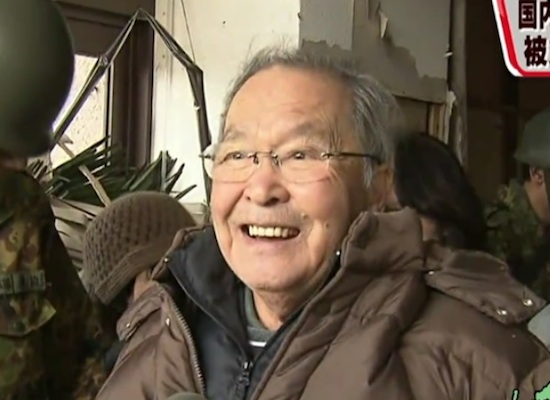
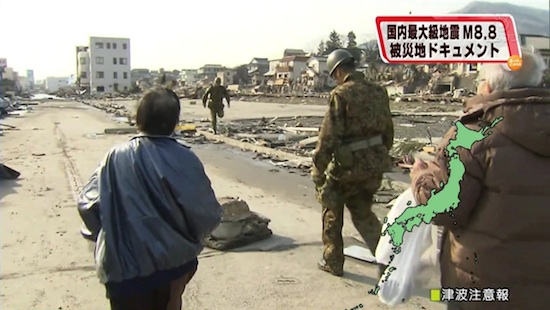
You want to see how real Japanese people are reacting? Here’s one fantastic example–a 72-year-old man who had been stranded with family on the 3rd floor of his house, in one of the towns devastated by the tsunami in Tohoku. As he is rescued by self-defense force personnel, he steps out onto the street, his whole town washed away before him. But he’s got a big smile on his face. “I’m all right!” (大丈夫です!) he announces to a reporter gaily. “I experienced the Chilean tsunami (a similar wave that hit Japan in 1960), so I’m OK!” (チレ津波も体験しているから、大丈夫です!)
As he steps out onto the street with his family and dog, he says with great vigor and spirit, and in a wonderful Tohoku accent, “Let’s rebuild again!” (また再建しましょう!)
Here’s the video:
Indeed, this is not the first time for this in Japan. A giant earthquake hit the Kanto region in 1923. Japan was flattened in the wake of WWII, and spent more than a decade recovering, but that they did. In 1960, the Chilean quake sent a similar tsunami to the east coast of Japan–the one the old man is referring to. Japan has been hit, again and again in the past. And recovered every time. The rest of us overlook this.
Japan will rebuild. It will recover.
The city of Onagawa, 1960, being hit by the Chilean tsunami. Onagawa was the closest city to last Friday’s quake.
This article from The Globe and Mail, forwarded by Steve, details the people’s state of mind fairly well:
In another country, there would be panic, rage and shouts aimed at the government and the sky. But not Japan. Despite the multiple catastrophes that have simultaneously hit this archipelago, a very Japanese calm and politesse has held back the chaos.
As one catastrophe piled on top of another, a very Japanese deference to authority emerged, as well as a national desire to see civility prevail, no matter the circumstances.
Along the crowded highway that connects Tokyo with the tsunami-battered north, people waited in orderly fuel lines hundreds of cars long without any shouting, honking or cutting in line. In the worst-hit city of Sendai, streets were shattered and cars were flung on top of homes by the force of the tsunami, but in three days there was not a single report of looting.
And here in Koriyama, the city closest to the escalating crisis at the Fukushima nuclear plant, residents queued around the block for drinking water being distributed from trucks parked outside a local gymnasium. When an official announced over a loudspeaker that supplies were running low and dozens of families would have to go home without, the line quickly and quietly dispersed.
Most notably, no one panicked and fled south even as the three reactors of the Fukushima plant continued their weekend-long flirtation with disaster. The French and U.S. governments advised their citizens to leave not just the region around the reactor, but also Tokyo 260 kilometres to the south, but most Japanese who live close Fukushima seemed in no hurry to flee.
There is a Japanese word for it: gaman. To persevere.
This quote from Tennyson’s Ulysses comes to mind:
Though much is taken, much abides; and though We are not now that strength which in old days Moved earth and heaven, that which we are, we are— One equal temper of heroic hearts, Made weak by time and fate, but strong in will To strive, to seek, to find, and not to yield.
Our power is due to go out in 15 min. or so. I am getting on Twitter, to see if I can get back in that swing again and to post while the area is dark… if 3G remains up, that is.
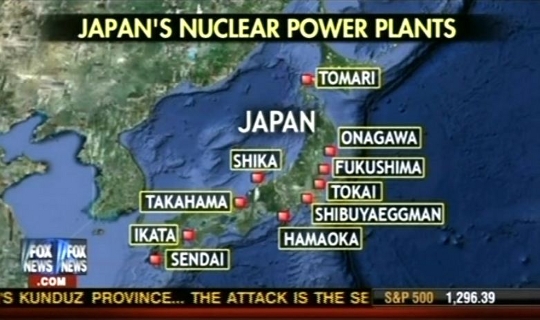
A little comic relief from Fox. At least, I am assuming this really happened–hard to believe, but then again, this is Fox we’re talking about, and the site reporting on it is usually pretty dependable about getting the facts straight. On Your World With Neil Cavuto, Fox reportedly showed a graphic depicting the location of nuclear plants in Japan:
First, that list seems a bit sparse; there are dozens of reactors in Japan. A quick check on Wikipedia (the IEAE site isn’t responding now) shows some of them clustered, but the Fox graphic is incomplete anyway. No big surprise there.
However, one of those names Fox does include seems a little funny: Shibuyaeggman, and it appears situated right here in Tokyo. We have a nuclear plant? And is that supposed to be in Shibuya? And “Eggman”? What the–oh, yeah, this is Fox I’m looking at. Neil Cavuto, even more to the point.
If this report is accurate, and I am betting it is, Fox identified a nuclear reactor existing in a Shibuyanightclub.
I would love to hear how Fox managed this one. I have to say, it makes me feel a bit better about having been taken in by Oehmen & Co. But then, I do expect more from myself, a random guy sitting in his apartment in Tokyo, than I do from the Fox News organization.
Looks like we might actually have a power outage today. The time is unclear, though–the local loudspeakers said 10:20, the TV seems to be saying after noon. We’ll see when it happens.
Like many others in Japan, I am on the mailing list of the U.S. Embassy in Tokyo, and get their warnings, advisories, alerts, and updates. This just came in, from the ambassador:
Since the first reports of trouble with the reactors, American nuclear experts have worked around the clock to analyze data, monitor developments, and provide clear assessments on the potential dangers. While at times we have had only limited access to information, I am personally committed to assuring that our experts have as much access and information as possible, and the necessary resources to understand the situation. I have personally been deeply engaged in these efforts.
After a careful analysis of data, radiation levels, and damage assessments of all units at Fukushima, our experts are in agreement with the response and measures taken by Japanese technicians, including their recommended 20kms radius for evacuation and additional shelter-in-place recommendations out to 30kms.
Let me also address reports of very low levels of radiation outside the evacuation area detected by U.S. and Japanese sensitive instrumentation. This bears very careful monitoring, which we are doing. If we assess that the radiation poses a threat to public health, we will share that information and provide relevant guidance immediately.
I have heard some people worry that the government will hide information to keep the public from mass panic or whatever, but I don’t really accept that. Yes, they’ll try to cover up blunders or foolishness, and they may suggest lame “duck and cover” style solutions–but if a cloud of radioactive vapor is headed our way, I don’t think they’re gonna try to hide it from us.
What may be harder to debate is whether they will let on exactly how potentially bad things can get. I tend to think that the Japanese government may try to hide things that could go badly wrong and would not really help the Japanese people if they knew–but I don’t really see the American government doing that in Japan. I could be wrong. Maybe I am. But I don’t think so.
And so far, I think the U.S. government’s advice to its citizens has been far more helpful and sound than that given by the French and Chinese governments, who seem to be more comfortable with playing it safe and not caring if it gives people the wrong idea.
All original content on this site is owned by and copyrighted by the author. If you wish to reproduce beyond Fair Use provisions, you must leave a comment and ask for permission.