Archive

Archive for May, 2012

The Streets, They Are A-Changin’

May 29th, 2012 2 comments

Maybe a year ago, I noticed that a bank on the shopping street from the station did a renovation, but with an odd touch: they shaved off a corner of the building and filled the corner, inexplicably, with concrete planters. Seemed rather odd at the time.

Hibredo01

Then came something even stranger: a small apartment building with a mini-spa on the 1st floor was built, but it came with an empty spot of land, wedge-shaped, that was fenced off. I could not figure what the purpose of the wedge was. It just seemed weird. If it was for access to the back, it was really badly designed.

Hibredo02

Then, across from both of these sites, a building was taken down and the area covered with asphalt. That seemed reasonable–a parking lot.

Hibredo03

But then, right next to the mini-spa, another building went down…

Hibredo04

…and suddenly, the pieces fit together.

Hibarinew00

These were no random redesigns; I had completely forgotten that a new road would be cut through here, as part of the city’s new plans for avenues.

For some time, there has been a big, wide avenue with large sidewalks which rather awkwardly starts about 350m from the station. Closest to the station, it suddenly narrows into a narrow, crooked road with no sidewalks. The city has long planned to fill in the remainder of that avenue, creating a large open space in front of the station exit, and extending the wide avenue to go all the way to the station. The thing is, a lot of buildings stand in the way.

However, plans seem to be in high gear now. In addition to all this reconstruction at the shopping street, a few large buildings near the station are also being torn down. How long it will take before the project is done is anyone’s guess. It seems right now like there’s a lot left to take down, but looking at the map, it appears that maybe already half the work is done already. I noted that a few other buildings, including a pharmacy way out from the station which shut down mysteriously early this year, are already shuttered and ready to go.

Two things I wonder about, though. First, there’s a cemetery plot which will wind up on a major intersection which you would expect to be primo commercial space. Do they relocate cemeteries in Japan? I would guess so, but will be interested to see how that is handled.

Second, when will they get around to the secondary streets adjoining the main one they are building. I ask because one of them cuts through our kitchen. Literally.

Update: Found a document which says that the station road is planned for completion in “fiscal year 2013.”

Categories: Hibarigaoka Tags:

Late Night Quake

May 28th, 2012 Comments off

Sachi and Ponta and I all just felt a strong, up-and-down trembler, one strong enough to make you think it could turn into “The Big One.” This one was centered in Chiba not too far from Tokyo, but it came on really fast and shook us rather noticeably. It appears to have been at least a 5.0 on the Richter.

Update: it was a 5.2.

Categories: Focus on Japan 2012 Tags:

The Next Step in HD TV (Long Post)

May 28th, 2012 2 comments

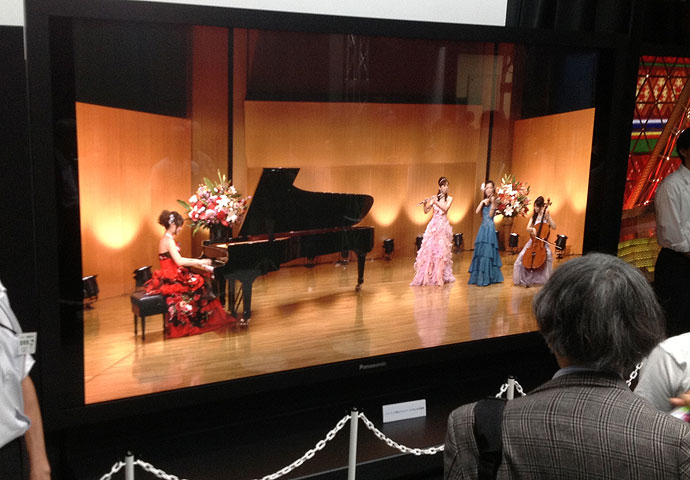
Today I visited the Open House for NHK labs in Setagaya to get a sneak peek at the new “8K” UHDTV (Ultra High Definition TV) standard, known in Japan and Super Hi-Vision. They had their 145“ super-LCD screen going, in full 7680 x 4320-pixel glory.
Screen01

The system is not just 16 times sharper than your latest-model HDTV; aside from having 16 times the pixels, it’s also progressive scan (not interlaced), and it’s got a refresh rate of 120 Hz. In short, it looks great.

Confused by the tech talk? Let me see if I can explain it.

First, let’s begin with some basic display vocabulary: scan, scan lines, interlaced and progressive scan, refresh rate, pixels, resolution, and aspect ratio. Let’s also go back to the earliest standard TV sets as well.

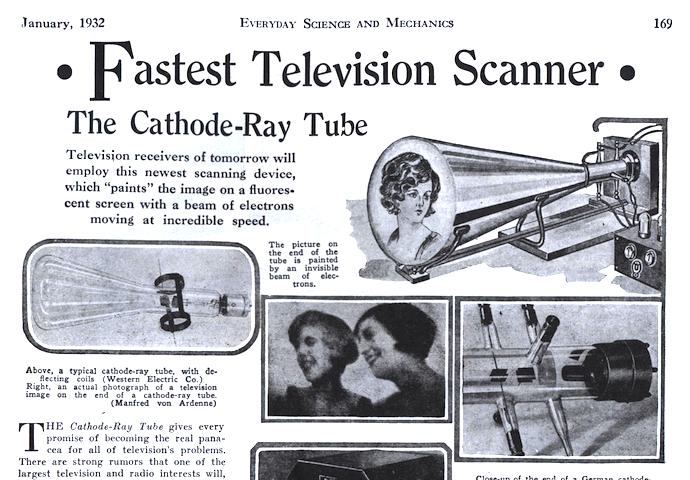
We refer to scanning in a television because of how the century old (!) TV technology works.

Farnsworth

That would be a CRT or Cathode Ray Tube. This was a glass vacuum tube with up to three electron guns (red, green, and blue for color) in the back. These guns would fire electrons at a phosphor (light-emitting) screen, in a rectangular shape called a raster.

If none of that makes any sense to you, then forget it. Just remember that the guns in the back of the tube fire energy at the screen to make it light up. But they do so in a pattern. They start at the top left, and slowly go left to right, painting a single line of the picture across the screen. When the right end of the line is finished, the guns would go back to the left side and start painting the next line. They do this over and over again, through hundreds of lines. All this in a fraction of a second.

This process was called scanning; each line was a scan line. When the guns finished at the lower-right corner of the screen, a single scan was complete. The number of scans per second is measured in hertz (Hz).
Earlytv

With the technology available in the mid-20th century, scanning each line in order didn’t work well; the picture did not show motion well, and there was flicker. As a result, they came up with a display method called interlaced scan. It fixed these problems, though it also had a disadvantage: it is not as sharp as it could be; small text, for example, often appears fuzzy.

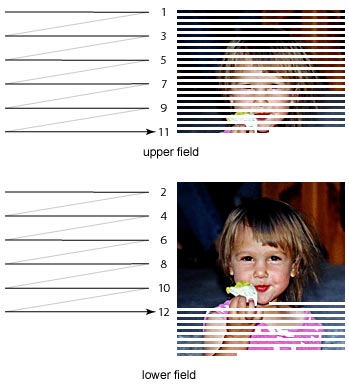
Interlaced scan means that the guns only painted every other line in each scan–that is, on the first scan, it would paint lines 1, 3, 5, 7 and so on; on the following scan, it would fill in the missing even-numbered lines, 2, 4, 6, 8 and so forth. In this way, a single full image took two scans to complete.
Interlaced Fields

The number of scans per second was called the refresh rate. This was set at 60 Hz; because of interlaced scan, this meant that 30 frames per second could be shown.

Interlaced scan was not the only way to show an image; progressive scan paints an entire image, all the scan lines, in one scan. Once the problems with motion and flicker were resolved, progressive scan was used in computer monitors, giving them a much better image.

The number of scan lines–the resolution–also had to be decided. The television most people grew up with originated in the 1940’s and 50’s. In North America, the NTSC (National Television System Committee) settled on a standard of 525 horizontal scan lines for the TV, although only about 480 lines are visible, and the other 45 lines are used for other information, including closed captions.

This picture is equivalent to an image on your computer screen 480 pixels tall, the vertical resolution. The horizontal resolution ranges from 640 to 720 pixels, depending on the type.

The aspect ratio (horizontal-to-vertical ratio) is 4:3, although a 720 x 480 screen would be 3:2.

OK, now that we’re through with all that, what did the old NTSC standard of 480 lines look like? Well, here’s an image with 480 ”lines“ of resolution in the NTSC aspect ratio:

480P

Looks OK, doesn’t it? However, there’s a catch–the image you see above is shown in progressive scan, so it looks sharper than it should. Still, that’s fairly close. This is what we used to think of as a clear, sharp TV image.

However, there’s another hitch: you’re looking at it in a very small space.That image might occupy only as much as 7 inches diagonally. Blow up the same image and paste it on a 40-inch TV, it won’t look so good.

We found this out at around the turn of the century, when the next-generation of TVs, called HDTV (High Definition TV) came out. (Japan calls this ”Hi-Vision.“) These TVs have a vertical line count of 1080. Since we use LCD screens, and they use pixels, we refer to the overall resolution as 1920 x 1080.

So before, we had 480i (480 lines interlaced); with HDTV, we got 1080i. That’s more than double the lines, and (because the screen has a wider aspect ratio) almost 7 times more information.

Now, I can’t show you an HDTV image on this screen, as it likely would be bigger than your display area (here’s such an image you can view separately). So instead let’s scale things down to about 1/3rd the height, or about 1/8th the area. Of the two images below, the one on top is the same 480i NTSC image scaled down, and below it, an HDTV (1080i) version of the same image. Were the two TVs to have the same ”pixel“ size, this is how they would compare. Note also the difference in aspect ratios:


Ntsc-230X172

Hd-690X388

As you can see, you’re getting a lot more image with HDTV, even if your newer TV doesn’t look that much bigger.

Now, look what an old 480 NTSC image would look like on a newer HDTV screen, with the 1080 image next to it for comparison:

Ntsc-In-Hd

Hd-690X388

The old NTSC image looks kind of fuzzy in comparison, doesn’t it? Now, keep in mind that you are looking at it on a progressive-scan screen at a small screen size! On a real HDTV, it would look even worse. That’s what you see on your new HDTV when they broadcast an old-timey teevee show!

So you can see that HDTV was a big improvement. Even more so was Blu-ray; instead of showing images in 1080i, Blu-ray shows them in 1080p. That’s the best quality you’ll see on your current TV. It also might even be better quality than some films shot on 35mm film in the old days, which is why Blu-ray doesn’t always seem to give you the ”best“ quality when you’re watching films from a long time ago.

Interestingly, George Lucas used a 1080p digital camera to shoot Star Wars: Attack of the Clones. While 35mm film can be better quality than 1080p, under some circumstances they are close enough that most people would not notice the difference, especially with processing that films go through.

So, is 1080 the end? Not by a long shot.


In fact, we’re now heading into perhaps as much as two generations beyond HDTV. They are referred to as 4K and 8K, or QFHD and UHD TV.

The 4K, or QFHD (Quad Full High Definition) is 3840 x 2160, which is exactly double the vertical and horizontal resolution of HDTV (also called ”FHD,“ or ”Full High Definition“), which gives it 4 times the pixels, or overall resolution. Thus the ”Quad“ label. Current HDTV has about 2,000,000 pixels (2 megapixels); 4K has more than 8,000,000, or 8 megapixels.

The ”4K“ label, by the way, does not come from the ”quad“ label; 4K comes from the rough number of horizontal pixels. 3840 is close to 4000, therefore we get ”4K.“

4K is just now becoming available; you can actually buy 4K Blu-ray players and 4K TV sets. HDMI cables are now capable of transmitting 4K video. And 4K is actually closer to a cinema standard–a movie shot in 4K video (as many are now) will look just as good as any shot on film.

However, there’s a catch: 4K TV sets (projectors, really) still cost at least $10,000, even if the 4K-ready Blu-ray players can be had for much cheaper. Oh yeah–there’s nothing to watch in 4K anyway. However, 4K might be good for HDTV-quality 3-D viewing, although that’s a limited use for expensive equipment.

Not that 4K won’t become cheaper and more available in the next few years. The problem is, by the time it catches on, it’ll already be obsolete.

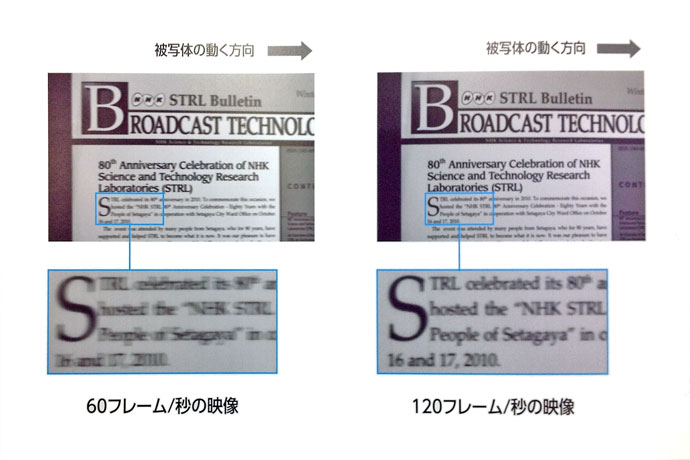
You see, NHK here in Japan is working on 8K: a full 7680 x 4320 pixels, more than 33,000,000, or 33 megapixels. That’s more than 100 times the number of pixels on a pre-HD television set! Not only that, it’s progressive scan. And it scans 120 times a second (120 Hz), so you get sharpness even with motion that would blur on current TVs.
Movingtext

Still not impressed? Let me show you a scale showing all the different resolutions:

8K

See that tiny orange scrap at top left? That’s your old NTSC TV set. The higher-quality version of it, with top DVD quality. The screen two levels down, the darker green one, marked ”HDTV 1080p“? That’s your current flat-screen set. The light green square is 4K, what is coming out right now. The largest light-blue square is Super Hi-Vision.

They say that it will be ready for broadcast from NHK’s satellites from 2020 (give or take a few years). By 2025 they expect to broadcast that over the Internet.

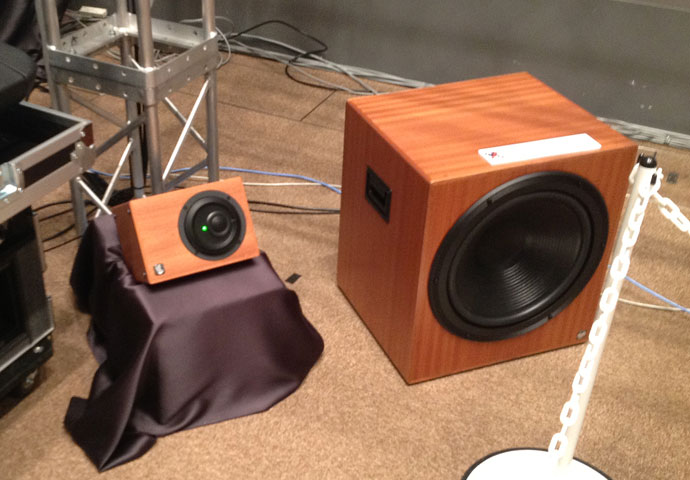
Not only that, the sound will improve. Today’s ”home theater“ systems include 5.1 surround sound, meaning there are five speakers surrounding the viewer, and a subwoofer for bass.

Super Hi-vision has a 22.2 sound system–yep, 24 speakers in all. 9 at the top of the room, 10 around the middle, and 3 normal speakers in front, accompanied by two subwoofers.

Nhkspeakers01

Nhkwoofer01

And still, we’re not finished. After all, you can’t just go and increase resolution by 16 times and expect it’ll still fit on the same media, right?

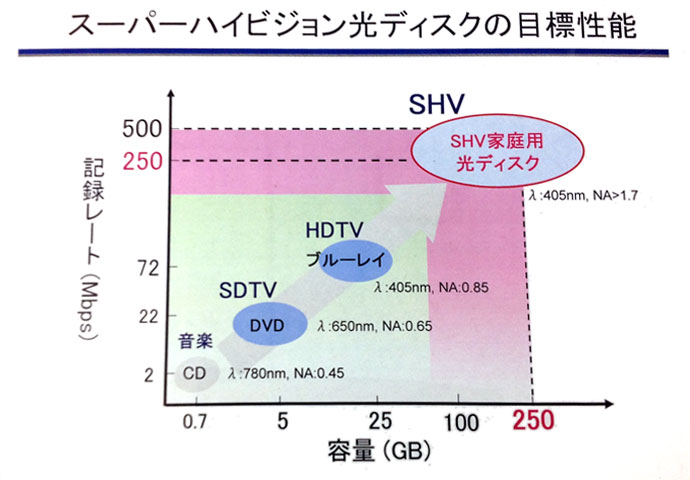
When DVDs were too small for recorded HDTV, we got Blu-ray, going from 4.7 GB for DVDs to 25 ~ 100 GB for Blu-rays. Even with compression, however, Super Hi-vision will require media that’s 250 GB in size, at least.

Now, Blu-ray might get there–it’s 25 GB per layer is already at 100 GB thanks to 4-layer discs, and 10-layer discs are not too far off. However, it’s not just the capacity: it’s the access speed. If the media can’t shoot out the video fast enough, it won’t work. And the guy I spoke to at NHK (several of them spoke pretty good English, not surprisingly) said that even with upgrades, Blu-ray just won’t cut it.

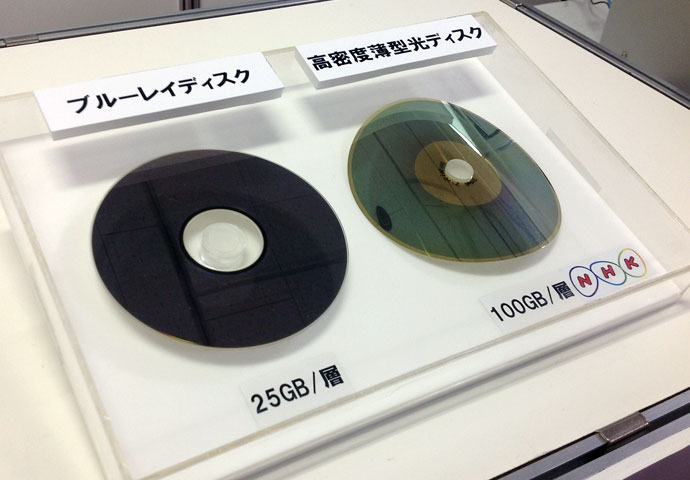
So NHK is looking into alternatives–like this:
Nhkdisc01

Note the NHK disc is floppy, not unlike the opaque black mylar film used in the original floppies decades back. But this disc (which will probably be more firm when released) holds 100 GB per layer due to a lens process with blue lasers which halves the width of the beam, thus producing 4 times the capacity. A 4-layer SHV disc would hold 400 GB, more than enough for a SHV video.
Shvmedia

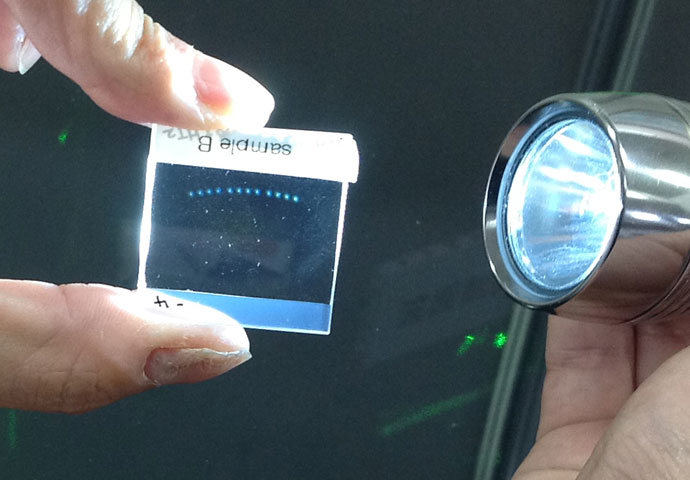
But that’s not all. They’re also working on holographic media:
Nhkholodisk

See those tiny little dots? Each one is 10 MB of data. Or was it 100 MB? Frankly, I forget–I didn’t write it down. Whatever the case, the guy said that one of those inch-square plastic (glass?) chips would hold as much as a terabyte of data. He also said that it wasn’t reliable enough for data storage yet–but he did say that he expected it to be sold on the market within three years.

He even had a cool laser setup you could look at:

Nhkholodisk02

That disc in the middle is not the media–the square chip on it is.

Now, when I saw this, something immediately came to mind. Data storage media, in the form of thick plastic cards… where had I seen those before…?

Trekmicrotapes

Of course, they seemed to have far less capacity back then.

Categories: Technology Tags:

A Bit Too Much of an Optimist

May 27th, 2012 2 comments

Richard Leakey believes that creationists will vanish within a generation or two:

Richard Leakey predicts skepticism over evolution will soon be history.

Not that the avowed atheist has any doubts himself.

Sometime in the next 15 to 30 years, the Kenyan-born paleoanthropologist expects scientific discoveries will have accelerated to the point that “even the skeptics can accept it.” …

“If you don’t like the word evolution, I don’t care what you call it, but life has changed. You can lay out all the fossils that have been collected and establish lineages that even a fool could work up. So the question is why, how does this happen? It’s not covered by Genesis. There’s no explanation for this change going back 500 million years in any book I’ve read from the lips of any God.”

I think that Leakey doesn’t really understand the Fundamentalist / Creationist mindset. He seems to believe that all you need is overwhelming facts and evidence, and they will accept something contrary to their strong religious convictions. That’s a mistake. These people literally take what they believe as an article of faith. They could be looking directly at a mountain of evidence clearly contradicting them, and still not waver. All they have to do is say it’s a trick, Satan’s behind it, so forth and so on, and then walk away. It’s pretty much what they are doing now.

I recall Arthur C. Clarke making the same error, writing in his stories that once we meet alien species, the superstitions of religious belief would melt away. I’m pretty sure that wouldn’t happen, either.

I think that if these people are to accept things like the age of the universe or the workings of evolution, it will not be until a much longer time than now, due to social workings and not wholly that of evidence.

Categories: Religion, Science Tags:

Manufactured Outrage

May 26th, 2012 Comments off

New York Daily News columnist S.E. Cupp recently took the brunt of another political hit job by the tastelessly liberal Hustler magazine, which criticized her politics and suggested “shutting her up” with male genitalia, and provided photoshopped artwork to that effect.

There is now a big fuss about it, mostly driven by the conservative media, which has been making a larger charge against both the mainstream media and against society at large: why is there only outrage against misogyny when it is directed against liberal women, but not when conservative women are the target?

That’s because incidents like this happen with such frequency and casualness that it’s clear people think there won’t be any pushback if they attack a conservative woman. Back in 2008, when some idiot hecklers shouted “Iron My Shirt” to Hillary Clinton, we talked about sexism for three days. But, like Weigel pointed out, no one at the AFL-CIO even thought twice about not only GETTING a piñata with Nikki Haley’s face on it or hitting said piñata, but similarly had no problem recording the event and UPLOADING IT TO YOUTUBE. If you do something sexist against a liberal, expect a firestorm. If you do something sexist (or pseudo-violent) against a conservative, well, they had it coming.

Right off the bat, this particular argument falls apart: the piñata incident, while tasteless, had nothing to do with gender. The target could just as easily have been a man.

This is either a blind spot with conservatives or it’s a hypocritical oversight: sexism and racism are not when you attack an individual for a reason unrelated to gender or race. Right-wingers seem to think that just opposing a female candidate on her politics is sexist, or blocking a judge on his rulings when he is Hispanic is racist–if said target is conservative, of course.

They apparently do not understand that sexism is when you attack someone because of their gender, or the attack is against the gender itself.

The “Iron My Shirt” incident, for that reason, was sexist: it was a reaction to a woman running for the presidency, and was essentially a symbolic slap in the face against women in general. If the sign had said, “Cut My Taxes,” or even, “Go Home, Idiot” it would not be sexism, as there would be no apparent relation to gender. People have expressed hatred and even symbolic violence against Hillary in the past without it being linked to sexism.


So, why is there no outcry against the Cupp photo?

Well, first of all, there is outcry against the image, especially in the conservative media. Why not from the left? Um… actually, people on the left are decrying the image. Even Rachael Larimore, who wrote the piece quoted above, took note that Planned Parenthood, the Women’s Media Center, and Sandra Fluke have all condemned the photo. So, what do they want? Every last liberal to shout it from the rooftops? They condemn the lack of coverage–but that charge falls short since all the coverage they provide itself ignores the left-wing outcry.

Second, the source is laughable: it’s Hustler magazine. If they published a similar image of a left-wing female politician, there probably wouldn’t be much outcry there, either. Not every act of misogyny creates a national public debate, only ones that come across as significant. Larry Flynt being an ass doesn’t rate that, any more than do countless right-wing imbeciles in the yahoo gallery doing crap which is just as vile and idiotic.

Which leads to point number three: the visibility of the target. After all, who is S.E. Cupp? If I have seen her before on some news show as a commentator, I don’t remember it. It’s not exactly realistic to expect the media to erupt in a furor every time a second-tier talking head gets snarked by a porno rag.


However, none of that is the central point here. In fact, misogyny is the issue, but not misogyny against conservative women. The fact is, conservatives in general don’t give a crap about misogyny. How do we know? Imagine the Hustler thing was about Hillary instead of Cupp. Would they be outraged? Hardly. They would probably chuckle over it, and stand ready to castigate any liberal or feminist group that complained. Which means they don’t care about the misogyny, they are instead complaining about the political outcome of misogyny.

But it goes much further than that: it stark opportunism, pure and simple. The recent stir regarding contraception has given Republicans a black eye and made them look bad to women. Republicans in Congress tried to deny coverage of contraception; they refused to hear from women, and instead held a women’s health hearing with an all-male panel, which appeared condescending and dismissive. After Fluke spoke later, Rush Limbaugh called her a slut and a whore, repeatedly. All kinds of other stuff happened on periphery, like the aspirin-between-the-knees remarks.

So now, right-wingers are smarting from that, and they need a way to fight back. They cannot actually come out for women on any substantial issues, of course. So this is their answer.

The Cupp story works for them well: they get to play the victim. They get false equivalency, creating the impression that sexism is equally bad on the left and the right (as if Larry Flynt were equal to Congressional Republicans, Rush Limbaugh, and many other representatives of conservatism). They get to act like misogyny happens against them even more by suggesting that it is simply dismissed and under-reported. They get to paint liberals as hypocrites.

But mostly, they get to act like the whole contraception thing never happened. Like Dan Rather’s error in reporting on a bogus memo meant that George W. Bush got excused for having gone AWOL.

In truth, most of these people probably don’t give a crap about what happened to Cupp–but it’s too good as a political weapon to pass up.

Nor is it just this case; most right-wing cries about sexism are similarly opportunistic. Remember the furor about Sarah Palin and the jogging-suit photos on Newsweek? That did get a lot of coverage, in part because women’s groups did not jump to Palin’s defense. But then again, they had good reason not to: the charge of sexism was petty and weak. Palin had intentionally posed for the photos ; she had chosen the outfit and the setting herself, but expressed outrage when the photos were used. It made no sense. Had Newsweek done something that was actually sexist regarding Palin, NOW and other groups probably would have come out on her side. As it was, the whole incident was more of an attempt to attack groups like NOW, so no wonder they did not chime in.

However, the Newsweek story shows that the whole claim by the right wing is false: the media does pay attention to sexism when it is levied against conservatives; the Slate piece by Rachael Larimore quoted at the top is poorly reasoned, providing poor support and a lack of objectivity. Outrage over “Iron My Shirt” is not equal to the Haley incident, it is more akin to incidents involving Palin. Neither is the Cupp incident equivalent to Fluke.

And yet, despite the rampant opportunism displayed by conservatives in regard to these kinds of stories, the media and the public at large still does treat misogyny against conservative women with equal regard. It’s just that significant acts of misogyny usually go the other way.

Categories: Election 2012, Social Issues Tags:

Romney’s Education Sham

May 25th, 2012 7 comments

It’s all worded very prettily, but in essence, it comes down to this: move money away from public schools while leaving them burdened with the highest-cost children they will not be funded to handle; place even more emphasis on meaningless assessment tools designed to punish experienced teachers in the public school system; reduce certification requirements so that private schools can save money and increase profits, while removing regulation that would require these schools to meet minimum standards, all in a push to privatize education in a way that will effectively award billions of taxpayer dollars to profit-seekers looking to cash in.

All worded rosily as “choice” for the “best” schools while “ensuring” quality and “rewarding great teachers” and so on. But if you look past the BS language and think carefully about how this will be implemented in the real world, not to mention what is not said in these phony outcome scenarios, it comes out to basically the same answer: reward our donors instead of theirs.

Sadly, this is expected to be an area where he will be seen as stronger than Obama–not that Obama has been superlative in this area himself, but Romney, essentially forwarding the conservative line on education, will be far more destructive.

Categories: Education, Election 2012 Tags:

Doctor Who?

May 23rd, 2012 3 comments

Screen Shot 2012-05-23 At 9.28.01 Pm

I can imagine he used the Tardis to help find bin Laden, but why did they send him to jail? Always getting into trouble, that Doctor…

Categories: The Lighter Side Tags:

Bad Traffic

May 23rd, 2012 20 comments

Last weekend, Sachi and I went on a kind of ‘day trip’ we have done from time to time: driving Ponta to a dog run in Tokorozawa, and then on to Costco for shopping. Now that we have the car, Costco trips are much easier–but because Costco always sets up shop in distant locations (presumably to avoid high land costs), it’s not an easy drive. Not because of distance–in total, it’s a 35 km (22 mile) round trip. Instead, it’s hard because of insufficient roads and horrific traffic control, making what should be no more than an hour in traffic into a four-hour road trip.

In Japan, most people use trains, in part because of cost, but also perhaps because traffic can be a nightmare at times. Tokyo, like most places in Japan, is not exactly traffic-friendly; thoroughfares are not ubiquitous, and often you have to navigate three sides of a square to get where you want to go.

Take our trip to the dog run in Tokorozawa. As the crow flies, it’s just 8 km (5 mi.). However, the most direct route is on small, narrow roads which, in Japan, qualify as streets with two-way traffic–which is to say, one car pulls over onto the curb while the one coming from the other direction slowly creeps past, with inches of clearance on either side. A lot of roads in Japan are like that, streets so narrow they would barely qualify as a one-way street in the U.S.

The same path is also filled with a multitude of turns, some of which are so subtle and confusing that it is easy to go down the wrong way.

However, this is usually the way that the GPS recommends, probably because it chooses the least-distance route and ignores how fast one might go. Google Maps does the same thing, claiming that the 11-km small-road route to the dog run takes 34 minutes–when in fact, it is more than an hour. Sachi and I discovered that a three-sides-of-a-square route, taking bigger roads, is much faster, despite the fact that it is 16 km (10 mi.).

However, what really gets me is the traffic control. In Japan, I really get the impression that when they plan traffic, they don’t. As in, they don’t give a good goddamn about traffic flow, instead they just follow pre-set standards someone set randomly some time in the past.

It’s like that with road designations and speed limits. You can be in the countryside, on a wide two-lane thoroughfare, with no lights or stop signs for a kilometer at a time, no pedestrians in sight and the sidewalk blocked off by large barriers in any case… and the speed limit will be set to 25 mph (40 kph). In the U.S., a similar street would have double the speed limit. In Japan, the limit is set by the road’s official classification–meaning that a narrower, pedestrian-laden one-lane street near the city center may have a higher speed limit.

Traffic control in Japan seems to be planned the same way–mostly arbitrarily. On our trip last weekend, we ran into at least three traffic jams which were obviously endemic; the exact same traffic jam is there every time we go, and I am sure the same is true of the new jams we encountered on our route this time.

The culprit is usually the same: a badly timed right-turn signal. In Japan, we drive on the left, so right turns must cross traffic. The roads are narrow, and right-turn lanes are short. A traffic signal, especially at a 5-way intersection (where these jams usually occur), may take 2-3 minutes to cycle. However, the right-turn light will last only two or three seconds–and no, I am not exaggerating, I timed it. (The turn light is actually 5 seconds, but straight-through drivers run their red light, cutting a few seconds off the turn signal traffic.) So, naturally, the line of people wanting to turn right quickly backs up, and very soon blocks the whole flow of traffic (as most streets are one lane), thus creating a traffic jam that backs up for more than a kilometer.

What is so stupid about it is that the jams could obviously be eliminated, or at least greatly lessened, by simply extending the turn light by five to ten seconds–nothing when you consider the overall cycle duration. And yet, it never happens. Not all right-turn lights are so poorly timed, but enough are, and they tend to be in key spots where you cannot get around them.

This last weekend, we got caught by exactly that type of traffic jam, made even worse by an incredibly idiotic placement of a parking lot exit stream just 100 meters or so from just such a right-turn trap. We were almost at Costco–one turn away–when traffic came to a stop. And I mean, a dead stop. At one point, I realized that traffic had not moved for more than five minutes. People were starting to get out of their cars to see what had happened.

Now, this was already bad enough before: a signal at the intersection had the same short-right-turn-lane combined with the three-second-turn-light syndrome. Add a steady stream of cars exiting the mall parking lot close by. (In previous trips, we noted that these people got impatient real fast, as if they had been the only ones waiting for half an hour, and tended to bull into the line and then go bumper-to-bumper, denying the main street traffic access to the stream again.)

But instead of simply adjusting that right turn signal, what did the morons in traffic control do? They added a signal just before the parking lot traffic flow. The timing was perfect: as soon as the new signal turned red for the main traffic flow, that’s when the line moved forward, essentially giving most of the flow’s movement to the parking lot traffic–but also more or less turning the main road beyond that point into a parking lot.

Stupid, stupid, stupid, stupid, stupid. For no cost, they could have alleviated most of the problem. Instead, they spent all that money to add a traffic light, making the problem even worse.

After 10 minutes and still no forward progress, I decided to do something that seemed counter-intuitive. Instead of trying to complete the last 500 meters of that nightmare, I turned around and took a 4-km “shortcut” around a large country club, essentially covering 3-1/2 sides of a large square. It took about 7 minutes, and saved us anywhere from half an hour to an hour.

Nor is this the only kind of stupidity one sees in Japanese traffic control. I remember when I lived in Inagi, they spent years building a completely new, luxuriously wide (for Japan), two-lane thoroughfare straight through the center of town. What used to require a circuitous, jammed-up ride down narrow roads was replaced by a beautiful, wide avenue where one could leisurely cruise straight across town.

Except, of course, they screwed it up with traffic lights. Lights at virtually every intersection, every few hundred meters. Of course, that would not be so bad… if the lights were not set to be staggered. Yep, you could see it down the straightaway: red green red green red. You just leave a red light, and seconds later, you stop at the next one. Each wait was about thirty seconds, and there was virtually no cross-traffic. You felt like a complete idiot, just waiting there for no reason. Then again. And again. And again and again. Just as stupid: I found that if you took a narrow side street, it had no stops signs or traffic lights, and so you could completely avoid the three-minute delay and zip past in seconds. And yet, I was apparently the only one who had found this–the side street was always empty, even when the traffic on the main street was heavy.

Ironically, the main, traffic-signal-filled street passed right by city hall. I don’t understand why the place has not get been burned to the ground by irate commuters.

Except that, this is Japan. People simply accept this crap–probably because they know that complaining will do no good. I would not be surprised it, six years later now, the traffic lights were still the same.

Categories: Focus on Japan 2012 Tags:

Eclipse

May 21st, 2012 8 comments

Just got finished viewing the eclipse here. People out on the street and all that. Got to see it through a filtered lens, and while the live view is something you should see, it’s still–ironically–way better on TV.

What was neat, though, was the quality of light–something which you can’t really photograph well. It got darker, but not the way it does with coldness. Kind of a muted shade, but still with direct sunlight. Spooky, and cool.

Categories: Focus on Japan 2012 Tags:

Romney’s “Job Creating” Shell Game

May 19th, 2012 12 comments

Robert Reich explains how Romney & friends over at Bain capital got stinking rich. A teaser: they risked not a single dime of their own money and used a bunch of accounting scams, while working Americans paid the price, and footed the bill in the form of taxes and debt to pay for the debris trail they left behind.

The Truth

May 18th, 2012 4 comments

Precisely. I’ve also been reading Thomas Frank’s Pity the Billionaire, which deals with the same topic from a different perspective.

The frustrating thing is, this should be so obvious, as obvious as the fact that the Laffer curve was full of crap. And yet millions, even a majority, buy into the bull.

Money naturally circulates upward; in order for an economy to work well, there must be some kind of mechanism to circulate the money back down. Conservatives think that jobs will perform this function all by themselves, even as they try to destroy unions, deny workers benefits, and otherwise minimize that precise flow downwards. In fact, a healthily progressive tax system and good working conditions are what create jobs and a prosperous economy.

The best way to stimulate the economy is to inject the money into the lower half of the economic cycle; injecting it into the upper half is counter-productive.

Taxing the rich is not only a good thing, it is a necessary thing. Government spending on infrastructure, education, and supporting the poorest among us is not just a good thing, it is a necessary thing. If you truly wish to have a robust economy.

But just as we still prosecute the same old drug war despite decades of studies telling us that decriminalization and treatment would be light-years better, we still bridle against the bloody obvious in economics.

We know it’s a fact that dollar for dollar, food stamps are the most effective stimulus mechanism, followed closely by unemployment benefits and infrastructure spending, and yet most of the nation seems to accept Republican whining about how that will destroy the economy.

It is just as solid a fact that dividend & capital tax gain tax cuts, corporate tax cuts, and the billionaire-slanted Bush tax cuts are among the absolute worst stimulators–and yet we somehow allow right-wingers to insist that these be given a priority.

We’ve tried it the Republican way for 30 years and we have nearly destroyed our economy. So now right-winger shrieks about how they have never gotten a chance and how liberals have ruined everything.

Once Again, A Reminder of Where the Deficit Really Comes From

May 16th, 2012 8 comments

Deficit-Causes

Answer: the policies and failures of George W. Bush, the same policies still being pushed by the GOP today, toward the same failures. Under a Republican administration, the cost of the wars in Iraq and Afghanistan might be replaced by expanding and extending our presence in those countries, plus maybe a new war in Iran (or who knows where else); the Bush tax cuts would not only be extended, but would be expanded.

Of course, all other costs of government could be put up there as well, but this does quite well to demonstrate what a huge difference the cessation of the wars and the repealing of the Bush tax cuts would make.

Not that this, even were it to come from an unbiased source, would make an impression on those opposed to Obama. They still think he’s not a Christian, for chrissakes, or even not born in the U.S. Even more moderate people have accepted the idea that the deficit is “his,” which it may be in a political sense, but clearly is an artifact of Bush and continued GOP pressure.

The problem is, voters seem far more interested in blaming whomever is in office when bad stuff is happening than they are in figuring out whose policies would lead to a better result.

It’s as if we had a babysitter who turned out to be a child molester, and after we got rid of him and hired a qualified babysitter, the kids are still suffering severe trauma, made worse by the molester hanging around, so we blame the current sitter and start looking at hiring back the molester.

Categories: Economics, Election 2012 Tags:

Romertopf Chicken

May 13th, 2012 4 comments

When I was a kid and our mom had to work nights, we took responsibility for our own cooking, and one of our usual meals was Romertopf clay-pot chicken. Romertopf is an unglazed ceramic cooking pot which does a great job of keeping juices in–I had just forgotten how well it can do that.

When my brother and his wife left Japan recently, they left us their Romertopf; they had acquired one small enough to fit into a Japanese microwave/convection oven. It was not as big as the ones we used to use, but it can be big enough.

Eager to try it out, I went to our local supermarket and ordered a whole chicken–they don’t sell them whole in Japan usually, and this one took 4 days. Now, my sister-in-law warned me that the pot would not take more than a 1.5 kg chicken, and so I tried to order one. The store guy warned me that the chickens they could order would be bigger than that, so I just asked him to order the smallest one he could get.

It turned out to be a 2.5 kg chicken.

And, as expected, it came nowhere close to fitting in the pot. I still wanted to try it out, though, so I cut off the neck (they had left about 6 inches of it), the wings, and a bit of the tail; I also cut off the legs and thighs, but didn’t leave those out. With everything trimmed, I could fit the torso in the pot, and though it was a tight fit, I was able to put the legs and thighs back in, albeit reversed.

One of the tricks, I think, is to leave the torso cavity open, stuffed with onions and spices, so I did not want to just chop the bird up and pile the pieces in–they would have fit better, but keeping the chicken as whole as possible was optimum.

So, after pouring on some soy sauce, brandy, and red wine, then adding the same spices I put in the chicken (basil, garlic & onion powder, celery salt) on top, with some paprika (Spanish pimentón in this case) for appearance.

Rom Ready

As you can see, it was bulging out. I could fit the cover on, but obviously there was not much space left. I could only fit in a few small potatoes, instead of several along with some carrots.

Figuring it was the best I could do, I put it into the oven–even with a small pot, it barely fit–and set it for 90 minutes at 175 C. Or, for 60 min at 180 C, as the oven couldn’t be set for more than an hour, and only could be adjusted to 10-degree intervals. After 60 minutes, I set it for another 30; you’re supposed to cook for 80 minutes, take the top off, then cook for another 10 minutes.

Of course, the oven was so small that I had to remove the whole thing to take the top off, and so all the heat escaped; I cooked for 15 minutes rather than 10 with the top off.

But boy, did it ever work!

Rom Cooked01

Rom Cooked02

Alas, the photos (different colors as they were taken by different cameras) don’t do it justice. It looked good enough from the outside, but when I cut up the meat, it was the juiciest chicken I remember ever seeing. Just fabulous. Again, this photo doesn’t do the spread justice:

Rom Table

We went in for seconds and thirds, eating nearly the whole chicken.

Next time, I want to try a 2 kg chicken, if I can get one just the right size. One of the nice things about Romertopf, however, is that it is really hard to get wrong; it’s very forgiving, and consistently good.

Categories: Focus on Japan 2012, Hibarigaoka Tags:

Romney and Character

May 11th, 2012 3 comments

Romney, as it turns out, was a bully as a teenager:

John Lauber, a soft-spoken new student one year behind Romney, was perpetually teased for his nonconformity and presumed homosexuality. Now he was walking around the all-boys school with bleached-blond hair that draped over one eye, and Romney wasn’t having it.

“He can’t look like that. That’s wrong. Just look at him!” an incensed Romney told Matthew Friedemann, his close friend in the Stevens Hall dorm, according to Friedemann’s recollection. Mitt, the teenage son of Michigan Gov. George Romney, kept complaining about Lauber’s look, Friedemann recalled.

A few days later, Friedemann entered Stevens Hall off the school’s collegiate quad to find Romney marching out of his own room ahead of a prep school posse shouting about their plan to cut Lauber’s hair. Friedemann followed them to a nearby room where they came upon Lauber, tackled him and pinned him to the ground. As Lauber, his eyes filling with tears, screamed for help, Romney repeatedly clipped his hair with a pair of scissors. …

“It happened very quickly, and to this day it troubles me,” said Buford, the school’s wrestling champion, who said he joined Romney in restraining Lauber. Buford subsequently apologized to Lauber, who was “terrified,” he said. “What a senseless, stupid, idiotic thing to do.”

“It was a hack job,” recalled Maxwell, a childhood friend of Romney who was in the dorm room when the incident occurred. “It was vicious.”

The bullying, and his reaction to it now, are somewhat reminiscent of another recent president, George W. Bush, who branded pledges with a red-hot coat hanger and defended it as being no worse than a “cigarette burn.” (A few reminders here, here, here, and here.)

Romney’s “youthful indiscretions,” however, go somewhat beyond that–leading a gang of youths who chased and tackled a kid, pinned him to the ground, and hacked off his hair while the kid screamed for help–for no better reason than that the kid was different.

Now, people change. People who were bullies as teens often mature and become better people. However, sometimes they only evolve into a different kind of person with the same basic disregard for other people. Like Dubya, sometimes they just get better at masking it.

What would have impressed me would have been if Romney had sat down and given a heartfelt expression of remorse. He could have told about how, when you are found and want to be liked by your peers, you do stuff that you regret later in life. That would not have been damaging to him–quite the opposite. It could have been an extremely human moment, respected by everyone, not to mention a teachable moment, helpful to many teens who might be doing wrong but could be steered right. It would be the kind of thing somebody like me, a person strongly opposed to Romney politically, could have said, “I may not like his policies, but I really respect what he did there.”

So, what did Romney say about violently assaulting a kid for being different?

“I’ll tell you,” Romney said, chuckling, “the thought that that fellow was homosexual was the furthest thing from our minds back in the 1960s, so that was not the case. But as to pranks that were played back then, I don’t remember them all, but again, high school days, I did stupid things. … And if anyone was hurt by that or offended, obviously I apologize for that.”

Holy crap. Really. My first thought is, this was just one of so many similar “pranks” that he can’t even remember what happened? What else did he do? How many other people did he assault? I mean, seriously, if he cannot remember chasing down and shearing a kid’s hair off while the kid screamed, that’s pretty goddamned significant.

It raises serious questions about his conscience, and shines a clearer light on how he could be proud of the work he did later on at Bain Capital, destroying companies and jobs for profit. What kind of person does even that one thing to that kid–or, as Romney himself admitted, many acts of bullying (excuse me, “pranks”)–that he can’t even remember something so chilling? The incident was so vicious that not only do the other people in his “posse” remember it vividly, but even bystanders, half a century later, have powerful recollections of it.

But then there’s his cavalier attitude toward it today, calling such a thing a “prank”–were I that guy he pinned down and cut the hair off of, I would be livid right now. (Sadly, he passed away years ago.) Worse, Romney said, “if anyone was hurt by that or offended, obviously I apologize for that.” “If”?? Really? You chase a kid down, pin him to the ground, and hack off his hair while he screams for help, and you’re still not sure if he was hurt or offended?

Like I said, holy crap.

Yes, In know–it was not his “human” answer, but his “politician” answer. Trying to minimize damage by apologizing and yet not admitting to any wrongdoing. Perhaps it only demonstrates that he’s a piss-poor, tone-deaf politician.

His campaign is also trying to minimize the story instead of dealing with it in a human manner:

“The stories of fifty years ago seem exaggerated and off base and Governor Romney has no memory of participating in these incidents.”

“Off base”? What is that supposed to mean? And exactly how can they know the stories are exaggerated if Romney says he cannot remember them? How can you both claim that a story is inaccurate and you don’t know anything about it?

A man who witnessed the incident seemed to remember it just fine–not to mention, had the appropriate response, years later:

Sometime in the mid-1990s, David Seed noticed a familiar face at the end of a bar at Chicago O’Hare International Airport.

“Hey, you’re John Lauber,” Seed recalled saying at the start of a brief conversation. Seed, also among those who witnessed the Romney-led incident, had gone on to a career as a teacher and principal. Now he had something to get off his chest.

“I’m sorry that I didn’t do more to help in the situation,” he said.

Lauber paused, then responded, “It was horrible.” He went on to explain how frightened he was during the incident, and acknowledged to Seed, “It’s something I have thought about a lot since then.”

Romney denies the attack on Lauber had anything to do with his assumed gender identity, but was known for similar attitudes toward other students–sadly, an attitude apparently encouraged by the school:

But Friedemann and several people closest to Romney in those formative years say there was a sharp edge to him. In an English class, Gary Hummel, who was a closeted gay student at the time, recalled that his efforts to speak out in class were punctuated with Romney shouting, “Atta girl!” In the culture of that time and place, that was not entirely out of the norm. Hummel recalled some teachers using similar language.

One could argue that Romney was simply a product of his environment and his time, and this may be true. It is certain that he has matured and would no longer look kindly on exactly these actions. But there does remain the question of whether he has evolved into someone who does look kindly on adult versions of the same kind of attitude. A disregard for those who are different, a lack of compassion for people in need, a disposition to confirm to the behavior of those in his environment rather than to work from an individual moral base.

People around him are talking about what a swell guy he is. But this means very little–remember, Dubya was described in the same way–in light of the fact that people with serious deficits in morality can easily present themselves as good ol’ boys.

Even more significantly, there is the realization few people understand, which is that most forms of discrimination and harm come from people who not only act decently most of the time, but who sincerely believe themselves to be moral people incapable of such things. Most racism today comes from such sources, as do most of the injustices, some large but the majority small, that happen in the world today.

One must judge people on their actions, not the image they project. Romney’s origins speak somewhat to his moral foundation, but his current casual disregard for the terrorizing he did as a young man speaks far louder.

Categories: Bush and Character, Election 2012 Tags:

Romney: “Actually, I Saved Detroit. You’re Welcome.”

May 9th, 2012 2 comments

Wow. It’s hard to imagine being more brazenly dishonest, hypocritical, and egotistical–all at once–as this.

I pushed the idea of a managed bankruptcy, and finally when that was done, and help was given, the companies got back on their feet. So, I’ll take a lot of credit for the fact that this industry has come back.

Well, I pushed the idea of a stimulus back in November of 2008, so I’ll take credit for millions of jobs saved. You’re welcome.

Oh, wait, you actually have to do something to get credit for it?

“Auto Czar” Steve Rattner is taken aback:

I’ve read, I think, everything Romney’s had to say on this subject, and the level of flip-flopping and dissembling is truly mind-boggling. He’s been on every side of the auto rescue at different times and said different things, so it’s hard to know what he honestly thinks.“

One notable area where Romney was relatively consistent was that he always pushed for private takeovers of the industry rather than using government money, though no private parties expressed any interest. He also advocated punishing the unions, which would essentially have meant devastating worker pay and benefits. Ironic, as well-paying America jobs were supposedly what this whole business was all about saving.

Like Obama’s call on bin Laden, the moves the president made with the auto industry were risky, unpopular, and could have sunk his presidency had he failed. However, he made them, succeeded–and, again as with bin Laden, Republicans who attacked him for even suggesting such moves now crowd in and try to take credit for their success.

When You Think about It, the Lack of Reasoning Makes Perfect Sense

May 7th, 2012 3 comments

Heartlandboard

The Heartland Institute is a conservative “think tank” (read: propaganda engine) set upon supporting conservative and corporate agendas. Aside from denying global warming, the institute has famously challenged the adverse effects of cigarette smoke, opposes public health care and education, and essentially supports privatizing almost everything government does. So one cannot expect them to exactly come from a place of reason if their purpose is so deeply set in supporting positions not achieved by reason. When you are so invested in issues that deny the obvious because they fail to benefit the political and economic agenda you want to believe in, basic logic tends to fly out the window.

Even so, the billboards on climate change had me puzzled for a while, in that they seemed so stupid, so nonsensical, that I figured I was missing the point. I mean, a fifth-grader could figure out that even bad people can believe in true things. “Adolph Hitler believed that pi equals 3.14159! Do you?”

Seriously, that does not even pass the laugh test. Trying to apply guilt-by-association to common-sense facts is, well, stupid. It truly puts on display how divorced from basic logic people like those at Heartland really are.

The State of the Campaign

May 2nd, 2012 4 comments

It’s no surprise that Romney is picking up where McCain left off, but “on steroids,” to use Bill Clinton’s recent phrasing. McCain, if you recall, was a flip-flopper who outrageously and hypocritically lied about his opponent as well. Romney, fresh out of the gate, apparently feels it necessary to go even further.

A few of his opening shots? Well, they certainly seem to understand their problem points, as they are going straight for Obama’s big strengths: he is popular with women, he helped save the auto industry, and he killed bin Laden. Knowing that these are tremendous pluses for Obama, showing him to be strong on social issues, jobs, business, and foreign policy, they feel the need to relentlessly attack him on these points; it is no mistake that these three points came first, and have no doubt that conservatives will, barring some huge embarrassment, continue to hammer Obama’s achievements in these areas. If they cannot deprive him of credit for these, then they hope to at least mire them in criticism and question enough to blur and weaken them.

A

s for Detroit, the Romney campaign is now claiming that not only was Romney not against the Detroit bailout, but that Obama was just “following Mitt Romney’s advice.”

This goes beyond Mitt’s trying to save face by pointing out that he was for saving the auto industry, but differed in how to do it. Romney wanted Detroit to go through a managed bankruptcy, and not receive any government funds–i.e., a Bain-style restructuring. At the time, he specifically contrasted his plan to Obama’s.

At the time, there was also not so much doubt about one big reason why not just Romney, but conservatives in general, wanted the bankruptcy: it would have broken the unions, and allowed the industry to strip workers of pay and benefits. Romney left no doubt about this, citing what he called “excessive union contract obligations.” (An excellent rundown of Romney’s positions here.)

Obama, in contrast, bailed out the industry, saved it without bankruptcy, saved tens or possibly hundreds of thousands of jobs while not wrecking the unions or the hard-won pay and benefits the workers enjoy, helped the industry not just recover but thrive… and now Romney, after disagreeing with and then criticizing Obama for what he did, is trying to take credit for it.

T

hen there is Osama bin Laden. Bin Laden was ignored for years by conservatives, embarrassed by their inability to capture him. After basing their entire mideast strategy on how much of a threat he was, they dismissed him as unimportant and stopped even trying.

During the 2008 election, Obama vowed to cross Pakistani borders and take bin Laden out, if there was actionable intelligence and Pakistan did not appear cooperative. He was referring to Bush’s grave error in Tora Bora, of course. At the time, Romney and most other conservatives came down on Obama as reckless and naive, and opposed any such move.

As it turned out, of course, Obama was dead right. Ever since then, conservatives have been trying to ignore something which, had it only been accomplished by a Republican, they would have celebrated as the ultimate act of a courageous leader.

Their first strategy was to act like Obama had nothing to do with it. They thanked the soldiers, they thanked the military in general, they even thanked our allies, some of whom they savagely attacked in the past. They also thanked President… Bush. They credited the capture to Bush, to torture, to Gitmo, to everyone and everything… except Obama. He was a braggart trying to take credit for everyone else’s hard work.

Then they started nipping at Obama like a bunch of ducks, attacking Obama for how he did it, for not showing the video, for not putting the body on display, for the burial at sea, or for even announcing that bin Laden had been killed at all. No detail was too small to claim that Obama somehow “blew it” and made things worse.

Then they tried to claim that “any” president would have done the same thing–ignoring the fact that Bush did not. “Even Jimmy Carter would have given that order,” Romney himself claimed. Of course, Carter gave the order to send helicopters into Iran–a mission which failed, and Republicans had no problem giving Carter full blame while never once suggesting that the soldiers or the military were in any way responsible. Which was appropriate–but now stands out as hypocritically inconsistent in regards to their reaction to Obama’s actions. Like it or not, Obama made a call, and had the mission failed, the blame would have been 100% his, and probably would have sunk his chances for re-election. Do you think, had the mission failed and soldiers died, that Romney would hesitate for a microsecond to politicize that? Hell, no.

Then there’s the question of whether Romney would have done it; after all, when Obama said he’d go after bin Laden if he were in Pakistan, Romney disagreed:

“I do not concur in the words of Barack Obama in a plan to enter an ally of ours… I don’t think those kinds of comments help in this effort to draw more friends to our effort,” Romney told reporters on the campaign trail.

Recently, has has attempted to pivot that statement, acting as if it were only Obama’s statement of intent, not his actual intent:

“It was a very, if you will, fragile and flammable time in Pakistan,” Mr. Romney said during an appearance with Rudolph W. Giuliani at Engine 24, Ladder 5 in SoHo. “And I thought it was a mistake of him as a candidate for the presidency of the United States to announce he would go in–rather than to say, as I did, we reserve the right to go wherever we feel is appropriate to secure the interests of the United States of America, and certainly to track Osama bin Laden anywhere he could be found.”

The problem? That statement contradicts what else Romney said when he criticized Obama in 2008:

Romney, the former Massachusetts governor who is one of the Republican front-runners, said U.S. troops “shouldn’t be sent all over the world.” He called Obama’s comments “ill-timed” and “ill-considered.”

“There is a war being waged by terrorists of different types and nature across the world,” Romney said. “We want, as a civilized world, to participate with other nations in this civilized effort to help those nations reject the extreme with them.”

So, in 2008, he felt that we should “participate” with other nations, and disapproved of sending troops “all over the world.” But in 2012, he said he meant to “reserve the right to go wherever we feel is appropriate to secure the interests of the United States of America, and certainly to track Osama bin Laden anywhere he could be found.” How can you criticize Obama for sending troops everywhere and at the same time mean that you would send troops “wherever … appropriate” and “anywhere [bin Laden] could be found”?

Finally, there is criticism that Obama is politicizing getting bin Laden. This, of course, is laughable on its face. Of course he’s using it in his campaign; that’s what any politician would do, what every politician does. If Romney had done it, he sure as hell would have mentioned it. And why not?

How about this by Bush in 2004:

“In Iraq, we saw a threat, and we realized that after September the 11th, we must take threats seriously, before they fully materialize. Saddam Hussein now sits in a prison cell,” the president said. “America and the world are safer for it.”

Was that inappropriate? Certainly Romney would not have thought so. Not to mention that Romney just appeared in New York near Ground Zero with Rudy “noun, a verb, and 9-11” Giuliani, making hay of the War on Terror and politicizing exactly what they criticized Obama for touting–how he performed in the war on terror.

McCain, a Romney surrogate, has also blasted Obama, saying “heroes don’t brag.” Alas, he didn’t seem to be aware of this when he was running in 2008, when he bragged about what his team and his party claimed were his own acts of heroism.

In the end, what we have is massive hypocrisy on the part of Romney and the GOP and all of their surrogates; no surprises there. But it is telling; to attack Obama on women, Detroit, and bin Laden betrays the fact that Republicans know that Obama is very strong in those three areas.

The question is, can Romney and the GOP successfully pull of the Etch-a-Sketch strategy, hoping voters forgot everything they said and did in past years, believe all the lies they now claim are true, and deny Obama credit where credit is due?

Categories: Election 2012, Right-Wing Hypocrisy Tags:

April Resort Birding – Karuizawa

May 1st, 2012 Comments off

In Karuizawa, however, there are birds galore (you ever want to go birding in Japan, Karuizawa is not a bad choice), and I took the time for birding there. The first interesting one I spotted was just outside the hotel, a Chestnut-cheeked Starling. Far more interesting than the white-cheeked version so common in Tokyo.

Ccstarling07

Ccstarling08

Ccstarling09

Ccstarling03

In the same location, I saw some Great Tits, Oriental Greenfinches, Meadow Buntings, Wagtails, and one I could not identify–as one birder I showed it to said, “a female something.”

Greattit02

Greenfinch01-690

Meadowbunting01

Wagtail01-1

Here’s the “something”–probably a Flycatcher of some variety (less probable but still possibly, a warbler), but I can’t tell myself. This was the only angle I got it at.

Unknown01

In Karuizawa, there is a special birding area–“yacho no mori,” or the “bird forest.” I caught great images of a misosazai, a Winter Wren, when Sachi and I went there five years ago. I immediately spotted some Long-tailed Tits:

Longtailedtit01

Longtailedtit07

Longtailedtit04

Coming out of the park, I spotted something I had never seen before: Coal Tits.

Coaltit03

Coaltit04

Here’s a beautiful shot of two of them, click for a larger version:

Coaltit01

And another nice shot with a larger version:

Coaltit07

The catch of the day, however, was a Blue-and-white Flycatcher wooing a potential mate. The Blue-and-white is kind of iconic to Japanese birdwatching; the deep blue colors and contrast with the whites get it put on the covers of most birdwatching books.

Bwflycatcher-12

Bwflycatcher-09-1

Bwflycatcher-11

It wasn’t too hard to spot; in its display, it was hanging around the female, which had perched along the walking path; the male was hopping from branch to branch, trying to be in easy view (unlike most birds in the park), and singing like, well, a songbird.

Bwflycatcher-05

A lot of its display was wagging its tail up and down.

Bwflycatcher-18

Bwflycatcher-17

The female is less spectacularly colored, but still nice:

Bwflycatcher-15

Bwflycatcher-16

Categories: Birdwatching Tags:

April Resort Birding – Fuji

May 1st, 2012 Comments off

Sachi and I took Ponta to a few dog-friendly hotels in April, first to a resort in Fuji, and then on the way back from ohaka-mairi (visiting the family gravesite), in Karuizawa. Along the way, I got a chance to do some birding–and surprisingly, saw four new species of bird I had never seen before, which is quite a few for me, in such a short time.

The first was at Fuji: a Brambling. Spotted this one in the forest just south of the resort. The colors are not as rich as an adult male in season, but the dark head, red shoulders and breast, and striped wings tag it fairly distinctively.

Brambling01

Brambling02

Brambling03

There was a Grey Wagtail, common in more inland, wooded areas:

Greywagtail01

There was some larger mystery bird lurking back where I could not catch it, but got this image–it’s probably a kakesu, a Eurasian Jay, but it’s hard to tell.

Unknown02

And there were the Black Kites, fairly ubiquitous for the countryside:

Blackkite01

Blackkite02

Blackkite03

Blackkite04

I did not spend much time birding at Fuji, however–frustrating a few times, because I am pretty sure I spotted some really nice birds but did not have my long lens.

Categories: Birdwatching Tags: