Archive

Archive for September, 2013

This Is Conservatism

September 29th, 2013 4 comments
Even in 2009, it was pretty evident. A foreign leader asked Obama:

“We don’t understand it. You’re trying to make sure everybody has health care and they’re putting a Hitler mustache on you — I don’t — that doesn’t make sense to me. Explain that to me.”

Conservatives are doing things which would have been unimaginable a few decades ago. Some things which we even take for granted now. Think about the following facts in the context of what would have passed muster a few generations ago—or even more alarmingly, in the context of sound reason.

Conservatives run a propaganda channel on TV which they shamelessly pretend is a “news network.”

Conservatives openly mock facts, deny science, and fervently stand behind statements which are easily proven false.

Conservatives are openly suppressing liberal voters under the laughable pretense of openly discredited “voter fraud.”

Conservatives work almost exclusively now via obstructionism, essentially stopping all meaningful legislation.

Conservatives oppose any and all legislation favored by the opposition regardless of what it is, even if it was what conservatives themselves were promoting until very recently.

Conservatives have utterly rejected the core principle of American politics—compromise—and now genuinely threaten to destroy the American economy if they do not get their extremist agenda passed. For conservatives, “negotiation” means nothing more than “give us everything we want and you get nothing.”

Conservatives are opposed to virtually any policy that would help their supposed constituents, the people: health care, retirement benefits, a living wage, solid public education, college education, union protection, infrastructure, corporate and government regulation, clean air, clean water, clean and/or cheap energy, environmental protection, reproductive choice, progressive taxes, network neutrality, unemployment insurance, food stamps, responsible gun control, the ability to sue if wronged… the list goes on and on and on. Anything that would help the people of the country, anything that would help the economy at large, conservatives oppose.

What do conservatives fight for? Lower taxes, mostly for wealthy people. Oil and coal. Military spending. Land wars in the Middle East. Privatization.

And yet, tens of millions of Americans who are most hurt by what Republicans are doing vote them back into office time and again.

Could the lack of a well-informed electorate somehow be involved?

Together, of course, with the excruciating inability of Democrats to effectively counter all of that or to even provide a marginally attractive alternative choice. As I put it in 2010, if Republicans had to advertise truthfully, their campaign slogan would be this:

We’re Crazy and Destructive, but the Other Guys Are Ineffective at Stopping Us!

Categories: Right-Wing Extremism Tags:

Tenure Tempest

September 28th, 2013 Comments off

You hear a lot about teacher tenure nowadays. Tenure is bad. Teachers get tenure automatically and then are guaranteed a job for life no matter how incompetent they are. We see reports in the press about how tenure makes school systems worse.

So, it’s a real problem, right?

Let’s begin with the article I link to above. It comes from the Wall Street Journal—a conservative publication, now owned by Murdoch, so there is immediate suspicion of bias. Then the report it quotes comes from the National Bureau of Economic Research, often cited as “non-partisan” and “highly respected,” which just happens to always report that Democratic ideas are failures and conservative policies are the bee’s knees. I’ll get back to this later.

Instead, let’s look at tenure itself.

Do all teachers automatically get tenure? No. You have to get certified and then teach while being evaluated for 2 to 5 years, depending on the state. During this time, a teacher can be fired at will, without any reason whatsoever. At the end of the review time, you are either given tenure, or you are dismissed. If the school grants tenure, that means that the school, after years of review, feels that you are qualified. If you do not pass muster, then you should not be allowed to continue teaching, and the school should hire someone else who is. If an incompetent teacher gets tenure, then it is a clear failure of the administration to perform their duties.

Is tenure a lifetime appointment? Don’t teachers wish. No, it’s not. Teachers with tenure can be fired, and often are. It is important to understand that K-12 tenure—the issue everyone is talking about—is very different from university tenure.

Does tenure make it almost impossible to fire a bad teacher? If a teacher is performing badly, the school can fire them; they simply need evidence of the poor performance, which would probably take the form of evaluations and student performance relative to other teachers—in short, the very data that would inform a school of poor performance in the first place. There is often talk about how it costs huge amounts of money to go through the process. Maybe, in some states, that could be true, but if it is, then the answer is not ending tenure, but instead to revamp the system so that standard evaluation methods could be applied to the process. However, I have the feeling that most “expensive” terminations are padded with costs like the full teachers’ salary during the period of review. I also suspect that most “extremely difficult” terminations are over reasons that tenure was designed to prevent, namely ones that are not actually related to teacher performance.

So, if a teacher can be fired, what is tenure about? Simple: it means a teacher cannot be fired “at will.” The school is required to show cause and to go through the process of demonstrating that cause. Which is, to be honest, what every employer should be required to do with every job. The fact that this is not true is not indicative of fault in schools, but instead of faults in how we generally treat workers like disposable objects.

So, why is there such a furor over teacher tenure?

The answer is simple: teachers are a liberal constituency. If you are a liberal constituency, conservatives will try their best to destroy you, and failing that, to vilify you. They will manufacture false outrage over trumped-up scandals and drive you and your organizations into the ground.

Who are the biggest supporters of Democrats? Unions. Conservatives are rather blatantly doing everything they can to vilify and crush labor unions. People are made to feel that unions are run and populated by thugs and demand sweet, cushy jobs at the expense of the public.

Hollywood is a liberal constituency, so it is often denigrated, devalued, blamed, and dismissed by conservatives (until a movie star voices support for conservatives, at which point Republicans swoon and try to elect that person to some office or another).

Any city with liberal leanings is smeared. San Francisco, Detroit, Chicago, many cities in New England—all horrific bastions of sin and disgrace. You’ve been hearing a lot about “San Francisco Values” and “Chicago-style Politics.” You’ve seen how Detroit has been treated. They are not the “Real America.”

Minorities are also big supporters of Democrats. So guess who just can’t help insulting, smearing, and working against the interests of minorities? Who works day and night to slant election laws to keep minorities from voting? Who attacks immigration reform and blames illegal immigrants for society’s woes?

Young people are also Democratic constituencies, but they’re harder to target—and yet conservatives often do. Republican politicians are known for resenting college voters (remember Rick Santorum sneering at the idea of going to college?), with many conservative vote-suppression techniques aimed squarely at them. Some Republicans have started challenging student voting rights altogether.

Tenure is not a problem. It is simply yet another opportunity for conservatives to paint a liberal group as a scapegoat.

Categories: Education, Right-Wing Lies Tags:

What Is Divisive

September 27th, 2013 2 comments

Derek Thompson writes that the Stimulus and Obamacare are the first and second “most divisive legislation in modern history.”

He’s wrong. The laws are not at all divisive. The Republicans are. The current conservative movement is the most divisive in modern history.

It’s easy to see. Consider these two scenarios.

First, imagine that the 2008 economic crisis happened two years earlier, in 2006, smack in the middle of Bush’s second term. Bush probably would not have tried to pass a stimulus like Obama’s, but consider what would have happened had he done exactly that.

The important point to remember is that Republicans and conservatives in general did not oppose the stimulus because it spent a lot of money; Bush had spent way more over the previous years and they were not really all that opposed to it. They would not have liked so much spending on infrastructure, but they would not have violently opposed it, either—so long as it was a Republican administration passing it. Democrats, not even close as willing to be divisive and opposed on purely partisan grounds, would have gone along with the bill. They would probably have complained that it did not spend enough on infrastructure and other left-wing wish-list items, but they would not voted against it.

When the stimulus passed, the horrendously plummeting job market immediately reversed, the stock market turned around and began a comeback, and several months later, unemployment stopped rising. Had this happened in 2007, Bush would have been hailed as an economic savant, a hero who stopped an impending economic disaster.

Try to tell me that wouldn’t be the right wing’s take on the issue. There’s really no question—of course they would have reacted that way.

The Stimulus in itself would not have been “divisive” at all.

Obamacare would have played out similarly. Imagine that in 2008, Romney got the GOP nomination and then won, maybe riding high on Bush’s Stimulus recovery. He brings the Massachusetts health care plan—essentially Obamacare—to the national level. Democrats complain, wanting single-payer Medicare for All, but Romney sticks with the conservative plan, which was created, after all, by the strictly conservative Heritage Foundation. Conservatives did not oppose the plan when the Heritage Foundation proposed it. Conservatives did not oppose the plan when Romney instituted it. They only opposed it when Obama made it his own.

Republicans, pleased to get on top of a winning issue that Democrats would otherwise have dominated, would have approved the conservative health care plan proposed by a conservative president who had successfully implemented it before. Some right-wingers would have opposed it, but not nearly enough to stop its passage. Again, Democrats would have complained it did not go far enough, but most would have voted for it.

Again, the legislation is not divisive at all.

People have to understand: the Stimulus is not divisive. Obamacare is not divisive. Obama is not divisive. Obama is hardly even a liberal, for Christ’s sake.

The current political atmosphere is divisive only because conservatives have decided that such extreme partisan rancor works well for them. Period. End of sentence.

Categories: Right-Wing Extremism Tags:

Screw Altruism

September 27th, 2013 2 comments

Never live for the sake of another man, nor ask another man to live for mine.

Motto of the man who hoards 40% of the wealth held by 100 people, after he has become wealthy.

Categories: Economics Tags:

In a Perfect World

September 26th, 2013 Comments off

Currently debunked at Snopes:

Article headline: Fox News classified satire by FCC written by Sarah Wood. States that Fox News will now have to run a disclaimer across the bottom of the screen stating “This is not a valid new source”. Is this true?

Indicative of how screwed up our world is, satire makes eminently more sense than reality. The satirical article specifies:

A statement put out by the FCC says, “The decision to classify Fox News as satire has come after several years of evaluation regarding the sources of their reporting and the bias of their programming. While much of their content is based on legitimate news, it is spun is a way that cannot not be deemed newsworthy to the viewing public. If Fox News so chooses to report actual news stories of legitimacy without skewing the content we may overturn our decision and reclassify the network to a valid news source once again.”

One can be assured that the FCC does not have the authority to do any such thing.

The thing is, there should be some group, somewhere, doing exactly that.

I have always believed that there should be a strictly non-partisan, independently-funded journalism ratings organization which sets several standards of responsible journalism—one which tracks accuracy, use of identified and reliable sources, relevance of news stories, use of objective language, clarity, etc.—and uses that data to rate everything from individual journalists to entire news organizations.

The freedom of the press was established as a primary right for the purpose of ensuring a well-informed electorate, one which would then be able to make informed decisions when casting votes. That system is now virtually destroyed, in large part because of Fox News and organizations like it. Something needs to be done to reverse that trend.

Categories: Journalism Tags:

Har

September 25th, 2013 3 comments

Splist02As I predicted, BCN’s practice of fragmenting iPhone models to diminish their top-rank standing has, as I predicted, rather spectacularly backfired.
As you can see from the graphic at right, the iPhone now occupies 9 of the top 10 spots (#10 being held by the Galaxy S4). Yep, nine different individual iPhones with a specific model, capacity, and carrier each all sold better by themselves than the Galaxy S4 did altogether.

And note the dates: 9/16 ~ 9/22. Meaning that this is just from the first two or three days of sales. Meaning that next week, with a full week of sales (albeit without the punch of the first-day buying spree), we may see the iPhone garner even more spots on the top list.

After all, the #11 spot went to Kyocera’s Gratina, the #12 spot to the Xperia A, and the #18 spot went to a Panasonic handset. The iPhone claimed all other seven spots in the 11-20 list.

And three spots in the 21-30 list. But I just find it amusing that 16 of the 20 top-selling phones are iPhones.

What I find interesting is that the high-capacity models are gaining top spots, when usually it is the 16 GB models that dominate—a discouraging sign that the prior system of making the new top-quality 16 GB iPhone free with a 2-year contract is no longer in effect—the much-less-appealing 5C has probably taken that place, making those who lust after the 5S pay a monthly fee or even buy outright, meaning that they pay only a little more to get the higher-capacity version.

I have a student in one of my classes who says that she has already ordered the gold iPhone 5S, but may have to wait a month or more before she gets it.


Categories: iPhone Tags:

Just Saying

September 24th, 2013 1 comment

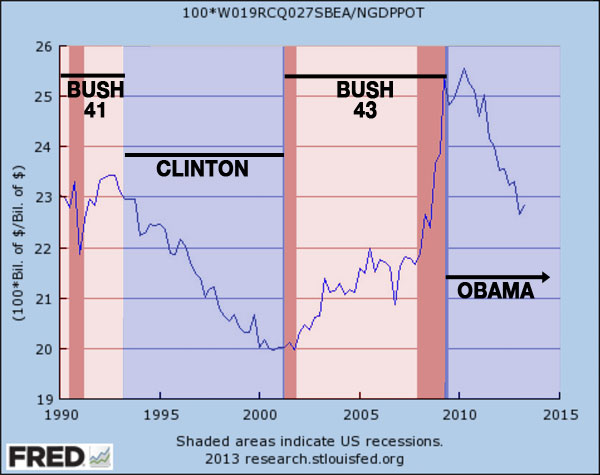
This is Krugman’s chart showing the U.S. budget as a percentage of potential GDP. To accentuate my point, I highlighted Republican administrations in red, and Democratic administrations in blue. There’s a pattern there, though it may be hard to discern if you are conservative.

Bgdpchart01

Categories: Economics Tags:

iPhone Fingerprint ID Uselessly Hacked

September 23rd, 2013 1 comment

A German site is claiming they have successfully defeated Apple’s Touch ID technology with “materials that can be found in almost every household.” OK, let’s see what they require:

  • A clean original print of the finger used to set the Touch ID;
  • Colored powder or superglue
  • Ability to photograph the print cleanly “with 2400 dpi resolution”
  • “A bit of graphical refurbishment”
  • A laser printer
  • A transparency slide
  • Wood glue
  • Glycerine

I think we have superglue in the house, and I have a high-quality digital camera and the graphics software. None of the other stuff, though. I’d have to go buy a laser printer and the transparencies. Other trouble with the list lies in the vagueness. For example, how much is “a bit” of cleaning up the image in a graphics app? From the photo they showed, it looked like a semi-tough job to me, balancing the contrast and then repairing the ridge detail just so. Most people I know couldn’t do that. And they say that you “may” use “glycerene” (I presume they mean glycerine), but did not say that they were successful without its use. Nor did they detail how many attempts were necessary with perfect conditions before they were successful.

But let’s see how this process might work in real life.

The trouble begins right there at the top of the list: a clean print of the correct finger. They assume this will be easy to get, from a glass bottle or doorknob. Getting such a print is not quite as easy as they suggest. Have you ever tried to get a glass or bottle that a stranger used? It’s not as if they are simply laying around everywhere. Unless you live or work with the person, you would have to go to quite a bit of trouble to acquire that. And a doorknob? If you happen to find one the person used, like on a hotel room door, would you really have the time and privacy to use the powder, glue, and photography equipment in order to lift the print?

You could try to use the phone itself, but that’s not entirely easy either. The phone will have to have a full, clean print of the correct finger. Take a look at your phone: you may see some prints, but look carefully, and ask if any of those prints are complete and clear enough (not partial or smudged) to lift a usable print. I checked my iPhone and my wife’s at a random time: neither had anything close to a usable print. My iPad had a lot more prints on it, but all of them were smudged and not complete.

So, if someone is lucky enough to steal your iPhone or find it when lost, what is the likelihood that they will also be able to get your prints? While it may be possible that you leave your iPhone at a bar with a glass or bottle with a clean print of the finger you used that you can pick up and leave without anyone noticing or objecting, the chances are not exactly high. Realistically, the thief would have to follow you around for days to find the opportunity to get your phone and the print, and probably would have to take significant risks in doing so.

Next is the process of getting an image of the print. It is described as being a simple process. If you think it is, then I suggest you try it. Maybe under good lab conditions with a great print specimen with an experienced person doing it—but most people, I am fairly sure, would not have an easy time of it at all without a great deal of practice beforehand. So, again, you need someone really dedicated to the endeavor.

I am further puzzled by the incorrect terminology, as they describe a “2400 dpi” photograph. DPI is a printing measure, not a photography measure. Perhaps they mean 2400 pixels per inch of fingerprint area? It would be more clear if they could express the required detail of the fingerprint in pixel resolution.

Finally, aside from not revealing how many tries were necessary under perfect conditions to get the usable fake print, they introduced a further vagueness: the video shows the same person who established the fingerprint on the iPhone also using the fake print to unlock the phone. Apple’s technology claims to look beneath the outer layer of skin; I am not sure if it would be harder for a different person to also successfully use the fake print, but their video example raises that exact question.


So, let’s review what is actually needed:

  • The ability to steal the phone (not easy in the first place);
  • The ability to acquire a clean fingerprint of the correct finger;
  • The skill to successfully process and photograph the print;
  • The skill to use graphics software to clean up the print;
  • An unclear number of attempts to create a usable fake print;
  • Presumably the ability of a person other than the original user to successfully apply the print;
  • All the materials listed in the first list above.

You begin to get an idea of how the chances for all of this to be applied in a real-life situation are vanishingly slim. Right off the bat, most people who steal a phone have no ability to also obtain a fingerprint, and few thieves have the forensic skills to actually accomplish this process. As stated above, the thief would have to spend a great deal of time and effort, specifically targeting you, just to have a chance at being successful.

And they would have to accomplish this quickly enough so that the phone’s owner does not have the time to notice their phone is missing and wipe the data from it.

Does Apple oversell the technology? Absolutely. If you are a corporate executive or government official with top-secret information which you happen to store on your phone, should you rely completely on Apple’s technology? Of course not, you would be stupid to do that.

But if you are just a normal person trying to keep your personal information safe, then frankly, this is more than secure enough for you. Anyone so dedicated to accomplish the described hack would probably have an easier time just figuring out your online account passwords.

Categories: iPhone Tags:

iPhone Sales in Japan

September 22nd, 2013 Comments off

Splist01
Wow. In the week before the new iPhones come out (9/9 to 9/15), the iPhone 5 still dominates, taking the #1 and #2 positions (Softbank and Au 16 GB versions), as well as the 7th and 10th spots (32 GB versions).

This is significant because usually sales drop off dramatically in the weeks before a new model is released. In the past, that has been the only time when other models get to surpass the iPhone in sales.

I will be very interested to see the numbers for the next few weeks, in part because of the tracking web site’s method of fragmenting iPhone sales by model, carrier, and capacity, something it does for no other phone, and clearly an attempt to make it appear that other phones are doing better against Apple’s handset.

This fragmenting has already produced eight different iPhone listings (for all three capacities of iPhone 5 plus the iPhone 4S, and two carriers).

However, from now, DoCoMo joined as a third carrier, and there are two new models concurrently released, with five different capacities, and the iPhone 4S. That’s eighteen permutations.

It is entirely possible that, for a few weeks at least, the tracker’s attempt to break up and diminish the appearance of iPhone sales in Japan will actually result in the iPhone inhabiting all ten of the top ten spots, and probably most of the #11 to #20 spots as well. Should be interesting to see!

Categories: iPhone Tags:

Reaching New Lows: Deranged, Perverted, AND Hypocritcal

September 21st, 2013 6 comments

a creepy conservative adConservatives have a new ad out, one which is universally being referred to as “creepy,” which attacks Obamacare. It depicts a woman at a gynecological exam having a ghoulish pervert in an Uncle Sam costume sneak up on her with a speculum.

The message, void of the warped imagery, is that Obamacare puts the government between you and your medical care, an old canard which conservatives always fall back on when it comes to anything related to health care reform, a message as fake as the asininely depraved vehicle used to deliver it.

The real irony: these same conservatives—pretty much exactly the same conservatives—are the ones who are getting laws passed around the country which force women, including rape victims, to undergo mandatory vaginal ultrasounds before they can get an abortion.

That’s right. The people who actually are getting Uncle Sam to creepily violate women in hospitals for no defensible reason are putting out ads falsely saying that Obamacare will do to women what they are doing to women. Imagine a rapist putting out a commercial saying that the district attorney sexually violates women, or an arsonist running a nationwide TV campaign about how firefighters actually start fires. That’s pretty much what we’re looking at here.

It would be creepy even if it weren’t true that these people want to force rape victims who are trying to stop the pregnancy caused by their rapist to undergo a medically unnecessary procedure equivalent to government-mandated rape. I’m trying to imagine how you could be even a little bit more perverse than these people without sounding ludicrously obscene, but these people have long since passed that landmark.

New Cell Phone

September 15th, 2013 4 comments

Got a giggle from reading a 10-year-old blog post about how I got a new cell phone.

I wrote about the “feature-rich” phones back then (relative to U.S. phones at least), and mentioned someone taking pictures of a nature spot with them. I can only imagine that they treasure their 144 x 120 pixel memories.

My other note in the post: how it took an expensive cable, hunted-down freeware, and hours of frustration to transfer the address book I had to enter on a PC to the phone. So difficult that I used it just the once.

From memory, I recall that most of the features were cyphers to me (it had three different kinds of “email,” I never figured out what they were), and I almost never used much except just the phone. Then, after a few years, the contacts for charging wore down so much that just recharging the phone was a mixture of enraging frustration and disappointing failure.

What I also recall is that I just wanted one thing, really: the ability to sync my address book with my phone. Just that would have made me a happy camper. And though I was able to, it cost a whole bunch and was so much trouble that I rarely repeated the process.

A little less than five years later, I got my first iPhone. You can guess how that changed things.

When I see people saying stupid crap like “Apple tried to patent the rectangle,” I get pissed off, because it is eminently clear that these people have completely forgotten how absolutely abysmal cell phones used to be before Apple changed the game.

Categories: Gadgets & Toys, iPhone Tags:

Do Tax Cuts for the Wealthy Stimulate Jobs?

September 15th, 2013 8 comments

For the past thirty years and some, conservatives have claimed that the best way to create jobs and stimulate the economy is to cut taxes for wealthy people. From “trickle-down” to the recent drive to cut or eliminate the capital gains tax, the idea is that if you put more money into the hands of wealthy people, they will invest in business, thus creating jobs, leading to a stronger economy with more people paying taxes on greater incomes. Presto! A revived economy and more revenue collected by the government.

This has always struck me as one of the most obviously stupid ideas I have seen. Let me paint a little scenario with two variations.


Let’s say you have a depressed economy. People are not buying products, let’s call them “widgets.” They want to buy widgets (who doesn’t?), they just don’t feel they can afford to. Then there’s a Wealthy Person, who has tens or hundreds of millions of dollars. That person wants to invest in what will give the best return on his investment.

Variation One: you cut the taxes of the Wealthy Person. Both income tax and capital gains tax. The Wealthy Person gets a few million dollars extra that he would have otherwise paid in taxes, adds it to his pile of wealth. So, what happens? Will the Wealthy Person invest that money in a widget factory, thus creating jobs? No: nobody is buying widgets. Investing in a widget factory would be a stupid investment, bound to fail. Cutting capital gains will not lead the Wealthy Person to invest in a business which will fail. It’s not like the Wealthy Person did not already have lots of money to invest; if they weren’t putting it into widget factories before, why will adding a little more to their fortune change anything? The Wealthy Person will take that money and instead apply it to investments designed to increase his personal wealth even further, not to investments that are designed to create jobs or stimulate the economy.

Result of Variation One: the economy is still depressed, you have less tax revenue, and more debt—and some very pleased Wealthy Persons.

Variation Two: you don’t cut the taxes of the Wealthy Person. In fact, you raise his taxes to a marginal rate of 50%. Then you take that money, add it to the money that would have gone to the Variation-one Tax Cuts for Wealthy Persons, and apply all of that to give tax cuts to the lower-middle class and assistance to the working poor. Suddenly, the people who want to buy widgets have enough money to do so. They start buying widgets, and suddenly demand outstrips supply. Building a widget factory is suddenly a prime investment.

What about your Wealthy Person? You just raised his taxes. He won’t have enough money to invest in the widget market, right? Wrong. He’s a Wealthy Person. Which means he has lots of money. He doesn’t need a government tax cut. You can raise his tax rates to much higher than 50%, that’s not going to stop him from wanting to make more money. He’s got piles of cash, so no matter what, he’ll want to invest that in whatever gives the best return. When people start buying widgets, he’s going to build widget factories. And even if somehow his assets are all tied up somewhere, there are things called “banks.” These banks love lending money to people with lots of collateral and who want to invest in a booming business.

In short, no matter how high you raise his taxes, the Wealthy Person will not have any problems investing in a booming market.

Result of Variation Two: a revived economy, more jobs, stable revenue—and Wealthy Persons who are still making money and increasing their overall wealth.


Where am I getting things wrong here, beyond the simplicity of the scenario? How does this math not work out?

Categories: Economics Tags:

My Right to Swing My AR-15

September 14th, 2013 1 comment

Every once in a while you read about a story like this one, from Appleton, Wisconsin:

Police detained two men openly carrying AR-15 rifles near Saturday’s farmers market, setting off a debate this week about response at the highly attended event.

It appears that two local citizens, Charles A. Branstrom and Ross A. Bauman, decided to exercise their constitutional rights by going to a peaceful public gathering armed with weapons designed to kill large numbers of people. Obviously, it was a stunt designed to flaunt gun-toting rights, with someone ready to video the whole thing.

Police told Branstrom and Bauman “that walking into a farmer’s market filled with a couple thousand individuals would be a recipe for disaster.”

Branstrom and Bauman maintained that they had the right to do so, the report says.

They have the right to provoke public fear and disruption. Interesting. I wonder what the revolutionary Minuteman fighters would have thought about heavily-armed people needlessly marching about the town square. Something tells me they would have had a better sense of propriety and responsibility regarding a solemn duty.

One can assume that Branstrom and Bauman point was, “We have a Second Amendment right to ‘bear’ arms, and that means we can carry our AR-15s wherever we damn please.” Gun advocacy groups call such stunts “educational,” claiming that people will get used to such things.

However, despite the viewpoints of people such as these, most Americans—including, and perhaps especially those who own guns themselves—do not like the idea of the streets being populated with people wielding military assault rifles. One can assume that the open-air violent crime rate in Appleton, Wisconsin is not in fact an actual threat, and even if it were, both police and local citizens would not feel more comfortable with random citizens eager to let go with their AR-15s in public taking it upon themselves to open fire on streets where their children walk.

Branstrom and Bauman acted ignorant of such attitudes, stating:

“I guess some people don’t like guns.”

They then claimed that the purpose for carrying the guns was “self-defense.” Really? They expected to get shot at at a suburban farmer’s market event? Or perhaps they thought it possible they might empty a few dozen rounds into a pickpocket?

Bullshit. There was no threat to them, and therefore no reasonable cause to carry the weapons. The reverse, in fact, is true: they were the threat. With no reasonable peaceful use for such weapons, their presence is a very real implicit threat to the other citizens there. It’s not that “some people don’t like guns,” it is that “some people don’t like implicit threats to slaughter their children.”

These gun-toting idiots may actually even think they were making a point about their rights and freedom, but what they were doing is the classic example of the only legitimate reason why any constitutional rights are abridged: infringing on the safety and rights of others. Some tend to forget about that rather vital and necessary counterpoint to one’s constitutional rights.

Categories: Right-Wing Extremism, Social Issues Tags:

Pooling vs. Redistribution

September 7th, 2013 4 comments

Conservatives today have a favorite bugaboo: “redistribution of wealth.” By itself rather innocuous-sounding, it is clear code for a variety of evils: taxes, stealing, and downright, outright communism. It has now commonly been replaced with the term “confiscation.”

What is strange is that redistribution, in its conventional form, is mostly admired, including by the very people who demonize it. Most people favor a progressive tax system, for example. Those who loathe redistribution nevertheless claim that the free market will redistribute, imagining that the wealth will circulate with wealthy people paying handsome wages in exchange for labor—as false a myth as you can find, of course. They approve of redistribution, they just naively and foolishly believe that wealthy people will do it unbidden—many even credulously believe that that is what is happening right now.

What is not usually spoken of is the only alternative to redistribution: pooling of wealth. Most of the wealth in a society being drawn to one place and staying there. Not funding jobs or infrastructure, not moving through the economic engine. Just sitting there, its only purpose to draw more money to the pool.

If you think that redistribution is distasteful, then the effects of pooling are downright catastrophic. We’re seeing many of those effects right now, and they are going to get worse. And as wealth pools more and more, the usual corrective measure of higher tax rates will affect it less and less, because tax only reaches wealth that moves. To reach pooled wealth, you need the estate tax, which takes generations to reenter the economic cycle—and which wealthy people are clamoring to eliminate.

The economy is an engine; capital is the fuel. Should wealth pool, the engine will stall. Redistribute, and the engine runs with efficiency. Even Romney understood the basic principle, he just believed, like so many conservatives, that the fuel runs between capital investors and corporations—from one part of the top to another part of the top—with money to workers being a by-product, if anything—instead of the actual path it must take for an economy to be dynamic, which is from bottom to top and top to bottom.

A necessary observation is that while the bottom is forced to spend upward to live, the top has no such built-in force, and unless forced to redistribute downward, the top naturally tends to collect wealth and remove it from circulation. Conservatives have been systematically dismantling the forces we had created to accomplish this, including taxes and unions, thus making downward redistribution voluntary—which, in real terms, means the minimum necessary and no more. And the minimum is too slow a trickle to make our economy run.

At the gut level, most people seem to know this. But too many people now have bought in to the scam that somehow managed redistribution is evil and destructive.

Categories: Economics Tags: