So Long As We Can All Have Them
Florida tried to get this license plate approved for public use a while ago, and now South Carolina is trying to pick it up and run with it:

I say fine, so long as they also allow this one to be sold:

Fair is fair.
Florida tried to get this license plate approved for public use a while ago, and now South Carolina is trying to pick it up and run with it:

I say fine, so long as they also allow this one to be sold:

Fair is fair.
Sachi and I just now got back from the Teppan-yaki place (cooking “right before your eyes,” as the famous Engrish misquoted) Sachi took me to for my birthday. Wow, that stuff is good! We ordered filet steaks–I got the “special” (read: extra-fatty) version, and the entire course was fantastic. The appetizer was high-quality roast beef, followed by a fish course of cooked scallop (though I got a replacement dish of nama-hamu and fruit), followed by the main course. Like Benihana in the U.S., the cook prepares the whole meal in front of you. He started by cooking garlic slices (delicious–just like garlic crisps!), then prepared the filet steaks (medium-rare), slicing them into bite-sized pieces as he cooked them, followed by asparagus and sprouts, everything garnished with delicious onions, garnished with rock salt. There were three tasty sauces–apple-flavored, tomato sauce, and soy sauce with an original wasabi garnish, all to dip it into before eating.
We were served a bottle of wine (after three beers between us), so we got appreciably high during the meal. The problem was, they seemed to be waiting for us to finish our wine before they served dessert, and we were saving the last of our wine to have with dessert. So it was a good 40 minutes or so of waiting before we finally got the idea and told them to take the wine to the dessert table–where they had a nice birthday cake (white layer cake topped with whipped cream, laden with cherries, orange slice and kiwi-fruit) waiting for us.
The place is local (to Ikebukuro) and pretty expensive, but man that was good! We splurged on a taxi home (all of seven dollars and worth every penny, in our state), and somehow made it back in the door.
Would every birthday be so delicious and fun.
Sachi got me a very nice Ralph Lauren suit for my birthday, and topped it off with a nice cotton shirt and matching tie this morning.

Why, what were you thinking the title meant?
Seriously though, I look like I’m running for office or something….
I’m teaching an evening class this semester on web page design, and I hope to get around to CSS this time. Of course, it helps to actually know CSS–which I didn’t–so I dove in recently. Now, I’ve known about CSS for years, and got slightly familiar with it five years ago when I started this blog–it was necessary to customize the blog’s appearance. But back then, it was mostly just taking a pre-made CSS style sheet and altering numbers and image URLs until I got what I wanted. I didn’t learn how to actually write CSS myself.
So I started looking around for an acceptable tutorial on CSS–and that’s not easy to do. Most tutorials for stuff like this which you find on the web are terrible. Either they’re written in so disorganized or unclear a fashion that you can’t understand it, or the writer assumes you know a lot already without even mentioning what you need to know before reading the tutorial. It’s incredibly helpful to find a tutorial somewhere that is understandable, and where you don’t quickly run into something leaves you completely befuddled. I found a few sites that seemed fairly good, but none that explained everything to my satisfaction. I had to go to several sites to find enough explanations that told me what I needed to know.
So here’s my own try. For this, I will assume that you know basic HTML–which you have to in order to get started with CSS, frankly. (If you don’t know HTML but want to, here’s what I use to teach it in my college course.) If you know about tags (commands) and attributes, basic rules, and have an HTML vocabulary that allows you to make a basic web page, then this tutorial on CSS will be understandable–I hope. Let me know what areas might trip you up.
If you already know or are not interested in CSS, just skip over to the next post. Sorry about the length of this post, but I didn’t want to hide the lesson under the fold.
CSS is a kind of coding related to HTML. It allows for much greater control of the formatting of a web page. Regular HTML allows for some format control, but it is very limited, like using a really basic, bare-bones text-editing program. CSS allows for much finer control, like a more advanced word processing program.
There are three ways to add CSS to a document:
In-line CSS is CSS coding which is independently inserted into an HTML tag. For example:
<p style="color: red;">This text will be red.</p>
will result in the text turning red. As you can see here:
This text will be red.
The CSS is in the tag attribute "style." There is no need for other CSS code to be placed anywhere; the code is independent.
Internal CSS is where you define certain styles within the head of a web page, and then refer back to those styles within HTML tags throughout the page. The value here is if you want to apply the same style in many different points in your document, but don’t want to insert the CSS code again and again at every point you need it.
External CSS is where you define your styles in a separate document called a style sheet. This allows you to define the styles for many web pages, all at once. Instead of defining the styles again and again in each page’s header, you define the styles once in the style sheet. Every web page links to the style sheet once in the head. After that, references to these style definitions in the web page code will draw from the style sheet’s definitions. This way is best for maintaining a single style over an entire web site (such as in this blog).
In this tutorial, we will begin by using internal CSS. This will allow us to later take this knowledge and apply it to in-line or external CSS.
Next, we need to understand selectors. In internal CSS, you put them in the head of your document; in external CSS, you put them in your style sheet. They define a style which can be applied in an HTML tag in the body of a web page.
Since we are doing internal CSS, then within the head command, you will add the command:
<style type="text/css">
</style>
And then within that command, you will place the selectors. Each selector begins with a name followed by properties inside curved brackets; the properties include declarations, each which take up a line and end with a semicolon; each declaration has a property followed by a colon, and then the value. Here’s what it could look like: <style type="text/css"> selector { property: value; property: value; property: value; } selector { property: value; property: value; } </style>
Following is an explanation of each type of selector. (Note that there are more than three types; we’re just looking at the main three.)
An element will change the effect of an HTML tag. For example, a <blockquote> command in HTML will have the effect of indenting text by a half inch in a paragraph separate from the preceding and following text. If, however, you define an element style for the <blockquote> command in CSS, then every use of that command will result in different effects. For example:
blockquote { background-color: lightblue; }
A nice feature of elements is that they allow you to create your own HTML commands. If the element you create already exists (for example, "blockquote") then the style you define will be added to the command’s existing properties. However, if you create an element which is not already an HTML command, then it becomes a new command with the properties that you define. For example: blah { background-color: lightblue; color=darkblue }
Next, a class allows you to add styling to a variety of HTML tags, or to some tags but not all instances of them. For example, what if you want some of your blockquotes to have light blue backgrounds, but some not? In such a case, you would introduce this selector:
.blueback { background-color: lightblue; }
Here, you have introduced a new class called "blueback." You can call the class anything you want within the naming rules (to be safe, keep it one word, lowercase, avoid punctuation or symbols). You then activate the class by adding the attribute class="classname" (no initial period) to any command that can use it. For example, you could add this to the <blockquote> command, the <em> command, the <b> command, and so forth.
At this point, however, you might wonder if it’s almost as much work to add the selectors and the tag attribute than it is to just add the CSS directly within the tag. But this example only has one declaration, which is "background-color." You can add as many as can apply, for example:
.blueback {
background-color: lightblue;
color: red;
font-weight: bold;
font-size: 16pt;
}
With that many declarations, it is much more economical to simply add the "class" attribute to any particular command.
Finally, we have id selectors. They begin with a number sign (#) whereas classes begin with a period (.). They are almost exactly the same as class selectors, except that they are supposed to be used with only one tag per page, instead of with many tags. This is for special cases where the position of an object on a page, as defined in CSS, is unique and does not exist elsewhere. However, since the class selector can do the same thing, id selectors are in a way redundant–but are still widely used anyway.
Now, for those of you who enjoy learning a few quick tricks now and then, here’s a fun one. Have you seen web pages where stuff changes when you pass the mouse over it? Text changes color, size, etc.?
This can be accomplished by duplicating a selector, adding ":hover" to the name of the second version of the selector, and changing the declarations in the hover version to be what you want. For example:
<style type="text/css"> .blueback { background-color: lightblue; color: red; } .blueback:hover { background-color: lightgreen; color: blue; font-size: 120%; } </style>
Naturally, there is a lot more to CSS, but what we have covered up to this point will get you a fairly long way. Of course, one of the most important points in learning a new language is vocabulary. Above, I have covered grammar and syntax–but to really use CSS, you must be familiar with–or at lest possess a cheat sheet–showing a lot of the possible properties and values. So I have created an independent cheat-sheet page which you can print out and use whenever you are coding CSS. It doesn’t have all properties that are out there, but it’s a long list with most of what a beginner would want or need.
In a later post, I will wrap up by explaining how to take what we’ve learned here and apply it to in-line or external CSS formats.
I hope that this tutorial serves to introduce you to CSS in as simple, clear, and useful way as possible. If you’re in my target audience–HTML coder who doesn’t know CSS very well yet–and you tried out this tutorial, please leave a comment to let me know how it achieved its goal. If you had a problem somewhere, please let me know where it was and what the problem was. Thanks!
Yesterday, my boss wanted to know what his cell phone number was. It’s not forgetfulness–many of us don’t know that because we never call our cell phones or even give the number out very often. I’ve had my cell phone for more than eight years, and I still don’t know my own number. But the problem my boss had was, he had no idea how to get the number from his own cell phone. So he handed the phone to me, the usual go-to guy for tech issues at my workplace, so I could figure it out. Now, on my own phone, I know how to do this–press Function and then Zero–but someone else had to show me–it was not marked in any menu, nor was it self-evident. It was more like an easter egg, in fact. And when my boss handed me his cell phone, I wasn’t able to figure it out myself. Now, the self-number is a no-brainer as far as features go–almost everybody has to access this from time to time. It should be self-evident, or at least not too hard to figure out. But I couldn’t find it. I went through all the obvious feature-access buttons and cruised the menus (most in English, though the phone sometimes jarringly switched to Japanese), tried sub-menu after sub-menu, checking all the logical suspects. After three minutes or so, I had to hand the phone back in defeat; I could not figure it out.
My own phone is not too dissimilar; it also has lots of features that I wouldn’t mind accessing from time to time. However, most of them are so buried in user-unfriendly toolbars and menus that it would be simply far too much work to figure out. Multiple menus with features too similar to each other to figure out why they have different menus, some features buried in seemingly unassociated menus, bad icon choices for many of the menus in the first place. To use any feature, I would have to dig out my manual (Japanese only except for a brief user’s guide in English, so I have to go into Japanese for any non-basic task) and teach myself how to use it.
The problem here is, unless you use a feature every few weeks–and many phone features you would not use so often–you can easily forget how to do it. Plus, if the task you want to do should only take a few moments, but learning how to do it takes up a solid fifteen minutes, then it starts becoming too much trouble to look it up. If your phone has too many features, then you won’t access many of them often enough to learn how to access them.
A new Wired article makes some good points about this, explaining how massive feature creep has overloaded Japanese phones:
Indeed, Japanese handsets have become prime examples of feature creep gone mad. In many cases, phones in Japan are far too complex for users to master.“There are tons of buttons, and different combinations or lengths of time yield different results,’” says Koh Aoki, an engineer who lives in Tokyo.
Experimenting with different key combinations in search of new features is “good for killing time during a long commute,” Aoki says, “but it’s definitely not elegant.”
Japan has long been famous for its advanced cellphones with sci-fi features like location tracking, mobile credit card payment and live TV. These handsets have been the envy of consumers in the United States, where cell technology has trailed an estimated five years or more. But while many phones would do Captain Kirk proud, most of the features are hard to use or not used at all.
Now, remember that the primary argument saying why the iPhone will fail in Japan is that it will be a yawner next to most Japanese cell phones, which have for some time featured much of what the iPhone offers, and often much more. While the feature sets in Japan have indeed been rich for a long time, that’s not what makes the iPhone special.
What makes the iPhone special is that it is easy to use. I don’t even have an iPhone, and only used one for a few minutes while helping my sister get used to hers last December, but I am fairly certain that I could have found my boss’ number without any trouble had it been an iPhone. Just go to the contacts, I’m pretty sure it’ll be there. Or else go to the settings, it should be there, too. I just expect these things from an Apple product. (Can anyone with an iPhone confirm that you can get your number either of these ways?)
Japanese cell phones are not like this. I tried using some of those feature-rich ones a few times when I passed a cell phone shop and had some time to look. It was painfully hard. I had a tough time understanding what the heck to do even when I got the salesperson to switch the phone to English (it took them a minute or two to figure even that out themselves). After ten minutes with a nice-looking phone, I decided that I did not want to use the damned thing, as attractive as all its touted features were. Not to mention that some of the “great” features are in fact dogs:
“When I show this to visitors from the U.S, they’re amazed,” Hayashi says. “They think there’s no way anybody would want an iPhone in Japan. But that’s only because I’m setting it up for them so that they can see the cool features.”In actuality, Hayashi says, the P905i is fatally flawed. The motion sensors are painfully slow, and the novelty of using them is quickly replaced with frustration. And while being able to watch TV anywhere is a spectacular idea, there’s no signal in the subways, and even above ground, the sound cuts out every few seconds.
“There’s nothing more annoying than choppy TV noises,” Hayashi says.
Long story short: Japanese phones have far too steep a learning curve, making most features unusable, and many of the features people would use are not as great as they seem.
That’s where the iPhone does its magic. You can do things with it. The list of features may not be as long, but they are good features, and you can use more of them, more easily. The list of usable features on an iPhone beats out the other phones. The web browsing is huge. Email is good, and the keyboard allows for much easier typing. Visual voice mail is a no-brainer. Google Maps with the search features tied in is huge (I know Sachi and I will use that a lot). The GPS almost certain to be included soon will make it even more attractive (I will use that so much when on my scooter). And you can easily forget that this is an iPod, with hi-res (for a handheld device) video, and the iPhone will probably get video telephony with the new models. Then there will be the app store, allowing for huge expandability. And odds are that most Japanese will be able to figure out more of these features, faster and with less reliance on manuals. Certainly, my boss would have never asked me for help that time if he’d had an iPhone.
That’s a big part of why I really want an iPhone myself. Before the iPhone was announced eighteen months ago, all I really wanted was a cell phone that could sync calendar and address book info with my Mac–I would have switched to another phone instantly had I found it (especially if it were bluetooth-ready). The iPhone delivers a great deal more than that. So despite living in the Nation of Advanced Cell Phones, I will wait for however long it takes to get an iPhone. And as soon as Japanese users–conditioned to simply take the standard Japanese fare without question–begin to see and hear about what the iPhone can do, it will take off.
It might take a year or two, but it will eventually trend that way. I seem to recall that when the iPod was introduced in Japan, people similarly predicted it would have trouble catching on because the Japanese market was already saturated with and dominated by advanced, domestic-produced music players. But today, when I walk around town, I see most people using iPods. The success was not immediate, as I suspect the iPhone’s will not be. But the iPhone should succeed despite the naysayers’ reasons, in just the same way as the iPod did before.
Unfortunately, we may need to wait a little longer: I dropped by the SoftBank store a few days ago, and the clerks there said they had no more info that was in the terse press release–but that they doubted the iPhone would be released soon. They have already released their summer line of phones, and new phones require setting up with the service. The clerk said a Fall release was the soonest he expected it, and it might even have to wait until the winter line comes out.

A lot of people are pointing this out recently: On McCain’s web site, “Golf Gear” is given just slightly less priority than Iraq. Now, we know the man is desperate for funds, but how much can he make off selling McCain-branded stuff at the cost of a presidential appearance? Both candidates sport links to stores which sell their stuff, but this looks more like some commercial promotion beyond pins, T-shirts, and bumper stickers. But that’s all within the store, not promoted noticeably on the candidate’s main page just above a prominent photo. Not to mention that the stores are less about money-making than they are about advertising, and you won’t advertise very well by having rich folks carrying around your stuff on isolated golf courses.
That leads to another mystery in regards to the gold gear: golf? I mean, nothing says “old rich white guy” quite like golf does. Selling sports gear in general including golf stuff would have been better–a more widespread and even youthful appeal–but why focus on golf so prominently? Are they trying to invite comments about his age? Not to mention that Obama proudly displays the fact that his store’s stuff is made in the US by union labor. McCain, who proudly boats how much he loves NAFTA, has no indication of where his gear was made. China, probably.
And the kicker: McCain hates golf.
On another note, what the hell was with McCain and that speech? Forget the Obama with 32,000 while McCain had a few hundred; forget the lime-green backdrop. What was with that demented laugh and smile?
Ouch. Keep that stuff up, McCain.
McCain’s feeble joke within his debate proposal:
McCain also suggested the two candidates fly together to the meetings, joking that that would save energy and money.“I even suggested we travel to them together on the same plane, probably help out on energy savings,” he said to applause from an audience in Baton Rouge.
No problem, McSame: you can both commute on your wife’s private corporate jet–you know, the one you’ve been monopolizing to get around campaign finance laws, violating even your own self-set policies.
Funny how nobody in the Liberal Media™, which has been giving wide play to McCain’s ‘joke,’ has so much as mentioned the corporate jet, much less gone for this low-hanging fruit of a jab, something the media usually leaps at. Oh, wait–I know why: the media has completely failed to report on stories like McCain’s immersion in lobbyists or the corporate jet story, so no one would get the jibe if they used it.
This is a theme now in McCain’s campaign, and you have to hand it to him that he’s getting the upper hand on these things by beating Obama to the publicity punch. A while back, McCain made a “challenge” to Obama to commit to public financing–which would suit McCain great because Obama is a fundraising giant, with the added advantage of raising most of his money from citizens in small denominations, where McCain is more dependent on large donors and PACs. Obama would have to be stupid to give up that incredible advantage, but McCain scored points off the impression that somehow the challenge shows McCain is somehow more of a campaign-finance saint, when in fact McCain is immersed in lobbyists.
Then, a few days ago, McCain pulled a similar stunt on Iraq, pointing out that Obama had not been to Iraq in a long time, and “invited” Obama to go with McCain to Iraq. Never mind that McCain doesn’t seem to have even the most fundamental facts about Iraq down, such as whether or not we are or soon will be back to pre-surge levels; never mind that trips to Iraq are for PR purposes only and don’t do much to actually educate politicians about what is going on there. McCain was able to play the situation up to make it look like he’s the knowledgeable expert on Iraq–despite the fact that he’s made almost every wrong decision on Iraq, while Obama has made better ones from day one. For Obama to go to Iraq with McCain would be pointless–neither would really learn anything–and doing so would allow McCain to lord his “superior” status over Obama, acting like the teacher giving Obama lessons.
And now McCain is taking the initiative in the debate arena as well, calling for ten town-hall debates with Obama. Again, it makes it sound like McCain is being open and reasonable–but at the same time, it plays incredibly unevenly in McCain’s favor. McCain does terribly at podiums, while Obama does very well; the town hall, meanwhile, is McCain’s home-field advantage, coming across as more homey, while Obama is not as skilled in that venue–and you can bet that McCain’s campaign would play to the hilt the low-expectations game, touting Obama as the great orator so that when McCain does well in town halls, Obama will look all the worse. So many town hall meetings would also play to McCain’s financial advantage, as they would give McCain more visibility and exposure without having to pay for it. So Obama would not be wise to take McCain up on that, at least not in full.
The details are as skimpy as they get, but SoftBank today announced on their web site that they’ve signed a deal with Apple:
SOFTBANK MOBILE Corp. today announced it has signed an agreement with Apple® to bring the iPhone™ to Japan later this year.
The Japanese version of the announcement says “in this year,” not “later this year,” but since both the English and Japanese come from SoftBank, I presume that they mean the same thing. “Later” is kind of fuzzy, though–are we talking August or December? It definitely doesn’t sound like July, though.
Also unclear is… well, everything else. Whether SoftBank is to be the exclusive carrier, for example. It would be a bit strange if it weren’t–as far as I am aware, Japanese cell phones are almost always (if not always) tied to specific carriers.
I was also on the verge of posting recently that Docomo seemed less and less likely to release the iPhone for a few different reasons; one being that they will be selling the Prada Touch phone by LG, considered an iPhone competitor; also, they just released a big line of new 3G cell phones, equipped with large screens, video streaming, GPS–the works. Doubtful they’d release such a big line of phones like that so close to announcing the iPhone.
Nevertheless, people are still talking about how the SoftBank iPhone contract might be a way of pressuring Docomo or something; for some reason, I doubt this a bit. I drive by a SoftBank store every day on my commute to work; maybe I’ll stop by today and ask some questions.

Meanwhile, just a few days before Jobs is expected to spill all the beans about the new 3G iPhone at the WWDC, rumors fly–ranging from minimalist reports that the new phone will be thicker and have no other upgrades aside from the 3G ability, all the way to hopeful, soaring rumors that the new phone will be slimmer, have a longer battery life, and will feature GPS, video conferencing and more. What many seem in agreement about is that the new form factor will have rounder edges, and the phone will come in at least white and black varieties (though more colors have been rumored).
In other Mac news: Apple’s “.Mac” service is going to get rebranded and maybe overhauled, it seems; Apple seems to have bough the names “Me.com” and “MobileMe,” and the new service will probably fold iPhone connectivity into the package, along with unknown feature changes. Among the rumors: online versions of Mac apps like Address Book and iCal in a new system that offers “push” syncing.
Also out today is news that Jobs will introduce OS X version 10.6 at the WWDC this week, an OS to be released next January–which is really early in terms of OS releases for Apple, just 14 months after Leopard. However, the release will be unusual: as it’s name–“Snow Leopard”–suggests, it will not be a full-featured upgrade. Instead, it will be “heavily focused on performance and nailing down speed and stability,” and will be made for Intel Macs only.
So, presumably, no tablet Macs with Multi-Touch which can talk in soothing tones while mixing drinks for you. But who knows.
One other thing–Sachi heard the SoftBank story on the news last night–and didn’t tell me. We’ve got to have a serious talk about this kind of thing.
I ran out of gas on the way in to work this morning, so I had to stop and fill up–and as a result, I was running a few minutes late. Still, I took care as usual when driving–did not exceed the speed limit (at least not by any more than everyone else did), and followed the traffic rules.
But then, not too far from work, after just rounding a corner, a motorcycle cop on foot flagged me down and waved me to the roadside. It was the typical speed trap–they have some guy with a radar gun right before the turn, and when you trip the sensor, they pull you over. Except I hadn’t been speeding.
Still, you get the usual range of surprise, fear, adrenaline, and (in this case) anger, when you get pulled over. It is an extremely unpleasant feeling, as your mind races over the fees and the points against your license, and the problems with renewing your license later on. No one enjoys getting pulled over by a cop.
So I pull over and a police woman approaches me. And hands me a package of tissue. What the…? It is accompanied by a flier, telling of traffic fatalities. “There have been a lot of accidents here, so be careful!” she starts out. Exasperated, I explain that I am late and don’t have time for this. She says something I don’t catch, then waves me on.
I was reminded of a story I once heard, of a woman who was driving along and a cop started his siren and pulled her over. It turned out that he wanted to compliment her on her good driving. She was livid. And so was I. The police have no business pulling people over for stuff like that–I was driving within speed limits, safely, and wearing better gear than most (a firmly-starpped-on full-face helmet, where most scooter drivers wear cheapo top-of-the-head-only plastic helmets, often loosely applied). Police must know they scare the crap out of people when they do that. A roadside sign would have done the job better. As I left the round-up, I was not more cognizant of traffic safety–I was seething at the police for needlessly scaring me and making me late, probably concentrating less on traffic safety as a result.
As I have written before, Japanese police, especially traffic police, are widely disrespected, and deservedly so.
Hello. This is the first time I have ever met you. Have you ever done anything that is even remotely interpretable as a bad thing? If so, you will suffer in great agony for all eternity unless you come to me begging for mercy, and do what I tell you to do.
Fair enough?
As crazy as this sounds, this is the message some religious people will send you. Go ahead, take this simple test. It’s an advertisement for a religion, where they simply refuse to believe that you are a good person–at least three times in this “test” you are given only the choice of “admitting” that you are a bad person, and so you must repent and accept Jesus as your savior or else burn in hell forever. (Red text shows links; h/t to Pharyngula.)


If you take the test a second time, it lets you “lie” for a while, but eventually scolds you, saying “Unfortunately, you don’t see yourself as God sees you. The Bible says all men are sinners, until you’re ready to admit that you can’t continue this test.” Then it urges you to take the test again. (Interestingly, it does the same thing even if you switch browsers–meaning that god depends on IP address recognition to see if you’ve taken the test before.)
Whatever you say or do, you wind up being a miserable sinner in the religion’s mortal debt. This is what you could call a “fixed” game–no matter what, you lose and I win.
And that’s what some religious people see life as being: a fixed game where you owe “god”–which in immediate terms means their church, and by proxy, them–everything, because you are a lying, stealing bastard, and your only hope is to admit that you are debased before them so you can receive god’s (their) forgiveness, so that despite being a lying, stealing bastard, you at least have a chance not to be tortured for all eternity. Most religious people are not like that, so understand that I do not address them, but rather those who bear this message I speak of.
For those people, I have a different idea: pack up your snake oil caravan, you hypocritical, arrogant, self-righteous morons. I’m not the idiot that you think I am, so apparently I do not belong in your church. Thank god for that much. So go away and stop giving the majority of spiritual people such a bad name.
Even before the results from Montana and South Dakota came in, the superdelegates finally decided that the time had come. More than two dozen suddenly announced their support for Obama; some have Obama now only a few delegates away from clinching the nomination. Apparently they want to be the ones who push Obama over the top, not the voters. Either way, Obama will without any doubt whatsoever get the nomination today. This while reports fly that Hillary is shutting down her campaign–or, as some have said, “suspending” it.
Finally.
If you’ve never been to Japan, then you probably have not even heard if the izakaya, a Japanese establishment that a great number of people here will frequent, at some time or another. It’s virtually part of the culture; at some point or another, your group will want to eat out, and the izakaya will be a natural choice.
Izakaya (居酒屋, three characters which literally mean stay-liquor-shop) is loosely translated as a “pub,” but is a bit more than that. You don’t just drop by for a pint. It’s kind of a cross between a pub and a full-blown restaurant, being neither of them, nor exactly a cross between the two.
An izakaya is a place where workers go after the daily grind has ended to socialize. It serves food, but in a communal fashion–small dishes are brought in for everyone to grab from. But drinking is the prevalent activity; this is a place to drink a lot of beer or sours, a category of Japanese spirits doused with fruit syrup to make the alcohol go down more easily. It’s a place where you relax and get down with friends and coworkers, loosening the normal inhibitions, allowing you to talk more openly. Not that most westerners have a problem with this, but it helps a good deal with Japanese sometimes. But mostly it’s a place to go eat and drink after work.
Have you guessed yet that I have been to an izakaya tonight and don’t have much else to talk about?
Nevertheless, these establishments are a solid part of Japanese culture that merit being discussed. Much more than the bar around the corner or the pub down the street, more than a tapas establishment, this is a place almost everybody goes to once in a while–it’s almost a prerequisite to continued residence in Japan.
Some izakaya are ripoffs–they string you out on dishes, taking their time to deliver each course, counting on you to buy more and more of their over-priced drinks while waiting for more food to come–this in the case where you pay for each round of drinks separately, in which case they want to maximize on the drinking while skimping on the food.
But a good izakaya will have a nomi-houdai (all-you-can-drink) course with a solid menu of foods delivered tasty and on time; that was the place we all went to tonight after work. We have visitors from home campus in Wisconsin and wanted to show them a good time. Additionally, we had that rare occasion of fourteen souls and not one dedicated smoker–and the izakaya we chose had a private room for us. In an izakaya, that’s a blessing–one of the worst things about such establishments is the lack of non-smoking areas, so you wind up coming home with clothes and hair smelling like an ashtray.
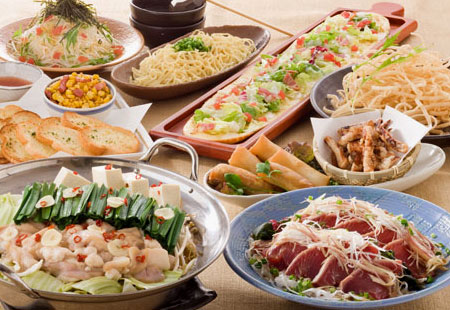
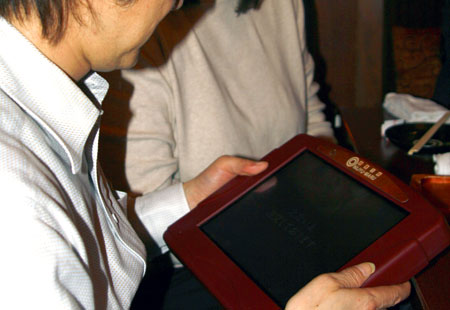
But tonight, we fared pretty well. We went to a joint that Sachi and I had visited a few times in Ikebukuro. When we went, we were taken aback at the prompt service; not enjoying an all-you-can-drink package, we expected the usual stringing-out of food dishes, and so ordered everything at once–and then it all arrived at once. Problem there. The next time, we ordered–using the handy wi-fi tablet menus–what we wanted and when we wanted it, and the food came fast, and well-prepared. A good place. I recommended it for our school dinner, and we were not disappointed. We got the ¥3000 ($29) per person set, which entitled us to two and a half hours of non-stop drinks, along with seven courses of pretty good food in sufficient quantity to satisfy everyone. A good deal.
In case you’re wondering, the place is Niju-maru, literally “two concentric circles,” which is their logo. Odd meaning for the name, but very good food and service.
The best that I can come up with in explaining what we see in the news is the idea that those Clinton supporters are the extremists, or perhaps the almost-extremists (the real extremists are the ones who, Scaife-like, claim that Obama was a drug-addicted murderer), and that most ardent Hillary supporters are not like the ones we usually see put forth in the media.
At the office where I work is a woman who fits the profile of a strong Hillary supporter–and older woman, a Democrat, a feminist and member of the civil rights generation. I asked her how she felt about the election. Her answer was instructive; not that I understood it fully, but it gave me a better idea of how some Hillary supporters feel.
Her primary reaction was anger at Obama. She surprised me by saying that the anger was for Obama just running against Hillary in the first place. But not for the reasons you might assume. My own thinking had been that Hillary supporters were angry at some slight they imagined coming from the Obama camp, but that wasn’t it. It was the idea that Obama is an upstart, an underachiever with little more than charisma, who has come to a race that was Hillary’s to win. Not that she was entitled because she is a woman, but rather because she had worked for so hard and for so long, and deserved the candidacy because of all that she had done, all the advancements she had fought for so hard. Furthermore, she is an icon of her generation, a representative of sorts for all the people who, like her, fought for civil rights, for women’s rights, and for the ideals of the party. This was to be Hillary’s time, her reward for all that she had worked for in her life–and this unknown guy just walked up and snatched it away from her with some smooth talk and a well-oiled campaign machine.
So the idea of Hillary’s entitlement was not one of “she’s a woman, so she’s entitled,” though for many that probably is an important component. It was not even so much that it was Hillary’s “turn”; the idea is that if someone else had worked harder and longer–or even if it were more close–it would not have been so much of a disappointment that Hillary lost. But Obama is a brand-new face, someone just out of state legislature, who hasn’t paid his dues or gained the necessary understandings or perspectives. He hadn’t sweat much for the party, but claimed the title nonetheless.
To my friend, it was like someone working hard and diligently in an office setting for decades, striving to reach a top management position; after so many years of labor and sacrifice, the position was almost in reach–only to have some new guy with charisma swoop in and get awarded the position because everybody liked him so much. That it was a man taking it from a woman is probably an added sting to the general insult. While my friend insisted that this was not about Hillary being a woman, I find it hard to shake the idea that this is not an important component, at least for many women.
Now, I say that I understand this a bit better than before, having heard this explained to me by someone I know and respect. But I do not understand it fully. True, in an office situation, I would join in the outrage; were Hillary such a worker and some upstart came in and took the position just like that, I would be crying foul just the same. The thing is, I never saw political nominating processes as being like that. My friend asked, “why shouldn’t they be?” and I had no good immediate answer. All I can say is, “because they’re not.” Politics simply doesn’t work that way. Had it been, Bill Clinton would not have won over George H. W. Bush. Fine, you might say–inter-party you can’t expect that, but what about intra-party? Well, again, there were others more qualified–Jerry Brown had political positions for a longer time than Clinton had, in a more important state, and had championed Democratic principles, the environment in particular, certainly much more than Clinton had. Yet Clinton blew past Brown. In 1988, Dick Gephardt had more experience than Michael Dukakis, and Jesse Jackson has more civil rights and general liberal credentials than Dukakis.
None of these cases are as striking a contrast as Obama and Clinton, but I think that a case can be made. Though perhaps the counter-argument would be, it wasn’t fair in those cases, either–and perhaps not. But my point would be that, for better or worse, the party does not entitle a candidate for service or seniority. These help, but they are not deciders.
The key point: this is not an appointment, it is an election. Potentially lesser candidates do not simply step aside out of respect for seniority or service. They run campaigns, and voters vote for them. The idea is to find the person who runs the best campaign, who appeals to the party members the most, who represents that ideas and the character of the party voters, and who stands the best chance of winning for the party, based on a wide range of variables, experience and service being just a few.
In an election, the millions of members of the party decide, based at least in part on who is capable of putting up a better fight. If it were even mostly about seniority and service, then there would be no need for an election–those properties would simply choose the candidate–but they do not. And though Hillary supporters say she put on a better campaign, the fact is that Obama won the fight–despite getting more negative media coverage, at that. The point is, this is not the way an office chooses a leader–that is not up to a vote, it is decided by a calculus where seniority and service do matter. An election simply is not like that.
And if your candidate loses the election, you are disappointed, but you understand that this is how it works; you don’t get bitter and divisive, you just forge ahead under the new banner. That’s why I don’t understand the anger; had my guy been the one with more experience, serving the party over a lifetime, and had been unseated by an upstart with charisma, I would have been disappointed, maybe even upset that my party made the wrong choice–but I would not be angry.
Even with this explanation from my friend, although I have a bit of a better understanding of the underpinnings of the resentment against Obama, I still do not fathom the intensity of the anger involved. My friend suggests that this is because I am not of that generation, I do not see things from that perspective. Maybe so.
Near the end of our conversation, my friend insisted that sexism hurt Hillary more than racism did Obama, and we could have debated the point, but I was not there to debate and it was late to boot–neither of us wanted to get into that right there. You have heard my reasoning on this before.
My friend will vote for Obama in November–no way she’s voting for McCain. I know that she’ll genuinely fight for Obama to win. But she’ll still be angry. And I’ll want to understand that better.
I know I shouldn’t be surprised when the U.S. news media ticks me off. Still, it does with regularity. I watched reports of Hillary in Puerto Rico, talking all about the win, little about the very low turnout, and nothing about the DNC ruling that signaled the middle of the end of her campaign. They talked about her looking forward to South Dakota and Montana this week, without noting that Obama leads in the polls there.
Then they talked about Obama leaving his church. Guess what? They used it as another excuse to replay for the ten billionth time the infamous “God Damn America” video, as well as other stuff that makes Obama look bad.
When I see “studies” that claim that Hillary has gotten a worse ride in the media coverage, I really have to question the data. Had Hillary been given even equal coverage, then the media would have called her campaign all but over quite some time ago, instead of propping it up like a corpse you need to make look like it’s sleeping so nobody’ll notice.
In fact, the idea that Obama had been getting unfairly positive press was itself an incorrect impression; it was the result of Obama drawing huge crowds which were newsworthy in themselves. But every time the media simply showed Obama in front of a huge cheering audience, this was somehow an example of media bias in his favor. In those early days, everything was going well for Obama; how is it biased media coverage to report that someone is doing well when they’re doing well?
But when, of all things, an SNL skit tweaked them on the concept, they went into full attack mode, leaving Hillary pretty much alone except for the Bosnia sniper fire incident. And nobody seemed to mind when Hillary had been getting only positive coverage before Iowa, deemed “inevitable” by a media that seemed eager to award her the nomination before even the first election had been held.
Nor has this same media, going negative on Obama after believing they gave him too good coverage, made the same about-face with McCain, who they continue to fawn over. While making a huge deal over Obama’s mixup of the names of concentration camps his grandfather helped liberate, they are giving McCain a bye not only when he got troop numbers in Iraq completely wrong, but also when he stood by his incorrect assertions, claiming them to be true when they were clearly not. This after endless negative stories on Obama and his preacher problem, and almost no bad coverage of McCain and his problems with multiple preachers.
And yet somehow, a study was able to parse the numbers to show that not only Obama got more positive press coverage than Hillary, but both of them got much better coverage than McCain.
Like I said, you have to question that assertion.
Update: Ah. The study only covers the campaign up until Super Tuesday, something you have to read a bit down in order to notice. The study, for some reason, decided to stop checking just before the media went medieval on Obama.
I didn’t listen to all of it–it was way late at night here in Japan, and this was no MacWorld keynote or anything–but I did listen to the DNC Rules & By-Laws committee for about an hour last night. One thing that struck me was the partisanship of the Clinton supporters in the crowd. I had heard something about Clinton supporters mobilizing for this thing, but had forgotten about that when I started listening. It didn’t stay forgotten for long; every time a Hillary supporter on the committee made a statement that helped Hillary, the Hillary supporters in the crowd burst out into applause and cheers. Not polite applause, but raucous cheering. Points that favored Obama were met with more muted, polite applause.
I thought that was bad enough; apparently, I would have been more disappointed had I continued listening:
Catcalls and boos from Hillary Clinton’s supporters rained down as former Michigan congressman David Bonior, representing Barack Obama’s campaign, suggested splitting the state’s lost delegation in half and awarding a part to each of the remaining candidates.
Other crowd reactions:
“We just blew the election!” a woman in the audience shouted. … Some audience members heckled [a Clinton supporter on the committee who approved of compromise]. “Lipstick on a pig!” one shouted. —Source
Clinton’s supporters jeered when results of the committee’s vote were announced inside a convention room at a downtown Washington hotel. They shouted “Denver, Denver, Denver” – signalling their hope to fight Obama all the way to the Democratic convention. — Source
Judging by the anger index out there today, that wasn’t going to happen any time soon. They felt robbed — by Obama, the Democratic National Committee, but mostly the media.
“I’m about ready to kick you guys down the street,” one woman from Minnesota said when approached by a reporter. — Source
Of course, that was not even the worst of it. If you need to shower anyway and don’t mind descending into rather uncomfortable depths, then read this report on the bottom-feeders among the Hillary crowd–they sound hauntingly familiar, so similar to the people who claimed that the Clintons were mass murderers.
Look. What was reached was a compromise, and it followed the rules that everybody knew full well going in. It was not everything either campaign hoped for, it was in-between–but with Hillary so far behind, anything but an absolute victory for her pretty much signals defeat. But that’s not a measure of unfairness to Hillary; it is simply a reflection of the fact that she’s behind and would need every blast thing to go her way to win this. You can’t expect to be given more than a fair split just because you’re desperately behind.
But Hillary supporters don’t see it that way. Some still are thinking that Hillary was entitled to the nomination and see this as robbery; and some are still raging at what they perceive as rampant sexism and–yes–even reverse racism. Geraldine Ferraro let go with a rant this week that I couldn’t finish reading, it was so filled with divisive and paranoid invective that made me wonder, could so many otherwise reasonable people truly believe all this? This is not even as thin as polling saying that 20% of Hillary supporters in West Virginia voted on the basis of race–at least in that case, there was some evidence of racism in play. But what Hillary supporters are reacting to is wholly perceived, not based on evidence or even opinions in surveys. It is based upon a highly subjective reaction not supported in fact.
What it boils down to is that these hard-core, die-hard supporters, like Hillary, will simply not give up. And there is a telling, not to mention chilling message in what a Hillary supporter shouted in the second quote above: “We just blew the election.” That says it right there: to many Hillary supporters, if Hillary doesn’t win, then McCain does.
Which means that to them, any attack or attempt to undermine Obama is okay because, after all, he’s never going to win anyway. That’s what scares me about this crowd: not necessarily just their invective, but the inference which signals a willingness to sabotage the party’s chances in November out of pure spite.
I suppose this quote pretty much sums up the Clinton crowd:
Hazel Rigby, a Clinton delegate from Virginia, disputed suggestions Clinton is too far behind to win, regardless of the outcome of the Florida and Michigan dispute.“I’m here because I still think she has a shot at it,” Rigby said. “I want her there in the worst way.”
The worst way, indeed.
Sachi and I are getting really, really tired of the bugs. Ever since we’ve moved in, they’ve been around. When we started spraying them, they receded for a bit but never disappeared. Now, they’re back with a vengeance.


I don’t know the specific type of bug they are (maybe someone out there can help), but they are small, noiseless, gnat-like bugs. While a friend claims they come out of the drains (we’ve never noticed them around the drains), my own theory is that they came in with the potted plants. When you disturb the dirt, you can see bugs of various sizes (but mostly the same shape) crawling around in there, and there are quite a few of them buzzing around the plants. They’re attracted to moisture, too–when we leave out a damp cloth on the kitchen counter, they tend to zero in on it. So I think they are drawn to the moist soil of the plants, lay their eggs there, and reproduce in that way.
While they tend to buzz around the windows and other light sources, they also have the massively annoying habit of flying right up to your face every minute or so. I just killed one that buzzed my glasses a moment ago, and as I write, Sachi is using our dustbuster (it has a sealed dust compartment) to snap up the ones buzzing in her part of the room. But what is amazing to us right now is just the sheer number. Although you never see more than a few at a a time, there seems to be an endless supply. I smush about a dozen every hour around my computer station, and a trip to the balcony window every hour can lead to your catching a dozen or so. I must have killed 30 or 40 yesterday, and Sachi and I zapped twice that many today, easily–and still they keep coming. It can’t be from the outside, we’re too high up for that.
We spray bug poison in the plant dirt, and will be resorting to a bug bomb on Monday, but if anyone knows of a solution we can use, we’ll be happy to hear it!
Maybe McCain should make a few more babysit-a-senator trips to Iraq before claiming he has the expertise which Obama lacks. Citing his superior knowledge of Iraq due to his several visits there, McCain told a crowd that we have drawn down troop levels to “pre-surge” levels:
I can tell you that [the troop increase] is succeeding. I can look you in the eye and tell you it’s succeeding. We have drawn down to pre-surge levels.
Which, of course, is false–we still have 25,000 more troops there now than we had before the surge, and current plans are to draw down to only 10,000 more than pre-surge levels. Later, McCain tried to deny he was wrong; when a reporter tried to ask him if he was wrong about pre-surge levels, McCain forcefully spoke over the reporter, repeating “I said we have drawn down! I said we have drawn down! No, I said we have drawn down!” as the reporter tried to work in the words “pre-surge.” He then went on about how some troops have been withdrawn and there are plans to withdraw more–as if somehow he never said the words “pre-surge,” or that they were not an important element of his claim.
The Liberal Media™ is predictably playing this down, calling it “squabbling” and “bickering” over numbers. Of course, they took it much more seriously when Obama mistook which Nazi concentration camp his grandfather helped liberate. When Obama made that error, The Associated Press said, “Obama mistaken on name of Nazi death camp”; after McCain’s gaffe, it’s “Dems, GOP squabble over McCain’s troop numbers.” Reuters’ headline on Obama’s gaffe read, “Republicans take aim at Obama comment on uncle’s war service”; on McCain’s, they wrote, “Obama, McCain bicker over US troop levels in Iraq.”
Considering that an understanding of current Iraq troop levels is far more important than WWII trivia, especially in the midst of McCain making a huge deal about how he has superior knowledge of Iraq, the McCain gaffe is a much bigger deal–yet the headlines clearly play down McCain’s gaffe as much as they played up Obama’s. Instead of focusing on McCain’s error, its significance, or the fact that he’s denying it when it’s clearly an error, they instead focus on the two candidates disagreeing, using the trivializing language “squabble” and “bicker,” as if there’s little importance involved. Not to mention that they are not reporting on the fact which HuffPo picked up on, which is that there were three suicide attacks in Mosul today, the same city McCain had called “quiet” immediately after saying that we’ve drawn down to pre-surge levels.
John Kerry pointed out why it is indeed important to know the numbers:
If you don’t know the numbers of troops, it’s very difficult to make a judgment about whether or not they’re over-extended. It’s also very hard to have an understanding, as a citizen, about what levels of troops he’s going to keep there. If he thinks 150,000 is ‘pre-surge,’ and that’s where he’s going to stay, that’s a deeply over-extended military, and it raises serious questions about his comprehension of this challenge.
Not that the Liberal Media™ believes that: there are only 40 stories out there right now which have the McCain quote, while there are currently more than a hundred stories about Obama and the concentration camp switch.
A little perspective, please?
I probably shouldn’t even be linking to this, but I just can’t help it–it’s too hilarious. Some bad, bad person got ahold of (a) photos of sumo wrestlers, and (b) Photoshop. Japan Probe (h/t) posted one of the photos in their blog by way of linking to it, but I won’t go that far. Very, very naughty indeed.
Watch it, get the embed code from the menu, and post it elsewhere–especially comment spaces on forums and blogs which allow it and which are peopled by independents or people who might not have all the facts on Obama straight.