NBC Chief Admits He Wants to Overcharge Customers

October 30th, 2007 Comments off

Jeff Zucker, the CEO of NBC Universal, more or less admitted that he wants to charge you a lot more for listening to music and watching TV shows over the Internet:

“We know that Apple has destroyed the music business – in terms of pricing – and if we don’t take control, they’ll do the same thing on the video side,” Mr Zucker said at a breakfast hosted by Syracuse’s Newhouse School of Communications.

NBC Universal recently snubbed Apple by not only pulling its TV selection from the iTunes Store and instead offering it via Amazon.com’s Unbox service, but it also started offering its music catalog on Amazon’s download service in the form of high-quality DRM-free tracks selling at 89 cents apiece, while pulling out of long-term music sales with Apple.

All the content producers have been claiming that they want more “flexibility” in their pricing, with the ability to “charge less” for some content, always emphasizing the “value” to the consumer. Well, it certainly seems like that’s what they’re trying to do–DRM-free songs at 256kbps for 89 cents? Free TV shows with just some advertising thrown in?

The thing is, Zucker laid out his game plan in his statement today: Apple “destroyed” the music biz by establishing a dollar-per-track pricing system that everyone now expects; consumers won’t go for $2 or more for a song any more, meaning that Zucker and his pals will have to settle for merely exorbitant profits instead of massively obscene profits, while stiffing the artists.

But there’s hope for TV and movies, Zucker is saying: Apple hasn’t won out that market yet, so there’s hope that we can charge $3, or maybe $5 per TV show!

So why aren’t they doing it already? What’s with the idea of selling better-quality songs for less, or TV shows at the same price or for free with ads? To destroy Apple’s grip on the market, of course. And that’s the danger of going over to Unbox or other services right now: do that, and you are more or less clicking on a check box next to the statement “I accept these terms”–but when you read the terms, they say that you agree to buying slightly cheaper stuff today in exchange for getting ripped off down the road. Not a good deal.

In the meantime, what is NBC paying the “artists” that they always mention when they blast pirates for depriving people of profits? Well, for a one-season DVD set of a TV series which brings in $40 a pop, NBC and the other studios pay writers… four cents. And they are risking a strike by writers because they want to refuse upping that payment to eight cents. They don’t want to pay a writer even two-tenths of one percent of the income from a sale.

It doesn’t take a genius to see what the whole motivation is for the studios, nor that they are endlessly greedy bastards who would charge you ten times more if they could figure out a way. While that does not make Steve Jobs a saint (he also would like to charge you as much as possible), at least the interests of Apple’s media distribution service coincide with yours–to charge less for music and video. And that’s not a terrible reason to stick with their service.

Categories: Mac News, People Can Be Idiots Tags: by

What’s Kept Me So Busy… Recently

October 30th, 2007 Comments off

Before it was the prospectus pamphlet. Now it’s my college’s Arts Day Festival video. Every year, I put together a video to kick off the festival, and it takes up all my free time for a few weeks. This year is no different.

Before, I tried posting these on my blog, but have since discovered how easy it is to use YouTube. So here are two small excerpts from the project. The first is for the Martial Arts Club:

The second is the “Wa-on” taiko drumming group:

Neither are completely finished, a few touches are left to put in, but it gives you an idea of what it’s been about. Editing videos is pretty darn easy in iMovie HD, but it’s still no easy task to collect hours of videotape and edit it down to 15-20 minutes of compact, well-edited video.

This is the 5th annual Arts Day Festival. I may or may not be able to stay for the whole thing this year, depending on how my (probable) herniated disc is doing by November 5th.

And after that? Installing Leopard!

Categories: Main Tags: by

Leopard Reviews

October 29th, 2007 2 comments

There’s a Leopard-vs.-Vista showdown on Engadget, and as you might expect, I find it rather strongly Windows-centric.

Take “Security,” for example: the showdown gives equal ratings to Leopard and Vista. Um, yeah. Within that category, both OS’s are marked down for not including anti-virus software. Come again? Apple doesn’t have anti-virus software because it doesn’t need it. I would think that this is not only an advantage, but a major one; not only do you not face the perils of malware, including spyware and adware, but you don’t have to shell out a hundred bucks to protect yourself against the stuff, not to mention all the time you have to spend maintaining it… and then Windows is still vulnerable to malware like the Storm superworm. To give Vista equal standing to Leopard in this category is ludicrous.

Other Leopard advantages are also overlooked; price, for example. The showdown allows features included in the Ultimate version of Vista to compete, while most users don’t have that, or pay a premium for it. Nor does Apple get credit for including all its features in one “version,” instead of going the Windows route and releasing a confusing jumble of different versions which mostly add up to “pay us a lot more if you want everything.”

And yet, despite the fairly evident Windows bias, Leopard still beats out Vista, 45 to 40.

This tends to support the overwhelmingly positive reviews Leopard has been getting (Wired, The New York Times, CNET, PC World, USA Today, Dallas Morning News, The Guardian, The Wall Street Journal) in most of the media.

The worst reviews I can find are mostly nits, such as this guy‘s review, which found “6 problems with Leopard” (but they’re pretty minor), or this Forbes writer who felt that the voice-recognition software wasn’t good enough. Other than that, most negative comments have to do with losing Classic or having a really old Mac (it would have to be more than 4 years old not to be able to use Leopard). But most reviews that point out these things still recognize that Leopard is better than Vista.

And maybe that’s one reason why Apple’s stock did not take the 5- or 6-point drop I expected after last week’s $16 rise.

For the final word, go and read this review at Ars Technica. In case you’re wondering, it’s very positive:

I started this review talking about expectations. As I’ve learned more about Leopard, it’s become increasingly clear where, exactly, those two-and-a-half years of development time went. Leopard is absolutely packed with improvements. It seems that not a corner of the OS has gone untouched.

Perhaps that’s not as clear to the casual user who just sees the surface changes and the major new features in Leopard. But even in that case, there’s more than enough to recommend it. if you’re wondering whether you should upgrade to Leopard, the answer, as it’s been for every major revision of Mac OS X, is yes.

I bought my copy already, but won’t install it at home until next week (I have a project to finish and don’t want it interrupted by anything). Leopard will still be just as good by then. It’ll also give me time to find the cheapest 320 GB hard disk for Time Machine to operate on.

Categories: Mac News Tags: by

Truth in Advertising

October 28th, 2007 Comments off

Wow. Either some atheist over at Apple got their way, or there was a strong rule about truth in advertising in effect. Look at the capture from the trailer page at Apple’s site for the new movie “The Ten Commandments”:

1007-10C-Fantasy

I bet that a lot of people on the religious right will be furious with that classification.

By the way, the movie looks atrocious. The computer animation is the most awful I’ve seen since they started doing this stuff; a lot of it looks like an amateur made this thing on his home PC. This would not have been state-of-the-art even ten years ago, an eternity in CG time. And the casting–Christian Slater as Moses? Elliot Gould as god? It’s almost as mind-boggling as how they could get actors of that level, let alone Ben Kingsley (narrator), to participate in a project put together as badly as this one seems to have been. Yeesh.

Categories: Media & Reviews, Religion Tags: by

Nova Files for Bankruptcy

October 28th, 2007 11 comments

I was pretty busy editing together the opening video for my college’s Arts Day Festival, so I didn’t catch the news right away: with something like ¥44 billion (about $385 million) of debt, Nova has filed for bankruptcy. It’s stock has plummeted to 12 yen per share, and trading on it has been suspended; the stock is set to be delisted from JASDAQ. Saruhashi failed to show up to an emergency board meeting and was dismissed. The branches are all closed and all employees are effectively out of work.

From Japan Probe:

Nova schools across Japan have closed their doors, and it is not clear when or if they will re-open in the future. Nova’s official website has been taken down and replaced with a notice in Japanese that announces the bankruptcy and includes a Q&A telling students that they cannot get refunds now because all Nova’s assets are now under protection of the courts. Teacher and staff wages have also been delayed indefinitely.

Japan Probe is also the source of this rather black-humoresque depiction of the Nova Bunny:

Nova-Bankrupt

What is decidedly not funny is the fact that about 4,000 foreign English teachers unlucky enough to have gotten on board with Nova are now up the proverbial creek without a paddle. Some are receiving help from their embassies, but most are getting little more than advice and offers to help contact family members. Qantas is offering the most tangible help, giving Aussie Nova teachers reduced prices on airfares home–but flights are filling up fast, if not already filled.

Of course, few can hope to get another job; the teacher market is likely now ridiculously flooded and way too competitive; it has to be a buyer’s market out there.

Imagine it: you’re not getting paid for the work you’ve done for the past month and a half or so; your landlord is evicting you because Nova pays the rent; there is no job to be found, or if there is, the pay and conditions are likely to be rock-bottom; and you may not even be able to book a flight home very easily. A British couple working for Nova reported to the BBC:

One Nova teacher, Alan Entwistle, 22, originally from the Wirral, told the BBC News website how he and his girlfriend Amy Jenkins were hit by the company’s collapse.

He said: “Neither of us have been paid for October and we’ve been told we’ve got to leave our apartment at the end of the month.

”We’ve ended up pawning some of our clothes. Now we are dependent on Amy’s savings. It’s a heartbreaking situation to be in.“

I am guessing that the rather bombastic union officials are going to be of very little help to the teachers now.

This is kind of like the Hindenburg of the English-teaching community in Japan, and is likely to have a negative impact on the profession for some time. Not a proud time.

Categories: Focus on Japan 2007 Tags: by

When You Don’t Want Stylish Beer, Try…

October 27th, 2007 5 comments

1007-Style Free-Asahi

Style-Free Asahi!

It even rhymes!

Categories: The Lighter Side Tags: by

Hospital Sale

October 27th, 2007 4 comments

I went in to the local city hospital today to get an MRI scan ($51) and saw something weird. As I was leaving (via the Emergency Room exit, not many people there), along the hallway there was somebody selling fur coats. Not hawking them on the sly; rather, he was set up with three or four coat racks, along with a desk lined up along the side of the corridor.

I did not stop to ask, but really had to wonder: what the hell? Selling fur coats in a hospital emergency room corridor?? And, of course, the thought comes to mind: where do they get the coats from? But you really don’t want to go there….

Categories: Focus on Japan 2007 Tags: by

Fulfilling the Perception

October 27th, 2007 2 comments

This report (via Mac Daily News) from RescueCom, a computer repair center, puts Apple computers at the top of its reliability list, saying that users are way less liable to need drastic repair of their desktop or laptop if it’s a Mac.

I’d love to give this report whole-hearted support, but there are a few problems. First, it’s a private business, basing the calculations upon what they figure as each maker’s market share (a nebulous proposition in any case); they then take the number of calls they get to rescue shattered computers and work out the score from that. Not exactly the pinnacle of “scientific” studies.

Not to mention one other problem: the phone number they have you call is 1-800-RESCUE-PC. With the well-known dichotomy of “Mac vs. PC,” many will simply figure that Macs are not included in their services–something most Mac users expect when looking at generic computer services in the first place. That would affect the numbers in the Mac’s favor.

On the plus side for the Mac, its low numbers might also be helped by the reputation and/or efficacy of its customer support; people might be less trustful of other makers’ support centers, or may be frustrated by attempts they have made to use them, and thus driven to use alternate help centers like the one making this report.

It would be very interesting to see how the Mac performs in a more objective, well-researched comparison. The reputation is that Macs break down somewhat less (perhaps more so in the laptop domain), partly because they are better-designed and -constructed, and partly because the same company makes the machine, OS, and much of the software, which means smoother operation and fewer conflicts. Additionally, users are a bit more likely to be able to handle problems themselves.

These are just perceptions, however, mostly backed up by polls or reports like the one above; I don’t think I have seen hard numbers to support this. If anyone knows of such research, let me know; I’d be interested to see the results.

Categories: Mac News Tags: by

Goodbye, OS9 (Officially)

October 26th, 2007 2 comments

One rather sad development in the Apple Leopard upgrade is the discontinuation of Classic support–that is to say, the ability of G4 Macs (Leopard does not support G3 Macs or earlier) to boot applications made before OS X. I actually do use some of these myself. A few are games: Risk and Super Yahtzee, for example. While games like Shanghai (mahjongg) have acceptable OS X equivalents, I have found no acceptable updated versions of those other two games–not among freeware, at least. Everything I’ve found is either not free, or is so clunky and poorly designed, I get no enjoyment from it.

Another Classic game that I sometimes indulge in is the original Civilization. I never got used to the angled view of the 2nd and 3rd versions of that game, and still enjoy the now completely-outdated original, with its cheesy graphics and everything. I also enjoys using some of the cheats developed for that version, to add variety. The down side of that game: it is a colossal waste of time. I allow myself maybe one play per year.

However, Classic can actually be useful in a more practical way. I still use SoundEdit 16 to edit and mix sounds. Yes, there are newer programs to replace it, but the best ones are not free (I have yet to feel comfortable with Audacity), and even while requiring Classic mode, the old reliable SoundEdit is easy to use and effective for my needs.

My father is in a tighter corner, however: his work in forensic acoustics requires the use of a Classic app that was very nearly custom-built for his needs, working fantastically well to do exactly what he has to do. Nothing since does the job better, and so if he wants to work the way he’s used to, he can’t give up on Classic.

There is a workaround for some needs, however: SheepShaver. It allows Classic Mac apps to run on Intel Macs and OS X, and reports seem to indicate that it will run under Leopard. The drawback: it’s a bit finicky and will not work 100%. For example, I can’t get sound to work–which means no help for my father’s must-have software. (YKW, any ideas for a work-around on that?) However, just now looking in a SheepShaver forum I just found, they seem to be posting new updates to the app. I’ll have to see if newer versions will work better.

Another solution is to use a dual-boot option–have Tiger sitting on an external hard drive somewhere, and fire it up when needed.

What remains is a discussion on whether Apple was right to abandon Classic. Even if advances in Leopard made Apple’s current “Classic Mode” inoperable, it would be relatively simple for Apple to adopt SheepShaver, and one might imagine they could make it work even better. So, why don’t they?

In one sense, Apple has always been willing to abandon old baggage, and it has worked well. Look at Windows, still carry baggage from a few decades ago; one of the common criticisms of Windows is how clunky and makeshift it can be in the name of backwards-compatibility. True, Apple gets flamed for cutting off people with old software or hardware–but that criticism usually dies off after a while as people inevitably adapt and adopt, and Apple gets kudos for having a more up-to-date system not bogged down by past technologies. Windows cannot avoid constant criticism as it continues to carry all that baggage with it.

Overall, I approve of Apple’s willingness to cast aside stuff that doesn’t work well any more. I still see Windows PCs selling with PS/2 and Parallel ports, and even floppy drives. Apple jettisoned that crap about a decade ago, and good riddance; if I need to use my old SCSI or Serial hardware again, I’ll revive my old G3 tower, or the older Performa I have laying around.

And though I don’t like leaving Classic behind, I’m willing to pay the price if it means a more streamlined computer and OS in exchange. Hopefully I am not misled in believing that this is what I’m getting, of course….

Categories: Mac News Tags: by

Useless Mac Freeware

October 25th, 2007 Comments off

Here are three really useless pieces of software for the Mac, ranging from funny-cool to incredibly annoying, and yet you may want to try them all for a laugh.

The first:

Sqtd-Title

Open the app, and it will self-close. After that, clicking the mouse anywhere will result in the same sound as squeezing a dog’s squeaky toy. It’s not fully one-dimensional; different clicks and drags will result in slightly different squeaks. But it earns well its motto, “Wow, that’s annoying!” You will quickly want to turn it off by running the app again. Also useful as a practical joke for a friend or loved one.

Next:

Mgme-Quicktime Small

The MegaMan Effect. While this is running, any time you open an app, it will open with the same kind of screen splash and fanfare you would expect from a late 1980’s video game. It also gets annoying soon, unless you really love those old games–but even then, you could tire of it pretty easily.

And last:

1007-Macsabericon

The coolest one, one that you might enjoy or hate but have to admit it’s pretty damned clever: MacSaber. Many Mac laptops have a motion sensor intended to warn the computer that it’s dropping to the floor, so the hard disk can be stopped before it gets destroyed by the impact. Several people have used this sensor to employ various effects, like slapping the side of the monitor to change from one app’s window to another’s. But MacSaber does something far less useful.

When you turn it on, there is the sound of a Star Wars lightsaber igniting, and then the familiar hum of one operating. You know that special lightsaber motion noise? When the swing or tilt a lightsaber in the movies, it makes that sound–so iconic and irresistible that the actors in the Star Wars movies would often make the sounds themselves as they were swinging the sabers around. That’s the noise MacSaber makes when the motion detector senses movement.

Here comes the stupid part: you pick up your Mac and start swinging it around. It makes just about the most unwieldy and awkward imitation of a lightsaber that you can imagine… and it’s hilarious as hell. Again, a matter of taste.

Categories: Mac News Tags: by

False Alarm

October 24th, 2007 3 comments

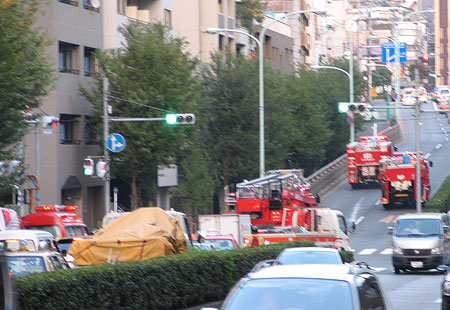
That must have been some false alarm. No fewer than nine fire trucks (and two ambulances) just pulled up outside, filling up the street for an entire block, across from my school.

There were no signs of smoke or other emergency, and then a truck made a loudspeaker announcement that there was no fire emergency.

A few of the fire trucks turning around and leaving in various directions:

1007-Fire1

1007-Fire2

My question is, what emergency would merit so many vehicles?

Weird.

Categories: Focus on Japan 2007 Tags: by

Double!

October 23rd, 2007 1 comment

When I woke up, I checked to see how Apple’s stock did since the quarterly report was released. The report was excellent: Apple blew past expectations and hit record sales and profits (again).

Because the report came at the end of the trading day, most of the reaction came after the market closed. Already, Apple had gained $4 (or 2.3%) at market close–but after-hours trading has Apple up an additional $12, or about 7%, for a total gain for the day of $16, ending up at over $186 per share. For me, that equals roughly a whole month’s salary gained in a single day.

That also makes it official: Apple stock is now double what it was when I bought it less than a year ago.

I am beginning to get the feeling that this is the main reason Apple has decided not to split the stock, at least for now: the value is going up too quickly. If Apple were to split the stock, that might give it too much “exuberance.”

This is not to say that Apple’s stock is going to fall. Yes, I would expect it to drop from its present height in the next week, maybe by as much as $5 or $6, but then it will almost certainly rise again. Even with a market cap (all shares of stock x current stock value) of $162 billion, Apple still represents growth. It currently has only about 6-8% of the market in computers, is releasing a new version of Mac OS X later this week, has a strong hold over the digital player market that shows no sign of ebbing, has just started to break into the lucrative cell phone market, and could enter other markets in the future. And we’re just getting into the hottest quarter of the year. There is so much room for Apple to grow, it’s hard not to see it getting bigger.

But the tricky question is, when will it top out? Eventually, it must; but from the looks of it now, that won’t happen any time soon.

Categories: Mac News Tags: by

Wingnuts Offended By Students Who Understand What They Pledge

October 23rd, 2007 6 comments

Michelle Malkin is apparently now offended by a group of high school students for their rather sophomoric rewriting of the pledge of allegiance:

I pledge allegiance to the flag and my constitutional rights with which it comes. And to the diversity, in which our nation stands, one nation, part of one planet, with liberty, freedom, choice and justice for all.

Yes, how offensive that they see themselves as unified with all humanity, and prefer Constitutional rights and choice over being forced to pay allegiance to a god they do not believe in. What bastards. What ungrateful, unbelieving, little heathen snots they must be.

Heaven forbid we should be encouraged by these students, whether you agree with them or not, for (a) wanting to stand up for their beliefs, and (b) being creative enough to write their own original pledge. Unforgivable that these students should not want to conform to a pledge which most Americans are forced to utter, like indoctrinated Soviet rubes, many years before they can actually understand what it is they are being made to promise (how meaningful that is!).

And how dare they even think of removing god from the pledge! It’s not as if god were thrown in as an afterthought, an unconstitutional plant by the religious right in the shadow of fear caused by Cold-war anti-communist fervor. It’s not as if the pledge was originally written without god in it, because we’re a Christian nation, right?

Hell, we should hold a contest to see who can rewrite the pledge in the most meaningful way possible, fit for the true, original principles of this country, made so that any loyal American can recite it without gagging on something contrary to their core personal beliefs as guaranteed under the Constitution. Here’s my version:

I pledge allegiance to the flag of the United States of America, and to the Constitution for which it stands, written to protect a nation of free people, unified to ensure liberty and justice for all.

And as an added touch, children would not be asked to recite it until, by testing, it is shown that they actually understand what the words mean. I don’t know about you, but I see it as stupid and empty to coerce a promise from someone who does not mean what they say, or worse, does not have the slightest idea of what their words mean. You might as well have the kids recite a meat loaf recipe in Arabic, for all the earnestness it would represent. I seem to recall being taught that unknowing indoctrination of children to mouth government pledges was an detestable Communist practice.

And to hell with the wingnuts, if they stand instead for forcing proselytizing oaths on our youth, and mindlessly attack children who actually understand the Constitution, condemning them for thinking for themselves.

Ouch!

October 22nd, 2007 1 comment

So, when I was helping out my boss with setting up the college’s desk at the American College Fair yesterday, I seem to have strained something. I got a backache on the way back, but unlike most such aches, there was a sharp pain in the side of my leg as well.

As luck would have it, I had an appointment this morning to see a doctor about possible arteriosclerosis, a side investigation resulting from the whole scotoma thing. I mentioned the back and leg, and he felt it more of an immediate worry, and so sent me to the orthopedic specialist. There, they x-rayed me, and the doc came up with a probable diagnosis of a herniated disc. He scheduled me for an MRI next Saturday (first opening we could schedule) and set me up with pain and anti-infammatory drugs in the meantime. He said it could take anywhere between 2 weeks and 3 months to clear up.

Total medical costs for today: about $30.

The pain is not extreme, but it’s enough to keep me off my feet. The doc said I could heat my back, so I’ve had my electric blanket in my computer chair, and it helps with the pain. Sitting up straight also helps; it hurts more when I slump.

As it is, I’m full up with doctor appointments recently, 2 or 3 a week (5 between last Saturday and this Saturday, by chance). It just happens that I’m in one of those everything-goes-wrong modes, so it seems.

Let’s hope that, at least, I don’t fall prey to the usual disaster-strikes-at-Christmas things that hit me for two years running (severe nosebleed, broken foot) before giving me a year off last year…

Categories: Health Issues Tags: by

What’s Kept Me So Busy

October 21st, 2007 3 comments

During the summer, my boss had to take a leave of absence, and as I had done his job before, I took over, in addition to continuing my own full-time duties (plus, I was moving house). So that kind of kept me busy through August.

But from August, a new job presented itself: creating a prospectus for my college. We recently got accreditation from the Japanese Ministry of Education (in addition to our two-decades-running accreditation from a U.S. agency), which means that we can sponsor student visas, and admit non-Japanese students. That means we need a new English-language prospectus. Our old one was about a decade out of date, and if we wanted to present ourselves well at college fairs and to international schools, we needed a new one.

Now, we’re a small branch campus, and often don’t have the major resources that universities can depend upon. We get a lot of stuff printed, but we didn’t have the budget for getting this one designed out-of-house. The faculty all were given assignments to collect and create the written text, and since I’m the most computer-savvy among the faculty, I was asked to do the layout and design. Sure, I thought–just give me the text, I’ll throw in some photos, and work out a design. No problem.

What a fool I was!

Creating a document like this is no small feat, and as I would soon find out, it was harder than I imagined, in several different ways. First off, the text that I was given was not in final form; since no one could predict the final layout, they could not produce exactly the text that was needed. That meant re-editing most of the text.

Second, the layout changed as we went. Pages got dropped, added, re-arranged, re-written… every week, there was something that had to be re-designed or completely redone.

Third, the photos weren’t as easy to plop in as I thought they would be. I had to sift through more than a few thousand images to find just the right ones, usually starting the process anew for each new photo that was needed (they were not catalogued or sorted even)… and often times, there were no appropriate images, and so I had to create them–go out and snap the images myself. And then I was often asked to change this photo to that one, and each new request meant reconsidering the entire page spread design.

And finally, I had to get everything right for the printers. All images had to be CMYK (Photoshop naturally does things in RGB, so every image had to be recast), with a resolution of 350 dpi. Two versions of each draft had to be done, one normally, and one where every text box was converted to outlines instead of being presented as text in a font face. All kinds of other small details, from the placement of staples to extending graphics beyond the edge of the page had to be painstakingly taken care of, page after page. Every photo had to get some adjustment to make the color, brightness, contrast, and association with nearby text and images just right.

All this had to be finished by early this month, so we could get it printed in time for a number of college fairs and international school presentations.

Well, we got it done. I even converted the thing into a PDF, in case you’re interested in reading it. To save on file size, I saved all images in relatively low quality–you can see them fine, but you can’t zoom in too closely or else they lose quality quickly.

Here’s a mini-sized sample of the cover and a few inside pages:

1007-Prospectus Sample

They used it at a college fair just today–by chance, held at Sunshine City’s Export Mart, just a few blocks away from where I live.

1007-Collegefair1

1007-Collegefair2

The thing took such a huge chunk of my time and work, it’s hard to just leave it behind. And I won’t be able to fully–we’re already more than halfway through using the initial 1000-copy printing, and already a few small errors have cropped up that need to be corrected for the next printing.

At least the hardest work is done, and from now on it’ll just be a job of reworking what’s there… but now, I am just a few weeks from having to present this year’s Arts Day video at the Arts Day Festival… and I’ve barely gotten started on that one. I look forward to November, when I will (hopefully) have no all-consuming projects left to eat up all my spare time.

Categories: Main Tags: by

Kasai Rinkai

October 20th, 2007 Comments off

I went to another appointment with the eye specialist today (everything seems fine, they don’t think I need to go back again), and figured that since it was so close, I’d drop by Kasai Rinkai Park.

As it happened, there was not too much to see. It was high tide, so no shorebirds were at the choice viewing spot, and the second-best spot was filled with workers clearing brush. I spotted a few birds that looked interesting, but suffered the usual bird-stays-there-until-just-when-you-point-the-camera-at-it frustration.

Still, there were some good birds around. Right off the bat, I got a fair look at an Ootaka (Northern Goshawk); as it turned out, its head was partially hidden by the tree, but it was a pretty bird nonetheless.

1010-Ootaka1

Here’s an animated GIF of the bird eventually taking off, if you can view animated GIFs. It’s a big file, so you might not be able to view it well if you have a slow connection.

1010-Ootaka-A1-1

There were the usual Great Egrets…

1010-Daisagi2-450

This one got fairly close:

1010-Daisagi1-450

And there were some Azure-winged Magpies to add a bit of color.

1010-Onaga1-450

1010-Onaga2-450

Of course, it’s not quite yet birdwatching season; things should get better towards December… if I can find the time these days!

Categories: Birdwatching, Main Tags: by

Health Care in Japan

October 19th, 2007 2 comments

There is a new entry in Snopes.com which analyzes an email about Canada’s health care system. The writer claims to be a Canadian, but in the first two sentences s/he mentions both Hillary Clinton and Michael Moore, so you are immediately guaranteed that this is a right-wing screed likely to contain wild exaggerations and outright lies. And that’s pretty much exactly what Snopes finds.

It seems that most claims about socialized health care, from both sides, tends to be idealized. There is both good and bad, and when it comes down to it, far fewer differences between the systems than either side would like to admit. One big difference, however, is that in countries with socialized medicine, you at the very least get universal or near-universal access to health care, with both the good and the bad included. Costs, errors, wait times, etc. tend to be the same, except with socialized insurance more people are covered for essentially the same price to the country as a whole, which is a big reason I support the idea.

Here in Japan, I am on the Kokumin Hoken, or the “National Health Insurance” (NHI) plan. It’s the plan you sign up for yourself. There is another system (Shakai Hoken, or “Social Health Insurance”) which depends on co-payments from your employer. Both pay for 70% of all non-cosmetic medical costs, and those costs are kept low because the government here sets prices for treatment. Most doctors, clinics, and hospitals accept National Insurance; it’s not hard to find a place which has what you need.

Let me give you a recent example. A few weeks back, I started developing a few scotomas (blind spots) in my eyes. Having just moved to Ikebukuro, I went to the closest big hospital, Otsuka Hospital, for the first time. I was signed up with minimal paperwork and saw a doctor within one hour, despite having no appointment. (In fact, I do not recall ever having been made to wait more than three hours in a hospital in all my time in Japan.) The doctor did a preliminary exam to make sure that nothing serious or preventable was going on, and arranged for an appointment two days later for a visual field test and further consultation. I came back for the second appointment, took the tests (again within an hour, including the 30 minutes I had to wait for the pupil-dilation drops to take effect). The doc found nothing wrong, but just in case, scheduled me for appointments with their Internal Medicine department to see if arteriosclerosis was a problem (perhaps limiting blood circulation to my retinas), and a follow-up exam and tests a few days after that. Appointment scheduling was a bit crowded, so I would have to wait two weeks for them.

Total out-of-pocket costs (the unpaid 30%) for the two initial visits: $30.

But within a week after those visits, the scotomas seemed to be getting a bit worse, and I was (a) not content to wait another week and a half or so to get treated again, and (b) would have felt more comfortable with an English-speaking doctor, not to mention a specialist. On the web, I found a clinic about a 45-minute drive from home which had a Harvard Med-educated eye specialist. I called and they said that the doc would be holding a kid’s clinic on a Saturday, but I was welcome to drop by. I did, and the doc saw me within half an hour (and again, I got a clinic member card with minimal paperwork, just two minute’s writing). The doc was great, and spoke English very well. After an initial exam, he handed me off to a retinal specialist (who spoke no English but the first doc came and translated when necessary). They performed a fluorescein angiogram (injected a dye into my blood and then took many images of the retinal bloodflow), and found no blockages, leading them to conclude that the scotomas were likely caused by vascular spasms, and the blind spots would fade with time (so far, they have), with a nominal chance of some blind spots remaining. They prescribed medication to help bloodflow and prevent further spasms, and made an appointment for me to visit again the following Saturday.

Total cost for the visit, consultation by two specialists, pupil dilation, fluorescein angiogram, and one week of medicine: $45.

Keep in mind that these were initial visits without an appointment, I was admitted either on the spot or for the next day, never waited for more than one hour, and received prompt treatment from specialists.

This is not to say that all medical treatment in Japan is so great; what it does mean is that you can shop around and find the doctor and/or clinic/hospital that is right for you. You’re never locked into a specific doctor or location, you can see any doc at any location you want, so long as they accept the National Insurance. In my experience, you can usually find the medical service you want and need.

Did I mention that it includes dental? I found a great, U.S.-trained dentist in central Tokyo, speaks English, does great work, and is similarly cheap, but has up-to-date equipment in a nice, clean office, even with a great view of parkland while you’re worked on. And they do good work, too.

Despite not covering cosmetic work (you’ll have to pay full price to replace upper incisors, for example, even if it’s not literally cosmetic), you can sometimes find ways around it. I had a largish mole under my lower lip that would bleed a lot if cut shaving, and I worried about cancer and so forth; I went to a clinic about it, and though they found nothing wrong with it, they volunteered to give laser treatments to get rid of the mole entirely. This was somehow covered and cost little, with good results.

My biggest gripe: no preventive medicine that I can find. The insurance does not cover regular comprehensive checkups. However, you can get around that by going to the hospital and giving a complaint that would result in specific tests which, combined, could get similar results to a general checkup.

Premiums are in the form of a “tax” (not not rolled into other taxes, it’s paid separately), which is approx. 8.5% of your income, with a cap of ¥530,000 ($4600) per year. Alas, I have just reached that cap, and so pay the maximum amount. There are a lot of other aspects and benefits to the program I haven’t gotten into (or needed personally yet).

If you’re healthy and never need work, it can be a hassle to see all that money go to the system. But if you need to see docs relatively often, and you want coverage in case of something catastrophic, I think it’s a fantastic program. Of course, your mileage may vary.

Categories: Focus on Japan 2007 Tags: by

Japan and Religion

October 18th, 2007 Comments off

This story about a cult which killed an elderly lady might be catching the eyes of people interested in Japan, and most of us are familiar with the gassing of the Tokyo subway by Aum Shinri-kyo (an attack that my brother and his wife narrowly avoided getting caught in). These kinds of stories tend to be the usual exposure we get to Japanese religion; not much else gets reported on them in the media. Oh, we’ll see the odd movie that shows a Japanese monk with the rounded hat, or a Shinto priest blessing a car, or something like that.

However, Japan is supposed to be a thoroughly religious society. See, it says so, right here on the label. According to the CIA World Factbook, 84% of Japanese “observe” both Shinto and Buddhist religions, and the remaining 16% observe other religions, with 0.7% of those being Christian. I’ve seen other designations that claim Japan is 98% Buddhist and Shinto.

The thing is, none of that is true. In fact, compared to America, Japan is about as non-religious as you can imagine a society being. At my college, we have young people with whom we discuss all manner of subjects, including religion. And few of them have any concept of religion at all. Neither is it only with young people; most Japanese, when asked, will tell you that they are not religious. People I have asked guess that maybe 20% of Japanese people, give or take somewhat, are religious to an extent we would consider being modest or normal in the West.

Oh, yes, everyone visits shrines and temples. However, that’s mostly just social stuff, not really connected to belief. Kind of like celebrating Christmas or having a minister at a wedding, it’s something that people do whether or not they believe. You go to Shinto shrines for weddings, Buddhist temples for funerals. You visit both or either on New Year’s, and each has its festivals and holidays and so forth. Sometimes you just visit because it’s a pretty or interesting place to go to.

Yes, Japanese people will “pray” when they visit; you throw your coin into the offering box, shake the rope with the bell at the top, clap your hands twice, and pray to the kami. But most Japanese seem to treat this the same way that westerners say “god bless you” when you sneeze.

Certainly, there are the fervent believers. Many do take the religions seriously, some make them their calling. But I would say that most Japanese see these religions as either cultural background or an insurance policy, kind of a just-in-case kind of thing. Many Japanese have some kind of belief about the afterlife or the nature of the universe, though that is more of a free-formed personal belief, rather than adherence to a specific religious doctrine.

As for religion itself, most Japanese people seem to treat it far more as a tradition to be upheld, and less like a serious set of doctrines to be followed. Especially Shinto, where there is less focus on morality and philosophy (compared to Buddhism or Christianity). A co-worker said he once met a Shinto priest who, in an unguarded moment, admitted that he didn’t take the whole thing too seriously himself–he did it as much out of familial loyalty than anything else.

Of course, most of the people I am exposed to are younger, and in Japan, that means less focused on religion. As might be expected, when Japanese people reach their senior years, there is more interest in religion, and more probability that the person involved will take it seriously.

Even then, religion in Japan is pretty quiet; aside from the odd Christians, few people will knock on your door and want to tell you about Buddha or Amaterasu. Yes, Soka Gakkai is (unofficially) affiliated with the Komeito political party, but you never hear about religious stuff being pushed in government. No bans on abortion, no mandatory prayer in schools, no abstinence-only programs, no demands for reshaping biology, geology, or history curriculums to allow for the creation of the Japanese islands by Izanagi and Izanami some three thousand years ago or whatever. The worst that happens in that sphere is prime ministers and their cabinets visiting Yasukuni Shrine (where some Class-A war criminals are enshrined), and that’s more of a diplomatic issue than one that actually affects one’s daily life.

All told, religion in Japan is refreshingly distant and hands-off. You’re allowed to indulge all you want; it’s there is that’s your thing, there’s nothing stopping you. But if you’d just as soon keep it at arm’s length and not have it bother you, Japan is much easier a place to live than is the United States, to be certain.

Yes, there are cults, but notwithstanding the extreme cases like Aum Shinri-kyo, they rarely if ever impact your life, unless a close friend or relative drags you into it.

Perhaps a lot of this has to do with there being far less in the way of a dominating holy book; there is nothing on par with the Bible or the Koran when it comes to Shinto or even Buddhism–nothing that dictates the shape of the world. You get the feeling that people in most Japanese religious sects could care less if you’re not interested, and don’t worry all that much about your soul, immortal or otherwise, if you care not to involve yourself. Mostly, it’s a matter of take-it-or-leave-it; there is no public pressure to subscribe to anything at all.

And that’s the way I like it.

Categories: Focus on Japan 2007 Tags: by

Moonbats on the March

October 17th, 2007 2 comments

Yesterday, when I suggested that right-wingers would attack the new S-CHIP poster child’s family, I didn’t expect the attack to be so quick nor so despicable. Here’s the money quote:

On the conference call, Dara admitted to me that she and Brian had been talking about having children since before they were married. She further admitted that after they were married she voluntarily left a job at a country club that had good health insurance, because the situation was “unmanageable.” From there she took a job at a restaurant with no health insurance, and the couple went on to have a baby anyway, presuming that others would pay for it and certainly long before they knew their daughter would have a heart defect that probably cost the gross national product of Burkina Faso to fix.

The message: Bethany’s parents were irresponsible to have a baby when they couldn’t afford to pay health insurance for it–with the added innuendo, by putting “unmanageable” in quotes and not explaining why, that the mother left a better job and took a worse one because she was irresponsible. One of the details left out: the mother left the job seven years before Bethany was born. Apparently, the right path was to stay in a job you hate because sometime in the following decade you might have a kid and so need the insurance policy.

Either that, or they were irresponsible for having a child. Apparently this wingnut now feels that there should be a means test before giving birth. Presumably if people don’t have enough money for full health insurance, they should practice abstinence.

Now, most conservatives are changing tactics on this debate. No, they’re not actually debating the program itself; they’re trying to shift the smear: they say Democrats are despicable for using young children to personify the S-CHIP issue.

Hey, news flash: The S-CHIP program is intended to help young children! Exactly whom should the Democrats put forward to demonstrate the human face of the program? Or is it that children may never be shown when we are trying to help them? It has already been well-established that Bush, like just about every other politician in known history, has used kids for political photo ops before. So, apparently, right-wingers only object to Democrats doing this–either that, or they were unaware that kids were ever glimpsed in political campaigns before.

1007-Bushkids 1007-Bushbaby
1007-Bushvetostem
1007-Bushkids2

The wingnuts apparently don’t know when to give up….

Categories: Political Ranting Tags: by

Oh Fudge

October 17th, 2007 1 comment

This has got to be the most hilarious photo of the 2008 campaign so far. I would scald the media for not running with it like they ran with Kerry-in-the-clean-suit, but then again, the unintended inference of this image is just far too outrageously ribald.

Mitt-N-Fudge

From DownWithTyranny via C&L.

Categories: The Lighter Side Tags: by