Republicans Kill Minimum Wage Hike

June 26th, 2006 3 comments

As Republicans busy themselves in a flurry of attempts to shovel hundreds of billions of dollars of yet more new tax breaks to the wealthy, they have just won another victory: they killed any hope of a minimum wage increase. 46 Republicans in the Senate blocked an up-or-down vote on the minimum wage, knowing that it would pass. 8 Republican senators sided with all the Democrats on the up-or-down vote, and likely would have provided the votes necessary to give millions of Americans their first pay raise in almost a decade.

This is the ninth time that Democrats have tried to raise the minimum wage in the past decade, and the ninth time that Republicans have killed it. And they’re still making the same lame, fake arguments that they always have–it’ll mean people will lose jobs, it’ll kill small businesses, it’ll raise prices, it’ll drag down the economy. All false–there is no evidence that any of that will happen, and in the past, the economy and job numbers have gone up as often as they have fallen after minimum wage hikes.

You’d think that a Republican would see it this way. They generally believe that if you shower the wealthy with money, they’ll invest, creating more jobs. Of course, we tried that, and it didn’t work. Rich people got richer, but the “recovery” is relatively jobless, with the new jobs being more and more often at the minimum wage. The results in the 80’s were similar–the rich got richer, but there was no “trickle down.”

Hiking the minimum wage would agree with that Republican throw-money-at-it philosophy, except that it would actually be logical, as opposed to the narrower throw-money-at-the-rich theory. Give rich people money, and there’s no reason for them to spend it on domestic goods or invest domestically. Especially when one can avoid taxes by sending it to the Cayman Islands and other such dodges. Especially when the GOP is making it so easy and profitable to invest in exporting American jobs overseas. Wealthy people are, in fact, probably the least likely to spend the money at home.

On the other hand, if you give the money to working people by hiking the minimum wage, they are definitely not going to sock it away in the Caymans, invest in foreign stocks, or buy a Mercedes Benz. They’re going to buy stuff right here, and it’s going to be basic stuff, far more likely produced in the U.S., most definitely serviced here in the U.S. The money will go right back into the American economy, where it will do the most good–and where it will create more jobs than would be lost, as we’ve seen in the past. And guess what–the last time we hiked the minimum wage, jobs didn’t take a nose dive. Unemployment did not rise. Small businesses did not shut down. Whaddaya know.

The sad thing is, people who make the minimum wage don’t vote as much as other people do–and Republicans do their damnedest to make sure it stays that way, fighting like hell to kill anything like motor-voter registration (God forbid we should encourage people to vote). But if minimum-wage earners started voting like Cubans or the elderly, even Republicans would become their new best friends and discover a change of heart. Which is why Republicans want to stop that, they don’t want to have to nuzzle up to working stiffs. Makes them feel dirty.

Categories: GOP & The Election, Political Ranting Tags: by

Futurama Will Be Back!

June 25th, 2006 Comments off

Futurama-SeeyouIt is now official, Comedy Central has commissioned Fox Entertainment to produce 13 new episodes of Futurama! The series is scheduled to come back sometime in 2008. Naturally, I’d love to see it back earlier and with more episodes per season (what is up with that baloney, anyway? 13 episodes? Hey, Cable TV, grow a pair, willya?), but any new Futurama is going to be good Futurama. All the original cast and crew have signed on to return.

Not to say they didn’t see it coming: when the last episode of Futurama aired, the opening subtitle gag read: “See You on Some Other Channel.”

And so it will be.

By the way: if you want a little fix now, see this Futurama-animated commercial for “An Inconvenient Truth,” voiced by Billy West, John DiMaggio, and Al Gore (“Yes, I play a streetwise pimp with a hybrid pimpmobile”).

Categories: Media & Reviews, The Lighter Side Tags: by

Bump Top

June 25th, 2006 1 comment

Bumptop ThEvery once in a while, a company somewhere comes up with a cool new idea for a computer interface to replace the standard Desktop/Finder paradigm used in Mac and Windows. These people have a pretty radical and very hip new idea for dealing with documents on a virtual 3-D desktop, based upon real-world document handling. It looks really nifty–but it could be undone by the very complex nature of its many features, the same ones that make it so cool. I’m pretty hip with using computers, and yet it’d take a lot of practice for me to get this system figured out. I can only imagine how confusing it might be to users who already find it tough to use today’s more plain desktops.

They have a video you can download to see the software in action. I suggest you take a look at it, though the full-quality movie is about 100 MB (a fair-quality YouTube link is available). Here’s a PDF explaining the idea.

The icons would suggest it’s Mac based. Maybe Apple should look into this?

Categories: Computers and the Internet Tags: by

Leopard Parts

June 25th, 2006 Comments off

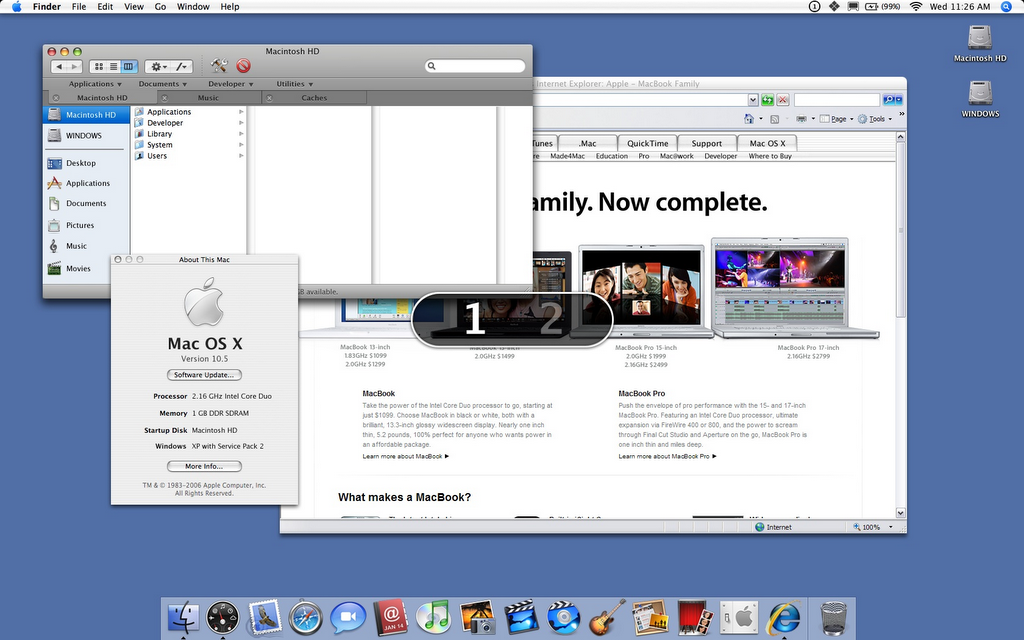
With the WWDC a little more than a month away, people are talking more and more about Leopard. So far, some “screenshots” have been released, but since they are contradictory, at least one of them–and just as likely both–are fake.

The first set were released on a Spanish-language web site, and are almost certainly fake. On the first image, of the Desktop, the window panes are repainted to match the new style in iTunes, and there’s a recolored iSync icon. The second image suggests a virtual Desktop switcher, but all the elements are again ripped off from existing Mac OS graphics.

And now a second set of two screenshots–of virtually the same activity, virtual Desktop switching–have been released through another site. These images seem much more realistic, and are more enticing, but are also probably fake. They show the intriguing feature of tabbed Finder windows a la Safari; a much better implementation of iTunes-style window panes (with a few new buttons and menus included); an icon for a joint Address Book and iCal app; menu bar icons for Windows and virtual Desktops; and, most intriguingly, a Windows app (Internet Explorer 7) apparently working seamlessly within the Mac OS. The “About” window seems to suggest that XP is working within Leopard as well. However, some flaws do show: the “About” window simply declares “Version 10.5,” while traditional beta builds show the raw build number; the Explorer window uses an XP-style scroll bar, suggesting it was Photoshopped in; and the shadows behind the Explorer window are incomplete, again suggesting a mock-up instead of the real thing.

Nevertheless, if it is a fake, as it almost certainly is, it is a very good fake.

So what will be in Leopard? Nobody seems to know for sure. Some kind of Windows-running solution, to be sure, but whether it will be a final version of Boot Camp, or a much-rumored virtualization technology, no one knows. The holy grail would be what is suggested in the second round of fake screen shots: the ability to run Windows apps from within Leopard, either transparently, or without even having to boot the Windows OS first. This is seen as the long shot, with virtualization (like that already provided by Parallels) more likely, and Boot Camp almost certainly (unless it is replaced by something better).

The two sets of faked screen shots both suggest virtual Desktops (a feature third-party apps now provide). This probably comes from this guy’s claims of having worked with Leopard, probably fake. He claims a lot of stuff, but mostly techie-oriented and unimaginative minor stuff (speed bumps, minor app reworks, etc.). And his multiple “Finder window” rumor may be erroneously based on this report based on Apple patent filing suggesting “multiple Finder window selects,” which is not about multiple Finders (Desktops), but about selecting icons in more than one open window at a time.

However, the iTunes theme is widely accepted as inevitable, as is the Address Book-iCal merger.

So what else? According to LoopRumors from last Fall, Leopard will include:

  • Window transparency (though this seems to “Vista-ish”)
  • Animated icons with sounds, maybe only in the Dock
  • Better Dashboard implementation (faster loading, using less RAM)
  • Applications running in Full-screen mode, or as Desktop pictures

Add to that a fixed Finder–though that also is already widely rumored. In fact, some rumors are that fixing the Finder will be a major focus in Leopard. Of course, that’s been rumored for almost every new version of OS X since it came out.

This very new report says that Apple will integrate a Google-Earth-type satellite image/road map/direction finder app into the OS. They also suggest that Boot Camp will be discarded in favor of virtualization, as reported above.

Other rumors include collaborative documents, allowing many people on different Macs connected on the Internet to make changes to a single app simultaneously. Others suggest an improvement in Boot Camp and/or virtualization allowing Vista and/or Linux to be run with Leopard as well as XP. Resolution scaling (the ability to make everything look larger without sacrificing image quality) is also being suggested. And some even suggest that Leopard will integrate BitTorrent, will use it for the iTunes Music Store and Apple Software updates–and users who donate their upstream bandwidth would get credit at the iTunes Music Store. Cool, if true (I could build up credit with my F/O), but I seriously doubt Apple has that much trouble with its own bandwidth to require such a thing. Some have also suggested that Leopard will use a completely new kernel (the core of the OS), but that is effectively being dismissed.

So a lot of rumors, but nothing at all confirmed yet. Apple might still be doing a very good job of keeping a lid on things, and we could all be surprised. But keep in mind that in the past, the reality is almost never as exciting as the rumors. Which is why so many people love the rumors…

Categories: Mac News Tags: by

Again with Howard

June 24th, 2006 Comments off

Okay, maybe you’re getting a bit tired of Howard, but I think he’s a lovely bird. I went down earlier in the afternoon this time, around 3:00, and there he was, as always. It is overcast today, but still, I got a few very good shots of him, both with 1000-pixel blow-ups if you click on the images this time. You can really see his colors well in the second shot.

062406-Howard2-450

062406-Howard4-450B

Categories: Birdwatching, Uncategorized Tags: by

Howard

June 23rd, 2006 Comments off

I’ve decided to call him Howard. No reason, it’s just the first name that came to mind. Howard, it appears, just loves that field. So far, every time I’ve gone to look, Howard is there. The other day, Howard was there with his mate (no name yet), but I didn’t have the camera then. Too bad, they were right below me that time. So far, I’ve only gone in the evening, after 5:00–which is why some of these photos are not the best quality, there’s not enough light. I’ll have to try earlier in the daytime and see if he’s around then as well.

0606-Pheasant623-450

0606-Pheasant623A-450

Categories: Uncategorized Tags: by

Democrats Have a Plan. The Problem Is the Media Not Reporting It.

June 22nd, 2006 1 comment

This is indeed typical. How long has it been that the media has been criticizing the Democrats for not having a plan? How many times have you heard the criticism that the Democrats simply don’t offer any alternatives, that they aren’t saying anything? And to most people, it sounds true because they don’t hear what the Democrats are saying.

But that’s not because the Democrats aren’t saying anything. It’s because the media isn’t reporting what they’re saying.

Just tonight, all nine Democratic women Senators appeared on the Larry King Live show, discussing a set of policies and proposals they are and have been offering.

How is this covered in the media? Nada. Not even a quick note with bullet points. The only appreciable mention of the appearance at all that I could find was this right-wing rag, whining that “Larry King Gives Free Campaign Hour To Female Senate Democrats.”

In the meantime, the Democrats are indeed trying to fight for Americans. While a few sided with the Republicans on the move to eradicate state-by-state food warning label requirements, a large cadre of Democrats is trying to making noise (scroll down for story), insisting that the states be allowed the right to make food sellers in their states warn their citizens of dangers that the federal government is failing to do. Republicans are trying to cave in to the food corps. and force the states to follow soft, wishy-washy federal standards, which fail to report possibly critical dangers in the foods we buy. Soon, your food labels might not be telling you all you need to know. Guess who’s not reporting this to you?

Another Democratic issue: the minimum wage. Right now, the minimum wage has less buying power than it has had in fifty years, and it has not been raised once in the past decade. And yet Republicans are still trying to block it. Worse than that: in a jobless recovery where poor people are being hit hard and wealthy people are doing well, the House Republicans are denying a vote on a minimum wage hike at the very same time they are pushing a vote to reduce the estate tax! What is this, the tenth consecutive tax cut for millionaires? They aren’t even trying any more to pretend to give a crumb to the middle class so they can falsely claim it’s really going to benefit regular people.

Currently, the estate tax only kicks on for non-farmers who have more than $2 million in assets (that goes up to $3.5 million in 2009), and that’s just for individuals (double that for couples). Even then it only begins at a very low effective rate–the $2/$4 million is an exemption and is not touched. This (yet another) Republican millionaire tax cut would up the minimum individual exemption to $5 million (presumably $10 million for couples), would tie the exemption to inflation (which they absolutely refuse to do with the minimum wage!), and would cut the tax rate after the exemption. All this would cost $283 billion–and that’s the conservative estimate. The real long-term cost could be as much as $800 billion.

Meanwhile, honest, hard-working Americans, who haven’t had massive multiple trillion-dollar tax cuts already, and who aren’t worth anything near $2 million because they’re getting paid crap, are working their asses off at three jobs each and still are fighting to stay above the poverty line. Their pay for real work is not tied to inflation, and the GOP wants to keep it that way.

How perverted can the Republicans get?

And how long before the media starts reporting on the alternative the Democrats have been offering all this time?

Categories: Political Ranting Tags: by

John Varley

June 21st, 2006 1 comment

Yes, I know I’ve been reading the Farmer book To Your Scattered Bodies Go for months and months now, just like I was reading Conason’s Big Lies for more than a year before that. I should really get rid of the “What I’m Reading Now” panel, since I rarely update it. Truth be told, I’ve been reading parts of Brian Greene’s The Elegant Universe and V.S. Ramachandran’s Phantoms in the Brain up until last week, as kind of a nostrum to get me to sleep faster. Not that the books are boring–far from it–but they aren’t page-turners that’ll keep me up all night. So when I start reading something good but not great after midnight, I’ll get to sleep pretty soon. And the books last a long time that way.
Mammoth
But like the Grisham novels that kept me awake earlier this year, I have started on a few new novels ordered from Amazon Japan. One of them is Varley’s recent novel, Mammoth.

For quite some time, Varley has been one of my favorite authors. My brother-in-law got me started on Varley’s Titan trilogy years ago, and since then I’ve tried to read everything he’s written. One of his more recent series was based on his dominant “Eight Worlds” future history, including Steel Beach and The Golden Globe, both masterful cacophonies of absurdly delightful entertainment. There’s supposed to be a third book in that series called Irontown Blues, but Varley seems to have set that aside for the moment.

And that’s where we come to his most recent books. Varley’s past novels have always had a certain weight to them, a seriousness and gravity despite the madness. With his last three novels, however, he has bucked that trend. It has long been clear that Varley is a big Heinlein fan, something made abundantly clear in Steel Beach. But somewhere around the year 2000, Varley’s writing turned away from his Eight Worlds depth and transformed into a Heinleinesque juvenile science fiction vein.

His first book in this trend, Red Thunder, was essentially a retelling of Heinlein’s Rocket Ship Galileo. Varley’s book had a group of youngsters getting mixed up with an ex-astronaut and his crazy-genius relative and making a backyard spaceship that would take them to Mars–to beat out the Chinese mission vying to be the first humans to set foot on the red planet.

Red Thunder kind of startled me when I read it, as it seemed like it wasn’t Varley at all. It was almost like Heinlein and Varley had collaborated to make the piece. In a way, I guess you could call it “Varley Lite”–less filling, but still tastes great.

I didn’t entirely expect Mammoth to follow in that vein, but it did–at least as far as I’ve read through it so far (200 of the 340 pages). It’s light reading, but quite a lot of fun. Not as thick and rich as Varley usually does; his prior novels held much more punch and value in every page. It’s almost like Varley consciously toned down his writing to fit a more Grisham- or Chricton-like popcorn pace, either to sell more copies, or possibly even in search of the one that will be bought out by Hollywood and made into next summer’s blockbuster.

It’s still fun, though. Mammoth begins with the title character, a hybrid Columbian and Wooly Mammoth being found encased in ice in Manitoba, like the Discovery Channel special on the Siberian mammoth unearthed a few years back. Except next to this mammoth, they find the frozen corpse of a human being, wearing a wristwatch and bearing a metal briefcase. Time travel pandemonium ensues. And don’t worry, I didn’t give away anything that’s not in the blurb on the back cover.

Varley’s latest book, Red Lightning, is a sequel to Red Thunder, but is still in hardcover, so I’m waiting on that one.

I wouldn’t mind, of course, if Varley came back and at least finished of Irontown Blues before continuing on his old-age juvenile kick.

Categories: Media & Reviews Tags: by

More Green Pheasant

June 20th, 2006 Comments off

At about 6:00 pm yesterday evening I went down to the empty field where I’d spotted the pheasant before, figuring I might get another shot–and what do you know, but there he was. And this time I got some good shots. The last in this series is the best by far, with a great 1280×854-pixel blow-up when you click it.

06-19-06-Green Pheasant3-450

The one above I got from the overpass, like I did last time. Then I went into the construction site itself, after the bird had hopped away up a hill towards an access road. Along the way, I got muddy feet, one foot submerged in wet mud ankle-deep, when I saw what looked like some sort of plover fly in–but was not able to get a shot in. But I did catch the pheasant, coming toward me this time:

06-19-06-Green Pheasant2-450

As you can see, he’s crouched down. Like with the very first time I saw him, it’s a defense posture. This time, however, he was in plain sight on a hillside, so it allowed for a few nice shots. Eventually, he figured I was not a threat, and so got up again.

06-19-06-Green Pheasant4-45

06-19-06-Green Pheasant5-450

But this one was the best shot, as I was able to catch the bird at the hilltop, with a nice focus contrast of the hills in the background. Again, remember to click to see the full-sized shot.

0606-Green Pheasant6-450

Categories: Birdwatching, Uncategorized Tags: by

Stripped

June 19th, 2006 2 comments

Well, that’s quite the strange experience.

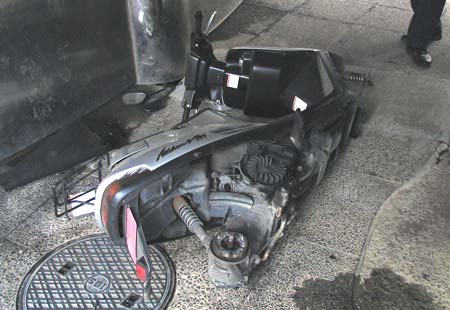
I got a phone call not two hours ago from the police. I didn’t know it was them until a bit later, as they didn’t use the word “keisatsu,” the one I know. But I could tell it was someone who worked for city services in some manner. They told me that my scooter was found abandoned in a nearby park, about a quarter of a mile from where I live; someone had found the insurance papers.

That gave me a start. I just bought a new scooter a year ago, and it’s a nice one, too. My immediate fear was that I had left the key in the ignition–something I have been known to do–and that someone had taken it for a joyride. But the guy on the phone told me that the scooter was beyond broken. Not good.

There was, however, a possible alternate explanation. I got the new scooter to replace the old one–and I hadn’t gotten rid of the old one yet. It was six years old, and probably didn’t even run anymore. I couldn’t even get the ignition lock open, it had rusted shut. I had been meaning to call someone to tow it away, but had never gotten around to it. So the missing scooter could be that one.

I had severe doubts, however. Who would want to steal a junker like that, when a nice new bike was right next to it in the parking area? (I did not think about the new bike’s security alarm at the time.) Also, the fact that the insurance papers had been found by the person who discovered the bike suggested that the seat was opened–which suggested that maybe I had been an idiot and had left the key in the ignition when I came back from Costco late Saturday afternoon. In which case I may have been out about $2000 for a new scooter.

As soon as I could, I got the caller’s number and went downstairs to check. Going out the door, I got a nice reassurance: my keys were where I usually leave them at the door, meaning I hadn’t forgotten them. And, when I got downstairs, sure enough, it was the old junker that was gone, its accompanying helmet left on the other side of the parking area.

I called back and discovered I was speaking to the local police officer (I found this out when he told me he was at the koban, the police box). I went down, and he showed me the insurance papers–indeed mine–soaked with water. The officer thought that they had been left in the rain from yesterday. He offered to take me to see the bike, and I wanted to go, to see what had happened to it. The officer had only been told that it had been deposited next to a pond at the local park, and so first took me to the place a quarter of a mile away, where we climbed stairs to go to a pond way away from it all. When the bike was not there, the officer admitted there was another pond–the one right across from the police box where we met–that the finder may have been referring to. We went there, and found the bike.

06-19-06-Stripped3-450

06-19-06-Stripped1-450

06-19-06-Stripped2-450

It was at the edge of an artificial pond, one which I pass every day. One edge of the pond is under an archway, relatively hidden. The bike was stripped bare–tires, wheels, engine, lamps, belts–everything. Even the seat was missing, with the contents of the helmet well left behind, scattered on the ground. Evidently the insurance papers had been tossed into the pond, which is how they’d gotten soaked.

Apparently what had happened was that some local kid had the same model scooter, and it was falling apart. Unable to afford new parts and repair from the shop, the kid stole my bike and stripped it bare. Saturday or Sunday night, he came to my apartment building and somehow spirited the bike off. That would have been no mean feat; as I mentioned, the ignition lock was rusted shut, and when I found the bike, it had not been opened. That means that the steering column was locked in a turn. Either the thief broke the steering column entirely at the parking area (directly four floors beneath my bedroom), or he and some hoodlum pals carried the bike to a truck and carted it off to the pond, where they could strip the bike unobserved.

As you can see from the photos, they did a hell of a thorough job. Fortunate for me that it was the bike I had fully intended to have taken away for parts and scrap anyway. I just prefer to do it on my terms, not some punk thief’s.

When the policeman and I found the bike, I made an effort not to touch anything. But he seemed indifferent about any investigating, and started touching parts on the ground, even asking me to pick up this or that. Afterwards, he apparently changed his mind and started printing the carcass. He found nothing but a partial shoeprint on the broken dash. It would seem that the thief or thieves had worn gloves during the disassembly. The officer allowed me to remove the license plate and take it with me. He told me that he’d see to it that the bike was junked, and kindly waived any fees for doing it. He told me that if they found anyone from the shoeprint, they’d give me a call. I don’t expect anything to come of it, but the officer seemed strangely confident.

Apparently, this kind of petty crime is not too unusual. The officer told me that it’s usually teenage kids with certain popular scooter types (which mine was) who steal other people’s bikes and strip them like this. He recalled one instance in particular where one teenage kid lost his scooter that way–and eventually discovered that one of his own friends had been the thief!

So it has been an adventurous afternoon, and I’m grateful that it was a lot less unfortunate or expensive as I had initially feared.

Categories: Focus on Japan Miscellaneous Tags: by

Trackback Cleanup

June 18th, 2006 Comments off

Wow! Turning off the trackbacks really made a difference in clearing out the spammers. I’m still getting about one hundred comment spam a day (MT-Blacklist gets about 75% of them, SpamLookup the other 25%), but the trackbacks seem to have been the real monster here, as I noted before. And it showed up like crazy in the AwStats: immediately after I deactivated the trackback script, the number of “visitors” dropped by a bit more than half. This may represent the clearest picture of visitors I’ve gotten from AwStats in quite some time.

But it also shows how lopsided spam has become. Half of my site’s “visitor” traffic was trackback spam. Maybe 25% of all traffic volume, in megabytes, was spam–the spam, at least, did not download movies or anything. Just made smaller hits–but there were so damned many of them. For a long time, I’d known that about a quarter of my site’s traffic was spam. Recently, I could see that my “visitor” traffic had inexplicably risen by about 30% to 40%. This explains why.

When I look at the “recent visitors” in my domain’s CPanel, I can still see them constantly hitting the site–but now all they’re getting are “500”-type server errors. Maybe in time they’ll even stop trying, once they see there’s no trackback there anymore.

Turning the damned things off was the smartest maintenance move I’ve made so far. If you still use trackbacks, consider shutting them down. They’re not worth it.

Categories: BlogTech Tags: by

Flag Burning

June 18th, 2006 3 comments

I think the whole issue is stupid.

If you burn the flag, you are burning the symbol of freedom that allows you to burn the flag.

If you ban flag-burning, then you are limiting the freedom that the flag represents.

American flag burners are stupid because the flag pretty much never represents the people or things they are protesting. If it’s done just to get a rise out of people, it’s still stupid because it rarely if ever gets the kind of attention that helps their cause.

Americans who want to ban flag burning are stupid because they either don’t understand freedom or they are trying to score points politically, which may not be stupid but it is dishonest.

The best solution: ignore flag burners. Which is not too hard, because there are so damned few of them. Problem solved.

Flame away.

Strict Constructionism and the Goals of the Conservative Movement

June 17th, 2006 5 comments

Strict constructionism is a philosophy of judicial interpretation and legal philosophy that limits judicial interpretation to the meanings of the actual words and phrases used in law, and not on other sources or inferences. Adherents look strictly at the text in question rather than relying either on legislative intent (as gleaned from contemporaneous commentaries or legislative debate) or on metaphysical ideas such as natural law. …

The underlying argument behind strict constructionism is that if a legislature truly wants to enact a particular law, they are capable of writing it down in plain English and passing it, and it is not the job of the judiciary to reconstruct what the legislature’s intent could have been. Supporters interpret this position as judging based on what the law is, not what it should be.

— Wikipedia

Strict constructionism has become somewhat of an issue as of late. Most if not all of Bush’s high-level judicial appointees have been constructionists. He likes to solemnly make the claim that he does not apply a litmus test to his candidates, and then, usually in the same breath, states that “I believe in strict constructionists. And those are the kind of judges I will appoint.” As if there is a difference between the two. For conservatives, “strict constructionist” is a code word for all of the litmus tests, on abortion and a broad range of civil rights issues. This was specifically spelled out in 1969 by former Assistant Attorney General, and later Supreme Court Chief Justice William Rehnquist:

A judge who is a “strict constructionist” in constitutional matters will generally not be favorably inclined toward claims of either criminal defendants or civil rights plaintiffs…

But strict constructionism is more than just a litmus test. It is rapidly becoming a way to help disassemble the Constitution of the United States and render meaningless many if not most of the rights and liberties guaranteed under it. Strict constructionism is a tool being used in the current conservative quest to place as much power as possible into the hands of government, and to weaken the power, rights, and capabilities of the American people, so as to make possible the imposition of a specific social and moral structure which, by nature, is unconstitutional. Since revolution and amending the Constitution can be difficult and messy, it is much easier simply to reinterpret the standing law under a new paradigm–ironically, in part by claiming that one should not be allowed to interpret anything.

If you think that’s a radical view, then read on, and I’ll explain.

Strict constructionism is supposed to mean that the law is exactly what is written down, and not one iota more. It specifically precludes interpretation, or the application of changed social standards and meanings into a broader or modernized meaning of the original law. Abortion is the classic case. The founders did not say anything about this, naturally. So the question becomes, can the government ban it? A strict constructionist would say “yes,” because the right to abortion is not clearly written down in the Constitution. They rail against the Roe v. Wade ruling that interprets a right to privacy from the text of the Bill of Rights, and applies that to medical decisions, including abortion.

What amazes me is that strict constructionism can exist at all, considering one rather sticky detail: the Ninth Amendment to the Constitution of the United States. That amendment reads:

The enumeration in the Constitution, of certain rights, shall not be construed to deny or disparage others retained by the people.

There is no question whatsoever that people everywhere consider privacy to be something they desire, even crave, and consider a right. The privacy of one’s own home, the privacy of the bedroom, the privacy of one’s personal life, one’s secrets. Privacy is perhaps one of the most natural of all expected rights. How could that not be covered by the Ninth? And yet, you have Supreme Court justices like Clarence Thomas saying,

“…just like Justice Stewart, I can find neither in the Bill of Rights nor any part of the Constitution a general right of privacy, or as the Court terms it today, the liberty of the person both in its spatial and more transcendent dimensions.”

Thomas was referring to Justice Potter “I know it when I see it” Stewart, who said in 1965, “I could find no general right of privacy in the Bill of Rights, in any other part of the Constitution, or in any case ever before decided by this Court.” Stewart, however, later reversed himself and voted for Roe v. Wade. (It should be noted that in his confirmation hearings in the Senate, Thomas said, “In my view there is a right to privacy in the 14th Amendment.” It is not clear whether he was lying, or like Justice Stewart, simply later changed his views. You can guess what I believe.)

Despite Thomas’ apparent blindness to the Ninth Amendment, it does exist, and it does say that the rights of the people are not limited to strict constructionism. Here’s a good example of how to see this: the Ninth clearly states that there are rights held by the people which are not enumerated in the Constitution, but what are they? The right to have children would be a big one, for example. Get a piece of paper and a pen or pencil, and start writing them down. See how far you can get without putting privacy in there in one form or another.

Actually, it’d be great if readers could record those rights they feel are on the list in the comments below.

My point here is, however, that the Ninth Amendment is antithetical to the core philosophy of the strict constructionists. By its very nature, it contradicts strict constructionism or related philosophies like textualism (which Thomas claims to adhere to). Strict constructionism says that you can only judge on what is written specifically in the law. But the Ninth Amendment says that there exist rights not specifically written in the law.

Well, we can’t have it so that everything is a right. There has to be some mechanism that determines what is a right and what is not. Currently, that role is played by judges, well-trained in legal, historical, and constitutional matters. They occupy a place best suited for judging our rights–determining the validity of the laws passed and the enforcement enacted. They do not bow to special interests, and the important ones do not have to run for re-election. Nothing is perfect, but that’s probably as close as we’ll get in our system.

However, the decisions made by many of these judges, even many of the conservative ones, appall the political and religious standings of many right-wingers, who rail against “legislation from the bench” (which more and more means “any decision I happen to disagree with, no matter how well-supported by law”), and call for constructionists to save the day.

But if judges cannot act as the mechanism to determine what our unwritten rights are, then how do we determine them? According to Antonin Scalia, an “originalist” (another brand of constructionist):

“Don’t think the originalist interpretation constrains you. To the contrary. My Constitution is a very flexible Constitution. You want a right to abortion? Create it the way all rights are created in a democracy, pass a law. The death penalty? Pass a law. That’s flexibility.”

In other words, Congress, the legislature, should be the judge of what rights we have. The problem: the Bill of Rights was specifically designed to deny the Congress the ability to refuse the people these very same unenumerated rights! And here’s Scalia, saying they should be the ones to determine those rights! That’s “flexible,” all right!

Clearly, strict constructionism has deep problems, even assuming it is a completely honest philosophy and not simply a means of applying one’s own personal moral code as predominant over the constitutional rights of the people.

For a moment, let’s move away from the judiciary, and to the conservative movement in general. In recent years, we have seen a broad range of attempts by conservatives to reshape the United States in a conservative political and religious paradigm, and this new social pattern is, by its very nature, unconstitutional. It includes:

Religion: A merging of church and state, making the United States a Christian nation, not just by makeup, but by law. It would impose Christian values upon social systems such as education (indoctrination) and medicine (abortion and pharmacology).

Plutocracy, government by the wealthy. While not a wholly Republican movement, it is an overwhelmingly conservative one. It places the welfare and rights of wealthy people, corporations, and institutions, over and above those of the people in general. We have seen this in the conservative handing over of power and influence in energy, agricultural, telecommunications, pharmaceutical, and credit industries; in each field, over the past several years, sweeping laws have been passed that favor corporate interests over the interests of the people. Tax laws passed in the past five years have overwhelmingly favored the wealthy.

Civil Rights: more and more, we see them violated. National security, now in the form of the unending “War on Terror” is being used as the mechanism to dismantle currently existing rights. The Fourth Amendment is simply the most recent to go, and in the most spectacular flameout. It has now been established that the government can search and seize without warrant in the name of national security, and because of national security, the government can avoid having to explain why. This does not just apply to the fourth amendment, but to practically all of the amendments. The government can abridge your freedom to speak or assemble (“free speech zones”), to petition for redress, to answer for a serious crime without indictment or due process of law, to be informed of charges being made against you, to have a speedy trial, to confront witnesses against you, to have a trial by jury or any trial at all, or to not have cruel or unusual punishments inflicted. All of these enumerated rights have been violated in the past few years.

An important point: on civil rights, I expect to hear what I have heard before: that these are only special cases where these rights are violated, and it won’t apply to most people. Even if such a thing is acceptable to you for any reason (read one of my very first blog posts to see why I disagree), I would still disagree on the grounds that any incursion on our rights, however little you may make of it today, will be used as a wedge to open a further incursion later on.

Don’t believe me? I can prove it. See this blog post, where I stated that the mention of God in the pledge, the oath, and on money should not be tolerated, because:

…these religious incursions, each one violating the principle of church and state, are used to justify the next step, the new religious incursion.

I made that statement because a post I had written the day before on a similar issue, and a commenter had replied that “little things” such as Ten Commandments displays should be allowed to pass. That was on March 3 and 4, 2005.

Well, one year later, almost to the day, Scalia wrote a dissent in McCreary v. ACLU which read, in part:

Presidents continue to conclude the Presidential oath with the words “so help me God.” Our legislatures, state and national, continue to open their sessions with prayer led by official chaplains. The sessions of this Court continue to open with the prayer “God save the United States and this Honorable Court.” Invocation of the Almighty by our public figures, at all levels of government, remains commonplace. Our coinage bears the motto “IN GOD WE TRUST.” And our Pledge of Allegiance contains the acknowledgment that we are a Nation “under God.” As one of our Supreme Court opinions rightly observed, “We are a religious people whose institutions presuppose a Supreme Being.” …

With all of this reality (and much more) staring it in the face, how can the Court possibly assert that “ ‘the First Amendment mandates governmental neutrality between . . . religion and nonreligion,’” … and that “[m]anifesting a purpose to favor . . . adherence to religion generally,” … is unconstitutional?

I hate to say “I told you so,” but I told you so. The scary thing is, Scalia’s dissent was a dissent only because O’Connor was the 5th vote in the majority; had McCreary been decided with today’s court, Scalia’s opinion would have been law. And it undoubtedly soon will be.

Any precedent, no matter how seemingly inconsequential or trifling, can and will be used as precedent, as a future legal justification for a much greater incursion against the rights of the people.

So, to recap, the conservative movement has been attempting, with great success, to reshape the United States into a new mold, incorporating elements of theocracy, plutocracy, and fascism by merging religion and state, empowering the wealthy and the corporations, and by weakening the individual rights of Americans.

Strict constructionism is simply the last building block of this conservative legacy in denial of the constitutional legacy left us since the formation of the country. Strict constructionism adds the element of denying unenumerated rights, in addition to denying the enumerated ones.

This does not paint a pretty picture for the future of the United States if it succeeds. But it is a working blueprint, and it is in the process of being enacted.

The question is, do the American people have the will, or even the desire, to stop it?

Categories: Political Ranting Tags: by

Trackback Off

June 16th, 2006 1 comment

So much for that failed blog element. Trackbacks are supposed to be an automated linking system between blogs that refer to each other. Say if Blog A has an interesting post, and the author of Blog B writes his own entry which refers to Blog A, complete with a link. When Blog B publishes this entry, his blog software will send a “trackback ping” to Blog A, informing him of the reference. Blog A will often catch this ping and automatically make a link right back to Blog B within the original entry’s comment section. A nice idea–you link to me, I link back to you, we know we’re talking about each other. Community. Cooperation. Swell.

The problem: spam. What else? Now, maybe once a month, at most, I get a genuine trackback ping. In that same time period, I get tens of thousands of fake trackback pings from spammers (called “spings“). What’s more, these fake pings show up in my referrals (AwStats, not Google Analytics) and make a further hash of the numbers beyond what referral spam does. It got so bad that after my spam logs got so flooded that it caused a server error and I had to purge the database, within a half an hour, 114 more trackback spams had started filling it back up again. It got to the point where comment spam was beginning to look like a minor annoyance.

Mind you, the filters were working–no trackbacks were getting through. But I have no real use for trackbacks anyway, so I got a special utility and closed off all the trackbacks for all the entries in the entire blog, and then I switched off the trackback script. And good riddance.

Categories: BlogTech Tags: by

What Sucks About Mac OS X

June 15th, 2006 4 comments

A guy named Thom Holwerda on OS News did a piece on what he feels sucks about Mac OS X. While he has a few good points, most of his rant is either highly subjective and personal, or is relative to what this guy has gotten used to in Windows after using that OS since he got a PC. This is not to say that Mac OS X doesn’t have its sucky points; I feel it does, like pretty much all users (of any OS). And since I have so often harped on what I feel is wrong with Windows, maybe I should put in some equal time for the Mac.

I’ll get to what I think is wrong with it, but first what Holwerda wrote:

The MacOS does not exactly feel fast.

This is one of his better points. There are more delays than there should be, probably because of all the eye candy. Conversely, a Windows PC with maximum eye candy installed can slow down, too. But with the Mac it can be harder to turn it off. This is covered more in my own point #1 below.

MacOS X is an inconsistent mess. Yes, it really is. Graphically, that is. OSX now has, what, 7 or 8 different themes…

It does? There are a few variations of the original OS X eye candy, and a few variations of the brushed-metal theme, but 7 or 8? And does it really jar the eye that much? Frankly, I’ve gotten so used to them that I don’t even notice. But then, I think they’re all classier than the standard Windows theme anyway. But this is my point–it’s highly subjective.

One of my biggest pet peeves: that annoying Google search field in Safari.

Are you kidding me? I hadn’t even noticed it up there, I just never use it. So what if it’s there? Besides, freeware exists to modify it. This guy is just too lazy…

Tiger has some serious issues with… Screen remnants.

I’ve seen these, but only rarely. Again, either he’s oversensitive or something is wrong with his OS. And I’ve noticed just as many redraw issues on my Windows XP machine. Live with it.

Macs need an indicator LED for HDD activity. It is really annoying when your Mac becomes slow or unresponsive and you have to lay your ear on the keyboard to see hear whether it is still doing something or not.

Again, something must be wrong with his Mac for that to happen often enough to matter. Besides, when my Mac becomes unresponsive, I can usually tell by seeing when it becomes unresponsive. Then I do a command-option-escape to see the Force-quit window, which tells me if the app is unresponsive. Then I force-quit and restart the app if I need to. What’s the big deal? Same as Windows, in fact.

Mail.app is a pointless email client, and I am flabbergasted I still use it every day.

Then don’t use it, you idiot. Get Eudora. I wouldn’t use Outlook Express on Windows myself, I’d use Eudora again. I wouldn’t say XP sucks because some of Microsoft’s apps suck. Same goes for this guy’s Safari beefs above.

…MacOS X has an evil dock. Yes, it looks cool and all, but it’s a UI nightmare. Instead of having a separate section for taskbar entries and application launchers, the dock has one section which aims to be both, but obviously sucks at doing so. It’s confusing.

No, the dock is fine. This guy is just too used to Windows. I think that the dock works a hell of a lot better than Windows’ methods, and Exposé beats the living crap out of dealing with Window’s stupid task bar. The dock is perfectly simple, if you’re used to it and know how it works.

OSX needs a decent uninstaller, supplied with the OS… . You see, Mac people will tell you how easy it is to uninstall applications: just drag to the trash and done. That’s wrong. When you drag an application to the trash, it leaves behind a trail of configuration files and the like all over the OS. Obsessive-compulsive as I am… , I want an application to really be gone when I uninstall it.

This guy is blaming OS X because he’s got OCD? What a lamo. Just leave the prefs where they are. They won’t hurt a thing, and will have zero effect on anything. Jeez. In fact, if you decide you want to re-install the same app in the future, your prefs are already there! Besides, this guy seems to be stupid enough to believe that Windows’ uninstall leaves his OS clean! If you’re lucky, uninstalling Windows apps will not break the other apps–if you’re lucky. And he’s got his panties in a bunch because the Mac OS has some harmless leftover scraps he’ll probably never even see? What a loser.

Apple needs to put more effort into backwards compatibility.

Apple has been backwards compatible, right up until this year with the switch to Intel. On my Powerbook G4, I still have a little game app from 1986 I still play. I’d say two decades of backwards compatibility is not bad. True, it sucks that my next Mac won’t be able to play the original Civilization, which I much prefer to later versions, but I can keep using my old G3 tower for that, if need be. My father depends on a Classic app for business which has not been upgraded, and so can’t use a Mactel for that. So if you have that kind of dependency, then Holwerda has a point here. However, there are benefits to Apple’s philosophy on this; Windows suffers from all the woes connected with native backwards compatibility, which makes Windows more buggy and inflexible, less secure, and bloated.


So what do I feel is sucky about OS X? Well, mostly smaller stuff, I’ll admit, but there are some really annoying things. The one that most Apple people agree of is:

1. FTFF, or “Fix the F***ing Finder.” Holwerda touched on one aspect of this, that being the relative unresponsive nature of the Finder (notable mostly on older machines). But there’s a bit more to it. For example, when you go to the View Options, there’s an option to have your preferences apply only to the current window, or to all windows. But this option seems to have no default, and could be set either way any given time you go into View Options. Another problem is how the OS slows down if there is a problem with a network shared volume–though that particular problem has been greatly alleviated in Tiger. Another FTFF issue is icon spacing. You can’t change it, which can be annoying as well. There’s other stuff, mostly more small annoyances. Rumors have it that this will be a big focus in OS X 10.5, Leopard.

2. Language Stickiness. This may be something that only applies to people who type using more than one keyboard layout, and may even be tied to the FTFF issue, but I find it annoying enough to go high on my list. I often switch to Japanese language input. Then I switch back. The problem: Japanese will often pop right back into play when I switch to a different app or window, or even a different text box. And since I hunt-and-peck and must look at my keyboard, I often won’t notice I’m in the wrong language until after I’ve typed a whole sentence. Annoying as hell, and it usually takes a while to go away.

3. Safari. OK, I’ll include the browser too, but in one shot. And I won’t blame Apple for the fact that some web content providers don’t support it (what’s up with that, Google?). Safari has its own problems. One is general responsiveness. Sometimes it seems like half the time I’m using Safari is spent looking at the damned beachball, waiting for things to load. And if a web page anywhere in Safari auto-reloads, it puts Safari on hold for way too long a time, essentially the whole time needed for that one page to reload. I usually have Google News open in a tab somewhere, and every five minutes, Safari goes beachball when GNews does its auto-refresh. And am I the only one to notice, or doesn’t anyone else get fed up with certain web pages being unresponsive in Safari? Every time I go to MSNBC, as a common example, and I double-click on a word, Safari will do the beachball thing for like ten seconds. If I’m stupid enough to click four or five times, I might as well go and take a bathroom break. This is more a problem for me, as scrolling in Safari is often too fast, and so I select a line or a paragraph to mark my place so I don’t lose it when I scroll.

All that said, let’s not forget that Window’s Internet Explorer is still the suckiest browser on the planet. Version 7 is supposed to be better, but if you give Safari the same amount of time to improve as IE has taken (ten years?), it’ll probably be a hell of a lot better by then as well.

4. Full, Native AVI Support. Not too big a deal, since VLC will handle practically any video file. But it’d be nice if Apple finally got off it’s butt and added full support for what’s probably the #1 video format on the Internet, for crying out loud.

5. Search. Granted, Windows sucks way more than Apple on this, and Spotlight is fast and very cool. But not without issues. First of all, there is a lack of ways to sort things once you’ve found them. Spotlight won’t let you sort by size, for example, which is stupid. Hopefully it’ll get fixed soon–it used to be possible, and Spotlight is new. As it is, though, you have to open the “information” button on any given item just to see the size in search mode. Also, you’re supposed to be able to search by filename only and exclude content by adding quote marks to the keyword. That doesn’t work like it should. One more gripe: while it’s nice to be able to hide certain folders from searching (lest content from dictionaries, web page caches, and email archives overwhelm any search), you should be able to override this by doing a direct search within the folder hidden from search. You can’t. You instead must go to the preferences, delete the folder from the hide list, search, and then add the folder to the hide list again.

6. Options and Features. Another app problem, but this is common in almost all of Apple’s home-grown apps. There are way too few features and options. Strangely, the OS itself has no lack in this department, but the apps are quite a different story. Some say that Steve Jobs wants to keep things simple and streamlined. I, for one, don’t like that. Add more options! More features!

7. Displays. This is more a problem if you use external displays, like a TV set, in both mirrored- and non-mirrored modes. Sometimes your Mac will get confused. Sometimes wallpapers will vary unpredictably. Sometimes, only the external monitor will register and my Powerbook’s screen will remain black!

That’s about as much as I can come up with after mulling it over for a day or so. It’ll be interesting to see how much of this gets addressed–if any–in 10.5. One thing remains, however–despite all of the flaws in the Mac OS, it is still heads and shoulders above Windows, which is why more and more people are saying what this guy is.

Categories: Mac News Tags: by

Google Earth: Now in Lower Res?

June 14th, 2006 1 comment

What the…? Google Earth 4 was just released, with, they claim, “updated satellite data and much more detail for places in the world that didn’t have close-up information before.”

Not in Tokyo, they don’t. In fact, a lot of Tokyo is now lower resolution than it was before! The images are updated, yes, but strangely so. An entire swath of western Tokyo, including where I live, was replaced not only with lower-resolution images, but the images are from winter, with the ground covered in snow, making the details even harder to make out. Nishi-Shinjuku’s image is from a time when the skyscrapers cast long northerly shadows. My own workplace in Shinjuku, before easily recognizable, is now extremely hard to make out. Where cars on the street in front of my workplace used to be easy to spot, they’re now practically invisible in the more blurry, shadowed mush.

What the hell is up with that?

Until now, I’ve been showing off Google Earth to my students every semester, showing them points they know, starting off with our building. So much for that. They wouldn’t know what they are looking at.

Categories: Computers and the Internet Tags: by

Tax Time

June 13th, 2006 1 comment

If you’re an American living and working in Japan, tax time is just about here. Even though you will probably owe no taxes–you get an automatic $80,000 exemption, and a $3,200 deduction for yourself in addition–you must file or lose the exemption! It’s not too late, though–we get an automatic extension until June 15th. You should have gotten your tax forms by now in the mail, if you’ve filed taxes from Japan before. If not, you can get your tax forms here as printable PDF files. Unless you make more than $80,000, you’ll just need forms 1040 and 2555. By the way, the 2005 yen-dollar exchange rate was 110.11 yen to the dollar.

Alas, the U.S. government, after handing out so many hundred-billion-dollar tax breaks to millionaires and billionaires, had to go all penny-and-dime on us expats and closed down the minimally-staffed IRS office at the U.S. Embassy–meaning that if you need any official help, you now have to call the U.S. and wait on hold for an hour for the IRS rep to get to you, and probably even then they won’t know what you have to do. But, lucky for you, I did a blog post two years ago which shows you step-by-step how to make out your tax forms. As always, I do not guarantee their accuracy and you follow them at your own risk. I have to say that–I’m not a professional tax preparer or anything. It’s just how I do mine. And if you’re confused about how to fill these things out, the guide will probably help a lot. Mail it off by June 15th and you’ll be fine.

Categories: Main Tags: by

Spam Blogs

June 13th, 2006 1 comment

Well, if this doesn’t beat all. Spammers have a new trick: create fake blogs, then steal blog post text from real blogs, and then load the blogs with ads for ringtones, pharmaceuticals, porn, and others spam commerce sites.

I found out about this by doing a Google blog search on the title of my last blog post, “Japanese Green Pheasant,” to see who else may have blogged on the bird. To my surprise, my own post appeared–three times. One was the original, and two more were spam plagiarists. Only a few lines of text are stolen, but it’s still theft, and still it’s spammers using my work to sell their crap.

Looking up other titles, I’ve found more of my posts stolen as well. So far, all the spam blogs I’ve found (and no, I won’t link to them) are on “yahoo-blogs.com”–but don’t be fooled, it’s not really Yahoo. A spammer apparently got ahold of that domain name, and uses it just for spamming.

Categories: BlogTech Tags: by

Japanese Green Pheasant

June 12th, 2006 Comments off

I decided to get a bit of casual birdwatching in today, without expecting much of a return. Mostly I just wanted to explore a bit of town that I hadn’t looked at yet. On my way back, I decided to scan the open, undeveloped fields in town to see if I could catch sight of a pheasant–and I got lucky! These are my best shots so far (as poor as they are) of the lovely male Japanese Green Pheasant that I kind of got a while back–but it was too dark. A beautiful bird, lovely plumage.

0606-Pheasant2-450

0606-Pheasant3-450

0606-Pheasant-450

You can click on that last one for a larger image.

Categories: Birdwatching, Uncategorized Tags: by

Now, That’s a Cat!

June 12th, 2006 1 comment

Last Sunday, a New Jersey tabby, and a highly territorial one, spotted an intruder in his yard. So, hissing and spitting, Jack the cat treed the intruder. Usually, you hear about dogs treeing cats. Well, this cat treed a bear. Twice. The cat’s owners had to call the cat inside in order to let the poor bear escape. But not before a neighbor photographed the spectacle.

2003053679

Categories: The Lighter Side Tags: by