Net Neutrality: Down But Not Out

June 12th, 2006 3 comments

You may have heard that a few days ago, a provision for Network Neutrality was voted down in the House 269-152. While a few Republicans voted for neutrality and several dozen Democrats voted against it, the vote was mostly along party lines, with Republicans against and Democrats for. Lobbyists won the day, bribing away like madmen; in an expensive election year, bribery is all too welcome in Congress.

While this loss is discouraging, it is not the end of the battle. It only means that the House will not positively vote for Net Neutrality; it does not yet mean that the House and the Senate will decisively vote against it when (and if) the telecom bill gets through Congress.

One more point to add to prior observations: the telecoms are trying to say that the big Internet media companies want to use these fast lanes for free to deliver content to you online. Aside from the untruth I noted before that these companies already pay high fees to the telecoms and get nothing for free, there is another fallacy: the metaphor of the goods being “delivered” to you, as if it’s the Microsofts and Googles which are the ones traversing the information superhighway. The fact is, no one is “on” these highways or “in” these pipes. However, if anyone is using these pathways, it is you. The content providers simply make things available at their end. You are the one who chooses to initiate the contact and receive the content. Much more than the content companies, you are the one who is doing the traversing. Which means that you’re the same greedy bastard that the telecoms are attacking for using their “pipes” for “free.” Are you? Do you get a free Internet connection? Or are the telecoms lying?

What it comes down to is whether you get to choose what comes across the Internet to you at high speed. If the telecoms get their way, you get no choice–they get to choose, and they get to charge money for it, money which you eventually have to pay, whether it is directly to them, or to them through the content providers. If Net Neutrality wins, then you get to decide what goes fast on the Internet, simply by requesting it. And it won’t cost a penny more in the end.

The fight’s not over. It’s not too late. Do something.
Often Enough, One Side Is More Than the Other

June 11th, 2006 Comments off

You’ll note that I do not often mention Ann Coulter on this site, partly because it’d be too easy to criticize her, partly because it would be responding to unrepentant liberal-baiting, partly because it would be giving her even the smallest morsel of legitimacy, and partly because my mom told me never to say bad things about crazy people. Of the ten times I’ve mentioned her name here (out of about 1850 posts), only one post was actually about Coulter, only one other had more than one sentence on her, and the rest were either lists of right-wingers or were indirect references. I honestly consider her, without exaggeration, to be part of the lunatic fringe, not worth paying attention to.

But here’s a thing: people seem intent on granting parity. By that, I mean that there is the odd tendency to equate everyone on one side of the political divide to someone on the other. The presumption is that both sides are equal, and everyone has an equivalent counterpart. Ann Coulter’s is often stated as being Al Franken. Although, with the relatively lower number of high-profile left-wing pundits, Al Franken is usually considered the equivalent to Rush Limbaugh and Bill O’Reilly as well. That alone should begin to demonstrate the inherent unbalanced nature of representation of both sides in the media.

Parity like this does not exist. Just because Franken and Coulter happen to be easily recognizable as firebrands for either side does not make them equivalent. Franken’s speaking is not even on the same scale as Coulter’s when it comes to sheer hatred and invective. And Franken, like him or not, is a hell of a lot more careful of facts than is Coulter, and is far more willing to publicly concede error. In tone, language, and emotional quality, the two could hardly be more different. And yet somehow they’re considered in the media as being equally shrill and objectionable.

But here’s the kicker: Ann Coulter is an out-and-out loon. I have no doubt that there is someone on the liberal side just as hateful, just as insane, just as offensive as she is. But that kind of a person could never become as popular, as well-liked and accepted, or nearly as often defended in the liberal world as Ann Coulter is on the right.

Most recently, Coulter’s new book, Godless: The Church of Liberalism, and her media tour to promote that book, has stirred up all kinds of ill will. In it, she portrays liberalism as the “religion” of America, claims that actual religions like Christianity and Judaism are “prohibited by law,” that evolution is “bogus science,” and starts getting outrageous from there. But what she has been most criticized for lately is her attack on the 9/11 widows, saying of the “self-obsessed women,”

These broads are millionaires, lionized on TV and in articles about them, reveling in their status as celebrities and stalked by grief-arazzis. I’ve never seen people enjoying their husbands’ deaths so much.

Now, I don’t think I’m going too far in saying that Coulter is being a loon. Massively and unacceptably offensive. And think about it: if the 9/11 widows had instead become flag-bearers and cheerleaders of the Bush administration, and those same words were spoken by Al Franken, do you think liberals would defend him?

Not for a freakin’ microsecond. I myself would be horrified to have someone as dependably repugnant as Coulter on my side of the issue, and would not hesitate to attack such a person were they to gain any sort of recognition as a spokesperson for progressives.

But somehow, some conservatives have little trouble either quietly accepting Coulter, or actively coming out in defense of her. True, some conservatives have spoken out against her, but most of those have been equivocal. Even though Bill O’Reilly said that Coulter “bombed,” he couched it in criticism of his own against the 9/11 widows, and compared Coulter favorably to Al Franken, claiming that while Franken’s lies are easy to spot, Coulter “never lies.” Coulter has been defended and even praised by people on the right like David Horowitz, Rush Limbaugh, Mary Matalin, and others. Even Lou Dobbs went easy on her–and he himself attempted to draw a left-right parity in comparing her with Michael Moore (which I’m sure from the conservative side must be a horrific insult, but in real terms is again highly inaccurate in favor of Coulter), to which Coulter responded by comparing herself with Mark Twain and H. L. Mencken.

Sometimes there is no parity. It is wholly possible and very real that one side of the political spectrum can have a far greater number of oafish louts and liars, that one side of the divide can be accepting of far more people guilty of vulgar and repulsive behavior which is massively disproportionate to what the other side will withstand within their own ranks.

And Coulter is an excellent example of this.

Categories: Political Ranting Tags: by

Long Time, No Colds

June 10th, 2006 4 comments

I haven’t had a cold in quite a while now. It’s been at least ten months since I caught one, maybe a year. True, I have been dieting and eating well for the past six months, and I’ve been exercising for the past two or three months, and I am sure that’s helping. But that doesn’t explain the four to six months before then. The strongest reason I’m not catching colds is, I believe, something else.

I tended to catch colds a lot. I teach college classes, and so I’m around lots of people with sicknesses all the time. The last time I remember catching a cold, sometime in the middle of last year, there was a student with a bad cough who insisted on sitting right next to the rather small class whiteboard, so as I gave the lesson, here was this guy, coughing like a madman just a foot away from me. A few days later, I was symptomatic.

But it didn’t always take something that dramatic to get me sick; in the computer lab, students often have trouble on their machines and I have to use their mice and keyboards at times. Colds would be inevitable, and I used to get three to six of them every year. And since my job involves a lot of lecturing, colds can be a double curse, tearing up your throat when you need it most.

So why did the colds stop? Well, I happened to stop catching them at the same time I started using an alcohol-based hand wash. It wasn’t even my idea at first–I noticed that my local supermarket started offering it. You see, in Japan, there are no baggers at supermarkets. When you buy your stuff at the checkout stand, it’s taken out of the handbaskets they give you, and into another. They also give you as many bags as you need. Then you go past the checkout stands to a row of tables, where you bag the stuff you just bought. Since you’re handling stuff like chicken meat (even though it’s packaged), the store considerately started supplying pump-spray bottles of alcohol wash at the bagging tables. I had known about the stuff before, but had never thought about using it. Using it at the supermarket made me want to use it at home, and so I found at bought a few bottles at the supermarket pharmacy, and have been using it ever since.

And since I started, I haven’t caught a single cold. Soon after I started noticing this connection, I expanded my supply, and now I have one bottle each handy at home and at work (two at work if I teach at two buildings). I wash my hands with it every time I come home from the outside, and every time I get out of a class. When I see people getting sick around me, I wash more often, especially after coming in contact with anybody, touching their hands or something they held.

In addition, I’ve become more careful about touching my face. They say that you don’t catch much that’s airborne; instead, most illnesses are caught by touching something or someone with the bug, and then by touching your face. So if I feel an itch on my nose during class, I use my sleeve to relieve the itch, and otherwise keep my hands away from my face in public, until I wash.

And as I said, it seems to work. We just went through a wave of illness at school, one which, before, I would almost certainly have fallen victim to. But I got through it fine.

I mentioned this to a student recently, and she commented that when she worked at a hospital, she had to use the stuff (most hospitals in Japan have it, and staff must wash after seeing each patient). She said she didn’t like it because it was sticky. I immediately knew what she meant, as the wash I saw my doc use once was the gel type, which I don’t like myself. The wash I get is not like that, it’s as liquid as water, and looks and smells just like regular home-use alcohol (though the writing on the side of the bottle suggests a lot of other disinfecting agents in there as well). It feels like alcohol, cooling, and dries off really quickly. And it has no deleterious effect on my skin.

So unless this was a huge fluke and I start getting colds all the time again, I am continuing to use this stuff.

Categories: Health Issues Tags: by

Two Down, One to Go

June 9th, 2006 Comments off

Congress shot down the gay marriage constitutional amendment (a wholly political, election year wedge non-issue). Then they shot down another Republican chestnut, the repeal of the estate tax (which, despite GOP claims, would not affect a single family farm, and only hits people worth several million dollars–and even then, not by much).

Now they’re stepping up to bat on Net Neutrality. A reminder: if the Telecoms get their way, this will mean only that prices will go up for you. Their claim that it will pay for you getting fiber optic broadband in the future is fictitious; when and if that comes, you’ll still be paying full price for it. And for now, you’ll have to start paying for more content on the web, and/or be more inundated with ads and spam, while the remaining free web sites slow to a crawl.

A danger less reported on: Telecoms will also be able to dictate to you which Internet applications you can and cannot use. Want to use Skype? Not if AT&T wants to sell their version of IP telephony, at a high cost to you.

And if Net Neutrality wins the day? Will the dire warnings of the Telecoms come true? No. This creates no new regulations; Net Neutrality has been the rule of the road since day one–that’s why they’re trying to get it changed. Will this force you to pay for fiber optics? No. In fact, you’ve already been paying, in higher fees allowed the Telecoms in exchange for their promise to use those fees to build fiber networks. They’ve taken in $200 billion in higher fees, and have done nothing. The extra fees they’ll rake in from killing Net Neutrality will not legally obligate them to lay a single F/O line, or when they do, it won’t obligate them to charge you a penny less.

Instead, with Net Neutrality preserved, the Internet will simply continue as it is: most content will be free, all web sites will be equally fast, and you are free to choose to use whatever applications you want, most of them cheap or free. Kill Net Neutrality, and you kill all of that.

Let your congressional reps know that. And act now–time is running out.

Categories: Computers and the Internet Tags: by

Finally, Someone in Nigeria–er, Russia–Needs My Help

June 8th, 2006 2 comments

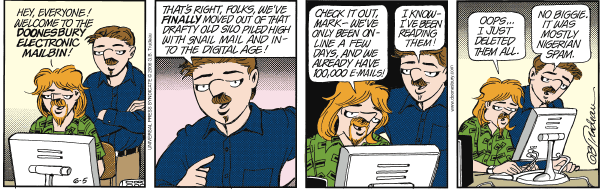
I don’t know what took them this time, but finally, five days after putting a virgin email address up on the main page, spam started coming in. A birthday present for me! Just one message so far–a Nigerian variant–but it’s beginning. I am adding it in the comments of the original post, where I will collect all future spam.

This Nigerian variant pretends to be a Russian barrister representing an oil tycoon who got arrested for bribing politicians, and needs to funnel $18 million through my bank account. I sent him my credit card number right away.

Doonesbury Nigerian Spam

Oh, and the travel agency is still hotlinking to my image. Bless their hearts.

Categories: BlogTech Tags: by

God Doesn’t Like to Be Tested

June 8th, 2006 1 comment

From Reuters, the ultimate epistemological test:

A man shouting that God would keep him safe was mauled to death by a lioness in Kiev zoo after he crept into the animal’s enclosure, a zoo official said on Monday.

“The man shouted ‘God will save me, if he exists’, lowered himself by a rope into the enclosure, took his shoes off and went up to the lions,” the official said.

“A lioness went straight for him, knocked him down and severed his carotid artery.”

Either God doesn’t exist, or He loves irony. Kind of like that evangelist preaching at a church in Ohio who asked God for a sign, and lightning promptly struck his church set it on fire.

Categories: People Can Be Idiots, Religion Tags: by

Web Host Alert

June 7th, 2006 Comments off

I’m not getting anything for this, but it could be a fairly good deal, so I thought I might put out the word. The web hosting service I use for this blog is Surpass Hosting. I signed on to this host 2 years ago when my old host went into the “too much trouble” mode that all web hosts seem to reach at some point. At the time, Surpass was having a 2-for-1 promotion, where if you signed up during the promotion, you got two accounts for the price of one. If you only have one domain, then it isn’t that great. But if you have several, like me, and especially if you’re hitting high bandwidth, then the deal is very good. I signed up, and have been more or less satisfied with the service. There were two periods where I almost felt like leaving, but it never passed that threshold.

In the second half of June, they’re reviving the promotion for the first time since I signed on. The lowest-cost shared hosting deal is their “Power” plan, which has these specs:

$6 per month ($65 for a one-year contract)
5GB hard disk space
200GB monthly data transfer
10 add-on domains
Unlimited email, subdomain, and FTP accounts, and unlimited SQL databases

You always have to take the “unlimited” claims carefully; there are limits in that you can only use up a certain percentage of the server resources. Too many active scripts on your site could get you into trouble, but you have to do a pretty heavy amount of activity to get there.

“Shared hosting,” by the way, means that your web site is one of a few hundred that inhabit the same server computer at the web host’s facility. It’s usually enough for a regular person’s web site, like a blog or something else casual. However, there are more chances for one or more other users on the same server to behave badly and negatively impact your site’s uptime and performance. The next step up is “Virtual” or “VPS” hosting, which also divides a single server among many accounts (often up to two or three dozen), but each gets a bigger share and each account resembles a private server in some ways. These accounts can be more expensive (starting at around $50/mo.), but allow greater access to site resources. Then you have “Dedicated” hosting, where you get a server machine all to yourself, with the CPU and hard drive dedicated to serving your site, with no one elbowing in on the resources. These are the most expensive, ranging from a hundred to several thousand dollars a month, depending on the package and the bandwidth you get.

As for the other specs: “transfer” means how much data can be uploaded by you/downloaded by visitors each month. My blog is pretty active (around 30,000 unique visitors/mo.), and I have several multi-MB files that get downloaded a hundred times each or so every month; my transfer amounts to about 30GB/mo., and is growing. “Add-on domains” means that in addition to the domain that dominates your account (mine is blogd.com), you can also have other domains run from the same account. Each one inhabits a subdomain, but appears to the world as an independent domain. For example, I have the domain “xpat.org” settled within my “blogd.com” account. Its real address is “xpat.blogd.com,” a subdomain, but if “xpat.org” is directly accessed, it’ll act like its own domain–just not at the moment, though, as I currently have it sleeping, and it redirects to this blog’s main page.

As I mentioned, Surpass is OK as web hosts go, but like all hosts, it has had its rough spots. Soon after I signed on in 2004, a string of hurricanes hitting Florida showed up a lack in their backup facilities, but that got resolved. And late last year/early this year, I had enough site slowdown and script failure problems to almost make me move, but I stayed on and that got resolved. Both are good signs–the bad sign is when the problems don’t get resolved, and your host shows little interest in doing anything about it. But even with Surpass, you gotta keep on their butts about it. Eventually, my latest problems were solved when they moved me onto a new server; the problems arose from another account on the shared server being a CPU hog.

One of the better points about Surpass is the rather quick response time to support ticket requests; they tend to answer in a few minutes, and often the solution is not far behind. But as with any host, different people have different experiences, and there is never any guarantee that any host won’t go south at any given time.

As usual, you can find user experiences and a variety of good advice on Web Hosting Talk forums.

Ah, and the tech support just got back to me: they upgraded my account. When I signed up, ten bucks a month got me 7GB of hard disk space and 75GB traffic; under the present deal, the same amount gets you 10GB and 400GB. So I asked if they’d up me to the present levels, and they did. Fair enough, but apparently you gotta ask in order to get it….

Categories: BlogTech Tags: by

Idiots

June 6th, 2006 6 comments

I can’t believe this. A commercial site, a business, a travel agency, is actually hotlinking to one of my China travel photos (the one at the bottom of the page). If they simply ripped off the image and hosted it on their own site, I would never have noticed. But the cheap idiots are hotlinking, actually using the image as it appears on my site. That’s thieving! Will these people never learn? Specifically, will they never learn that a hotlinked image is controlled by the site where it is hosted? And they just happened to hotlink to an image which I just happened to change, purely for the use on my own site. If it happens to blend in with their own page, then that’s their own damn fault for putting it there. Nothing to do with me.

Update: Skaah alerted me to the fact that the hotlinker finally saw the image swap–it took about a week for that to happen. Now the web site is, as Skaah points out, hotlinking to yet another image, this time on a professional photographer’s site. I’m sending the site owner a message warning him of what’s going on.

In the meantime, here’s a link to an image of the page when it was hotlinked to my altered image!

Categories: People Can Be Idiots Tags: by

This Is Leadership

June 5th, 2006 1 comment

Oil is reaching $75 a barrel (up from $21.50 at the end of 2000, just before Bush took office, by the way), and Iran is threatening to devastate the U.S. economy with massive oil price increases if we do not stop interfering with their nuclear program. Peak oil further threatens our energy security, and energy companies are running off unchecked with tens of billions of dollars in usurious profits. The situation in Iraq continues to deteriorate, now with reports of American troops killing civilians destabilizing the local landscape even further, and giving America a dark and sickening image in Iraq and worldwide, as sectarian violence continues to escalate, with Iraqis killing Iraqis as well as our troops, the last two months being much bloodier than average in the continuing conflict. Meanwhile, the national budget continues with huge debt, deficits, and massive porkbarrel overspending as more and more widespread corruption among congressional Republicans is revealed and more tax breaks for millionaires flow from Washington. Meanwhile, tens of millions of Americans, especially children, don’t have health insurance, American jobs are getting crappier, the minimum wage festers as more and more Americans drop into poverty after it declined under Clinton.

So with all this crisis, with so much threatening the well-being of our nation, what are Bush and congressional Republicans–who control the course of debate and voting in the nation’s capital–deciding to spend time on?

A constitutional amendment to ban gay marriage.

Categories: GOP & The Election Tags: by

Colbert College

June 5th, 2006 1 comment

Some quotes by Stephen Colbert giving the commencement address at Knox College in Galesburg, Ill. on Saturday:

But I guess the question is, why have a two-time commencement loser like me speak to you today?  Well, one of the reasons they already mentioned…I recovered from that slow start. And I was recently named by Time magazine one of the 100 Most Influential People in the World! Yeah! Give it up for me! Basic cable…THE WORLD! I guess I have more fans in Sub-Saharan Africa than I thought. I’m right here on the cover between Katie Couric and Bono. That’s my little picture—a sexy little sandwich between those two.

But if you do the math, there are 100 Most Influential People in the World. There are 6.5 billion people in the world. That means that today I am here representing 65 million people. That’s as big as some countries. What country has about 65 million people? Iran? Iran has 65 million people. So, for all intents and purposes, I’m here representing Iran today. Don’t shoot. …

Also globalization, e-mail, cell phones interconnect our nations like never before. It is possible for even the most insulated American to have friends from all over the world. For instance, I recently received an e-mail asking me to help a deposed Nigerian prince who is looking for a business partner to recuperate his fortune. Thanks to the flexibility of global banking, a Swiss bank account is ready and waiting for my share of his money. I know, because I just e-mailed him my Social Security number. …

And when you enter the workforce, you will find competition from those crossing our all-too-poorest borders. Now I know you’re all going to say, “Stephen, Stephen, immigrants built America.” Yes, but here’s the thing—it’s built now. I think it was finished in the mid-70s sometime. At this point it’s a touch-up and repair job. But thankfully Congress is acting and soon English will be the official language of America. Because if we surrender the national anthem to Spanish, the next thing you know, they’ll be translating the Bible. God wrote it in English for a reason! So it could be taught in our public schools.

So we must build walls. A wall obviously across the entire southern border. That’s the answer. That may not be enough—maybe a moat in front of it, or a fire-pit. Maybe a flaming moat, filled with fire-proof crocodiles. And we should probably wall off the northern border as well. Keep those Canadians with their socialized medicine and their skunky beer out. And because immigrants can swim, we’ll probably want to wall off the coasts as well. And while we’re at it, we need to put up a dome, in case they have catapults. And we’ll punch some holes in it so we can breathe. Breathe free. It’s time for illegal immigrants to go—right after they finish building those walls. Yes, yes, I agree with me. …

I have two last pieces of advice. First, being pre-approved for a credit card does not mean you have to apply for it. And lastly, the best career advice I can give you is to get your own TV show. It pays well, the hours are good, and you are famous. And eventually some very nice people will give you a doctorate in fine arts for doing jack squat.

Videos of Colbert are available on YouTube.

Categories: The Lighter Side Tags: by

NHK at the Door

June 4th, 2006 6 comments

I got a visit from the NHK guy a few weeks back. For those of you who don’t know, NHK is the public television network in Japan; kind of like PBS in the U.S., but less independent of government. It is funded by quasi-mandatory individual fees (like British television fees), which are collected by besuited men who come to your door every so often. This time I was able to fend the fee collector off by pointing to my Sky Perfect satellite dish, and pointing out that I do not watch any terrestrial broadcast television (though I will admit to peeking when there is an earthquake, but don’t tell the NHK guy–and I wouldn’t mind losing that ability, they can shut off my NHK if they want). He accepted this and went away, unlike other visits I’ve had, where the NHK guy will shove an English-language slip of paper at you and insist that it’s the law that you pay.

The thing is, the rules are less than clear on this. The law does not say it’s mandatory to pay, and there is no penalty for not paying. However, it also says you have to make a contract “to receive NHK broadcasts.” But NHK broadcasts–terrestrial ones, at least–are not arranged by contract, they are there whether you want them or not. But what it comes down to is, they can’t force you to pay. And most foreigners in Japan have figured this out, which is why many NHK fee collectors are either resigned about us, or try to get in our faces and pressure us. They used to have far fewer problems with getting Japanese to pay, but with corruption scandals over at NHK, more than a million Japanese who used to pay refuse to do so now. And that got the government into a tizzy about what to do.

However, the laws may be changing soon. A government advisory council is going to release a report Tuesday with recommendations to the Ministry of Internal Affairs and Communications about how they should suggest to the national Diet that the NHK fee laws be changed. It is expected that the report will propose that NHK fees be made mandatory and that failing to do so carries a punishment by law. They also are expected to suggest that NHK fees be “drastically” reduced. Currently, terrestrial broadcast fees are ¥2,790 ($25) every two months, and satellite NHK is ¥4,680 ($42) every two months (though that includes the terrestrial fee; you don’t have to pay both). How much that amount would be reduced is unknown.

After the report is submitted, the ministry could use it to propose new legislation as early as 2007. If it passes, it is not clear if it would take effect immediately or if it would be scheduled for a future date for implementation.

All this takes me back to my days in Toyama in the mid-80’s. I lived in an apartment building back then where the NHK guy made frequent visits. I was able to fend him off with my magical gaijin powers: I pretended that I understood no Japanese, and that did the trick. Then one day, the NHK guy came when my girlfriend was at my place. I had not briefed her on my technique with the NHK guy, so when she heard me tell the guy at the door that I could not speak Japanese, she innocently and helpfully walked up and offered to translate. Strangely, I forget how I handled that particular situation, though I am quite sure that I never paid the fee.

Categories: Focus on Japan 2006 Tags: by

Namibia, Birthplace of the Stars

June 3rd, 2006 Comments off

In the southern African country of Namibia, where Jolie & Pitt had their celebrity baby, a newspaper went out on the street to collect citizen reactions to the event. It could just as well have been in The Onion:


Wdyt Photo4.Article Wdyt Photo1.Article Wdyt Photo2.Article
BEATHA NATHANIEL,
Systems Analyst
“I think it’s really great that they’re marketing our country. I’m sure other actors would like to have their babies here as well.”
KADIRI MUSA,
Merchant
“I guess they read the report about how the U.S. infant mortality rate is higher than Namibia’s.”
ISAAC PETRUS,
Senior Account Executive
“They should go in the Guinness Book of Records for being the first Hollywood couple to have a baby in Namibia.”

Believe it or not, only one of those quotes is made up. I got the name and occupation for the fake one from a Nigerian scam email I got sent.

Categories: The Lighter Side Tags: by

Spamcatcher

June 3rd, 2006 19 comments

I wanted to retry an experiment I carried out a few years ago, except this time more visibly and in real time. The experiment is to demonstrate what happens if you post your email address on a web page anywhere on the Internet. Spammers and con men use bots, automated programs, to scan web sites constantly in search of email addresses they can hit. Just now, I created a new email address. It has never been used before, never been on anyone’s lists at all. Completely virgin. A few minutes ago, I posted it on this web page, and this web page only. The catch: it’s not visible to the naked eye. I put it in a small spot way down the page where there’s a solid color background, and then made the font color for the email address identical to the background. The only way you’ll see it is to select the text (if, for some strange reason, you want to, then select all the text in the “powered by” box at the bottom of the right sidebar–but shush, don’t tell anyone).

Why do this? To demonstrate how fast spammers and scammers will pick up your email address if you are naive enough to post it on a web site. Also, because I want to see how things may have changed in the spambot world. Last time, spams started coming in only a few days after the address went up, and after two weeks, 33 spams had come through, about 1/3 of them scam attempts, mostly Nigeria 419 and Euro-Lottery scams.

This time, I will post the emails I get to the comments of this blog post as they arrive–of course, only after I have scrubbed out all the links, email addresses, and anything else that could benefit the senders. When I finish, I’ll re-date this post to move it to the top of the queue.

Categories: Computers and the Internet Tags: by

Pulse It Like Beckham

June 3rd, 2006 Comments off

Although I can walk on my broken foot now, and have been for a few months, it’s still somewhat broken. That is, the bones aren’t properly knitting. There’s pain, but not at the break, rather at nearby joints, and that may be from the atrophy from having used crutches for more than three months. Still, the break should be healing faster, and better. It’s not.

As a way to help with the healing, I’m using a system called SAFHS (“Sonic Accelerated Fracture Healing System”; scroll to the bottom of the linked page to see illustrations), pronounced “safes.” It’s a very-low-frequency ultrasound pulse device, which is reported to help bone healing, especially in cases like my own. The FDA approved it 12 years ago. When the World Cup was played in Japan in 2002, David Beckham broke his second metatarsal (I broke my fifth) just a few months before the games started; he used the same technique (as my doc loves to tell me):

“We have an ultrasound product that’s capable of repairing broken bones. David Beckham wouldn’t have played in the last World Cup if it hadn’t have been for our ultrasound bone healing technology when he broke his metatarsal.”

While my doc at first dissuaded me from using it (he thought it was not covered by insurance and would not be overly effective), I went to see a second doctor who urged me to use the device. Sure enough, sources on the web report rather dramatic improvements in healing when using the device–makes me wish I had started using it a lot sooner. And it turns out that insurance will cover it after all; my first doc had it wrong on that account, too.

Still, it’s not cheap. It costs ¥125,000 (about $1100), 70% of which my insurance pays for, so I’m shelling out $330. I gotta figure that most of that pays for the research & development for the device, because the device itself doesn’t look like it should cost nearly that much. It’s a little thing, almost small enough to call it handheld, with a cord leading up to a small rubber puck-like thing (imagine a rubber drain stopper), which is the pulse generator. With a gel applied, that gets snapped into a belt with a round hole that goes around my foot; turn on the machine for 20 minutes a night, and that’s it. It’s a take-home device, on loan to me until whenever the doc says the healing is good enough.

Let’s hope it works.

Categories: Main Tags: by

What’s With the Lights?

June 2nd, 2006 3 comments

I try not to post too often about personal peeves in my daily life, but the city where I live has gone out of its way to make life difficult for commuters. It seems like there can be no such thing as a convenient solution for these boneheads. For the past many, many years, probably before I moved here six years ago, the city has been working on a central thoroughfare down the middle of town. Before now, it was only half completed, and so you had to take one of two alternate routes through town.

In order to get from where I live over to the other end of the city (where the only bridge over the river is), you’d either have to take a narrow, one-lane road congested with traffic, or you’d have to go way out around the edge of town on the small riverside road. The narrow road is more direct, but the river road has fewer lights and much less traffic. Neither was really a good solution, and one would lose quite some time either way.

But finally, after all those years, they finally finished the big road right smack through the middle of town. They must have spent a fortune on it, too–buying up all that land couldn’t have been cheap, not to mention paying for years of construction (nothing ever seems to get done around here quickly). So now, there’s a nice, big, wide, new boulevard. When I saw it had opened, I figured that getting through town would be a snap. What an outrageous fool I was.

The city planners, of course, just had to find some way to completely screw it up. Their solution: stack the traffic lights.

Let me give you a picture of what it’s like right now. First, to get on the new road from my side of town, you can take one of two quick routes from a common intersection. I’ve tried both several times. In both cases, you leave from the common intersection when the light turns green, and hit another traffic light before you get to the traffic light at the intersection at the beginning of the big road.

If you take the first option of the two, you immediately hit a red light. You wait, and then once it turns green, you meet the another light just turning red.

Seeing how that sucked, I tried the other way. Leaving the common intersection, you get an immediate green light at the next intersection–but then two red lights in a row, again, each turning red just as you arrive. Same thing as the other route.

Both leave you at the entrance to the main road. When that light turns green, you move forward about 50 feet–to be immediately stopped at a light just turning red as you get to it. And here, you see the inevitable frustration ahead of you: as you approach, you can see the next two intersections beyond the light that just turned red on you. The next one has just turned green, and the one after just turned red. That’s right–three lights in a row, closely spaced, turning alternately.

In other words, within just a quarter of a mile, no fewer than five traffic lights timed to catch all traffic, both ways, for the maximum possible duration, each light turning red just as traffic reaches it. Frustrating as damned hell. I mean, I didn’t even think it was possible to do that, but they found a way. And three of those five intersections have no cross traffic. That’s right, no cars coming the other direction. You’re stopping for no reason whatsoever.

And, not a little symbolically, as you wait at the middle light, you are right smack in front of city hall, where you can vividly imagine the traffic planners laughing their asses off at the hapless schmoes (that’s you, bub) getting stopped every fifty or sixty feet.

I timed it, by the way: the old ways through town were quicker by a minute or so–when this new way should have easily saved three or four minutes of transit time.

I’m used to seeing this kind of stuff, unfortunately. I mean, if it’s geared to make traffic going one way faster, I’m perfectly fine with it. But all too often, you come upon a stretch that stops traffic both ways–or even worse, it makes it so that drivers can get through the lights only if they speed like madmen, which they all too often do. (I don’t know whether it’s a good thing or a bad thing that the cops don’t patrol these areas.)

But this new way “through” town takes the cake, easily winning the award for the dumbest-ever traffic planning solution. What a damn fool waste of time, energy, opportunity, and money.

OK, peeve rant over.

Categories: People Can Be Idiots Tags: by

You Mean They’re Not Really Japanese?

June 1st, 2006 5 comments

Back in the late 80’s, when the economy in Japan was still booming and Japan was still poised to take over the world, there was a lot more building going on and a lot more workers were needed. But Japan didn’t want to let in just any old foreigners. They wanted a better class of foreigners. So they got an idea: Japan sent a lot of its people over to South America about a century before, and there are still a lot of them down there that are still pure Japanese, or close enough. Let’s bring in the Japanese foreigners!

Even that surprised me. I remember when I first traveled in Japan. It was in a group led by my Japanese language teacher, Mrs. Hiramatsu. She was born and raised in Japan, even worked as a newscaster in the Kansai region. She moved to America with her husband (also Japanese), and they both became U.S. citizens. Speaking to her in Japanese, there was no mistaking her native language proficiency. And her name is very easy to “spell” in Japanese, the kanji well-known and easily drawn. And yet, whenever I saw her name in print prepared by people we visited in Japan, it was spelled out in katakana–an alphabetic script reserved for foreign words and for spelling out other sounds which were not Japanese words. Simply because she was no longer a Japanese citizen. That bit of exclusivity struck me back then.

Well, it seems like Japan has remembered that exclusivity, as it is now looking at changing the immigration laws that allowed these foreign Japanese into the country since 1989. After a decade and a half of having South American Japanese in Japan, it’s not working out. For one thing, Japan discovered that these ex-Japanese can’t speak Japanese. Hell, they could have asked me–or anyone familiar with sansei on down–and we could have told them that the language doesn’t survive overseas past the third generation. So now Japan has all these South Americans living in Japan. What’s worse, they look Japanese. Hard to deal with that one!

The problem for me is, I don’t know if I’m going to be caught up in this. The changes would affect “long-term visa renewals,” which, for all I know, might include anyone looking for permanent residence–something I’m thinking of, once I qualify in three years. Apparently, applicants would have to pass a Japanese language proficiency test. I can get by just fine in everyday conversation, but I’m pretty sure that I’d do badly on a formal test. Despite having lived in Japan for some years, I teach in English–which would make such a Japanese language provision rather ironic in my case.

I might be worrying for nothing; the measure seems aimed to effectively reverse Japan’s allowing South American Japanese permission to live in Japan long-term as unskilled laborers. But things are getting more and more anti-foreigners around here lately. Not as bad as the 80’s, but it’s as if the government is working really hard on getting back to that mindset. Every year or so, good ol’ Ultranationalist Tokyo Guv Shintaro Ishihara drags out the artificially inflated gaijin crime stats and beats his chest about the dangerous foreigners. And the federal government is using terrorism as a reason to re-institute the old fingerprinting laws for foreigners, which was abolished just six years ago, but is now back.

Fortunately, it’s still just the government, I haven’t noticed this filtering down to the personal level, or even to the local police. Let’s hope it stays that way.

Categories: Focus on Japan 2006 Tags: by

Feeds Click Through, Please

June 1st, 2006 3 comments

Starting today, as an experiment in statistical accuracy, I am resetting the RSS feed for each blog story to a lower amount, meaning people who read this blog by feed readers will have to click through to the actual blog page to read the whole blog posts. If this is too annoying for some, please let me know. For the time being, at least, I would like to know how many people are actually coming to read via RSS. Thanks for your cooperation.

Categories: BlogTech Tags: by

Odds & Ends, End of May

May 31st, 2006 Comments off

78 3.JpgSomeone is selling a very precise and fully-tricked-out Back to the Future DeLorean time machine car on eBay, in “pristine” condition, can actually be driven, and has all the special effects including flux capacitor and time circuits. Vanity plate “OUTATIME” not available (too many letters anyway), instead it reads “BK2D80S.” For the ultimate geek who has everything. Looks like it would be fun to ride in, for about five minutes, and then the embarrassment would quickly overtake the novelty.

I mean, it’d be OK for a joyride, but really, can you imagine going shopping in it? Of course, it would probably be theft-proof; even if a car thief did want to steal it, it’s not like the police couldn’t track it down in ten seconds flat.

The eBay description does not guarantee flyability or accurate time displacement. Your mileage may vary.


Speaking of movies, there’s going to be yet another remake of the The Seven Samurai, this time with a Chinese cast (Donnie Yen, Zhang Ziyi et al), plus George Clooney. Um, wha? According to the rumors, the film, budgeted at $100 million, will feature lots of Kung-fu action and digital effects. This is a movie that Harvey Weinstein (producer of Pulp Fiction, Lord of the Rings, Scream, and Scary Movie among others) has reportedly wanted to make for some time. Clooney is said to be taking the role of the lead samurai, portrayed by Takashi Shimura in the original. It’s anyone’s guess as to where and when the remake would be set, or how Clooney could fit in. One can only hope that it won’t be as terrible as it sounds.


Supposedly another of Weinstein’s projects will be Fahrenheit 9/11 ½, a new film due out in 2007 (presumably after Sicko) by Michael Moore about the state of Bush’s America since the 2004 election. Make of it what you will.


A very interesting birth: a child born in Shanghai with three arms–and it is difficult to tell which of his left arms is more developed than the other. While doctors debate which arm should be removed, another question is, should either arm be removed? The photo is not grotesque (unless that kind of thing especially bothers you), but what is unnerving is how similar it seems to all the pictures we’ve seen over the past years showing frogs being born with similar extra limbs. The next sign of environmental damage taking its toll?of it what you will.


And finally, I did not know that you could be fined and even jailed by a court of law in Japan for disrupting a high school graduation ceremony. Apparently you can be. But I’ll bet you any amount you like that 65-year-old retired Social Studies teacher Katsuhisa Fujita was not fined ¥200,000 by the Tokyo District Court just because he was disruptive. My bet is that he would never have been arrested, tried, or fined had the disruption been about anything else but the Japanese national anthem and flag. Fujita’s crime was that he urged parents attending the ceremony to remain seated during the anthem as a way to protest Japan’s growing nationalism, which many see as represented by the government’s demand that the anthem and flag be displayed and mandatorily saluted at schools across the country.

The “tumult” caused by Fujita delayed the ceremony by all of two minutes, for which the prosecutors wanted the senior citizen thrown in jail for eight months. Which, one would presume, would convince everyone that Japan is not becoming a totalitarian state, because we all know that liberal democracies are renowned for throwing the elderly in prison for the egregious crime of free speech, especially when agitating against fascism. And with the prosecutors’ job done, Japan is again safe from 65-year-old Social Studies teachers trying to teach everyone about democracy.

Categories: Main Tags: by

Poetry

May 30th, 2006 Comments off

506Homecoming

Sometimes the elegance of a single photo can truly strike you. I wish I had a larger version of this picture, but this one from a CNN set (via DKos) will have to do. Taken by a family member of a returning soldier, this is the kind of photo you expect to win a Pulitzer for its simplicity and its symbolism. You see no faces, and yet the image could not be more full of expression. A father returning home to what is most important to him, his weapon casually yet significantly discarded. The composition could not be more perfect. One could write volumes and yet not articulate as exquisitely as this as desirable a resolution to conflict.

Categories: Main Tags: by

DSL, e-Japan, and the La-Z-Boy Mentality

May 29th, 2006 4 comments

It’s strange to see news articles from the U.S. talking about DSL starting to become widespread.

About 84 million U.S. residents now have broadband Internet access at home, up 40 percent from 60 million last year, a study by the Pew Internet & American Life Project found.

The increase comes as both the price of personal computers and the cost of Internet service continue to fall. AT&T, for instance, is selling DSL to new customers in the Bay Area for as low as $12.99 per month.

One interesting point in the high-tech San Francisco area paper is that they don’t mention speeds. A provider in my family’s area–very close to Silicon Valley–is offering “High Speed Internet” packages. While starting very cheap at $13, the speeds offered start at 1.5 Mbps, and top out at 6 Mbps. And as the article pointed out (as does the ad, in asterisks), the prices are promotional, to try to steal away customers from cable providers. But the speeds are what catch my attention; these are new speed levels, a big improvement over what’s been available up to now.

And yet, here in Japan, those speeds are way out of date. I believe it was 3 or 4 years ago that the 12 Mbps speed stopped being the fastest rate. Now most ADSL services are providing 50 Mbps as the top speed, and most areas have some form of fiber-optic, usually topping out at 100 Mbps. I still read about some American colleges and universities boasting a 100 Mbps fiber optic connection for the whole school, which includes hundreds, perhaps over a thousand computers in the network. My school has had that speed for years, and we have only a few dozen computers sharing it. When I explain this to my students, they’re shocked; they expect America to have better Internet connectivity, not worse.

While the telecoms can blame rural areas for being expensive to upgrade, what’s their excuse for urban areas, like my parents’? There are certainly no problems with great distances in such areas, and no shortage of people willing to pay. So why is even the heart of computer territory still so painfully slow?

Part of it is probably that, despite being allowed to charge higher fees in exchange for the promise that they’ll build broadband networks, the telecoms are just putting off any significant upgrades and instead are just raking in the fees for as long as they can. But part of it is that the government has no unified plan for encouraging broadband.

Japan was backwards in Internet speeds in 2001, and in just a few short years, leapfrogged high over the U.S. with a strategy called “e-Japan,” which had the philosophy of “maximizing the benefits of users” and “promoting fair competition” to establish 30-100 Mbps Internet connections for everyone in the country by 2005. And guess what: it worked. They did it. It’s here. In fact, they finished before 2005, and in 2003, they started on the “e-Japan Strategy II,” a plan to use those fast pathways to the best effect, especially in the areas of “medical treatment, food, life, small-and-medium-sized-enterprises, finance, knowledge, employment, government service.” The idea is to ensure good IT management and high-quality content, with strong interconnectivity between public and private institutions, with a focus on user satisfaction.

The American government faces bigger obstacles in the size of the country, but that’s no excuse for not having a coherent policy at all. It’s no excuse for such paltry speeds even in the heart of the computer industry, in crowded urban areas with almost every home owning a computer.

This is all to reminiscent of America’s lapse back into big gas-guzzlers, with Japanese carmakers again being in the forefront in terms of high-milage vehicles. It’s as if the lessons of the 80’s were completely forgotten, and America eased back into its “La-Z-Boy” mentality. Only this time there probably won’t be a Japanese bubble-burst and decade-long recession to allow American businesses to come back from behind.

I won’t be too surprised if we see a repeat of the last generation all over again–except that while Americans apparently have not learned from past lessons, the Japanese may have learned very well indeed.

Categories: Computers and the Internet Tags: by