Apple Gaining Ground?

October 12th, 2005 1 comment

There’s a new article from a publication called The Streets which claims that Apple’s retail market share shot up about 50% in the past year, from 4.3% to 6.6%. If true, that’s a significant amount. however, there are a few caveats. First, the article, linked to by many sites, has either been edited or changed–the quoted statistic no longer appears. Whether simply an error by the publication, an address mix-up, or a knowing decision to edit the article and leave out the information is not clear. I can’t find the claim made elsewhere (without quoting that changed article), so it’s up in the air. Other qualifications include the fact that this figure only quotes retail and not online sales, which would lower the number a bit, but would still represent a significant difference.

Nonetheless, there are factors that suggest that Apple’s market share is actually higher than most report. For example, Apple computers tend to last longer. If one company makes tennis shoes that are popular but wear out in a month and must be replaced, and another company makes higher-quality shoes that last for years, the former company would see more sales–but it does not mean that so many more people actually use the shoes. It just means they sell more. This is suspected with PCs and Macs, where Apple has maybe 5% of all computer sales, but more than 5% of computer users own an Apple.

Certainly Apple is still faring well with people who buy them. Customer satisfaction for Macs not only exceeds all other makers, but it exceeds all other makers by a wide margin–in both laptop and desktop models.

The current increase is seen as an iPod “halo” effect–people who buy iPods but use Windows see the high quality of the product and want to try the computers out as well. But starting next year, Apple will have a new inroad which will probably propel its sales even faster than they are increasing now. That will be the switch to Intel chips, making it possible to run not only Mac OS X, but Windows OS as well–both on a Mac, both at native speed. You can bet that there will be the ability to switch OS’s on the fly, by typing one key or another. And with that, a great many people will be perfectly willing to shell out a few hundred more bucks for a machine that has both in one. People can continue to use their old software on Windows, while at the same time get new software for the Mac OS, using both operating systems toward their strengths. It will suddenly become a lot cheaper to “switch” from PC to Mac.

Categories: Computers and the Internet, Mac News Tags: by

New Rule: It’s Everybody or Nobody

October 11th, 2005 Comments off

Why not emulate Bill Maher’s “New Rules”? He had a great idea, so let’s rip it off.

New Rule: When you have a “Town Hall” meeting, the whole town has to be invited. Otherwise it’s a staged party-members-only event. Bush became infamous for these stacked-audience love-in events, pretending as if they were open to anyone while at the same time, severely restricting the audience to the party faithful and sometimes even requiring loyalty oaths to be signed. And even then, the questions were usually screened and rehearsed, and were either softball questions that allowed Bush to pitch his selling points, or they were unabashed gushing compliments to our Dear Leader.

California Governor Schwarzenegger has been doing the same kind of thing, and even Senator McCain criticized this after attending one to support Schwarzenegger:

As at many of Schwarzenegger’s campaign events, outsiders were not allowed to attend what the governor’s office called a “town hall meeting” at a hotel near Oakland’s airport. Union protesters gathered outside the venue carrying signs. …

At a subsequent news conference, McCain, a possible candidate for U.S. president in 2008, said he had always favored town hall meetings open to the public, adding that some especially noisy dissenters had occasionally been ejected. “The benefit of an open town hall meeting is one that you get to hear a lot of different views, and two it has credibility,” said McCain.

Couldn’t have said it better. Of course, many Republican politicians don’t want that; look at what happened when Kerry tried it: he was often heckled and jeered at by conservatives who came for no other reason than to make him look bad. He didn’t always have open events, but even his closed events were far less restricted. So, far more often, Kerry paid the cost of hearing different views and having credibility, and some Republicans know full well that they don’t need or want either.

Well, too bad. You have a closed event, it’s not a “town hall.” It’s a rally for the party faithful.

Categories: Political Ranting Tags: by

The Obsequious Instruments of His Pleasure

October 11th, 2005 3 comments

A lot of people are onto this now, but it merits reprinting far and wide. Andrew Sullivan points out that in the Federalist Papers (No. 76), Alexander Hamilton writes on the reason why the Senate must confirm any nominees put forth by the president. Remember that the Federalist Papers were written chiefly by Hamilton and Madison as a means of explaining the Constitution to the people of New York, defending it against those who wanted to reject it. They are a primary source for interpretation–the Supreme Court’s job. Also consider the nature of Harriet Miers’ nomination, and why Bush chose her. With that in mind:

To what purpose then require the co-operation of the Senate? I answer, that the necessity of their concurrence would have a powerful, though, in general, a silent operation. It would be an excellent check upon a spirit of favoritism in the President, and would tend greatly to prevent the appointment of unfit characters from State prejudice, from family connection, from personal attachment, or from a view to popularity. In addition to this, it would be an efficacious source of stability in the administration.

It will readily be comprehended, that a man who had himself the sole disposition of offices, would be governed much more by his private inclinations and interests, than when he was bound to submit the propriety of his choice to the discussion and determination of a different and independent body, and that body an entire branch of the legislature. The possibility of rejection would be a strong motive to care in proposing. The danger to his own reputation, and, in the case of an elective magistrate, to his political existence, from betraying a spirit of favoritism, or an unbecoming pursuit of popularity, to the observation of a body whose opinion would have great weight in forming that of the public, could not fail to operate as a barrier to the one and to the other. He would be both ashamed and afraid to bring forward, for the most distinguished or lucrative stations, candidates who had no other merit than that of coming from the same State to which he particularly belonged, or of being in some way or other personally allied to him, or of possessing the necessary insignificance and pliancy to render them the obsequious instruments of his pleasure.

That last part is the most relevant: the authority of the Senate to confirm nominees was put into place so that the president “would be both ashamed and afraid to bring forward, for the most distinguished or lucrative stations, candidates who had no other merit than that of … being in some way or other personally allied to him.”

I would strongly point this out to those who believe that Supreme Court nominees should just be rubber-stamped by Congress as a political privilege for the president. According to the founding fathers themselves, this was never intended, and Bush should be ashamed of himself.

The thing is, you know he isn’t, and never will be.

Categories: Political Ranting Tags: by

Another Good Read

October 10th, 2005 3 comments

MotecoverThis one is better if you’re already into science fiction, but god overall as well. It comes from a writing duo, Larry Niven and Jerry Pournelle. together, they wrote books such as Footfall (elephantine aliens invade the Earth) and Lucifer’s Hammer (comet hits the Earth), but their best collaboration is The Mote in God’s Eye, written in 1974.

It’s one of those books with a very detailed, background rich environments that usually strengthens a good story, not as rich as Dune, but certainly deep enough to make a big difference. A thousand years in the future, humanity has regressed from its zenith of the First Empire, though it still capable of space travel using something called the Alderson Drive. The drive uses gravitational lines of influence between stars to allow for a jump from one system to another. No alien species are encountered, however.

New Caledonia, a human colony on the far side of the Coalsack Nebula has been isolated from most of humanity for some time due to wars. During that time, something strange is observed. From the colony, the Coalsack Nebula resembles a hooded man, and two stars–a red giant and its yellow-dwarf companion, appear as the Eye of the man, with the yellow dwarf seeming to be a mote in the eye. But suddenly and inexplicably, the Mote turns bright green–and the green light is coherent. In other words, laser light. After many years, the light gets brighter and brighter, and then suddenly it just turns off. Because of the war, scientific observations are not possible, and the change gets passed down into folklore.

Then, 145 years later an alien probe enters New Caledonia space using a solar sail. When the probe is intercepted, the alien occupant is found dead. But that occupant is bizarre: it is asymmetrical, with one powerful arm on the right, and two delicate ones on the left; a large bat-like ear on the left, a single teat on the right. Its mouth is fixed as if in a smile.

A ship is sent to explore the origin of the craft, which is problematic because the exit point of the interstellar jump to the red giant is within the star itself. It can be done using a special shield, but it also explains why the aliens had to use a solar sail, beyond just lacking the technology: there is only one jump pathway between their world and the universe, and it requires a ship to pass through the red giant’s atmosphere.

The human ship successfully makes the transit and enters the alien system, and that’s where you’ll have to pick it up. The alien race created by Niven and Pournelle is wild and fascinating–and more than just a little scary. There are a lot of secrets, a lot of mysteries about the race, and it is a great deal of fun to see it all revealed over time. The aliens–Moties, as they are called in the book–are very likable, at least the ones you meet. There’s a good deal of exploration, intrigue, and action involved.

If you read Footfall, don’t worry–the aliens in Mote are a lot better drawn than those in the alien-invasion novel. And if you’re not a huge Larry Niven fan (or if you’ve noticed that his latest novels are almost bizarrely discordant), again not to worry, Pournelle tempers Niven’s style; the two make a good combination.

There is a sequel to Mote, titled The Gripping Hand (named after the strong, single right arm that Moties possess), which is good, but not as good as its predecessor, as is so often the case with sequels. But the original is one of the top ten science fiction books I would recommend.

Categories: Media & Reviews Tags: by

Congressional Republicans

October 9th, 2005 4 comments

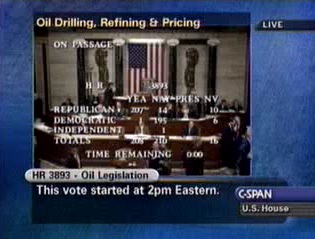
ShamerepsThat about says it all, those two words of the title of this post. Congressional Republicans will do just about anything, abuse any power, burn any bridge if it will gain them any more control. They’ll do all this and then turn around and call the Democrats bloody bastards for doing even a tenth as much, and they won’t even blink at the outright hypocrisy. This was expressed in all its sordid splendor the other day when a vote was called on an energy bill that was little more than yet another sop to energy companies, while making it seem like the Congressional Republicans were doing something to fix the problem, instead of actually being the problem.

You have got to look at the clip from start to finish to see what I mean. Just hearing that the Republicans extended the vote from five to more than forty minutes because the initial count did not go their way; they held the vote open only long enough until they could do last-minute arm-twisting, claiming that they wanted to give everybody “a chance to vote,” when in fact they were waiting until the shifting numbers came into their favor and then slammed the door shut. Every time the Democrats tried to object, the Republicans shut the door in their faces, not allowing them to speak to the dishonest tactics being used to pass a bill that was so contrary to the interests of most Americans that even their own people needed to be cajoled into getting a slim majority. This in addition to the usual dishonest Republican oppressive, immoral tactics like introducing the bill and pushing a vote before any House member has even the least amount of time to read a fraction of what they are voting on.

It’s as if the Republicans don’t even care anymore, that they believe that since they have power now, they have to squeeze every last drop of influence out of it before the Democrats take over and they can return to… I was about to write, “blaming the Democrats for everything,” but realized that even though the Republicans hold all the power, they are still blaming the Democrats for everything.

Just watch the video. C-SPAN was never so compelling.

Categories: Political Ranting Tags: by

Happy Anniversary

October 8th, 2005 2 comments

85Visa

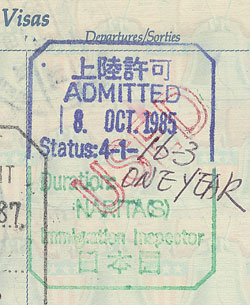
By the way, today was the 20th anniversary of my coming to Japan to work and live. Hope you enjoyed the recent posts, and if I think of anything more to say on the topic, I will.

Categories: Focus on Japan 2005 Tags: by

Bashing the Victims

October 8th, 2005 Comments off

Snopes.com, the arbiters of urban legends, has commented on one of many false accusations regarding the New Orleans evacuees. Since the first days of the debacle where Bush and FEMA left the people of that city to fester for the better part of a week, right-wingers have been quick to shift blame to everyone else–and the victims of that disaster and of Bush’s negligence have been prime targets. Early reports of lawlessness in the flooded areas, combined with the fact that many trapped in New Orleans were poor and black, sparked the imagination of the wingnuts, sending them on a spree of completely bogus claims regarding their behavior. Note that the email uses this story specifically to excuse Bush and FEMA:

Like everyone in this nation, I watched as the news media blasted FEMA and President Bush for the “poor response”. While everyone on TV saw nothing but people being let down by government, I saw people letting down people. … FEMA did not fail them. … I have always said New Orleans was a toilet; now everyone has proof that not only was it a toilet, but a toilet long overdue for a flush.

The idea is that if the victims can be blamed, then sympathy is less and Bush doesn’t look so bad. People either knowingly propagate these rumors, or readily believe and disseminate them as they play into their own political desires.

Here’s an example of that phenomenon in action, a copy of the claim that Snopes investigated and found to be utterly false. The claims are that evacuees who were taken to Utah brought with them an epidemic of crime, including drug use (claimed to be immediate after deplaning), rape, and the formation of violent gangs. The evacuees were depicted as lazy and ungrateful.

While many commenters weren’t taken in, obviously many people were. The state governor, however, felt it necessary to dismiss rumors early on; on September 8, he released a statement that included:

Guests on the base have displayed exemplary behavior and been cooperative with volunteers and law enforcement. No major crimes or incidents have been reported at Camp Williams since the arrival of our guests.

And yet, here we are, a month after the events in the letter were officially noted as false, and still it persists. Right–wing blogs have been picking it up, needless to say. And this is just one example–there have been many other such fake claims. It is sad. It is racist. It is political. And it is quite notably right-wing tactics, to blame anyone–even innocent victims of a horrible natural disaster, people whose lives have been ruined–so as to divert blame from right-wing politicians. This is about as low as you can go.

Categories: Political Ranting Tags: by

A Little Egret

October 7th, 2005 Comments off

Today was a bit busy, so the post will be primarily a photo I took recently. This was from the Tokyo Port Wild Bird Park, the same day I got the Kingfishers, Herons and Snipes. I was able to catch a cute image of a Little Heron taking off. You know the Little Heron from its yellow feet. Well, here they are quite visible:

1005-Littleegret-450

That’s a cropped version of the image. If you click on the picture, you’ll get a full-sized Wallpaper image, which includes the bird’s shadow on the water. I like this image because the Egret’s wings are down, making it look like the bird is just leisurely hanging in mid-air, feet dangling.

Pretty soon I should blog on all the birding locations I’ve found in Tokyo, like I promised a while ago. I’ve got a lot of good water locations, but need to get more land watching places–I’ve still not seen a lot of passerine (land-based) birds, not as many as I’d like. They’re tougher, of course–you have to see them in trees, which is tough, as opposed to shorebirds which sit there out in the open.

Categories: Uncategorized Tags: by

Japan, Expectations, and Food

October 6th, 2005 6 comments

Recently I saw an American late-night talk show interview in which the guest had recently visited Japan, and the subject of raw food came up. As if it’s hard to find anything but raw fish in Japan. I mean, sheesh, come on, guys. Let it go. It’s like saying that it’s hard to eat anything but hot dogs in America.

But these are difficult images to swat down, just like the images of Japan I had when I first visited–Mt. Fuji, shrines, being one with nature. Hah. On the Limousine Bus ride from Narita to Ikebukuro my first evening in Japan, what I saw out the bus window was not what I expected. Neon. Lots and lots of neon. Pachinko parlors, yes, but lots of other stuff too. It felt like Las Vegas, but not in English as much. The following morning, as I was at the age of 19 less prone to jet lag, I got up early and walked around the neighborhood of the Sunshine City building and ran into other stuff I didn’t expect. A wedge area cut out of a corner building, empty flat concrete where space was at a premium. It wasn’t until I looked up that I saw the hoses for pumping gas hanging from the ceiling and realized I was standing in a gas station closed in the morning. Then I found a vending machine on the street which I could not figure out, selling three different types of flat square boxes, about three inches square by half an inch thick, each a different color. I stared intently at the boxes in the machine for several minutes, trying to work out the nature of the products from the little katakana and hiragana I could make out, until I realized that I had spent several minutes staring at a condom vending machine.

That’s the kind of experience you have when you wander into a completely new context. You can’t figure things out at first. The first time I stayed in a Japanese home and had to go to the bathroom, I spent a few minutes trying to figure out where the light switch was. I looked all around inside the small half-bathroom after not finding the switch at hand-level on the inside wall on right side of the door, where the switch is supposed to be. It was dark in there, so I just figured that I missed it somehow, until a host family member showed me the light switch panel outside the bathroom.

So a lot of stuff is unexpected, but more importantly, a lot of the strange stuff you do expect is not really there as much as you think it will be. It’s not all raw fish. But it most certainly is not home when you first get here, either. You find that out quickly enough when you try to find things that you’ve become used to most of your life.

On my first trip to Japan, I stopped by a McDonald’s and ordered a medium root beer (they still served it at McD’s in the U.S. then), only to be told that they did not serve alcohol. I had to explain, and still the girl behind the counter did not understand. My mistake. Just like most westerners come to Japan find they cannot stomach natto and umeboshi, most Japanese cannot stand the tastes of licorice or root beer, and both are very hard to find here.

There are a lot of things that you come to miss. Chocolate is different here. Japanese chocolate, that is; it tends to be less sweet or rich, and sometimes more waxy. And remember, back in the 80’s, stores carried far, far fewer imported goods or foreign brands than they do today. Hell, you can even get boxes of After Eight mints in supermarkets now. That’s not the Way It Was. And having a sweet tooth, I was in trouble, since what passed for “sweet” in Japan was not what I had in mind. Consider that you are reading the words of a See’s Candy addict, and if you don’t know See’s, I feel sorry for you. Mmmmmmmmm. Seeeeee’s. [insert sound of Homer Simpson drooling here] Decadent. Godiva? Give me a break. It’s not the same thing. But See’s is way too sweet for many Japanese. Should I try the local color? I’m sorry, but I just can’t get into sweet bean paste.

Other things were different or missing. Like breakfast cereal. No Cap’n Crunch, that’s for sure. Corn flakes have been here for a while, and recently they’ve gone wild and added even Fruit Loops to the store shelves (those nutty guys), but for a long time it was flakes or nothing. And the milk tastes strange too, even if you can find the rarely-sold skim variety. So what can you have instead? Vegetables. Come again? For breakfast? The first trip I came here I had a one-day homestay in Okayama and was served Okra with natto sauce. It looked like someone sneezed on a skimpy salad. Yech. Vegetables and soup just didn’t go with breakfast for me. You could get toast, if you liked it sliced two inches thick. I’m not kidding.

Things have changed. More of what I missed is available now. Many of the candy bars being sold now are more to my liking, much to the detriment of my health. I mean, you can get white-chocolate Kit-Kat bars with maple syrup flavor now. That would have sent many Japanese of 20 years ago into diabetic shock. And the more-meat, more-bread, more-sugar diet is changing the shape of people. When I first came to Japan, I could stand on a crowded train and see clearly in every direction. Not so today. In 1983, in a small tourist town, some young ladies’ toy airplane had landed on a roof awning, and a local store clerk was madly jumping up and down, arms stretched up high, not even reaching the awning; I came up and simply plucked the toy plane down without even reaching up too high. And I’m five foot ten. And a half. Today, my view is blocked in crowded places, even with that extra half inch working for me. And while Japanese people are still thin enough to make me feel fat (in contrast, when I visited Wisconsin, I felt downright skinny), Japanese people today, in general, are larger in girth as well as height.

I’m okay with it. Seriously, we’re talking white chocolate with maple syrup here. Mmmmmmmm.

Categories: Focus on Japan 2005 Tags: by

TypeKey Buggy

October 5th, 2005 4 comments

I am turning off TypeKey on this blog for the time being. It is so screwed up that the TypeKey cookie expires after only a few minutes. Even when trying to comment on my own blog, if I don’t type and save my own comments within a few minutes after logging on to TypeKey, I get shut out. Completely. Not only will my comment not be accepted, but even if I log out and try a normal comment, it will not register. Even if I open another browser and try an anonymous comment, the comment will not register. Even if I go to a different computer and try, the comment will not register. Somehow, because I did not click the “post” button on the comment within three minutes of logging into TypeKey, the damned system actually locked my own IP address out of my own blog comment system. But only for the post I tried to comment on. How completely screwed up is that?

Furthermore, it performs this way in an even more bizarre fashion. After attempting to comment, the “thank you” message appears, and says that my comment is in the registration queue. But the comment does not appear there, does not generate an email, and apparently just completely vanishes. And no matter what I try, the state persists for hours. This problem has been bugging me for a few months now, but today it elevated to new heights of absurdity. I am ready to trash the whole system and just have unregistered comments from everyone, to be moderated equally. Sorry, but I refuse to use a system that locks me out of commenting on my own blog.

Categories: BlogTech Tags: by

Now It Matters

October 5th, 2005 Comments off

Suddenly conservatives care about SCOTUS candidates being qualified, and believe that Congress has the right to turn down nominees if they want.

Categories: Political Ranting Tags: by

Litmus Tests

October 5th, 2005 Comments off

Bush has claimed more than once that when he makes a choice for a Supreme Court nominee, he does not apply a litmus test on the issue of abortion. He does, however, apply a litmus test on the issue of strict constructionism.

News flash: they’re the exact same thing.

Categories: Political Ranting Tags: by

Media, O English Media, Where Wert Thou?

October 5th, 2005 2 comments

Okay, now on to the topic I first promised some time ago. Sorry for getting sidetracked. Three days until the 20-year anniversary, though, so there’s still time.

When I arrived in Toyama in October of 1985, I simply did not know what to expect in terms of living there. Does it snow? Yes, so bring warm clothing. I could predict simple stuff like that. But what about the fact that Japanese shoe stores stock sizes that end three centimeters short of my size? How about the (then) ludicrous prices for eyeglasses? I could tell stories about those, but what really got to me more than anything else was the dearth of media.

Today it is far, far different. Today there’s cable and satellite TV with CNN, Super Channel and so on, endless English TV. But back in 1985, even the aptly-named BS TV (alas, it stands for “Broadcast Satellite,” though the obvious alternative does apply) was not there yet–at least, I believe it started in 1987 with minimal service. I recall getting bad piped-in reception in my last apartment in Toyama just before I left, mostly just beginning programming with Yu Hayami’s “Let’s Get Happy” repeated endlessly as the theme song for the new service.

So mostly television was not English-friendly. Yes, the TVs even then had “bilingual” ability (essentially, the left audio channel of the stereo broadcast carries English while the right channel carries Japanese), but it was not used enough for English speakers to depend upon as a media carrier. In fact, aside from the English translation of NHK news, sometimes the only bilingual broadcast you could look forward to was the Wednesday Foreign Movie Roadshow (or some title along those lines), a weekly showing of foreign films that all too often featured dreck like Death Wish III, which I swear to God I saw broadcast several times in my first several years in Japan. There may also have been the Sunday Movie Theater, hosted by Nagaharu Yodogawa, the little grey-haired guy who spoke in a birdlike manner and always signed off with his famous “Sayonara! Sayonara! Sayonara!” But those broadcasts were not always foreign movies, as I recall. And what movies were broadcast were usually crap. And we watched every one of them, usually all of the teachers from the Y together, like a weekly event. It reminds me of the Woody Allen joke where he recounts two elderly ladies complaining about the food they were served; one said, “such terrible food!” and the other chimed in, “yes, and such small portions!”

My TV addiction may also have been frustrated by the fact that I lived in Toyama. Now, even in Tokyo there were only 8 or so channels, including the two obligatory NHK channels (General and Educational), which would have been considered sparse for any metropolitan American area. But Toyama was limited to four channels, two of them NHK. So that left the video rental store, which probably kept most of us foreigners from going mad from lack of English entertainment.

Books were even more scarce. Kinokuniya was the place you went to for English books, and out in the countryside I had to travel to Kanazawa in Ishikawa prefecture to get to the Kinokuniya bookstore which had an English-language rack, sparsely populated of course. Not ideal. Even in Tokyo, where the whole 6th floor of Kinokuniya was dedicated to English books and magazines, you had to deal with usurious prices. Kinokuniya posted an “exchange rate” by which you could take the price of an English book in dollars and translate it to yen. It was about double the real exchange rate, making any book cost twice as much as the list price. And forget about magazines or newspapers.

Even as late as the mid-nineties, the book situation was not all that good; the alternatives included English-language used book stores and the Foreign Buyer’s Club, and I seem to recall there was a book seller by mail order somewhere, but most of those got knocked out when Amazon Japan started up after the turn of the century. But back in the 80’s, the best way to get books you really wanted was to go book shopping when you went back home on holiday. That’s what I did, stuffing perhaps half of my suitcase with paperbacks. And maybe the sparsity of books is how I got into the habit of re-reading books again and again and being happy with it.

Today, there is the Internet. Amazon.com and other stores for books. Cable and satellite TV. As much media as you can eat. It’s hard to express what a difference there is. And I have to admit that it may not be a completely positive one, and not just because of the media itself, but because of the draw it provides away from the country in which we live. It allows us to keep perhaps too strong a tether to home and to our native media. I should watch Japanese TV more, but I don’t so much. But frankly, if it’s a choice of too little or too much, I choose too much. There ain’t no ginger*.

Next: food and other stuff you buy.

Categories: Focus on Japan 2005 Tags: by

Cell Phones on Planes

October 5th, 2005 3 comments

Well, that would be just great. Like everyone else, I get the feeling that I’m the one who always attracts the unwanted neighbors on planes. Certainly I have not had luck in terms of the forward seat: over the last several years, on every flight, the passenger in the seat in front of me reclines his or her seat all the way back for almost the whole flight. I’ve been luckier with squalling infants, and so-so with passengers dominating arm rests and jabbing me with elbows. But allowing cell phones? I dread the day.

I just can’t see how the airlines could agree to this. Hell, they more or less insist that you close the window shutter during the time most people sleep; how could people get to sleep if a passenger nearby is gabbing away? Not that I get much sleep on planes, but I like to at least rest. And it would be hell for me to be stuck on a plane for hours on end with that distraction. I can only hope and pray that the service is not active over the Pacific Ocean, where I do most of my flying.

Now, Internet access on flights, that’s a horse of a different color. The worst noise that could come from that is keyboard tapping, which when lost in the background roar of the jet would be hardly noticeable. No problem there.

But even more desirable than that is the idea of power outlets, which are now available only in first class and maybe business class on some airlines. If you’ve ever tried to use a laptop for prolonged periods of time on an airplane, you know what I mean; on international flights, your laptop runs out of juice long before the flight is even half over. You need an adapter cable to plug in to an airline power outlet, but if an airline were to add that feature to economy class, I would consider that a huge plus.

Categories: Main Tags: by

This and That

October 4th, 2005 15 comments

Some unrelated bits and pieces for today.


Bush’s choice for the replacement for Sandra Day O’Connor is drawing reactions as confusing as the choice itself. The candidate is Harriet Miers, White House counsel.Democratic Senator Harry Reid is said to have urged Bush to select her. She has no experience, zero, as a jurist, and has never argued a case before a high court, Supreme or appellate. She’s not a constitutional scholar. She started work for the Bush White House as a deputy chief of staff but also as a staff secretary. She has no paper trail. She’s a Bush loyalist and crony. The Republicans don’t like her, at least on the surface and on first glance. Bush chose someone without a paper trail, a cipher, which is usually a move which indicates that he’s got a rabid conservative but wants to hide it so he can get an easy confirmation. Or it could be he’s doing whatever he can to avoid a fight now that he’s very weak. Miers apparently thinks that Bush is the most brilliant man that she’s ever met.

What in the name of hell is going on here? There’s obviously a lot we don’t know. Speculation at this point is pointless. Stay tuned.


Though I sold my old TiBook (which got replaced by my new AlBook), the ads persist for a while and now I am getting far more enquiries than I was before I sold it. One of them came from a guy in, believe it or not, Nigeria, telling me that his laptop broke and he needs me to ship mine to him right away. I don’t know what his scam was, but hell, a guy from Nigeria, world capital of email fraud, wants me to ship him my PowerBook? I don’t care what “safe” payment plan he has. And maybe he really is legit. But I’d have to be stupid to take the chance, even if I still had the computer to sell. Which makes me figure that those 419 scammers have ruined anyone trying to do business from that country–probably no one wants to do business with anyone operating from there anymore.


Check out Firefly. It’s really good. Weird how Fox (whose entertainment branch does a decent job, apparently not at all connected to the News branch) aired the series’ episodes completely out of order, showing the 2-hour pilot episode last and not even airing 3 of the 14 episodes made. Like with the Young Indiana Jones Chronicles (the ones with Sean Patrick Flanery as the teen Indy, not the episodes with boy Indy), when ABC kept changing days and times, taking it off the air for weeks or months and then airing a few episodes here or there. Sometimes networks seem intent on sabotaging good shows. Cancel Dark Angel after two seasons and run dreck shows for three times as long? And Futurama, even after five years, what the hell were they thinking canceling that?

Anyway, it has me wanting to see the new flick Serenity, though, as usual, it’s all mucked up for Japan, which might not get the film at all.


Paramount has semi-left the Toshiba HD-DVD camp and says they’ll support both HD-DVD and Sony’s Blu-Ray. That makes a majority of major studios siding with Blu-Ray, along with Apple and the greater number of corporations, though Microsoft and Intel recently signed on to the HD-DVD ticket. Disney, Columbia (owned by Sony), and 20th Century Fox are on the Blu-Ray ticket, which Warner Bros. and Universal still are on the HD-DVD side, though Warner Bros. is expected to follow Paramount’s move and put one foot in the Blu-Ray camp also, thus weakening HD-DVD that much further. It may even prompt Universal to follow as well, and that could be the beginning of the end of HD-DVD.

In case you haven’t been paying attention, Blu-Ray and HD-DVD are the next-generation DVD players designed for HDTV content. Current DVDs store from 4.7 to 8.5 GB on a single side, which is not enough for the new high-definition media. The new DVD formats use higher-wavelength blue lasers to pack more data into a disc the same size as today’s DVDs. Toshiba’s HD-DVD can save 15 to 30 GB on a single side (single- or dual-layered), while Sony’s Blu-Ray can save 25 to 50 GB (single- or dual-layered, though a 4-layer version could get as much as 100 GB on one side). The two formats are incompatible, making this to be a fight along the lines of the 1980’s VHS vs. Betamax struggle, which (of course) Sony’s Betamax lost due to Victor’s decision to open-source the VHS standard. Beta was introduced in 1975, by the way, and conceded defeat as late as 1988, 13 years later. Know anyone with a Betamax machine?

Sony looks to be the winner this time, though–despite the fact that HD-DVD was designed for easy manufacturers’ upgrade to existing DVD production technology, Blu-Ray offers more features and better speed in addition to more capacity. And while HD-DVD was supposed to get an early start, they had to delay the release of their product so it gets released about the same time as Blu-Ray. In addition, Sony is going to include Blu-Ray in the next version of the popular PlayStation video game player, which will pump up production and bring prices down faster. And Sony got the jump on selling Blu-Ray machines here in Japan.

But there’s still a heated argument over which side is going to win. Hard to say, but as you could tell in this writing, I have a feeling that Blu-Ray is going to come out the winner.

Update: Intel, which last week jumped on the side of HD-DVD, is now wavering, saying that it may also put one foot into the Blu-Ray camp, if Blu-Ray can deliver a certain kind of copying technology.

Categories: Main Tags: by

The Fisher King

October 3rd, 2005 3 comments

Or, more accurately, the Kingfisher, or more specifically, the Common Kingfisher (Kawasemi • カワセミ), though its appearance is anything but common. I finally got some great shots of this bird, after several attempts that only gained small, fuzzier images. For a “common” bird, it’s not so easy to catch. But I got two good looks at the little guys yesterday at the Tokyo Port Wild Bird Park.

The first one sat on a post maybe fifteen meters away, in the direct light. This first image has a beautiful 1280×854 blowup version if you click on it–the water reflection behind the bird is just great in the enlargement.

1005-Kingfisher1-450

1005-Kingfisher2-450

Then this guy flew up within perhaps 8-10 meters of one of the blinds, sitting on a rope across the water put there for just this purpose: to attract Kingfishers. Note the beautiful blue-green stripe down its back.

1005-Kingfisher3-450

1005-Kingfisher5-450

Categories: Birdwatching, Uncategorized Tags: by

So Much for Warding Off Referral Spam

October 2nd, 2005 Comments off

While Comment and Trackback spam are under tight control, the referral spammers have broken through the AwStats referral patch; despite quickly adding any new spammers to the list, blacklisted domains continue to break and flow through. As always, the spammers get zero benefit–the spam is visible to me and no one else, and no links at all go back to them. But now it seems like they’re just doing it for fun–as is marked by the fact that the referral spam almost invariably accesses blog entries I have made on spam. So we’ve gone from aggressive advertising to pure vandalism, not that any spammers out there are anything but vandals.

Next step: wait for someone to create a better site statistics filter. Probably the folks at AwStats should rework the software so as to include this natively, allowing for manual control of filtering–but more important, retroactive filtering, a la MT-Blacklist. The current patches only stop spams as they come in, and they miss a certain amount even if they are working. It seems like such an obvious thing–referral spam is making AwStats useless, so one would only imagine that the people who make AwStats would do something about it.

Categories: BlogTech Tags: by

Snipe Hunt

October 2nd, 2005 Comments off

I got two new birds today: a Common Snipe and a Striated Heron. That along with some other nice photos, but the two new ones first. I should note that this brings my Japan life list to 76–I mistakenly thought I’d had 75, but I had 74. These two then bring me to seventy-six.

You may have heard of a “Snipe Hunt” before, a practical joke where a hapless mark is taken out into the forest late at night with a gunny sack and told to find and capture a “snipe” using the bag. As it turns out, the Snipe is a shorebird, and is not nocturnal, as the joke would have it. And I just caught my first one today, actually one of a group of four Common Snipes (Tashigi • タシギ) at the Tokyo Port Wild Bird Park.

1005-Commonsnipe1-450-1

1005-Commonsnipe2-450

The second new bird, the Striated Heron (Sasa-goi • ササゴイ) was hard to see–I only was able to find it because someone from the Wild Bird Society (they had a group tour there today) had spotted it and pointed it out to me. It’s kind of like a Black-crowned Night Heron, but its colors are not quite so contrasted and it has yellow and not red eyes. I wasn’t able to get too good an image because of how far it stayed from the viewing points in the park.

1005-Striatedheron1-450

1005-Striatedheron2-450

It became much more visible when contrasted against a darker background:

1005-Striatedheron3-450

Like I said, the quality of these images are lacking. I really like the camera I have now; however, this guy had the kind of equipment that I really want:

1005-Watchers1-450

His camera was a very simple, plain digital job just costing a few hundred bucks, but he had hooked it up with a mini-video screen, a shutter cable, and a monoscope on a tripod. He had to carry with him a boxed set of maybe a dozen double-A batteries to run the monitor, but the setup worked, an beautifully–he could aim using the viewscreen and take great long-distance shots. Not so good, he admitted, for moving birds, but for stationary ones, it was very impressive. Though I have to temper that desire with the knowledge that it would take a car to conveniently carry all that gear around…

Here’s a close-up of the setup, with an enlarged image (you can see he’s shot the heron) available if you click it.

1005-Watchers2-450

Categories: Birdwatching, Uncategorized Tags: by

Japan, 1985 – Conclusion

October 1st, 2005 7 comments

This is not the conclusion to my looks back to twenty years ago, but rather the conclusion to the story of how I came here in the first place. As you’ll recall from my previous two posts, I found out about teaching in Japan during a summer trip in 1985, and later was contacted by the YMCA, who then sent me the wrong info about how to get a visa.

So on Monday, October 7th, I set off on my journey. I would rather have taken a direct flight to Seoul on Korean Airlines and then a quick jump from Seoul to Tokyo (Korean had no direct SF-Tokyo flights), but the ticket I had bought was non-changeable. (It had to be Korean because after the 1983 downing of Korean Air flight 007, their prices were very low and their service great, so I preferred that airline.) I had, in fact, paid more for the multi-leg ticket, on the YMCA’s advice.

So the airplane trip began, the longest I have ever taken, and an outstanding example of why I now demand direct flights. The first leg was not even Korean Air, from San Francisco to Los Angeles. I’m pretty sure it was PSA, the fun airline that used to paint smiles on the front of their planes. I recall the pilot cracking jokes before take-off (“I’d like to request that the flight attendant move out of the aisle so I can see out the rear window”), and on landing (“If you enjoyed your trip, remember you are on PSA flight 274. If you did not enjoy your flight, then remember you are on South West flight 781″).

At Los Angeles, I switched to a Korean Air Flight to Seoul with a layover in Anchorage. By the time we arrived at Anchorage, I had run out of reading material and still faced many hours ahead on the trip. I went to the kiosk at the airport (it was late at night, so the regular fully-stocked book store was not open), but could not find much that I would like to read. The only thing I could find was a Playboy magazine with articles that seemed of interest. (It was a near-empty flight, no adjacent passengers to offend.) Now, I’m not saying I never bought that particular magazine for the pictorials, but I swear to God, this time I really, actually did buy it for the articles. In fact, I didn’t even think of it as pornography, but as reading material–which is why I took no special care hiding it deep in my carry-on. When I was finished reading (stop snickering), I just laid it on top of everything else in the bag and closed it.

And so set up my rather interesting entry into Japan.

You see, Japan has always had rather interesting pornography laws, in that you could show bare breasts on prime-time television, but you could not show pubic hair anywhere. It was strictly verboten. And don’t even ask about genitalia. Severe violence and sexual situations were all fine in practically any media, but that one specific place always had to be airbrushed out. Now, Playboy was no Hustler in those days, but even it was in excess of what Japan’s laws would allow.

So by the time I arrived in Tokyo, after more than six hours sitting in Seoul Airport, and after the trip that lasted more than a day, I was dead tired and still had quite a bit of traveling left to do. I had put away the magazine when we were pulling into Seoul maybe 8 hours earlier and had completely forgotten about it. And so I sauntered up to customs unaware of the trouble I was about to get into.

Sure enough, the customs agent asked me to open the carry-on, and out popped the Playboy. As the agent picked up the magazine, I remembered the Japanese laws and realized I was in trouble. So I automatically switched to stupid-gaijin mode with the agent, who could not speak English. Kore wa dame! he told me, holding up the magazine. I played dumb, as if not understanding that he told me the magazine was not good. I hoped he would just take the magazine, put it into a drawer, and wave me on. But this guy was insistent. When I feigned ignorance, he wanted to show me exactly why the magazine was no good. So he opened the magazine and started looking for a photo with the offending patch of hair.

Comically enough, he couldn’t find one. He tried the centerfold, no luck; he riffed through many pages, landing all too often on pages with text or photos that would not serve as an example. Meanwhile, a line started backing up behind me as the agent searched more and more intently through the Playboy. Finally, he found a page with what he wanted. Kore! he exclaimed triumphantly, pointing at the model’s nether region. Kore wa dame! This part is not good!

It took every ounce of my self-restraint not to switch into my basic Japanese and tell him that it was, in fact, very good! Somehow I kept a straight face, nodding sagely, saying, “Ah!” to show I now understood. Then the agent got his assistant to take over while the agent walked me to the men’s room at the back corner of the luggage claim area, where he showed me a trash can styled like a mail box, so that you could not reach in and get anything out. He then handed me the magazine and gestured for me to drop it in, which of course I did. Crisis resolved, and he let me go.

So I left the airport, got to Ueno station by the Skyliner (a different trip back then), transferred to JNR to get to Shinjuku, from where I caught the express train to the Japan Sea coast, and Toyama city. I seem to recall that I arrived there early evening Japan time, and after my bags got stowed, the gang immediately took me out to have yakitori at Akiyoshi, a restaurant chain from Fukui which I still frequent today.

TyportSoon afterwards, I was introduced to my apartment (a bare-concrete-walled 6-mat room with a unit bath and a hallway kitchenette, with no windows except the balcony doors, and was soon to be overcome by mold) and my job. It offered a minimal salary–210,000 yen a month, plus 40,000 yen for the apartment rent. And the Y never compensated me for the extra few hundred bucks that the longer-flight ticket cost me, despite the fact that they not only caused me that excess expense but very nearly cost me much, much more. I wanted to rant at them, but it being my first time living and working in Japan and wanting to build a good relationship with my employer–not to mention that they made it clear they would never pay–I decided not let it go. Alas, that was not my last problem with that particular branch or its management at the time. Like when they ripped me off on the apartment’s key money (they said I would pay “half,” but didn’t tell me that I was paying the non-refundable half while they paid the refundable deposit–though they made me move when I left their employ, retaining ownership of the lease), or when they essentially stole $700 I made teaching on a side job (“Thank you for the donation”), or when they threatened to deport me when I complained about the lost wages. I could make a whole other blog post about it, but I probably won’t.

After one and a half years with the Y, I left to go full-time (if only for six months) with evening classes at a local 2-year public college, and company classes. Though I worked only a few hours a day (the YMCA had me on morning to night, with lots of idle time with nothing to do), I made a lot more than the Y ever had paid me. But I couldn’t get local visa sponsorship after the end of the second year in Japan, and so went to Tokyo, where I found a job for the next three years. It was after the fifth year that I decided it was about time I went back to get my A.A. and my B.A. I had also found out from my first few years in Toyama that if one could get a job at a university, the salary and working conditions were excellent–and thus began my initial interest in living in Japan permanently. That, more than anything else, was the life-changing part of that first few years in Japan, which stemmed from the initial offer to work there.

I got my B.A. in 1992, went back to Japan until 1995, when I returned again to get my M.A. in TESOL. In 1998 I came back for good. There’s another story about my arrival, but it’s not a 20th anniversary thing, so maybe later.

In the next post of this series, I’ll get back to the original topic, which was about what things were like in Japan back then–don’t worry, I didn’t forget. I just thought it would be appropriate to preface that with the story of how I got there. Seeing how this story has fleshed out, I’m beginning to think that the original post idea will not be nearly as meaty… but I’ll try.

Categories: Focus on Japan 2005 Tags: by

Japan, 1985, Fall

September 30th, 2005 6 comments

In a recent post I told about my summer trip to Japan twenty years ago. Here is the next part of the story.

I came back home from the 6-week trip to Japan in late August of 1985, with an acceptance letter in hand from U.C. Berkeley to get my B.A. degree, and from there, who knows where I would have gone. I was to start at Berkeley in January, and so started to look for housing, hopefully international housing so I could have some Japanese housemates and we could have language exchange. That was the general idea. At least until I got the phone call.

The phone call came from Toyama, Japan, where I had stayed for a week or so, “teaching” some classes at the YMCA in exchange for a homestay and the countryside experience. The phone call was from the YMCA. One of their teachers was leaving, They wanted to know if I could come and work for them. In less than ten days.

I was wholly unprepared. I was setting up to move to the East Bay, not the the Far East. I was being asked to wrap up my whole life and move to a completely new and foreign one, in just over one week’s time. To take on a job as a teacher, for which I had no training or experience. One might wonder why they asked me to do the job in the first place, and the answer, as I was to find out later, was that it was extremely difficult for them to find anyone willing to live and work that far out away from the central areas of Japan, for the paltry paycheck they were offering.

But I was ready to make my decision. I figured that life experience overseas was the trump card–to live and work in Japan, in the culture and with the language I had been studying for more than two years so far, that seemed like a good decision. Before going on and getting my Bachelor’s degree in Japanese, why not pack some real experience under my belt first? So I made up my mind to go.

I sent a letter off to U.C. Berkeley explaining why I was not going to attend. I informed the YMCA that I would take the job. And they express-mailed to me the documents I would need. And at the same time, I packed up my life–stored what I could of my possessions in my parents’ garage, got the gear I felt I would need for my trip, and got ready to go.

But it is never just as simple as that.

The YMCA mailed the visa documents to me and explained what I would have to do. They told me I would have to go to Korea first, and while there, drop off my work visa application at the Japanese embassy in Seoul. Then I would go to Japan and wait for the visa to come through, go back to Korea, pick up the visa, and then go back to Japan and get to work. So I bought a ticket via Korean air, one which would constitute a 24-hour-plus flight: San Francisco to Los Angeles, with a two-hour layover; Los Angeles to Anchorage, with a two-to-three-hour layover; Anchorage to Seoul, with a six-to-seven-hour layover (during which I foolishly imagined I would be able to get to the Japanese embassy to make the application and then get back to the airport–I was not aware this was impossible); and then Seoul to Tokyo, from where I would board a train to Toyama. All seemed set.

Little did I know that the Toyama YMCA had absolutely no idea in the world what they were doing, or what they were setting me out to do.

I was scheduled to fly out in the morning on Monday, the 7th of October, 1985, to arrive in Tokyo on the 8th. On Friday, the 4th, I decided on a lark to drive up to San Francisco and check out the Japan Center to see if the Kinokuniya Bookstore there had anything I might want to get first. While there, completely on a whim, since I saw the signs showing the way to the consulate, I decided to drop by and confirm that my visa plans were solid. Boy, was that a good move.

You see, it turns out the plans were completely wrong. The YMCA had led me astray, and had I not checked in with the consulate, I would have been out of a job, out more than a thousand dollars in airline tickets, maybe even my life savings in a futile long stay in Seoul, and I would not have been able to get back in to U.C. Berkeley. In short, I would have been screwed, royally. Because when I checked with the consulate, they told me that there was no way the YMCA’s plan would work. I would need to stay in Korea while the visa was processed, which could take months. And that would most definitely not have worked.

I found this out on Friday, at about eleven a.m., with my non-refundable one-way ticket to Japan set to take me out Monday morning. Upon first discovering this, it seemed that I was indeed screwed in the regal sense.

But then the consulate people, obviously taking pity upon me, told me that while there were no guarantees, maybe they could do something. I don’t know if it was the reputation of the YMCA or my panicked 21-year-old puppy-dog eyes, but they said to get the basic materials I needed to apply for a visa and bring them back to the consulate as soon as possible.

Now, remember, I was in San Francisco, near downtown. My house was in the south peninsula, near Palo Alto, a good 45 minutes’ drive in good traffic, each way. I needed the papers from the YMCA, my passport, passport photos, and my college diploma. Diploma? I asked them, and they said, yes, you need a bachelor’s degree for a work visa. Um, I don’t have one, I replied. What do you have? they asked. I studied at community college for more than two years, I replied. Then bring your A.A. degree, they said. Um, I don’t have one, I replied. A few courses short on that. Well, they answered, get your transcripts of what you do have and show them to us.

So off I went, knowing that the consulate closed late but not late enough that afternoon. I must have gone I-don’t-know-how-many miles per hour, it felt like warp ten, down highway 280, all the way to Los Altos Hills, to get to my college and wait in line to get my transcript printed and sealed. Then up to Stanford Shopping Center to get some passport photos taken. Then home to get the papers the YMCA had sent me to use in Korea, with my passport of course. Then back up 280 to Japan Center to the consulate. I may have broken several laws of physics to get there in the time I did, for somehow, I got back up there by maybe 1:30 pm, and handed them what I had. They took the sheaf and told me to come back by 4:00.

Boy, do I owe those guys one, wherever they are now. I came back at 4:00, and sure enough, they handed me back my passport with a one-year work visa. I didn’t need to go to Japan via Korea, but the ticket was non-refundable, so I went that way anyway. And I was grateful. Had the S.F. consulate people not taken pity on me, all would have been lost. Even if I had decided to sweat out two or three months in Seoul and had the Toyama YMCA been willing to wait, the embassy there probably would have turned me down because I didn’t have the proper degree. By chance, I had stumbled coincidentally into the only way I could have ever gotten to work in Japan, not having the prerequisites to do so officially. To this day, I do not know what the people at the Toyama YMCA were thinking. They were not thinking enough, that much is for certain.

So I landed in Tokyo and got my visa stamped on Tuesday, October 8th, 1985. But not before my 24-hour-plus flight, on which something else quite memorable happened. Which will be the topic of part three of this story, coming soon.

Categories: Focus on Japan 2005 Tags: by