It Starts This Way

December 30th, 2004 1 comment

We now have new laws that have been created solely for terrorism and homeland defense, laws which infringe upon our civil liberties to an extent that made the real patriots among us nervous. But we were assured that the government’s ability to use these laws would not be abused, and it would only be a tool against terrorism.

Yeah, right. As expected, the laws are now being more broadly applied to cases that obviously have nothing to do with terrorism. Not that this wasn’t completely expected.

And not that more blatant, political abuse hasn’t popped up before. But the idea that now any criminal we don’t like can be called a “terrorist” is too far an encroachment of definitions; this is more than just the camel’s nose under the tent. This is a clear and unmistakable step in the direction of taking the rights-endangering laws which were supposed to be used only against terrorists, and applying them to the general population for whatever purpose prosecutors feel they want to use them for (and let’s not forget that local politics probably plays a big part here). And that is unacceptable.

We know what terrorism is. So let’s end the farce.

Categories: Political Ranting Tags: by

Musings on the Fundamentals

December 29th, 2004 4 comments

Before I even start, let me preface this by saying that I am not an atheist or anti-religion. I am an agnostic with leanings towards Deism, the idea that the universe was created by a being that does not intervene in its progression. These beliefs are founded upon the presumption of non-presumption, that I am fallible and that while I believe these things, I could be wrong (ergo the agnosticism), and on observation and use of reason rather than blind faith or the historic weight of certain scriptures beyond the value of the concepts introduced in said scriptures. I believe faith is a good thing when used selectively with judgment, but I believe that skepticism when used selectively with reason is just as important. People talk about our faith being tested by science, but these people seldom speak of our reason being tested by religion. I see faith and reason as being two complementary attributes of the mind, as religion and science are complementary. I get along fine with most people who call themselves “religious,” it is that stubborn, outspoken minority called “fundamentalists” that I am almost always at odds with. And even then, only in the sense of how they apply their beliefs to others, not as much in the beliefs themselves or how they live with them. I may or may not agree with their beliefs or respect the reasons why they believe, but ultimately I respect their beliefs and their rights to hold them.

I am pretty Libertarian when it comes to religion. I see it as a personal prerogative, not “belonging” to any leader or church or nation; that it is purest in the heart and mind of the individual, and when congregated, it is most diffuse; I oppose central authority except where strictly asked for or desired by those under that authority. However, for that authority, whether on its own or in the name of its adherents, to attempt to impose its control on others who are unwilling to comply, to me is a cardinal sin–it is a direct abrogation of those people’s religious freedom. You can persuade and preach religion, but thou shalt not force it down anyone’s throats.

So you can begin to understand where fundamentalists and I might have problems. I live in a world where one is allowed to question, discover and believe and do what one feels right, where people of any religious stripe could be correct in their beliefs, an inclusive world where nothing is eliminated from the running. Fundamentalists, from my perspective, live, innocently or otherwise, in a world of arrogant presumption based upon the suspension of reason, a world which must be conquered by faith; where something is considered true not because it is observed, reasoned or real, but rather simply because someone of influence wrote it down before. I am sure that they would see me as someone without faith or the conviction of my beliefs, who refuses to allow the clearly apparent love of God into my heart and allows myself to be corrupted by the temptations of Satan, probably as one who is untouched by the Lord and destined to burn in Hell. And probably a lot more, and maybe I have the list of charges wrong, but likely something like that. Neither of these views need be disparaging, but rather only observations of states from the perspective of the observer.

I do not see these people as evil–on the contrary, the reason I respect them most is their sincerity and their actual concern for my mortal soul, and their willingness to work hard to save it. (That does not include the proudly arrogant ones who try to act superior and lord it over others.) It is important to realize that this concern is genuine and is the basis for much of what is being pressed in the public arena today: these people see themselves as being on a holy mission to bring light to the world. While of course there are bad or mean-hearted fundamentalists, I presume that the ones I deal with at any one time are sincere. My problem is where they cross the line of forced proselytization.

Under the fundamentalist creed, those whom they wish to convert must be converted or be doomed; and so to convert them to the Truth, one must somehow present them with the elements of conversion in the manner most likely to succeed. And proselytization works best if introduced young and if introduced as a publicly approved standard. But they also understand that there are certain structures in our society–in particular, the separation of church and state and the principles behind it–that prevent this from being done, and so certain strategies must be adopted in order to sugar-coat the pill, if you will. That is why we get things like school “meditation” or classroom “moments of silence.” While superficially conforming to public rules of conduct on separation of church and state, proposals such as these are specifically designed to violate the spirit of said conduct, in other words, to indoctrinate, to proselytize. To introduce that religion as the public norm, the clear implication if it is introduced in public schools. Less subtle attempts at such indoctrination include the press to post the Ten Commandments in classrooms and schools as a cure-all for discipline problems. There is little more the fundamentalists would like than to convert public schools into Christian schools as a means of universalizing religion.

Intelligent design is one of the more subtle efforts. In public school science classes, what conforms to the principles of science is taught. The results of empirical observation and experimentation are presented. Everything that is presented is subject matter that has gone through a prolonged process of theory, testing and proof. If it cannot be proved as an absolute fact, it is presented as theory, that being an explanation for the facts discovered and understood so far, within a framework that stands up to questioning better than most or all other possible theories. The idea of intelligent design was crafted specifically to wedge Creationism into that rubric as well as possible, and then ram it through the rest of the way via public pressure.

The problem is, Intelligent Design is not really a tested scientific theory–it is, as I just stated, a tailor-made form of Creationism designed to look like a scientific theory. At its center is the presumption that complexity cannot arise from random chance. This presumption has no proof whatsoever; it is not even a scientific postulate, rather a simple feeling, usually prejudiced by religious beliefs. What can’t such complexity arise out of random chance? The theory is hobbled from the very beginning, and has not passed through strenuous review by the worldwide scientific community–nor could it.

What is frightening, however, is how the fundamentalist viewpoint, while in the small minority, is being presented by the press as mainstream. It is as if the media believes that only those who seek you out to speak or come out publicly to proselytize are of importance, and even a quiet majority can be ignored simply because they are quiet. The fundamentalist viewpoint that the Bible could not by any chance whatsoever be allegory in any way, and that every word in the current English translation of the favored version of the Bible is the literal absolute truth–this view is somehow the view, or at least the primary alternate view being offered these days by the media, and they represent that as the mainstream view.

There are other beliefs, however, held by a much greater majority of Americans (and likely Christians worldwide), that allow for allegory and a reasonable amount of human fallibility in the transmission of the message so that one does not have an old man with a long beard grabbing some clay and splat, there’s man–but rather that the processes and evidence we have observed indicate the manner in which God chose to create us. That God created the universe with the Big Bang, that God shaped us by using evolution. A view which not only is true to scripture, but also jibes much more with what we see in the universe around us. The idea that God has to do it exactly as written today in the Bible or it must be impossible is, to me, completely unnecessary, and, since it contradicts what we find in our world, it seems nonsensical. How does it belittle the grace of God to presume that he took thirteen billion years rather than six days to make the universe as it is, that God used magnificent and unimaginably complex forces of evolution to make us into what we are instead of simply squishing some clay and breathing into it?

It seems to me that science discovers and displays to all of us the great and glorious creation which is the universe, and to presume the limited literal scope of what Genesis presents is what belittles that very creation. Genesis is limited to just us humans here on Earth. Did God create hundreds of billions of galaxies, each with hundreds of billions of stars and likely even more planets in each one, spanning the vastness of billions of light-years for no reason except to drop the Earth into it so that it practically disappears? Science has opened our eyes to far more of physical being of creation than the Bible ever could; it would be sad to think we were limited to the one book and miss everything else. And I don’t think that such a thing is right.

We have done this all before, remember: the Ptolemaic view of the universe was embraced by the Church (though there was really little support for Ptolemy in the Bible, as I understand it), and as scientific views were therein bonded to religion, any attempt to dispute them or proffer a different theory was met with accusations of heresy. As a result, our science stagnated for perhaps a thousand years. Are we going to let our science be dictated by religion again?

Religion is not science, nor is it a replacement for it. By the same token, science is not religion, and is not a replacement for it, either. Whenever one has attempted to tread the ground of the other, trouble has always ensued. If you hear a scientist claim that science disproves God, they are being a poor scientist–such a claim is unsupportable, not to mention outside the field. But if you hear a ‘religionist’ claim that the Bible disproves science, they are being equally ridiculous. What are you going to believe, the words in this here book, or your lying eyes? Religion is our tool for discovering the soul, science is our tool for discovering the world. The Bible is a guide for the soul, not a science handbook.

Some say, “To be the Word of God, the Bible must be true.” But there are questions as to what is meant by true, and in what sense. True in the literal sense, in terms of days and clays and serpents, or true in the philosophical and moral sense? Is the Bible false if God took 13 billion years and not seven days?

Rationale for accepting both the Bible and what science has uncovered is hardly difficult to see. The Bible was not penned by God, but by humans, and however holy and noble they may have been, they were limited by human fallibility and by the understandings and the mores of their times. Imagine that God told Moses the story of creation. And presume that God did use the Big Bang and evolution and everything else science has observed. But Moses did not understand hydrogen or light-years or DNA, and since God was not telling him the story for his own personal edification, but rather to spread the word to others, he could not just magically give Moses the understanding in any case. So he describes creating the universe to Moses, do you think he will explain the inner workings of the Big Bang, what happened in which microsecond? Of course not; he would simply say that he said, “let there be light.” Moses does not have to understand anything else for these purposes. God would not speak to Moses of billions of years, because Moses would not understand numbers larger than the tens of thousands. Just as we allegorize to children when we need to get past some minor but complex point they would not understand, so would God when telling Moses, trying to get to the more important parts; hence, days, not eons. Or if you think that the Bible is a bit more literal than that, consider that the Hebrew word yôm can mean both “day” and “eon,” but we prefer “day” now because that’s the way the translator went when translating from Hebrew. Or you could go the other way and accept the entire tale as loose allegory, that the creation details were generated by the storyteller because they would have to be there, and we get to the important stuff later.

It is far from necessary to require that the Bible be absolute literal truth, as fundamentalists claim–in fact, it would be much harder to support, both in terms of reconciling contradictions within the Bible and in terms of reconciling scripture with the reality we observe around us.

Fundamentalists often zoom in on flaws in evolution, both ones pointed out by the scientific community and ones they come up with by themselves. And while there are flaws with the specifics of the theory, the basic foundation–that mutations and other factors have changed simpler life forms into more complex ones–still stands strong. Missing links have never been proof against evolution; if you find 750 pieces of a 1000-piece puzzle and fit them all together as well as you can, the fact that 250 are missing does not mean they never existed and the puzzle is therefore unreal. Indeed, the fact that you have found so much proves that the puzzle is actually there, not missing, and that the missing pieces are in fact that–missing–not nonexistent. The facts remain: the geological and paleontological records show that life began as simple, and that as time progressed, that life became more complex and evolved along many different lines.

So how is it disproved? It is not; it is simply that fundamentalists presume it is, and however much their arguments crumble, they maintain that they are somehow correct, simply by faith. But this is a confusing contradiction: fundamentalists are all about faith, but jump on any flimsy “proof” which comes along.

I once worked with a young woman who was (and likely still is) a fundamentalist. She once explained to me proudly how she knew science was wrong about the age of things. You see, in her high school science class, the teacher gave a lecture one day about radioactive dating techniques. He explained that the scientist first estimated the age of a found object (by clues such as where the object was found), and then tested the age of the object via radioactive dating. My friend was able to tell the whole thing was not viable by the simple fact that if the scientist used an estimate at the beginning, and that entered the ultimate equation, the estimate would determine the age found–so the result of carbon dating (the type she was quoting, and which most people equate with radioactive dating) is always the result of what scientists think the age of an object will be. This reasoning made her certain in her belief that the scientists were wrong and she was right.

I was mature enough at that point not to try to correct her. It seemed clear enough that she was not truly engaging in debate that she would call either way depending on the evidence–that her faith was sufficiently resolved that no matter what proofs came up that contradicted her faith, she would always find a way to disbelieve them and stay with her faith. If she were truly inquisitive, then she would have probably, at some point, realized that the reflections of one high school student after a summarized lecture by a high school science teacher were unlikely to uncover so flagrant a flaw in a scientific standard upon which the careers of tens of thousands (probably far more) of highly skilled and educated people based their entire life’s works upon, without them noticing that flaw. Nor did she challenge the teacher with the information.

That processing was for only herself, and if I had presumed to lecture her, the end result would not have changed. In fact, there are a series of radioactive dating tests, with carbon dating simply being one of them. Carbon dating is most well-known because it dates the more recent objects. Each radioactive dating test works for a specific range of time–for example, the measurement of carbon-14 in an object is only accurate up to tens of thousand years; the older an object is, the larger the margin of error is because the amount of carbon-14 that remains is so limited that an accurate measurement is less reliable. But there are other tests (some radioactive, some not) beyond that which measure other ranges of time. So when the scientist makes that original estimate, it is not to plug it into the equation and determine the answer, but rather to determine which dating method is most likely to generate the final result. But if an object is a thousand years old and the scientist guesses a million, the guess will not change the results of any test. The test will tell the scientist that the estimate was way off, and you need to try another dating method. It is very much like a mechanic seeing a nut and reaching for the right-sized wrench; the mechanic will guess the size of the nut, but if the mechanic guesses wrong, it will not change the size of the nut. The wrench simply will not work, and the mechanic will know to reach for a different-sized wrench.

That would have made my friend think, perhaps, but there is little doubt about it altering her faith. She might be a bit more thorough in checking out the veracity of future claims, perhaps. But my mission was not to convert her to my belief, so I didn’t try, and simply let it lie.

But it did remind me of that point about fundamentalists that seems a bit odd: they seem to love finding ‘evidence’ and ‘proof’ that science and scientists are wrong. The question is, why? Especially when so much of the talking is aimed not at scientists but at the ‘faithful.’ If faith is all you need, then why all the time wasted on ‘proof’? Especially when, in the end, it is impossible to prove any religion wrong. If you assume an all-powerful creator, anything is possible. I could posit that the universe was created twelve minutes ago by the all-powerful, one-and-only God Elmer, and everything we see around us was created to give us the illusion that the world had been around for quite a while longer than twelve minutes. You can’t disprove it. And all-powerful god can do, literally, anything.

But fundamentalists also speak about something else: testing our faith. I have never understood this particular practice God apparently goes to such lengths to fulfill. God certainly doesn’t need it–an omniscient god would know the status of your faith quite well. So the test must be for the individual. But let’s reflect on what that test involves. For examples, the existence of the fossil record certainly begs an explanation. If you postulate that the world is 6,000 years old, then how did a T-Rex get buried under far more than 6,000 layers of sediment? Did Adam know and name the T-Rex? Did dinosaurs roam before the age of Noah? One would think that biblical people would have noted such creatures, yet they are absent. Even if you are one to believe that the Grand Canyon was carved by Noah’s flood, its’ kind of hard to explain everything that we’ve found. Not to mention that there are a lot of stars and galaxies much farther away from us than 6,000 light years, so if the universe was created that long ago, God had to have created the radiation from these objects streaming toward us as if they around for billions of years. Our world and the universe are full of things that are impossible should the universe be only 6,000 years old.

The answer we are given is that God is testing our faith–creating these anomalies to show us if our faith is strong enough to keep us grounded in the truth of scripture. But I don’t buy it. I simply cannot accept that God would go to such incredible lengths to falsify the appearance of the world for that purpose, nor do I see it as a fair or accurate test. After all, what is being tested: the strength of a person’s faith, or where they put that faith? And what is faith–would it be our ability to deny the evidence of the physical world and believe something we are simply told instead? Is that really a positive attribute? Am I to be condemned to an eternity of unimaginable suffering because though someone tells me the earth is 6000 years old, I see clear physical evidence contradicting that? Furthermore, is our faith supposed to lead us just to God or is it supposed to lead us to a specific God with a specific dogma? I have what you could call a belief in God, but it sure ain’t what the fundamentalists say is God, not in the details at least. Is my faith lacking simply because I don’t believe in their version of God? Will I suffer eternal pain because I don’t get the details right? And if it is because God counterfeited the world to fake me out, did not the test encourage my failing it? Why not simply tell people the truth and let them acknowledge it? I could go on, but it seems abundantly clear that the whole “testing your faith” deal is a crock.

So it stuns me that the fundamentalists get as much respect as they do. Part of it is that they are not scientists, and therefore do not put their ideas through the strenuous process of verification that scientific ideas must survive. But it is also because they are religious, and despite their continuous wails of how awfully they are persecuted, their beliefs are given far more respect than would normally be granted. In this country, if you are a scientist, you can be lambasted and ridiculed and tarred and feathered. But if you are religious, you are given a respect and leeway to say and do things that you would not otherwise be able to do. Although the fundamentalists so often cry victim, they are anything but.

If fundamentalists want to believe these things, that’s their option, and I respect their freedom and would work to protect it, however much I might disagree with it–as outlined above. But, as I also pointed out, their mission is not just to believe, it is to proselytize, to inject their world view into schools, into government, into the public view, and to tear down–not co-exist with–other beliefs.

So while I respect the right of fundamentalists to believe in intelligent design, I do not by any means respect their perceived right to force it on others. They do not have that right, to do so is an infringement against the rights of others, and it should not be tolerated. It is not as if there is any problem for fundamentalists to teach these things to their own children. Prayer, scripture and creationism is part of their belief system, not the school curriculum. If they choose to believe something that is contradicted by observed fact, it is incumbent upon them to ‘protect’ their children from the world, not to have the world change to their desire. These things also do not belong in any state-funded arena, nor in any venue where attendance by all is mandatory (such as public schools); you can find my reasoning for that here.

This is all why I roll my eyes and sigh tiredly when I see stories such as this one, which seem to be cropping up more and more nowadays. It is as if we are swinging towards a more religion-infused state of society, and by the time things swing back, the fundamentalists may have wedged yet another icon of God into the public domain, like they did with “in God we trust” on money, “under God” in the pledge, and “so help me God” in oaths–none of which were originally part of American life, but got stuck in at times such as this.

So what will it be this time?

Categories: Religion Tags: by

Nasal Matters

December 28th, 2004 Comments off

Well, the nose is doing better, for the moment at least. After it got packed, there were a few small bleeds for the first few days, but then nothing for three days–I thought I was going to be able to fly back as scheduled. But, as it turned out, there were three rather profuse bleeds on that fourth day, two days before the airplane trip–which should have been today. So I had to cancel that flight and we made an appointment to see the doctor again today (Monday).

However, the bleeds stopped after those profuse ones, and things seemed fairly well by the time of unpacking this morning. And indeed, when the doctor pulled out the loads and loads of gauze (which hurt a bit, but the stiff, over-sized multi-inch sponge up the other nostril really hurt the most when taken out)–but without causing a rebleed, to everyone’s surprise. So I can be without packing–for a day at least–and get irrigation and air, and then, tomorrow, the doctor goes in with an endoscope to see if cauterization is still a possibility–that could potentially put an end to the whole affair. So we’ll see how it goes.

In the meantime, we wait, and I remain as inactive as I can. If possible, I will get back before New Years’ and this whole thing will be over. But I’ve learned all too well not to take anything for granted here.

Categories: Main Tags: by

Tsunami Devastates Southern Asia

December 27th, 2004 2 comments
Quakemapsumatra
    Map from USGS, altered

As you may have heard, the fifth largest quake in a century and the largest quake period in forty years hit in one of the worst possible places–underwater in the Indian Ocean, causing a large tsunami with walls up to 30 feet tall impacting shores of Indonesia and of nearby nations, hitting nearby Sri Lanka next worst after Indonesia itself. As of this writing, the death toll is up to 8,600, but that number will certainly grow, and probably will exceed 10,000. (Note: as I wrote this, new stories came out stating the 10,000 mark had already been exceeded). Go here for the time-ranked Google search results on the quake (link should work through most of January, 2005).

The quake hit early morning, and I’m guessing that the areas worst afflicted did not have sufficient tsunami warning services–in Japan, when any quake hits, there is an immediate notification on television about possible tsunamis, and local public warning alarms as well. Indonesia was just hit too fast for warnings to have much of an effect, and India and Sri Lanka were not part of an international warning system.

I include the map at top right because few news pages are showing where the quake hit in the region. The map originally comes from the USGS, from a page on the quake today. If you’re interested, here is a page showing the 11 largest quakes over the past century.

The death toll so far:

Indonesia: 4185
Sri Lanka: 3225
India: 2447
Thailand: 310
Malaysia: 42
Maldives: 15
Bangladesh: 2
Total: 10,226

Update: here’s a better map, just found via Yahoo Photos.

Categories: Main Tags: by

If Only Reality Followed Art

December 26th, 2004 1 comment

One of the DVDs I got for Christmas was the Third Season of The West Wing. It’s a great show simply on dramatic and writing merits, but there are parts which are simply inspiring. One episode, “H. Con-172,” has both the Republicans and the President each performing their own class act, acts of decency and rightness. In the story, it has come out that the President has multiple sclerosis, and was hiding that fact during the first election and the first three years of his presidency. The Republicans hold hearings to skewer the president and everyone they can get their hands on, but the committee chair Bruno (James Handy) and the Republican counsel, Clifford Calley (Mark Feuerstein), generously offer Leo McGarry (whose alcoholism and prior drinking problem are about to be exposed) a way out–censure of the president. And while Leo is outraged and refuses, in the end, Bartlet accepts:

LEO: Doing this to save me the embarrassment I’ve got coming to me is about the dumbest reason I can think…

BARTLET: There’s another reason.

LEO: What?

BARTLET: I was wrong. I was. I was just…I was wrong. Come on, you know that. Lots of times we don’t know what right or wrong is but lots of times we do and come on, this is one. I may not have had sinister intent at the outset but there were plenty of opportunities for me to make it right. No one in government takes responsibility for anything anymore. We foster, we obfuscate, we rationalize. “Everybody does it.” That’s what we say. So we come to occupy a moral safe house where everyone’s to blame so no one’s guilty. I’m to blame. I was wrong.

So often, you watch this show and think, man, that is really the way government ought to be run.

But you know it’s not. Neither side. But we should start taking lessons.

Categories: Media & Reviews, Political Ranting Tags: by

Merry Christmas

December 25th, 2004 1 comment

Well, despite the pessimistic views expressed here and elsewhere as of late, there is still good in the world, and there always will be–but look toward people, not institutions, to find it strongest. I tend to believe in the inverse-square law of spirituality: just as the intensity of light falls off by the square of the distance, so does spirituality when removed from the individual. Warmth, compassion, understanding and hope all originate from the human heart. In the glowing brilliance of your homes, find it there and stoke it, keep it alight, and the morning will come.

Merry Christmas, Happy Hanukkah, whatever turns you on. Good night.

Categories: Main Tags: by

Ya Think?

December 25th, 2004 Comments off

The suicide bomber who killed 22 people at an American mess tent in Mosul this week probably wore an Iraqi military uniform and made it through a screening process for new Iraqi troops that, in this case, was “likely not satisfactory,” the American military commander in northern Iraq said Thursday.

—NY Times Article on Dec. 21 Bombing

First off, it is highly doubtful that the bomber was just “wearing” an Iraqi uniform–it probably was an Iraqi soldier. In light of that, think about what Bush was commenting on the day before:

…first of all, recruiting is strong. The place where the generals told me that we need to do better is to make sure that there is a command structure that connects the soldier to the strategy in a better way, I guess is the best way to describe it. In other words, they’ve got some generals in place and they’ve got foot soldiers in place. But the whole command structure necessary to have a viable military is not in place, and so they’re going to spend a lot of time and effort on achieving that objective.

And so the American people are taking a look at Iraq and wondering whether the Iraqis are eventually going to be able to fight off these bombers and killers. And our objective is to give them the tools and the training necessary to do so.

–President Bush, Dec. 20 Press Conference

So where do you think the confidence of the American people in the Iraqi soldiers we’re recruiting in the hope of “fighting off” these bombers when the soldiers themselves are becoming bombers? And when we are giving them access to U.S. bases (including Iraqi workers going about these areas unescorted), allowing them to walk straight up to our troops?

This is along the lines of what I discussed earlier: the way Bush is running things, we will never be able to trust them and they will never be able to trust us. And in the end, that’s going to be the thing that brings it all down.

Categories: Iraq News, Political Ranting Tags: by

Perception Reporting and the Death of Informed Consent

December 24th, 2004 Comments off

I’m getting sick and tired of the prevalence in the media of polls which report what people believe, which seem now to be the norm in terms of informative stories in the press. It seems that spin has all but erased the possibility of objective journalism. Instead of reporting what Social Security is, how it works, and what it is doing, for example, we get this story from the Washington Post:

A strong majority of respondents, 63 percent, do not think Social Security will have enough money to pay the benefits they are entitled to, and 74 percent think the system faces either major problems or is in crisis — as Bush has asserted. The president also has at least general support from 53 percent of the public for the concept of letting people control some of their contributions to invest in the market.

The article then goes on to report on how this perception will play into the politics of the issue. This is just like the polls on whether you believed Scott Peterson was guilty or not. Not being on the jury, how could you possibly make an informed decision? The results of these polls are worse than useless.

There are far too many stories out there of the type I quote from above; you see them all the time. It seems that almost all news reporting nowadays is based on this kind of journalism, and not on edifying the public. Since when did public perception of the truth trump the actual truth in journalism? The role of the press, if I am not mistaken, is to inform and educate the public in matters of importance. People are obviously making up their minds about social security and solidifying their stands without having the slightest clue about what anything is about on the issue. We get far better information in ballot pamphlets on referendums, when an issue is carefully spelled out and various views given. But we don’t have that in the press today, we have something more akin to a popularity contest. News organizations are not giving us information, they’ve turned into 24-hour spin machines.

What we need is more primers like this one from CNN/Money, which lays out the Social Security system, what the suggestions are, and what the possible fallout could be from any particular plan. It is simple and informative. It should, ideally, be followed by links to various other explanations, each one presenting a further level of detail, with access to information sources and links to opinion pieces. In other words, the facts should be laid out by the press so the people can read, learn, understand–and then decide. But such primers are rare, especially in contrast to the stories about spin. Right now we’re simply assaulted with plans by politicians neck-deep in spin and then quizzed by the media about how they sound, the results of which are them used to “inform” us (regurgitation, not nutrition), and gauge how politically viable the plans are.

It is, in short, a joke.

The public needs information. Data. Facts. Explanations. Not spin, not polls, not uninformed reactions, not spin on uninformed reaction based on polls based on spin.

But then, I am probably asking for too much, aren’t I?

Ask yourself, have you made a decision, even a tentative one, on what course to take on social security? If so, what is that decision based upon? Are you truly informed? Answer some very fundamental questions to find out:

1. The taxes paid by workers will exceed the benefits paid to retirees until what year?

a. 2018
b. 2042
c. 2052
d. 2100

To see the answer to any one question, select the text in the black box to reveal the answer:

a. 2018

2. Will Social Security be “out of money” by that year?

a. yes
b. no

b. No. It can draw from Treasury notes
for some time after that.

3. When will Social Security really be out of money?

a. 2028
b. 2042
c. 2052
d. 2100

“b” or “c”, depending on who you go by.
But even then, it will still have enough funds
to pay for 75% or 80% of benefits.

4. True or false: Bush’s plan will put more money into the system, staving off a financial crisis in Social Security.

False. It will remove as much as 1/3 of
the fees paid into the system, which will
quicken the day when it runs out,
leading to an earlier crisis.

5. Bush will pay for this by:

a. Borrowing trillions of dollars, adding massively to the deficit
b. Raising taxes in general
c. Raising payroll taxes, raising the retirement age, and/or reducing benefits
d. The system will magically pay for itself

If you answered “d”, then you are most decidedly
a Republican. “a” is what Bush is saying now, but
as with so many of Bush’s plans, the major costs come
long after he’s out of office. A combination of “a”, “b”,
and “c” is more likely, though that’s just my opinion.

It is very likely that you did not know the correct answers to many of the questions above. And you may very well be more informed than the people answering those polls. A simple understanding of the system leads you to the simple conclusion that you don’t solve a financial crisis in social security by depriving it of up to 1/3 of its funds–but this is not reflected in what the media is reporting because they tend to forget to inject the facts into the equation at some point. We blame Bush and Cheney for making 70% of Americans think that Saddam Hussein was directly involved in 9/11, but the fact is that the media creates these impressions by simply reporting spin and then reporting on public perception of the spin. If more journalists reported on facts instead of spin, more news readers would make decisions informed by facts, not by what politician’s delivery they like best, which party they belong to, or what opinion is prevailing so I can follow the winning side.

People, let’s keep a lookout for primers. If you send me the address of a primer on any major topic of the day–not an opinion piece left or right, nor a fake primer by a leaning source, but a real, informative, balanced primer, I’ll post it here. If I get enough, I’ll make a special part of the page or a new page to hold them. Let’s start with Social Security. I found the one at CNN/Money; any other ones out there?

Categories: Media & Reviews, Political Ranting Tags: by

Update and Comments on the Mosul Bombing

December 24th, 2004 Comments off

The number of killed, thankfully are not as high as thought–22 people were killed, not 24, 15 of the soldiers, not 19. But still, it was one of the deadliest attacks on U.S. soldiers so far, and sets a chilling new tone on the insurgency. This is not just a few organized cells that can be wiped out. This is an indication of how long a struggle this will be.

The bomber was not some obvious fanatic; it had to be someone who could have gotten clearance to be on the base, someone who could walk past several security points without being detected. It was likely an Iraqi who worked on the base but was a member of the insurgency or some radical group–or was somehow manipulated by them. Either way, it means that those who want to kill the troops now have a new way of doing so, and unfortunately, there’s not much we can do about it. Yes, security can be tightened, but there will be averse effects there as well; the Iraqis who are needed to work on the bases will not be trusted, and will be searched probably everywhere now, creating resentment among them. And still some bombers will find a way through, perhaps with more willing volunteers as Iraqi resentment rises and things become generally worse throughout the country. The ‘success’ of this bombing will likely also encourage other groups to take their own shots. And out troops understand the security problems:

“Iraqis here on this base are supposed to be escorted, but you see them walking around by themselves,” said Lance Cpl. Chris Roell, a member of a K-9 unit deployed to Iraq. “They’ve got better digital cameras than we do.

“We’ve got Iraqis trying to make us feel better, saying this is the holiday season, cheer up, and then they’re leaving base and giving their buddies grid coordinates.”

But this bombing is also symbolic of a larger, longer-term theme to the war, bringing it ever-closer to the inevitable comparisons to the Vietnam War. In case the subtlety was lost on anyone, Vietnam was a war of insurgency, and so is this. Mosul was supposed to be a success story for the U.S., but it is now just as much an example of how that claim of success is premature. At the very, very best, it will be a long, grating haul for our people, knowing they can be blown up at any time, being deathly suspicious of any native Iraqis. This is not a problem to be solved, it is rather an inexorable fixture of the landscape.

We still don’t have an exit plan, in case you haven’t noticed. That alone should show you something. The Iraqi people don’t want us there, and we don’t want to be there. Most Americans–and likely most Iraqis–believe this whole thing is a mistake. We are waiting for an endgame which is not defined and far from promised. The question now is not whether we will win the war, but rather, how can we possibly ‘win’ this war? The war that President Bush has decided to fight is the hardest, and the most prone to failure. Or perhaps he didn’t choose it–but it is less than satisfying to know that we got sucked into another Vietnam by a president who just simply didn’t have a clue.

Categories: Political Ranting Tags: by

Notes on the Bush Press Conference

December 23rd, 2004 Comments off

A few days ago, Bush had one of his blue-moon press conferences. I haven’t posted so far because the issues involved are, well, involved, and require a great deal of time. And with this damned nose problem of mine, it’s hard to find time when I’m not in great pain to be able to deal with the issues. As it is, I am probably not up to snuff today, but I’ll give it a shot anyway. Blame the errors, if any, on the coedine…

In this conference, Bush gave his initial statement, then answered questions form 15 reporters. Bush was in his usual present state, which means he lost track of things a lot, stopped and hemmed and hawed frequently, and lost full track of a reporter’s question at one point. He seems to be getting worse with each one of these conferences.

In his opening statement, he gave firm hints about what he plans to do: scrap and rewrite the tax code, privatize social security, and blame Democrats for the budget. Well, he didn’t put the last one that way, but he made it clear: we have to have “strict discipline,” he wants to halve the budget deficit–but it requires “both parties working in a spirit of bipartisanship,” which is rather clearly code for “if the Democrats don’t agree with what we do and try to block it, we can blame them for it.”

The first two questions were obviously pre-chosen, basically generalized questions that allowed Bush to lay out his positions and talk up for PR reasons a few major points that they wanted him to touch on, while not appearing to focus on them too much. The first was on relations with Putin and Russia, the second–the big one–so as to give Bush a chance to lay down his spiel on Donald Rumsfeld, in hopes to pre-empt actual, detailed questions on the matter. In short, Bush praised Rumsfeld, once again glossing over rather glaring flaws and errors. Bush has a sort of associate blindness, an if-I-like-him-he-must-be-OK mentality–and that is the kindest interpretation.

The third question dealt with Kerik. You know, once, just once, I’d love to hear Bush answer a question straight. The whole Kerik situation was handled incredibly poorly; the entire point of a vetting process is to check out a candidate beyond their word. Kerik had so much stuff wrong with his that it showed up the Bush vetting process as practically useless. And yet Bush said that he had “great confidence in our vetting process,” and part of his reply was so muddled as to be practically nonresponsive. He was explaining the vetting process and why he has confidence in it:

There was a — you know, when the process gets going, our counsel asks a lot of questions, and — and the prospective nominee listens to the questions and answers them and takes a look at what — what we feel is necessary to be cleared before the FBI check and before the hearings take place on the Hill. And Bernard Kerik, after answering questions and thinking about the questions, decided to pull his name down. He — I think he would have a done a fine job as the secretary of Homeland Security, and I appreciate his service to our country.

Note all the stops and starts, the switching of subjects in mid-sentence–but even more, the disjointed nature of the reply within the context of the situation. It’s almost stream-of-broken-consciousness. How did any of that explanation support the idea that the vetting process is worthy of confidence? Is that its extent? If so, then it is pitifully inadequate, though it would explain why they didn’t find anything on Kerik when it took the press all of a few days to uncover a mine of questionable activities and associations.

And this again is an example of how badly Bush does in answering questions–and yet GOP spokespeople talk about him being at the top of his game, and performing brilliantly. They cannot be so blind, and neither can the press–Bush simply gets a bye from the media for these answers–answers so poor that I would give such a failing grade if it came from any of my non-native-speaker students. And yet somehow it is a brilliant answer from the president?

Then Bush was questioned about the weaknesses of the Iraq War in terms of the Iraqi army and the confidence the U.S. people have in the war in general. Bush’s reply was to gloss over the problems–“There have been some cases where when the heat got on, they left the battlefield.” Ya think? I suppose, given the abysmal state of affairs in Iraq, Bush answered as well as he could, but it still came out lame. In the end, he boiled it all down to, “polls change…. Polls go up, polls go down.” This is essentially what all of Bush’s responses to his failures boils down to: trivialization and masking the reality with a fantasy view built out of masking tape, spit, and a pittance of good-news items that pales when you take a good, hard, honest look at the totality of the situation.

It was on Social Security, however, that Bush got grilled on the most; the questions boiled down to: Mr. President, in order to get social security into order, your privatization plan won’t do squat, so in order to fix the real problem, won’t you have to make some actual tough decisions, like reducing benefits, raising the retirement age or raising payroll taxes just enough so that in 48 years, when Social Security might start lacking some funds, things will remain solvent?

That’s where it’s really at: Social Security is not in any real danger. Bush is trying to make it look like it’s falling apart so he can dismantle it completely, under the guise of rescuing it. But he’s not about to make the mistake of getting detailed. Instead of offering specifics about what he’s going to do, he flatly refused to discuss it under the rationalization of “I’m not going to let you make me negotiate with myself,” repeated again and again in his answers. God forbid a president, claiming to have a plan to essentially disassemble one of the most popular government programs, should have to offer details about it. Instead, Bush claims to be an “idea man”: “I’ll propose a solution at the appropriate time, but the law will be written in the halls of Congress.” Unless, of course, Congress makes the horrible error of not realizing that social security is going to fall apart at any moment:

And I understand how this works. You know, many times legislative bodies will not react unless the crisis is apparent, crisis is upon them. I believe the crisis is. And so for — for a period of time, we’re going to have to explain to members of Congress the crisis is here. It’s — lot less painful to act now than if we wait. That’s —

Ah. Well said.

The next reporter up–after Bush flatly refuses a request for a follow-up–asked Bush rather baldly to tell us how privatization will not destroy the system–although I was hoping desperately that this reporter would have the guts to lay down the specifics, not allowing Bush to simply ignore them–but he didn’t. He did not, for example, point out that investment companies would be taking a rather large percentage of workers’ contributions in the form of fees, or that even at its best, the system would leave many seniors in poverty. So Bush was able to entirely sidestep the glaring, gaping flaws in his idea and instead give a practiced PR spiel about how nifty the accounts are. First: they “encourage an ownership society”:

One of the philosophies of this government is if you own something, it is — it makes the country a better — the more people who own something, the country’s better off. You have a stake in the future of the country if you own something.

And he thinks we don’t have that system already? He thinks people feel that not owning things is better? This is just fluff, idiotic at that. One of the things Bush just doesn’t get is that we own the government. Like when he said we should give the wealthy a huge tax cut (and the common American a tiny sliver of one), because “it’s your money.” As if the national debt is not your debt. If anything, Bush believes in an “ownership society” only to the extent that if wealthy people can earn billions by manipulating the money markets, they “own” that money and god forbid that any of it should be taxed.

The second point Bush made: “it’s capital available for — when people save, it provides capital for entrepreneurial growth and entrepreneurial expansion, which is positive. In other words, it enhances savings.” In other words, it takes money from a secure government system and allows money manipulators to gamble with your retirement account money. And many will wind up losers. Those with little money in the first place will, at best, get meager returns; but when the markets go down, as they sometimes do–for long periods of time–how many poverty-line families will be able to support themselves, aside from continuing to work at the minimum-wage “quality” jobs this administration loves so much? Will they have to work well into their seventies while the economy gets better, if they’re lucky enough to have anything left in their accounts to leave to accrue on the chance the markets will come up enough so they can get some pittance from their accounts?

The final point Bush made was that people can pass on their accounts to family members or others. Well, that’s nice. But there ain’t no such thing as a free lunch. Money ain’t gonna start falling from trees just because you invest in the market rather than pay into a government fund. All the things Bush highlights suggest that everyone will be getting what they get now and more, but that simply is not realistic–especially when you consider that current retirees get paid by current workers. In other words, we’re paying into the system backwards. Instead of investing ahead, we’re paying late. Retirees don’t get the same money they paid in, that’s been spent already; they get money that new employees are paying now. If you switch to a new system which cuts that off, where will the money come from to pay for all the people who don’t have the investment accounts? We would essentially have to double-pay for social security–pay for the retirees off the current system for several decades while at the same time paying fully into the new account system. It just doesn’t add up.

Just like school vouchers, private social security accounts sound good so long as you don’t look too hard at them. Closer scrutiny, however, unveils hosts of problems that reveal that the system will simply not work.

Moving along… one intrepid reported asked Bush, if Iraq was enough of a threat to invade, then what about Iran and North Korea. Bush pulled out his standard “we negotiated with Iraq for 13 years and so we had to attack” chestnut. What, like we haven’t been negotiating with North Korea since, I don’t know, the end of the Korean War? That they haven’t violated so many agreements, that they don’t actively supply terrorists with weapons, that they don’t maintain a nuclear program, that they don’t oppress their own people and cause millions to starve?

Let’s get beyond the fiction here: Bush invaded Iraq for reasons all of his own: political capital, control of oil resources, playing to his base and satisfying the neo-con hardliners. None of these would be satisfied by invading North Korea, else Bush would be trying to get us there right now. One is only confused if one is stupid enough to believe that we went into Iraq because of WMD or to help the Iraqis.

Bush ended his answer with a real gem: “diplomacy must be the first choice and always the first choice.” Yeah, right.

Another reported pointed out that Bush never vetoed a spending bill. Bush answered incredulously, I set a budget, they spent the money in the budget, so how on Earth could I possibly veto their spending. Good lord, what a stupid answer. You veto spending bills if the Congress is spending money like a madman on pork. You use the veto to give yourself negotiating power, so you don’t need a line-item veto. (You know, of course, that the only reason we don’t have a line-item veto is because the GOP knows that Democrats sometimes inhabit the White House, and they can’t just have it rescinded temporarily at times like that. The real answer for Bush here is that he allowed a hemorrhage of spending to occur for Republicans in Congress and didn’t have any inclination at all to stop it–and likely will do the same in the future. Promises for cutting the deficit are science fiction.

The final question was about the Iraq War and its affect on Middle East diplomacy, and again Bush passed the buck here, saying essentially that we’ll make investments on negotiations once the Palestinians got around to electing just the government that we want.

All in all, a rather average press conference for Bush. Full of lies and misinformation. In a by-the-way line of observation, there were a few things I noted in this conference, not really new stuff, but worth noting. His staff occupied at least the first row of seats in the conference. When did they start that? And why are they sitting there? As far as I recall, in the past, it has always been reporters in those seats, and his own people sit or stand by the side, or at the president’s side.

But the other observation is one that I’ve made before: these press conferences are a sham. Bush is rarely challenged as presidents always used to be, the press is intimidated and held harshly in check. This editorial, for example, makes just a few of the many points that can be made on the topic. Harken back to the days of Kennedy when he held such meetings on a regular basis, sometimes every two weeks or so, and handled an inquisitive press corps with intelligence and style.

What we have today is a joke.

Categories: Political Ranting Tags: by

Blast at U.S. Base in Mosul

December 22nd, 2004 Comments off

The details are here, but in short, as many as 24 people are dead, perhaps 19 of them U.S. soldiers, killed in a mess tent explosion. The area was populated by U.S. servicemen, civilian contractors, and Iraqi soldiers. 57 were also wounded in the blast. Earlier reports put the incident down as a suicide bombing, but now the military spokespeople are leaning more toward “indirect fire,” in short, a mortar attack or missile. But the holes caused by shrapnel are “uniform,” suggesting ball bearings or other regular-sized shrapnel within the bomb.

More details as they come–but without doubt, this is not the last we’re hearing of this. It may in fact be another escalation.

Categories: Uncategorized Tags: by

The Nosebleed Seat

December 21st, 2004 1 comment

Not actually a seat so much as a nosebleed. A major one. Or ones, that is. Bloody. Gruesome. I wouldn’t advise it.

They started coming a few days into the trip, after I’d had a throat cold and then an airplane trip. Then a few days after arriving, I got blood in my mouth, and then later that evening, a full-blown nosebleed. I mean it took twenty or thirty minutes to stop, and it was not just a trickle, it was a gusher. I’ll spare you the gory details.

Even though Japanese national insurance does not cover treatment in the U.S., and I have no insurance just for the trip (something that will change in the future, I assure you), we figured that we’d get me to a doctor anyway. Well, four days, three doctors, and six or seven nosebleeds later (they would start after almost any activity, finally got three bad ones in one day)–most of them similarly gory messes–I finally got the treatment I needed. I got my nose packed. Both nostrils. It may not sound that bad, but just try having someone stuff WAY too much gauze–or one of those stiff, non-nostril-shaped sponges–down your nostrils, with insufficient anesthetic. It is not fun, trust me.

And yet, if bleeding continues around the packing, we go to stage three: a balloon inserted into the nasal cavity and then inflated. Which they say is extremely painful, so much so that I’d have to be hospitalized for the pain shots. And already, on an outpatient basis, this is costing us hundreds of dollars. Such a stay would be thousands.

Another problem: my flight back. These things don’t heal quickly. And a serious nosebleed, of the type from which I suffer, can even be fatal on an over-water international flight. And the tickets are non-refundable, non-changeable. Delaying would cost another thousand dollars.

The only possibility is to have the nose unpacked later this week (assuming no new bleeds take place), and then immediately re-packed; after that, I could take the airplane ride home. A 16-hour ordeal from door to door, arriving home early evening. Then, the next day, to the local hospital in Japan, to have the nose unpacked, and treatment continued.

Not exactly the Christmas season I’d expected. Still, let’s hope against hope for the merely miserable.

And now you know why I haven’t blogged on the Bush press conference yet. I watched it, took extensive notes, wrote three paragraphs, and then bled a lot. Maybe cause and effect, we’ll never know.

Categories: Main, Travel Tags: by

Woodpeckers and More Jays

December 20th, 2004 Comments off

Went to Stanford Shopping Center via the San Fransquito Creek this morning and got a nice bird show right at the bike bridge. First, some Stellar Jays rooting around in the brush, and then some Acorn Woodpeckers (instead of the more common Hairy or Downy Woodpeckers). The Canon performed well in the photos that came out, but I am beginning to have serious doubts about the focusing. Given a foreground object and a background of, say, trees, the Canon went to the background, losing me all of my first shots of the woodpeckers, in addition to many of the jays. I did get the shots I wanted, but that was almost out of luck rather than having the camera perform well. I probably have the settings wrong, though–I’ll have to check the manual on that. In any case, the successfuyl shots are displayed below.

Stellar2

Acornw

Categories: Uncategorized Tags: by

Rumsfeld Petulantly Agrees to Spend a Few Seconds on Dead Soldiers

December 20th, 2004 1 comment

But not without moaning about how hard he slaved in ordering a form letter written–no, wait, he wrote the original form letter himself! (yeah, right) and how he laboriously told someone to use the printing machine:

“I wrote and approved the now more than 1,000 letters sent to family members and next of kin of each of the servicemen and women killed in military action. While I have not individually signed each one, in the interest of ensuring expeditious contact with grieving family members, I have directed that in the future I sign each letter.”

“Ensuring expeditious contact”? What the hell is that? To make certain contact will be made promptly? In the context of this situation, that makes no sense whatsoever–his signing the letters will not speed up the process. The reason he says this is to avoid openly stating the real reason he’s starting to sign the letters: so he can make it appear that he gives a good goddamn about the fallen soldiers when he actually does not. This is about expressing true regret, not speed. It’s about expressing the minimum possible amount of human warmth and caring, which Rumsfeld seems incapable of truly expressing.

And by the way, the number is 1,304. He could at least know the number of fallen soldiers to the nearest three hundred.

Categories: Iraq News, Political Ranting Tags: by

Packaging Peeves

December 19th, 2004 4 comments

Batt1
Okay, I’ve probably mentioned before about excessive packaging in Japan. But the U.S. is not without its wastefulness in this area. What I speak of is the Giant Plastic Casing for the Small Electronic or Other Item. The batteries I bought for my new camera the other day are a good example. If you note the total package on the right, six AA batteries came in a plastic case about 20 inches tall. Now exactly why is that? It’s not just this, either. Music CDs sometimes come in a case twice as big as the CD, for example. Lots of items here nowadays seem to come in the oversized casings.

But that’s not the worst part. The worst part is the Hard Plastic Casing From Hell. You know what I’m talking about. The thick plastic casing heat-pressed together around the item, usually unnecessarily beveled around the edges, which keeps the oversized packaging stiff. It’s about as hard to open as any packaging I can imagine. You can’t just pull it apart, and cutting it open, even with heavy shears, is a near-impossible task. And it’s not just with the oversized casing, it often comes in smaller sizes as well. Whose bright idea was this, anyway? Sure, it makes it impossible for one to get pre-opened merchandise without it going back to the factory for re-casing. But hell, if you want to assure factory freshness, just put a tape seal or something on the damn thing, don’t make it so that you need one of those giant James-Bond-Villain lasers to slice it open.

Batt2

Categories: Main Tags: by

Local Shots

December 18th, 2004 1 comment

So one of the aims in testing the zoom on the new camera is to go outside and try to shoot some wildlife. The lesser catch was another black squirrel, and I just missed a few woodpeckers.

Bsqrl2

But the real find, a bird not often seen hereabouts, is the Stellar’s Jay, a crested Jay that is found more often near water (though there is a creek nearby). But I always have had a liking for crested birds. The shot below is reduced from its original size, by the way.

Stellarsjay
Hummer
One would expect that hummingbirds would not winter this far north, but here’s one. I do hear them quite a bit, their call is fairly distinctive. And I guess that the Silicon Valley area is quite warm enough this time of year to accommodate the little buzzers. This one was sitting atop a branch over my house, spotted from the backyard; the bird is only a few inches tall, and was about fifty feet away. The image to right is cropped, but not enlarged in any way. Not the clearest image, but considering the size of the subject and the distance involved, it’s still a pretty good shot. It’s an Anna’s Hummingbird, by the way, if I’m not mistaken.

Categories: Travel Tags: by

Canon PowerShot S1-IS: First Impressions

December 17th, 2004 5 comments

For the past two years or so, I’ve had the Canon Powershot S30, a 3.2-megapixel camera which still today is regarded as one of the best digital cameras out there (though now it’s the S45, it’s still essentially the same camera). What I’ve always missed, however, was zoom–the S30 and its immediate kin only do the standard 3x zoom, which really isn’t much. Other features–such as better movies, for example–were on my list, but the zoom, on a good camera, was my top want. For some time, I;ve had my eye on the Canon PowerShot S1-IS.

I looked around at various cameras, and almost at one point switched to the Olympus C-770 Ultra Zoom, slightly more expensive and slightly better-rated than the S1; I also trust Olympus’ cameras (I had a nice one, until a former girlfriend stole it from me–an $800 camera at the time of purchase, too!), and the C-770 has 4 megapixels to the S1’s 3.2, and has better macro features, as far as I can tell. However, the Olympus only takes xD memory cards, and I have grown to respect the Compact Flash type of flash memory card–they are cheapest and have the biggest capacities (the SanDisk Ultra CF card has a transfer speed about twice the xD’s, and the 1 GB Compact Flash card is actually cheaper than the largest xD card, half the size at 512 MB). I also didn’t much care for the Olympus’ interface. So in the end, I went with the Canon.

I’ve only been using it for a bit over a day now, and in general I am very pleased with it. First of all, the zoom performs as advertised, giving me the extra reach I’ve wanted for a long time. Canon enhanced the zoom with very effective image stabilization (the “IS” in the camera name), and that helps to get sharper images not only in long zoom shots, but also regular low-light shots. With a regular camera, it took careful holding and several tries to get a sharp image at 1/30th of a second or less, but the new camera makes that a lot easier. It does feel a bit funny not to have the image displayed on the LCD exactly match your hand movements, but that’s a very small thing to get over.

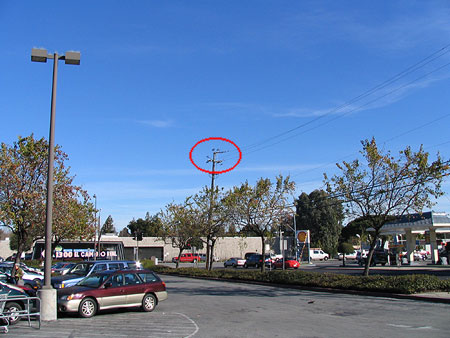
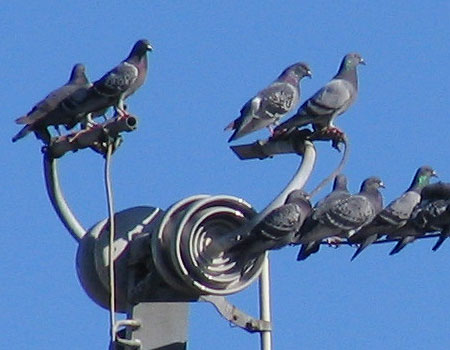
Very soon I’ll be comparing shots with the 10x zoom versus my dad’s S40’s 3x zoom, but for now, here is a little example of just the 10x zoom. First, a reduced image of the entire shot I took of pigeons on a power pole and line, taken from across a supermarket parking lot:

Pigzoom3

The birds are circled at the center. Now, the same shot, at full size, cropped to show the birds at the center:

Pigzoom2

And finally, a shot taken at 10x zoom, also full-size and cropped:

Pigzoom1

That’s not a bad zoom! I also found a black squirrel in a tree, and managed to get a shot of that with the zoom; for this display image, I had to scale it down by half in addition to cropping:

Bsquirrel

I still have a lot more experimentation to do, but as you can see, the zoom seems to be doing great so far. Canon’s zoom is also very fast and very quiet; I can go to full 10x zoom much faster than I can go to full 3x zoom on my old camera. In fact, most first-time handlers of the camera see the zoom as too fast–hard to get an intermediate zoom because it just zips to the extremes; but with a little practice, you’ll notice that an incremental touch on the zoom toggle allows for a slower zoom and perfect control. The zoom is also very quiet, and so can be used while shooting video.

I was a bit worried for a while that this camera had no macro mode. There is no flower-icon macro setting button, and macro focus is not mentioned in the manual at all. But it can take pretty good macro shots without switching settings; just be sure to have the camera fully zoomed out. And while it is advertised as having a minimal focus range of 3.9 inches, I found that I could focus on objects closer than 2 inches from the lens. Here is one photo of a small flower, maybe just less than an inch across, full-size but cropped:

Flowermac1

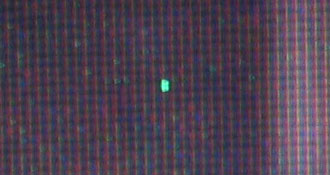
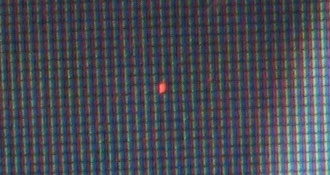
With my S30, I wanted to take photos of stuck pixels on my Powerbook so as to show them to my students in the Computer class I teach, but with that camera, even in macro mode, I could not get close enough to take a good shot; however, the automatic macro mode on the S1 allowed me to take clear pictures of the stuck pixels easily, hand-held, in low light:

Stpx1

Stpx2

So even that, though unadvertised, seems to work better than my previous camera.

The S1, in many ways, is similar to my old S30: both cameras having the same resolution (image size), and the same basic settings and controls. While I would have enjoyed a better minimum shutter speed, 15 seconds (the same as the S30) is sufficient, and I was able to get the following shot (cropped and reduced) of Orion tonight:

Orion2

Orion1That’s Sirius in the lower left corner, by the way. I almost even got resolution on the Orion Nebula (the center “star” in Orion’s sword, see unreduced image at right), but that’s at minimum zoom–when I get my hands on a tripod another night, I’ll try a 10x zoom on it and see what develops.

Unlike the S30, the S1 mysteriously lacks a focus assist light (the little lamp that comes on while focusing to help with low- or no-light focusing), a flaw many have noted; however, the S1 seems to focus OK in low light, you simply have to find an edge with enough contrast for the camera to lock the focus on. The S1 also has a slightly smaller LCD monitor–but it is on a very convenient swivel, making it easier to take photos from odd angles and still see what you are doing (it also allows you to turn the LCD screen inwards so as to protect it from being scratched while stored in a pocket or bag). With the S1, Canon fixed what I saw as a big flaw on the earlier Powershots: the “set” button used to be part of the 4-way toggle switch; in order to use it, you have to push the loose toggle switch exactly down, and not tilted to any side, for it to work properly, which is very hard to do. Now the “set” function has its own button, and is much easier to use.

This camera also has a lot of buttons on it: aside from the shutter/zoom toggle and the main setting wheel, there is a power on/off/play button/toggle, a separate button to start recording video, the four-way selection toggle, and ten other buttons–six on the back, two on the top left side, and two more on the lens base (if you don’t count the attachment ring release button, that is). One complaint I read was that it is hard not to accidentally press some of them in the normal handling of the camera. I don’t find that a difficulty, however; the normal areas for your fingers to go are button-free, so if you just hold it right, it shouldn’t be a problem.

The S1 does have a few weak spots, though. While 3.2 megapixels will do fine for me, they could’ve made it 4.0 at least, or so you’d think. The lack of an autofocus assist lamp is also a serious oversight (or maybe they had to make tough choices, I don’t know); and the lens cap is very poorly designed, is very loose-fitting and falls off at the slightest brush. I don’t even have to take it off, in fact: just turn on the camera, and the extending lens assembly gently slips it off. For now, I have it awkwardly tethered to one of the strap holders. But I got the lens adapter, which extends just beyond the maximum extension of the zoom lens, and plan to add a UV filter, to act as a sort of transparent lens cap, which should make the regular cap unnecessary.

One more down side, unavoidable really, is the form factor. The zoom lens does not allow for the camera to be slim enough to slide into your shirt pocket, which the S30/45 barely does. The S1 will fit on my jacket pocket, but only with the lens retracted; with the lens adapter, it might not fit so well. But I’m willing to live with that, and might even get a camera case, though I dislike them quite a bit.

I have noticed a strange artifact, that while locking the autofocus in direct sunlight, I sometimes get red vertical streaking on the LCD panel–but it disappears after taking the photo, and does not show up on the photo itself.

The camera’s video, aside from being zoomable, is now available as full-frame and full-speed, and will play just like footage shot with a digital video camera. The 1 GB Ultra II CF card I got ($85) is not only fast enough to record the video well, but also can take up to 11 minutes and 25 seconds of such footage (640 x 480 pixels, 30 fps). It’s a huge amount to download into the computer, but it could replace a digital video camera if you don’t film huge chunks of footage all at once. It saves the video in AVI format, so I’ll have to see if that can be imported into iMovie or not.

The S1 runs on 4 AA batteries, either Ni-MH rechargeables, or standard Alkaline batteries. That means you can easily buy extras in an emergency if your rechargeables run out, no proprietary battery packs holding you back, like the S30 has. My father gave me a set of four NI-MH’s with a fast charger unit, and I bought another 12 at Costco today (for about $25), so with four sets–each taking up to 500 or so images before quitting–I should never run out of juice again, with or without the backup.

One other personal drawback, I’m buying the camera in the U.S. to save about $150 on the purchase price, but Canon does not have a worldwide warranty like companies such as Apple have–which means if a defect shows up after I go back to Tokyo, I’ll have to eat the repair costs in Japan, or ship the camera back to the U.S., taking even longer and adding greater shipping costs. Hopefully, the camera will not need repairs, as my S30 has not–aside from those caused by dropping the poor thing on concrete a few times…

Overall, the camera is extremely satisfactory so far. More on its performance as I go. (And more photos, too!)

Categories: Main Tags: by

One Reason to Watch the Inaugural

December 16th, 2004 Comments off

There is a movement, centered at this web site, to execute a silent protest against Bush on his inauguration day. As the site points out, the Bush administration has become highly efficient and effective at gagging public protest, shipping them off to distant “free speech zones” and arresting anyone who dares criticize Bush within eyeshot of his motorcade. So they’ve developed new–and inevitable–tactics. Wear no anti-Bush shirts, buttons or other apparel, and carry no protest signs. Instead, mass along the route of the inaugural motorcade, and when Bush passes by, turn your back on him. It would be unspeakably embarrassing for the country and the administration for an American to be arrested for simply turning around–not that I’d put it past them.

This strategy will make it impossible for anyone–even those organizing and participating–to know who is participating and who is not. It also means the protesters will be thoroughly mixed in with the rest of the crowd. Because they will have no distinguishing appearance–they’ll just be facing the other way–it may not be as visually impressive as you might expect. But it will be telling, in more than one way: it will be virtually the only way that Americans can protest to their president in any direct fashion. That in itself tells you a lot about how hostile and uncaring this administration is to its own people in a country that is supposed to be the world’s leader in public participation and empowerment.

Categories: Political Ranting Tags: by

Parasitism: Who’s Leeching Whom?

December 16th, 2004 1 comment

Well, the MPAA is now going after BitTorrent and eDonkey, trying to shut them down like the RIAA tried to do with KaZaA, and Napster before that. While the RIAA got Napster, KaZaA is still out there, just as Gnutella is still going strong. Considering the worldwide structure of the filesharing networks, it is doubtful that they will make much of a dent.

Then there is the question of whether or not sales are affected. Despite online downloads of movies, DVD sales remain spectacular, so much so that they actually outstrip box office sales–DVDs now represent 60% of the film industry’s revenue, and films are beginning to sell more in DVD form than at the theater. So how is it that BitTorrent downloads are killing the industry?

This is the same lame argument made by the RIAA, which studies (such as this or this, PDF files) have continually dismissed. Sales did not decline until after Napster shut down, and losses generally match major economic trends–not to mention the fact that music sales took a downturn just the the music industry drastically cut the number of new releases they generated–hmmm, they put less music on sale and music sales fall, what could possibly be the correlation?

My favorite quote from these stories, however, is this:

John Malcolm, the MPAA’s director of worldwide antipiracy operations, said: “These people are parasites, leeching off the creative activity of others.”

Ah. The downloaders are leeches on the creative activity… not the labels and studios that consistently rip off and abuse the artists? Please. No big industrial media firm is ever going to get my sympathy by claiming their “creative activity” is being “leeched” when they’re doing what they’re doing. Take Forrest Gump, for example: the film cost $55 million to make, probably about as much to promote, and it grossed $660 million at the box office alone–add a few hundred million for DVD sales–and yet Paramount claimed that it didn’t make any profit, and refused to pay the author, Winston Groom, a single penny of the “net profit” they had promised him. This is hardly uncommon–Hollywood, just like the recording industry, makes it a standard practice to vastly underpay the artists and overcharge the consumers. They steal billions, then cry poverty, outrage and parasite at the filesharing phenomenon.

Hypocrites. I have no sympathy for them at all, only contempt.

Categories: Media & Reviews Tags: by

Forced DVD Trailers

December 15th, 2004 7 comments

Okay, so it’s not earth-shatteringly important. But I am sick and tired of paying twenty bucks for a DVD, only to be forced to watch commercials! That’s one of the big reasons why you get a DVD, so you don’t have to watch it on commercial TV. I just got my first Amazon shipment of DVDs that I’m ordering, and wanted to check out Shrek 2. But before you get to the main menu, you have to sit through ‘previews’ of upcoming stuff they’re working on. In this case, two trailers for Dreamworks features. The skip and menu features are disabled here. This, thankfully, is not on most DVDs, but Disney has them a lot, and now Dreamworks, it seems. You ask me, whatever genius decided to add the “feature” to disable such things on DVDs should be taken out and shot. A DVD player which could override such blocks would be worth buying, if they could make such a thing. Fortunately, the fast-forward feature still works on the Shrek DVD, and you can get through the trailers after a minute or so–often times, the forced trailers do have some way of getting around them, but you have to try three or four things before you find them.

Now, I’ve bought perhaps over 100 DVDs, a sizable investment, largely because the prices are usually just reasonable enough–but the forced trailers are exactly the kind of thing that would drive me to download the movie from the Internet instead. Commercials are for people who don’t pay. Not for people who just coughed up some cash for the media. Pardon my opinion.

By the way, if you are considering buying the Shrek 2 DVD, and one of the factors pushing you in that direction is the “all-new surprise ending,” then pull back–it’s not what you think. It’s not a new ending, it’s simply another karaoke video like they had on the end of the first film. If you like that, then great–and I like the film enough to want to have the DVD anyway–but this is one of those cases of blatant false advertising.

Categories: Media & Reviews Tags: by