Larry King can be interesting sometimes, but all too often the show gets just too trashy for me to handle. One recurring theme is the celebrity trial, or the celebrity investigation, which Larry tends to cling to for weeks or months, with Nancy Grace always hovering, always ready to gut and pillory whomever has been accused or is suspect, no matter what the evidence. Although not even close to a legal forum, it is nonetheless a highly popular show, and when Larry starts in by saying essentially that because a person–like Gary Condit, for example–does not come on the show and spill his guts, maybe he’s hiding something, after which Nancy will jump in and comment on how suspicious-looking that is, and how if she were innocent, it is the first thing she would do. (As a lawyer herself, she should know what a lie that is–you should never needlessly expose yourself to questioning which can be used against you in court–especially when you are innocent.)
This is the kind of thing that drove me away from being a regular watcher. I have very strong feelings about the rights of the accused, and a carefully balanced justice system that will do its level best to discover and convict criminals but will be as cautious as possible not to convict or unduly harm the innocent. But such comments–essentially, appear on the show or we’ll talk about how guilty you’ll look–is not only a public affront to the individual’s 5th Amendment rights, but is also a conflict of interest on Larry’s part, one which should never appear on a show that often reports hard news, and one that could potentially destroy the reputation and careers of innocent people.
That tends to be the more serious reason I dislike the show; the more trivial but just as insulting is when he brings on guests like he had tonight, “psychics” like Sylvia Browne. Flipping channels, I saw a few seconds at a particularly outrageous point, and figured this was good blog fodder. Larry has them on from time to time, and every time they come across to any reasoning viewer as absolute frauds–but Larry gives them full credence, even cheering them on with credit they did not earn. I recall one that took a call and predicted that there were problems with the caller’s roof, or the roof of the deceased, on which she was totally incorrect–but after the call had finished, Larry commented that she was “100% correct.”
The “psychics,” rather obviously, are performing what is called the “cold read.” This is achieved by first allowing the person being read to give as much information as possible, and then making guesses that, while sounding specific, can actually be applied to almost any individual, or, if wrong, can easily be turned into a different “sight” or re-interpreted to fit the story given by the person being read. For example, a read-ee might introduce their story by asking about their dead father. Already, even from such a vague description, the cold reader has all kinds of data: the apparent age of the person being read, the gender and apparent age of the person who has died, and, from the speaker’s voice, possibly what part of the country that person came from or grew up in. Then come the vague guesses: “I see a man with a receding hairline,” or “I see a woman with her hair back,” or “I see a man in a uniform.” If the specific person who is being spoken of does not fit that description, then it is applied to any family member, dead or alive–and if that still doesn’t conjure up someone who matches the vague description, then the psychic tells the read-ee that there is someone like that, so go and find out who it is.
So many psychics have their own schtick–John Edwards, for example, works not individuals but crowds–whenever he makes a wrong guess, he claims it’s coming from someone new in the crowd; otherwise, his guessing is so transparent and uninspired, it is frankly astounding that even gullible people could take him seriously. Ergo, my particular enjoyment of the South Park episode that so thoroughly lampooned him.
Tonight on Larry King was little different, except that Browne was in particularly shameless form. Some psychics cover up their mistakes by saying they don’t get them all right (no kidding), or that there are so many people, it is hard to see, or “I just get general feelings, not specific facts.” Browne, however, just plows right through and claims she is right, no matter what. For example, one caller from Japan perhaps tried to trick Browne; here is the exchange:
CALLER: I’d like to ask about my mother. We had some unresolved issues.
BROWNE: Yes. But I don’t know if you could have had any resolved issues with your mother because she was so very difficult to deal with. And I’m not saying that to be cruel. So, you see, the thing that you got to realize is when somebody goes to the other side, everything is OK.
CALLER: But she’s — you can definitely see her on the other side?
BROWNE: Yes. Little. She’s little.
CALLER: Yes, well, the last time I spoke to her, she was alive.
BROWNE: Yes, but see, I don’t — she’s not alive now.
CALLER: She’s dead.
BROWNE: Yes.
CALLER: You’re telling me my mother has died?
BROWNE: Yes.
CALLER: You’re sure about this?
BROWNE: I’m positive.
CALLER: OK. Well, I’ll have to get back to you after I’ve called her.
BROWNE: All right.
Naturally, the caller was not allowed back on or did not have time to check and get back. Highly unlikely that the woman’s mother actually died, though.
A classic trick is the old “he went quickly” routine. If the psychic gets information that would indicate the person might have died quickly, they venture that guess. But all too often, it was a lingering disease like cancer, and the situation deteriorates:
BROWNE: What I’m saying is, wasn’t this a fast death? It looks like she went quick.
CALLER: She has cancer.
BROWNE: Yes, but what I’m saying is she went quick. She felt you holding her hand.
CALLER: I was not over there.
BROWNE: I don’t know. She says she felt you holding her hand.
CALLER: I see. Okay. Okay.
KING: She’s saying she went fast when she discovered the cancer, wasn’t long before she died?
BROWNE: Right.
Nice save, Larry. Usually the psychic provides that rationalization, but Larry has been hosting them for so long, he knows the routine.
Here’s one where Browne guessed wrong and simply plowed through:
CALLER: Is he with me, Sylvia?
BROWNE: Yes, honey. Did you know that he had a stroke?
CALLER: No. The doctor said that — the paramedics said that it was a heart attack, and he went peacefully.
BROWNE: Yes, he did, but it was a stroke, though. But it doesn’t matter. But he did go peacefully. He didn’t know what hit him.
Or this classic of cover-up:
CALLER: I lost my father six years ago on the plane traveling to Europe. I’d like to know how he died, because we never had any explanation from the airline. I was left with my mom suffering from Alzheimer’s. I’m doing his wish. I hope he’s happy and he’s protecting us.
BROWNE: Was your father — had beautiful dark hair with some gray in it?
CALLER: Very blond.
BROWNE: No, no. This man that I see is dark. Dark haired. Because he comes and says he’s a spokesperson.
So if the man she identifies is not the right one, he’s a “spokesperson”–a variant on the “who else could possibly fit the description routine. But Browne takes it to extremes, telling people when her guesses miss that relatives are dead, houses should be vacated, careers should be changed–stuff that could really mess up people’s lives if they take her seriously, as many clearly do. Normally I don’t object to psychics who do their best to make their clients feel good, as part of a self-indulgent fantasy (I don’t respect it, but that’s their choice), but when a person like Browne tells a person that loved ones are dead or that they should change their lives because she can’t do a cold read that well, it’s kind of sickening.
King was helping her out, too. You could hear some callers pausing to think, trying their hardest to come up with some connection that could account for the guesses Browne was throwing out. But sometimes, even the most cooperative callers would get stumped into absolute silence, at which point Larry would jump in, throw Browne a softball (“So once they die, there’s no pain?”), Browne would give a quick reply, then King would move on to the next caller. That happened quite a few times.
Here’s a transcript of the show–you decide.
Again, if this were widely accepted as pure entertainment, it would be fine–but these people try to pass themselves off as the real deal, and though some people get comfort, others get confusion and sometimes life-altering bad advice. Not too funny.

 A former flame and now good friend Hiromi has happened onto a new thing: salt candles. Mined from ancient salt deposits in the Asian subcontinent, these are more than just lumps of salt; they make very attractive candle holders. With holes drilled through their cores, exactly to the size of tea candles, they light up and make for very nice ornaments.




 One of the first things one might do in visiting Tokyo is to visit the Ginza district. Made famous in the post-war years by U.S. military personnel doing their shopping and entertaining, the Ginza has today become a kind of upper-class shopping district. To me, this meant that it turned out to be kind of boring. Department stores and boutiques are not my kind of thing, really. There used to be a McDonald’s when I first visited in 1983, but it was more or less banished for not being upscale enough (kind of like the Stanford Shopping Center has been trying to do to their McD’s for a long time). For a while, there was a Mrs. Fields’ Cookie shop there, and that brought me down from time to time. Otherwise, I just regarded it as another overrated, overrun, high-profile street.


 In the middle of the fourth floor, there was a table for the kids, and very nicely set up, too. A low, round table equipped with CRT eMacs loaded with kids’ software, with nice, modern-looking black ball chairs set around. Not too many kids in the joint, but they had found this place. A very nice touch.

 Going downstairs, one finds something that seems very out of place for a shop: a theater. You see this from the elevator going up. It really looks like a movie theater, except for the size and the fact that there is a podium with a tech person giving explanations to the shows. Here is where they give the Introductory Presentations and the Workshops. The Presentations seem pretty much like commercials, introducing the lineup of Apple products. But the Workshops seem to be a very nice service, especially for newbies. The Workshops are free, from three to five of them given each day, each day having a theme (e.g., movies, music, photos). If you want more advanced lessons, you have to pay for the Studio Series.
 As it turned out, I didn’t get too many actual answers. They had never heard of my problem with browsing networks before (sometimes shared folders, which should appear as network-globes-in-a-glass-box icons, instead show up as plain folders with the same names, but empty), nor could they explain why some of my students’ USB Flash memory sticks were not showing up on my Mac’s desktop. But the Genius helping me did give me some ideas about how to test out why my father in the S.F. Bay Area and I can’t get a voice chat going, so it wasn’t a complete wash.


 Well, it is exactly a month before Christmas, and I’ve noticed people putting up their Christmas decorations recently; scattered apartments and houses around Tokyo putting up lights, stores with the usual displays, playing Christmas carols for store music. Even though Japan is predominantly Shinto and Buddhist, with Christians forming a minority 1% or so, Christmas is nonetheless a middlin’-to-big thing over here, for much the same reason it is in the U.S.: commercialism. But with a Japanese twist.
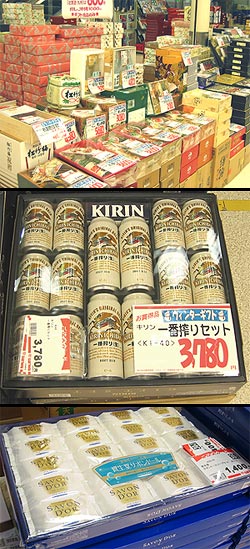 marks the Chugen season, the winter one is called Seibo. Each one is marked by a special gift section created in stores across the country, sometimes taking up as much as half of a floor of a department store. In such gift areas you’ll find a plethora of items, popular ones including small rolled hams, and a wide variety of product packs–a 20-piece soap package, a 15-can beer package, packages with assortments of cookies, coffees, salad oils, fruit juices, canned seafood, and countless other consumer items. One buys gifts here and either gives them or has them delivered to the recipients. The Seibo gift centers are already open for business.