Not There Yet

November 5th, 2008 Comments off

It’s fascinating, really. There should be no question about this election, none at all. Obama ran as good a campaign as one could imagine–a strong, 50-state strategy, a positive, above-board campaign, well-funded, well-organized, as much done right as anyone could hope for, almost no missteps. McCain, on the other hand, ran a bad campaign: he lacked focus in some of his home territory, lied his ass off, called his opponent every name in the book–and unlink many past campaigns, he did so in his own name–and his campaign was not as well-funded, made terrible choices, and was peppered with gaffes and missteps.

There was not just a double-standard at work here, but a decidedly marked double-standard: had Obama performed like McCain had, it would have been a rout, McCain winning by huge margins, nobody questioning the outcome well before election day. In this race, Obama had to do everything right, but McCain could pull all kinds of crap and get away with it clean. Early in the year, McCain blatantly violated campaign finance law, and yet despite founding his reputation on campaign finance reform, the media paid no attention. McCain did the same thing on several issues–violating what he had built up as his core principles–without having to pay any penalty for it. He played the veteran war-hero image up to the hilt, but got away clean with a dismal voting record on veterans’ issues; he played up how he had been tortured, yet never paid the price in public for caving in and supporting Bush’s torture policies; he based his career on campaign finance reform, yet his campaign was run by lobbyists, and this was rarely touched on by the media. McCain flip-flopped on almost every issue imaginable, reversing his position blatantly, sometimes within weeks or months of having stated the opposite, and yet the media never called him out for it–in fact, they jumped on Obama for “shifting” his policies, even when he did no such thing. McCain supported deregulation of the financial industry, and his campaign manager was and even still is a paid lobbyist for Freddie Mac and Fanny Mae–and yet you never seemed to hear about this outside of the liberal blogs, even when McCain made loud accusations that Obama was in those institutions’ pockets because of the most tenuous of connections.

A lot of this is the tire swing effect, but a lot of it is the GOP’s success in working the refs. Too many reporters were unwilling to call out a veteran and former POW for rather blatant dishonesty and even lawbreaking. Too many otherwise-objective reporters created false equivalencies for fear of being called “liberal media,” while the conservative-leaning media–substantial in number–had no problem whatsoever being full-out McCain supporters while calling themselves objective with a smug self-assuredness.

And so forth and so on. You get the idea. Obama ended up about 10% ahead in the closing polls before election day. By all standards, there should be no doubt right now. But there is–a fairly good amount of it. I find myself nervous, uncomfortable. I know Obama is probably going to win, but I maintain this fearful, nagging doubt. There has been too strong an impact from the results of 2000 and 2004, there is too much doubt about those voting machines and the right-wing’s dirty tricks. McCain is gloating, pronouncing that he’s going to win it, and though you know it’s probably just an attempt to encourage his supporters to vote, one cannot escape the feeling that he knows something that we don’t.

All fears, all worries based upon past experience and not the actual vote from today. But there they are. This should be a landslide, there should be no question.

The fact that there is such question, that there is such doubt, not just from me but in so many people, demonstrates, I think, that there is something badly wrong with our system, that there could be any doubt that so superior a candidate as Obama could lose, or that so inept and damaged a candidate as McCain could win–especially after the last eight years, especially after this economic disaster we’re facing, especially after McCain is tied so closely to both.

Something is very wrong with the way things are.

Categories: Election 2008 Tags: by

Meanwhile, Back at the Ranch

November 4th, 2008 Comments off

Few people have been paying attention to George W. Bush, and I for one stopped paying attention to his poll numbers after he stalled at 28~30% for several months. Just took a look, and saw that despite a few polls putting him in the 26-to-29% range, Bush has been festering between 20 to 23%. That is the lowest rating for any president in the last 70 years–lower than Nixon when he resigned, lower than Truman’s lowest.

Bush, meet dust bin of History.

Categories: Bush and Character Tags: by

Don’t Forget to, You Know, VOTE

November 4th, 2008 Comments off

It’s not over quite yet. The Gallup, SurveyUSA, Rasmussen, Zogby, and network polls don’t actually decide who’s president. Obama has won zip so far, and complacency anywhere could lose this thing.

If you haven’t already… then tomorrow… bright & early…

VOTE!!!

Categories: Election 2008 Tags: by

The Case for Barack Obama, Part II

November 3rd, 2008 Comments off

Let’s continue looking at the issues. In Obama’s book, he outlines three big investments that will make America more competitive; I wrote on this back in January when I made my initial “Why Obama?” post:

I believe that Obama also has an intelligent and correct focus on what is important. I myself have always believed that the three best investments that we as a nation could make are in education, infrastructure, and science. In his book, in the chapter titled “Opportunity,” Obama lays out his big three investments: Education, Science, and Energy. He lays out the case for each, and I find myself reading his words as if I were reading my own. And while he placed energy in third place ahead of infrastructure, I find myself having to agree that it is a more pressing matter, and am not discouraged because he highlights the importance of infrastructure elsewhere.

The section I refer to in his book begins on page 159 (paperback edition). Let’s take a look at each issue:

Education: First, getting children off to a solid start: Obama plans to focus on pre-school education initiatives, making sure that kids are either prepared or that whatever problems exist are flagged and acted on right out of the gate. He would increase Head Start programs and work to provide affordable child care–a critical factor with so many families having both parents forced to work full-time jobs.

Second, financial aid for students: creating $4000 scholarships that will help cover critical costs for most students–especially from low-income families–in exchange for community service, a deal that will create a positive feedback effect, getting more kids through college at the same time that you are helping the community, a large part of that going to creating an environment which further encourages education and increased personal success. This is about as close as you can come to legislating morality–not by forcing people to follow your code, but by giving them a chance to earn a college education while experiencing first-hand the value of public service.

And finally, paying attention to teachers. As Bill Maher said, we call them heroes, but we pay them like chumps. Obama would focus on recruiting, preparing, retaining, and rewarding a talented population of educators. If anything, Obama goes nowhere near far enough, but his attention to this subject is a huge plus for me, even though it will not affect me personally (I am quite a bit outside the sphere his policies will influence). The reason I am encouraged is that it pays attention to something that needs addressing: if you want good education, you have to be willing to pay teachers a fair salary. Of course, hold them accountable–but the conservative emphasis has been on accountability, in a fashion that rewards cheating and short-changing students.

On McCain’s site, he also mentions Head Start–but instead of promising to quadruple the program as Obama has, McCain mostly emphasizes existing programs and policies, with attention paid to better-performaing Head Start centers. He promises a certain amount of funding, but it is unclear how this compares with existing levels–and McCain lays a caveat even on that, which depends upon “availability of funding,” claiming more money will be spent “if more funds become available.” In other words, there is no solid promise of increased funds at all. McCain does something similar with teacher development and rewards: he talks about doing these things, but when you read the fine print, you discover that he only talks in terms of using existing funds–in other words, he will not add a single extra cent into such programs. Instead, we’ll simply be left with rearrangement of what funds are already there, but teachers will have to face a whole new set of performance requirements–and if they are anything like what conservatives have pressed on education in past years, they will likely make things worse, not better. When you get to college education, it’s just more of the same: simplify, fix, improve–but never add another cent to education.

In short, Obama plans to actually add to existing education programs, starting new initiatives, funding and expanding programs, giving new and real incentives to teachers and students in ways that will truly improve education–whereas McCain will simply rearrange existing funds and then claim he’s fixed everything.

Science and Technology: Number One on Obama’s web page is a statement of support for Network Neutrality–something which McCain’s web site dismisses as a buzzword, a clear signal that he opposes it. Right there, Obama has my respect; Network Neutrality, far from being a buzzword, is all about the rights of the user and protection from corporate entities abusing the Internet for unearned profits. Obama also gets my attention with his statement of support for modernizing America’s Internet infrastructure–something the Bush administration utterly failed to do. I have 100 Mbps fiber-optic service direct to my apartment; if you live in the U.S., can you say that you have the same? For $40 a month? An aggressive government policy (“e-Japan”) got Japan’s infrastructure modernized but quick; Obama looks to be the best candidate to do this for America, a very wise move if the U.S. wants to stay on top of this rich market it created.

Other issues high on his list include diversity in media ownership–another vital issue–and recognition of the right to privacy, something that conservatives like McCain detest, as they see such a right as helping the pro-choice movement. But the right to privacy is an essential issue for the 21st century, and it is telling that Obama recognizes this. McCain’s policies, favoring DRM and parasites like the RIAA, point away from privacy and toward corporate ownership of what you paid for.

Beyond this, Obama has sheafs of policy initiatives that would use technology to forward American competitiveness in business, similar to how Al Gore did this when he kept the Internet alive in the 80’s; that would educate children in Math and Science (think 1960’s) to meet the technological challenges coming; to retrain adults to adapt to new technologies; and to apply technology to address the nations’ problems.

Some of McCain’s technology policies are similar to Obama’s–they both support R&D tax credits, for example. Both support training the workforce; one can guess how much emphasis each would actually place on it. But McCain’s focus on technology is far more oriented towards business lobbyists’ goals rather than those important to most Americans. He uses the advancement of technology, for example, as an excuse to lower corporate taxes and scale back all capital gains taxes, not just the taxes for those who truly need a break.

Beyond that, McCain lists as top priorities open trade (cheap imports while American manufacturing jobs get shipped overseas), intellectual property (those RIAA and other media lobbyists are very generous), and “keeping the Internet free from government regulation” (giving away ownership of the Internet to the telecoms so they can charge people for not being slowed down and force them to use only software the telecoms sell them). In short, McCain’s technology package was mostly drafted by business lobbyists.

There’s really no comparison: Obama would modernize and revitalize our technology industry for the benefit of all Americans; McCain would just be a shill for the corporations.

Energy: Both candidates claim to strive for Energy Independence; the differences come in how they plan to achieve that goal.

Obama’s plan emphasizes clean energy technologies, creating a new energy infrastructure upon which millions of new jobs would be based–essentially a Clean Energy boom similar to the Internet boom of the 90’s. Obama would encourage use of hybrid cars and creating renewable energy resources in large numbers within the next four to seventeen years. These are the policy drives that Obama lists as most important.

The top initiative listed on McCains site: drill, baby, drill! Just months ago, he recognized the fact that drilling would take about a decade to produce new oil supplies of any note, and even then they would not be significant enough to truly reduce prices. That was before he climbed onto the oil company bandwagon, and now drilling (not in the untapped areas already possessed by oil corporations, but in the other places, mostly environmentally sensitive, that the oil companies want to access using their own artificially high prices as an excuse) is “the” answer.

A lot of other policy initiatives between the two candidates are similar, but the key here is which initiatives each emphasizes: Obama with the development of new and clean energy sources, McCain for more drilling and exploitation of oil, coal, and nuclear.

The theme of the last two issues I’ve gone over here makes clear a fundamental and important divide between the two candidates, demonstrating Obama’s attention to forwarding the nation’s interest first, and McCain’s attention to serving the corporations whose lobbyists make up the bulk of his campaign.

Again, a very clear choice for American voters.

Categories: Election 2008 Tags: by

Last-Minute Lies

November 3rd, 2008 Comments off

We know that McCain and Palin have been prone to spread bald-faced lies over the past few months, even in the face of outstanding evidence proving their statements to be lies. But now, as we enter the home stretch, we are encountering a new–and at the same time, a very traditional–kind of political lie: lies aimed to enrage key voters, lies which are demonstrably false–but ones which the liars hope will stick because there isn’t enough time for the truth to be as widely spread as the lies:

”Barack Obama explained his plan to the San Francisco Chronicle this year,” [Sarah Palin] told a rally in Ohio Sunday. ”He said that sure, if the industry wants to build coal-fired power plants, then they can go ahead and try, he says, but they can do it only in a way that will bankrupt the coal industry.”

She added, ”And you’ve got to listen to the tape.”

”Why is the audiotape just now surfacing?” Palin asked the crowd, according to a report from CBS News. Someone in the crowd shouted, ”Liberal media!’

Several right-wing web sites are jumping on the “hidden interview” bandwagon, as are a few small but legit news sources which are obviously just being lazy in passing on prepackaged news. Of course, there is no “hidden” audiotape; Obama held an interview with the Chronicle in January, and it has been online since. Far from being hidden, it was widely advertised. The audio (mp3) is here, and the video is here (I am currently unable to get the video to play, but the audio comes across perfectly). They have been up consistently over the past ten months, out there for anyone to listen to or watch.

Obama goes into the coal issue just a little more than halfway through, describing his policies. Summed up, he says that a “no coal” policy is an illusion, as we use a lot of coal and China is building more and more coal plants; the emphasis should be on figuring out ways to use coal cleanly, using a cap-and-trade system which would penalize pollution as a means of spurring clean-coal technologies as well as alternative forms of energy.

Palin has two charges here: that Obama wants to bankrupt the industry, and that the interview was hidden. On the first charge, Obama said that it was an “illusion” that we could get rid of coal, and mentioned “bankruptcy” only in the context of building new coal plants without trying to reduce carbon emissions and greenhouse gases. Either Palin is saying that clean coal is impossible, or she’s just lying.

Second, Palin charged that there was a liberal-media conspiracy to hide the interview; also false, as the whole interview, as stated above, has been plainly available in both audio and video forms since the interview was held in January. Here, she’s plainly just lying.

No coincidence that Palin is spreading these lies in Pennsylvania–coal country, which McCain and Palin have to win if they want any chance of being elected–just a day before the election.

Categories: Election 2008, McCain Hall of Shame Tags: by

The Case for Barack Obama, Part I

November 2nd, 2008 Comments off

Okay, you’ve heard me make point after point about How John McCain is a completely inadequate and inappropriate choice for president, but you haven’t heard a great deal about why Obama would be a good choice. The fact is, it’s simply easier to point out McCain’s shortcomings–there are just so damned many of them–and hearing about Obama’s policy points is a lot less exciting. Nevertheless, thats what people should hear–and frankly, what you should have heard by now.

The fact is, getting word out about his policy is just about all Obama has been doing for the length of the campaign–talking about his tax policy here, his health insurance plans there, his foreign policy goals elsewhere, and so on. Not to mention that his policies are right there on his website, and have been all along. There’s no mystery here; despite McCain & Palin insinuating that Obama is some shadowy unknown, his political philosophy and policy goals have been out there for a long time–a few years, in fact, as much of it was outlined in his second book, The Audacity of Hope.

So if you don’t know where he stands on the policies, then it’s hardly his fault. Still, like I said, this stuff can be a lot less exciting, and so a lot of people probably haven’t gotten around to it, even at this late date. Despite knowing the policies, I’ve procrastinated in putting this post together–it’s been on the slate for some time now.

So what are Obama’s policies, and how do they compare favorably with McCain’s? Let’s begin with three big ones, Taxes, Iraq, and Foreign Policy:

Taxes: Obama will cut taxes most for the poor, starting at a 5% drop for the neediest Americans; this will taper off to a 2% cut for someone making $66,000, 1.5% for someone making $227,000, and will go to zero at about $250,000. He then starts raising taxes, the hikes becoming most notable for people making over half a million dollars a year, but the biggest increases–almost 8%–for people with incomes over $3 million a year. McCain, on the other hand, gives the poorest people a paltry 0.2% tax cut–virtually nothing–and then grows the tax cuts for people making more money, with people having incomes in the millions getting the biggest breaks. McCain calls Obama’s policy “socialism” on the premise that Obama is redistributing the wealth–except that McCain’s plan does exactly the same thing, just in the other direction.

You may have heard McCain or Palin claiming that Obama is going to raise taxes on everyone making more than $102,000; that’s a knowing lie distorting Obama’s plan to raise the payroll tax ceiling so that rich people no longer get away with paying a miniscule amount relative to their total income. Currently, the payroll tax only applies to the first $102,000 of anyone’s income, so middle-class families get socked, but wealthy people end up paying a far lower percentage of their total income. McCain’s lie presumes that Obama will tax everyone making more than $102,000, but Obama has made it crystal clear that he would create a “donut hole” where income between $102,000 and $250,000 would not be subject to payroll taxes, but everything above that would be.

Bottom line: if you make less than $250,000 a year, Obama won’t raise your taxes, and if you make less, he’ll cut them. If you make less than $112,000 a year, Obama will cut your taxes more than McCain will–that includes “Joe the Plumber.”

Additionally, McCain’s tax plan, which mostly benefits the wealthy, will also cost a lot more–it will cost a trillion dollars ($1,000,000,000,000) more than Obama’s tax cuts over the next ten years.

Other tax policies: Obama plans a windfall profits tax on oil companies which he’d give back to regular taxpayers, a move criticized by many as meaningless as the oil companies will simply raise prices to compensate. Obama would eliminate taxes on seniors making under $50,000, and would simplify tax filing for everyone. He would end tax breaks for companies sending jobs overseas. Finally, Obama would eliminate all capital gains taxes on startups and small businesses.

McCain’s big plans include cutting taxes mostly for the wealthy, lowering corporate tax rates (from 35% to 25%), enacting a “gas tax holiday” (which is criticized as being just as ineffective as Obama’s windfall profits tax), and would at least partially privatize Social Security, though he vehemently denies the last, insisting on calling it “establishing personal accounts”–which is simply another way to say “privatization.” On his site, there are a lot of other ‘proposals,’ but mainly they talk about “keeping taxes low” for individuals and small businesses (not actually lowering them), not providing health care costs for businesses, and saving everyone money by magically solving the energy crisis and balancing the budget. Like most of McCain’s plans, he says he will pay for all of this by cutting earmarks and wasteful spending–though he has not detailed where the money could be cut, except for a few small examples. It is generally recognized that there is nowhere near enough waste to pay for even a fraction of McCain’s plans, and although McCain shows the willingness to eliminate what waste there is, he has provided no evidence that he would be any more effective than any other president in eliminating such waste, which is usually protected by the entrenched and established powers-that-be in the government. In other words, all talk, no plans–just make McCain president and all of Washington will kneel before him and relinquish all it power and treasures to him.

In essence, McCain plans to maintain the conservative course: lower taxes even more for corporations and the wealthy, give a pittance at best for the working classes, and generally stop any programs that would benefit the poor or middle class at the expense of corporations and/or the rich–stuff like comprehensive health care.

Iraq: Obama calls for withdrawing US troops on a timeline that would have most of our people out of Iraq by the middle of 2010–a plan that both Bush and McCain initially attacked, but now Bush has adopted it and McCain called the basic concept reasonable. Obama’s plan would pull out troops based upon conditions on the ground, allowing for changes if the situation merits. At the same time, there would be an emphasis on diplomacy, training Iraqi troops to handle security more independently, arranging international efforts to prevent humanitarian crises, and emphasize Iraqi responsibility for stabilizing matters–something there was no incentive for so long as the U.S. promised to keep troops in Iraq indefinitely. While the plan is not the wholesale, immediate bugout that many liberals have called for, Obama explains that the car has been driven into a ditch and you can’t just abandon it and run–you have to get the car out of the ditch, and that’ll take more time, lives, cost, and effort than many would prefer. But it has to be done.

McCain, on the other hand, wants to stay in Iraq until there is a “stable, prosperous, and democratic state in Iraq that poses no threat to its neighbors and contributes to the defeat of terrorists.” Since these terms are subjective at best, there is no telling when McCain would get us out of Iraq, or how much more money and lives will be poured into that effort over the next X number of years. McCain lists as priorities (1) political reconciliation and stable government, (2) creating a “vibrant, growing” Iraqi economy, and (3) pressuring Syria and Iran to lay off (because that has worked so well up to now). McCain does not specify on his web page, but he foresees an indefinite American presence in Iraq over the next several decades, perhaps even over a century and more, in the same manner that the US maintains bases in Japan and Germany. His “hundred years” comment is usually represented as a hundred years of war; this is often disputed because McCain claims that there will be peace in Iraq in just a few years under his stewardship. Of course, if that doesn’t happen, then we will have the long, indefinite war.

Foreign Policy: Obama emphasizes controlling nuclear material and curbing the spread of nuclear weapons and technology, but the heart of his foreign policy lays in the re-establishment of diplomacy. Diplomacy to deal with Iran and other hostile states, but also the rebuilding of diplomacy and good relations with our allies, both current and potential. There would be a strong focus on the Israeli-Palestinian conflict, a new initiative to fight poverty, a consolidation of alliances within NATO, and new alliances with Asian partners.

McCain’s site does not have a specific section on Foreign Policy, instead listing such issues under “National Security” and “Homeland Defense,” emphasizing the “dangerous world” paradigm. McCain leads with intelligence work to fight terrorism, relying on missile defense programs, and increasing the size of the military and modernizing it. Elsewhere he outlines a policy to fight nuclear proliferation, somewhat similar to Obama’s. For the Middle East, McCain emphasizes defense of Israel, and takes a notably bellicose stance against Iran. Reviewing the page on McCain’s site addressing the Middle East, it is full of fear-provoking language–words like danger, threat, regime, violence, and catastrophe, using action words such as tough, sanction, cannot allow, launch, and force. Everyone knows about McCain’s “joke” about bombing Iran and his general support for such plans.

McCain is also known for his idea to build a “League of Democracies,” essentially a plan to establish a permanent “Coalition of the Willing,” in other words, a group of nations that would basically do what the U.S. wants them to do; the body would be exclusive, like a group of kids making a club where only those they approve of can join. As can be inferred from so much else that is and is not stated on McCain’s site, this would be much less about diplomacy and much more about throwing our weight around, with the assistance of whomever we can get to stand behind us.

It should be no wonder, then, that in worldwide polls, Obama is vastly favored over McCain; a large number of countries have strong preferences for Obama, and in only a few countries is there more support for McCain–but McCain’s support never surpasses the “don’t know/refuse to answer” category. McCain’s support is greatest in Georgia (no surprise there), the Philippines, and Cambodia, with a razor-thin lead in Laos. In Lithuania and Pakistan McCain and Obama are tied. Obama, however, holds commanding leads, being ahead of McCain by 50% or more in at least a dozen countries, with strongholds in Europe, Canada, Australia, and Africa.

There should be little or no doubt that Obama would be far, far more popular and effective on the world stage than would McCain.

In Short, Obama has (1) tax plans that reverse the Bush-McCain trend of shifting wealth to corporations and the rich, giving more tax cuts to the middle class in an economically responsible fashion; (2) a clear but responsible plan for withdrawal from Iraq that does not involve permanent bases or a potentially endless war; and (3) a foreign policy strong with diplomacy versus McCain’s aggressive, bellicose stance, which may explain why most of the world is praying for an Obama victory.

More policy reviews tomorrow.

Categories: Election 2008 Tags: by

Google Map Directions Now Work in Japan

November 1st, 2008 2 comments

Gmapweb01

Well, this was an unexpected but nice surprise. Google Japan has just added the Directions feature to their maps service, something that was missing until now. I found out when someone posted that Directions now works for their iPhone on the iPhone in Japan forum.

On the web version (shown above), you can choose to find directions by car or by train. By car, you can exclude toll roads and/or give preference to “normal” roads; the results display with an option to see the Street View to get an idea of what each turning point looks like. Missing feature: not being able to click on the map to define a starting/ending point (unless it’s there and I just missed it). By train, it works just like Yahoo! Transit, but better–as it not only shows the route on a map, but it’s all contained on one page, and seems to have more options. Very, very nice.

The iPhone version is nice as well, but with a major failing: there’s no option to exclude toll roads. This is a deal-killer for anyone like myself who has a vehicle that is not allowed on toll roads. It also makes no sense as often the toll roads are jammed and local roads serve better, not to mention that the tolls are expensive and you might prefer the regular roads in any case. Hopefully, there will be an upgrade to the Maps program at some point (soon?) in the future which adds this critical option. Who knows, it may come with the iPhone firmware update v. 2.2 coming soon–the update allows for Google Street View, which means that they’re changing the Google Maps app.

Gmapdir01 Gmapdir02

Nevertheless, this is a welcome step forward for Google Maps Japan, not very long after Street View became available here.

What’s still missing: traffic information.

Amateur Hour: Heckling from the Cheap Seats

October 31st, 2008 Comments off

Here’s the latest from Palin:

Republican vice presidential candidate Sarah Palin on Thursday said Democratic nominee Barack Obama would be incapable of meeting U.S. national security challenges.

There is more to this than just the plainly obvious fact that Palin has zero credibility in this area and has no place whatsoever judging Obama’s abilities. One could claim that Palin is not at the head of the ticket, and is simply selling McCain’s experience as being far better than Obama’s.

Except that Bush and McCain are both now pitching and following Middle East policies first proposed by Barack Obama, policies they both initially mocked and scorned. Bush called Obama an appeaser for wanting to open discussion with foreign leaders that Bush is now opening dialogs with. McCain is now pitching Obama’s Afghanistan policy. Bush is now following up on a time line for withdrawing troops from Iraq by 2010. Neither McCain nor Bush seem to think Obama is a guy who is incapable of meeting foreign policy challenges–not if you judge by their actions.

Palin herself is a pale shadow of even Bush & McCain’s dependence on Obama for foreign policy leadership, and the American people know it:

A New York Times/CBS poll published on Thursday, in which Obama led McCain by 11 percentage points, also found that 59 percent of respondents believed Palin was not prepared for the job of vice president, up 9 percentage points since the beginning of the month.

But you can bet that when Palin made that attack against Obama, she got a great reaction from her audience–you know, the standard Republican-event crowd where you have to prove party loyalty before getting in. For someone who herself is incapable of simply answering a reporter’s questions without getting them fed to her in advance, for a politician who is incapable of holding a solo press conference without training wheels and daddy’s steady hand on her back, she sure has a lot of gall claiming that Obama is the one who is incapable. Obama not only holds up to normal interview conditions, he held up very well even against an unabashedly hostile Bill O’Reilly. Imagine Palin being interviewed by Keith Olbermann–she would be a reduced to a mound of jello quivering on the floor within the first thirty seconds.

But that’s not going to happen, just like a regular press conference with Palin is not going to happen. Even McCain doesn’t have a fraction of the guts Obama has–he’s not going on Olbermann, and for the same reason. Obama has been consistent and reasoned, McCain and Palin have not. That’s why Obama stood up to O’Reilly and came through unscathed; neither McCain nor Palin could do the same under similar circumstances, for precisely the reason that neither has been consistent nor reasoned.

Categories: McCain Hall of Shame Tags: by

Why Is McCain Doing So Well?

October 30th, 2008 Comments off

Kevin Drum asks, “Why is Obama winning?” The idea is that with all that conservatives are lobbing at Obama, how could he still be ahead by so much? My immediate reaction is, “why isn’t he ahead by more”? Seriously.

I hesitated on that question, primarily because I thought that my own bias was getting in the way. But then I thought of a way to get past that.

Think of it this way: what if Obama were the Republican and McCain were the Democrat? What if the Republicans had a youthful, charismatic, African-American candidate who was a great orator, and the Democrats were running a septuagenarian fuddy-duddy with a weird laugh and a so-so-speaking style? What if the Republican was outspending the Democrat four-to-one in advertising? What if the Republican was the one with consistent policies and the Democrat had flip-flopped on almost every issue? What if the Republican promised bigger tax cuts to the middle class, and the Democrat’s proposals were the ones promising to explode the deficit more? What if the Republican had a solid if not-so-exciting running mate while the Democrat chose a lightweight, far-left whacko? What if the Republican had a solid campaign organization running a competent 50-state policy while the Democrat’s campaign was in disarray? What if the Republican was standing tall while the Democrat was lying left and right and running a pathetic smear campaign?

Take all that, and then add the idea that the election comes after an 8-year Democratic presidency mired in war, corruption, and policy disaster ending with the biggest economic downturn in generations, and the Democrat was running on essentially the same policies as his predecessor?

I mean, seriously: are you freaking kidding me? The Republican would be ahead by huge margins. A landslide would be confidently predicted. There would simply be no question.

So the question becomes, why are things the way they are? Why isn’t McCain losing by a lot more? Why is this even as close as it is? Only so much can be explained off by McCain’s war hero image versus the guy with the funny name. Only so much can be attributed to conservative and rural voters being far less tolerant of a black man who does not enthusiastically share their political views. A bigger part of it is, I believe, the fact that Democratic voters are far less willing to accept BS than Republican voters are. When an al Qaeda affiliate all but endorsed McCain, all I heard from Democrats was that the statement could have been self-serving; had the statement ‘supported’ Obama, the right wing would have erupted in an orgy of finger-pointing, name-calling, and smears. Again, this could just be bias talking, but the right wing far more easily accepts demagoguery, incompetence, and unethical behavior in the name of ideology than the left does.

Another factor is quite simply the media. In part, it’s because they wanted a horse race, but in my opinion, it’s much more because there is a rather glaring right-wing bias involved. Come on–how many times did you see McCain do stuff and note, “if Obama had done that, he’d be toast”? Rather than being about what the public would accept, this is mostly due to what the media decides it will focus on. Just at the beginning of the year, we had McCain blatantly violate campaign finance law, a felony charge with a five-year prison sentence, and the media gave it a total pass. I don’t think anyone could competently argue that Obama would have received the same bye on such a matter. The expression “on the tire swing” gained recognition on its own merit and became widely recognized as describing a reporter who had lost objectivity and favored McCain; the expression “in the tank” for Obama was pushed by the McCain campaign, and instantly died.

The truth of the matter is, had the media reported objectively, truthfully, and with equal depth and candor on both candidates from the beginning, McCain would not have had even the slim chance he now has. Part of Obama’s recent rise came, I believe, as a direct result from the media bailing out on McCain after Palin was chosen as his running mate. At that point, the McCain campaign stopped giving them the access they craved, and started peddling such absurd lies that even those who had been on tire swings were now egregiously offended by the McCain campaign assumption that they would willingly play along when they were being so obviously dumped on.

Categories: Election 2008 Tags: by

Wither the Hero?

October 29th, 2008 Comments off

Kevin Drum brings up an article written by David Gelernter where he gushes about McCain’s character:

More than any candidate in recent decades, perhaps more than anyone since Dwight D. Eisenhower, McCain asks to be judged not as a talking white paper but as a man. Of course no candidate can advertise his own moral stature; he can use weak words like “maverick” and “I have been tested,” but can’t quite say “I stand before you as a hero of proven nobility.” On the all-important question of moral stature, McCain’s friends must speak for him. They have tried, but have come up short. …

Granting the importance of the topic, the difference in moral stature between presidential candidates has rarely been as enormous as it is today–not (or not only) because Obama’s is so small but because McCain’s is so large. There is no single English word for McCain the hero, the moral entity. But in Hebrew he would be called a tsaddik–a man of such nobility and moral substance that he approaches holiness. If this assertion sounds crazy, that only shows how little we have thought about the issue.

Why does Gelernter believe McCain is a noble hero one hair’s breadth short of being a holy man? On page two, he explains that it is because McCain volunteered for military service, was shot down and became a POW for five years, survived the pain of his ordeal, and “chose to suffer for their principles and for love of country.”

Um, did anyone ever tell him that McCain repeatedly admitted that he never loved America until he was “deprived of her company”? Meaning that his choice to join the military and suffer what followed could not have been made for the love of his country. Nor, likely, for principles–McCain came from a family of military men, and most likely joined the military because it was expected of him; his near-bottom-of-the-class grades were likely evidence of his lack of enthusiasm for his service.

Nor has Gelernter apparently been clued into the fact that McCain’s campaign was founded upon the whole “honor” and “hero” thing, that despite McCain never having used the word “hero” about himself, he used everything short of it, constantly reminded everyone about his POW years at the drop of any and every hat, and had his campaign and surrogates play up the “hero” and “POW” angles to the hilt, and beyond.

And I think that the “beyond” part is one factor that caused the state Gelernter is now lamenting: McCain used up the “hero” bit way too early in his campaign. They over-used it as a way to defend McCain from criticism over his gaffes, missteps, and scandals, until people started talking about “a noun, a verb, and John McCain was a POW.”

After that, McCain and his campaign had to leave it alone before it became more of a joke than it was already becoming. But at that point, his “hero” creds were damaged, his shining armor worn away, and thus McCain was no longer as immune to doubt and criticism as he had been previously. So when McCain started lying incessantly, when he started making absurdly ridiculous choices and statements, and when his campaign devolved into a morass of smears, attacks, and badly-managed stunts, McCain could no longer count on the “I was a POW” refrain to shore up Americans’ doubts about him. That credit card got maxed out.

The fact is, people don’t see McCain as an honorable man so much because of the way McCain has been acting. Calling his opponent a traitor and a terrorist sympathizer without having the guts to say it in so many words. Making bald-faced lies about things that had already been proven as lies. Inciting his base to the point where they are calling for violence. The thing is, honorable men don’t do these things. That creates a conflict: you either have to believe that John McCain is not honorable, or that he is such a weak-kneed dupe that he can be forced to say and do these things against his will, which is hardly better, if it is different at all.

Right now, people simply shake their heads and wonder how a “hero” could have sunk so low. But the truth is, McCain wasn’t the hero everyone thought he was. There are a number of facts about his life, military service, imprisonment, and subsequent political career that even to this day haven’t been discussed widely, mostly because nobody wants to be called out on “smearing” such an honorable man. But they’re not smears if they’re the truth. His personal life is filled with unpleasant episodes and examples of poor judgment. His military service was very poor, and he would never have been called a “hero” had he not been captured and tortured.

But even in his being a POW, McCain has a weakness: the story has been played up and exaggerated, with McCain cast as John Sterling Steele, a hero who stood out among heroes. And that’s just not right. McCain was a human being like most of the rest in imprisonment. Many believe that McCain never broke under torture–not true, he broke after four days. Many believe that he never denounced his country or did propaganda for the enemy–again, not true–he did those things. Many, including Gelernter, play up the fact that McCain refused early release–but they gloss over the fact that such a refusal was not an act of solidarity in support of his cellmates, but was simply because in order to gain his freedom, McCain would have had to make statements that would have violated military law and set him up for a court-martial. None of this is vilifying; it is simply the way things were, and you or I likely would have done no better.

None of this is to say that McCain didn’t serve, wasn’t a POW, didn’t suffer, or that he was a horrible person during his time in captivity in some way. It is simply that McCain was a POW no better than any of the others. And that’s the tragedy of his own publicity: had he not exaggerated his past or allowed it to be exaggerated, had he simply told a more modest truth, he would have been lauded as even more of a hero. Had he actually maintained silence about his own military record and asked his surrogates to not play it up so much, he would be far more respected for it.

Instead, he played it up and maxed out the credit card–another thing real heroes don’t do.

I will simply judge McCain on what is plain to see: he is a man who sold out his honor and dignity for a shot at power. He has lied, cheated, taken bribes, prostrated himself before those who humiliated him, and done all the things a hero never does.

And that’s why more and more people judge him in a poor light: because his deeds do not live up to his reputation. Simple as that.

Categories: McCain Hall of Shame Tags: by

A New MacBook Pro

October 28th, 2008 Comments off

When I wake up early several mornings in a row, my body clock becomes used to it and I wake up at the same time for a while thereafter, until something (like my usual tendency to stay up way late) interrupts it. So I woke up early enough this morning that the hyper-early takkubin (Japan’s FedEx) didn’t wake me up. I knew the MBP was coming sometime soon as Apple sent an email to that effect last night, but didn’t expect it quite so fast after notification. But Japanese express mail is like that–almost always next-day delivery.

Setting up the computer just seems to be getting easier and easier. No problem getting on the WiFi network. The printer was recognized and driver auto-installed in seconds. My iTunes account gave the computer basic registration info, and logging into my Mobile Me account got most of my important data; my calendar, address book, browser bookmarks, and other stuff got synced, and all my email accounts are subscribed to. All that in just the first fifteen minutes or so. Apple knows how to make it painless. Most of the rest of my data I transferred almost as easily, hooking up my new MBP to my old Powerbook via an 800-to-400 Firewire cable. And it’s nice to have 250 GB (well, 230 GB in fact) available on a laptop.

Now, the screen. It is a mirror. Not a full-blown one, but a mirror nonetheless. If I want to check my appearance before a Skype call, all I have to do is turn the brightness on the monitor down all the way, and I can see myself perfectly, albeit a bit darkly.

So, is it a deal-killer? Not quite, but it is worse than I had gathered from looking at display units. The reflection is muted by two factors: first, there is a different focal point for the screen and what is reflected in it; if the reflection is far enough away, just focusing on the screen contents helps filter the reflections out (closer reflections can be more distracting). And second, the full brightness of the LCD screen washes out most non-bright reflections. Additionally, I think that your mind will, over time, learn to disregard the reflections–I found myself not noticing them after a while.

Macbook-Powerbook-02
Facing away from the windows; the new MBP’s screen is quite notably brighter.

Macbook-Powerbook-01
Facing toward the windows; the MBP actually seems brighter still, but more washed-out–and note the reflections.

In the right place, and at full power, and with practice, the reflections won’t bug you at all. That said, there are situations where those conditions can be nullified. For example, when you unplug the MBP from the power cable, the screen immediately darkens, and the reflections pop out at you. For this reason, you should probably switch the dimming feature off in your Energy Saver preference pane, and just take the hit on battery life.

Outside, the screen is barely usable–but it does outperform my old Powerbook’s screen. Let’s face it, laptops rarely have screens that are usable in direct sunlight; even in the shade, you stand to suffer from some setback with any screen, and you just have to work around it. As it happens, I almost never use my laptop outdoors, so it makes little difference to me in any case.

As for performance, this thing rocks. Maybe it’s just because it’s a brand-new Mac, but everything ran incredibly fast–especially web pages, which seemed to load lightning-fast. It could be the faster CPU (the 2.4 GHz Core 2 Duo is faster than my iMac’s 2.16 GHz chip), the 1 GHz+ Frontside Bus, or the 4 GB of DDR3 RAM; the 7200 rpm HDD probably doesn’t hurt, either. We’ll see how performance does over time.

The trackpad: I love it. It’s huge. I was already addicted to the 2-finger swipe for scrolling–I find myself trying to use the gesture on every other computer I encounter and realizing with annoyance that it doesn’t work. I never scroll using the scroll bar anymore. The new gestures are at least as useful, if not more so. The three-fingered swipe for “next” and “previous” is more universal than I thought–it works with browser windows and Finder windows, not just your photo albums. It essentially is a way to active the history arrows in any app that recognizes the gesture. The four-fingered up- and down-swipes for Exposé I know I will use a lot–but I have to re-train myself, as I am too used to using the F-keys I assigned for the task. I still don’t use the trackpad for zooming in and out as much as I should be. And I had forgotten that swiping four fingers left or right activates application switching.

In fact, I have gone a step further and have activated, after a long time avoiding it, the trackpad touch-click. Not because I don’t like the click-anywhere trackpad feature–I found myself using it without even thinking–but I have come to really like not having to apply as much pressure. And a two-fingered tap for a pop-up menu is just too hard for me to pass on, now that I am aware of it again. I tried this out before and didn’t like it, but I think that Apple has improved the software over time, and it’s now a lot better at interpreting your intentions.

The keyboard is as good as I recall from trying out the display model at stores last week. I find myself making a lot fewer errors, primarily, I think, because the keys are spaced; most other keyboards have the keys adjacent, which leads to all kinds of mis-strikes. There is also a nice, soft, responsive feel to the keys. If you’re thinking of buying a laptop, try out this keyboard.

I have yet to try out a lot of stuff–for instance, connecting to television sets (Apple says it won’t work, but I at least want to try) and external monitors, using the Superdrive, trying out the higher-performance graphics chip, testing WiFi vs. the old Powerbook, and so on. Heck, I’ve only had my hands on the thing for a few hours now, and most of that has been transferring files.

More later.

Categories: Mac News Tags: by

All That Can Happen in a Week, And Yet

October 27th, 2008 1 comment

Wow. While Obama is off seeing his sick grandmother, a Republican strategist criticizes him for flying his jet to see “grandma.” Meanwhile, McCain-Palin, basing their campaign (that is, the small part of it not dedicated to attacking Obama) on cutting wasteful spending, reveal that the campaign spent $150,000 on Sarah Palin’s wardrobe and make-up, and her beautician is the highest-paid staffer on the campaign. Plain claims that anyone who attacks her on that is sexist. Then the “diva” Palin starts to “go rogue”–according to McCain-Palin loyalists and campaign staffers.

Meanwhile, McCain makes some flubs, some simply amusing, at least one obscene (it’s happened before), while his brother calls 911 to complain about traffic and then cusses at the operator.

A psychologically troubled McCain supporter fakes a story about a black Obama supporter who viciously attacks her, and the McCain campaign starts pushing a sensational version of the woman’s story to the news services.

And now we hear that staffers for the McCain campaign are starting to put their names out in the job market, calling businesses for jobs as campaign leaders begin forming a “circular firing squad,” positioning themselves to avoid the blame for the expected loss.

But hey, the GOP is making up for it–by emailing 75,000 Jewish Pennsylvania residents and warning that voting for Obama will lead to a second Holocaust.

With all this happening and with Obama ahead by 7-10 points in the polls just ten days before the election, you’d think that we Obama supporters would be pretty confident–even giddy–about Obama’s chances. But then, if you’ve been a Democrat for the past eight years, you know why we’re not. After one election that was definitely stolen and another that may have been, after eight years of dirty tricks, smear campaigns, fake terror alerts, and electronic voting machines made by Republican party chairs that have no paper trails and mysteriously malfunction almost exclusively in favor of the Republican candidates… well, let’s just say that we’ll celebrate when the deed is done. I have some friends who are deeply suspicious that we’re heading for yet another stolen election, and they are not completely without cause in worrying over such “conspiracy theories.”

Me, I think that GOP leaders may welcome at least four years of Obama–now that we’re headed into a desperate spiral of economic doom–if for no other reason than that they need to be able to blame someone else for their blunders and wait a few years for the public to forget what criminals they are.

I foresee an Obama win–followed by four years of non-stop smear campaigns that’ll make the McCain campaign seem like a session with Stuart Smalley. I hope I’m wrong, but I too have seen too much to be complacent.

Categories: McCain Hall of Shame Tags: by

Not to Belabor the Point, But..

October 26th, 2008 2 comments

If you run Windows, then you should read this:

After Microsoft released an out-of-band update for a critical Windows vulnerability that allows hackers to execute a malicious Internet worm on users’ computers, security experts are strongly recommending that users apply patches immediately. Specifically, the remote execution vulnerability allows hackers to write worm code—malicious self-propagating code that doesn’t require any user interaction—by crafting a special RPC request. A successful attack would enable the hacker to take complete control of a victim’s computer, and ultimately steal sensitive financial information from their victims. In addition, once a user’s system is affected, the malicious code has the ability to rapidly self-propagate and infect every other unpatched computer in the network. …

Security experts maintain that the exploit code has actively been used in the wild, with exploits stemming from hackers who have already reverse-engineered the patch. …

Henry said that researchers detected malicious code designed to grab user credentials before encrypting them and sending them to a New Jersey-based server. Henry said that the malware has so far affected at least 3,600 users, but said that the number would likely increase significantly over the weekend.

Needless to say, there has never been a worm–not even in proof-of-concept form–that could affect Mac OS X. In the annals of OS X malware, three trojans is all I have counted, and only one of those in the wild with any real chance of having any effect at all on a Mac–and I haven’t heard of actual, real-world infections even from that one. And trojans are more about fooling the user than beating the computer’s security system.

In this case, we have not only a worm which is spreading widely, but one which can still bypass most anti-virus software; one can only be fully safe by downloading and installing a patch, something that many if not most Windows users don’t do.

According to the article:

The flaw, which affects almost every Windows operating system, is rated “critical” for many of the earlier versions of Windows, including Windows 2000, XP and Server 2003. However, the bug was given the less severe rating of “important” for Windows Vista and Server 2008.

I presume that this means that Vista users are vulnerable if, like most Vista users, they have disabled security in order to escape the unending, intrusive warnings and requests for confirmation that Vista subjects its users to. Maybe SP1 cured that (though I suspect not) and I’m wrong here–but an “important” rating means that Vista is still vulnerable.

Now, has the Mac had warnings of vulnerabilities before? Yes, but never has it suffered an onslaught as damaging and as serious as this. And this current attack is nothing new. When new vulnerabilities on the Mac have been found, users have so far not been affected by any of them–and the software update on Macs tends to allow protection to be applied quickly, just in case. See if you can find a vulnerability which allowed more than 3600 Macs to fall prey to a worm that can take over their computers. You can’t, because nothing like that has happened before, ever.

And yet, we are supposed to believe that Vista is “more secure” than Macs. Why? Because there are ways to count and parse “vulnerabilities” so that you can bean-count Vista into being “more secure.”

How about counting actual real-world, in-the-wild exploits that affect actual users’ computers?

Naw, can’t do that–it would make Windows seem less secure.

Categories: Computers and the Internet Tags: by

Intelligent Design

October 25th, 2008 Comments off

This morning we did a redesign of the office where I work. Previously, the office had been designed purely on paper–we (Okay, I) had no sense in advance of the physical space save for speculation based on measurements alone, and had to create the layout halfway blind. Because of this, requests for equipment such as more office computers won out over spacing. We all thought it looked good on paper, but in practice, it was way too crowded. The spaces between desks were underestimated as people tended to naturally push away from their desks far more than I had guessed; additionally, I had not taken into account the constant conferencing of teachers with their students, who would grab nearby chairs and cluster in an area. As a result, the office was far too crowded, and avenues of movement were constantly being blocked, in addition to other problems.

Today’s redesign was a vast improvement; by getting rid of two cabinets and two computer desks we really did not need, we were able to move more desks to the wall areas and instead of two desk islands, reduced it to one–and now the office looks hugely improved. One tall partition that used to be in an island in the middle of the room is now removed, making the room seem larger and more open. It looks a hell of a lot better and should work a lot better as well.

There is also one feature of the room which I have always liked: the allowance for wiring under the floor. The room’s carpet is laid down in squares about a foot and a half to the side; they adhere to the sticky of small wood panels beneath. The wood panels cover an array of styrofoam blocks with channels in them, and this allows for wires to pass beneath the floor. Electric and computer network cables can be run to anywhere in the room, popping up to serve any desk or station.

Floorwiring01

The same is true in the computer lab I work in. I have to assume that this is a standard design in a lot of offices and other rooms, but I had never seen it before I started working at my college–few people realize these floors are here or how they work–and always thought it was a very clever and useful design.

Categories: Main Tags: by

Don’t Get All Sentimental, Now

October 25th, 2008 Comments off

Some Engrish seen on the undershirt of a tough guy ordering lunch at Subway:

Sappy100801

Sappy100802

Categories: The Lighter Side Tags: by

The Hidden Feature

October 24th, 2008 Comments off

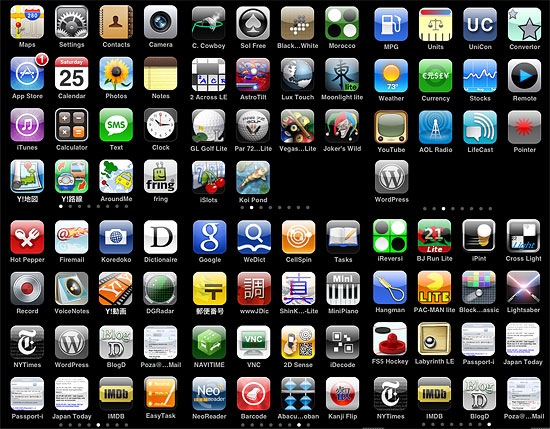
As it turns out, the iPhone is going gangbusters. Despite a wash of analysis claiming that the iPhone is now irrelevant because there are other touch-screen smartphones out there, Apple maintains strong sales, and easily beat its own goal of selling 10 million units by the end of this year. This is one reason why:

Allapps1008

Those are all my current apps–the ones I have present on the phone, at least, I have some more hibernating in iTunes.

Granted, I don’t use most of them–I use maybe a dozen of them daily, and maybe two or three times that number more than once a week. But there’s a hell of a lot there, lots of them features that the iPhone is supposed to lack–and a lot of them simply unavailable on any other mobile-phone platform.

And then there’s price–I paid for four of them, I think, for a grand total of eight dollars, if I recall correctly. The rest are free apps.

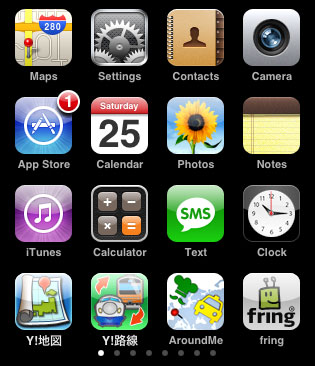
Allapps1008-1

Here’s my main screen. “AroundMe” is one of those GPS-enabled business finders, this one working in Japan. But the big addition here is Fring, which brings Skype to the iPhone; I can now Skype my family in the U.S. from anywhere I am in Japan.

Allapps1008-2

The games screen is almost always the one my phone rests on, however. Sol Free is a fantastic free Klondike game (Sachi has become addicted to it as much as I have); Morocco (Othello/Reversi) gets lots of play, too. But new additions are Joker’s Wild (a fairly good slot machine app) and Lux Touch, a Risk! game. Lux doesn’t have the easiest interface, but it does what it advertises. Koi Pond, a recent paid purchase, is also getting a lot of use, though it’s best as a show-off app.

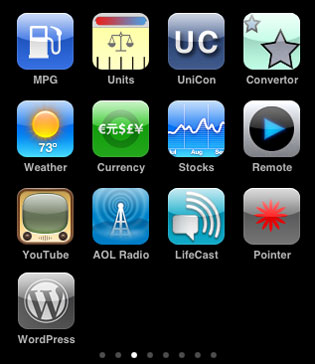
Allapps1008-3

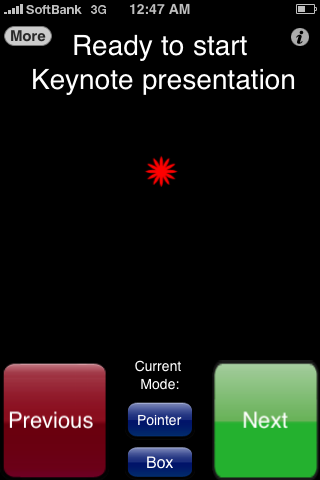
MPG is one of those apps I paid for also; it allows you to track your gas mileage. I’m still trying to figure out which of the Unit Converters I like best. WordPress works as it did last time I reported, but I have yet to try out LifeCast, which could supplant it. But the big new app on this screen is Pointer, a Mac-based WiFi PowerPoint/Keynote controller you can get for a dollar.

To run Pointer, you need to download a small free app from the company’s web site, and it must be run when you use the iPhone app. You also have to join a WiFi network with your computer and the iPhone on it; if no WiFi network exists, you can create one using your Mac laptop, then set your iPhone to join it. Once you do all that (a quick run-through once you’ve done it once or twice), Pointer will look for and find your computer.

Pntr01

Once you connect, the iPhone’s touch screen becomes a wireless mouse, and can switch between the regular cursor and a faux laser-pointer light splash. It won’t activate the Dock, but it can be used for anything clickable.

Beyond that, you have to set the app for PowerPoint or Keynote, and then use one of two control sets to run your slide show:

Pntr02 ®Pntr03

I tried it out, and it worked beautifully. I’ve been waiting for an app like this for a while.

And this is one reason the iPhone is so successful–endless expandability. New apps come out by the dozen per day, with an almost-as-rich stream of free apps. Just recently, two pretty good golf games and a nice billiards game came out, all free. Some are demos, some have ads, but they’re pretty nice and eminently playable.

In order to support paid apps better, Apple recently took down their Free Apps link, and now your ability to view new free apps via iTunes is somewhat limited. But someone is always working on stuff like this, and sure enough, there are feed sites which you can subscribe to which tell you about all the new free apps that come out every day. I use this one, and have it collect listings in my Mail app.

But I have to admit, the interface is still what draws most people. My students continue to Ooh and Ahh whenever they see it, as do other people.

Categories: iPhone Tags: by

Playing the Terrorist Constituency

October 23rd, 2008 Comments off

The news came out recently that commentators with ties to al Qaeda writing that McCain has the terror group’s support, as his policies would further their goals.

Now, it’s no secret that I believe this to be true; I have posted at least a few times in the past that the Bush administration’s policies have benefitted al Qaeda greatly, and that in fact, the two have fed off each other since 9/11. Since McCain’s policies are essentially an extension of Bush’s, it naturally follows that the the terrorist organizations would want McCain to win. An Obama victory, on the other hand, would just by its presence win a great deal of sympathy toward America from al Qaeda recruiting grounds, diminishing their strength and effectiveness. Obama’s policy of going straight for al Qaeda to defeat them, rather than feeding and using them as a tool to gain more power, would just as certainly not be welcome with the terrorists.

So forth and so on–you get the idea, but that’s not the central thrust of this post. The reason I did not jump on the news when it came out was because any statement from al Qaeda or its supporters must be suspected as self-serving; while I believe that the statement made was true in a factual sense, it could be interpreted in the opposite sense as well, in that such a statement is bound to hurt McCain and that might have been its intent. So the end valuation of the remark is self-cancelling, and therefore can not be interpreted as having any real meaning or impact.

However, as I reasoned thus, I immediately reflected on the fact that had the al Qaeda statement been in support of Obama instead of McCain, conservatives–the McCain campaign and John McCain himself at their vanguard–would have exploded into an orgasmic state of exuberant mega-attack against Obama that would have made a shark feeding frenzy look like a Jenny Craig seminar. That the terror group’s support was reported to be with McCain made things different: Democrats know that riding such pronouncements is dishonest and thus we have the resultant relative silence on the issue.

On the conservative side, however, the perception is very different. Maybe intellectually they know that Democrats are too straight-arrow to jump on this, but their conservative smear-campaign instincts just won’t allow them to believe that in their truthiness-imbued guts. They obviously felt that someone on the left would make a big deal about it, so they held what a reporter called a clearly “panicked” conference call intended to defuse the issue. Which, of course, was self-defeating, as the Democrats were not going to play this news like the Republicans would have.

In the conference call, the McCain spokespeople just reinforced their own reputation for opportunistic dishonesty, the same reputation they were trying to foist on the Obama campaign. They not only claimed that the al Qaeda-affiliated endorsement for McCain was actually an attempt to undermine McCain, but they also brought up the litany of unsavory people (Hamas, Ahmadinejad, Gaddafi) making statements that appeared to support Obama–in effect, attempting to turn the anticipated attack against Obama and thus voiding or reversing it.

Sometimes, just the simple state of being a bottom-dwelling, scum-sucking rat bastard can be its own worst curse. But you knew that already.

Campus Cool

October 23rd, 2008 Comments off

Just reported:

Apple Inc. is hiring the dean of Yale University’s business school to start a project that it calls Apple University.

No details on what it is yet, but I’d like to know when they start hiring faculty….

Categories: Mac News Tags: by

Electoral Math

October 22nd, 2008 1 comment

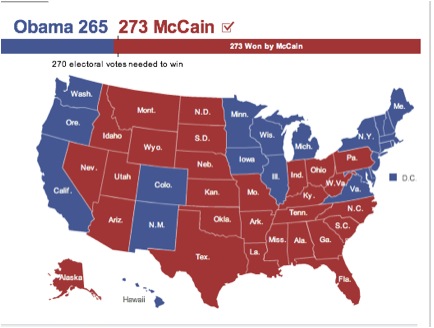
Not only is it looking pretty bad for McCain, but we should be able to know the end results pretty early this election day. In order for McCain to win the election, he is going to have to pull off some pretty amazing upsets. Here is a best-case-scenario squeaker win for McCain:

Poulosmap1022

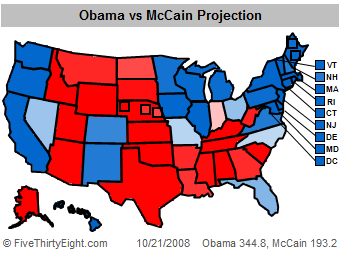
Compare this with the actual present-day electoral map according to an aggregate of state polls:

538Map1022

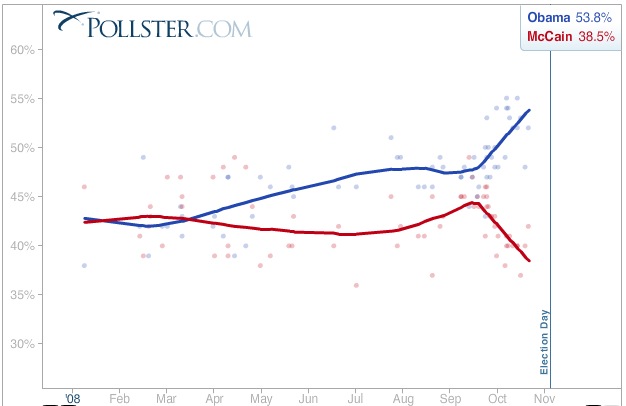
In short, McCain has to win not only all the states where he currently holds a lead (Obama seems to have a long-shot chance at Georgia), but he also has to win all four states currently trending slightly for Obama–Nevada, Missouri, Ohio, and North Carolina–and he has to win back Florida, tilting slightly more for Obama–and he has to win a big state currently solid for Obama, and it looks like they are trying for Pennsylvania. Which probably explains their strong emphasis on race and distrust–they hold that image of Hillary beating Obama there and that race being decided on those very issues. The problem, of course, is that Obama’s lead in Pennsylvania is not only significant, it is still trending sharply for Obama:

Pennpollster1022

Maybe I’m crazy, but I just don’t see McCain pulling off Pennsylvania.

In short, on election day, watch for how McCain does in the Keystone State. If he loses that race, then he has virtually zero hope of winning the election.

In the meantime, go to Pollster and check out the situations in Florida, Ohio, North Carolina, Missouri, and Nevada. In only one of those states–Ohio–does the trend favor McCain. In Florida, the candidates are both holding steady. In all the other states, Obama is the one moving upward.

Going by the trendlines, one has to conclude that with the time remaining, McCain would have to pull off a literal miracle to win this election. No way he’s going to win it on his own–there would have to be some incredibly significant, game-changing event in the next two weeks to move the public’s opinions that fast, that sharply.

Categories: Election 2008 Tags: by

New tactic for McCain’s Legions: Protest the Vote

October 21st, 2008 Comments off

The right-wingers have really started to outdo themselves. McCain followers are rally getting scary, and I mean scary. It’s bad enough that you have people attending McCain and Palin rallies shouting, “Terrorist!” and “Kill him!” Bad enough that McCain supporters have demonstrated outright racism, like hanging Obama in effigy on front lawns or putting Obama tags on monkey dolls.

But now, McCain/Palin supporters have started taking on tactics of the extreme pro-life movement: just as you see pro-lifers grouping in protest a mandatory distance away from abortion clinics and screaming at women who enter, we are now starting to see McCain’s followers protesting voting places. That’s right, they are protesting the vote. This example was in North Carolina, as voters went to a polling place after an Obama rally. The protesters were lined up to heckle and harass the voters. Some even had graphic “dead baby” signs up, again mirroring the pro-lifers. This group was shouting anti-Obama, pro-McCain rants at the voters in line. Make what you will of nthe fact that the voters standing in line to exercise their public right and duty were mostly black; the crowd shouting at, taunting, and decrying those voters were mostly white. Anyone who knows their history should be at least a bit disturbed by the imagery.

This is voter intimidation in its rawest form. If I were a McCain supporter, I would be deeply ashamed.

Categories: Election 2008, McCain Hall of Shame Tags: by